
Contemplative Inquiry

This blog is about contemplative inquiry

Tag: Lovingkindness

BOOK REVIEW: BOURNEBRIDGE OVER TROUBLED WATERS

Highly recommended, especially for readers interested in local initiatives to address the climate crisis. Bournebridge over Troubled Waters (1) is a sequel to Tony Emerson’s Unlikely Alliances, which I reviewed in October 2022  – (https://contemplativeinquiry.blog/2022/10/27/book-review-unlikely-alliances/). Although the new book stands on its own, I think it works best after reading Unlikely Alliances, now republished as Creating Hope in the Valley of the Bourne. The setting continues to be a fictional community  on England’s south coast.

In the new book, we have reached the year 2030. The publisher’s blurb describes it as ‘a story of love and friendship’ as well as commitment to climate action. On my reading, the ways in which people do ‘love and friendship’ are integral to the action itself.

This is shown in a group of leading characters who gradually assemble together in an old rectory building. This is less by design than the need for decent housing and a belief that larger dwellings should be fully occupied. But the rectory evolves into a strong base for its residents’ flourishing.

In many ways they are a diverse group. But they all, sometimes with a little tlc, reveal themselves as naturally affectionate and ethically grounded. The culture of the house nurtures these co-operative qualities.  It is a creative and supportive place to live. As part of the life of the house, the residents develop a system of peer mentoring for their work in the wider world. There’s also a concern, for some of them, about a progressive Christianity that honours the world and the flesh and is ecologically aware. I am reminded of Matthew Fox’s use of the term ‘original blessing’.

As was the case in Unlikely Alliances, the government is committed to climate action. The earlier book describes their Climate Action Plan, which has put  serious wealth taxes in place, rationed fuel and food (especially meat), placed restrictions on air travel, created  a Civilian Community Service Corps to provide training and jobs for the unemployed and 2 years national service for school and college leavers. Housing policy is not all about new build, but also addresses better use of existing resources.

The fields covered by our band of rectory activists and their colleagues include agriculture, hospitality, renewable energy, relevant university research, transport, housing, trades union development, clothing (new and renewed), second hand shops, and renovation, repair and maintenance services of various kinds. These are practical needs and also model a cultural shift away from throwaway consumerism. All of this work is depicted as dynamic and gaining momentum.

Temperatures are continuing to rise, and there is an unprecedented level of flooding to contend with. At the same time, vested interests and violent climate deniers, branded as ‘True Britannia’, continue to undermine the Climate Action Plan. Life goes on. Lovers get together. Children are born. Older people die and are lovingly remembered. Music is made. Rugby is played. Hospitality is exchanged. Events are organised and enjoyed. People maintain contact with family members further away, travelling throughout Britain and Ireland, though rarely further than that. It is not clear what the future will hold, but there are some grounds for optimism.

When I finished reading Bournebridge over Troubled Waters I felt as if pitched back into my own timeline. It’s as though my 2025 couldn’t be the one that led to their 2029-2034. I didn’t feel that way even when I read Unlikely Alliances in 2022. My reading of books like this seems to depend not only on who I am but when I am. If I become timeless, I can respond to these books as parables reminding us that we have the power to be better than we are. We just don’t use it enough. That’s a call to respond to whatever the outward circumstances or likely outcomes.

(1) Tony Emerson Bournebridge over Troubled Waters UK: The Conrad Press, 2O24 (www.the conradpress com)

BOOK REVIEW: UNLIKELY ALLIANCES

Highly recommended. Unlikely Alliances (1) is set in the years 2029-2033, in a fictional town on England’s south coast. It offers a degree of hope about the climate crisis, presenting a positive response to its challenges at the global, national and, especially, local levels. Towards the close of the book, one of the characters reflects on a benign economic austerity that includes social justice: “limited food in the shops, clothes and shoes having to last many years, trips abroad requiring special license … but look around us, are we really worse off?” The answer is a qualified no, on the grounds that everyday life has become less constrained and less stressful, thanks to the choices that have been made.

Unlikely Alliances offers a gentle, compassionate and good-humoured lens on a subject that can seem grim and edgy. The title refers to the changing political, professional and above all personal relationships of people working on adaptation goals in their Bourne Valley community. They are from a wide variety of backgrounds, including local government, academia, trade unions, churches, the voluntary sector, management consultancy, the hospitality industry, sports organisations and farming. Unexpected synergies are generated. The novel shows how its band of protagonists find themselves, each other and a new sense of purpose in this work. As fiction, the book has the space to be about lives as well as issues. New culture, adapted to new times, is created in the lived experience of friendship, romance and community building.

The Climate Action Plan of a progressive coalition government provides a political framework, drawing on ideas from the US 1930’s New Deal and the UK reconstruction post World War 2. It is in power because of a wake-up call resulting from a huge inundation in the Netherlands and the presence of a large number of Dutch refugees in Britain – a disaster too close to ignore. For the first time since the mid twentieth century, serious wealth taxes are in place. Food and fuel are rationed: everyone gets at least something at an affordable price. There are new approaches to housing. A Civilian Community Service Corps provides training and jobs for the unemployed and a two-years national community service for school and college leavers.

In crisis conditions, this government is broadly popular. Even so, it is vulnerable to defections within its own Parliamentary ranks, the vigorous opposition of vested interests and those who speak for them, and the violence of militant climate denialists on the street. These struggles are not minimised, and they are vividly portrayed in the book. But most of the focus is on resource and resiliency building at the local and regional levels, and on the changes in the lives of the main characters, as they open up to each other’s influence and affection. It is their efforts that prevail, since they come to make practical sense to more and more people.

A brief review cannot do full justice to a book that deals with a civilisation at the edge, presented from a stance of generosity and warm commitment to human flourishing. Tony Emerson has long experience of working with environmental issues and is also an accomplished storyteller. I found Unlikely Alliances heartening and enjoyable to read, and a well-informed glimpse into a possible near future.

(1) Tony Emerson Unlikely Alliances https://FeedARead.com 2021 – e-book created by White Magic Studios – http://www.whitemagicstudios.co.uk 1922. Available on Amazon (UK and USA).

LIVING WITH EASE

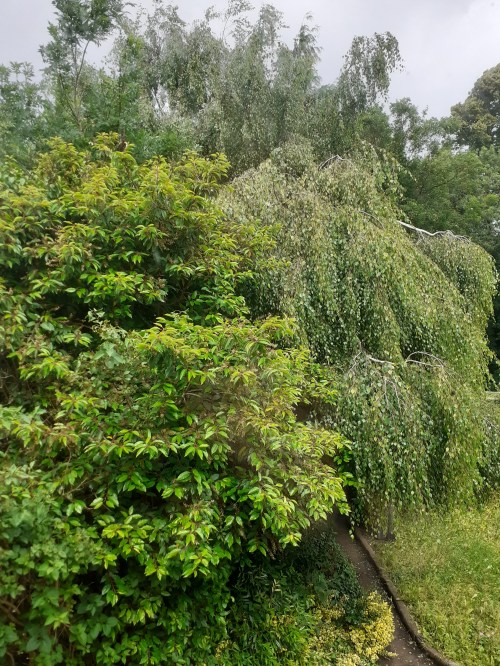
By simply looking out from my bedroom window, I can enjoy the abundance of high summer, as the year moves on from the solstice. The lush foliage speaks of ease and fulfilment. ‘Summertime and the living is easy’, says the old song. In a customised version of the Buddhist lovingkindness meditation, I say: ‘A blessing on my life. May I be free from harm; may I be healthy; may I be happy; may I live with ease’ … gradually extending the circle of care through my loved ones through wider circles of acquaintance, eventually including all beings throughout the cosmos. But what does living with ease add to freedom from harm, or to health and happiness?

In my experience, this comes from my experience of ‘at-homeness in the flowing moment’. I treat the flowing moment as a quality of experience rather than a unit of time. Otherwise I might be tempted to measure the right length of a moment’ to be ‘present’ or ‘flow’ in. It would have to be brief, but long enough to register experientially. Even so, I would probably find myself lying in wait for such a moment in the hope of catching one before it went. This would not be a skilful means of living with ease.

Instead, I enter the flowing moment, intentionally, by slowing down and taking notice. Eyes open, I take in the world visually, in all its riches, and check out my sensations, feelings, thoughts and any internal imagery that might override the physical view. I am not identified with any of these experiences. They are not me. I am empty and at home in the flow of sensation and perception. In this state, I ideally avoid stories like ‘there are trees on the other side of this window’. If I enter such a story, that is just another passing experience, a bubble in the flowing moment. It is in my empty core that the flowing moment becomes my home. In a sense, it is the emptiness itself that is the home. But it feels most like home when a world of sensation and perception appears to fill the space. Emptiness and form are interdependent. They need each other to flourish.

The flowing moment is not my default setting in daily life. Other states of attention come to the fore. The flowing moment, which I can enter and leave at any time, is available as a home to go to when I want or need it: hence my phrase ‘at-homeness in the flowing moment’. Entering and leaving is a conscious, careful decision, though it does not require retreat conditions or labelling as a formal spiritual practice.

‘At-homeness in the flowing moment’ can work in bad times as well as good. For the emptiness at my core can also be full and loving. It does not judge distressed and negative reactions. It does not try to smooth over feelings of dismay about the wider world. It holds them in peace and lovingkindness. In my morning circle, I ask for peace in the four directions, in the below, the above and throughout the world. But the centre is different. I stand in the peace of the centre, at the heart of living presence. This is the source of my ease, the nurturing emptiness that stands behind my at-homeness in the flowing moment .

VALUES FOR 2020

I want to give my contemplative inquiry for the next year a strong focus and intent. This includes re-stating the values in which it is grounded, updated after some reflection over the last twelve moths.

I  use the word values where others might choose ethics or virtues. I make commitments rather than resolutions or vows. These commitments commit me to ‘cultivate’ a quality or behaviour. Hence, for example, I say “I will cultivate lovingkindness”. I cannot guarantee acting with lovingkindness as a simple act of will. But I can cultivate this quality and help it grow in the rough and tumble of life. I would like lovingkindness to be my default response in the heat of the given moment.

This year I will work with four commitments, listed below with brief commentaries.

  • I will cultivate lovingkindness towards myself, others and the wider world. I find the Buddhist metta meditation  a good working method for this (1). Lovingkindness is different to what I mean by love, more in the territory of good will. Love involves my spontaneous natural affections and needs to be free.
  • I will cultivate positive health and well-being, within whatever constraints may apply. This includes work with diet and exercise, and resiliency factors for mental and emotional health, such as connecting, being active, taking notice, and continuous learning and giving (2).
  • I will cultivate a life of abundance in simplicity. The dance between these terms creates, for me, a specific quality of richness. More widely, it contributes to living lightly on the earth.
  • I will cultivate openness, creativity and wisdom, learning how better to understand these qualities and how to enact them. I am curious about how they can work together.

The commitments give me a set of value words to work with: lovingkindness, health, well-being, abundance, simplicity, openness, creativity, wisdom and cultivation. Part of the work is to develop my understanding and application of such terms in the light of experience and reflection. Although I am making use of abstract nouns, the process of working with values is dynamic and subject to revision. This post is a record of where I stand on the brink of the 2020s.

(1) We extend lovingkindness to beings in this order: ourselves; a person who has benefited us; a person about whom we have no strong feelings; an ‘enemy’ or person with whom we experience difficulties; all beings without exception. We want to be able to say, congruently: may I/you/we be free of danger; happy; healthy; live with ease. – See: Sharon Salzberg & Joseph Goldstein Insight Meditation Correspondence Course Work Book Boulder, CO: Sounds True, 2004 (First published 1996)

(2) These are explained in detail at adrianharris.org/blog/2018/06/five-steps-to-mental-wellbeing/

Earth Eclectic

music that celebrates Earth and speaks to the heart

Sarah Fuhro Star-Flower Alchemy

Follow the Moon's Cycle

Muddy Feet

Meeting nature on nature's terms

Rosher.Net

A little bit of Mark Rosher in South Gloucestershire, England

Becoming Part of the Land

A monastic polytheist's and animist’s journal

selkiewife

Selkie Writing…

Charlotte Rodgers

Images and words set against a backdrop of outsider art.

Prof Jem Bendell

living with metacrisis and collapse

Towint

The pagan path. The Old Ways In New Times

The Druids Garden

Spiritual journeys in tending the living earth, permaculture, and nature-inspired arts

The Blog of Baphomet

a magickal dialogue between nature and culture

This Simple Life

The gentle art of living with less

Musings of a Scottish Hearth Druid and Heathen

Thoughts about living, loving and worshiping as an autistic Hearth Druid and Heathen. One woman's journey.

Wheel of the Year Blog

An place to read and share stories about the celtic seasonal festivals

Walking the Druid Path

Just another WordPress.com site

anima monday

Exploring our connection to the wider world

Grounded Space Focusing

Become more grounded and spacious with yourself and others, through your own body’s wisdom

The Earthbound Report

Good lives on our one planet

Hopeless Vendetta

News for the residents of Hopeless, Maine