
Contemplative Inquiry

This blog is about contemplative inquiry

Tag: Life of Merlin

THE SACRED HEAD OF BLADUD
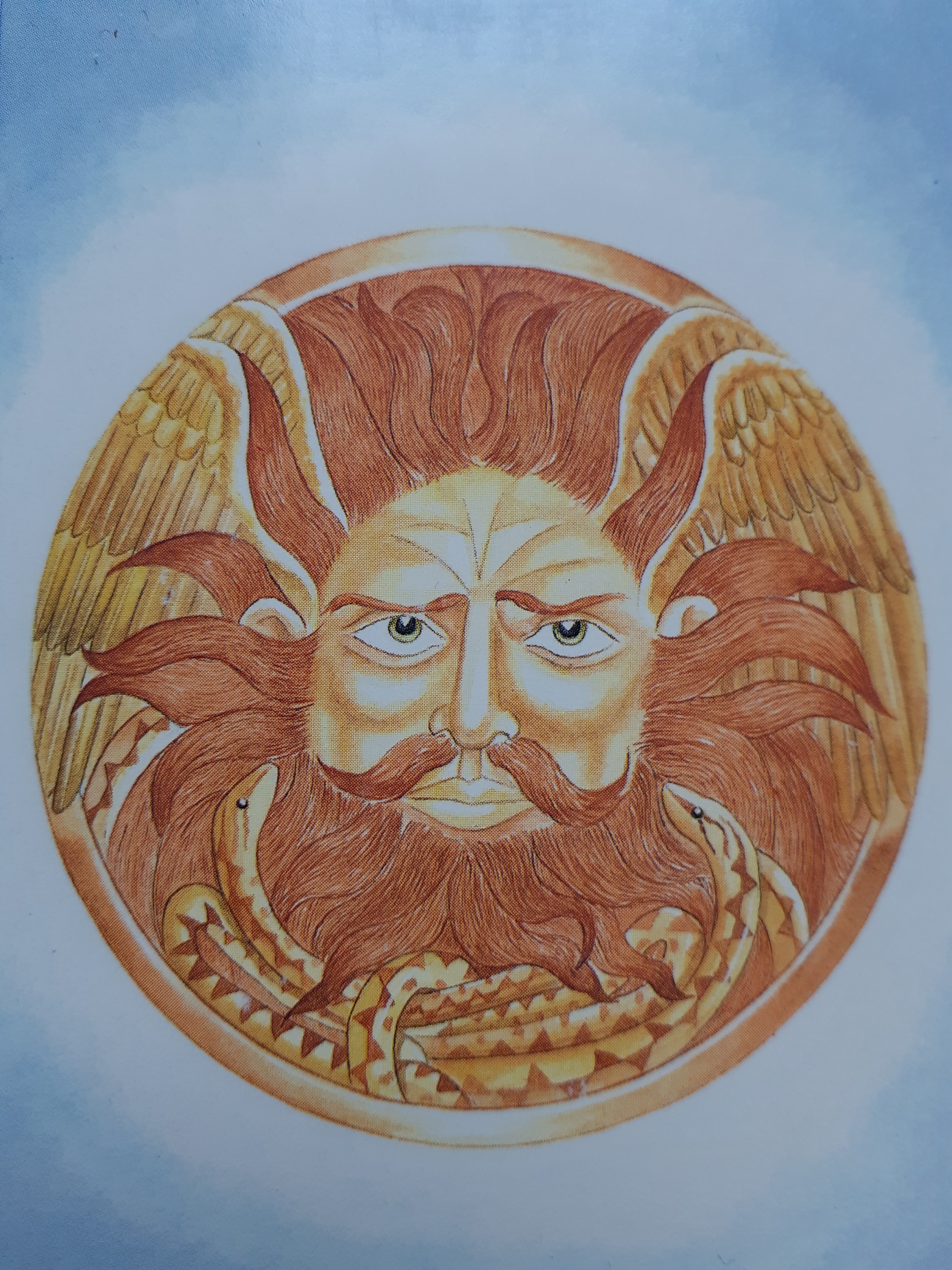
The historic city of Bath is about thirty miles from where I live and – from another direction – thirty miles from where I was born. It has always been part of my psychogeography. This post concerns both its ‘historical’ and ‘legendary’ past.

“A satisfying connection between modern archaeology, ancient legend, sacred kingship and Celtic religion is found at Aquae Sulis, the Roman name for Bath, England. In his legendary Historia Regum Britanniae [History of the Kings of Britain] (1) Geoffrey of Monmouth reports that King Bladud, grandfather of Bran and Branwen, founded the site and taught the druidic arts of ancestor magic and flight, eventually crashing to his death on the site of what is now London (the name Bladud means ‘light-dark’ or ‘bright-shadow’). In his Vita Merlini [Life of Merlin] (2), Geoffrey of Monmouth has Bladud and his consort Aleron (‘wings’) presiding over the hot springs of Bath, which are at the centre of the Bardic universe described by Taliesin to Merlin, forming the gateway to the Otherworld.

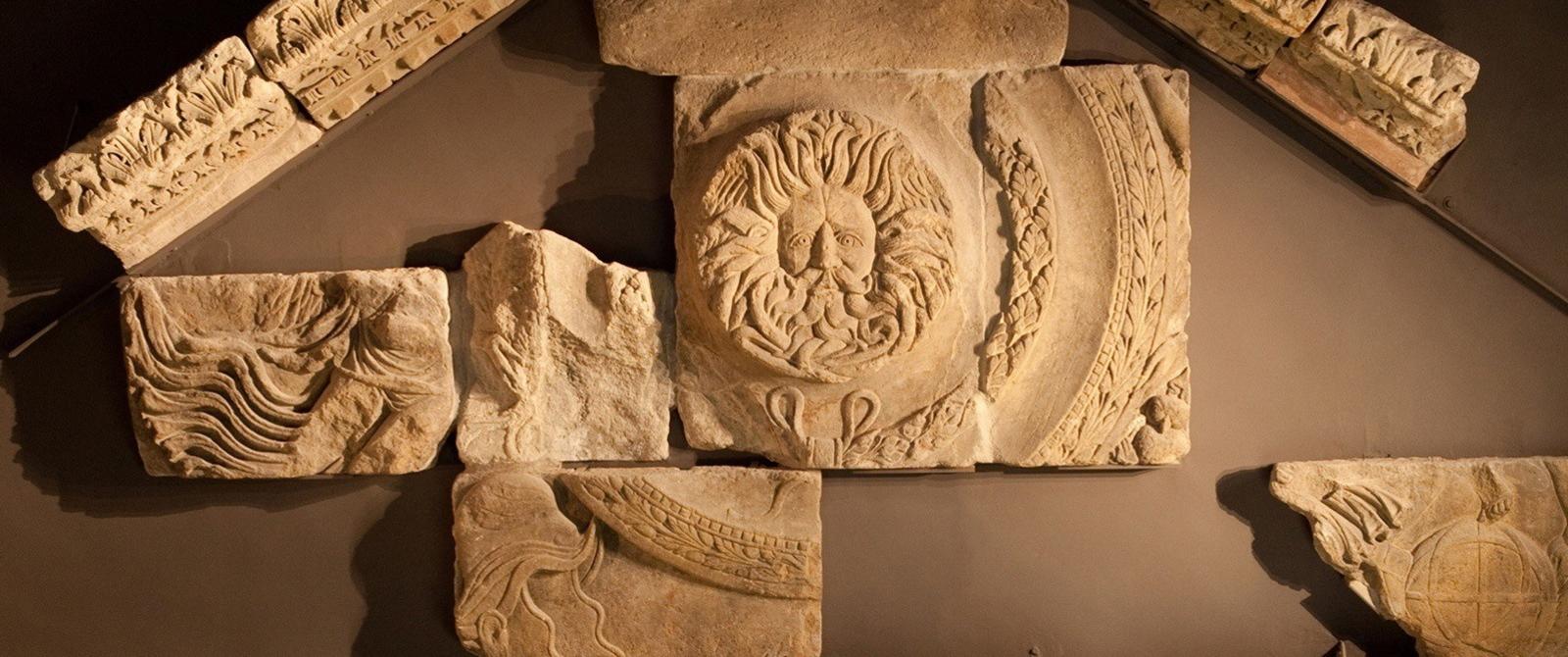
On show in the museum at Bath is a superb Celtic solar head (often inaccurately called a Gorgon’s head). The carving is a circular relief of an imposing male face with wild hair, long moustaches and staring eyes. He has wings on either side of his head and is surrounded by flames. Beneath his chin are two serpents, linked in the manner of a torque, the Celtic symbol of royalty. This solar deity is probably the being called Bladud in the legendary histories, connected to magic, flight and a fall from the heights to the depths. He has upon his brow the mark of the three rays, which are very often described as the primal three powers of universal creation.

The goddess at Bath, presiding over the sacred hot springs, was called Sul or Sulis, which means ‘eye’ or ‘gap’ (with a sexual connotation), for she is a variant of Ceridwen, the goddess of the Underworld. The entire Celtic/Roman complex of Aquae Sulis is an excellent example of ancestral Underworld magic refined by Roman politics into a temple of Minerva.

“The sacred or prophetic head is an embodiment of the relationship between the three worlds, for it is aware in all worlds, through all time. While we may have ideas that an anthropologist would suggest originated in primitive head-hunting magic, the theme of the sacred head becomes an allegory of divine and human perception and declaration.

“There is a further element to the sacred-head theme, for it is also interlinked with beliefs and practices concerning the regeneration of life, particularly with the cauldron. Titanic figures such as Bran, acting as sacred kings and guardians of the land, also partake of the mystery of the sun at midnight, light regenerating out of darkness. And this, after all, is the secret of inspiration, a sudden light born out of fruitful darkness.”

R. J. Stewart and Robin Williamson Celtic Bards, Celtic Druids London: Blandford, 1996
(1) Geoffrey of Monmouth History of the Kings of Britain London: Penguin, 1966 (Translated with an introduction by Lewis Thorpe)

(2) Mark Walker Geoffrey of Monmouth’s Life of Merlin: A New Verse Translation Stroud: Amberley, 2011

NOTE: the first illustration is from R. J. Stewart The Merlin Tarot London: Element, 2003 , illustrated by Miranda Grey. The Bladud image is on the reverse of each card, implicitly re-ascribed to Merlin as embodying the same archetype in a different way. The second illustration can be found on http://www.romanbaths.co.uk – click on discover and then walkthrough.
DEATH (THE APPLE WOMAN)

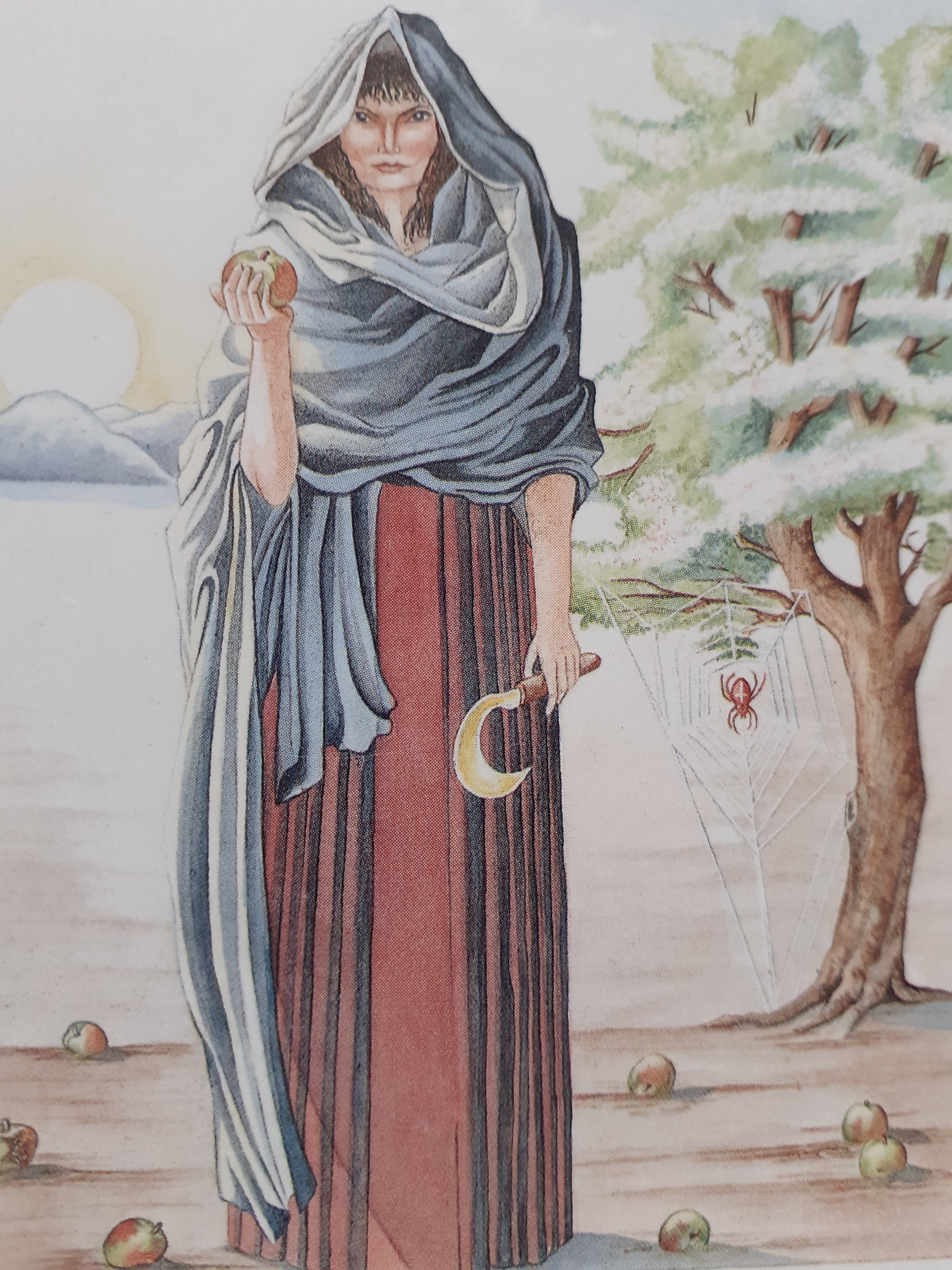
In the approach to Samhain, thoughts turn to death. In R. J. Stewart’s Merlin Tarot (1,2) the Death card has The Apple Woman as an alternate name.

Stewart explains that “the original image for Death is that of the taking or destroying Goddess”, for “who but the creatrix may truly destroy and withdraw created life?” He adds that, in Celtic tradition, she often appears as a female power offering magical fruit.

In his source text, Geoffrey of Monmouth’s Vita Merlini (Life of Merlin), we find a mysterious woman – ex-lover of Merlin – who lays out poisoned apples to entrap him. These apples, arranged “under a tree upon a pleasant green”, are eaten by Merlin’s boon companions: they are either killed or driven insane. Although Merlin escapes the apples, he does not escape his own later insanity in the Caledonian Forest, brought on by the traumatising Battle of Arfderydd.

For Stewart, the Apple Tree is one of the simplest expressions of the Tree of Life. “It is the Otherworld or Underworld Tree that reveals eternal potential, the fusion of ending and beginning in one paradoxical form”. The apples are the fruit of raw, untransformed power. Whereas Merlin’s companions snatch at the apples and eat them greedily, the legendary Thomas Rhymer volunteers to pick magic apples for the Fairy Queen, who recognises his gallantry by giving him the bread and wine that can nourish him. He wins the gift of prophecy and the tongue that cannot lie.

Both lover and killer, the Goddess of Death and Change is young and ancient, weaver and unweaver of a web that is the universe. She is destroyer of hope and giver of hope, for “in her hand she bears the fruit of perpetual life and rebirth, and the razor Sickle that cuts the tread of continuity”.

Stewart ends with this reflection: “perhaps Merlin’s sub-story of The Apple Woman simply means that adulthood is our most deluded period of life. We reject understanding and substitute self-image, habit and even dogma, in our convoluted attempts at survival; the hostility we experience is not that of the Goddess, but our own hostility reflected upon us. Reject love, risk poisoned apples – such fruits are deadly to the greedy and unprepared. But if we accept the fruit or any of its many transformations (such as bread and wine) from the Goddess, she blesses us with gifts of timeless understanding. These gifts may appear in the outer world as prophecy, attuning to the land; death itself is a timeless moment of understanding when all relative interactions cease. Ultimately, we are the fruit”.

(1) R. J. Stewart The Complete Merlin Tarot: Images, Insight and Wisdom from the Age of Merlin London: The Aquarian Press, 1992 . Illustrated by Miranda Grey ISBN 1 85538 091 9 No cards, but a full explanation and discussion of the system and its imagery.

(2) R. J Stewart The Merlin Tarot London: Element, 2003. Illustrated by Miranda Grey ISBN 000 716562 5 (First published by London: The Aquarian Press, 1992). Cards, handbook and notebook for record keeping.

HONOURING ‘THE WAY OF MERLIN’

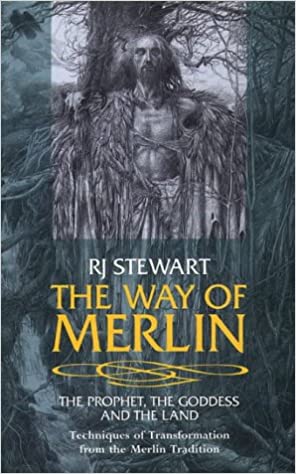
The Way of Merlin came into my hands at the right time. It seeded a number of key understandings, which nudged me onto a Druid path in October 1993. The first is that “sacred space is enlivened by consciousness. Let us be in doubt that all space is sacred, all being. Yet if human beings dedicate and define a zone, a location, something remarkable happens within that defined sphere of consciousness and energy. The space talks back”. Author R. J. Stewart backed this up with the further declaration that “The mystery of Merlin is a backyard mystery, for it declares the smallest, most local space to be sacred, to be alive, to be aware.” I was living in South London at the time and remember being challenged in this book to befriend a spring and a tree. At first, I thought, ‘what?’. Then I found them both, on the day I started looking, in a local park.

Such activities went with the view, “yourself and the land are one”, and that this apparently humble work has a larger context of “holism … identical to the deepest perennial magical and spiritual arts”. Magic is seen as a process of having intent and applying energy and imagery in service to it. Working within mythic frameworks asks for an enabling suspension of disbelief rather than a dogmatic literalism.

I did not work with the suggested programme of visualisations and rituals concerning Merlin, the weaver goddess Ariadne, and other scenes drawn largely from Geoffrey of Monmouth’s Life of Merlin. As practices they seemed too long and formal. But reading Stewart’s text was psychoactive in itself. The weaver goddess Ariadne is a key figure, and the vision of Ariadne reveals a cosmic mother at the threshold of Being and Unbeing. She draws us into the empty silence of the Void, out of which emerges the sound of breath – our own breath and at the same time the breath of all Being. Being breathes through us, “and we realise that we have a body that is the body of all Being. The stars are within us. We are formed of the weaving”.

The specific image of Ariadne never took root in my imagination. But I acknowledged the power of this Pagan Gnostic creation myth. Its sense of our reality emerging from empty potential at the behest of a cosmic mother has stayed with me. My work with Sophia earlier in this inquiry pointed in the same direction. So does my recent post about Dancing Seahorses and Modron (2). I am happiest with the Modron image, because it is less defined and anthropomorphised than those of Ariadne and Sophia. At at the threshold of being and unbeing, she shows us that we are not separate from the divine breath that forms us, or from the creation that is formed. The stars are indeed within us, whether we know it or not.

The Way of Merlin has something like an ancestral role in my spiritual life. R. J. Stewart and I were born in the same year, but he was doing this pioneering work in the 1980’s when I was busy with other things. He influenced me in the period immediately before I embarked on a Druid path, and I have revisited his work over the years. It still has riches to offer.

(1) R. J. Stewart The Way of Merlin: the Prophet, the Goddess and the Land London: The Aquarian Press, 1991

(2) https://contemplativeinquiry.blog/2020/06/25/dancing-seahorses/

BOOK REVIEW: SCOTLAND’S MERLIN

Scotland’s Merlin: A Medieval Legend and its Dark Age Origins, by Tim Clarkson Edinburgh: John Donald, 2016. I find this book a useful resource. Author Tim Clarkson says of Merlin that, “like King Arthur and Robin Hood, he is both familiar and mysterious – an enigmatic figure who seems to stand on the shadowy frontier between history and myth”. Clarkson is firmly on the historical side of that frontier, working clearly and accessibly through the early literature as he quests for the source of the legend. Some of it is a proto-Merlin literature in which the central figure bears other names: Lailoken for the wild man of the Caledonian woods; Emrys for the young prophet of Snowdonia. Myrddin Wyllt is the name given in a group of early Welsh poems to the Scottish Lailoken, and Geoffrey of Monmouth goes on to create the medieval Merlin out of these and other disparate sources. Clarkson provides extensive extracts from the literature, showing how the Merlin of Arthurian literary legend was able to emerge.

Clarkson’s main interest is in the Merlin who, traumatised by his experience of the Battle of Arfderydd, flees to the forest. The battle was an historical event, was fought in C. E. 573 and is well covered by Clarkson, who earned his PhD with a study of warfare in early historic (i.e ‘dark age’) northern Britain. Historically, there is real difficulty in knowing who was fighting against whom, and what their motivations were. In a Scottish hagiography of St. Kentigern, Lailoken is simply a veteran of the battle. Its context is not discussed, and little is said about Lailoken himself, beyond describing his broken wildness. He has occasional encounters with St. Kentigern, who eventually blesses him. Shortly after this he suffers a threefold death, as he himself had prophesied, by falling down the banks of the Tweed onto a sharp stake with his head bent into the water. Everyone praises St. Kentigern for enabling Lailoken’s salvation by blessing him in time.

By contrast, Geoffrey’s Merlin (1) recovers, and he becomes a contemplative forest hermit together with his sister Ganieda. His madness has been a journey, not just a torment. A threefold death is prophesied by Merlin, and occurs. But it is not his own death. Instead, Merlin gets a new lease of life revolving around summers in the woods and winters in an observatory that has been built for him. He is able to have erudite and wide-ranging conversations with his visitor Taliesin, presented as a colleague and peer. But the setting is the same, a specific landscape in south west Scotland, where early British place names are still found – Loch Mabon, the River Nith and Caer Laverock (on Solway Firth at the mouth of the Nith) being three of them, with two ancient god forms thereby remembered. For me, the written records are a demonstration of how culture, and cultural agendas, change over time. Fragments of stories are pressed into the service of new cultural imperatives. The deeper past keeps its secrets, even whilst new understandings are crafted around its after-image.

There is no sense here of the what R. J. Stewart calls the Mystery of Merlin (2) – no suggestion of a local connection with the youthful prophet, though local Mabon names point to one. The Romano-Celtic world (including this region, immediately north of the wall) had Apollo Maponus as a significant deity. Clarkson is good at orienting readers to the general culture of early historic Scotland, and relating his Merlin story to a specific local landscape – with a good selection of maps and plates. He explains that, in the context of the sixth century, ‘Britain’ names an island without any political connotations. The terms ‘British’ or ‘Britons’ describe the native Celtic people who once inhabited the whole island. The story is set in what later Welsh literature described as Hen Ogledd (The Old North), which Clarkson takes to be southern Scotland below the Forth Clyde isthmus, “together with some adjacent parts of what is now England”. He notes that, by 800 C.E., on the eve of the Viking invasions, the British ruled in only three areas: Cornwall, Wales and the Valley of the Clyde.

Clarkson is the author of The Men of the North (4) and The Picts (5) which between them cover much of Scotland in the early historic period. He believes that a kernel of the Merlin/Lailoken story – about battle trauma and flight to the woods – is about an historic individual who took part. He also acknowledges that the story may preserve a memory of early shamanic practices in the locality. Merlin lives on in many different ways.

(1) Mark Walker Geoffrey of Monmouth’s Life of Merlin: A New Verse Translation Stroud: Amberley, 2011

(2) R. J Stewart The Way of Merlin: the Prophet, the Goddess and the Land London: The Aquarian Press, 1991

(3) Tim Clarkson The Men of the North: The Britons of Southern Scotland Edinburgh: Birlinn, 2010

(4) Tim Clarkson The Picts: A History Edinburgh: Birlinn, 2012

Earth Eclectic

music that celebrates Earth and speaks to the heart

Sarah Fuhro Star-Flower Alchemy

Follow the Moon's Cycle

Muddy Feet

Meeting nature on nature's terms

Rosher.Net

A little bit of Mark Rosher in South Gloucestershire, England

Becoming Part of the Land

A monastic polytheist's and animist’s journal

selkiewife

Selkie Writing…

Charlotte Rodgers

Images and words set against a backdrop of outsider art.

Prof Jem Bendell

living with metacrisis and collapse

Towint

The pagan path. The Old Ways In New Times

The Druids Garden

Spiritual journeys in tending the living earth, permaculture, and nature-inspired arts

The Blog of Baphomet

a magickal dialogue between nature and culture

This Simple Life

The gentle art of living with less

Musings of a Scottish Hearth Druid and Heathen

Thoughts about living, loving and worshiping as an autistic Hearth Druid and Heathen. One woman's journey.

Wheel of the Year Blog

An place to read and share stories about the celtic seasonal festivals

Walking the Druid Path

Just another WordPress.com site

anima monday

Exploring our connection to the wider world

Grounded Space Focusing

Become more grounded and spacious with yourself and others, through your own body’s wisdom

The Earthbound Report

Good lives on our one planet

Hopeless Vendetta

News for the residents of Hopeless, Maine