Contemplative Inquiry

This blog is about contemplative inquiry

Tag: Lammas

HARVESTING INSIGHT

Noticing a single corn stalk under our neighbouring birch trees, I wonder whether the seed simply blew in or was planted by an unknown hand. If the latter, what was their intention? I realise that I will never know.

I do know how much I enjoy its presence in this space at this time. I experience it as a miracle inviting gratitude and it has marked the seasonal moment for me, this first harvest of a now declining year.

With increasing clarity I understand that I do not work well with personified and individualised images of the divine. Something seems subtly off, as if I am failing to sound my own authentic note in the Great Song of the world.

I believe that we are given different gifts in our encounters with the Cosmos, leading to legitimately different understandings. When I lean in to the notion of divine personality – even when using the term ‘Spirit’ in that sense – I am not fully living my own truth. I subtly disempower myself and weaken my connection.

For in my universe, when I rest in my own clarity, there is no separation between nature (including culture) and spirit. In the awkward activity of identification and labelling, I answer to terms like animist, panentheist and nondualist.

These words are approximations, with the power to be distracting and slightly depressing. I can find words that point to my experience well enough. But the explanatory words, the more formal and generalised terms, feel clumsy. There’s a necessary level of unknowing that these isms don’t recognise.

When consciously living in spirit, I am neither alone, as a single human person, nor am I with another being. I am simply in a different dimension of embodied awareness, supported and empowered by the bubbling source from which I spring. For me, Nature is more than the ‘nature’ of dualist spiritualities and of the scientific humanism that grew out of them.

As I harvest the learning, or relearning, of this lesson, I renew my commitment to practice and path, once again revising the beginning and end of the modern Druid’s prayer (1). I move from from ‘Grant, Spirit your protection, and in protection, strength … ‘ to ‘In spirit I find protection, and in protection, strength …’. I end with ‘and in the love of all existences, the love of this radiant Cosmos’ rather than ‘the love of God/Goddess/Spirit and all goodness’. These small changes formalise and anchor my understanding.  For me, they are an important affirmation, illuminating my path.

(1) Traditionally, this prayer runs:

Grant O God/Goddess/Spirit, your protection,

And in protection, strength,

And in strength, understanding,

And in understanding, knowledge,

And in knowledge, the knowledge of justice

And in the knowledge of justice, the love of it

And in the love of it, the love of all existences

And in the love of all existences, the love of God/Goddess/Spirit and all goodness”.

NB Providing the options of God/Goddess/Spirit is I think an OBOD (Order of Bards, Ovates and Druids) innovation. The original version, from the late 18th century, simply said ‘God’. Some modern Druids say ‘God and Goddess’.

FIRE ON WATER

8pm, 25 July. Alchemy on the canal. The evening sun, low and potent in the sky, strikes the flowing water. At points the union of the two creates a molten liquid light, clearly defined in the still image above.

By contrast, the short video below reveals light and water together in movement. Flow, and patterns in the flow, draw my attention. They show me an energised harmony, becoming more than the sum of their parts.

I notice also that when I play the video without sound, I find it contemplative and reflective. When I play it with sound, the birds immerse me in living nature. I value both experiences.

I usually feel a transition into late summer about now, a little before Lammas/Lughnasadh. The days here are still long, though now clearly not as long as they have been. It’s a warm time, often the warmest of the year. Blackberries have appeared on their bushes, a foretaste of autumnal fruit bearing.

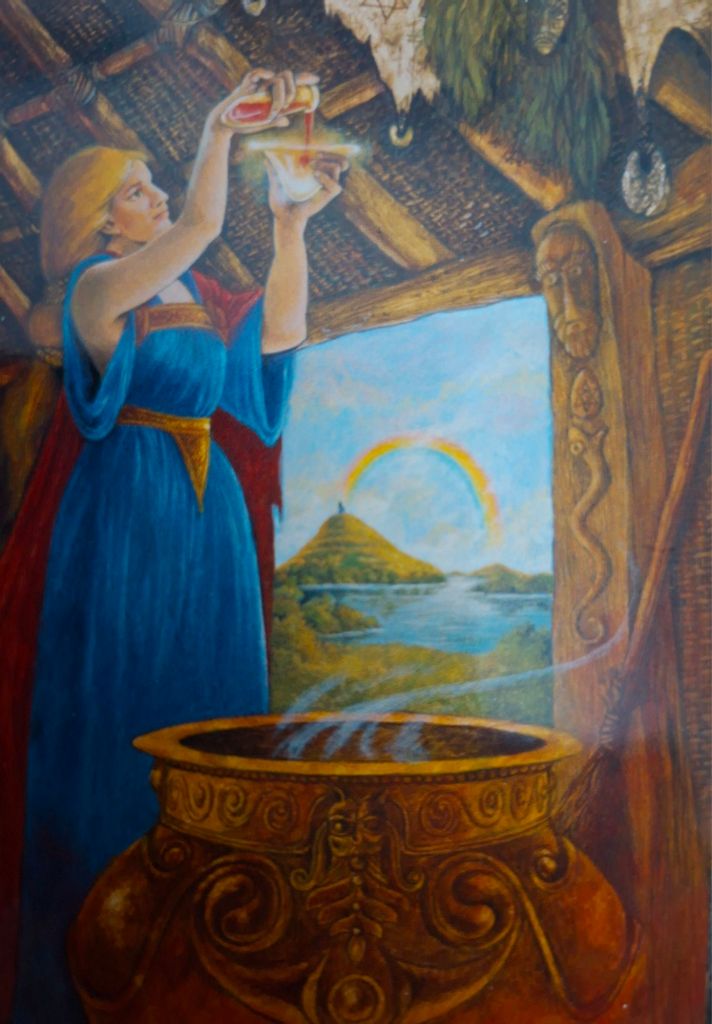
I am reminded, too, of the Fferyllt, the Druid alchemist in OBOD tradition. She is a woman of power and a devotee of Brigid. In the Druidcraft Tarot (1) she is represented by Trump XIV, standing for fluency between worlds, creativity, harmony, peace, alchemy and magic. My canal side encounter with fire on water nudged my imagination towards this figure, who somehow completed it.

(1) Philip and Stephanie Carr-Gomm The DruidCraft Tarot: Use the Magic of Wicca and Druidry to Guide Your Life London: Connections, 2004. Illustrated by Will Worthington.

NOTICING TWILIGHT

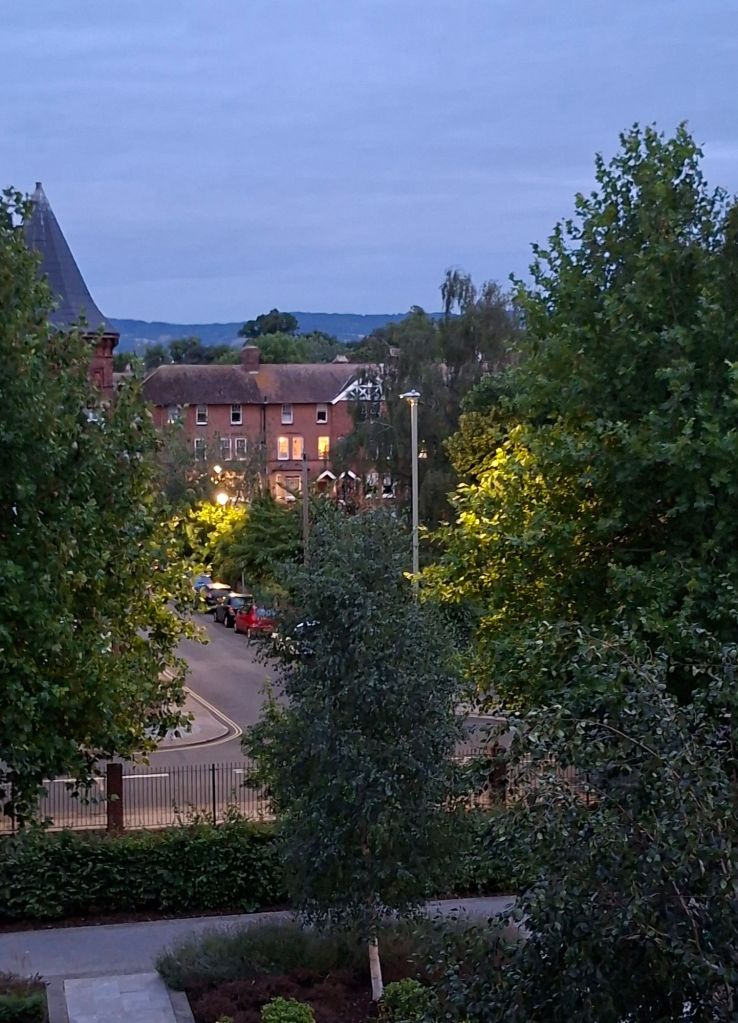
I see change in a familiar scene. Looking out from our apartment I contemplate a gentle twilight. It is modified by artificial light. During the recent heatwave I somehow had little consciousness of this moment in the day. But now, with lower temperatures and rain, my world is a tiny bit different. I discover myself in a twilit scene, and a twilight frame of mind, a little after sunset.

Although this sunset is only ten minutes earlier than the sunsets of the Solstice period, I feel, deep within me, the turning of the Wheel. It’s as if I am leaning in to the spirit of late summer, and the first of the harvest festivals that define the waning year. We are not there yet, though Lammas is but a fortnight away. I am simply becoming aware of a coming seasonal shift.

I am also aware of wanting to savour the sense of a change without wanting to hurry it on. Above, an image of trees, houses, hills and sky anchors me into a specific place and time. It’s a ‘now’ experience rather than an anticipation. Below, an image of birch leaves back-lit by electric light holds me in an appreciation of the pattern they make. I am held by the power of a simple pleasure.

LUGNASADH 2023: INQUIRY HARVESTING

A circle is cast on sand. It is almost complete. The image is that of the Wheel, tenth major trump in the Druidcraft Tarot (1). Arianrhod, as Goddess associated with the Wheel and the Milky Way, is casting the Circle of Life. The adjacent cave has resonances of both womb and tomb. The seashore is a liminal space. The Celtic Otherworld is often linked to the sea and what lies underneath its surface. This image as a whole is associated with harvesting. Arianrhod carries a flail as well as a wand and a symbolic eight-spoked wheel.

It is Lugnasadh/Lammas, the first harvest-related festival of 2023. I am sitting with the notion of ‘winnowing’ in my inquiry. In agriculture, winnowing involves blowing a current of air through grain to remove the chaff remaining after threshing. We find a reference to winnowing towards the end of the medieval Welsh poem The Hostile Confederacy from The Book of Taliesin (2):

“I have been a grain discovered,

Which grew on a hill.

He that reaped me placed me,

Into a smoke hole driving me.

Exerting of the hand,

In afflicting me,

A hen received me,

With ruddy claws, (and) parting comb.

I rested nine nights.

In her womb, a child,

I have been matured,

I have been an offering before the Guledig.

I have been dead, I have been alive.

A branch there was to me of ivy,

I have been a convoy.

Before God, I have been poor.”

It seems that winnowing (or being winnowed) is far from an end point to our journeys. The processes of life go on, very likely in unexpected ways. Any state of peace has to be found within these processes, rather than in efforts to halt or break out of them.

At Lughnasadh 2023 I find myself at ease within Druidry, though I do also continue to refine lessons from other paths that enrich my practice of Druidry. The most significant, and the best embedded, is ‘interbeing’ as a spatial relationship and its temporal equivalent ‘impermanence’. It is like a kernel of grain I have winnowed from Mahayana Buddhism to grow into another life in my Druidry. The Druid soil is fertile for this purpose, as indicated through the image of the Wheel drawn on sand, and the passage from The Hostile Confederacy in The Book of Taliesin. For me, Thich Nhat Hanh simply provides a particularly persuasive languaging of this perspective.

He says (3): “The insight of interbeing is that nothing can exist by itself alone, that each thing exists only in relation to everything else … looking from the perspective of space, we call emptiness ‘interbeing’ [NB ’emptiness’ here = empty of a separate self] ; looking from the perspective of time we call it ‘impermanence’ … to be empty is to be alive, to breathe in and breathe out. Emptiness is impermanence, it is change. …When you have a kernel of corn and entrust it to the soil, you hope it will be a tall corn plant. If there is no impermanence, the kernel of corn will remain the kernel of corn forever and you will never have an ear of corn to eat. Impermanence is crucial in the life of everything”.

There is another level to this year’s inquiry harvest. Recently I have engaged more fully with the challenge of Thich Nhat Hanh’s understanding of the Mahayana emptiness teachings, which stand behind the interbeing/impermanence insight. In the light of this understanding he finds neither an individual nor a cosmic self – and hence no ultimate reality or ground of being. “Our notion of emptiness should be removed. It is empty”. Many teachers I have worked with in the past are on the other side of this debate, finding the Divine in ‘Presence’ (Eckhardt Tolle), Pure Awareness (Rupert Spira), and the ‘Clear Awake Space’ of Douglas Harding’s Headless Way. They find God as ‘No-Thing’. For Thich Nhat Hanh, no-thing is simply nothing.

I have been all over the place on this question, developing a language and practices compatible with both views, as I slipped and slid between them. This is fine in its way, but I have wanted some kind of resolution, if only to avoid the energy drain of uncertainty around something that matters to me and to many spiritual traditions. Tomas Sander, co-writing with Greg Goode (4) has also explored the Mahayana ’emptiness’ texts. He reports that “as a person who had been seeking truth and ultimate reality” he finds a “greater sense of ease” in the approach of these texts. Unlike Thich Nhat Hanh, he does not take away an active disbelief in a cosmic ground of being. Instead, he arrives at a relaxed unknowing, a place of ‘joyful freedom’. He says: “spiritual teachings tend to have notions of absolutes, which by their very nature seem to trump everything else. None of them can claim to have an absolute, transcendent truth on their side”.

Tomas Sander finds that “it was a wonderfully freeing moment to recognize that there is no one way that reality ‘really’ is, and therefore no way to miss out on it”. So he adopts different criteria for evaluating spiritual paths. “They need to prove themselves on the level of ordinary, conventional reality with practical questions like: who does the view serve and who is being marginalized? Is the view helpful, compassionate or humane?’ I have known of and entertained this view for some time, but it has only recently clicked with me as a good way of settling this question. Metaphysical speculation will no longer be part of my inquiry. This does indeed feel like winnowing, like blowing away the chaff. The promised harvest? Druidry as joyful freedom.

(1) Philip and Stephanie Carr-Gomm The Druidcraft Tarot: Use the Magic of Wicca and Druidry to Guide Your Life London: Connections, 2004 (Illustrated by Will Worthington)

(2) William F. Skene The Four Ancient Books of Wales Forgotten Books, 2007 (First published in Edinburgh 1868

(3) Thich Nhat Hanh The Other Shore: A New Translation of the Heart Sutra with Commentaries Berkeley, CA: Parallax Press, 2017

(4) Greg Goode and Tomas Sander Emptiness and Joyful Freedom Salisbury: Non-Duality Press, 2013 (Section written by Tomas Sander)

MUIN: “GATHER IN WHAT IS DEAREST TO YOU.”

Muin (Ogham name for Blackberry) is one of four plants that have a place in both The Green Man Tree Oracle (1) and The Druid Plant Oracle (2). In the latter, from which the illustration is taken, it is called Bramble.

Muin is an important plant ally for me. At times I have identified closely with ‘Mr. Bramble’ (3). He is stubbornly resilient, with deep and extensive underground root systems. Above ground, he can create an almost impenetrable barrier of briars. He digs in. He is a survivor. He tests qualities and intentions. He protects the deep earth and undervalued dimensions of being. Yet he also grows abundant tasty fruit, that can be made into wine or gin.

Where I live, Muin’s time traditionally runs from Lammas/Lugnasadh to Michaelmas/Mabon – essentially the calendar months August and September. This year, as this time approaches, I am thinking of Muin as a teacher. The Green Man Tree Oracle offers words of ‘green man wisdom’ for all its trees. Muin’s words are: “gather in what is dearest to you“. I find “gather in” friendly and relational, very good to hear in a world where ‘harvesting’ is often cold, impersonal and mechanistic. Muin’s more warmly relational note is reinforced by the words “dearest to you”. We are invited to consider “riches of the soul and the things that give us inspiration” as our recommended harvest.

There are obvious questions here: what is ‘mine’ to ‘gather in’? what to I choose? what do I let go? But this is not, fundamentally, a questioning and list-making task. It is more about being open to Muin’s magic. This, I believe, is rooted in an unusual combination of qualities: tenacity, challenge, depth, an invitation to pleasure and, indeed, a certain kind of intoxication. Over the coming weeks, I will draw on Muin’s inspiration as I gather this harvest of the soul*.

(1) Philip and Stephanie Carr-Gomm The Druid Plant Oracle: Working with the Flora of Druid Tradition London: Connections, 2007 (Illustrated by Will Worthington)

(2) John Matthews & Will Worthington The Green Man Tree Oracle: Ancient Wisdom from the Greenwood London: Connections, 2003

(3) See: https://contemplativeinquiry.blog/2020/08/30/mr-bramble/

  • I think of soul as a process not an entity, though we don’t have the word ‘souling’.

TOWARDS THE SEASON OF HARVESTS: 2021

In the northern hemisphere we will soon be entering a quarter of harvests and waning light, starting with Lughnasadh/Lammas. In the south there will be the energy of rising light and growth. In the manner of the yin/yang symbol. a taste of that energy is present here too. As I approach Lughnasadh/Lammas this year, I am living largely day-at-a-time, and sense only the faintest outlines of what might be coming into my life. I intuit change, but not its nature, scale. or specific form.

So I look to harvesting possibilities that are within my power. I wrote recently that Druidry and the Eckhart Tolle Community are currently my key points spiritual reference. This invites a new synthesis and integration of spiritual practice and understanding. Druidry remains primary. It is the container. But there are two areas in which the Tolle work has strongly influenced me.

The first is through reframing my understanding of meditation. Instead of being a specialist activity, it has become the gateway to living from what Tolle calls ‘stillness’, ‘presence’ and the ‘Deep I’. These simple terms are pointers to a way of experiencing the world that cannot be accurately languaged but is easy to recognise if we are open to it. Meditation, here, is a state of openness and availability. It does not require extended time or any specific form.

I still value formal daily practice. It is a way of keeping fit in this domain. But while, in the past, I have seen meditation as a specific activity, I now see that anything can be a meditation if it is a gateway to stillness, presence, or the Deep I. Tolle tells a story about his early days as a teacher, when he would sometimes make presentations to the Theosophical Society in London. The first time he showed up with a set of notes virtually amounting to a script. His eyes were frequently on it and although he was received respectfully, many of his listeners’ eyes were glazing over. The next time he abandoned this approach, faced his listeners and simply waited, open and trusting, for the words to come. They did. He connected. Energy levels in the room were high, and the presentation was successful.

I’ve been taught versions of this lesson a number of times in my life, but I clearly needed to hear it again with a new and different language. For my second Tolle influence concerns ‘awen’. As a Druid I might want to use ‘awen’ in the context of Tolle’s story. But it doesn’t feel right. I love the awen chant and the awen symbol. I love the alchemy of the Hanes Taliesin and the way it points to possibilities of human transformation. But it belongs in a world that is not my own, that of Brythonic bardistry and seership. I feel more connected to my own experience when I use Eckhart Tolle’s language. It holds more possibilities for me. I do not count myself as among the awenyddion. But I can speak from stillness. I can speak from the Deep I.

HIGH SUMMER 2021

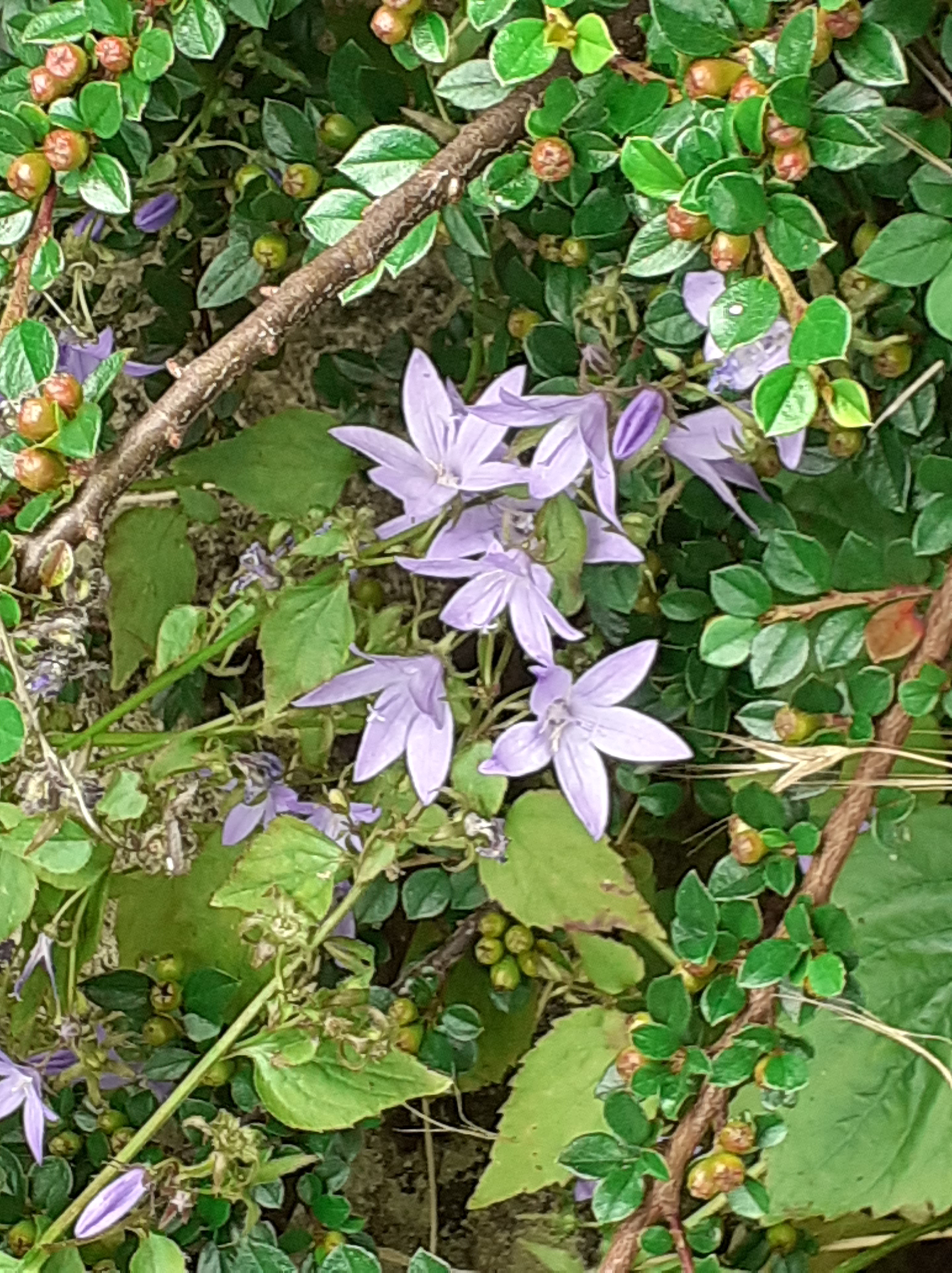
It is some time since the solstice. Where I live, the time between sunrise and sunset has shortened by about 20 minutes. Though the change is still slow, it is noticeable now. But I do not yet feel a pull towards Lughnasadh/Lammas. I took these pictures on 11 July, and this is its own time, a time of abundance and ripening. They give me the sense of a summer that has kept its promise and is managing to mature despite a year of patchy weather.

At this stage, the willows below, early to leaf, remain majestic in their abundance – whilst hinting at a tiredness that will manifest in late summer, when energy starts to withdraw, and turn inwards.

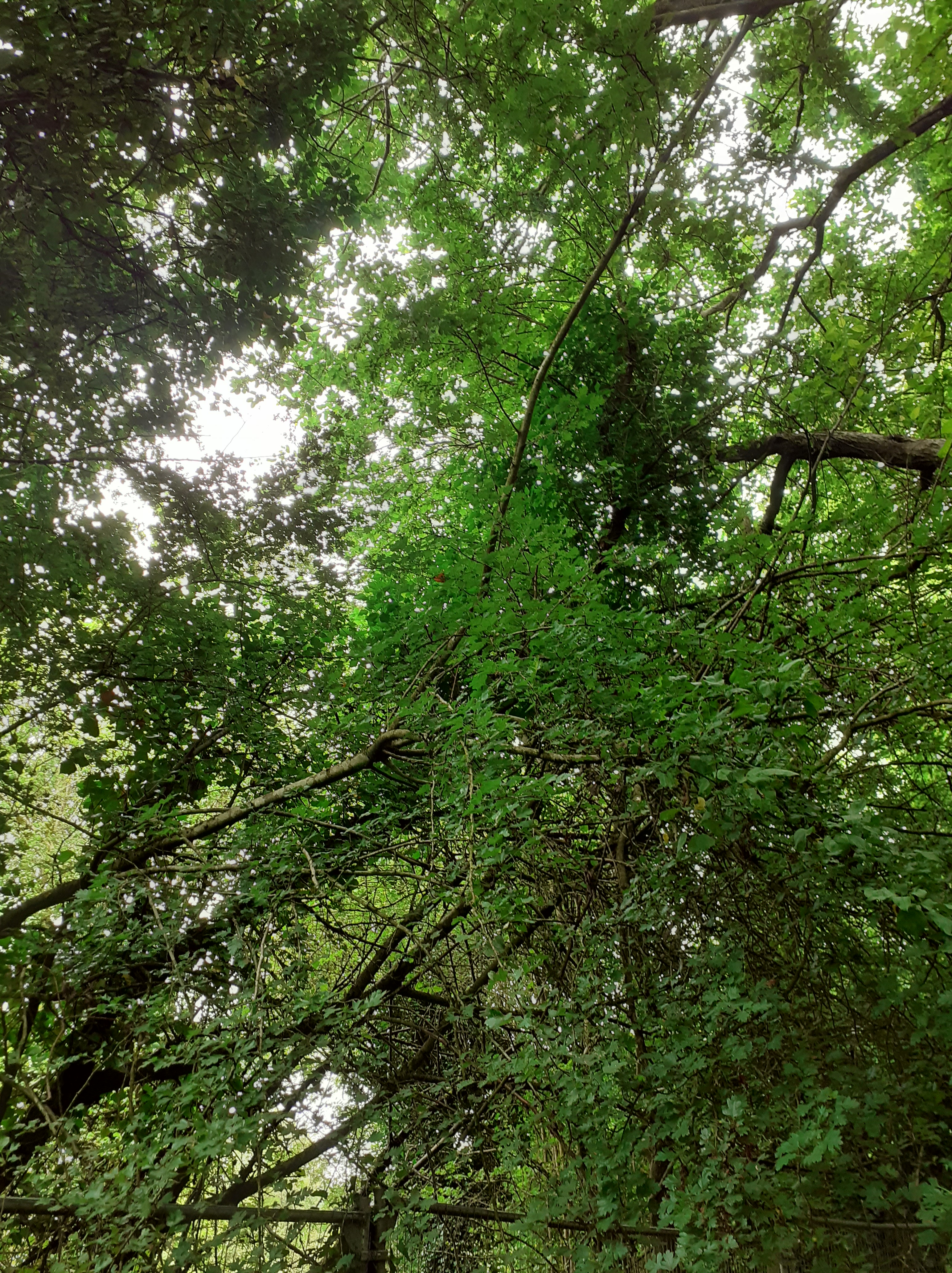
But this isn’t the case with the treescape as a whole. In the woods I continue to find the fresh green of a vigorous life energy. It is the time when I get the strongest sense of a canopy, even in a relatively small and modestly wooded space. It hints at the glories of old forest, even though it isn’t one.

Whilst there is a sense of flora moving into new stages of their cycle, the process is gradual. There is time and leisure for slow change. There is no sense of having to be perfectly one thing and then, immediately, perfectly another.

Above all. I notice subtle differences in shape and colour within a setting of predominantly green growth. My gaze is drawn by intricacies of variation, contrast and patterning within this always astonishing display of life, and its natural will to be and become.

In mid-July, life rests in its moment, with harvesting some way off.

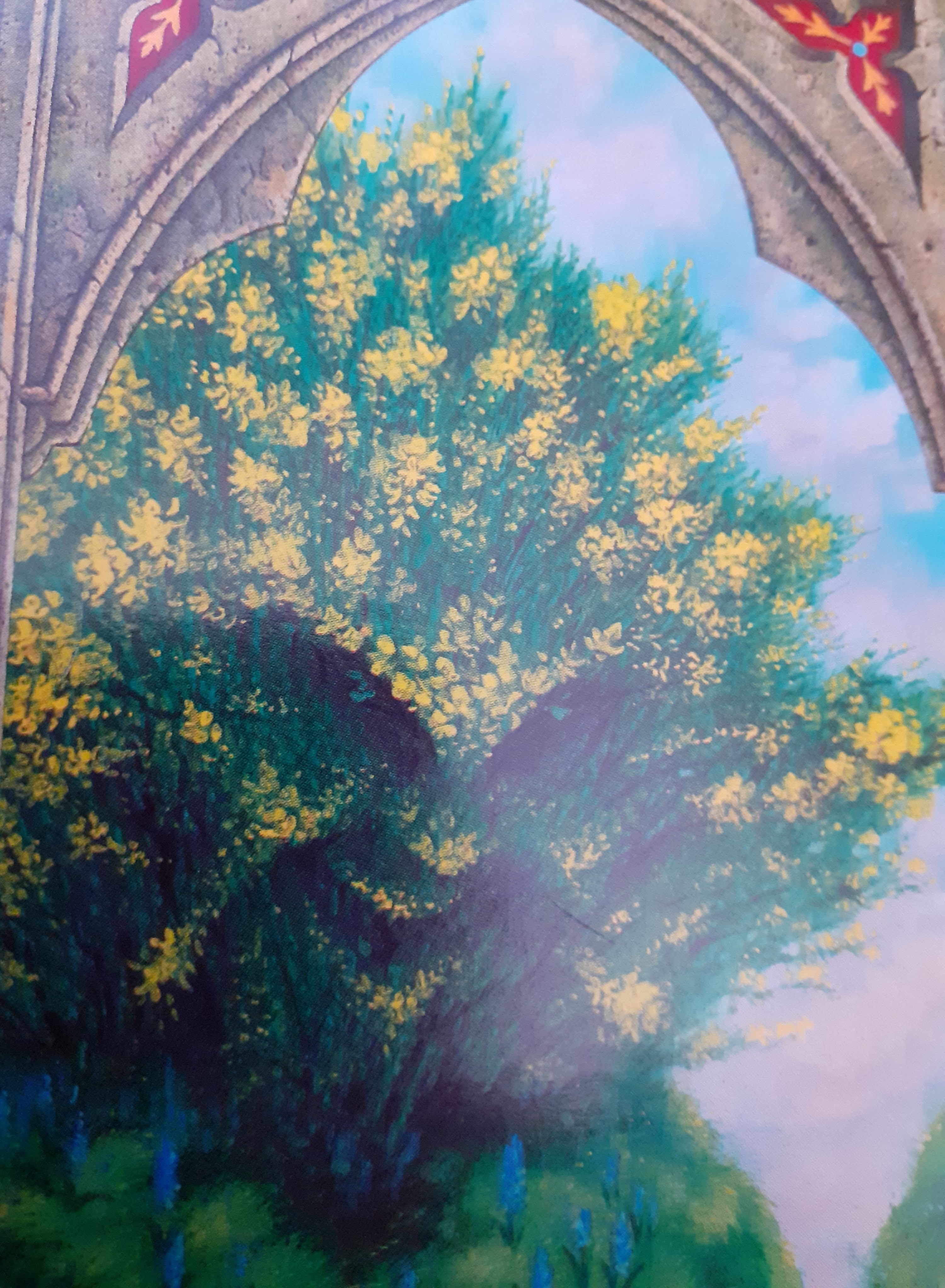
TREE MANDALA: GORSE

In my wheel of the year tree mandala (1), gorse covers the period from 9-31 July. It is the last tree of the summer quarter, handing over to apple at Lughnasadh/Lammas on 1 August. The illustration is from The Green Man Tree Oracle (2).

I know from my childhood that gorse can make a tame, gently sloping hill seem wild and edgy. Navigating through gorse requires an eye to self-care. Flowering gorse is not confined to summer, but for me it is anchored to summer in memory. Seen from afar, gorse was a vivid harbinger of the summer holidays with days of warmth (rising to heat) and freedom to roam. It carried a hint of adventure and disinhibition. Sometimes the promise was fulfilled. Sometimes there was a hot heavy dullness broken by only storms, and a degree of frustration. July days were unpredictable.

Gorse (ogham name Onn) was sacred to the Irish god Lugh, and thus to light, to all manner of skills, and to the fire in the head of ecstatic creativity. Lugh has a trickster aspect, and can be seen in certain lights as more a god of lightning than of the sun. He has a cousinship with the Brythonic Lleu Llaw Gyffes, the warrior magician of the fourth branch of the Mabinogi. He has also been linked to the Norse Loki, for tricksterism is an aspect of the smouldering fertile mind.

Gorse makes good fuel and so has an obvious role in fire festivals. In Brittany, 1 August was marked by the Festival of the Golden Gorse and gorse has has strong associations with the faery folk. It is a plant of power. We cannot make assumptions about how we stand with it. A wary respect might be wise.

NOTE: This post brings to an end a year in which I have featured the sixteen trees in this mandala. I began on 16 July 2020 with an out-of-sequence Rowan (3), because I had had a vivid encounter with a rowan tree in the woods. (Its time in the mandala is 9-31 October.). Then I moved on to apple (4) and blackberry (5). From the Autumn Equinox (1) the enterprise became more systematic. As a blogger, I won’t be repeating the cycle in the same way in the coming year. Once for the record feels enough.

(1) This mandala is based on my personal experience of trees in the neighbourhood as well as traditional lore. Moving around the summer quarter from Beltane, 1 May, the positions and dates of the four trees are: Hawthorn, south-east, 1-23 May; Beech & Bluebell, south-south-east, 24 May – 15 June; Oak, south, 16 June – 8 July; Gorse, south-south-west, 9 – 31 July. The autumn quarter then starts with Apple at Lughnasadh/Lammas. For a complete list of the sixteen trees, see https://contemplativeinquiry.blog/2020/autumn-equinox-2020-hazel-salmon-awen/

(2) John Matthews & Will Worthington The Green Man Tree Oracle London: Connections, 2003

(3) https://contemplativeinquiry.blog/2020/rowan/

(4) https://contemplativeinquiry.blog/2020/three-trees/

(5) https://contemplativeinquiry.blog/2020/mr-bramble/

HARVESTING IN MIXED WEATHER

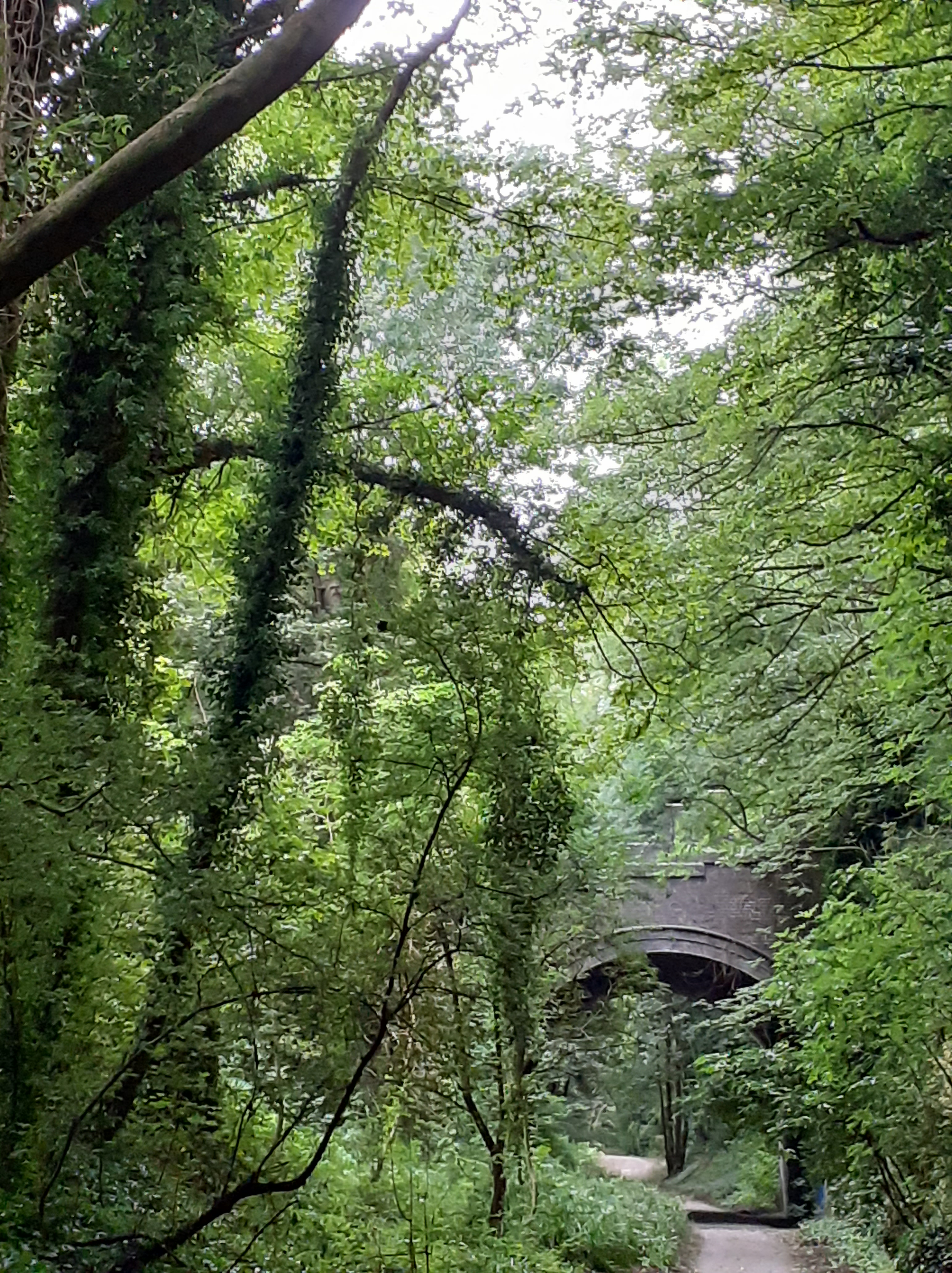
This picture was taken early one morning, at a moment slightly defended from the heat of early August. I was walking through woods to shelter from the sun.

Those days, intense in their moment, have already receded into the past. After a period of somewhat lower temperatures, and of flashes and rumblings in the sky followed by modest rainfall, we found ourselves in a flash flood on Sunday evening. For a relatively brief period, the A46 (a main road, locally) turned into a fast-flowing river not far from our house. Guttering held, but needs attention.

It was as if, following a period of contest, water had succeeded fire as the prevailing element. Now, the situation is less clear cut. But we are in a cooler and wetter place than we were at the beginning of the month. Daylight hours are reducing. We are leaning in to autumn.

During this time I have been busy with my own harvesting. The meditations presented in my last three posts (1) complete a basic repertoire of formal solo practice in my renewed Druidry. I have been fruitfully indoors during both heat wave (beyond my comfort zone) and the return of rain. I have been inwardly focused.

In my own Innerworld wheel of the year, apple presides over the first three weeks or so of the post Lughnasadh/Lammas quarter. Apple, in many traditions, is a Goddess tree, associated with both wisdom and healing (2). It is linked to a visionary ability to see beyond the surface: perceptions grow wiser and the heart sees further than it might otherwise do.

In Irish myth, Lugh was sent to collect apples from a Tree of Light found in the Otherworld. In Britain, after the Battle of Camlann, Arthur was taken by three Celtic goddesses to be healed on the Isle of Avalon (=Island of Apples).

In a more everyday way, my meditations serve the same goals. The timing of my work on them wasn’t exactly planned. But it doesn’t surprise me that my commitment to living the wheel of the year has led to this result.

(1) Links to the meditations:

MEDITATION: LIVING PRESENCE

MEDITATION: WISDOM’S HOUSE

MEDITATION: ENERGY BODY

(2) See: John Matthews & Will Worthington The Green Man Tree Oracle: Ancient Wisdom from the Greenwood London: Conections, 2003

AFTER MANY A SUMMER

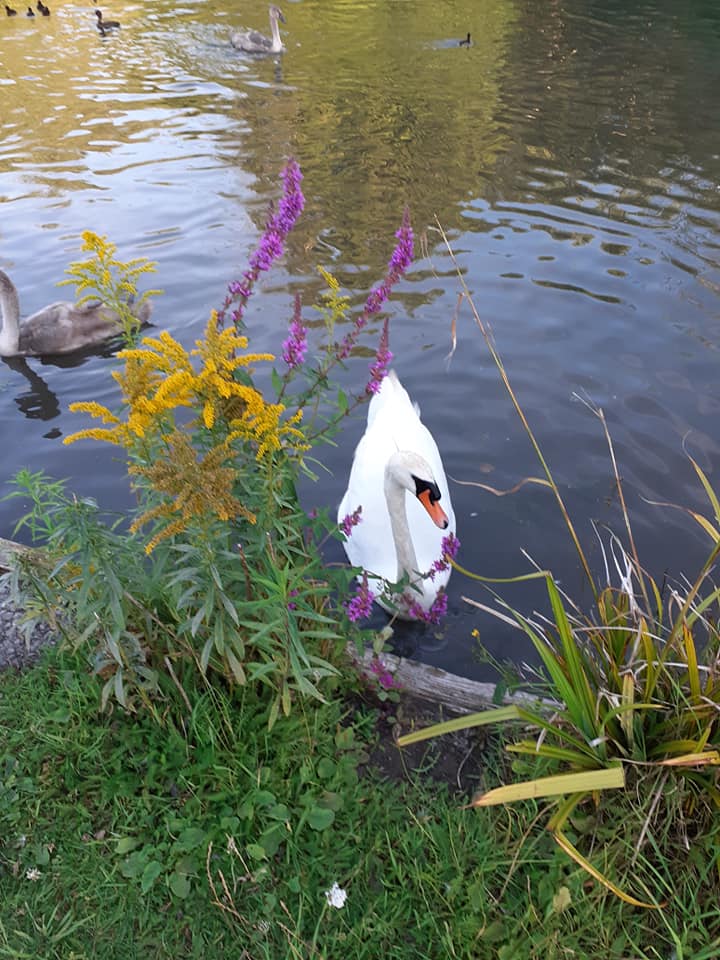
I notice swans at this time of year. They are mute swans, the largest birds in Britain, and they live here throughout the year. In my locality, there is an abundance of fresh water and they tend to do well. Now they are in their family groups, with the cygnets becoming adolescent.

Watching swans, even this soon after Lammas, cues me in to an elegaic mood, a slight bitter sweetness in the heart. Their family life is in its later stages. The generations will go their own ways before long. The parents will stay together since the swans mate for life, but they will be moving into a new cycle of life and parenting. There’s an anticipatory poignancy about this, where the current moment knowingly invites images of a probable future. I sense impending separation, not precisely fixed in time.

I am influenced by literature and legend, as I slip in to the autumnal quarter. Yeats sets The Wild Swans at Coole (1) at a moment when “the trees are in their autumn beauty”. He counts 59 swans “upon the brimming water among the stones” and the poem gives voice to the soreness of heart that goes with a feeling of unwanted change, and the foreknowledge of their departure from the lake. There are resonances here of the legendary Dream of Oengus, where King Oengus and his secret Cymric lover Caer Ibormeith (Yewberry) can meet only for a brief time at Samhain, and then only every other year, in the form of swans (2).

But the main reference for me is Tennyson’s Tithonus, a Tojan hero who asks for eternal life, and is granted it, by his divine lover Eos the Goddess of Dawn. He neglects to ask for eternal youth, with very sad results.

“The woods decay, the woods decay and fall,

The vapours weep their burthen to the ground,

Man comes and tills the field and lies beneath,

And after many a summer dies the swan.

Me only cruel immortality

Consumes: I wither slowly in thy arms,

To dwell in presence of immortal youth,

Immortal age beside immortal youth,

And all I was, in ashes.” (3)

Aldous Huxley published his novel After Many a Summer in 1939 (4). This was a year or two after he moved to California to become a Hollywood screen writer, and also to engage in earnest with Eastern spirituality. In a youth worshipping culture, a self-referential multi-millionaire hires an ambitious doctor/research scientist to extend his life span. What could possibly go wrong?

Meanwhile, in the wider world, Barcelona falls and the Spanish Republic is extinguished. At one level, the novel is a simple satire. At another it is a vehicle for Huxley’s view, on the eve of World War II, that political and military solutions to the world’s problems will, by themselves, always fall short. A spiritual dimension is needed to make a difference. Without such a dimension, ‘peace’ will be sought by unskillful means and ‘eternity’ will be confused with extended time. Both are found authentically in another – counter-cultural yet nonetheless accessible – approach to life. Huxley explores these ideas in more depth, with more of a sense of how to develop and maintain a healthy society, in his last novel Island (5) published in 1962.

Politically and culturally, I feel perplexed and disoriented. Individually, I have many ways of responding to my experiences of love and loss, growth and decay, life and death. Anxious anticipations of unwanted experiences and events are certainly a feature. My contemplative inquiry is in part about learning to be lovingly open and engaged with experience, whilst at the same time wisely anchored in the peace and stillness of living presence. An acceptance of falling short is baked into this stance.

(1) W. B. Yeats The Wild Swans at Coole In:A. Nroman Jeffares Poems of W. B. Yeats London: MacMillan, 1964 (Selected, with an introduction and notes)

(2) Philip and Stephanie Carr-Gomm The Druid Animal Oracle: Working with the Sacred Animals of the Druid Tradition New York, NY: Fireside, 1994

(3) Alfred, Lord Tennyson Tithonus (extract) In: Tennyson Poems and Plays London: Oxford University Press, 1968

(4) Aldous Huxley After Many a Summer Vintage Claasics e-book edition. (Original publication 1939)

(5) Aldous Huxley Island Vintage Classics e-book edition (Original publication 1962)

Earth Eclectic

music that celebrates Earth and speaks to the heart

Sarah Fuhro Star-Flower Alchemy

Follow the Moon's Cycle

Muddy Feet

Meeting nature on nature's terms

Rosher.Net

A little bit of Mark Rosher in South Gloucestershire, England

Becoming Part of the Land

A monastic polytheist's and animist’s journal

selkiewife

Selkie Writing…

Charlotte Rodgers

Images and words set against a backdrop of outsider art.

Prof Jem Bendell

living with metacrisis and collapse

Towint

The pagan path. The Old Ways In New Times

The Druids Garden

Spiritual journeys in tending the living earth, permaculture, and nature-inspired arts

The Blog of Baphomet

a magickal dialogue between nature and culture

This Simple Life

The gentle art of living with less

Musings of a Scottish Hearth Druid and Heathen

Thoughts about living, loving and worshiping as an autistic Hearth Druid and Heathen. One woman's journey.

Wheel of the Year Blog

An place to read and share stories about the celtic seasonal festivals

Walking the Druid Path

Just another WordPress.com site

anima monday

Exploring our connection to the wider world

Grounded Space Focusing

Become more grounded and spacious with yourself and others, through your own body’s wisdom

The Earthbound Report

Good lives on our one planet

Hopeless Vendetta

News for the residents of Hopeless, Maine