Contemplative Inquiry

This blog is about contemplative inquiry

Tag: John Matthews

APPROACHING THE YEAR’S TURN

We have a small patch of garden at the front of our house, remodelled only a week ago. It has a modestly zen pagan reference, with just a hint of spiral. In the bigger picture, where I live, we are rapidly approaching the turn from an inward to an outer arc of life energy. The Winter Solstice is very close.

I’m not experiencing deep stillness this year. It feels more like an extended pause for breath – a time for taking stock and regrouping. I’m peering in to the 2020s. Calendar numbers might be arbitrary, but they are numbers of power in our culture. They award shape and identity to years and decades. Part of me sees the 2020s as pure science fiction, with an increasingly dystopian tilt. Themes of alarm, determination, resourcing and resilience come up for me at multiple levels.

I have checked out older resources which have been neglected for awhile. One of these is the popular and respected Wildwood Tarot. I bought it years ago but didn’t much engage. Now its time has come round, prompted by an impulsive consultation. It happened in the early hours of a recent morning, at a rare time of sleeplessness. I spent several hours getting to know it. Here it is enough to say that I am drawn by its strong wheel of the year orientation, by its choice of imagery for the major trumps in particular, and by its own focus on resiliency.

I am going to live the year from 22 December with heightened attention to the wheel of the year, and with this resource as my companion. My current warm up process is already changing the way I think and feel about contemplative inquiry and will re-shape how I do it. In the meantime I enjoy the front garden and await the return of the sun.

Mark Ryan & John Matthews The Wildwood Tarot Wherein Wisdom Resides London: Connections, 2011. Illustrations by Will Worthington

TEMPLE OF SOPHIA

My ‘Temple of Sophia’ recollects the active imagination work I did when practising Druidry and the Way of Sophia as a fusion path. The Temple keeps the work alive for me, though its presentation lacks the dynamism of the original set of practices when I was working them. The Temple structure owes something to the ‘art of memory’ of the ancient Greeks This was a system of impressing ‘places’ and ‘images’ on the mind, which continued into the dawn of modernity. Late practitioners included Giordano Bruno and the English alchemist Robert Fludd (1).

Here is how the visualisation goes.

“[I am] …on the water of a lake, in a rowing boat … mooring on the western shore … walking eastwards on a path between carved stones … on the left hand a Pictish ‘dancing seahorse’ … on the right hand, a Levantine image (a pomegranate tree, serpent coiled around the base, dove at the top) … moving up to the western door of the Temple of Sophia, a domed stone building, half hidden in extensive tree cover … basically round but with arms extended in each of the 4 cardinal directions to create an equal armed cruciform shape.

“I enter the temple through a porch at the western end, over which are written two lines from Primary Chief Bard, in the Book of Taliesin (2): I stood at the cross with Mary Magdalene; I received the Awen from Ceridwen’s cauldron. I find myself facing the eastern wing. Its most striking feature is a rose window at the back. It also has an altar whose white cloth is embroidered with a golden gnostic cross, and strewn with white and red rose petals. At the centre stands a chalice, white candles on either side. Looking around me I see steps spiraling downwards to a crypt, left (northern extension) and steps spiraling upwards to an upper room, right (southern extension).

“The main body of the temple is lit by chandeliers hanging from the ceiling as well as natural light from the windows. On the floor is a large mosaic given definition by the golden outline of a circle, crossed at the cardinal points by golden lines which merge at the centre within a fully golden circle, which includes 3 white seed pearls in a triangular cluster at the centre.

“Just outside the outer circle, around the wheel of the year, are depictions of 16 trees: yew, north-west; elder, north-north-west; holly, north; alder, north-north-east; birch, north-east; ash & ivy, east-north-east; willow, east; blackthorn, east-south-east; hawthorn, south-east; beech & bluebell, south-south-east; oak, south; gorse, south-south-west; apple, south-west; blackberry & vine, west-south-west; hazel, west; rowan, west-north-west. Each representation of a tree on the mosaic offers a portal for further communication with the tree. If I visualize myself standing on the image, then I may enter another imaginal landscape for a fuller experience – whether through sensing or communicating with the tree in question, or indeed becoming it.

“Moving in to the delineated quarters of the main circle, I find: north, a seated white hart in a yellow square; east, an eagle with wings outstretched, in a blue circle; south, a mottled brownish adder in a red triangle; west, a silver salmon over a silver crescent moon. These positions, too, are potential portals into an Innerworld landscape. If I visualize myself standing on an image, it has the power to take me to another imaginal landscape, and to forms of engagement – whether simply connecting, communicating or indeed journeying there. At the golden centre of the circle, the cluster of three white pearls recollects the three drops of inspiration distilled from Ceridwen’s cauldron and the visionary power of Awen. There are also other trinities – the triple goddess; the orthodox Christian trinity; or the divine mother, father and child; or the singularity of Tao becoming the two, three and 10,000 things. This is more a place for simple contemplation.

“Spiraling again out of the circle, and exiting north, I descend into the crypt. Here I find an empty sarcophagus dimly lit by candles. Two or three steps below the sarcophagus is a small, warm pool, lit by night lights – a ‘birthing pool’, perchance a re-birthing pool. There is an image of a coiled serpent at the bottom of the pool and a red ankh painted at the centre of the ceiling. I can spend time lying within the sarcophagus, contemplating change, death and dissolution. I can also move on to the birthing pool, and taste the experience there.

“Leaving the crypt and moving across the temple, I climb the steps to the upper room, which has a meditation chair at its centre, with a chalice, or grail, on a small table in front of it. There is a white dove painted on the ceiling; otherwise the room is plain. If I centre myself and drink from the chalice, saying, my heart is home to Sophia, I may find myself in a Garden. It has a fountain at the centre, surrounded by four flower beds of alternating red and white roses. There are fruit trees, apple, pear and plum, trained around the walls. Sometimes, full bright sunlight shines on the scene and strikes the dazzling water of the fountain, warming an illuminating each drop as it falls. At other times, I am in moonlit or starlit night, and I hear as much as see the fountain. Either way, I open myself to the experience of the Garden. Sophia herself as psychopomp may or may not appear. Indeed, there is no ultimate distinction between Sophia, the Garden and me.

“On coming back from the vision of the garden, I sit and rest for a while. Eventually I leave the upper room, and, descending into the main body of the temple. I walk to the south point of the circle and from there move, spiralling, into the centre. I face the altar at the east, bowing and giving thanks before I leave the temple.”

(1) Frances A. Yates The Art of Memory London: Pimlico, 1966

(2) John Matthews Taliesin: Shamanism and the Bardic Mysteries in Britain and Ireland London: The Aquarian Press, 1991

WESTERN WAYS II: MOVING TOWARDS SOPHIA

In my earlier Western Ways post I talked about a distinction between a ‘Native’ Tradition and a ‘Hermetic’ one, acting as “complementary opposites”. The first was said to be concerned with “ancestral earth-wisdom”, whilst the second was described as a “path of evolving consciousness”. (1)

I am influenced by this idea and the distinction that is being drawn. But I have a different sense of the detail, and a different experience of how these themes have played out in my life. My original choice to ground myself in Native tradition resulted from an experience in the Orkney’s. I was allowed to hold an ancient eagle claw necklace and an extraordinary energy shot through me – ancestral power, certainly, and a lesson in taking the heritage of land and ancestors seriously. However my current  of Druid doesn’t directly follow on from this experience, but is, rather, a contemplative nature mysticism. This is spacious and gentle and from my perspective generally works well in both its personal and collective versions. I feel satisfied with what I am doing and, in a good way, my inquiry energy for it is waning, even as my practitioner energy is present and available..

For me, now, the call of Sophia is more dynamic. It is a call from the other half of the Western Way – though not strictly Hermetic, because not concerned with the Greek-Egyptian figure Hermes Trismegistos. So I have decided to make my Way of Sophia the focus of a new  personal inquiry cycle. It is not like starting something new. It is more about making this aspect of my spirituality more focused and specific.

In my private sacred space I will establish a Temple of Sophia and this will be separate from from my involvement in Druidry. Ultimately there will be an integration and unity, but I’m aiming to craft a coherent overall Way. I’m not happy to treat pick’n’mix eclecticism and pluralism as more than a staging post. I want to give the Goddess her due and discover for myself how these apparently diverse approaches fit together. I hope that this may be of interest to other Druids, since many of us have a simultaneous engagement with other traditions.

I will report developments in this blog, and I will also continue to write posts outside the inquiry, including book reviews, poems, Druid contemplative developments, and other news and events.

  • Caitlin & John Matthews (1986) The Western Way: A Practical Guide to the Western Mystery Tradition: Volume 2 – the Hermetic Tradition London: Arkana

WESTERN WAYS: DRUIDRY AND SOPHIA

In my world, Druidry and the Way of Sophia are linked, though not the same. In The Western Way (1,2) authors Caitlin and John Matthews made a distinction between a ‘Native’ Tradition and a ‘Hermetic’ one, which act as “complementary opposites”. The Native Tradition is “the inward spiral of a maze which leads into the heart of ancestral earth-wisdom”. The Hermetic Tradition is the outward spiral of the same maze: a path of evolving consciousness which is informed by the inner resources of our ancestral roots, “augmented in a macrocosmic way” (2).

My original interest in a ‘Celtic’ spiritual thread, developing from the 1980s, wasn’t specifically Druid or Pagan. It came mostly through Celtic and Celtic influenced literature. Although a long tradition in its own right, it post-dates the demise of institutional Druidry and Paganism in Celtic speaking regions. Most of it has been written with at least an element of Christian reference and influence. So we get verses like this from the medieval Welsh Book of Taliesin:

I was at the cross

With Mary Magdalene.

I received the Awen

From Ceridwen’s cauldron. (3)


What I intuitively liked about this was the sense of a culture working to integrate diverse influences rather than attempting to be ‘pure’. Pure culture (or the attempt at it) narrows horizons and banishes possible resources, becoming limited and inflexible in my view. Sophia is both an image of the divine and expresses a blending of Jewish and Greek wisdom traditions. She came to prominence in Alexandria, the largest city of Roman Egypt. She is cosmopolitan. In the verse above Mary Magdalene (an incarnation of Sophia in some gnostic traditions) and Ceridwen (not a traditional Celtic goddess from Pagan times) both have Sophian roles in relation to male figures seen in different ways as light bringers.

Some of the Celtic-derived stories from the medieval period are clearly breaking new cultural ground whilst using resources from the Celtic past. They belong to a realm of creative mythology, as Joseph Campbell called it, whose purpose is “the opening … of one’s own truth and depth to the depth and truth of another in such a way as to establish an authentic community of existence” (4). Twelfth century Western Europe sought to renew itself by drawing on its classical heritage (native in Italy) and Geoffrey of Monmouth drew on it in his Mystic Life of Merlin (5), for example by dedicating a contemplative ‘Observatory’ to the owl deity Minerva, Roman Goddess of Wisdom. It also drew on Celto-Germanic heritage, with the Arthurian mythos – the matter of Britain – taking a prominent place. This mythos does not name Sophia. But it does have the image of the grail and the story of the grail quest. For me the grail represents the presence and energy of Sophia, and Caitlin Matthews has described it as “a prime symbol of Sophia” (6).  Perceval, the grail winner, has to encounter the divine in a new way for himself. At one level his role is to honour and heal the land, renewing its tantric energy. But the Grail Goddess, whilst enabling that traditional collective healing, adds a new and more individuated depth of wisdom and compassion. So although I have always been moved by the scenes and images of the more archaically oriented Peredur (7), I have found a more compelling narrative in Parzival (8). It is the innovative aspect of the story that engages me and the grail image that nourishes me.

In the Gnostic Gospel of Thomas, (9) Jesus of Nazareth asks three leading followers to say what they think he is like. Peter, traditionally Jewish, says “you are like a just messenger” (or righteous angel in other translations). Matthew, familiar with Graeco-Roman ways, says “you are like a wise philosopher”. Thomas says, “my mouth is utterly unable to say what you are like”. The teacher responds, ‘I am not your TeacherBecause you have drunk, you have been intoxicated from the bubbling spring that I have tended’.  As I read this text, it is a confirmation that a lived spirituality is beyond packaging.

In this sense, terms like Druidry, Way of Sophia or Western Way have only a limited use. Joseph Campbell said “the best things cannot be told; the second best are misunderstood; after that comes civilised conversation”. The problem is real yet I believe he overstates his case. I think it is worth the effort of finding words, making distinctions and enabling affiliations in full awareness of the difficulties. Civilised conversation with moments of … something more … feels like an honourable pursuit.

  1. Caitlin & John Matthews (1985) The Western Way: A Practical Guide to the Western Mystery Tradition: Volume 1 – the Native Tradition London: Arkana
  2. Caitlin & John Matthews (1986) The Western Way: A Practical Guide to the Western Mystery Tradition: Volume 2 – the Hermetic Tradition London: Arkana
  3. John Matthews (1991) Taliesin: Shamanism and the Bardic Mysteries in Britain and Ireland London: The Aquarian Press (with additional material by Caitlin Matthews)
  4. Joseph Campbell (1976) The Masks of God: Creative Mythology Harmondsworth: Penguin
  5. R. J. Stewart (1986) The Mystic life of Merlin London: Arkana 
  6. Caitlin Matthews (1986) Sophia Goddess of Wisdom, Bride of God Wheaton, IL: Quest Books
  7. The Mabinogion (1976) Harmondsworth: Penguin (translated with an introduction by Geoffrey Gantz)
  8. Wolfram von Eschenbach, W. (1980) Parzival Harmondsworth: Penguin (translated by A. T. Hatto)
  9. The Gospel of Thomas: the Hidden Sayings of Jesus (1992) San Francisco, CA, USA: Harper San Francisco (translation with introduction, critical edition of the Coptic text and notes by Marvin Meyer; with an interpretation by Harold Bloom)

POEM: PRIMARY CHIEF BARD

Gnostic Bardistry from The Book of Taliesin? These are just five of the verses, selected by me from one poem. What interests me is not so much working out what to us seems like a set of puzzles, but how something new and dialogical is created by interweaving indigenous material and biblical references. I say a few words in italics after each verse.

Primary Chief Bard

Primary Chief Bard

Am I to Elffin

And my native country

Is the region of the summer stars.


The first statement is a statement of identity. It begins with a local (though important) role, and goes on to the cosmic and transcendent. This taps into a sense of belonging somewhere else (whether perceived as a place or state). It makes me think that statements like ‘being here now, in the present’ and ‘my native country is the region of the summer stars’ only seem contradictory: meaning depends so much on context and the work that words are doing. If the two statements are separated and polarised, they diminish into limiting slogans. Taken together, they can lead us to a different quality of experience.

I was full nine months

In the womb of the hag Ceridwen.

Before that I was Gwion

But now I am Taliesin.

Taliesin’s current personal identity is explained in terms of a second birth, in this life, triggered by the actions of Ceridwen. This second birth fits him to be a Bard and take the Bardic name ‘Radiant Brow’, one that bespeaks major shifts in energy and consciousness. It also allows the sense of the summer stars as his ‘native country’ to be real within him. It orients him to his true home.

I was patriarch

To Elijah and Enoch.

I was there at the crucifixion

Of the merciful Mabon.

Elijah and Enoch ascended to heaven without dying. They have deep roles in Jewish mysticism. They are in the tradition of so-called ‘ascended Masters’. If we treat these metaphors (insofar as they are metaphors) as concerned with enlightenment, then – as their ‘Patriarch’ – Taliesin is claiming primacy over them. He is in some sense a Christ figure and so can be present at the crucifixion of another Christ figure, referred to here by the name of the magical child of British tradition ‘the Mabon’.


I was at the cross

With Mary Magdalene.

I received the Awen

From Ceridwen’s cauldron.

The poem presented here is a product of the later Middle Ages, likely as late as the fourteenth century. Traditions giving Mary Magdalene the role of major teacher and possibly spouse of Jesus were deep underground, but everyone in Christendom Knew of her witnessing role at both the crucifixion and the resurrection, and so as privileged in some way. She also shares her name with Mary the mother. The two couplets together bring the idea of Christ’s transformation through death on the cross with Taliesin’s transformation from Ceridwen’s cauldron, and the critical role of a feminine power in each.

I was in the larder

In the land of the Trinity

And no one knows whether my body

Is flesh or fish.

Despite all the above, Taliesin remains an enigma – a shape shifter and trickster. He defies definition and description and won’t fit into any box that attracts unwanted piety. Other readers may understand this verse much better than I do, but I see it as very tough minded and unwilling to let me parcel up this poem and tie it with a neat bow. To the extent that I get a sense of medieval Welsh literature, this seems very characteristic. However, in the most obvious ‘Land of the Trinity’ (Western Christendom) people want to know where everyone stands. The accepted narrative is that we’re with Jesus the avatar of Pisces and through the sign of the fish we know him. And yet the old Celtic world has many trinities and many fish, including the salmon of wisdom. And Taliesin’s body might be flesh after all. So we are thrown back on our resources, with riddling words and ambiguous images to reflect them.


The complete poem can be found in Taliesin: Shamanism and the Bardic Mysteries in Britain and Ireland by John Matthews London: The Aquarian Press, 1991.

SAILING TO BYZANTIUM

This post is inspired by The Byzantine Tarot, a collaboration between two notable talents – John Matthews as writer and Cilla Conway as artist. It’s an excellent piece of work, but this post is not a review. It’s about two of the major trumps and their effect on me.

I impulse-bought the pack about a month ago. I didn’t get it for divination. I wanted it for the iconography of the major trumps, though in fact all the cards are carefully chosen and beautifully rendered. Part of the integrity of this tarot is that the images are drawn from the culture they reference – a culture itself very busy with sacred images, though at times its ruling circles reacted against them. Cilla Conway’s work is a wonderful evocation of this culture and its imagery, an imagery consciously crafted in the service of Christian Orthodoxy*.  It’s an interesting subject for a tarot pack, since the tarot form itself introduces an element of gnostic subversion into the work.

In the Byzantine Tarot, Sophia appears as the Papesse/High Priestess. She mediates “between the higher and lower realms of creation, watching over the Holy Fool on his journey and guiding those who seek her blessings to find their own path through the world”. In the apparent world, Byzantine Orthodoxy had no vacancy for a Papesse/High Priestess, and was not in business to encourage people to find their own way unless it was also the Churches’ way. The Fool of this tarot is a Holy Fool and draws on the history of the Desert Fathers, though the specific image is from Moscow, for the Slav world inherited the Orthodox tradition and the role of the Holy Fool. There is a happy reframing of these formidable world-renouncing ascetics in the text. A naked, haloed man steps outside his cell raising his hands towards the dove of the Holy Spirit and “prepares to step off into the air above the sea, asking without words to be allowed to access the joy and wonder of the world”. He is said to represent ‘crazy wisdom’, also known to Sufi and Buddhist tradition.

I feel engaged with these images, but not close to the Orthodox Church. Fortunately good images transcend doctrine. They have a larger suggestive power. I see a Goddess, depicted in one card as an angelic intercessor and in the other as a dove. I see a devotee who is a completely opened up. I’m learning how development works in spirals. A few years ago I was taken up with the image of Sophia and this modified my experience of Druidry. It was initially her influence that got me to explore meditative disciplines and see through the eye of contemplation more systematically. When my exploration took me further East, my specific sense of Sophia began to diminish.

Two tarot images have brought her back into my life. Now that she’s in my life, I have to move on from the specific images, for all their potent catalyst role. In relation to my life and practice, the Sophia depicted is too hierophantic and static. I like the Holy Fool icon, but the ‘Crazy Wisdom’ references in the text open up unwelcome possibilities of dogmatic intuitionism and licensed abuse-by-Guru that we find in Crazy Wisdom Masters from many traditions.

If I want to orient myself to the ‘Holy Fool’ archetype, there are lines within W. B. Yeats’ poem Sailing to Byzantium, which act as a better guide. He starts with the complaint “That is no country for old men” – Ireland, but more essentially the world of “whatever is begotten, born and dies, caught in … sensual music”. Then he says:

“An aged man is but a paltry thing,

A tattered coat upon a stick, unless

Soul clap its hands and sing, and louder sing

For every tatter in its mortal dress.”

On my reading the world of begetting, birthing and dying – with all its sensual music – is absolutely fine and to be celebrated. It’s the being “caught” in it that’s the problem. For there is another dimension. The seven directions operate vertically as well as horizontally, with eternity at the centre, within, around and throughout.  Sophia reminds me of this, and it changes everything.

* Early in the 4th century C.E. the Roman Emperor Constantine began the Christianisation of the Empire and moved the capital eastwards from Rome to the old Greek city of Byzantium which he rebuilt and modestly renamed Constantinople. Two hundred years later when Orthodox Christianity was dominant and enforceable, a new Cathedral of Hagia Sophia (Holy Wisdom) became the greatest building of the city. It still is in some ways, having survived two conversions since the fall of the city in 1453, first into a mosque and later into a museum in today’s Istanbul.

Matthews, John & Conway, Cilla The Byzantine Tarot: Wisdom from an Ancient Empire London: Connections Book Publications, 2015

Yeats, W. B. Poems of W. B. Yeats London: MacMillan & Co, 1964 (Selected with an introduction and notes by A. Norman Jeffares)

POEM: ARTHUR

Behind storm-fretted bastions gray and bare

Flame-crested warriors of Cunedda’s line

Feast in a gold ring, – their targes shine

Along the wall and clang to gusts of air;

And in the shadow, torches blown aflare

Reveal a chief, half human, half divine,

With brooding head, starred by the Dragon Sign,

Hung motionless in some undreamed despair.

But when he starts, three torques of twisted gold

Writhe on his breast, for voices all men fear

Wail forth the battle-doom dead kings have borne;

And as the mead-hall fills with sudden cold,

Above the wind-tossed sea his heart can hear

The strange gods calling through their mystic horn.

Arthur is one of Six Celtic Sonnets written by Thomas Samuel Jones and included in From the Isles of Dream: Visionary Stories and Poems of the Celtic Renaissance, selected by John Matthews and with a foreword by Robin Williamson (Floris Books, 1993).

Thomas Samuel Jones (1882-1932) came from Welsh and Irish stock and was born in Oneida County, New York State, near the Adirondack Mountains. Each of the six sonnets reflects a facet of Celtic tradition. They were originally published in 1930 as part of the collection Aknahton and Other Sonnets. For those of us who resonate with Druid and Celtic spirituality, they are part of our modern cultural ancestry.

POEM: A DRUID TOWN

A sunless maze of tangled lanes enfold

The magic dwellings of the forest race,

Whose hidden shapes are flames that leave no trace

At mid-moon when the Druid’s dream is told;

The shadows of enchanted orchards hold

Red thatch of wings and woad-stained doors that face

The wandering stars, and guard the sacred place

Where faery women thread their warps with gold

The dragon knight shall lose his strength of hand

Nor ever raise his long leaf-shapen shield,

If he but follow where the white deer roam;

And never will the mariner reach land

When harps ring seaward as the dawn fires yield

The golden caer upon the ninth wave’s foam.

A Druid Town is one of Six Celtic Sonnets written by Thomas Samuel Jones and included in From the Isles of Dream: Visionary Stories and Poems of the Celtic Renaissance, selected by John Matthews and with a foreword by Robin Williamson (Floris Books, 1993).

Thomas Samuel Jones (1882-1932) came from Welsh and Irish stock and was born in Oneida County, New York State, near the Adirondack Mountains. Each of the six sonnets reflects a facet of Celtic tradition. They were originally published in 1930 as part of the collection Aknahton and Other Sonnets. For those of us who resonate with Druid and Celtic spirituality, they are part of our modern cultural ancestry.

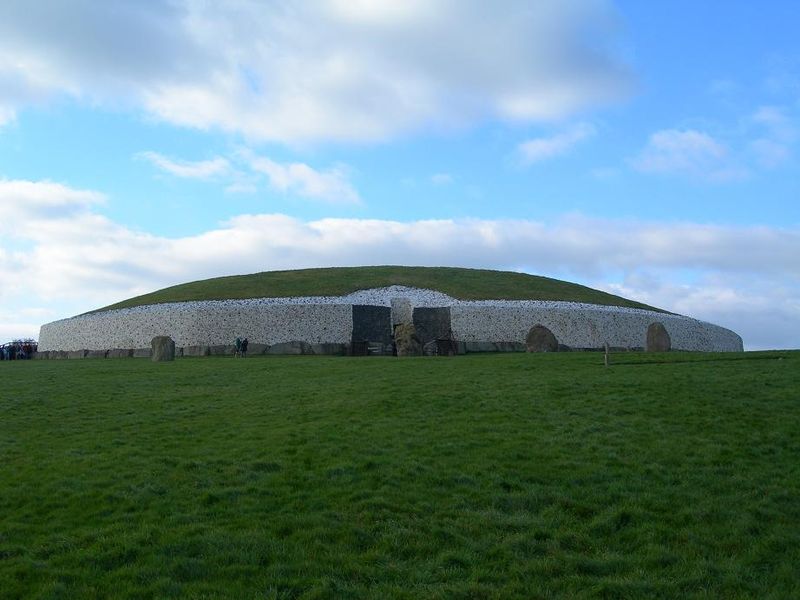
POEM: NEW GRANGE

800px-Newgrange

Picture cc by 2.5 pl – originally uploaded by Shira-commonswiki

The golden hill where long-forgotten kings

Keep lonely watch upon their feasting-floor

Is silent now, – the Dagda’s harp no more

Makes sun and moon move to its murmurous strings;

And never in the leafy star-led Springs

Will Caer and Angus haunt the river shore,

For deep beneath an ogham-carven door

Dust dulls the dew-white wonder of their wings.

Yet one may linger loving the lost dream –

The magic of the heart that cannot die;

Although the Rood destroy the quicken-rods;

To him through earth and air and hollow stream

Wild music whines, as two swans wheeling cry

Above the cromlech of the vanished gods.

New Grange is one of Six Celtic Sonnets written by Thomas Samuel Jones and included in From the Isles of Dream: Visionary Stories and Poems of the Celtic Renaissance, selected by John Matthews and with a foreword by Robin Williamson (Floris Books, 1993).

Thomas Samuel Jones (1882-1932) came from Welsh and Irish stock and was born in Oneida County, New York State, near the Adirondack Mountains. Each of the six sonnets reflects a facet of Celtic tradition. They were originally published in 1930 as part of the collection Aknahton and Other Sonnets. For those of us who resonate with Druid and Celtic spirituality, they are part of our modern cultural ancestry.

POEM: TALIESIN

An unfamiliar (at least to me) image of Taliesin. One of ‘Six Celtic Sonnets’ by Thomas Samuel Jones, first published in 1930. Taken from the ‘Isles of Dream’, an anthology of work from the ‘Celtic Renaissance ‘.

On lonely shores where dreams are drifted sand

He follows to the end a star’s bright course,

A ghostly hunter without hound or horse,

The warrior-bard, last of the Druid band;

But still his wizard harp rings in his hand

Beside the Stream of Sorrow’s hidden source,

Still from a breaking heart his wild songs force

Their way into the god’s mysterious land.

Dauntless he sings, and sees the drear woods turn

To golden orchards by the river bed

Where healing waters of the rainbow run;

And past the valley near great peaks that burn

With beaconing fire the hero-bard is led

Up toward the Dragon City of the Sun.

Taliesin is one of Six Celtic Sonnets written by Thomas Samuel Jones and included in From the Isles of Dream: Visionary Stories and Poems of the Celtic Renaissance, selected by John Matthews and with a foreword by Robin Williamson (Floris Books, 1993).

Thomas Samuel Jones (1882-1932) came from Welsh and Irish stock and was born in Oneida County, New York State, near the Adirondack Mountains. Each of the six sonnets reflects a facet of Celtic tradition. They were originally published in 1930 as part of the collection Aknahton and Other Sonnets. For those of us who resonate with Druid and Celtic spirituality, they are part of our modern cultural ancestry.

Earth Eclectic

music that celebrates Earth and speaks to the heart

Sarah Fuhro Star-Flower Alchemy

Follow the Moon's Cycle

Muddy Feet

Meeting nature on nature's terms

Rosher.Net

A little bit of Mark Rosher in South Gloucestershire, England

Becoming Part of the Land

A monastic polytheist's and animist’s journal

selkiewife

Selkie Writing…

Charlotte Rodgers

Images and words set against a backdrop of outsider art.

Prof Jem Bendell

living with metacrisis and collapse

Towint

The pagan path. The Old Ways In New Times

The Druids Garden

Spiritual journeys in tending the living earth, permaculture, and nature-inspired arts

The Blog of Baphomet

a magickal dialogue between nature and culture

This Simple Life

The gentle art of living with less

Musings of a Scottish Hearth Druid and Heathen

Thoughts about living, loving and worshiping as an autistic Hearth Druid and Heathen. One woman's journey.

Wheel of the Year Blog

An place to read and share stories about the celtic seasonal festivals

Walking the Druid Path

Just another WordPress.com site

anima monday

Exploring our connection to the wider world

Grounded Space Focusing

Become more grounded and spacious with yourself and others, through your own body’s wisdom

The Earthbound Report

Good lives on our one planet

Hopeless Vendetta

News for the residents of Hopeless, Maine