Contemplative Inquiry

This blog is about contemplative inquiry

Tag: John Matthews

EVERGREEN OVERVIEW

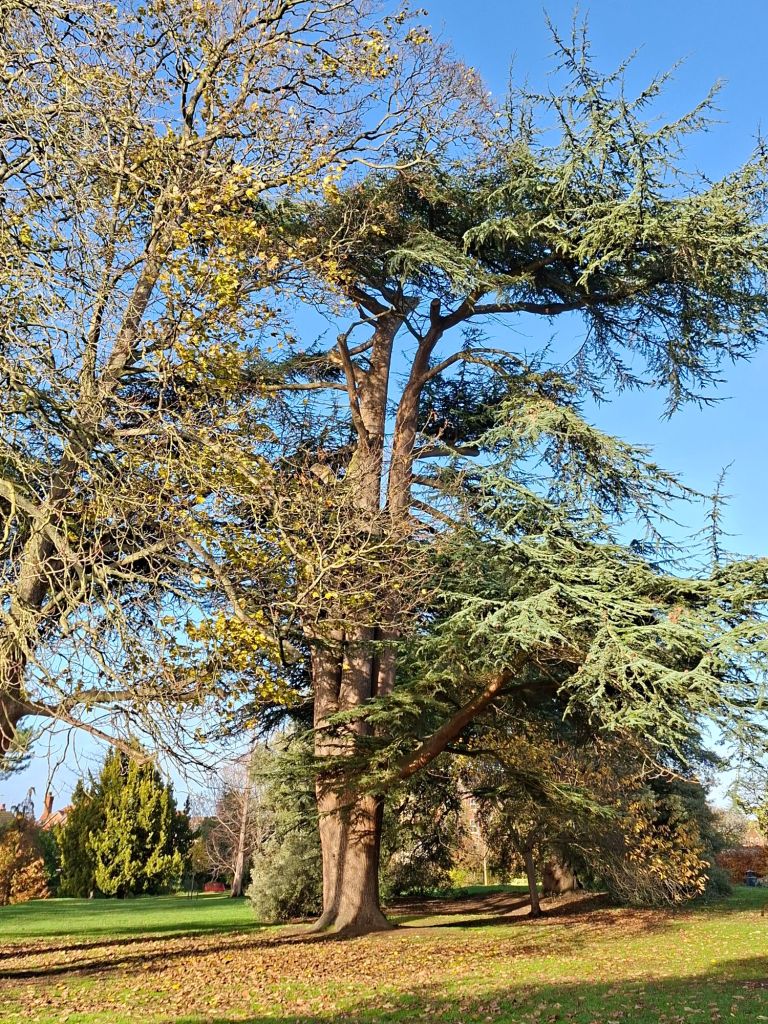
A Scots pine in Hillfield Gardens (1), 28 November, 10.32 am. It stands out both as a tall tree and an evergreen. It asks me to look up and pay attention to it, and beyond it, almost  losing sight of its deciduous neighbour. For me, this representative of the ‘eternal green’ has a commanding presence.

The Scots pine is one of the oldest trees native to Britain. It is also one of the trees associated with ogham lore (2), where the Scots pine is linked to the wisdom of overview. According to The Green Man Tree Oracle, ancient shamans of many traditions would literally climb to the top of a central tent pole or tree and “from this vantage point they could see clearly into the spirits’ inner world and come back with knowledge for the tribe or family they served” (2).

For me as for many people, the end of the calendar year is a time for reflection and taking stock. New year resolutions are a possible modern version of this process, but mine never really worked.  They were overprescriptive and a way of setting myself up to fail.

‘Overview’ asks for a less driven and more contemplative approach, one more connected with Spirit. This is a good reminder as I start to wonder about how I am going to navigate 2026: divining what my contributions and satisfactions might look like as the Wheel continues to turn.

(1) Re Hillfield Gardens, Gloucester, see https://contemplativeinquiry.blog/2024/11/22/

(2) John Matthews and Will Worthington The Green Man Tree Oracle: Ancient Wisdom from the Greenwood London: Connections, 2003

DEEP AUTUMN 2025

“All things ripen and rot that rose up at first,

And so the year runs away in yesterdays many,

And here winter wends again, as by the way of the world it ought,

Until the Michaelmas moon has winters boding brought.” (1)

Even today, deep autumn opens the door to winter. This was even more the case in the North Staffordshire and Derbyshire regions of 14th century England, where Sir Gawain and the Green Knight was written. Even in castles, people were less sheltered from the growing cold and damp than we are. So readers and listeners of the period are reminded that the coming of winter is both natually and divinely ordained.

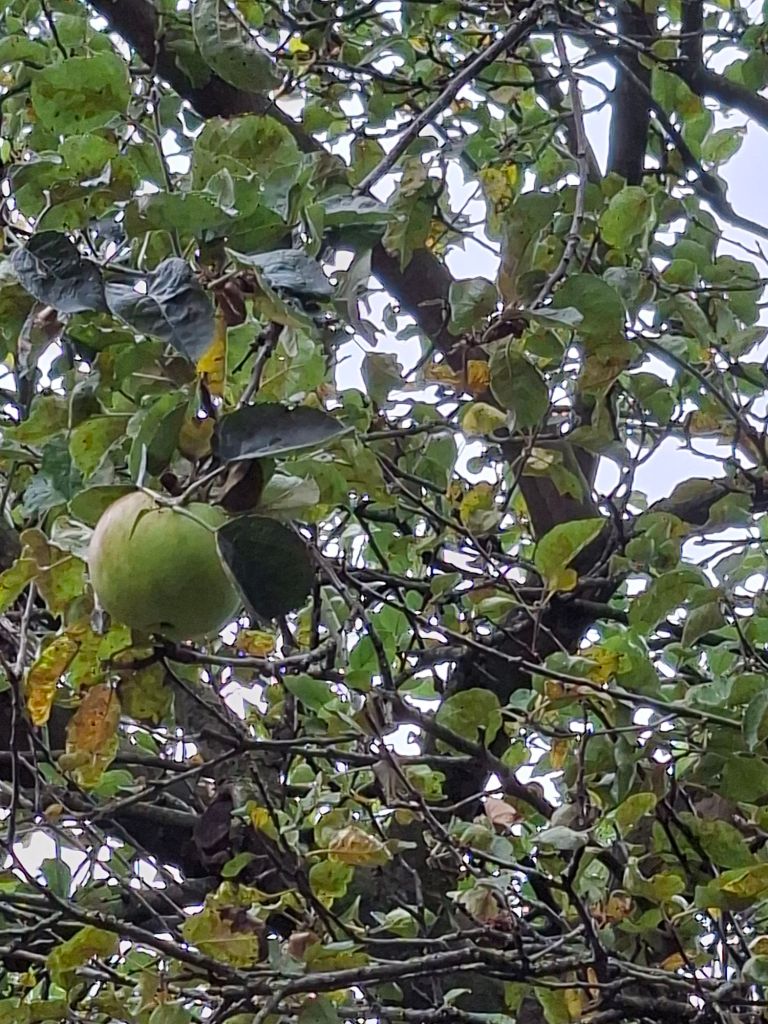
Here and now, the sight of the apple harvest in its later stages (pictured above) seems quite different than in the early ones (2) – less bright, less novel, less shiny. Rotting apples lie on the ground, now fallen outside the wall of  Gloucester Cathedral’s orchard. From Nature’s exuberant perspective, this is all part of the plan.  Waste is built in.

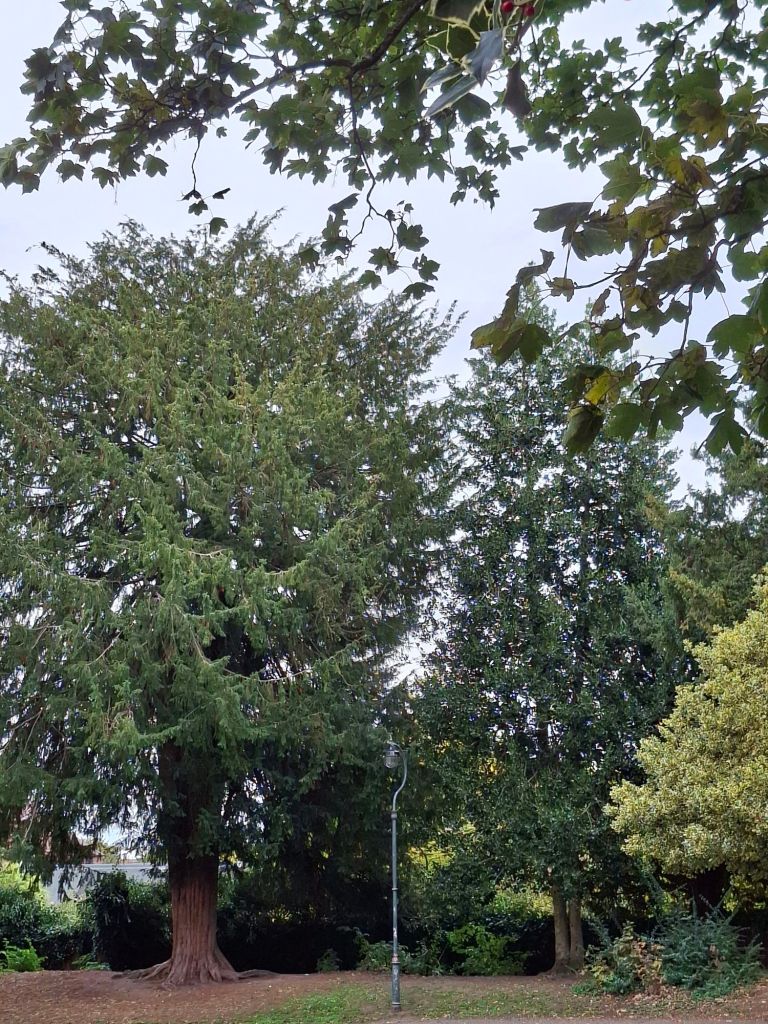
This time draws me further into the declining year. I am in the cathedral’s  grounds, now looking at a yew tree and its associations with death. I’m thinking of the approach of Samhain (aka Halloween/All Hallows) at the turn of the month. Once it marked the 3rd harvest of the year – the blood harvest, where animals were slaughtered in preparation for winter. Now it is more a time to remember our ancestors, and our dead more widely.

Yet the seasonal moment, and the yew, can also be linked to wisdom and transformative change in life. I launched my contemplative inquiry at Samhain 2011. Like many people, I find that this period can be a resonant and creative time.

Below the yew, I have included a section of the cathedral itself. I have old personal associations linking medieval Gothic architecture with the feeling-tone of the declining year. I am also aware that this building is linked to the trees I picture and discuss. Gloucester Cathedral was a monastery when Sir Gawain and the Green Knight was written but many of its features were already in place.

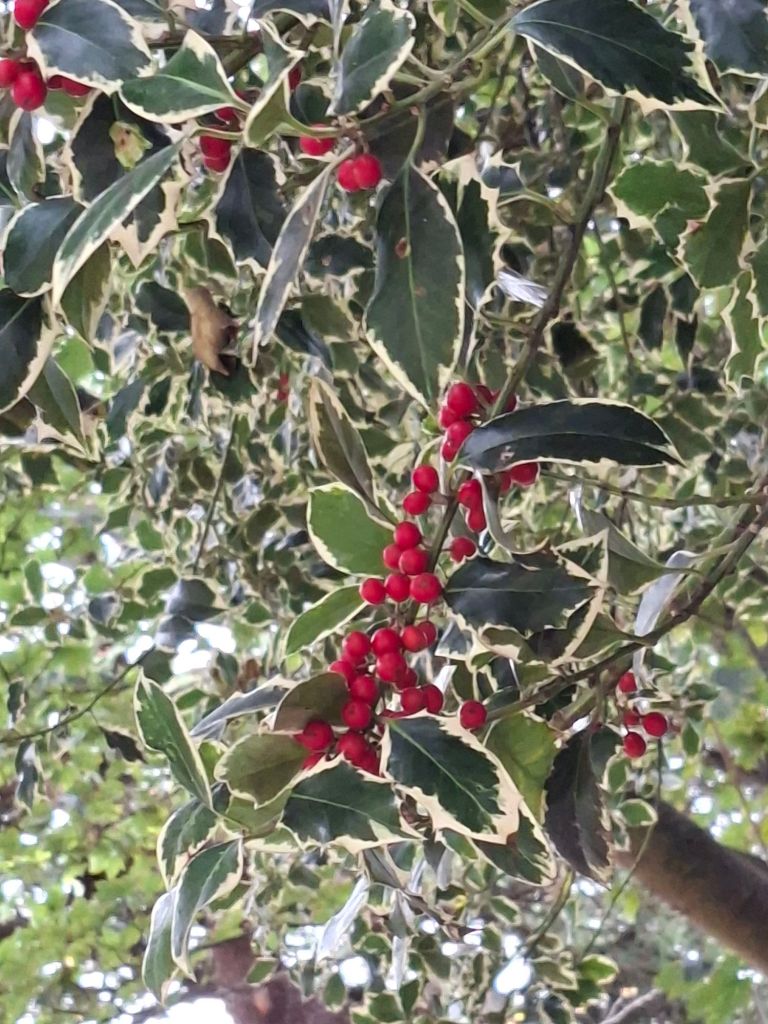
In the same space, I find both holly and ivy, with berries on the holly tree.  I immediately thought of the Christmas carol The Holly and the Ivy. It is an ancient folk carol, which interweaves Christian themes and others that belong with the land. The version which is now popular was collected by Cecil Sharp in 1909 in Gloucestershire from Mary  Clayton.

Many people think that the indigenous Pagan themes are the oldest, and that the central focus here is on the holly. The authors of The Green Man Tree Oracle say: “Holly’s connection with the Green Man is especially strong. In his guise as the Holly King – an ancient giant and symbol of fertility – the Green Man makes a notable appearance in the 14th century poem Gawain and d the Green Knight. Here he takes the form of a fearsome knight, who comes to King Arthur’s court to offer a midwinter challenge, carrying a club of holly and wearing a holly crown (as symbols of his true identity).” This challenge happens every year, where the Green Man/Holly King demands that we encounter him through our dealings with the natural world.

Elaine and I went to the Gloucester Cathedral Close and its surroundings on Saturday afternoon 18 October to outrun an  extended period of gloom, wind and rain. We are now in it, so the lessons of the trees in deep autumn, anticipating the coming of winter, are not lost on us. The dark of the year is on its way.

(1) J.R R. Tolkien (translation of anonymous texts) Sir Gawain and the Green Knight, Pearl, Sir Orfeo New York: Ballantine Books, 1980.

(2) https://contemplativeinquiry.blog/2025/08/22/ (3rd photo)

(3) John Matthews & Will Worthington The Green Man Tree Oracle: Ancient Wisdom from the Greenwood London: Connections, 2003

ROWAN’S LATE SUMMER SIGN

Where I live, late summer is often the warmest time of year, and the driest. This is likely to be the case in 2025, already a warm dry year. But in the sun’s apparent annual journey, it is also a time of waning. Sunrise is an hour later than at the solstice, and sunset is forty-five minutes earlier. This change will accelerate from now on.

I do not see waning as negative. There is power and beauty in this ‘waning’. In the rowan (aka mountain ash) picture above, the berries are moving from tentative orange to bright scarlet, an effect of the seasonal changes in the light. Rowan is an ogham tree, linking a group of indigenous Irish and British trees to an ancient Irish alphabet. Its Gaelic name luis means bright or flame.

Looking at the year as a whole, some of the berries will still be holding on beyond midwinter, by which time the tree, which can live for up to 200 years, will be making its annual comeback. At that time, as described in William Anderson’s justly venerated in Green Man poem (1):

The hungry birds harry the last berries of rowan

But white is her bark in the darkness of rain

‘I rise with the sap’, says the Green Man

‘I rise with the sap’ says he. (1)

The resilience of the tree runs throughout its year and lifetime. In  late summer specifially, this resilience is manifested in berries at their brightest, against the backdrop of a still blue evening sky.

Traditionally Rowan has strong associations with protection, spiritual  protection not least. According to The Green Man Tree Oracle (2), ‘it can also offer insight into danger through the invocation of higher wisdom’. Ancient Druid shamans were said to breathe in the smoke from rowan fires to initiate a trance state that allowed them to predict coming danger.

The Druids also planted rowan, as well as oak and ash, in their sacred groves. But Celtic Druids were not the only people to place a high value on the rowan tree. Our modern word rowan is probably descended from the Norse runas – narrowly translated as ‘charm’ but in fact bringing the wider runic and Norse traditions with it.

When I encountered the rowan I was strongly moved by it. It stood out from everything else.   I had previously decided not to take pictures on my walk, but felt compelled to change my mind. I didn’t need ancient lore to feel more alert and heartened. It’s just that the framing it provides added cultural depth.  The encounter with rowan put a spring in my step and was a highlight of my evening.

(1) William Anderson Green Man: archetype of our oneness with the Earth Harper Collins: London & San Francisco, 1990

(2) John Matthews & Will Worthington The Green Man Tree Oracle: ancient wisdom from the greenwood  London: Connections, 2003

MUIN: “GATHER IN WHAT IS DEAREST TO YOU.”

Muin (Ogham name for Blackberry) is one of four plants that have a place in both The Green Man Tree Oracle (1) and The Druid Plant Oracle (2). In the latter, from which the illustration is taken, it is called Bramble.

Muin is an important plant ally for me. At times I have identified closely with ‘Mr. Bramble’ (3). He is stubbornly resilient, with deep and extensive underground root systems. Above ground, he can create an almost impenetrable barrier of briars. He digs in. He is a survivor. He tests qualities and intentions. He protects the deep earth and undervalued dimensions of being. Yet he also grows abundant tasty fruit, that can be made into wine or gin.

Where I live, Muin’s time traditionally runs from Lammas/Lugnasadh to Michaelmas/Mabon – essentially the calendar months August and September. This year, as this time approaches, I am thinking of Muin as a teacher. The Green Man Tree Oracle offers words of ‘green man wisdom’ for all its trees. Muin’s words are: “gather in what is dearest to you“. I find “gather in” friendly and relational, very good to hear in a world where ‘harvesting’ is often cold, impersonal and mechanistic. Muin’s more warmly relational note is reinforced by the words “dearest to you”. We are invited to consider “riches of the soul and the things that give us inspiration” as our recommended harvest.

There are obvious questions here: what is ‘mine’ to ‘gather in’? what to I choose? what do I let go? But this is not, fundamentally, a questioning and list-making task. It is more about being open to Muin’s magic. This, I believe, is rooted in an unusual combination of qualities: tenacity, challenge, depth, an invitation to pleasure and, indeed, a certain kind of intoxication. Over the coming weeks, I will draw on Muin’s inspiration as I gather this harvest of the soul*.

(1) Philip and Stephanie Carr-Gomm The Druid Plant Oracle: Working with the Flora of Druid Tradition London: Connections, 2007 (Illustrated by Will Worthington)

(2) John Matthews & Will Worthington The Green Man Tree Oracle: Ancient Wisdom from the Greenwood London: Connections, 2003

(3) See: https://contemplativeinquiry.blog/2020/08/30/mr-bramble/

  • I think of soul as a process not an entity, though we don’t have the word ‘souling’.

BENDIGEIDFRAN (BRAN THE BLESSED)

Bendigeidfran, Bran the Blessed, is a legendary King of the Britons. He is best known to us through the medieval Welsh text The Second Branch of the Mabinogi (1). The primary theme is hope betrayed, most chillingly by Efnysien, Bran’s “brother on his mother’s side”. A marriage feast ends in a series of disasters. But this is not the whole story.

The marriage is between Bran’s sister Branwen and Matholwch the King of Ireland, intended to bring the two kingdoms together in peace and amity. But Efnysien mutilates the Irish party’s horses at the celebration hosted by Bran. It is among the worst things he could do.

In one savage, impulsive act, Efnysien opens the space for an outpouring of resentment, suspicion and hostility – eventually, from both the Irish and the British people. Bran’s efforts to resolve the situation through explanation, consultation and negotiation end in failure. The level of compensation and apology he offers is too much for the British and too little for the Irish. The time comes when Branwen is seriously abused in Ireland. The absolute breakdown of trust between the two countries leads to a bitter, brutal war.

After the war, Bran returns from Ireland with seven surviving companions, his only victory being that he has got them home. Ireland is completely devastated. Bran has been wounded in the foot by a poisoned spear, probably a mortal wound. Bran makes a radical decision, leading to a period of healing and renewal for his companions and a new protective role for his country. “Bendigeidfran ordered his head to be cut off. ‘And take my head’, he said, ‘and carry it to the Gwynfryn in London (the White Mount, now the Tower of London) and bury it with its face towards France. And it will take you a long time; you will feast in Harlech for seven years, with the birds of Rhiannon singing to you. And you will find the head to be as good company as it ever was when it was on me. And you will stay for eighty years in Gwales in Penfro. And so long as you do not open the door to Aber Henfelin, facing Cornwall, you can remain there, and the head will not decay. But as soon as you open that door you can stay no longer. Make for London and bury the head. And now set off across the sea”.

Bran has never been an average human. Too big “to fit inside any house”, he wades across the sea to Ireland “carrying all the stringed instruments on his back”. Later, he bridges the River Liffey by lying down across the river: “hurdles were placed on him, and his men walked on top of him to the other side”. Bran is more than a physical giant. There is something numinous and otherworldly about him, built into his name Bendigeidfran, Bran the Blessed.

The term ‘blessed’ points to something other than it would in the life of a Celtic saint. Caitlin & John Matthews call Bran the Blessed a “titanic god of the Celts … a god of earth and mountain” (2). R. J. Stewart and Robin Williamson describe him as a “primal guardian deity” (3) enacting a role of sacred king traditionally concerned with music, poetry and bridging. In the narrative world of the The Second Branch, such roles are alluded to rather than fully described, but the world is full of magic and spiritually ambiguous, with formal religion little mentioned.

The decapitation of Bran is a magical act. It has two successive effects, both of them benign. The first is when the presence of the head enables an extended period of protected respite for Bran’s companions: the seven years when they feast and hear the birds of Rhiannon (4), and then eighty years as “the Assembly of the Noble Head”. During this time, they forget “all the sorrow they had themselves seen and suffered, [and] … any grief in the world”. Life is pleasurable and delightful and no one seems to age.

It has to end, for the story to continue. The western door is opened, by Heilyn son of Gwyn, driven by curiosity. Grief, loss and ageing return to the companions’ world. They hasten to London to complete their destined task. As long as the head remains buried, no enemy can conquer the kingdom. This is where The Second Branch story ends. Bran, through the agency of his buried head, is confirmed as enduring protector of the land.

There is a coda. It is said that King Arthur dug the head up in later days in the belief that no one but he should protect the country, and that subsequently the head was lost. In later days, the power of the head was transferred to the presence of resident ravens. Bran’s name means raven (also crow), which allows the ravens to take on his power. He is them. They are him. Ravens are kept in the Tower of London to this day, a practice insisted on by Charles II, concerned for the preservation of his country as a kingdom. During World War II the ravens fled after a bombing raid, and every effort was made to ensure that they were swiftly replaced. Seven ravens, the responsibility of Ravenmaster Chris Skaife, live in the Tower now. (5).

(1) The Mabinogion Oxford: the University Press, 2007. (Translated with an introduction by Sioned Davies)

(2) Caitlin & John Matthews The Western Way: A Practical Guide to the Western Mystery Tradition London: Arkana, 1985 (Foreword by Gareth Knight)

(3) R. J. Stewart & Robin Williamson Celtic Bards, Celtic Druids London: Blandford/Cassell plc, 1996 (Colour illustrations by Chris Down)

(4) https://contemplativeinquiry.blog/2017/8/4/a-bird-of-rhiannon

(5) https://www.hrp.org.uk/tower-of-london/whats-on/the-ravens

IOLO MORGANWG: 3 RAYS OF AWEN

According to Kristoffer Hughes, the three ray symbol for Awen, as it appears today: “is mostly inspired by the efforts of one individual, a Welsh bard of the late eighteenth and early nineteenth centuries called Edward Williams, who took the bardic name of Iolo Morganwg*”.

Hughes goes on to tell us something of Iolo’s story: “I touch briefly on the Awen-filled story of this remarkable individual, for it sings loudly of the power of Awen to transform, not just an individual, but the future. His symbol for the Awen has become directly associated in Neopaganism with Cerridwen, making an exploration of his influence a valuable exercise in our understanding of Awen in the modern world.

“Iolo Morganwg was a stonemason from South Wales, an imaginative, poetic genius who made elaborate claims of ancient documents and wisdom that he had discovered and preserved for the world to see. Blighted by ill health, he was addicted to the narcotic laudanum for over fifty years of his life, spending most of his days in a drug-induced state, and yet poems in their thousands fell from his frenzied mind onto scraps of parchment. He composed elaborate poetry, inspired prose, but falsely claimed that some of the poems were written by ancient bards. … And yet through all of the accusations of forgery and deception, Iolo dreamed something into being that those in the different streams of Celtic spirituality today, both monotheistic and polytheistic, are descendants of. He dreamed a new mythology into being and planted seeds that would gestate a profound wisdom in the future.

“In a time of great social crisis, he dreamed an identity for the Welsh that took as its foundation that the bardic tradition of Wales was a direct line to the ancient Druids of Britain, who he perceived as the true ancestors of the Welsh. He longed for his people to connect to the might and power that the Romantic movement imagined the Druids to express. And, in doing so, he deliciously imagined a new identity that the Welsh could be proud of: he blended fact with fiction, legend with history, myth with reality. His bewildering array of notes and journals continue to baffle modern academics who strive to make sense of this enigmatic figure.”

Reflecting on Iolo’s story, Hughes concludes that, “in a profoundly logocentric world where new thoughts and ideas were expected to be substantiated by manuscripts, Iolo simply invented a past that we, as the Welsh, could be proud of . … He carried the seeds of Awen and profoundly influenced a future he could not have imagined. In the twenty-first century, those drawn to the Cerridwen and Taliesenic mysteries (2) who may artistically express, understand, or wear the symbol of the Awen all carry the dream of Iolo Morganwg. He is testament to the Awen’s consistent stream and how it too changed its countenance to meet the needs of different people at different times. The period he occupied was a cauldron of new ideas, with the new era of bardic tradition in its infancy and occult fascination among the learned of the time increasing in popularity”.

(1) Kristoffer Hughes Cerridwen: Celtic Goddess of Inspiration Woodbury, MN: Llewellyn Publications, 2021. See also my review at: https://contemplativeinquiry.blog/2021/03/26/book-review-cerridwen-celtic-goddess-of-inspiration/

(2) See also: John Matthews Taliesin: Shamanism and the Bardic Mysteries in Britain and Ireland London: Aquarian Press, 1991. It includes a complete English translation of the Hanes Taliesin (Story of Taliesin) and English translations of the major poems of Taliesin Pen Beirdd from The Book of Taliesin as well as other medieval Welsh and Irish material. In the Taliesin story, the three rays of Awen become three drops from the brew in Cerridwen’s cauldron).

*NOTE: Iolo Morganwg (=Ned of Glamorgan, his native county). In his own words, the Awen sign /|\ is “a symbol of God’s name from the beginning”. He goes on to say: “from the quality of this symbol proceed every form and sign of voice, and sound, and name, and condition”. It is when God pronounced his Name that “all the universe leapt together into existence of life, with the triumph of a song of joy. The same song was the first poem that was ever heard, and the sound of the song travelled as far as God and His existence are, and the way in which every other existence, springing in unity with Him, has travelled for ever and ever. And it sprang from inopportune nothing; that is to say, so sweetly and melodiously did God declare his name, that life vibrated through all existence, and through every existing materiality”. J. William Ab Ithel (editor) The Bardas of Iolo Morganwg: A Collection of Original Documents, Illustrative of the Theology, Wisdom, and Usages of the Bardo-Druidic System of the Isle of Britain Forgotten Books, 2007 http://www.forgottenbooks.org (First published 1862, from notes and journals left by Iolo on his death at 79 years of age in 1826).

TREE MANDALA: GORSE

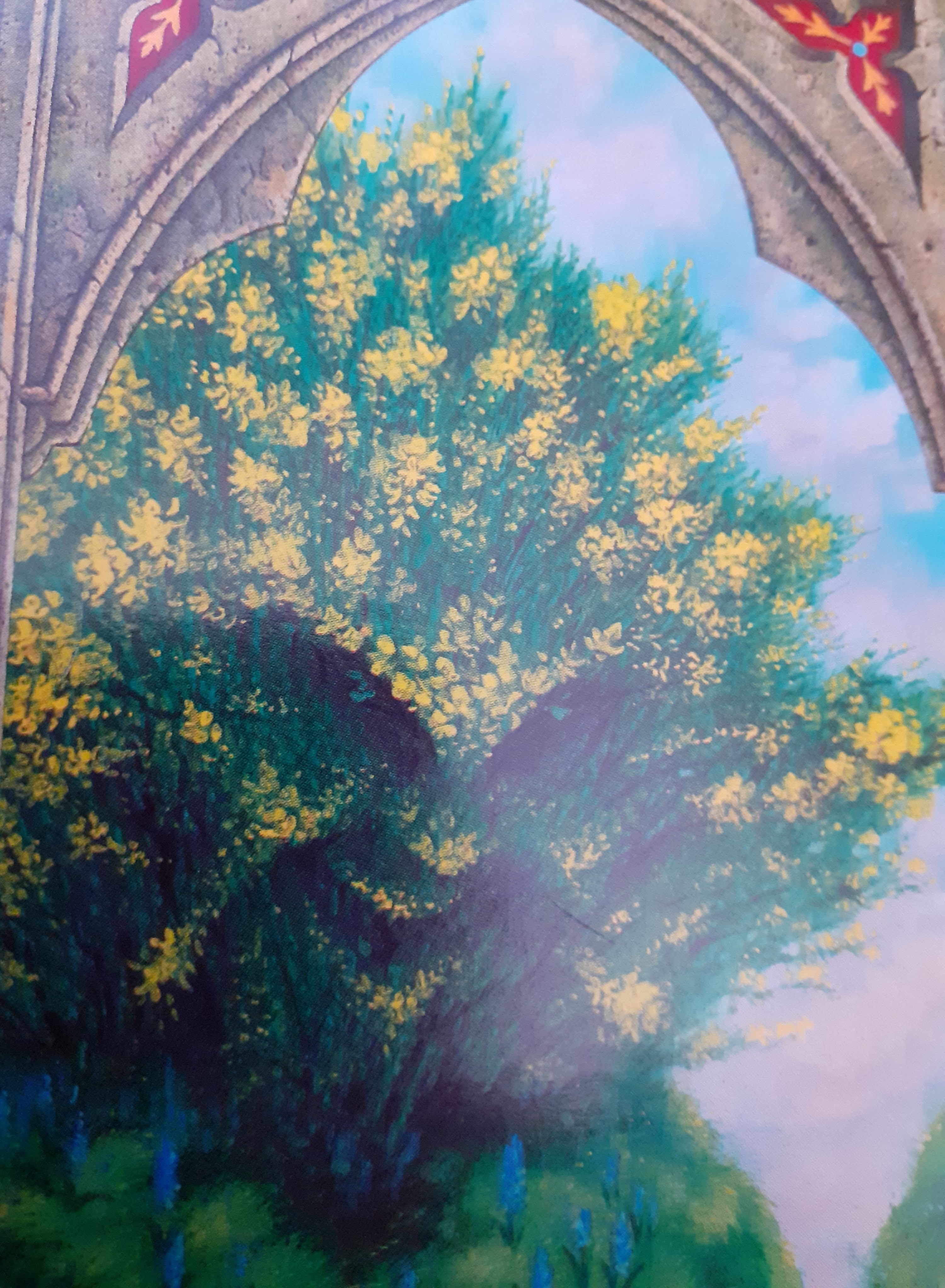
In my wheel of the year tree mandala (1), gorse covers the period from 9-31 July. It is the last tree of the summer quarter, handing over to apple at Lughnasadh/Lammas on 1 August. The illustration is from The Green Man Tree Oracle (2).

I know from my childhood that gorse can make a tame, gently sloping hill seem wild and edgy. Navigating through gorse requires an eye to self-care. Flowering gorse is not confined to summer, but for me it is anchored to summer in memory. Seen from afar, gorse was a vivid harbinger of the summer holidays with days of warmth (rising to heat) and freedom to roam. It carried a hint of adventure and disinhibition. Sometimes the promise was fulfilled. Sometimes there was a hot heavy dullness broken by only storms, and a degree of frustration. July days were unpredictable.

Gorse (ogham name Onn) was sacred to the Irish god Lugh, and thus to light, to all manner of skills, and to the fire in the head of ecstatic creativity. Lugh has a trickster aspect, and can be seen in certain lights as more a god of lightning than of the sun. He has a cousinship with the Brythonic Lleu Llaw Gyffes, the warrior magician of the fourth branch of the Mabinogi. He has also been linked to the Norse Loki, for tricksterism is an aspect of the smouldering fertile mind.

Gorse makes good fuel and so has an obvious role in fire festivals. In Brittany, 1 August was marked by the Festival of the Golden Gorse and gorse has has strong associations with the faery folk. It is a plant of power. We cannot make assumptions about how we stand with it. A wary respect might be wise.

NOTE: This post brings to an end a year in which I have featured the sixteen trees in this mandala. I began on 16 July 2020 with an out-of-sequence Rowan (3), because I had had a vivid encounter with a rowan tree in the woods. (Its time in the mandala is 9-31 October.). Then I moved on to apple (4) and blackberry (5). From the Autumn Equinox (1) the enterprise became more systematic. As a blogger, I won’t be repeating the cycle in the same way in the coming year. Once for the record feels enough.

(1) This mandala is based on my personal experience of trees in the neighbourhood as well as traditional lore. Moving around the summer quarter from Beltane, 1 May, the positions and dates of the four trees are: Hawthorn, south-east, 1-23 May; Beech & Bluebell, south-south-east, 24 May – 15 June; Oak, south, 16 June – 8 July; Gorse, south-south-west, 9 – 31 July. The autumn quarter then starts with Apple at Lughnasadh/Lammas. For a complete list of the sixteen trees, see https://contemplativeinquiry.blog/2020/autumn-equinox-2020-hazel-salmon-awen/

(2) John Matthews & Will Worthington The Green Man Tree Oracle London: Connections, 2003

(3) https://contemplativeinquiry.blog/2020/rowan/

(4) https://contemplativeinquiry.blog/2020/three-trees/

(5) https://contemplativeinquiry.blog/2020/mr-bramble/

TREE MANDALA: OAK

“Green man becomes grown man as flames of the oak

As its crown forms his mask and its leafage his features;

‘I speak through the oak’, says the Green Man.

‘I speak through the oak says he'” (1)

In my wheel of the year tree mandala (2), oak covers the period from 16 June-8 July and thus includes Alban Hefin, the summer solstice. I am starting to bring it in. The oak has many associations – regal strength, for example – but for me the sense of the green man, the archetype of our oneness with the earth, speaking through the oak, is the most numinous. At Dodona in ancient Greece (3) an oak shrine was “guarded by priestesses who interpreted the future from the rustling of leaves on the great tree, the voice of the sacred spring that rose at its root and the behaviour of birds in its branches”. Celtic tradition describes a number of sacred oak trees, themselves roosting places for sacred birds. I like the sense that the oak does not stand alone and autonomous in these stories. For leaves to rustle, the wind is needed. Birds and springs may also participate in the ecology, of a distributed wisdom – a wisdom of interdependence, of interbeing. The oak’s great branches are matched by still greater roots, and therefore an underground network of communication and exchange that we now know sustains a mature forest (4).

The ogham name for oak, duir, means door in both Sanskrit and Gaelic (5). This can bespeak solidity and protection, for the oak can survive lightning. It was sacred to Taranis, the Celtic god of lightning and storms, to Thor in the Nordic pantheon. and to Zeus among the Greeks. But a door isn’t just defensive. It is there to be opened as well, with a sense of welcome and relationship. Dagda, father god of Ireland, was associated with the oak and never failed to give hospitality to those who asked for it.

For Druids (whose name means ‘oak wisdom’) oak was the central tree in their mysteries. There is a theme, in these mysteries, of communication between worlds, with a sensed Otherworld being less than a heart beat away. The power of the oak combines strength and sensitivity. My mandala links oak to the period in which the light has its greatest expression, and then gives way, at first very slowly, to its necessary descent into the dark. The tree bears witness as the wheel continues to turn.

(1) William Anderson Green Man: Archetype of Our Oneness with the Earth Harper Collins: London & San Francisco, 1990.

(2) This mandala is based on my personal experience of trees in the neighbourhood as well as traditional lore. Moving around the summer quarter from Beltane, 1 May, the positions and dates of the four trees are: Hawthorn, south-east, 1-23 May; Beech & Bluebell, south-south-east, 24 May – 15 June; Oak, south, 16 June – 8 July; Gorse, south-south-west, 9 – 31 July. The autumn quarter then starts with Apple at Lughnasadh/Lammas. For a complete list of the sixteen trees, see https://contemplativeinquiry.blog/2020/autumn-equinox-2020-hazel-salmon-awen/

(3) John Matthews & Will Worthington The Green Man Tree Oracle London: Connections, 2003.

(4) https://contemplativeinquiry.blog/2021/05/23/suzanne-simard-finding-the-mother-tree/

(5) Liz & Colin Murray The Celtic Tree Oracle: a System of Divination London: Eddison/Sadd Editions, 1988 (Illustrated by Vanessa Card)

TREE MANDALA: BEECH AND BLUEBELL

In my wheel of the year tree mandala (1), beech and bluebell together cover the period from 24 May-15 June – taking over from hawthorn and handing on to oak. In this instance, I am drawn by the powerful visual effects of bluebells carpeting woodland in which beech is the dominant tree.

The picture above is an old one. The last year in which Elaine and I went into this space (2018 or 2019) the wood felt weird. Part of it – not quite the area in the picture – was a scene of desolation. A lot of the trees had been taken down, with a kind of ragged insensitivity. It felt like a bad moment in Lord of the Rings. I don’t know the story behind this. Perhaps there was disease, or some other genuine need for a thinning out of trees. It was certainly systematic, with notices about the work being done – the result of management, and not of vandalism, in the conventional usage of our language.

The beech is an elegant tree, and I experience it as having a soft energy. It has been traditionally feminised, and thought of as ‘Queen of the Woods’, sharing the place of honour with the kingly oak according to The Green Man Tree Oracle (2). The same source says that “slivers of beech wood and leaves were once carried as talismans to bring good luck and increase creative energy”. Local British traditions associate the beech (ogham name phagos) with serpents “probably because of its long serpentine root systems”, they add – and I wonder too about the archaic link between the Goddess and serpent power in many cultures.

.

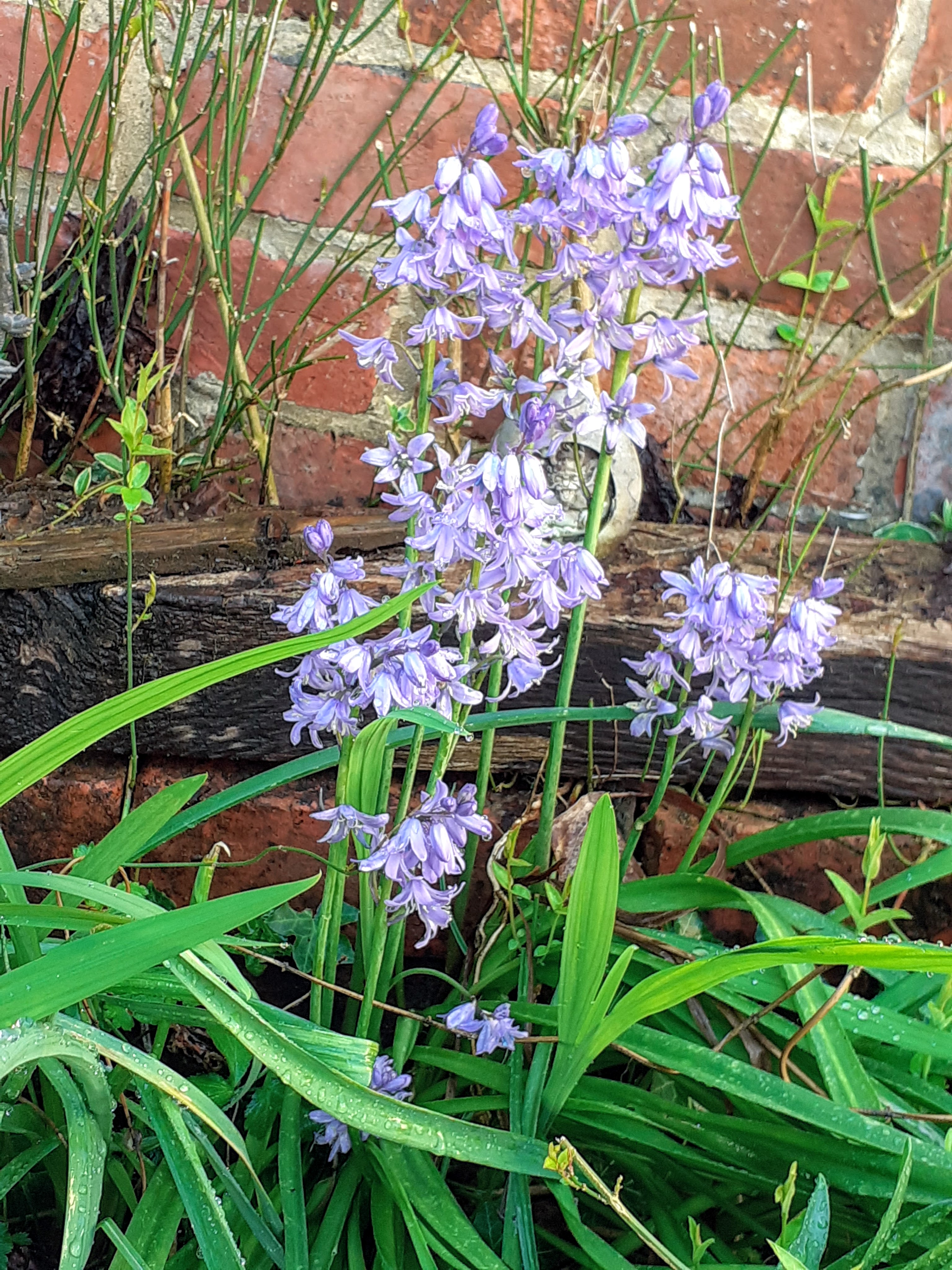
My personal connection with the tree itself is limited. It concerns this time of year and the association with bluebells. Indeed the bluebell is my main focus, with the beech as complementary. If they are separated, I follow the bluebell, and the picture below is a recent one, of the Spanish variety, from our garden. For me, it represents a favourite moment in the year, to be appreciated while it lasts. It reminds me simultaneously of the poignancy of impermanence (including my own) and the beauty of the eternal present (within which I am held).

(1) This mandala is based on my personal experience of trees in the neighbourhood as well as traditional lore. Moving around the summer quarter from Beltane, 1 May, the positions and dates of the four trees are: Hawthorn, south-east, 1-23 May; Beech & Bluebell, south-south-east, 24 May – 15 June; Oak, south, 16 June – 8 July; Gorse, south-south-west, 9 – 31 July. The autumn quarter then starts with Apple at Lughnasadh/Lammas. For a complete list of the sixteen trees, see https://contemplativeinquiry.blog/2020/autumn-equinox-2020-hazel-salmon-awen/

(2) John Matthews & Will Worthington The Green Man Oracle London: Connections, 2003.

TREE MANDALA: BLACKTHORN

In my wheel of the year tree mandala (1), blackthorn (ogham, straif) covers 8-30 April, the final twenty-three days before Beltane. It has a beautiful white flower and elegant sharp thorns. I have seen descriptions of the latter as ‘vicious’, but they only hurt us if we invade the blackthorn’s space. The plant is not a triffid. It doesn’t come after us. So I don’t follow the line of tradition that links blackthorn to harsh fate. Blackthorn doesn’t ask to be turned into guardian hedges or crowns of thorn. That is down to our fellow humans.

The picture above comes from my magic year of 2007, happily well documented, when I was much engaged with trees and Druid study. I felt a pull towards blackthorn, more than towards the generality of hawthorn during that period. (I will write about the Glastonbury Thorn, the exception, at Beltane, my last tree mandala with a ‘memory lane’ theme).

I am drawn particularly to the strand of tradition that links blackthorn to powerfully creative magic – for it was long used in the making of wizards’ staffs. The text of The Green Man Oracle (2) suggests that “we have forgotten the magic that lies within us”. Blackthorn in particular has the ability to “foster waking dreams”. The Oracle adds that, “to access this personal magic, we must step away from busy, surface consciousness, and sink deeply into the ever flowing stream of our magical dreams. The ideas, scenes and presences that throng the deepest levels of our understanding require intense listening” Such magic, the Oracle continues, brings a light into the darkest places. For me that would mean just enough light to illuminate them, and not so much as to dazzle them into negation. How otherwise can the denizens of the dark be offered a welcome home if they want it, and in any event a better understanding?

(1) This mandala is based on my personal experience of trees in the neighbourhood as well as traditional lore. Moving around the spring quarter from 1 February, the positions and dates of the four trees are: Birch, north-east, 1-22 February; Ash & Ivy, east-north-east, 23 February – 16 March; Willow, east, 17 March – 7 April; Blackthorn, east-south-east, 8 – 30 April. The summer quarter then starts with Hawthorn at Beltane. For a complete list of the sixteen trees, see https://contemplativeinquiry.blog/2020/autumn-equinox-2020-hazel-salmon-awen/

(2) John Matthews & Will Worthington The Green Man Oracle London: Connections, 2003.

Earth Eclectic

music that celebrates Earth and speaks to the heart

Sarah Fuhro Star-Flower Alchemy

Follow the Moon's Cycle

Muddy Feet

Meeting nature on nature's terms

Rosher.Net

A little bit of Mark Rosher in South Gloucestershire, England

Becoming Part of the Land

A monastic polytheist's and animist’s journal

selkiewife

Selkie Writing…

Charlotte Rodgers

Images and words set against a backdrop of outsider art.

Prof Jem Bendell

living with metacrisis and collapse

Towint

The pagan path. The Old Ways In New Times

The Druids Garden

Spiritual journeys in tending the living earth, permaculture, and nature-inspired arts

The Blog of Baphomet

a magickal dialogue between nature and culture

This Simple Life

The gentle art of living with less

Musings of a Scottish Hearth Druid and Heathen

Thoughts about living, loving and worshiping as an autistic Hearth Druid and Heathen. One woman's journey.

Wheel of the Year Blog

An place to read and share stories about the celtic seasonal festivals

Walking the Druid Path

Just another WordPress.com site

anima monday

Exploring our connection to the wider world

Grounded Space Focusing

Become more grounded and spacious with yourself and others, through your own body’s wisdom

The Earthbound Report

Good lives on our one planet

Hopeless Vendetta

News for the residents of Hopeless, Maine