Contemplative Inquiry

This blog is about contemplative inquiry

Tag: John Cowper Powys

“DULL, DREAMY, MOON-STRUCK”

Contemplative states come in different varieties. In today’s culture, we tend to privilege an alert language of mindfulness, presence and awakening. Through these tools, we learn take more responsibility for our own experience – not so much for what happens (though our effective agency may improve), as in how we respond. At a deeper level, we learn to embrace the gift of experiencing, even when specific experiences are unwanted or painful. We lean in to the at times heart-breaking miracle of human life.

There are other, also potent, ways to contemplate. In the following extract from his magical realist novel Atlantis (1) John Cowper Powys presents an archaic, more than human world, with a very different take on consciousness and our place in the cosmos. We are on the island of Ithaca, in the later life of its King Odysseus, following his belated return from the siege of Troy and resumption of control at home. We begin in a moment of great collective foreboding – something terrible is happening or about to happen. This is coincident with the old king planning a final voyage. In this place and time, a young boy encounters Atropos, oldest and most powerful of the three Fates. He intuitively grasps that sentient beings help to weave their own destiny simply by falling into states “wherein we simply escape for a moment from the trouble of being a conscious creature at all”.

“The longer Nisos Naubolides looked into the eyes of Fate and the longer Fate looked into the eyes of Nisos Naubilides the more clearly did the later realize that the imperishable frame of Atropos, the ‘one who could not be turned’, was made of a substance drawn from a level of existence outside both time and space, though cunningly adapted to play its part in each of them.

“The boy proved how ‘clever’ he was by imbibing, like an inexhaustible draught of timeless experience, much more at that moment than the mere physical nature of the oldest of the Fates; for there came over him in a trance that was more than a trance the surprising knowledge – and this … was really with him to the day of his death – that Atropos helps us in the creation of our individual fate by an infinitely long series of what some would call nothing but blind, stupid, dull dreamy, moon-struck ‘brown studies’, many of which take place inside the walls of houses, and others when we are moving about on our ordinary errands outside.

“In these interruptions of our ordinary consciousness we fall into a brainless, idea-less moment of dull abstraction in which we cease to think of anything in particular but just stare blindly and dully at some particular physical object, no matter what, that happens to be there at the moment. This object, in itself of no particular interest, and never selected for its real purpose is merely an object to stare at, lean upon, rest against and use as a trance=background, or brown-study foreground, or, if you like, a shoal beneath a stranded consciousness, or a reef of brainless abstraction, wherein we simply escape for a moment from the trouble of being a conscious creature at all.

“Nisos showed how born he was to be an interpreter if not a prophet by his complete acceptance – as from the trunk of his spruce-fir he faced the Mistress of Fate as she leaned against the trunk of her spruce-fir – of the revelation that our individual destiny is made up of an accumulation of brainless, uninspired brown-study moments of abstraction wherein we cease to be organic living creatures and almost become … things of wood and stone and clay and dust and earth, almost become what we were before we were intelligent of instinctive creatures: almost – but not quite!

“For, as our young friend looked Atropos in the face, there was permitted to him what is permitted to few among us mortals during our lifetime, namely the realization of what actually happens to us when we fall, as we all do, into these day-dreams. At that moment as Nisos Naubolides now knew well, all over the surface of the earth there were living creatures, many of them men, women and children, many of them horses, cattle, lions, wolves, foxes, wild asses and tame pigs, sheep and goats, rats and mice, who were standing or crouching, lying or sitting in one of these brooding trances when dazed or dreaming, we are asleep and yet not asleep.”

(1) John Cowper Powys Atlantis London: Faber & Faber, 2011 ebook edition.

NOTE: John Cowper Powys (1872-1963) grew up mainly in the English West Country, went to Cambridge University and then became a teacher and lecturer, mostly in the USA where he lived for about 30 years. On returning to the UK, after a short spell in Dorset, he settled in Wales in 1935 where he lived for the rest of his life. His best known works are Wolf Solent, A Glastonbury Romance, Maiden Castle, Weymouth Sands, Owen Glendower, Porius and his Autobiography. His literary editors describe him as having a “weird, mystical, brilliant and obsessive imagination.”

See also:

JOHN COWPER POWYS: PORIUS AND TALIESIN

THE BLESSINGS OF TIME

THE BLESSINGS OF TIME

The wheel of the year, particularly now, prompts me to attend to time and the blessings of being time-bound. In John Cowper Powys’ Porius (1), Myrddin Wyllt (Merlin) is an incarnation of Saturn, Cronos, Old Father Time. By the end of the book Porius its main protagonist understands himself as a devotee: “there are many gods; and I have served a great one”. Earlier he reflects on “a delicious human satisfaction, in defiance of so many austere and implacable metaphysicians, in thinking of Time, the alter-ego of crooked-counselling Cronos, as the creator of all the value and beauty there was in Space, if not of Space itself.”

This is directly contrasted with the view of the priest Minnawc Gorsant in the same story. “Upon what great word … does our Christian faith depend? … Eternity! … What eternity destroys – swallows up, rather! – is this contemptible, this miserable, this wretchedly human thing, Time!” Gorsannt goes on to assert that “the human race wasn’t created to be happy, or To be good, or to improve its lot. The human race was created, purely, solely, exclusively, arbitrarily, for the glory of God, and for that alone.”

If there is any meaning in the word eternity, it has proved to be the enabler of time, at least in this universe. Through time I am given life, relationship and agency, however transient they may be. They are the greatest gifts imaginable. If, at times, I also experience them as compromised, then I can look at negative experiences and their roots – physical, psychological, relational, social or ecological. I experience the ‘spiritual’ dimension as living in all of these, not as a separate realm. So distresses and dysfunctions need to be compassionately acknowledged, addressed, perhaps accommodated, perhaps challenged and transformed, at their own level. If I find myself seeing the world (rather than my limited and illusory sense of it) as a prison to bust out of, then something has gone very wrong, because for me there is nowhere else to go.

When I pay attention to the wheel of the year, I experience a day-by-day process where the festivals act as markers. They are not a prime focus, and I have even known them to become another way of being distracted from distraction by distraction. Following the wheel helps me to acknowledge both time and place. Whilst no two years are alike, this way of living in time emphasises the cyclic rather than linear, always with an ebb and flow, a dying away and (where I live, thus far) a promise of renewal.

The effect on me is to slow it down, localise it, and better allow me to discern patterns, rhythms and tides. I find it very suited to an earth-oriented eco-spirituality, and at chosen times it can become a meeting place between stillness and movement. Perception becomes richer and the desire to share this richness becomes stronger. It is a sacrament that collapses the distinction between sacred and secular. It is entirely dependent on time, If Time is a god, it is indeed a “great one”.

(1) John Cowper Powys Porius: a Romance of the Dark Ages Overlook Duckworth, 2007. Edited by Judith Bond and Morine Krissdottir, with a foreword by Morine Krissdottir. The first abbreviated edition was published in 1951.

JOHN COWPER POWYS: PORIUS AND TALIESIN

Porius (1) is John Cowper Powys’ last novel. It took him seven years to write, and he completed it in 1949, when he was 77. It is set in the year 499 CE, in North Wales. Porius is a Romano-British prince. Arthur, a suspect foreigner to most local people, reigns as Emperor. Rome is ruled by Goths, but links are maintained with Constantinople. The Saxons are an existential threat. People have to find a way of dealing with the situation in which they find themselves. But the book is at least as much about the inner lives of the characters as it is about the action they take.

Powys thought of Porius as his masterpiece. His publishers did not agree and insisted that he cut it by a third, which he did over two agonising years. Fortunately, a complete edition is available now thanks to modern editors Judith Bond and Morine Krissdottir. In her foreword Krissdottir says, “I am always reminded when I read the novel of these lines: ‘we are always in error, lost in the wood, standing in chaos, the original mess, creating a brand-new world’. Powys was as gloriously lost by the time he had written Porius as the reader sometimes is … but he was still the superb craftsman, who knew that it was the story itself that had the power to shape the forest within and without, that had the power to create a brand-new world”.

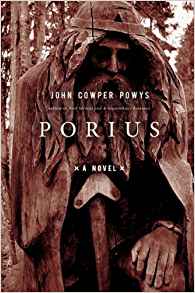
Instead of writing a review, I want to focus on one character, Taliesin, and what Powys has to say through him about the creative life. Powys has a number of point of view characters, with a variety of stances. He seems to give them equal air-time, making Porius a genuinely multi-vocal novel. Taliesin is portrayed as a young, mercurial bard, popular thanks to outstanding skill in cooking as well as poetry. (The cover illustration above is of Merlin – old, saturnine, more central to the book as a whole). Powys builds Taliesin’s bardic character, and the idiosyncratic working of his awen, with care.

“Taliesin had indeed worked out for himself, quite apart from his power of expressing it in such assonances and alliterations as had never been heard before, a really startling philosophy of his own. This philosophy depended on a particular and special use of sensation; and its secret had the power of rendering all matter sacred and pleasure giving to the individual soul. And it had the power … of fusing the immense past with the immeasurable future and of doing this, moreover, not by means of an ‘eternity’ beyond experience and imagination, but by means of a quivering vibrating, yet infinitely quiescent moment of real Time.”

Taliesin can rely on an easy fluency with language. More important is his capacity for open creative reverie, based on a deep sensitivity to the perceptions of the moment. He is described as sitting on a four-legged stool in the deepening of a late October evening. As he sits, he feels the full warmth of a fire and is able to see “the glittering path of moonlight on wind-ruffled water”. He can see a hawk’s nest, and the “ancestral sword of Cynan ap Clydno, thrust to the depth of half its blade, in the buried stump of a vanished oak tree”. The sword is reminiscent of a cross. Taliesin muses that “any sort of thing happening near a cross, not to speak of a sword, always seems in some way to be watched – if not heard and guarded against”. J.C. Powys comments, “considering the sword and the cross, the moonlit space between that figure on the four-legged stool and Clydno’s rusty weapon may well have vibrated with dangerous antipathy as the words ‘The Mothers’ and ‘Nothingness’ and ‘Annwfn’ floated away towards the lake. Rather than writing, Taliesin speaks into the darkness. Writing may come later. The piece that follows is lengthy, and eventually settles into a contemplation of “the thing none can utter, the thing inexpressible” yet “known from before the beginning”. Here is the final section:

“I know it from pond slime and

frog spawn and grub spit,

From bracken’s green coral,

white lichen, yellow mosses,

Newts sinking with their arms

out to reedy pools’ bottoms,

Swords rusting in their oak

stumps, wrapped in the long rains,

Eggs rotting in their lost nests,

enjoying the wild mists, I know it from all these, and to

men proclaim it:

The ending forever of the Guilt

sense and God sense,

The ending forever of the Sin

sense and Shame sense,

The ending forever of the Love

sense and Loss sense,

The beginning forever of the Peace paradisic,

The ‘I feel’ without question,

The ‘I am’ without purpose,

The ‘it is’ that leads nowehre,

the life with no climex,

The ‘Enough’ that leads forward

to no consummation

The answer to all things, that

yet answers nothing,

The centre of all things, yet all

on the surface,

The secret of Nature, yet Nature goes blabbing it

With all of her voices from

earth, air, fire, water!

Whence comes it? Whither

goes it? It is nameless; it is

shameless;

It is Time free at last from its Ghostly Accuser,

Time haunted no more by a

Phantom Eternal;

It is godless; but its gods are as

sea sand in number;

It’s the square with four sides

that encloses all circles;

Four horizons hath this Tetrad

that swallows all Triads;

It includes every creature that

Nature can summon.

It excludes from Annwfyn nor

man, beast nor woman!”

The mid twentieth century was a time of considerable interest in the Matter of Britain and Arthurian themes. But generally, then, we find a polished and rather conservative Christian perspective, applicable even to Taliesin. The Inkling Charles Williams wrote two collections of linked verse about him – Taliessin Through Logres and The Region of the Summer Stars (2). The latter collection includes these lines from the poem Taliessin in the Rose Garden:

“I was Druid-born and Byzantium trained.

Beyond Wye, by the Cauldorn of Ceridwen, I saw

the golden cycle flash in the forest, and heard

the pagans mutter a myth; thence by the ocean

dreaming the matter of Logres I came where the heirarchs

patter the sacred names on the golden floor

under the throne of Empire.”

John Cowper Powys, too, was a man of his time. But insofar as his Porius relies on legendary history, he borrows more from archaic Welsh tradition than the better known pan European literature that developed out of it. He himself is much more nature friendly and Pagan in sensibility. I see him as following a broadly emancipatory direction in modern spiritual culture, and we are his heirs.

(1) John Cowper Powys Porius: a Romance of the Dark Ages Overlook Duckworth, 2007. Edited by Judith Bond and Morine Krissdottir, with a foreword by Morine Krissdottir. The first abbreviated edition was published in 1951.

(2) Charles Williams Taliessin Through Logres & The Region of the Summer Stars Berkeley, CA: The Apocryphile Press, 2016. Edited with an introduction by Sorina Higgins. (Taliesin Through Logres first published in 1938; The Region of the Summer Stars in 1944)

Earth Eclectic

music that celebrates Earth and speaks to the heart

Sarah Fuhro Star-Flower Alchemy

Follow the Moon's Cycle

Muddy Feet

Meeting nature on nature's terms

Rosher.Net

A little bit of Mark Rosher in South Gloucestershire, England

Becoming Part of the Land

A monastic polytheist's and animist’s journal

selkiewife

Selkie Writing…

Charlotte Rodgers

Images and words set against a backdrop of outsider art.

Prof Jem Bendell

living with metacrisis and collapse

Towint

The pagan path. The Old Ways In New Times

The Druids Garden

Spiritual journeys in tending the living earth, permaculture, and nature-inspired arts

The Blog of Baphomet

a magickal dialogue between nature and culture

This Simple Life

The gentle art of living with less

Musings of a Scottish Hearth Druid and Heathen

Thoughts about living, loving and worshiping as an autistic Hearth Druid and Heathen. One woman's journey.

Wheel of the Year Blog

An place to read and share stories about the celtic seasonal festivals

Walking the Druid Path

Just another WordPress.com site

anima monday

Exploring our connection to the wider world

Grounded Space Focusing

Become more grounded and spacious with yourself and others, through your own body’s wisdom

The Earthbound Report

Good lives on our one planet

Hopeless Vendetta

News for the residents of Hopeless, Maine