“Contrary to the current genetic determinism that sees increased longevity as a wasted aberrance created by civilisation, The Force of Character presents an explosive new thesis: the changes of old age, even the debilitating ones, have purposes and values ordained by the psyche. The older we become, the more our true natures emerge. Thus the final years have a very important purpose: the fulfilment and confirmation of character.” (1)
I have known and walked with James Hillman’s book for a number of years, but only recently have I felt it coming into its own in my life. Hillman, originally a pupil of Carl Jung, went on to found his own school of Archetypal Psychology – a psychology which remembers that ‘psyche’ first meant ‘soul’. He describes his own journey as about challenging what he sees as limiting beliefs that “clamp the mind and heart” (1) into positivistic science, bottom-line capitalism and religious fundamentalism.
I am growing old and experiencing frailties together with a beloved partner in the same position. What is happening in the depths of my psyche? I notice that I do not perceive a single entity here, but multiple aspects, including a dialogue between youth and age. Both have always been present. But their roles have changed. I now find myself seeking them out, engaging with them and listening to them.
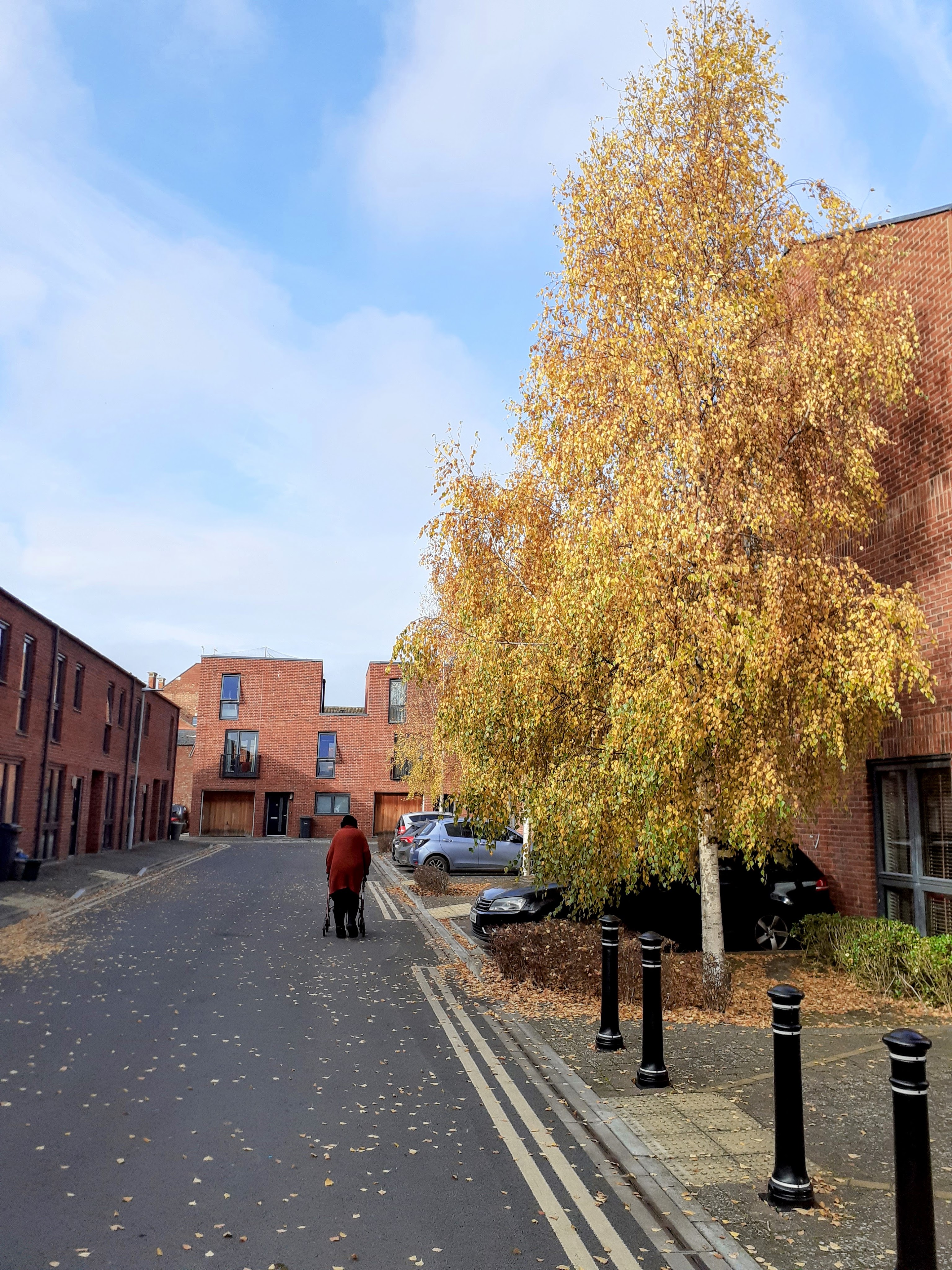
How do I recognise re-enchantment in my everyday life? Simply being open and alert to experiences as they come. On the morning of 10 November there was blue sky for a limited period. We walked around our Greyfriars Estate (once the site of a Franciscan Priory). There was a good-natured Remembrance Parade close-by: a custom beginning in 1919 after Word War I, when people hoped they had been through the war to end all wars. I am not very military minded but I’m glad we have this occasion all the same. I’ve made it to 75. A lot of the people we think about at this time didn’t make to 20 and they shouldn’t be forgotten. Honour was being paid to the dead, and an intentional act like that always changes the space.
Elaine and I however were at some distance from the event so that she could practice her walking. Whilst I was looking at some young birch trees with vigour still in their end-of-autumn leaves, Elaine carried on walking on her own. She didn’t need me hovering around her. It was the first time she’d walked outside on her own since her accident in Gran Canaria six months ago. I had witnessed a wonderful emancipation and, more than that, a fulfilment and confirmation of character.
(1) James Hillman The Force of Character and the Lasting Life Milsons Point, NSW: Random House Australia, 1999. First quote from back of cover blurb, second from main text.
This post looks at Animism as the guiding principal of my Druidry. The term itself comes from nineteenth century anthropology, and is somewhat problematic. Scholars from European and North American backgrounds , formed by a mix of Christian and secular ideas, were studying, and labelling, the traditional practices of other people. The people themselves were mostly in the process of becoming colonial subjects and living in cultures under stress. So ‘Animism’ started out as a top-down classification, which gave Animists a lowly position in the hierarchy of cultural and spiritual life. A stigma persists to this day.
Despite this dubious history, the word ‘Animism’ is now being turned around by people from the global north itself, spiritually hungry in our now palpably faltering 21st century world. Some years ago, research by Graham Harvey distinguished two positive uses of the term Animism among modern western Pagans. “Some Pagans identified Animism as a part of their religious practice or experience which involved encounters with tree-spirits, river-spirits or ancestor-spirits. This Animism was metaphysical. … Other Pagans seemed to use ‘Animism’ as a short-hand reference to their efforts to re-imagine and re-direct human participation in the larger-than-human, multi-species community. This Animism was relational, embodied, eco-activist and often ‘naturalist’ rather than metaphysical” (1).
My Animism draws primarily on the second of the two accounts above. But it is deepened by a Buddhist influence, especially that of the Vietnamese Zen Master Thich Nhat Hanh: “There is no absolute dividing line between living matter and inert matter. If we took the so-called inanimate elements out of you and me, we would not be able to live. We are made of non-human elements. This is what is taught in the Diamond Sutra, an ancient Buddhist text that could be considered the world’s first treatise on deep ecology. We cannot draw a hard distinction between human beings and other living beings, or between living beings and inert matter. There is vitality in everything. The entire cosmos is radiant with vitality. If we see the Earth as a block of matter lying outside of us, then we have not yet truly seen the Earth. The Earth is also alive” (2).
Thich Nhat Hanh follows an old tradition. In thirteenth century Japan, Zen Master Eihei Dogen had taught that enlightenment is just ‘intimacy with all things’. Elsewhere in his own text, Thich Nhat Hanh says: “Just as a wave doesn’t need to go looking for water, we don’t need to go looking for the ultimate. The wave is the water. You already are what you want to become. You are made of the sun, moon and stars. You have everything inside you”. Thich Nhat Hanh explains that a flower is made only of non-flower elements. We can say that the flower is empty of separate self-existence. But that doesn’t mean that the flower is not there. “When you perceive reality in this way, you will not discriminate against the garbage in favour of the rose” (2).
This Buddhist wisdom doesn’t seem to me to come directly out of the four noble truths or eightfold path. The Buddhists of south-east and east Asia were at ease with the traditional Animism of their cultures, and the views expressed above appear to me to be at least partly a cultural gift from the Animists. Japan, for example, was intensely influenced by Buddhism without any thought of displacing Shinto, and the traditions readily interwove.
It was otherwise in the west. Already, In the first century CE, the Roman philosopher Plutarch wrote of the death of Great Pan, after the time of Jesus but before the rise of Christianity. James Hillman comments: “With Pan dead, so was Echo; we could no longer capture consciousness through reflecting within our instincts. … The person of Pan the mediator, like an ether who invisibly enveloped all natural beings with personal meaning, with brightness, had vanished. Stones became only stones – trees, trees; things, places, animals no longer this god or that, but became ‘symbols’, or were said to ‘belong’ to one god or another. When Pan is alive, then nature is too – the owl’s hoot is Athena and the mollusc on the shore is Aphrodite … Whatever was eaten, smelled, walked upon or watched, all were sensuous presences of archetypal significance”.” (3).
James Hillman, after service as Director of Studies as the Jung Institute in Zurich, went on to develop his own form of archetypal psychology. He was a strong proponent of Panpsychism, a world view very similar to forms of Animism being articulated today. Panpsychism literally means the ensoulment of everything (from the Greek), though the sound ‘Pan’ also associates us with the god. At the same time this view broadly fits with the understanding of Zen Buddhist Thich Nhat Hanh, described above.
‘Animism’ is for me a word, not a thing, or a another religious banner to raise. It points to a wide range of experiences, understandings, and articulations. Pinned down to a single, dictionary definition, it would lose its power and energy. Yet Animism has become the word that best describes my way of being a modern Druid, both as view and as practice. I find it grounding and regenerative to have decisively adopted this word.
(1) Graham Harvey (ed.) The Handbook of Contemporary Animism London & New York: Routledge, 2014 (First published by Acumen in 2013)
(2) Thich Nhat Hanh The Art of Living London: Rider, 2017 (Rider is part of Penguin Random House)
(3) James Hillman The Essential James Hillman: A Blue fire London: Routledge, 1989 (Introduces and edited by Thomas Moore in collaboration with the author)
My world is now in full summer, rich in life and growth, palpably drawn towards the solstice moment. Even in the middle of the woods the solar influence is evident, vivifying both light and shade. The power and clarity of midsummer’s day will be balanced by the different energy, conceivably more disturbing, of the midsummer night’s dream.
Sometimes it is easy to see the path behind, but not the one ahead. In the first half of this inquiry year I have refined my personal Druid practice and strengthened my contemplative inquiry. Giving more energy to this blog has helped. I am clear that, whilst not mobilised around deity and devotion, I also do not accept current positivistic science as a complete account of lived experience. I incline to a ‘consciousness first’ view of cosmos because it offers the richest contextualisation of the ‘at-homeness in the flowing moment’ experience now at the core of my own life. But the map is not the territory, and I have stayed away from adopting this as a doctrine. It feels good to have clarity here, and also to remain appreciatively at ease with other points of view and their protagonists.
My recent awen inquiry has stirred up a range of feelings, thoughts, images and intuitions. I do not see a path ahead very clearly. But I intuit that my future direction may be explicitly age-related, at least to some degree. I had my 71st birthday last week. So now I’m not just 70: I’m ‘in my 70’s’. As a contemplation I am using a passage from James Hillman’s The Force of Character and The Lasting Life (1). As I get to know it better, I will discover what inspiration it offers.
“T. S. Eliot wrote that ‘Old men ought to be explorers’; I take this to mean: follow curiosity, inquire into important ideas, risk transgression. According to the brilliant Spanish philosopher Jose Ortega y Gasset, ‘inquiry’ is our nearest equivalent to the Greek alethia (2), … ‘an endeavour … to place us in contact with the naked reality … concealed behind the robes of falsehood.’ Falsehood often wears the robes of commonly accepted truths, the common unconsciousness we share with one another … we must become involved wholeheartedly in the events of ageing. This takes both curiosity and courage. By ‘courage’ I mean letting go of old ideas and letting go to odd ideas, shifting the significance of the events we fear.”
(1) James Hillman The Force of Character and the Lasting Life Milson’s Point, AUS: Random House Australia, 1999
(2) As in alethiometer, for readers of Philip Pullman’s His Dark Materials trilogy
One of my inquiry intentions this year is to live the wheel of the year with heightened attention. For the Innerworld aspect of this journey, I am working with the Wildwood Tarot (1). I likeits strong wheel of the year orientation, its choice of imagery and its focus on resiliency.
Tarot images are often described as archetypes. The word is derived ultimately from Plato’s eidos – the ideal forms that he saw as building blocks of the universe. They can be abstract – Justice, Wisdom, Beauty – or concrete – Horse, Wheel, Tree. Without these ideal forms in the mind of a Creator, their worldly approximations could not exist. They are “the absolute changeless objects of knowledge.” (2)
In the early 20th. Century, C.G Jung brought the archetypes into the realm of human history and psychology. June Singer explains how, for Jung, “the term archetype indicates the presence of … a universal and collective image that has existed since the remotest times. Archetypes give rise to images in … tribal lore, in myths and fairy tales, and in contemporary media. They are, by definition, unconscious, and their presence can only be intuited in the powerful motifs and symbols that give definite form to psychic contents.” (3)
The shift from ‘archetype’ to ‘archetypal image’ is a helpful one for me and can be taken further. James Hillman, a modern Platonist, pupil of Jung’s, and founder of an Archetypal Psychology, asks what makes an image archetypal, and concludes that: “any image can be considered archetypal … by attaching archetypal to an image, we ennoble or empower the image with the widest, richest and deepest possible significance.” (4) ‘Archetypal’ is a word that gives value, influencing our own response to an image and the way we treat it, contemplating it carefully, taking it into our hearts, and letting it work with our senses, feelings, intuitions and thoughts arising from it. With this approach, the descent from heaven to earth is complete. We are free to understand archetypal images as products of human consciousness that have the power to move and change us. Extending our imaginations, they extend our realities.
This is how I am going to work with The Wildwood Tarot. I am aware that the images can be mapped onto the Western Mystery tradition’s version of the Kabbalist Tree of Life, a highly conscious and artful meta-archetype, or blueprint for the cosmos. The greater trumps are archetypal images; the classical elements are archetypal images; each number is an archetypal image; key figures in patriarchal royal courts are archetypal images. All are linked together in an elaborate web of archetypal imagery. The architecture and arrangement of the Wildwood Tarot are fairly conventional, if I take the Rider Waite Tarot, understood as the effective origin of the modern form, as my point of comparison. But the concern with the wheel of the year, aspects of the narrative, and much of the imagery point in a somewhat different direction. I feel able to engage in a fresh way that both honours tradition and feels empowered to enter new and unexpected spaces. This process has already begun, and forms part of my inquiry.
(1) Mark Ryan & John Matthews The Wildwood Tarot Wherein Wisdom Resides London: Connections, 2011. Illustrations by Will Worthington
(2) Thomas Mautner The Penguin Dictionary of Philosophy London: Penguin, 1996
(3) June Singer Androgyny: Towards A New Theory of Sexuality London: Routledge & Kegan Paul 1977
(4) The Essential James Hillman: A Blue Fire introduced and edited by Thomas Moore London: Routledge, 1990
Early this morning, I re-dedicated my contemplative inquiry. Yesterday was my 67th birthday. It seems like a good moment for re-visioning and renewal. I recently received my Sophia icon from Hrana Janto* and finally understood that my contemplative inquiry is itself my Way of Sophia. I don’t see this as a project – more as an ongoing life practice. My contemplative Druid work and exploration of the Headless Way are aspects of inquiry, and this re-dedication is an integrating move.
The original dedication was at Samhain 2011. It assumed a Druid and specifically OBOD context, and I did see it as a project. I didn’t give it a timescale, but later I thought in terms of 5 years. The re-dedication comes a few months short of that, at a time when – amidst many continuities – there has been a clear shift in focus.
Today I made use of the icon, entered into a reflective space, before deepening into an Innerworld journey. Working with imagery puts me in a realm of what James Hillman (1) understands by ‘soul’ work. For him, soul (or psyche, or anima) is “a perspective, rather than a substance, a view point towards things rather than a thing in itself … by soul, I mean the imaginative possibility in our natures, the experiencing through reflective speculation, dream, image and fantasy – that mode which recognizes all meanings as primarily symbolic or metaphorical”. For Hillman, soul makes meaning possible and turns events into experiences. It is communicated in love, and characteristically has a religious concern.
In my morning ritual, I open my heart to the wisdom of Sophia and gaze at my icon. I remember and appreciate the initial inquiry – writing articles for OBOD’s member journal Touchstone; gradually bringing people together, holding the first events, launching the Contemplative Druidry Facebook Group, connecting with people in other Druid bodies (The Druid Network and Order of the Sacred Nemeton in particular); developing a monthly meeting cycle for the home group; writing the Contemplative Druidry book, offering contemplative Druid events to the wider Druid and fellow-travelling public, including both day retreats and a residential. This feels good to recall, because sometimes I think that the project hasn’t spread very far or been widely understood, mostly through my own limitations and relative reclusiveness. Here I can focus on what has been achieved, and allow myself to recognize that there is something to appreciate.
Completing this period of reflection, I close my eyes and slip into Sophia’s Innerworld nemeton, which takes the form of a walled garden. At the centre is a fountain surrounded by four rose beds separated by run-offs. Two of the beds hold white roses, and two hold red. There are seats around the fountain, big enough for two people, on all four sides. The rest of the garden is more of an orchard with many kinds of fruit tree, including some trained up the garden walls. These walls are brick, and have an eighteenth century feel. The orchard isn’t over-manicured. It might indeed be described as slightly unkempt, though not with any sense of neglect. When I visit this garden, the Sophia of the icon may sit opposite or beside me. But she may also take different forms – a dove, a rose, a tree, the fountain itself. She may be another bird or creature that turns up in the space. She may be sunlight in a drop of water. I may also experience her as all of it, so that goddess and nemeton are one. She is always a friend and guide.
This time she is in her icon form, though the dove is in a tree and the chalice by her side as she sits opposite me, in the late May dawn, east facing west. I go into my headless state and know that the same is true of her. But the context (the Innerworld, in this garden, with Sophia) changes the state, making it more intimate, relational and local. I like it. In my heart, I have more care about the particularities, indeed vagaries, of the writing than the pristine emptiness of the paper that holds them, though both perspectives matter and they do belong together. If form is nothing but emptiness, and emptiness nothing but form, then what we always have is paper being written on, and it is the story writing itself that mostly draws a storying monkey like me.
As this thought, within my living dream of the garden, passes through, Sophia comes to sit beside me. We are simply companionable, watching the fountain, as the clear fresh water bubbles up. It is from an inexhaustible spring. In this archetypal garden setting, Sophia renews an eternal pledge – that wisdom’s commitment is to extend and transmute knowledge, and not to repress it. And in this moment the garden, the fountain and Sophia begin to fade …
I came away from my ritual of re-dedication feeling encouraged and refreshed, and a new cycle begins from here.
What do we mean by soul? Why does it matter? For me, soul is a bandwidth of experience rather than a detachable entity. James Hillman described it as “a world of imagination, passion, fantasy, reflection, that is neither physical nor material on the one hand, nor spiritual and abstract on the other, yet bound to them both. By having its own realm psyche has its own logic, psychology – which is neither a science of physical things nor a metaphysics of spiritual things”. As Jung’s successor, he believed that “psychological pathologies also belong to this realm. Approaching them from either side, in terms of medical sickness or religion’s suffering, sin and salvation, misses the target of soul”.
As a champion of soul, Hillman is contrastingly a bit grumpy about spirit, another bandwidth of experience, which according to him “always posits itself as superior, operates particularly well in a fantasy of transcendence among ultimates and absolutes … strait is the gate and only first or last things will do … if people choose to go that way, I wish they would go far away to Mt. Athos or Tibet, where they don’t have to be involved in the daily soup … I think that spiritual disciplines are part of the disaster of the world … I think it’s an absolute horror that someone could be so filled with what the Greeks called superbia to think that his personal, little, tiny self-transcendence is more important than the world and the beauty of the world: the trees, the animals, the people, the buildings, the culture”.
Hillman’s sense of soul is deeply intertwined with “a style of consciousness – and this style should not even be called polytheistic, for, strictly, historically, when polytheism reigns there is no such word. When the daimones are alive, polytheism, pantheism, animism and even religion do not appear. The Greeks had daimones but not these terms, so we ought to hold from monotheistic rhetoric when entering that imaginative field and style we have been forced to call polytheistic”. Then, he says, soul can show its patterns through imagery, myth, poetry, storytelling and the comedy and agony of drama – releasing “intuitive insight” from the play of “sensate, particular events”.
A universe of soul is a pluralistic universe, a world of Eaches rather than the One or the All. For Hillman oneness can only appear as the unity of each thing, being as it is, with a name and a face – ensouled by and within its very uniqueness. He quotes William James as saying: “reality may exist in distributive form, in the shape of not of an all but of a set of eaches, just as it seems to be … there is this in favour of eaches, that they are at any rate real enough to have made themselves at least appear to everyone, whereas the absolute (wholeness, unity, the one) has as yet appeared immediately only to a few mystics, and indeed to them very ambiguously”.
For me this is where the terms Oran Mor (Great Song) and Web of Wyrd – from the Celtic and Northern traditions respectively – come into their own. The diversity and uniqueness of every note in the song, of each position within the web, are fully honoured and acknowledged. But these metaphors do also speak of a song and a web. Their unity is a unity of interconnectedness and relationship. Our current scientific metaphor of the Big Bang is a bit similar, in giving us a vast universe (or multiverse) bursting from a point at which time and space themselves originate. This image will doubtless change and may come to be seen as a ‘local’ presence/event (?) within a yet ‘larger’ system (?) ‘beyond’ our knowledge. But it offers a sense of being of the same stuff, and having a common source which in time bound 3D terms we come from and in eternal terms we simply are. Some non-dualists make much of this second aspect and frame it as an affirmation of divinity. But I see such an ultimate unity-at-source as a weak aspect of any identity I can usefully lay claim to and I’m agnostic veering sceptical about any evolutionary teleology or ‘as-if’ intentional drive. The gift – a gift, certainly, evoking deep gratitude even in the absence of a discernible giver – is my precious, vulnerable, fleeting human life, time and space bound though it is. That’s why I value Hillman’s lens of ‘soul’, whilst also choosing to incorporate ‘spiritual’ disciplines into my own life.
Hillman, James The Essential James Hillman: A Blue Fire London: Routledge, 1990 (Introduced and edited by Thomas Moore)
Western Humanism, in John Heron’s view, comes in waves. The first began in 5th century BC Greece, when the Sophists and Socrates “called philosophy down from heaven to earth” by introducing social, political and moral questions. The second began in the Italian Renaissance, which affirmed the worth and dignity of human achievement over against the Christian pre-occupation with sin. The third began with the Enlightenment of the 18th century and became the rational scientific, secular and atheistic humanism of modern times. For Heron, there has also been a fourth wave, distinct in many respects from the third, which began in the domain of humanistic psychology.
The two primary protagonists of humanistic psychology, which emerged in the USA in 1961, were Abraham Maslow and Carl Rogers. At that time they were clearly aligned to the humanism of the third wave. Maslow was concerned to demonstrate that “spiritual values have naturalistic meaning; that they are not the exclusive possession of organized churches; that they do not need supernatural concepts to justify them; that they are well within the jurisdiction of a suitably enlarged science.” Rogers had a more experiential and phenomenological approach: “It is to experience that I must return again and again; to discover a closer approximation to truth as it is in the process of becoming in me. Neither the Bible nor the prophets – neither Freud nor research – neither the revelations of God nor man – can take precedence over my direct experience.”
Over time, both Maslow and Rogers shifted their views. Maslow and other colleagues like Stanislav Grof, became increasingly concerned that they had left out a ‘spiritual’ element within the human psyche and wanted a psychology “that would honour the entire spectrum of human experience, including various non-ordinary states of consciousness”. So they invented a new discipline of ‘transpersonal psychology’ that over time came to be supported by existing, in some ways more traditional, psychological movements with a spiritual dimension – such as the successors of Carl Jung (including the archetypal psychology of James Hillman) and the psychosynthesis tradition initiated by Roberto Assagioli. Carl Rogers was slower to embrace spirituality within psychology and didn’t involve himself in the transpersonal movement. But towards the end of his life he spoke increasingly of presence, inner spirit and self-transcending relationship. “I find that when I am closest to my inner intuitive self, when I am somehow in touch with the unknown in me then whatever I do seems full of healing. Then simply my presence is releasing and helpful to the other. When I can be relaxed and close to the transcendental core of me it seems that my inner spirit has reached out and touched the inner spirit of the other. Our relationship transcends itself and becomes part of something larger”.
John Heron draws on Rogers for his understanding of a fourth humanist wave. The core precept of fourth wave humanism concerns animation through reaching out and connection: an animism of process rather than ideology. It differs from the doctrinally naturalist view of the third wave by suggesting that our reality exists within a field of what might be called divine potential, or becoming: “the self-determining capacity of humans … presupposes a dynamic context of spiritual animation/inspiration [NB reminiscent of imbhas/awen in Druid tradition] in which persons can actively participate”. In Carl Rogers’ terms, inner spirit reaches out, touches the inner spirit of the other, thereby transcending itself and becoming part of something larger. In Heron’s language, spirit exists within us, between us (named by someone in one in one of his groups as “the band of golden silence”) and beyond us, where an ‘I am’ statement can bring us to a threshold “where personal consciousness is open to consciousness that is anywhere and everywhere”.
Fourth wave humanism, though grounded in human experience, moves on from the exclusivist human centric stance of the third wave. Spiritual animation occurs between people, between people and place and other kinds of beings in that place, or between other kinds of beings independently of humans – the “deep resonance” between trees in the forest is one obvious example. Indeed, like the second wave humanism of the Renaissance, fourth wave humanism makes provision for (but does not insist on) an Otherworld within an extended view of nature/spirit/reality – one with denizens who may be available for animating connection. It is understood that different people – indeed beings – are gifted with different bandwidths of perception, which they will then give an account of in different ways in the light of both personal and cultural factors.
Fourth wave humanism has a strong view of personhood, but one with an alert sense of the tension between the individual and universal. “The spiritual animation between people appears to have a basic polarity, a radical and dynamic complementarity: there is the impulse to realize the individual distinctiveness of being and the impulse to realize interactive unity within wider fields of being … it is a subtle balance: too much individualism leads to egocentric narcissism; too much universalism leads to spiritual fascism, authoritarianism and oppression.” Sometimes, as an alternative to fourth wave humanism, Heron uses the term ‘participatory spirituality’ or a ‘participatory paradigm’ as his world view. This is supported by various co-operative endeavours involving a delicate dance of hierarchy, peer co-operation and personal autonomy and by the discipline of spiritual inquiry.
There is much more to be said, and Humanism: the fourth wave, can be found in full on http://www.human-inquiry.com/hum4.htm I spent many years teaching co-counselling, the peer and reciprocal support system at the heart of John Heron’s work, and also (against my career interests) undertook both Masters and Doctoral degrees using co-operative inquiry, his other major working method, as my methodology. So in a sense this kind of understanding is an embodied part of me – inevitably not in quite the way presented by John Heron himself. I don’t now use either co-counselling or co-operative inquiry as working practices. But I do see my current direction as one of synthesising the best of ‘fourth wave humanism’ with the best of modern Druidry: I discern fruitful synergies between them. My view and practice of Contemplative Druidry (both personal and group based) have already incorporated aspects of this approach. This can be taken further. For me, embodied and lived ideas inform our stand in life and influence its effectiveness. They have consequences in the wider world.
“A cry went through late antiquity: ‘Great Pan is dead!’. Plutarch reported it in his On the failure of the oracles, yet the saying has itself become oracular, meaning many things to many people in many ages. One thing was announced: nature had become deprived of its creative voice. It was no longer an independent voice of generativity. What had had soul, lost it: or lost was the psychic connection with nature.
“With Pan dead, so to was Echo; we could no longer capture consciousness through reflecting within our instincts. They had lost their light and fell easily into asceticism, following sheepishly without instinctual rebellion their new shepherd, Christ, with his new means of management. Nature no longer spoke to us – or we could no longer hear. The person of Pan the mediator, like an ether who invisibly enveloped all natural things with personal meaning, with brightness, had vanished. Stones became only stones – trees, trees; things, places and animals no longer were this god or that, but became ‘symbols’, or were said to ‘belong’ to one god or another.
“When Pan is alive then nature is too and it is filled with gods, so that the owl’s hoot is Athena and the mollusc on the shore is Aphrodite. These bits of nature are not merely attributes or belongings. They are gods in their biological forms. And where better to find the gods than in the things, places and animals that they inhabit, and how better to participate in them through their concrete, natural presentations. Whatever was eaten, smelled, walked upon or watched, all were sensuous presences of archetypal significance.” (1)
The above is an extract from a piece by James Hillman, one time director of studies at the Jung Institute in Zurich. Hillman later went on to develop his own variant form of archetypal psychology. Here he is a strong proponent of panpsychism, a world view very similar to the forms of animism being articulated today. Panpsychism literally means the ensoulment of everything (from the Greek), though the word ‘pan’ also cues in a reference to the Roman god of that name. I find his approach both passionate and liberating as a stance to take towards ‘nature alive’.
(1) Hillman, James (1989) The essential James Hillman: a blue fire London: Routledge (Introduced and edited by Thomas Moore in collaboration with the author)



 Early this morning, I re-dedicated my contemplative inquiry. Yesterday was my 67th birthday. It seems like a good moment for re-visioning and renewal. I recently received my Sophia icon from Hrana Janto* and finally understood that my contemplative inquiry is itself my Way of Sophia. I don’t see this as a project – more as an ongoing life practice. My contemplative Druid work and exploration of the Headless Way are aspects of inquiry, and this re-dedication is an integrating move.
 Contemplative Inquiry