Contemplative Inquiry

This blog is about contemplative inquiry

Tag: Irish Paganism

AN TUAGH: SONG OF AMERGIN

The Song of Amergin, here sung in Old Irish Gaelic, is the oldest known extant song in the Atlantic Archipelago*. The performers here are An Tuagh, whose core focus is the Gaelic-Norse traditions of northern Scotland. They have a YouTube channel, a Facebook page and an Instagram presence. The Song of Amergin is featured in their album Bard and Skald, as is a Beith-Luis-Nun Ogham chant. If you subscribe to the An Tuagh YouTube channel, there are commentaries on both pieces. The one for the Song of Amergin includes both Irish and English texts. However versions vary widely and An Tuagh have copyrighted theirs. I have included an open source English version below, to give some impression of what is being sung.

I am the sea blast
I am the tidal wave
I am the thunderous surf
I am the stag of the seven tines
I am the cliff hawk
I am the sunlit dewdrop
I am the fairest of flowers
I am the rampaging boar
I am the swift-swimming salmon
I am the placid lake
I am the summit of art
I am the vale echoing voices
I am the battle-hardened spearhead
I am the God who inflames desire
Who gives you fire
Who knows the secrets of the unhewn dolmen
Who announces the ages of the moon
Who knows where the sunset settles

I have listened to An Tuagh’s rendition of the Song of Amergin a number of times, sinking into a sense of shared presence with something preciously archaic and other. An Tuagh are the intermediaries, helping me to catch an after echo of that time. I don’t have fully to understand it, but simply respond. I am grateful both to the old culture, and to skillful modern bards.

*British Isles until all too recently

See also https://contemplativeinquiry.blog/2024/09/13/an-tuagh-helvegen/

BOOK REVIEW: THE TORCH OF BRIGHID

Highly recommended for anyone interested in Brighid, Celtic spirituality and the evolving culture of modern Paganism. In The Torch of Brighid, Erin Aurelia eloquently describes her flame tending path as a devotee of the Goddess Brighid. For her, this is a path of celebration, contemplation, creativity and deep personal change. Her book shares the fruits of a remarkable journey.

The author makes clear that she is not reconstructing a past Pagan practice. No such practice is known. She references a Christian history dating from 480 CE, where nuns maintained a sacred flame at Kildare in Ireland. This was documented as still in place in the later 12th century CE by Gerald of Wales in his History and Topography of Ireland. It was repressed by the English King Henry VIII – who also ruled Ireland – as part of his violent religious revolution of the 1530s and 40s. On 1 February 1993, flame tending was revived both by Catholic Brigantine sisters in Kildare by the neo-Pagan Daughters of the Flame in Vancouver, BC. Both groups were influenced by Gerald of Wales’ description.

Erin Aurelia has been a flame tender for 20 years. She began in the Daughters of the Flame and then founded her own Order, the Nigheanan Brigde Flametending Order, going on to lead it for eight years. The original model involved moving through cycles of twenty days, in which nineteen flame tenders take a day each to tend the flame, leaving the Goddess to take care of the twentieth. Erin found that she wanted an intensified practice and a closer fellowship with other Brighid devotees. During those years, she writes: “Brighid inspired me to develop guided meditations to use during vigils, seasonal feasts, and lunar phases”. Later came “the template for a whole new way to practice flame tending: the way that the flame tending cycle matches with the twenty letters of the traditional Irish tree ogham alphabet, in which each alphabet letter is denoted by a tree and infused with esoteric meaning”. She describes herself as “enthralled and excited” by this discovery, which lead on to daily communing with Brighid and a fuller development of her work.

She found the process transformative, and learned that “growth is not only made through obtaining wisdom, but by implementing it. And Brighid showed me that I can effectively implement it by embodying her own skills as Shaper, Healer, Seer, and Transformer. Through embodying her skills, I became empowered”. In the narrative of her own journey, Erin shows her willingness to innovate, take initiatives, lead when called to do so, and also step back from leadership. Her relationship with ancient culture is to be inspired by it without being bound by it. I see her as modelling the best of modern Pagan practice in these respects.

Erin provides extensive information on her flame tending vigils, and how to set them up. She shares prayers, meditations and path workings. She includes her unique approach to ogham work, and also her own way of working energetically with the traditional ‘three cauldrons’ (of warming, vocation and knowledge). She shares her ways of working through the four Irish fire festivals from Imbolc (1 Feb.) to Bealtaine (1 May} to Lughnasadh (1 Aug.) to Samhain (1 Nov.). She has an Imbolc advent practice centred around the four Sundays prior to Imbolc – because it starts the year in this tradition and is specifically dedicated to Brighid. Her book is a powerful addition to the growing literature about Brighid as a much loved Goddess.

BRIGID AT IMBOLC

“Every day and every night

That I say the genealogy of Bride,

I shall not be killed, I shall not be harried,

I shall not be put in a cell, I shall not be wounded …

No fire, no sun, no moon shall burn me,

No lake, no water, no sea shall drown me.” (1)

Brigid has a long history, stretching back in Gaelic traditions to at least the pagan Celtic iron age. The words above come from the Western Highlands of Scotland, in this form probably dating to the traumatising early modern period. Caitlin Matthews suggests that, even though the the words are addressed to ‘St. Bride’ rather than the Goddess of poets, they still have the talismanic power to preserve life.

More recently, Brigid has been successfully revived as a Pagan Goddess, where, according to an affirming Imbolc self-dedication story by Morgan Daimler (2) she has lost none of her capacity to protect her devotees.

“When I decided that it was essential for me a self-dedication to the pagan path, just like all my books talked about, I chose Imbolc to do it on. At that point the holiday to me was on the 2nd, the same day as America celebrated Groundhog Day, and was about cleansing and blessing of the self, so it seemed ideal for a self-dedication. I got everything together and when the night of the ritual arrived I was excited to take such a life changing step. At 13, coming from a non-religious background, doing something like this was momentous and I felt like I was ready to commit myself to the spirituality I had been studying.

“I went out alone into the bitter cold, without a winter coat on, and tried to do the ritual the way I had learned how to, but it was hard to focus. February in Connecticut is frigid and the darkness on that particular night was total, without any moon to light my way. It was Brigid’s holiday, so I automatically started calling on her, asking for her help, for the strength to do what I planned to do. At the same time it was almost a reflex to call on a Goddess I associated with warmth a light under those circumstances. It was important to me to make a declaration of my religious path, the books I’d read at that point had emphasized the need to be outdoors, and I was too stubborn to let the cold weather stop me. So I prayed to Brigid.

“It’s funny the way, as children, we simply take experiences in our stride, without considering them at all out of the ordinary. I don’t remember ever feeling Brigid’s presence or having a sense of the numinous, but I prayed and then I was warm. The cold simply ceased to be something I noticed, as if everything around me had become an indoor room temperature. I took the usual half hour or so kneeling on the cold ground to do my ritual, dedicating myself to the Irish Gods and to pagan spirituality. And then I got up, collected my supplies and went back inside, feeling euphoric.

“At the time it never even registered that what I did was dangerous or that I was risking frostbite and hypothermia. And I never stopped and thought that it should seem at all remarkable to pray to Brigid for warmth and then be warm. It all seemed entirely natural and normal.

“We speak, and the Gods really do listen. Sometimes they even answer.” (2)

(1) Alexander Carmichael Carmina Gadelica Edinburgh: Scottish Academic Press, 1972 (Cited in Caitlin Matthews The Element of the Celtic Tradition Shaftesbury: Element Books, 1989)

(2) Morgan Daimler Pagan Portals – Brigid: Meeting the Celtic Goddess of Poetry, Forge, and Healing Well Winchester UK & Washington USA: Moon Books, 2016. Daimler identifies as a reconstructionist polytheist pagan working in the Irish tradition.

SWEENEY’S SHAPESHIFT

Two extracts from Sweeney Astray, Seamus Heaney’s version of the medieval Irish work Buile Suibhne. Reflecting a time of religious change in Ireland, the first beautifully describes a shapeshifting transformation whilst making it the result of a curse. In the second, there is at least a suggestion that it might, rather, have been another route to holiness. Meanwhile Christian priests have taken on Druid powers and roles, – non-canonical forms of cursing and binding, the support of animal allies and directing peace negotiations.

“There was a certain Ronan Finn in Ireland, a holy and distinguished cleric. He was ascetic and pious, an active missionary, a real Christian soldier. He was a real servant of God, one who punished his body for the good of his soul, a shield against vice and the devil’s attacks, a gentle, genial, busy man.

“One time when Sweeney was king of Dal-Arie, Ronan was there marking out a church called Killaney. Sweeney was in a place where he heard the clink of Ronan’s bell as he was marking out the site, so he asked his people what the sound was.

“It is Ronan Finn, the son of Bearach, they said. He is marking out a church in your territory and what you hear is the ringing of his bell.

“Sweeney was suddenly angered and rushed away to hunt the cleric from his church. Eorann, his wife, a daughter of Conn of Ciannacht, tried to hold him back and snatched at the fringe of his crimson cloak, but the sliver cloak-fastener broke at the shoulder and sprang across the room. She got the cloak alright, but Sweeney had bolted, stark naked, and soon landed with Ronan.

“He found the cleric glorifying the King of heaven and earth, in full voice in front of his psalter, a beautiful illuminated book. Sweeney grabbed the book and flung it into the cold depths of a lake nearby, where it sank without trace. Then he took hold of Ronan and was dragging him out through the church when he heard a cry of alarm. The call came from a servant of Congal Claon’s who had come with orders from Congal to summon Sweeney to battle at Moira. He gave a full report of the business and Sweeney went off directly with the servant, leaving the cleric distressed at the loss of his psalter and smarting from such contempt and abuse.

“A day and a night passed and then an otter rose out of the lake with the psalter and brought it to Ronan, completely unharmed. Ronan gave thanks to God for that miracle, and cursed Sweeney.

….

“After that, Ronan came to Moira to make peace between Donal, so of Aodh, and Congal Claon, son of Scannlan, but he did not succeed. Nevertheless, the cleric’s presence was taken as a seal and guarantee of the rules of battle; they made agreements that no killing would be allowed except between those hours they had set for beginning and ending the fight each day. Sweeney, however, would continually violate every peace and truce which the cleric had ratified, slaying a man each day before the sides were engaged and slaying another each evening when the combat was finished. Then, on the day fixed for the great battle, Sweeney was in the field before everyone else.

“He was dressed like this:

next his white skin, the shimmer of silk;

and his satin girdle around him;

and his tunic, that reward of service

and gift of fealty from Congal,

was like this –

crimson, close-woven,

bordered in gemstones and gold,

a rustle of sashes and loops,

the studded silver gleaming,

the slashed hem embroidered in points.

He had an iron-shod spear in his hand,

a shield of mottled horn on his back,

a gold-hilted sword at his side.

“He marched out like that until he encountered Ronan with eight psalmists from his community. They were blessing the armies, sprinkling them with holy water, and they sprinkled Sweeney with the rest. Sweeney thought they had done it just to mock him, so he lifted one of his spears, hurled it, and killed one of Ronan’s psalmists in a single cast. He made another throw with the second spear at the cleric himself, so that it pierced the bell that hung from his neck, and the shaft sprang off into the air. Ronan burst out:

“My curse fall on Sweeney

for his great offence.

His smooth spear profaned

my bell’s holiness,

cracked bell hoarding grace

since the first saint rang it –

it will curse you to the trees,

bird-brain among branches.

Just as the spear shaft broke

and sprang into the air

may the mad spasms strike

you, Sweeney, forever.

….

“There were great shouts as the herded armies clashed and roared out their war cries like stags. When Sweeney heard these howls and echoes assumed into the travelling clouds and amplified through the vaults of space, he looked up and he was possessed by a dark rending energy.

“His brain convulsed,

his mind split open.

Vertigo, hysteria, lurchings

and launchings came over him,

he staggered and flapped desperately,

he was revolted by the thought of known places

and dreamed strange migrations.

His fingers stiffened,

his feet scuffled and flurried,

his heart was startled,

his senses were mesmerized,

his sight was bent,

the weapons fell from his hands

and he levitated in a frantic cumbersome motion

like a bird of the air.

And Ronan’s curse was fulfilled.

“His feet skimmed over the grasses so lightly he never unsettled a dewdrop and all that day he was a hurtling visitant of plain and field, bare mountain and bog, thicket and marshland, and there was no hill and hollow, no plantation or forest in Ireland that he did not appear in that day; until he reached Ros Bearaigh in Glen Arkin, where he hid in a yew tree in the glen.”


The second extract, where the Church is represented by the friendlier Moling, describes the end of Sweeney’s life – still as a wandering bird.


“At last Sweeney arrived where Moling lived, the place that is known as St. Mullin’s. Just then Moling was addressing himself to Kevin’s psalter and reading from it to his students. Sweeney presented himself at the brink of the well and began to eat watercress.

“‘Aren’t you the early bird?’ said the cleric, and continued, with Sweeney answering, afterwards.

Moling: So, you would steal a march on us, up and breakfasting so early!

Sweeney: Not so very early, priest. Terce has come in Rome already.

Moling: And what knowledge has a fool about the hour of terce in Rome?

Sweeney: The Lord makes me His oracle, from sunrise till sun’s going down.

Moling: Then speak to us of hidden things. Give us tidings of the Lord.

Sweeney: Not I. But if you are Moling, you are gifted with the Word.

Moling: Mad as you are, you are sharp-witted. How do you know my face and name?

Sweeney: In my days astray, I ested in this enclosure many a time

…..

Moling: Look at this leaf of Kevin’s book, the coilings on this psalter’s page.

Sweeney: The yew leaf coils round my nook in Glen Bolcain’s foliage.

Moling: This churchyard, this colour, is there no pleasure here for you?

Sweeney: My pleasure is great and other: the hosting that day at Moira.

Moling: I will sing Mass, make a hush of high celebration.

Sweeney: Leaping an ivy bush is a higher calling even.

Moling: My ministry is only toil, the weak and the strong both exhaust me.

Sweeney: I toil to a bed on the chill steeps of Benevenagh

Moling: When your death comes, will it be death by water, in holy ground?

Sweeney: It will be early when I die. One of your herds will make the wound.

“You are more than welcome here, Sweeney, said Moling, for you are fated to live and die here. You shall leave the history of your adventures with us and receive a Christian burial in a churchyard. Therefore, said Moling, no matter how far you range over Ireland, day by day, I bind you to return to me every evening so that I may record your story.”


When Sweeney is indeed mortally wounded by one of the communities’ herdsmen, the rest of the community feel anger and grief.


“Enna McBracken was ringing the bell for prime at the door of the churchyard and saw what had happened. He spoke this poem:

“This is sad, herd, this was deliberate,

Outrageous, sickening and sinful.

Whoever struck here will live to regret

Killing the king, the saint, the holy fool.

…..

My heart is breaking with pity for him.

He was a man of fame and high birth.

He was a king, he was a madman.

His grave will be a hallowing of earth.”


Sweeney lives long enough to confess and take the sacrament. “He received Christ’s body and thanked God for having received it and after that was anointed by the clerics”. Moling who “with holy viaticum” has “limed him for the Holy Ghost”, also expresses affection for Sweeney and reveals that he, too, has learned something.


“The man who is buried here was cherished indeed, said Moling. How happy we were when we walked and talked along his path. And how I loved to watch him yonder at the well. It is called the Madman’s Well because he would often eat its watercress and drink its water, and so it is named after him. And every other place he used to haunt will be cherished too.

“Because Sweeney loved Glen Bolcain

I learned to love it, too. He’ll miss

The fresh streams tumbling down,

The green beds of watercress.

He would drink his sup of water from

The well yonder we have called

The Madman’s Well; now his name

Keeps brimming in its sandy cold”.


Seamus Heaney Sweeney Astray London: Faber & Faber, 1983

POEM: NEW GRANGE

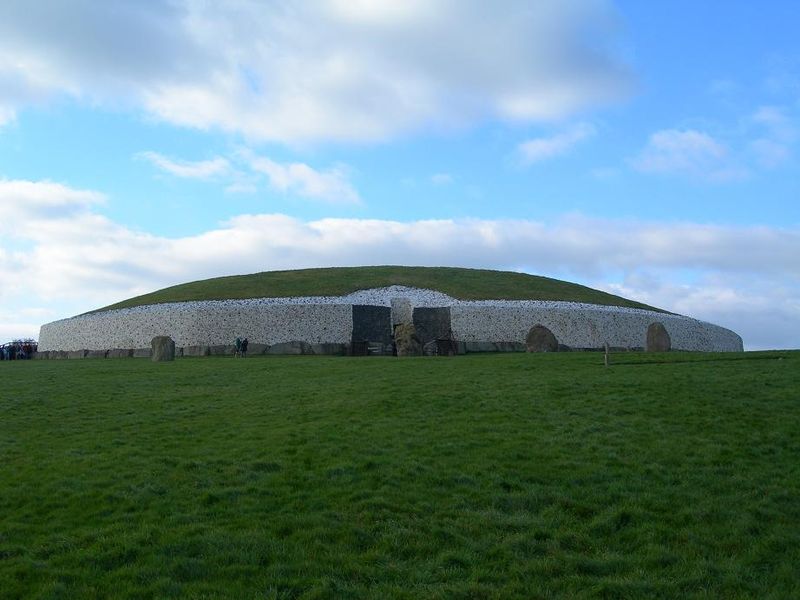
800px-Newgrange

Picture cc by 2.5 pl – originally uploaded by Shira-commonswiki

The golden hill where long-forgotten kings

Keep lonely watch upon their feasting-floor

Is silent now, – the Dagda’s harp no more

Makes sun and moon move to its murmurous strings;

And never in the leafy star-led Springs

Will Caer and Angus haunt the river shore,

For deep beneath an ogham-carven door

Dust dulls the dew-white wonder of their wings.

Yet one may linger loving the lost dream –

The magic of the heart that cannot die;

Although the Rood destroy the quicken-rods;

To him through earth and air and hollow stream

Wild music whines, as two swans wheeling cry

Above the cromlech of the vanished gods.

New Grange is one of Six Celtic Sonnets written by Thomas Samuel Jones and included in From the Isles of Dream: Visionary Stories and Poems of the Celtic Renaissance, selected by John Matthews and with a foreword by Robin Williamson (Floris Books, 1993).

Thomas Samuel Jones (1882-1932) came from Welsh and Irish stock and was born in Oneida County, New York State, near the Adirondack Mountains. Each of the six sonnets reflects a facet of Celtic tradition. They were originally published in 1930 as part of the collection Aknahton and Other Sonnets. For those of us who resonate with Druid and Celtic spirituality, they are part of our modern cultural ancestry.

Earth Eclectic

music that celebrates Earth and speaks to the heart

Sarah Fuhro Star-Flower Alchemy

Follow the Moon's Cycle

Muddy Feet

Meeting nature on nature's terms

Rosher.Net

A little bit of Mark Rosher in South Gloucestershire, England

Becoming Part of the Land

A monastic polytheist's and animist’s journal

selkiewife

Selkie Writing…

Charlotte Rodgers

Images and words set against a backdrop of outsider art.

Prof Jem Bendell

living with metacrisis and collapse

Towint

The pagan path. The Old Ways In New Times

The Druids Garden

Spiritual journeys in tending the living earth, permaculture, and nature-inspired arts

The Blog of Baphomet

a magickal dialogue between nature and culture

This Simple Life

The gentle art of living with less

Musings of a Scottish Hearth Druid and Heathen

Thoughts about living, loving and worshiping as an autistic Hearth Druid and Heathen. One woman's journey.

Wheel of the Year Blog

An place to read and share stories about the celtic seasonal festivals

Walking the Druid Path

Just another WordPress.com site

anima monday

Exploring our connection to the wider world

Grounded Space Focusing

Become more grounded and spacious with yourself and others, through your own body’s wisdom

The Earthbound Report

Good lives on our one planet

Hopeless Vendetta

News for the residents of Hopeless, Maine