A familiar scene, in its equinoctial clothing. My experience of it is made different by a recent fall, in which I fractured my left humerus bone near the shoulder. I am left-handed, so it’s the ‘wrong’ side for a break. Happily my wrist and fingers remain flexible, and I don’t need surgery for the fracture. It could have been much worse.
Nonetheless Elaine, still depending on a rollator for walking, and I have to be resourceful and strategic in leaving and re-entering our apartment. Essentially I specialise in legs and she specialises in arms, though we each have some capacity in the other’s domain. We’re a team, after all. We work together. But we aren’t getting out much for the time being.
I look out a little wistfully and write a bit ouchilly. I feel limited and constrained. I also feel loved and supported. I’m a little foggy in my thinking, but I don’t see an episode like this as time off from my contemplative inquiry. All experiences are there to be acknowledged, moment by moment, day by day. Otherwise the practice becomes an alienated exercise, or performance, separated from the ups and downs of life. In reality, it sits ever-present within them.
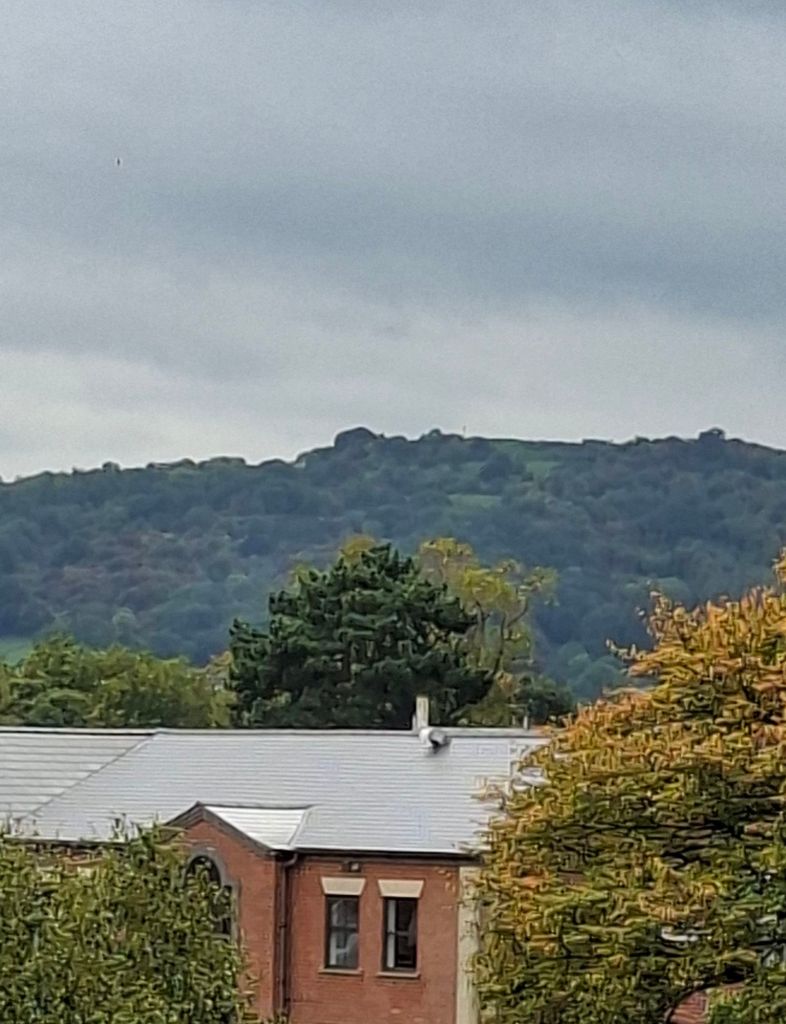
I look within myself. I look across at Elaine. I also look out of window to connect with the world outside and its changes over the year. The grey sky is typical for this September, but blue sky is too. Variation is the overall story. It’s an inherently changeful and unsettled time. I’m intrigued by the way in which Robinswood Hill retains its green cover, when the town trees are in an advanced stage of turning. I’m alive.
Highly recommended, especially for readers interested in local initiatives to address the climate crisis. Bournebridge over Troubled Waters (1) is a sequel to Tony Emerson’s Unlikely Alliances, which I reviewed in October 2022 – (https://contemplativeinquiry.blog/2022/10/27/book-review-unlikely-alliances/). Although the new book stands on its own, I think it works best after reading Unlikely Alliances, now republished as Creating Hope in the Valley of the Bourne. The setting continues to be a fictional community on England’s south coast.
In the new book, we have reached the year 2030. The publisher’s blurb describes it as ‘a story of love and friendship’ as well as commitment to climate action. On my reading, the ways in which people do ‘love and friendship’ are integral to the action itself.
This is shown in a group of leading characters who gradually assemble together in an old rectory building. This is less by design than the need for decent housing and a belief that larger dwellings should be fully occupied. But the rectory evolves into a strong base for its residents’ flourishing.
In many ways they are a diverse group. But they all, sometimes with a little tlc, reveal themselves as naturally affectionate and ethically grounded. The culture of the house nurtures these co-operative qualities. It is a creative and supportive place to live. As part of the life of the house, the residents develop a system of peer mentoring for their work in the wider world. There’s also a concern, for some of them, about a progressive Christianity that honours the world and the flesh and is ecologically aware. I am reminded of Matthew Fox’s use of the term ‘original blessing’.
As was the case in Unlikely Alliances, the government is committed to climate action. The earlier book describes their Climate Action Plan, which has put serious wealth taxes in place, rationed fuel and food (especially meat), placed restrictions on air travel, created a Civilian Community Service Corps to provide training and jobs for the unemployed and 2 years national service for school and college leavers. Housing policy is not all about new build, but also addresses better use of existing resources.
The fields covered by our band of rectory activists and their colleagues include agriculture, hospitality, renewable energy, relevant university research, transport, housing, trades union development, clothing (new and renewed), second hand shops, and renovation, repair and maintenance services of various kinds. These are practical needs and also model a cultural shift away from throwaway consumerism. All of this work is depicted as dynamic and gaining momentum.
Temperatures are continuing to rise, and there is an unprecedented level of flooding to contend with. At the same time, vested interests and violent climate deniers, branded as ‘True Britannia’, continue to undermine the Climate Action Plan. Life goes on. Lovers get together. Children are born. Older people die and are lovingly remembered. Music is made. Rugby is played. Hospitality is exchanged. Events are organised and enjoyed. People maintain contact with family members further away, travelling throughout Britain and Ireland, though rarely further than that. It is not clear what the future will hold, but there are some grounds for optimism.
When I finished reading Bournebridge over Troubled Waters I felt as if pitched back into my own timeline. It’s as though my 2025 couldn’t be the one that led to their 2029-2034. I didn’t feel that way even when I read Unlikely Alliances in 2022. My reading of books like this seems to depend not only on who I am but when I am. If I become timeless, I can respond to these books as parables reminding us that we have the power to be better than we are. We just don’t use it enough. That’s a call to respond to whatever the outward circumstances or likely outcomes.
(1) Tony Emerson Bournebridge over Troubled Waters UK: The Conrad Press, 2O24 (www.the conradpress com)
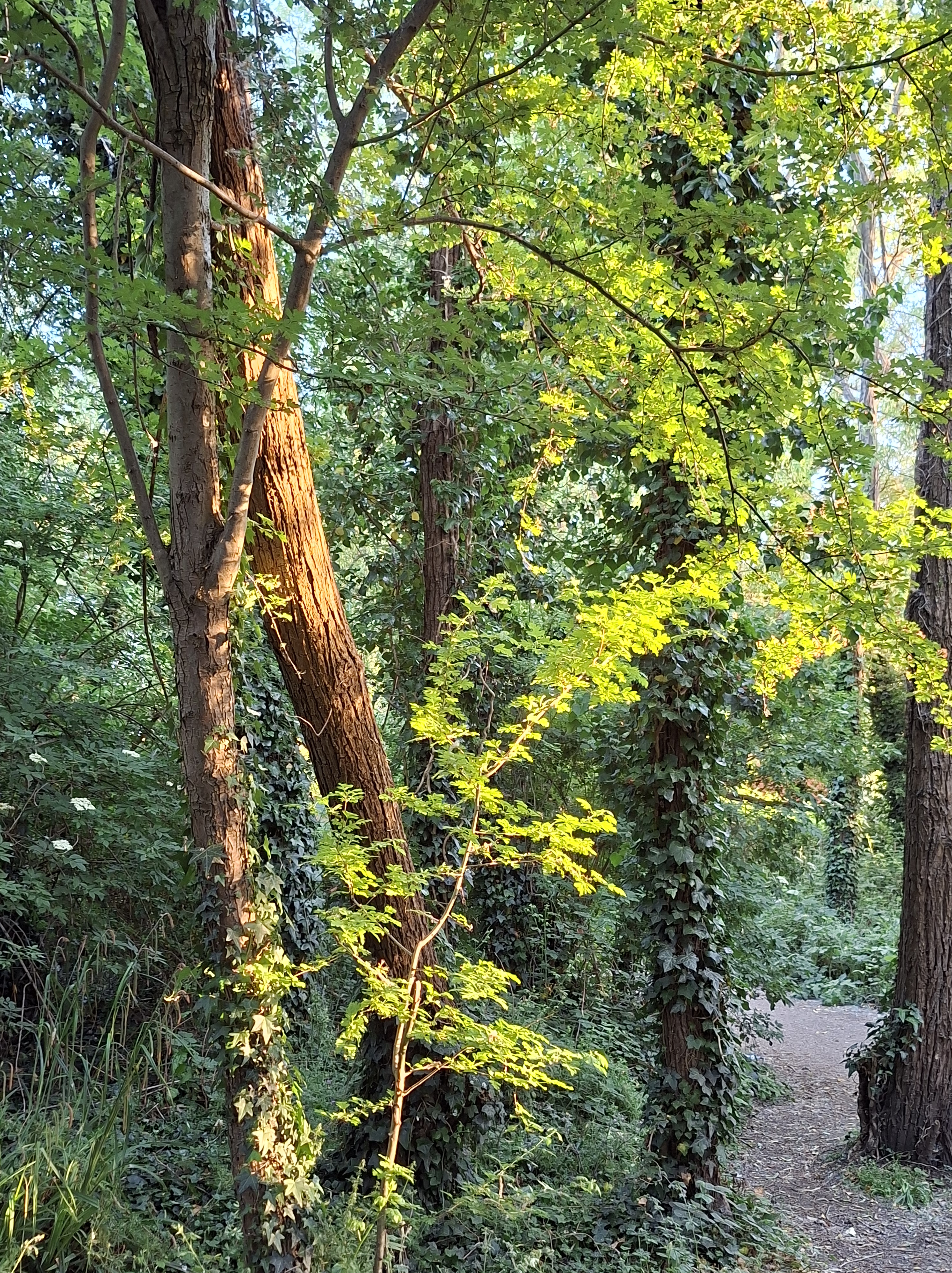
For me, mid May is the beginning of summer. All of the pictures in this post were taken between 16 and 24 May. It was a warm and sunny time that has now morphed into something else – cooler, wetter and windier.
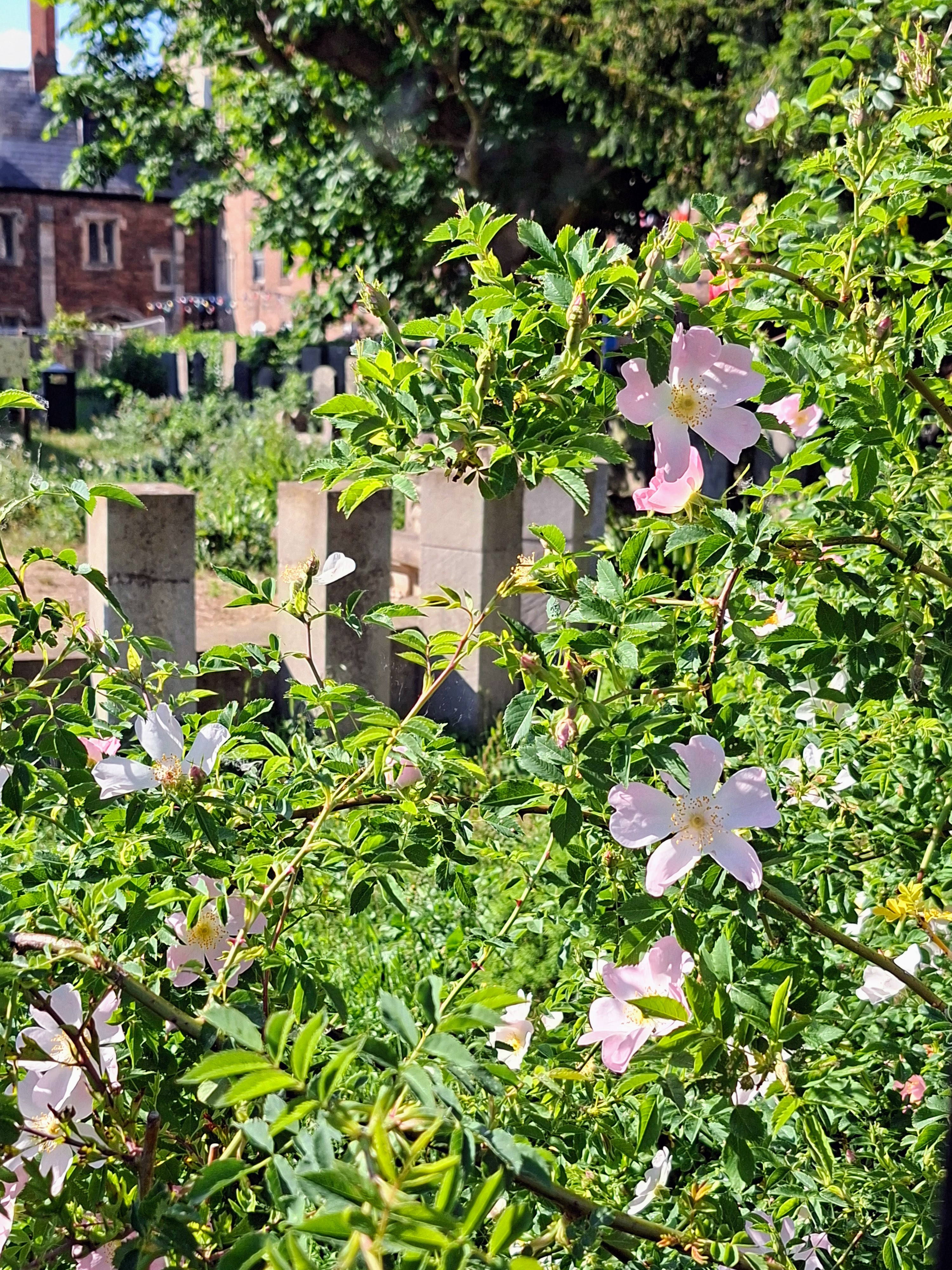
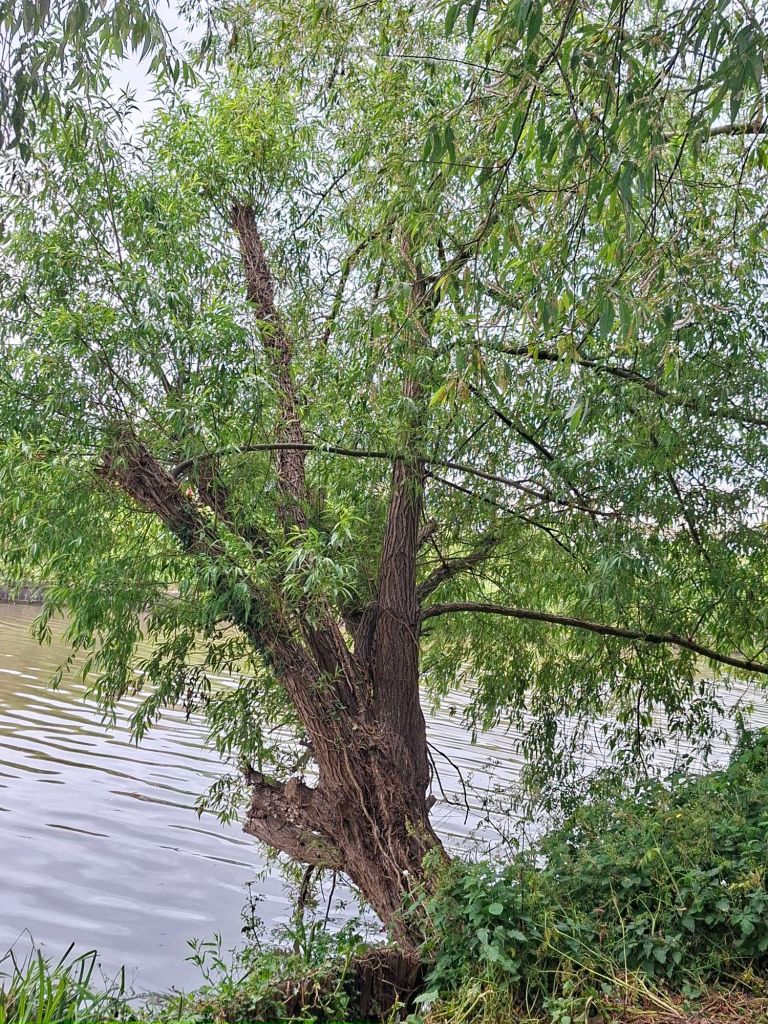
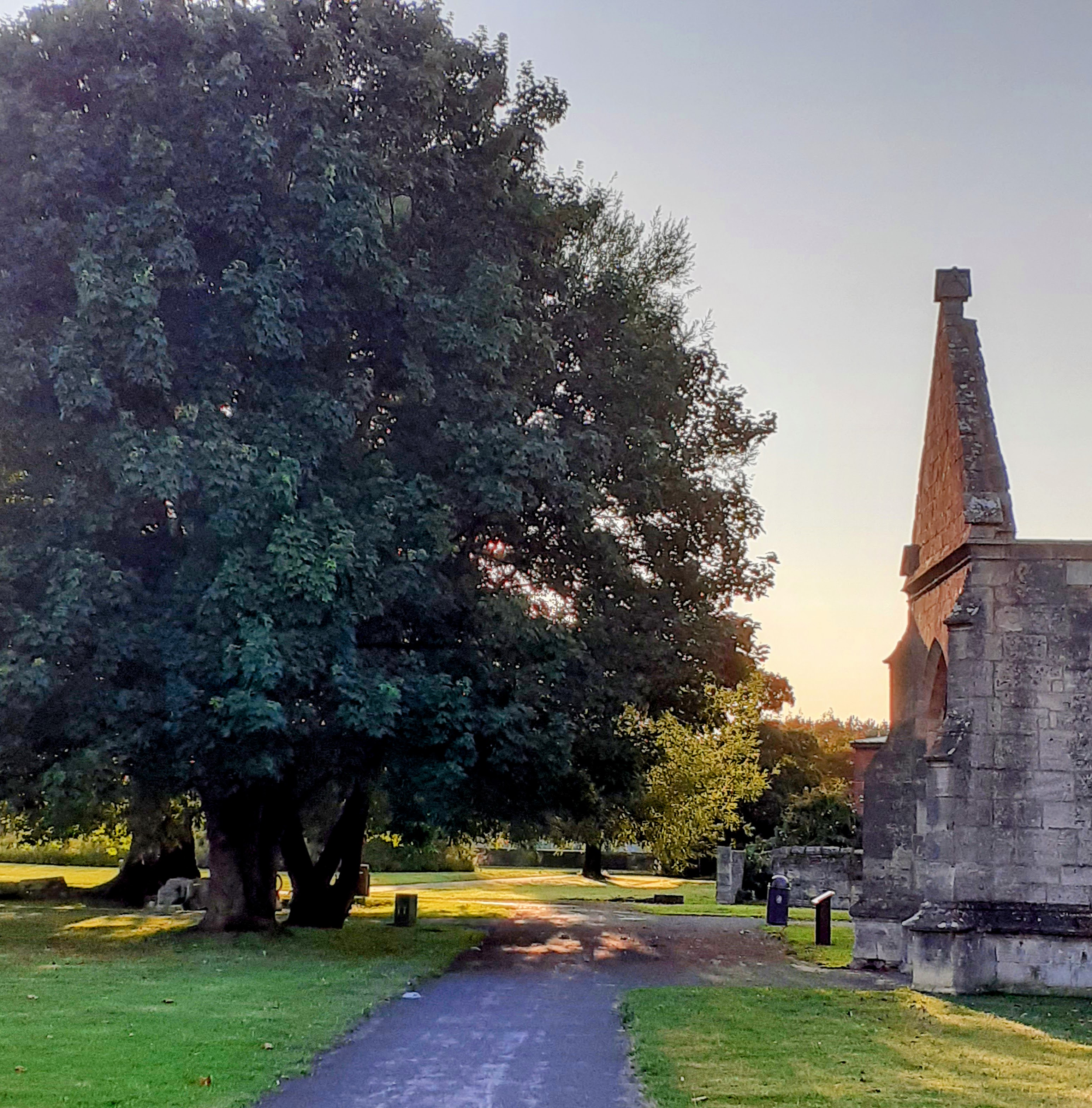
It was a time of brightness and growth. The plant kingdom showed a tremendous will to live and flourish: above, on the canal path as it skirted adjacent apartment buildings; below, close to the Greyfriars ruins, looking out towards the old town.
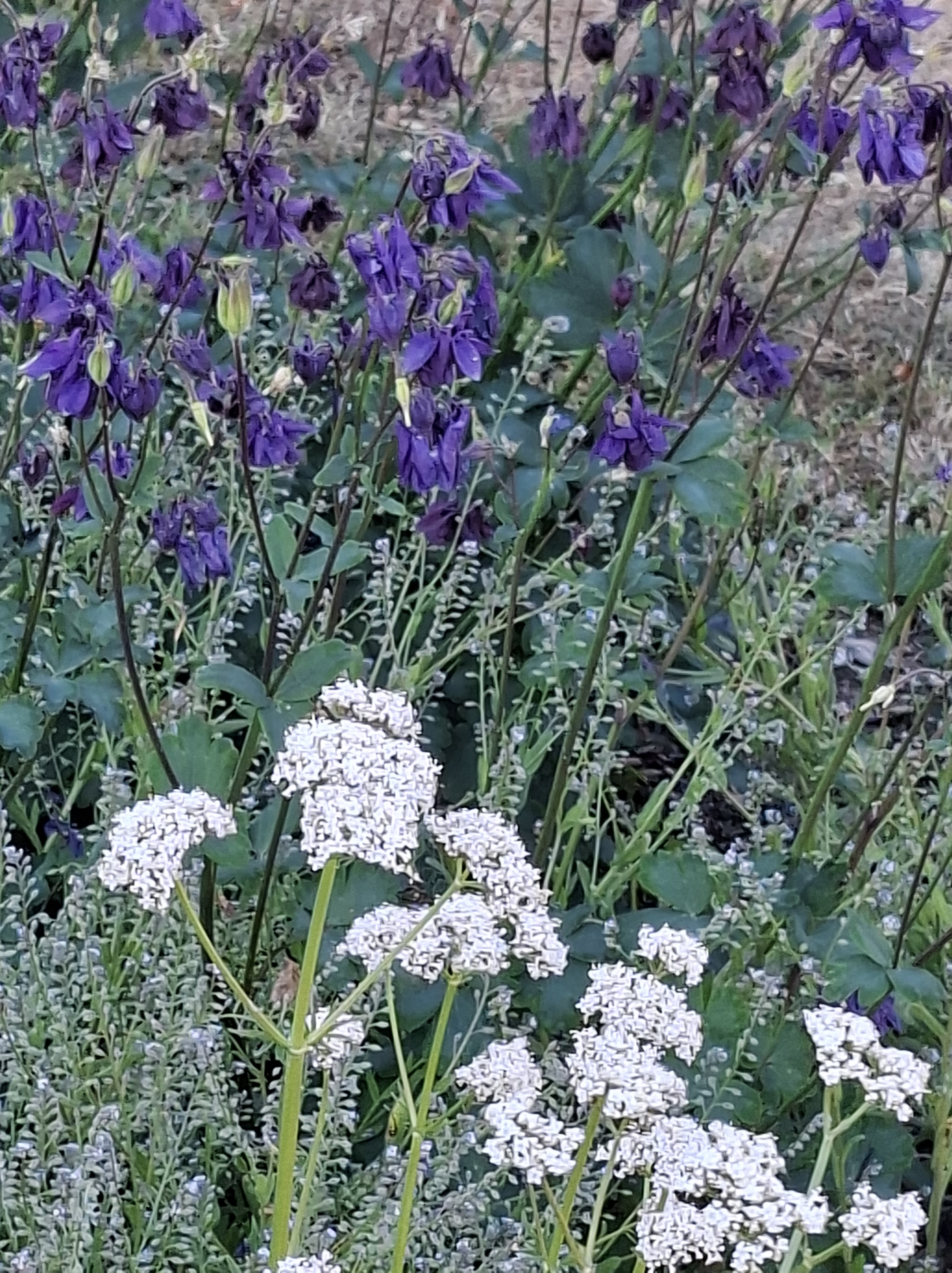
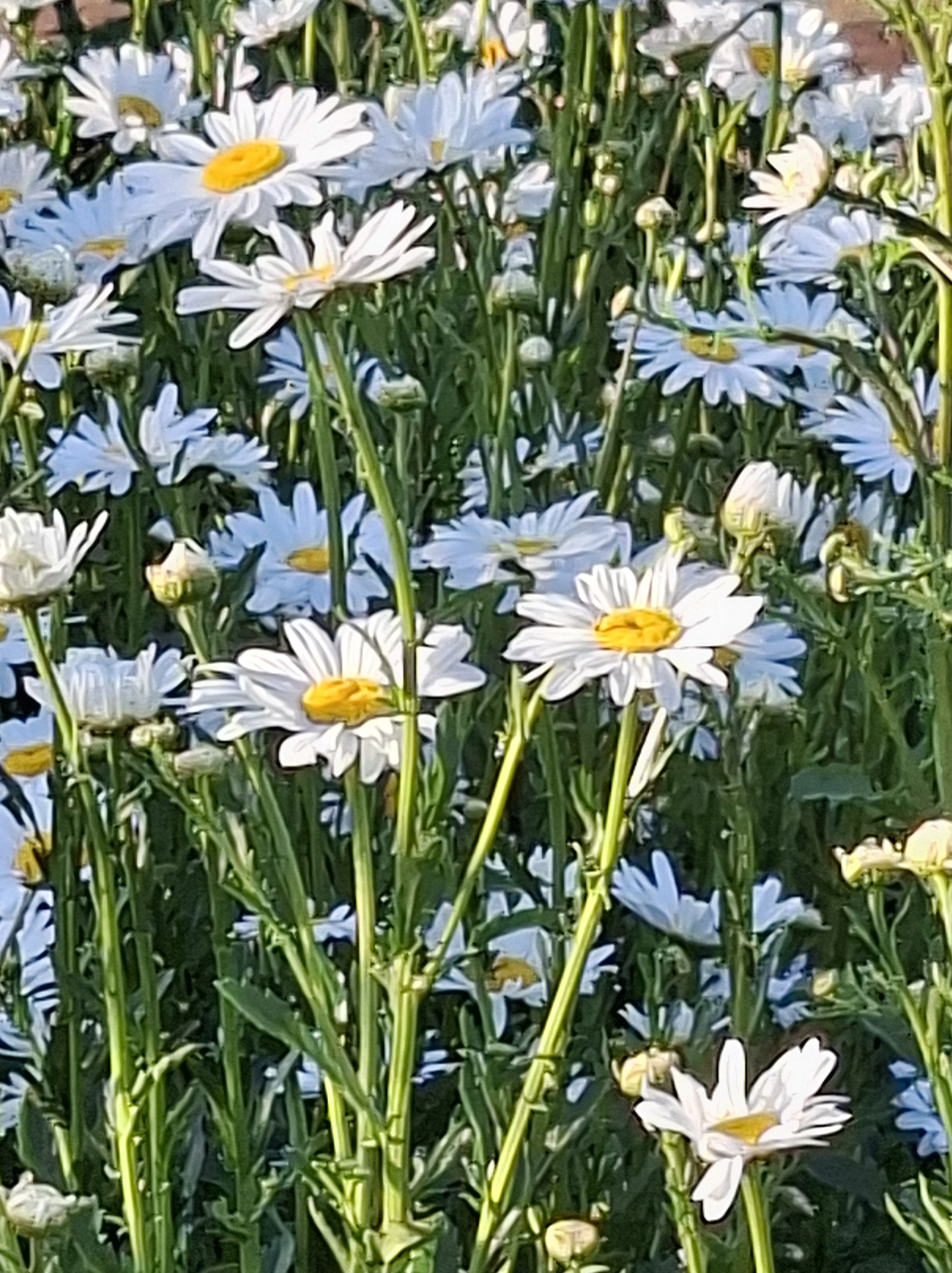
The following three pictures are all from Llanthony Priory, in what was once once the ‘physic garden’ of the monks. What moves me about all of them is the vitality, variety and colour they display. Such an affirmation of abundance.
The same benign and dynamic period saw a big step forward in my wife Elaine’s mobility. She can now leave and return to our flat, sit in pleasant public spaces, walk around town, attend local events and shop on her own. This is new and different for both of us, emancipatory yet still slightly unfamiliar. A new way of life is emerging for both of us.
On 25 May, about the time the weather broke, I celebrated my 76th birthday and entered my 77th year. As I wrote to one of my grandsons, ‘sounds terrible, feels OK’. In truth, it feels more than OK. I feel good.
It was also the anniversary of Elaine’s homecoming after her hip fracture in Gran Canaria, her hospitalisation for a month there, her repatriation and another 12 days in the Gloucester Royal Hospital. The year has been a tough one, especially after the strain on Elaine’s already vulnerable heart became fully manifest. But Elaine herself has been an inspiration with her own will to live and thrive. This feels like a good moment in my life and our lives together. Much gratitude for that.
I first registered Contemplative Inquiry on 28 August 2012 and WordPress have sent me 12th anniversary greetings. That’s a long-term project by my historic standards. True, the first two years were tentative and I took an 8 month break in 2018/9. But my contemplative inquiry, both as blog and as practice, now feels like a settled part of my life. I continue to ground it in a form of modern Druidry with, Janus-like, both pagan and universalist faces.
Through my inquiry, I came over the years to understand myself as, at heart, ‘living presence in a field of living presence in a more than human world’. This may sound like something of a formula, but it is at least my own formula, providing a compressed account of my experience and understanding, It is not connected to any particular belief system, and arose through a simple recognition of what seems to be given to us, in joy and sorrow alike.
When I open and deepen to living presence, a gestalt of self-and-world, not just self, reveals itself in a sometimes transfiguring way. It is not complicated to practice or experience. In consequence I have found myself nudged, however haltingly, towards a spirit of openness, an acceptance that nothing stays the same, an ethic of interdependence and a life of abundant simplicity.
I no longer think of the inquiry as a path or journey. It is more like a deepening, or maturation, in place. Looking back at early blog posts I find seeds of my current view right at the beginning of my inquiry. As early as 2 September 2012 I wrote about Satish Kumar’s experience (1,2) of outdoor walking meditation. It made a strong impression on me. The difference today is that I have internalised it and given it my own unique flavour. This year I celebrate a clearer understanding and a more confident voice. I am grateful both to influences like Satish Kumar and to the version of me who launched this inquiry twelve years ago..
I am writing on the last day of 2022. My very best wishes for 2023 to all readers. Many blessings for the year ahead!
The picture above was taken on 26 December (in England called Boxing Day/St. Stephen’s Day) – this year a chilly day of bright blue sky. The truncated spire* of St. Nicholas Church, Gloucester, reaches up towards the vivid sky, despite its history of damage. For me, this image of spire against sky is one of clarity, definition and spaciousness. It is a breath of fresh air.
I don’t know what 2023 will bring. I do want to bring clarity, definition and spaciousness to whatever unfolds. As my contemplative inquiry continues, I find that it subtly modifies its purpose. Discovering and re-discovering the purpose involves an element of divination, since my thinking personality is not exactly in charge.
It is as if authentic clarity and definition come out of the spaciousness itself, not out of cognitive review or ‘brain-storming’. These may be aids, but I have also to wait for signs. When I began this blog, I surprised myself by calling it ‘contemplative inquiry’ rather the ‘contemplative Druidry’. I see now that contemplative inquiry is the root description for my path.
For me, contemplation is a yin quality, an open and receptive engagement with experiences – most especially, with forms of relationship. Inquiry is a yang quality, actively deepening knowledge, refining understanding and seeking meaning. Together they support my path. Druidry is a vehicle that supports spiritual self-direction, and also challenges disastrous social norms concerning both nature and culture. Today I have revised the ABOUT section of this blog, on the eve of 2023, and my key statements are below:
“My contemplative inquiry began in 2012. It is grounded in modern Druidry, though not wholly defined by it. I acknowledge the influence of other sources, especially the wider turn towards an eco-spirituality that meets our historical moment. The inquiry process itself is my core practice, from which others radiate out.
“Over my inquiry years, I have found an underlying peace and at-homeness at the heart of experience. Here, it is as if I am resourced by a timeless, unboundaried dimension from which I am not separate. I find myself guided towards a spirit of openness, an ethic of interdependence and a life of abundant simplicity.”
*NOTE ON ST. NICHOLAS’ SPIRE: the church was first built in 1190 and added to over the centuries. A 200 ft. spire was built in the fifteenth century, but received a direct hit from cannon fire in 1643, during the English Civil War. The final repair waited until 1783, when the spire was reduced in height and capped.
Highly recommended. Unlikely Alliances (1) is set in the years 2029-2033, in a fictional town on England’s south coast. It offers a degree of hope about the climate crisis, presenting a positive response to its challenges at the global, national and, especially, local levels. Towards the close of the book, one of the characters reflects on a benign economic austerity that includes social justice: “limited food in the shops, clothes and shoes having to last many years, trips abroad requiring special license … but look around us, are we really worse off?” The answer is a qualified no, on the grounds that everyday life has become less constrained and less stressful, thanks to the choices that have been made.
Unlikely Alliances offers a gentle, compassionate and good-humoured lens on a subject that can seem grim and edgy. The title refers to the changing political, professional and above all personal relationships of people working on adaptation goals in their Bourne Valley community. They are from a wide variety of backgrounds, including local government, academia, trade unions, churches, the voluntary sector, management consultancy, the hospitality industry, sports organisations and farming. Unexpected synergies are generated. The novel shows how its band of protagonists find themselves, each other and a new sense of purpose in this work. As fiction, the book has the space to be about lives as well as issues. New culture, adapted to new times, is created in the lived experience of friendship, romance and community building.
The Climate Action Plan of a progressive coalition government provides a political framework, drawing on ideas from the US 1930’s New Deal and the UK reconstruction post World War 2. It is in power because of a wake-up call resulting from a huge inundation in the Netherlands and the presence of a large number of Dutch refugees in Britain – a disaster too close to ignore. For the first time since the mid twentieth century, serious wealth taxes are in place. Food and fuel are rationed: everyone gets at least something at an affordable price. There are new approaches to housing. A Civilian Community Service Corps provides training and jobs for the unemployed and a two-years national community service for school and college leavers.
In crisis conditions, this government is broadly popular. Even so, it is vulnerable to defections within its own Parliamentary ranks, the vigorous opposition of vested interests and those who speak for them, and the violence of militant climate denialists on the street. These struggles are not minimised, and they are vividly portrayed in the book. But most of the focus is on resource and resiliency building at the local and regional levels, and on the changes in the lives of the main characters, as they open up to each other’s influence and affection. It is their efforts that prevail, since they come to make practical sense to more and more people.
A brief review cannot do full justice to a book that deals with a civilisation at the edge, presented from a stance of generosity and warm commitment to human flourishing. Tony Emerson has long experience of working with environmental issues and is also an accomplished storyteller. I found Unlikely Alliances heartening and enjoyable to read, and a well-informed glimpse into a possible near future.
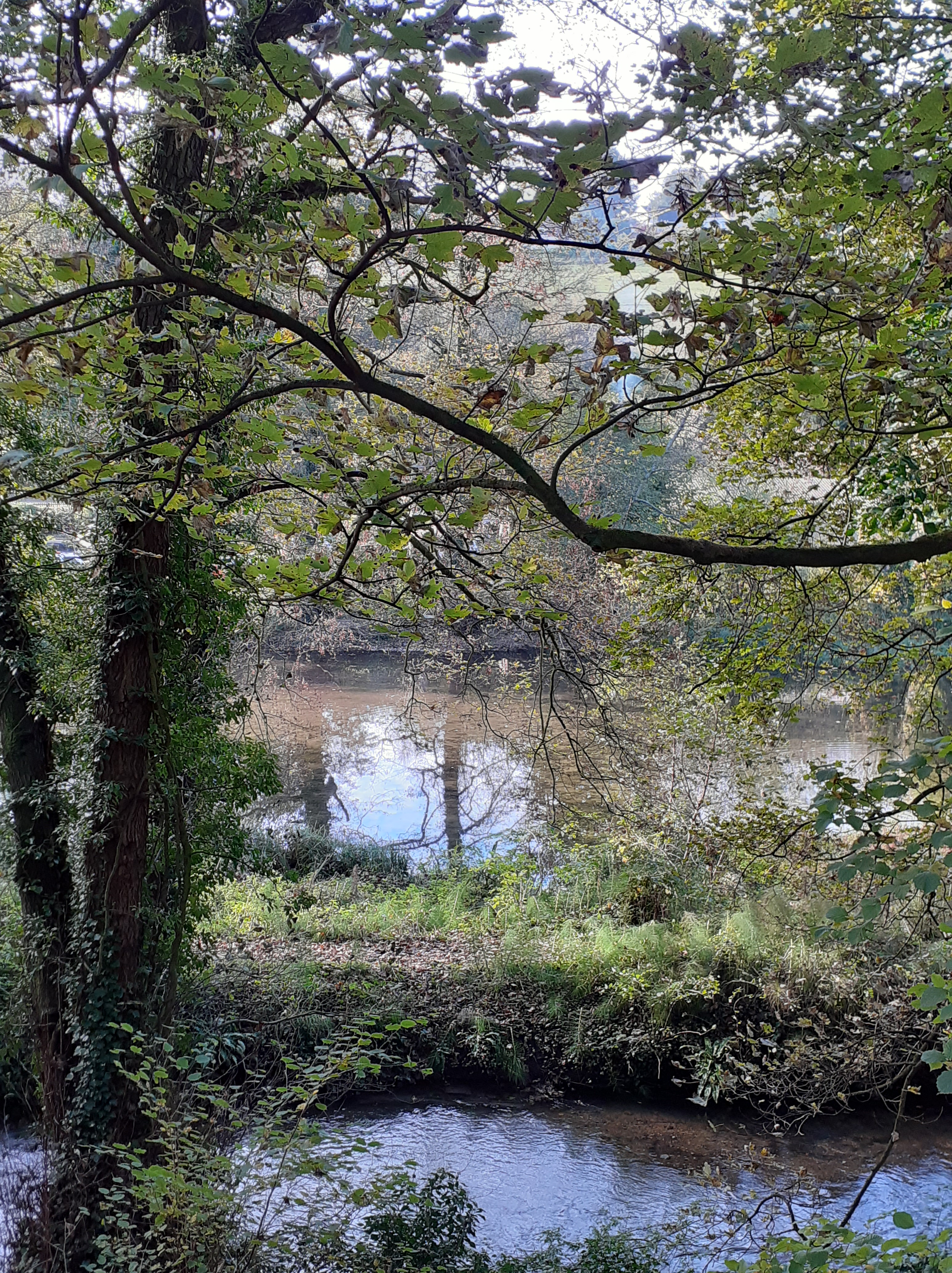
It is colder now, and gloomier indoors for much of the day. But outside, this November keeps on giving. My walking range has increased again with a walk to nearby Nailsworth, a leisurely lunch in this little town, and a walk back again: ten miles. The picture above includes both a stream beside my path and a small lake nearby.
But my attention hasn’t been all on the world around me. I have been reflecting on an old statement about my practice, currently included in my About section, and finding that it still holds. “My inquiry process overall has helped me to discover an underlying peace and at-homeness in the present moment, which, when experienced clearly and spaciously, nourishes and illuminates my life. It is not dependent on belief or circumstance, but on the ultimate acceptance that this is what is given. I find that this perspective supports a spirit of openness, an ethic of interdependence and a life of abundant simplicity.”
There is no reliance on metaphysics here. This allows me a pared down focus on experience and values. My practice has been relatively stable over a long period, whereas my thoughts about metaphysical questions are more volatile. I experience thinking as volatile by nature, and fine within its limits. Over the years this blog has found room for diverse approaches to the meaning, if any, of terms like divinity and consciousness. I have wondered about the possibility (or desirability) of establishing any foundational truth about absolute or indeed conventional ‘reality’. I notice now that when I explore these questions – especially when reading – I am more interested in seeing how people put their worlds together than I am in identifying insights or finding answers to the questions themselves. It has become a human interest rather than a philosophical quest.
I have noticed this especially over recent days when engaging with Carlo Rovelli’s discussion of the Buddhist philosopher Nagarjuna (1,2). My interest was in seeing how a distinguished physicist makes use of Nagarjuna’s emptiness doctrine. I have less stake in assessing the view itself, because my peace and at-homeness are the result of an experiential inquiry, and not of speculative thinking. I continue to find that this perspective supports “a spirit of openness, an ethic of interdependence, and a life of abundant simplicity”, My inquiry focus, if ‘inquiry; is even the right word, is about how best to walk the talk.
(1) Carlo Rovelli Helgoland global.penguinrandomhouse.com 2020 (Translated by Erica Segre & Simon Carnell, 2021). Carlo Rovelli is a theoretical physicist who has made significant contributions to the physics of space and time.
Dr. Suzanne Simard grew up in the Monashee Mountains of British Columbia, in a family of low impact traditional foresters. She worked for many years a researcher in the Canadian Forest Service, before moving into academia. She is currently Professor of Forest Ecology at the University of British Columbia’s Faculty of Forestry. Throughout her career she has had a leading role in changing the way that science thinks about trees and forests. Her research on tree connectivity, communication and cooperation – and their impact on the health and biodiversity of forests – has shown how the imposed monocultures of commercial forestry are a disaster for forests, forestry and the wider ecology of the planet.
Her book Finding the Mother Tree: Uncovering the Wisdom and Intelligence of the Forest was published by Penguin Books in the UK, USA, Canada, Ireland and Australia in 2021 in paper, kindle and audio versions. It describes both a personal journey and a scientific one, and shows how the work Simard came to do grew out of the place and culture in which she was raised. It is as if her achievement had her name on it even at the beginning. I highly recommend this book to any one with an interest in ecology and the sentience of trees.
I cannot do justice in to this inspiring book and its thesis in a single post. Instead, I refer readers to a TED talk on How Trees Talk To Each Other (1), which Simard gave in 2016, summarising her work and its implications in just over 16 minutes. If the talk whets your appetite, the book will likely satisfy it. It says more about Suzanne Simard’s personal and family journey. It describes her ground-breaking (though also fraught and frustrating) time within the Canadian Forest Service in some detail. It also says something about the ecological wisdom of the indigenous peoples of the forest and takes Simard’s own research up to 2020.
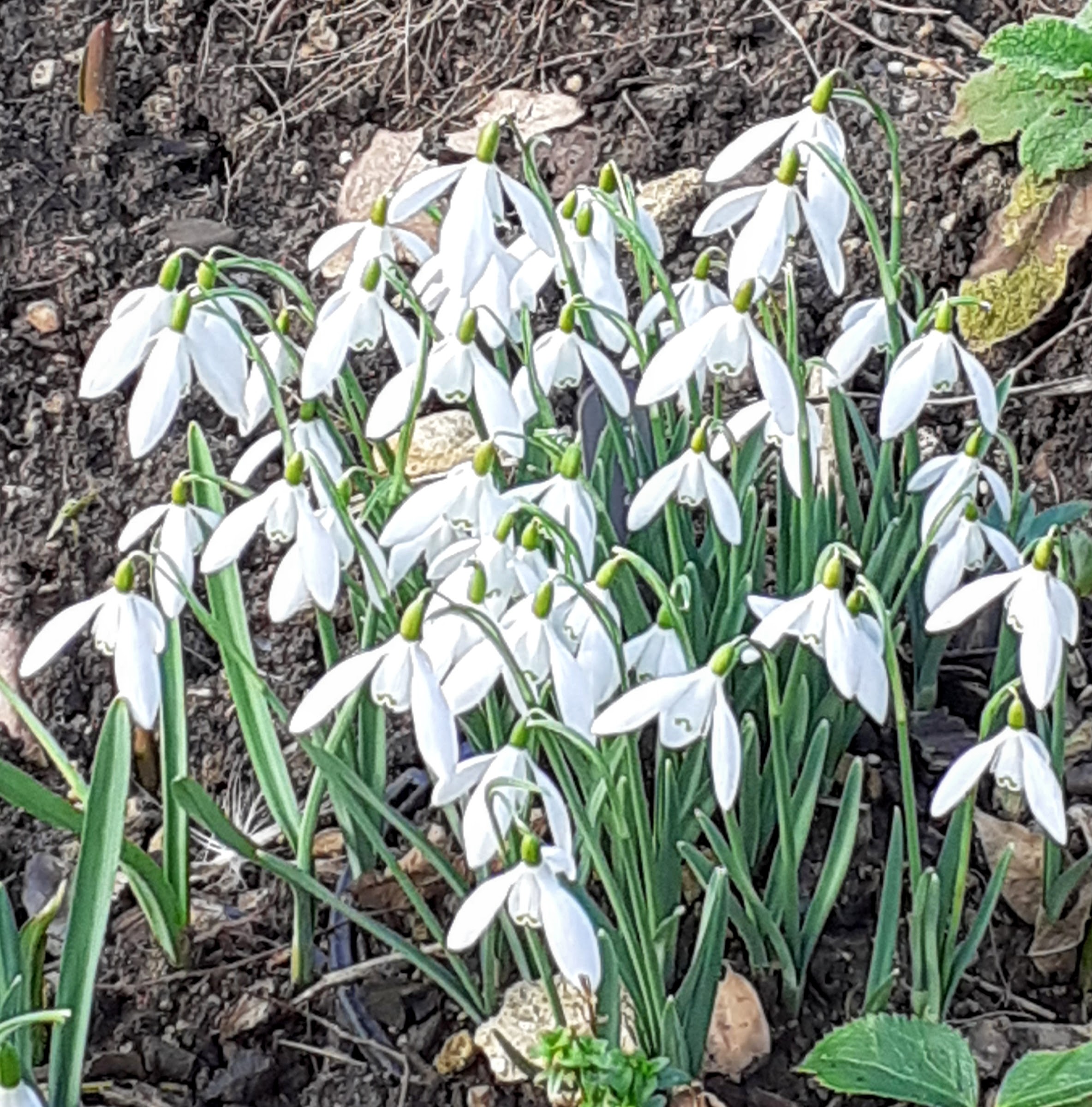
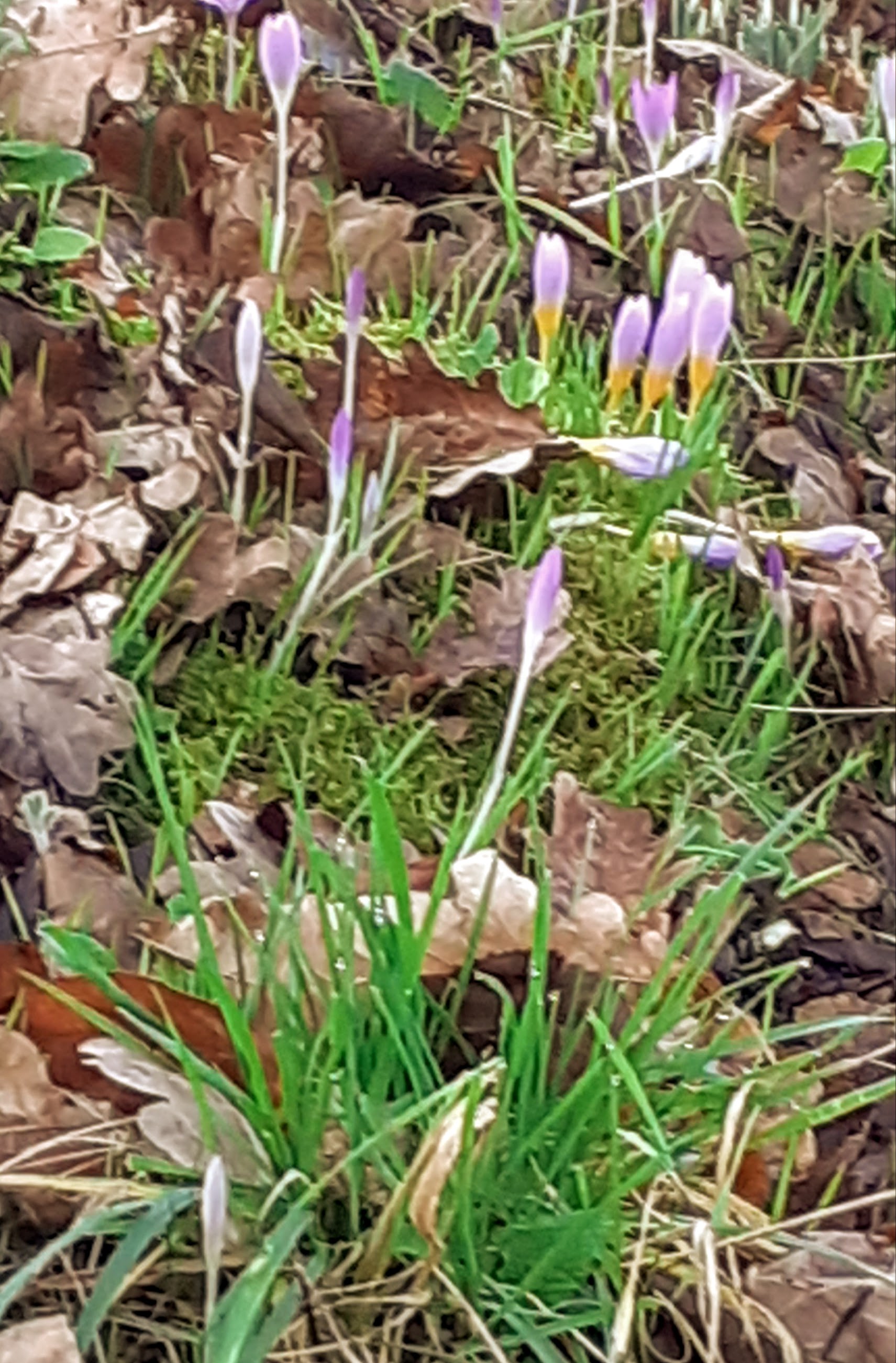
Every process in nature has its season, and its interdependence with other processes and events occurring at the same time. Part of our climate crisis involves the breakdown of long-standing relationships of interdependence. Where I live, the year at least seems, mostly, to move in its time-honoured way, though with an increase in storms and flooding. The flowers of early spring are comforting both in their presence and promise. Yet there are nagging questions about what disruptions the future holds for us, and how soon. This is before I open my awareness to include what other people in other places are already having to deal with.
Such instability impacts my contemplative life. I cannot rely on an externalised ‘nature’ for re-assurance about a world and life that will endure for me, or for beings like me living lives I can recognise. Conceptually, I have always known this, at least since I read H. G. Wells’ The Time Machine when I was eleven years old. It opened me up to the full implications of evolution by natural selection, a memorable moment in my education. I can remember sitting in early summer grass absorbing the insight. Now, both context and understanding are different. I am a lot older, in a time where premonitions of decline and fall can be placed in a near rather than remote future.
Yet the wheel of the year continues to move beautifully around the circumference of my circle. The centre is a different space entirely. I name it, in the About section of this blog, as “an at-homeness in the flowing moment”. This phrase comes out of my own experience rather than from the language of the traditions, and it “is not dependent on belief or circumstances, but on the ultimate acceptance that this is what is given”. I link this with peace and non-separation from source, a groundless ground though the latter might be.
Over the last year I have been influenced Robert Lanza and Bob Berman’s work on Biocentrism (1,2) discussed at https://contemplativeinquiry.blog/2020/02/03/biocentrism/ – I find myself leaning into their view of a cosmos where space and time are removed as “actual entities rather than subjective, relative and observer-created phenomena” thereby pulling the rug “from the notion that an external world exists within its own independent skeleton”. Such cosmology, not yet on the horizon for the Wells of 1895, makes reality more provisional and more ultimately unknowable than the reality of common sense. But for me, common sense reality is not lessened by being relativised, and I remain very busy with space and time. Rather, it becomes richer and more vivid, and more imbued with possibilities and potentials than my blinkered understanding can readily grasp. My contemplative ‘centre’ (ultimately unboundaried) is paradoxically a setting of peace and happiness – and also one of creativity and hope.
(1) Robert Lanza, MD, with Bob Berman Biocentrism: How Life and Consciousness are the Keys to Understanding the True Nature of the Universe Dallas, TX: Benbella Books, 2009
(2) Robert Lanza, MD, with Bob Berman Beyond Biocentrism: Rethinking Time, Space, Consciousness, and the Illusion of Death Dallas, TX: Benbella Books, 2016
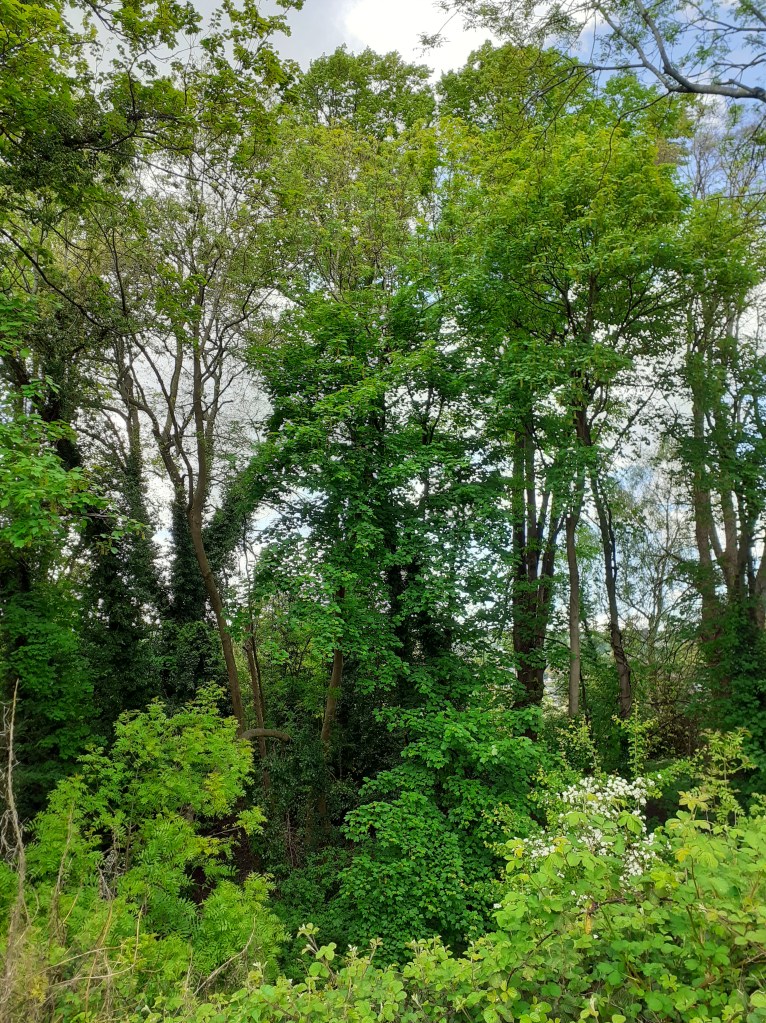
On 1 May I strode out with a spring in step, for my statutory walk. I was stir crazy and determined to meet the day. I made sure to take my camera with me. I wanted both to savour and record the fresh abundance of the green. Although I was in a familiar landscape, both the look and the feel of it had changed. I was in places I hadn’t been in for a week or more, and the world seemed dynamically verdant with a new intensity. I had a transformative hour of it before returning home.
In his Green Man (1), William Anderson reminds us that the Green Man utters life through his mouth. “His words are leaves, the living force of experience … to redeem our thought and our language”. Anderson’s Green Man speaks for the healthy renewing of of our life in and as nature.
He also suggests that the emerging science of ecology – the study of the house-craft of nature – is one such form of utterance. It gives us a language of inquiry into the interdependence of living things. My sense is that 1960’s images of Earth from space have also provided support to concepts like that of a planetary biosphere, and for the revival of Gaia as an honoured name. As a species, quality knowledge, rooted in quality imagination, is our greatest resource. Anderson’s book was published in 1990, based on ideas that had already been maturing over many years. I am sad that we are where we are in 2020. But the message of hope still stands, and the energy of a green May bears witness to it.
(1) William Anderson Green Man: the Archetype of Our Oneness with the Earth London & San Francisco: HarperCollins, 1990 (Photography by Clive Hicks)









 Contemplative Inquiry