Now in the fourth week after my shoulder fracture, I have ventured out on a contemplative walk.
I rested for awhile in the erstwhile physic garden of Llanthony Secunda Priory. It is a friendly space for me. Yet at first I felt very small. An alien energetic sky raced high above me towards an unknown horizon.
I wasn’t used to the outdoors. The garden stretched in front of me, defined by a long straight path. I experienced the world as a place of distance and extension. I felt alarmingly unsheltered, until I stilled myself and looked down.
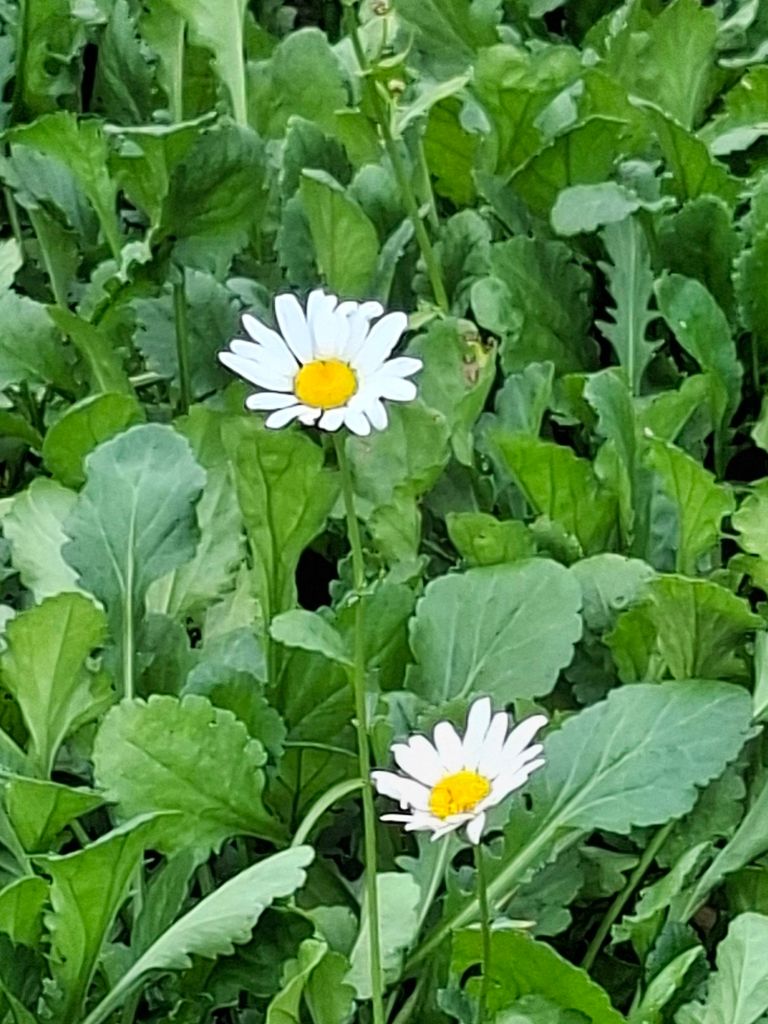
The sight of Michaelmas daisies altered my state. Seasonal flowers and a living, shining green. Although I didn’t move to touch them, I felt like a toddler reaching out for a mother’s hand. I was held again within the wheel of the year. Autumn, the season of bearing fruit.
I looked out further and received rhe assurance of an old stone wall, and the majesty of mature trees. The trees might be turning. The wall might be part of a ruin. But they were still in place, still present in time, still offering a quiet companionship.
These changes in perspective allowed me to experience the garden afresh, more closely and intimately. It was easier to be in, and easier to connect with. Still unsheltered, but unalarmed, I knew that I belong.
Highly recommended, especially for readers interested in local initiatives to address the climate crisis. Bournebridge over Troubled Waters (1) is a sequel to Tony Emerson’s Unlikely Alliances, which I reviewed in October 2022 – (https://contemplativeinquiry.blog/2022/10/27/book-review-unlikely-alliances/). Although the new book stands on its own, I think it works best after reading Unlikely Alliances, now republished as Creating Hope in the Valley of the Bourne. The setting continues to be a fictional community on England’s south coast.
In the new book, we have reached the year 2030. The publisher’s blurb describes it as ‘a story of love and friendship’ as well as commitment to climate action. On my reading, the ways in which people do ‘love and friendship’ are integral to the action itself.
This is shown in a group of leading characters who gradually assemble together in an old rectory building. This is less by design than the need for decent housing and a belief that larger dwellings should be fully occupied. But the rectory evolves into a strong base for its residents’ flourishing.
In many ways they are a diverse group. But they all, sometimes with a little tlc, reveal themselves as naturally affectionate and ethically grounded. The culture of the house nurtures these co-operative qualities. It is a creative and supportive place to live. As part of the life of the house, the residents develop a system of peer mentoring for their work in the wider world. There’s also a concern, for some of them, about a progressive Christianity that honours the world and the flesh and is ecologically aware. I am reminded of Matthew Fox’s use of the term ‘original blessing’.
As was the case in Unlikely Alliances, the government is committed to climate action. The earlier book describes their Climate Action Plan, which has put serious wealth taxes in place, rationed fuel and food (especially meat), placed restrictions on air travel, created a Civilian Community Service Corps to provide training and jobs for the unemployed and 2 years national service for school and college leavers. Housing policy is not all about new build, but also addresses better use of existing resources.
The fields covered by our band of rectory activists and their colleagues include agriculture, hospitality, renewable energy, relevant university research, transport, housing, trades union development, clothing (new and renewed), second hand shops, and renovation, repair and maintenance services of various kinds. These are practical needs and also model a cultural shift away from throwaway consumerism. All of this work is depicted as dynamic and gaining momentum.
Temperatures are continuing to rise, and there is an unprecedented level of flooding to contend with. At the same time, vested interests and violent climate deniers, branded as ‘True Britannia’, continue to undermine the Climate Action Plan. Life goes on. Lovers get together. Children are born. Older people die and are lovingly remembered. Music is made. Rugby is played. Hospitality is exchanged. Events are organised and enjoyed. People maintain contact with family members further away, travelling throughout Britain and Ireland, though rarely further than that. It is not clear what the future will hold, but there are some grounds for optimism.
When I finished reading Bournebridge over Troubled Waters I felt as if pitched back into my own timeline. It’s as though my 2025 couldn’t be the one that led to their 2029-2034. I didn’t feel that way even when I read Unlikely Alliances in 2022. My reading of books like this seems to depend not only on who I am but when I am. If I become timeless, I can respond to these books as parables reminding us that we have the power to be better than we are. We just don’t use it enough. That’s a call to respond to whatever the outward circumstances or likely outcomes.
(1) Tony Emerson Bournebridge over Troubled Waters UK: The Conrad Press, 2O24 (www.the conradpress com)
4.30 pm, 25 February 2025. Sunrays are caught in willow branches. The sun is a little stronger today than it was in full winter. The willows have begun a tentative greening. But there is much shadow in this picture. The day has begun its decline.
The world retains a winter feel for me. I aware of the change in my local park, but I do not altogether trust this spring. In the moment of taking this picture, I see a world in shadow, softly darkened. This is partly because of where I have chosen to stand. It is the image I seem to want.
In the brighter picture below, I show daffodils growing among dead leaves. Daffodils are iconic harbingers of spring, yet not my sole focus. Both pictures were taken intuitively and without any mentally registered intent. It seems as if something in me wanted to make a statement.
I know and accept that I am in the winter of my life. In the wheel of my own life, I can’t quite see how my winter will move into spring, certainly in any personal sense. Dissolving into interbeing is easier to imagine.
My customised Druid liturgy names winter as the season of dying and regeneration. It has associations with law and faith. I understand law in a karmic or ‘natural law’ sense. But it can also be an acknowledgement of the nature we see around us. Faith, in part, concerns the willingness to accept dying and regeneration without knowing what they are like. In my last post, I discussed (1) ‘being nobody’. My current reflections take this suggestion a step further. Evidently, I still have much to learn.
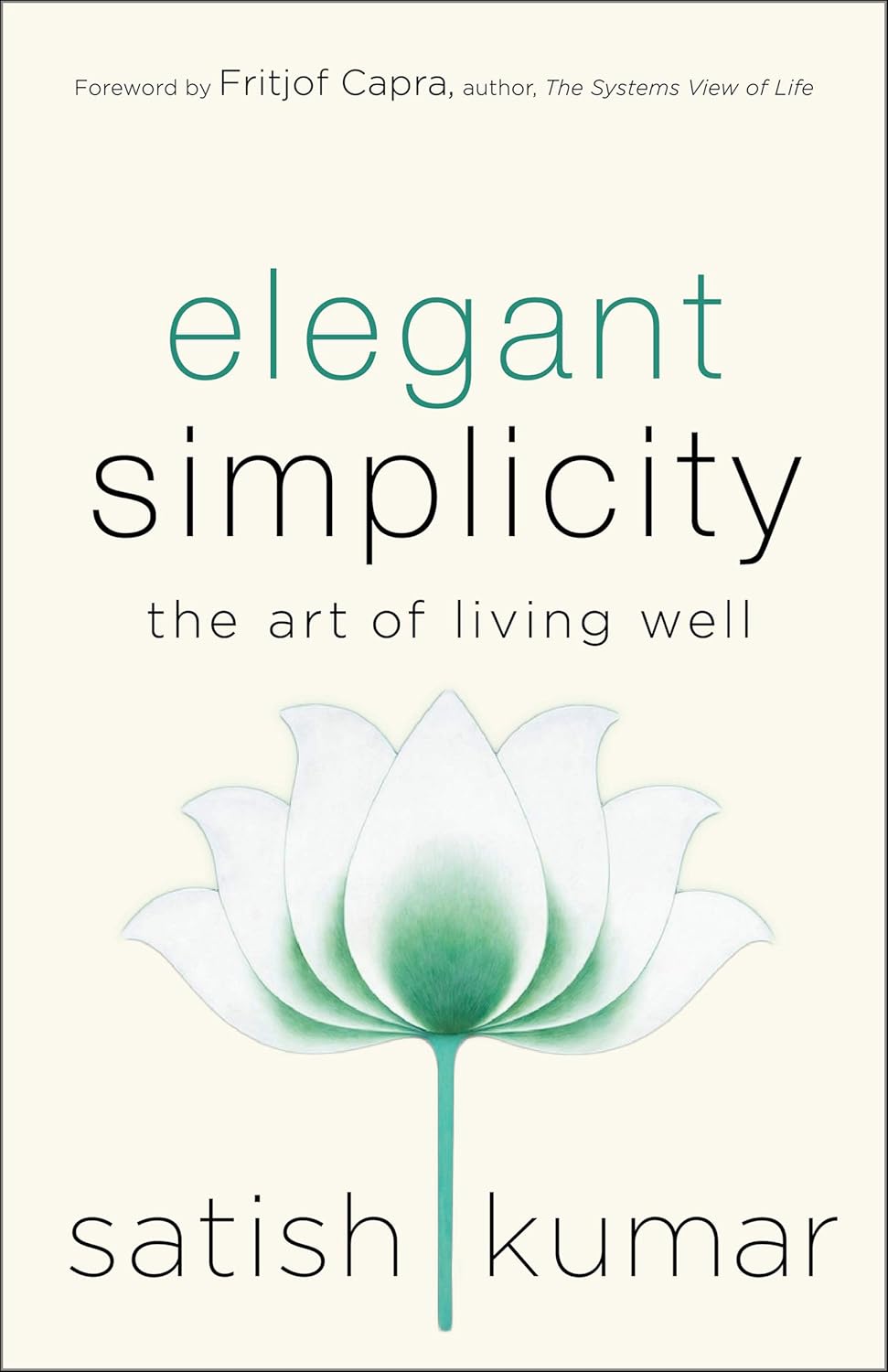
Highly recommended. Satish Kumar (born in 1936) published Elegant Simplicity: the Art of Living Well in 2019 (1). It begins with a foreword by Fritjof Capra and a preface by the author Let’s be Simple which quotes the 1848 Shaker song ‘Tis the gift to be simple, ‘Tis the gift to be free. The book summarises the author’s personal story as well as discussing his values. I have written posts based on some of his other work before (2). I especially recommend this book to anyone interested in knowing more about Satish Kumar’s practice (grounded in Jain spirituality and Gandhi’s non-violent activism) and his influence on deep ecology, creative arts and education.
Elegant Simplicity has a summarising quality, looking back on decades devoted to sacred activism in different forms. It is divided into fourteen chapters: Each is preceded by a brief and relevant quotation from another thinker. The chapter then becomes a meditation on the quote:
1 My Story: Beginnings – ‘True happiness lies in contentment’ Mahatma Gandhi.
2 Simplicity of Walking – ‘All truly great thoughts are conceived by walking’ Friedrich Nietzsche.
3 Life is a Pilgrimage – ‘Faith is not the clinging to a shrine but an endless pilgrimage of the heart’ Abraham Joshua Heschel.
4 Elegant Simplicity – ‘Any fool can make things complicated, it requires a genius to make them simple’ E. F. Schumacher.
5 A Society of Artists – ‘This world is but a canvas to our imagination’ Henry David Thoreau.
6 Yoga of Action – ‘Life is a process not a product’ Brian Goodwin.
7 Learning is Living – ‘Education is not preparation for life; education is life itself’ Thomas Dewey.
8 Right Relationships – ‘We are all related – relationships based on obligation lack dignity’ Wayne Dwyer.
9 Love Unlimited – ‘There is no charm equal to tenderness of the heart’ Jane Austin.
10 Power of Forgiveness – ‘It’s one of the greatest gifts you can give yourself, to forgive. Forgive everybody.’ Maya Angelou.
11 Dance of Opposites – ‘Life and death are one as the river and the sea are one’ Kahlil Gibran.
12 Deep Seeing – ‘To see clearly is poetry, prophecy, and religion, all in one’ John Ruskin.
13 Union of Science and Spirituality– ‘Science is not only compatible with spirituality; it is a profound source of spirituality’ Carl Sagan.
14 Soil, Soul and Society – ‘We live in an interconnected world and in an interconnected time so we need holistic solutions to our interconnected problems‘ Naomi Klein.
Fellow activist and author Vandana Shiva describes Elegant Simplicity as “the distillation” of Satish Kumar’s ideas and actions. “It shows the intimate connections between the inner and the outer world, soil, soul and society, beauty joy and non-violence. It indicates that the solutions to the big problems of our time – climate change, hate, violence, hopelessness and despair – lie in thinking and living with elegant simplicity, reducing our ecological footprint while enlarging our hearts and minds”.
For me, Satish Kumar is an inspiration rather than a direct model. Even in the conditions of the early 1960’s I would not have walked, or aspired to walk, from New Delhi to Washington DC without carrying any money. Yet Satish Kumar and his companion E. P. Menon succeeded and made a huge public impact at the time. Their peace pilgrimage gave oxygen to the campaign for nuclear disarmament. No state gave up its arms, but treaties limiting the numbers and testing of nuclear arms became normalised for some decades. Satish Kumar’s initiatives in deep ecology and education, especially the ‘small school’ and Schumacher College, have changed lives. Directly and indirectly, his influence has awakened many people from the dystopian trance of our dominant cultures. Satish Kumar is a widely revered elder: a peaceful warrior for a more liveable, generous and creative world.
(1) Satish Kumar Elegant Simplicity: The Art of Living Well New Society Publishers (https://www.newsociety.com): Gabriola Island, BC, Canada: 2019
NOTE: “Satish Kumar (born 9 August 1936)[1] is an Indian British activist and speaker. He has been a Jain monk, nuclear disarmament advocate and pacifist.[3]Now living in England, Kumar is founder and Director of Programmes of the Schumacher College international center for ecological studies, and is Editor Emeritus of Resurgence & Ecologist magazine. His most notable accomplishment is the completion, together with a companion, E. P. Menon, of a peace walk of over 8,000 miles in June 1962 for two and a half years, from New Delhi to Moscow, Paris, London, and Washington, D.C., the capitals of the world’s earliest nuclear-armed countries.[4][5] He insists that reverence for nature should be at the heart of every political and social debate.” (Wikipedia)
My walking time is still restricted. Perhaps because of this, familiar outdoor spaces have become exotic and magical to my eyes. My limiting circumstances are paradoxically making me more focused and attentive, enhancing my felt quality of life. I am readier to find joy in simple, passing experiences.
On my contemplative walks, the shapes and colours of trees move me deeply. Grasses and sky have a similar impact. I am very aware of these July days. I am very aware of summer. I am very aware of my place in the world as the year turns in my immediate neighbourhood.
A little further away, I stand on a canal bridge (below) and look back towards the city, which seems distant and small. Water and sky give me space and perspective. I let the elements of water and air nourish me at a time when I am largely grounded.
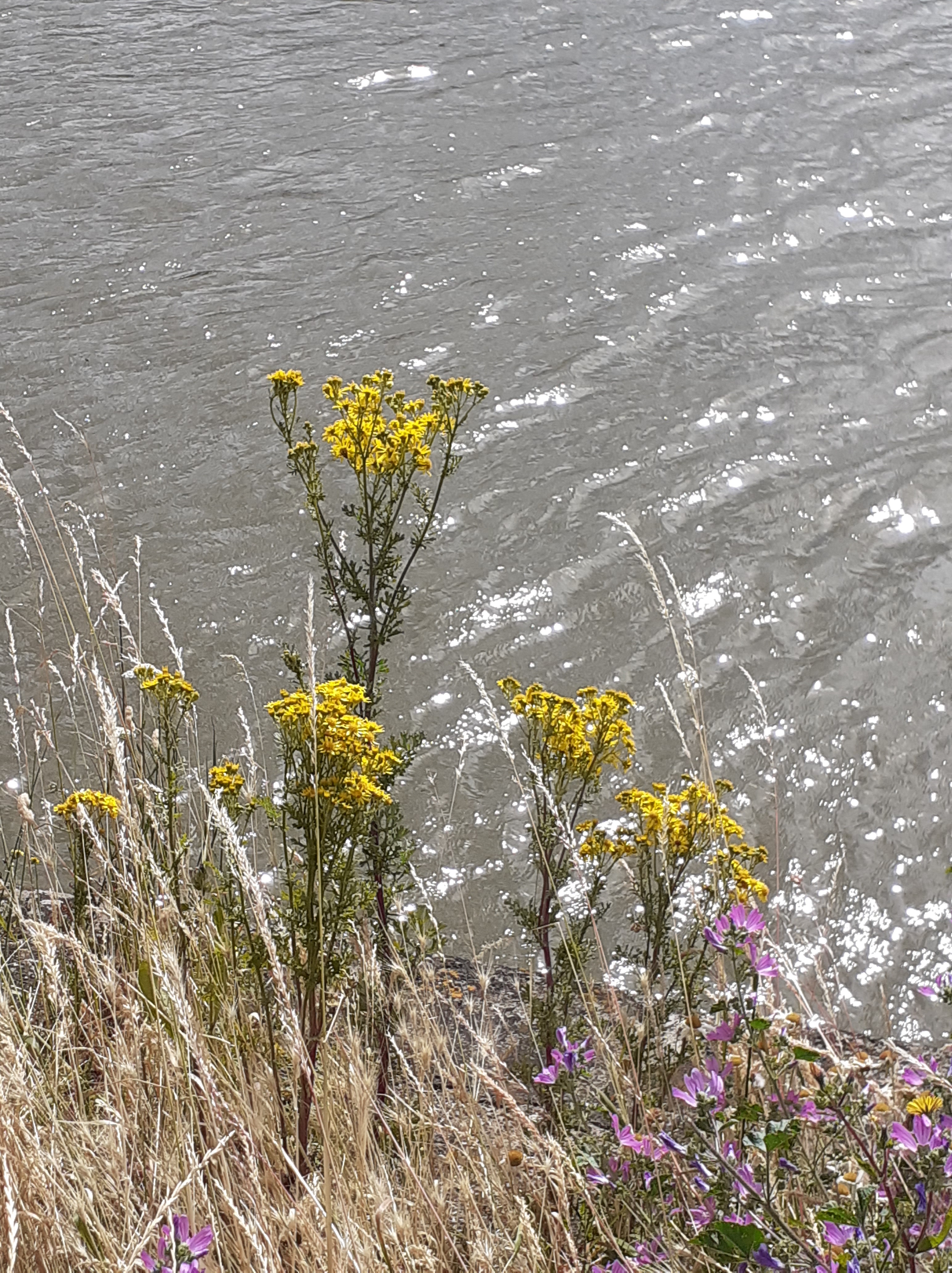
Close up at the water margin, I find light shining on the water. There is energy and movement here. The power of the sun is present in both a shifting luminosity on the water and the flowering resilience on the bank.
I shift into a meditation on the four classical elements – earth, water, air and fire – and how they work together to make the fifth (life, spirit) possible. Consciously engaged with the four, I can stand as the fifth, resourcing my individual life within a world of impermanence and interbeing.
“A sign is what characterises the appearance of something, its form. If we recognise things based on their sign, we may think that this cloud is different from that cloud, the oak tree is not the acorn, the child is not the parent. At the level of relative truth, these things are helpful. But they may distract us from seeing the true nature of life, which transcends these signs.
” ….
“You are always changing form. You are browsing through a family photograph album, and come across a photo of yourself as a young child. Where is that little child now? You know that it is you. You have the same name, and yet it doesn’t look like you. Are you still that child or are you someone else? This is a practice of contemplating your own signlessness. Today you look, speak, act and think differently. Your form, feelings, perceptions and consciousness are all very different. You are not fixed and permanent. You are not the same person, but you are not a totally different person either. When you are no longer caught in specific images or appearances, you can see things more clearly. You can see that the little child is still alive in every cell of your body. It is possible still to listen and take care of the little boy or little girl in you at any time.” (1)
(1) Thich Nhat Hanh The Art of Living London: Penguin Random House UK, 2017
Recently I’ve been unwell and housebound, hardly even watching the world go by. But there came a day when I could go out again, a day that was blessed with sun. It seemed bright and new. I was almost blinded by its luminous presence on a white tree-patterned wall. I had entered late fall, a season with both autumnal and winter features.
The sun shone on trees in Gloucester City Park which retained some of their foliage, but in an end-of-season way that signals austere changes to come. Leaves showed a fragile, lingering beauty, prior to their necessary descent.
The Brunswick Gardens, sitting under a clear blue sky, were home to trees where the leaves had already fallen, leaving the branches as patterns of quiescent arboreal bones. The leaves were on the lawn. Other, managed, flora continued to flourish.
In visual and tactile ways, after an indoor confinement, the neighbourhood was full of reward for me. But I felt cold, and it was indeed the coldest it’s been for many many months. I could not stay out for long. But I had encountered a moment in the year, of interbeing, of living presence – where the wheel is visibly and palpably turning. I was glad to be there, however briefly, available for a nurturing and healing experience.
Highly recommended. Unseen Beings: How We Forgot the World Is More Than Human (1) is about the many beings we humans have actively ‘unseen’ and the consequences of our human-centric lens. Author Erik Jampa Andersson describes his book as a diagnostic exploration of the roots of the climate crisis, itself an extreme consequence of a much wider malaise. Whereas the common view of ‘saving the planet’ tends to be one of ‘guarding the storehouse’, a better focus would be on ‘supporting the welfare of living beings’.
Andersson has a background in Tibetan Buddhism and Tibetan medicine. In the manner of Buddhism’s Four Noble Truths, and of his medical training, he divides his book into four parts: Diagnosis, Causes and Conditions, Prognosis, Treatment.
Diagnosis concerns “our ecological disease”. Andersson reminds us of what the climate crisis is, how far it has been allowed to go, and the “fanciful stories” with which we have soothed our fears: “full of human exceptionalism, divine protection, techno-fixes and post-apocalyptic salvation”. For Andersson, the foundational root cause is “the sundering of human and non-human beings, and our perceptual separation from ‘Nature’. He refers to “the poison of anthropocentricity”. He reviews the evidence for plant and fungal sentience and awareness as well as that of the animal kingdom. He concludes that Nature is not a place, but “a tightly knit community of interconnected beings, some seen, many unseen, all engaged in their own affairs and with their own experience of reality”. He describes this relational approach to the living world as “what most scholars now call ‘animism’ … neither a religion nor a system of belief, but a paradigm of more-than-human relationship”. He sees this stance toward the world as “our natural state”.
Causes and Conditions A mini-ice age some 13,000 years ago interrupted an early agricultural period in some places and prompted a series of innovations. The domestication of the horse was especially significant. Andersson sees a move away from our ‘natural state’ beginning at this time. But it is not fully evident to us until the age of written philosophy and scripture. The Greek philosophers Plato and Aristotle declare a hierarchy of sentience from plants up to animals and then humans at the top, uniquely endowed with a rational soul. In the Hebrew book of Genesis, God gives dominion over the Earth and its animals to man for his use. In the Western Christianity of the 13th century CE, Thomas Aquinas says that Christians have no duty of charity to non-humans because they are resources, not persons. In the 17th century CE, early in the West European led colonial era, Descartes holds public vivisections of dogs and other animals declaring that they are soulless automata and that their apparent distress is meaningless. In the mid 19th century CE, Darwin restores other beings as our ancestors and cousins, but but without much sense of kinship or empathy.
Prognosis Here Andersson introduces two concepts from Tibetan medicine: ‘provocation’ and ‘spirit illness’. The provocation of other sentient beings is a health risk. He discusses the origins of the recent Covid-19 pandemic in these terms, as human become ever more invasive of our remaining wild spaces. In cases of deforestation, pollution, and any disruption of air, water, soil and trees, there is a price to pay for the wounding of other spirits, whether seen by the eye, seen through a microscope and normally unseen but recognised by tradition. (‘Supernatural’ is an unhelpful word here – everyone is part of nature). In Tibetan tradition, the cultivation of a clear mind is highly prized and works within human psychology, but not for disruptive events like these. There is a need to make amends. Rituals are held in sensitive and damaged places. The damage caused in these circumstances and the resultant chronic collective disease can only be addressed by learning how to care for eachother, non-human beings and the planet itself.
Treatment Using the Buddhist 8-fold path as a structure, Andersson recommends ‘cultivating care’ over a system of rules and regulations aimed at a ‘sustainability’ which tries to restore the old status quo. We cultivate care of the Earth, one another and non-human beings. Hence: 1 right view is a return to our ‘natural state’, as described under Diagnosis; 2 right intention describes commitment to a path of rewilding and regeneration; 3 right speech is the use of “life-affirming language” (e.g. using ‘they’ as an alternative to ‘it’ for non-human beings); 4 right action is causing as little harm as possible to other beings; 5 right livelihood means adopting principles of authentic sustainability and non-exploitation; 6 right diligence is based on “the durability of the heart-felt ethic; 7 right mindfulness means “paying attention to nature’s vitality”; 8 right concentration involves imaging a new future with “authentic myth-making”.
Concerning 8 above, Andersson has been profoundly moved by the work of J. R. R. Tolkien from his later childhood onwards. As a result, he developed a high valuation of authentic myth-making and enchantment. In this realm, the non-human is essential. Tolkien had his own life-changing moment of enchantment when, as a student, he first read the Old English words: Eala earendel engla beorhtast, ofer middangeard monnum sended. (Hail Earendel brightest of angels, above the middle-earth sent unto men). Of this evocation of Venus arising as the morning star, in the old language, Tolkien later wrote: “there was something very remote and strange and beautiful about these words, if I could grasp it, far beyond ancient English”. For Andersson, authentic myth and authentic science work together in support of a redemptive animist vision. By contrast, the form of discourse to worry about is ‘fallacy’ – a complete dissociation from the truth. Andersson again quotes Tolkien: “if men were ever in a state in which they did not want to know or could not perceive truth (facts and evidence) then Fantasy would languish until they were cured. If they ever get into that state (it would not seem at all impossible) Fantasy will perish and become morbid delusion”. For Andersson, this too has become a symptom of our current ecological disease, making the need for honest and healthy communication all the more urgent.
For me, Andersson has made a valuable addition to a growing literature about the current crisis, whose most alarming symptom is climate breakdown. He goes to the root of the problem, offering a clear and coherent view about how to stand in the face of it. It is a well-researched, well-crafted and compassionate contribution to the genre.
(1) Erik Jampa Andersson Unseen Beings: How We Forgot the World is More Than Human Carlsbad, CA & New York City; London; Sydney; New Delhi: Hay House, 2023
I attach a links to conversations between the author and Andrew Harvey below. It adds considerably to what I can present in a review:
From the modern animist perspective of his Unseen Beings: How We Forgot the World Is More Than Human, Erik Jampa Andersson looks at what we owe to our canine friends.
“In our own evolution as a species, non-humans have often played crucial roles. Plants and animals weren’t always just our food and possessions – they were are mentors, companions, even our ancestors.
“There’s one non-human, in particular, whose profound impact on our human story warrants far more recognition … They were descended from the beasts of legend – formidable hunters who commanded vast swathes of land with ferocious might. In many of our myths and legends, they were immortalized as guardians of the underworld and crucial intermediaries between the human and non-human domains. Before we had ever tamed a horse, milked a cow, or sown a field of grain, we had befriended a dog.
“… It’s believed that humans and wolves were gradually drawn together during the perilously harsh conditions of the Last Glacial Maximum [20,000+ years ago: JN]. As our paths began to cross more and more frequently in our pursuit of mutual prey, what likely started as a timid sharing of spoils led to an unusual sense of kinship between the two predators. Wolves were drawn into the warmth of human encampments, and ultimately made themselves quite at home at the foot of our beds. They offered us vital protection, companionship, and a natural ‘security alarm’ in a wild and dangerous world, while we provided them with warmth, food, and evidently also emotional satisfaction.
“Studies of canine intelligence have repeatedly attested to dogs’ advanced capacity for memory, social cognition, inferential learning, and even comprehension (and possible use) of human language. But beyond their clear intelligence, what deserves significantly more attention is the very real impact dogs have had on our own evolutionary trajectory.
“Unlike predators who prefer to prey on weaker animals, wolves thrived as persistence hunters, successfully felling giant mammals by stalking them to exhaustion in well-organized packs. As territorial animals, they also went to the great trouble of staking out their own tribal domains, maintaining a distinctly pastoral lifestyle in complex social groups.
“Such practices were wholly foreign to early humans and other simians, but by the time our ancestors found their footing in the Eurasian wilderness, they had become rather formidable and territorial pack hunters themselves. Researchers suggest that these novel human behaviours were at least partially influenced by our burgeoning relationship with canines, who introduced us to their world, taught us their hunting tricks, and afforded us peace of mind by protecting our settlements against less amiable foes.
“The domestication of dogs was one of the key forces that led to the development of fully modern humans, impacting our relationship with one another and the world at large for many millennia to come”.
(1) Erik Jampa Andersson Unseen Beings: How We Forgot the World is More Than Human Carlsbad, CA & New York City; London; Sydney; New Delhi: Hay House, 2023
Saturday morning, 8 July. Gloucester, England. I am warm. I am indoors. I am contentedly lethargic. My gaze turns to a balcony door.
I contemplate Elaine’s balcony garden. The flowers are less dramatic than during the solstice period. Their colours are softer. I see more green. I see raindrops on the other side of the door. They are evidence of a gentle rain falling on this tiny garden.
“I am the movement of the breath and stillness in the breath”, I say in my Druid contemplative liturgy. “Living presence in a field of living presence: here, now and home”. This can be true at any time, but some conditions are more helpful than others. Here and now, I become alive to the balcony garden, fully present. Knowing Elaine as creator of this garden extends my sense of connection. A simple nourishing moment.
Hours later, with a flash and a crash, the heavens opened and my world changed, heralding a new kind of experience.








 Contemplative Inquiry