Contemplative Inquiry

This blog is about contemplative inquiry

Tag: Impermanence

THE FEELING OF HOME

On completing a breath exercise I sometimes say, ‘I am the movements of the breath and stillness in the breath; living presence in a field of living presence in a more than human world: here, now, home’. This is both my most parsimonious and most spacious sense of home in a world where nothing lasts forever or stays the same. I find my ultimate feeling of home in simple breath and awareness.

Yet my body and feelings, my heart and my imagination cannot thrive on breath and awareness alone. I need love, loyalty and connection inside the turbulence and uncertainty of the world. For me, the risk of getting hurt is an acceptable price to pay.

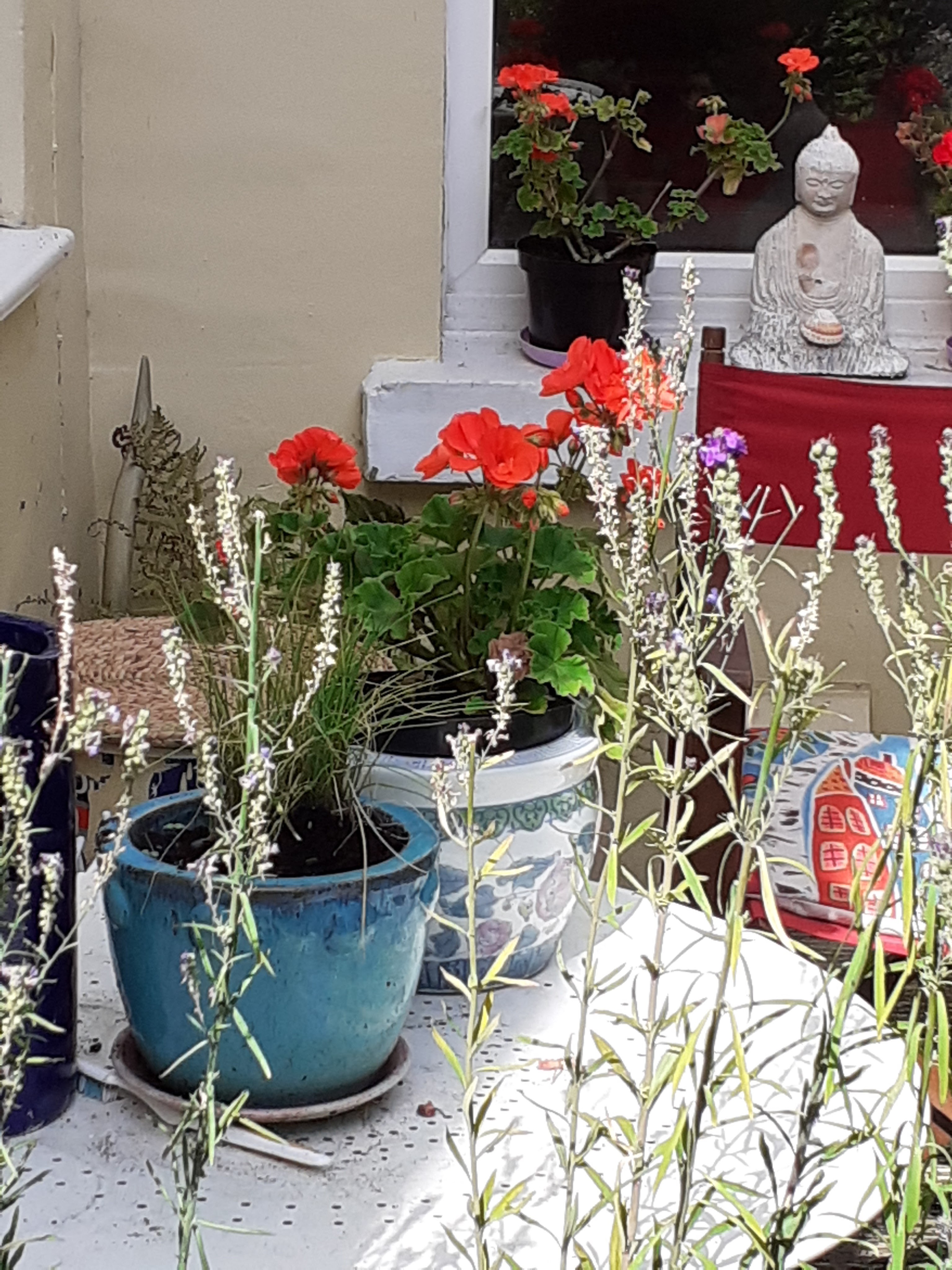
Thinking simply of ‘home’ spaces, I have lived at my current address for two and a half years. Not long, but enough to establish familiarity and loyalty. The picture above was taken very close to the building I live in. Our estate has planted lavender and let the grasses grow wild. I have come to love this. Our public library building, opened in 1896, is in a  simplified and elegant form of 19th century Gothic in its last stage. I know it as a busy and widely loved place. I also know that it won’t be used for its present purpose much longer. Yet I continue to experience it as ‘home’.

Earlier in the year, I wrote about a small group of birch trees growing up beside our flat. Then, they had a  bare  look apart from a few catkins (1). Now, in the picture below, they are in full leaf. I love the way they are now and also the way they have changed. Without impermanence and mutability nothing can happen. These very characteristics enable ‘living presence in a field of living presence in a more than human world’. They too are a necessary part of ‘home’.

(1) https://contemplativeinquiry.blog/2025/01/18/late-winter-regeneration/

POEM: AT THE BEGINNING OF SUNSET

Looking out

from my apparently restricted life

I see the wide world,

expectant.

It is the beginning of sunset,

a critical moment

in the wheel of the day.

Facing east,

I have the sun behind me

still with some warmth –

but on the brink

(I know)

of accelerated descent.

My eastward vision embraces

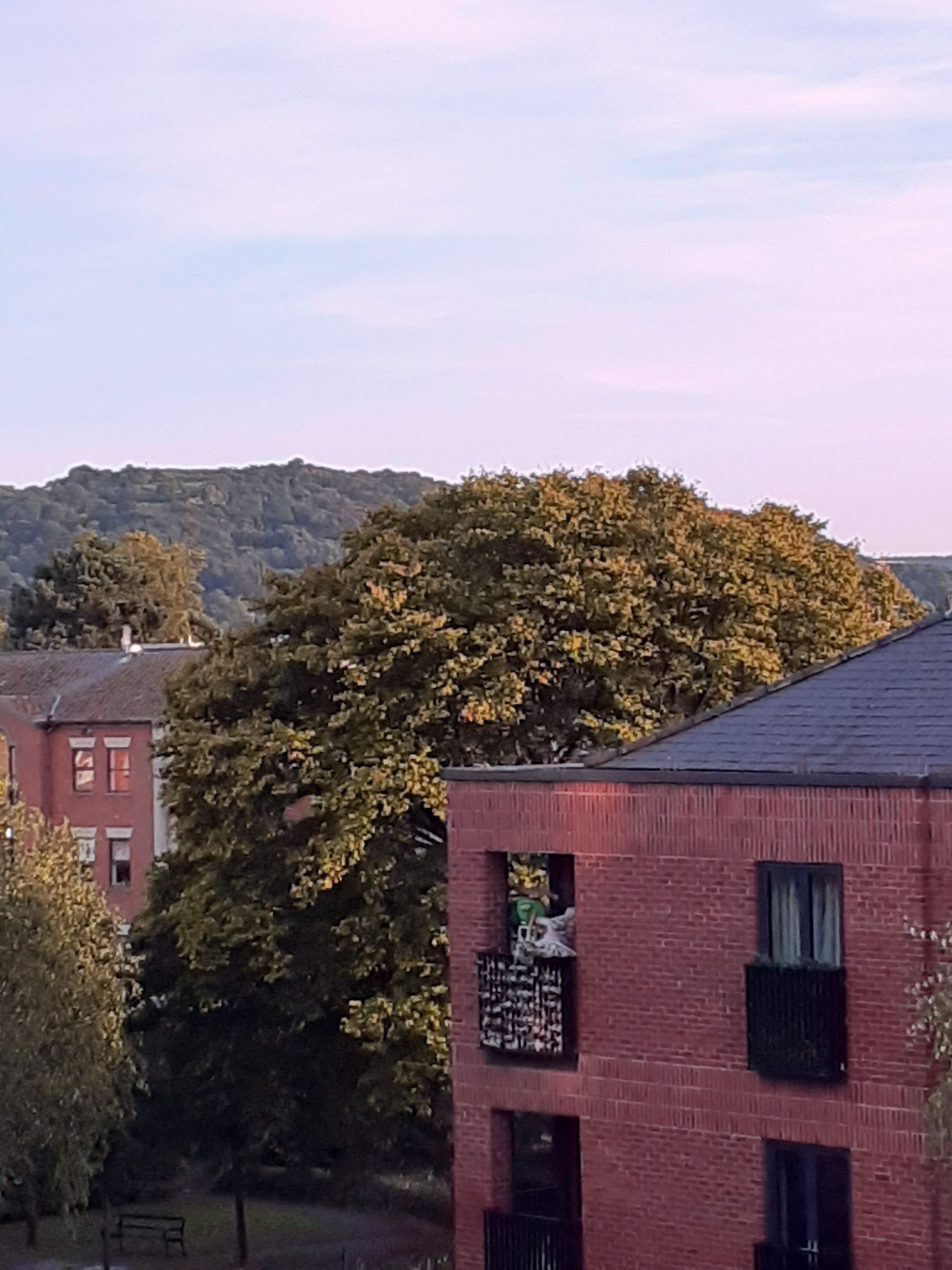
pale blue sky

pink clouds

wooded hills,

and a residue of sunlight

on the majestic hornbeam

whose leaves have begun to turn.

Early autumn, early evening:

a whole world in seeming suspension

between one state and another.

The wheel turns

through both day and year.

States are not fixed

at any point in time.

Yet to notice the moment

with softened heart

and strengthened sight

makes that moment eternal.

Looking out

from my apparently restricted life,

I see the wide world,

expectant.

JULY DAYS 2024

My walking time is still restricted. Perhaps because of this, familiar outdoor spaces have become exotic and magical to my eyes. My limiting circumstances are paradoxically making me more focused and attentive, enhancing my felt quality of life. I am readier to find joy in simple, passing experiences.

On my contemplative walks, the shapes and colours of trees move me deeply. Grasses and sky have a similar impact. I am very aware of these July days. I am very aware of summer. I am very aware of my place in the world as the year turns in my immediate neighbourhood.

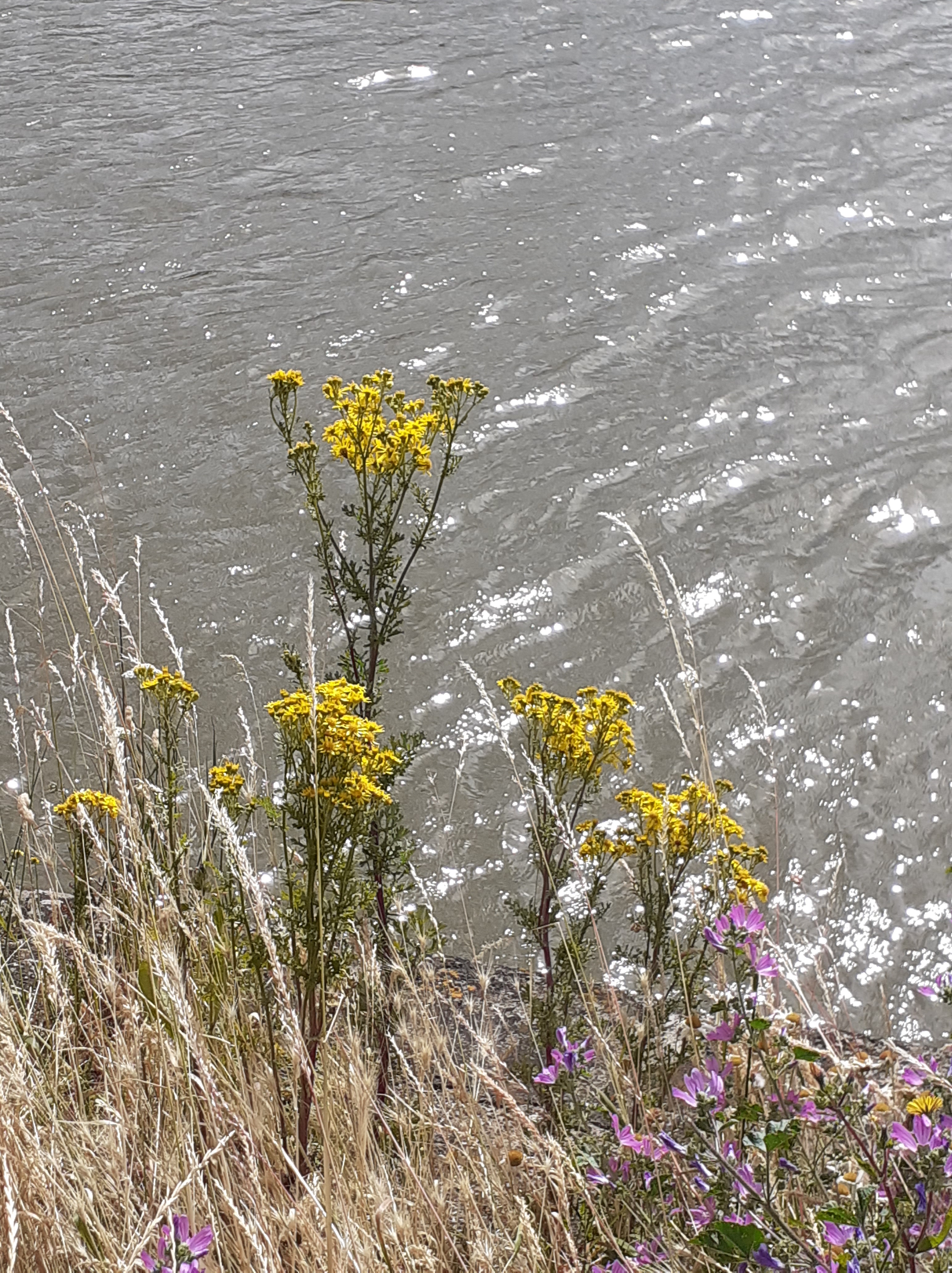
A little further away, I stand on a canal bridge (below) and look back towards the city, which seems distant and small. Water and sky give me space and perspective. I let the elements of water and air nourish me at a time when I am largely grounded.

Close up at the water margin, I find light shining on the water. There is energy and movement here. The power of the sun is present in both a shifting luminosity on the water and the flowering resilience on the bank.

I shift into a meditation on the four classical elements – earth, water, air and fire – and how they work together to make the fifth (life, spirit) possible. Consciously engaged with the four, I can stand as the fifth, resourcing my individual life within a world of impermanence and interbeing.

SEEING BEYOND SIGNS

“A sign is what characterises the appearance of something, its form. If we recognise things based on their sign, we may think that this cloud is different from that cloud, the oak tree is not the acorn, the child is not the parent. At the level of relative truth, these things are helpful. But they may distract us from seeing the true nature of life, which transcends these signs.

” ….

“You are always changing form. You are browsing through a family photograph album, and come across a photo of yourself as a young child. Where is that little child now? You know that it is you. You have the same name, and yet it doesn’t look like you. Are you still that child or are you someone else? This is a practice of contemplating your own signlessness. Today you look, speak, act and think differently. Your form, feelings, perceptions and consciousness are all very different. You are not fixed and permanent. You are not the same person, but you are not a totally different person either. When you are no longer caught in specific images or appearances, you can see things more clearly. You can see that the little child is still alive in every cell of your body. It is possible still to listen and take care of the little boy or little girl in you at any time.” (1)

(1) Thich Nhat Hanh The Art of Living London: Penguin Random House UK, 2017

PEONIES IN LATE MAY

As I look at these peonies, I delight in their lushness. But the word ‘poignant’ also comes to mind. Delight is mixed with sadness, and a sense of time slipping away. These are probably the last pictures of these peonies that I will take. They are in the back garden of our old home on the day it was emptied of our remaining possessions. Historically they have ushered in the first fullness of summer. They have confirmed a warm sense of home, year after year, as the wheel turns.

But now I am leaving a place Elaine and I called home for many years, at a time when the future remains uncertain on many levels. The stability of the wheel itself, or at least of its local manifestations, is palpably in question. You have to work perversely hard, now, to maintain an ignorance and denial of the climate crisis. Even here, in a cool temperate island.

I cannot dwell in sadness alone, potentially drawn down into a stuck and demobilised distress. The health and viriditas in my bodymind won’t allow it. I find myself staying open to a delight in what is given, here, in these seasonal images. The invitation to celebrate the bounty of nature in an everyday modest setting is very strong, and I respond. The nudge to make a record is likewise strong. Records and memory matter. They change any living moment to which they are invited. The opportunity to contemplate this image of peonies, knowing the context of the picture-taking, is a resource for future times.

WAITING FOR THE STORM

I took this picture from an upstairs window before 9 a.m. on18 February 2022,. It shows blue sky and the tower of St Mary de Crypt, Gloucester. The image is calm, and I enjoy its simple beauty. But I am bracing for a severe storm, officially named ‘Storm Eunice’. We are on red alert, which is very rare in this country. I contemplate the tower, which stands both for longevity and impermanence.

It is 10.15 a.m. now and the wind, at first just playful, has moved into serious gusting. Paper and leaves blow about in a courtyard. The sky is grey and there are raindrops on my window pane. Taking another picture, I notice I have lowered my sights. I have included more material substance, roof tops in particular. The invitation to skyward contemplation, so poignantly encouraged by towers like this, isn’t so present for me in this moment. The theme now is embodied endurance and solidity, weathering the winds of the world. For they don’t seem at all celestial, their current force at least partly the result of our own collective behaviour. Strong walls and a decent roof are the focus of my desire. I am, after all, a Pagan.

I am an urban Druid now, more clearly than before. It gives me a different view of nature. On one hand I am reminded that everything is included in ‘nature’. But in so far as I make a city/country distinction, I do notice a different experience of the elements, seasons, and the varieties of life. In an old and relatively small city (pop. 165,000) it is easier to see the evolution of human culture as a gradual and organic process than in other built environments. Today is a special day because raw and conceivably violent nature is coming on a visit. Whilst I notice fears around this, and am distressed by the notion of harm to anyone, I also find an aspect of Spring, and renewal, in this. I do feel energised, now, just after 11 a.m., and this at least is welcome. I have no idea of how the day is going to play out here, or what I am going to feel about my experience of Storm Eunice at the days end.

EXPLORING ‘EMPTINESS’: CARLO ROVELLI AND NAGARJUNA

A modern western humanist learns from an ancient Buddhist philosopher. Carlo Rovelli’s book Helgoland (1) is mostly about the development of quantum mechanics in the early to mid-twentieth century and the scientists who developed it. The title references ‘Werner Heisenberg’s sojourn on the remote island of Helgoland working on the maths. But one chapter concerns the second century CE Buddhist philosopher Nagarjuna, and how his work has helped Rovelli to frame a philosophical understanding of quantum phenomena.

“When speaking about quanta and their relational nature I had frequently met people who asked: Have you read Nagarjuna? … Though not widely read in the West, the work in question is hardly an obscure or minor one: it is one of the most important texts in Buddhist philosophy. … The central thesis of Nagarjuna’s book is simply that there is nothing that exists in itself, independently from something else.

“The resonance with quantum mechanics is immediate. Obviously Nagarjuna knew nothing, and could not have imagined anything, about quanta – that is not the point. The point is that philosophers offer original ways of re-thinking the world, and we can employ them if they turn out to be useful. The perspective offered by Nagarjuna make perhaps make it a little easier to think about the quantum world (2).

“If nothing exists in itself, everything exists only through dependence on something else, in relation to something else. The technical term used by Nagarjuna the absence of independent existence is ‘emptiness’ (sunyata): things are ‘empty’ in the sense of having no autonomous existence. They exist thanks to, as a function of, with respect to, in the perspective of, something else.

“If I look at a cloudy sky – to take a simplistic example – I can see a castle and a dragon. Does a castle and does a dragon really exist, up there in the sky? Obviously not: the dragon and the castle emerge from the encounter between the shape of the clouds and the sensations and thoughts in my head; in themselves they are empty entities, they do not exist. So far, so easy. But Nagarjuna also suggests that the clouds, the sky, sensations, thoughts and my own head are equally things that arise from the encounter with other things: they are empty entities.

“And myself, looking at the star, do I exist? No, not even I. So who is observing the star? No one says Nagarjuna. To see a star is a component of that set of interactions that I normally call my ‘self’. ‘What articulates language does not exist. The circle of thoughts does not exist.’ There is no ultimate or mysterious essence to understand that is the true essence of our being. ‘I’ is nothing other than the vast and interconnected set of phenomena that constitute it, each one dependent on something else. Centuries of Western speculation on the subject, and on the nature of consciousness, vanish like morning mist.

“Like much philosophy and much science, Nagarjuna distinguishes between two levels: conventional, apparent reality with its illusory and perspectival aspects, and ultimate reality. But in this case the distinction takes us in an unexpected direction: the ultimate reality, the essence, its absence, is vacuity. It does not exist.

“If every metaphysics seeks a primary substance, an essence on which everything may depend, the point of departure from which everything follows, Nagarjuna suggests that the ultimate substance, the point of departure … does not exist.

….

“The illusoriness of the world, its samsara, is a general theme of Buddhism; to recognize this is to reach nirvana, liberation and beatitude. For Nagarjuna, samsara and nirvana are the same thing: both empty of their own existence. Non-existent.

“So is emptiness the only reality? Is this, after all, the ultimate reality? No, writes Nagarjuna, in the most vertiginous chapter of the book: every perspective exists only in interdependence with something else, there is never an ultimate reality – and this is the case for his own perspective as well. Even emptiness is devoid of essence: it is conventional. No metaphysics survives. Emptiness is empty.

“Nagarjuna has given us a formidable conceptual tool for thinking about the relationality of quanta: we can think of interdependence without autonomous essence entering the equation, In fact interdependence – and this is the key argument made by Nagarjuna, requires us to forget all about autonomous essences.

“The long search for the ‘ultimate substance’ in physics has passed through matter, molecules, atoms, fields, elementary particles … and has been shipwrecked in the relational complexity of quantum field theory and general relativity. Is is possible that a philosopher from ancient India can provide us with a conceptual tool with which to extricate ourselves?”

“The fascination of Nagarjuna’s thought goes beyond questions raised by contemporary physics. His perspective has something dizzying about it. It resonates with the best of much Western philosophy, both classical and recent. … He speaks about reality, about its complexity and comprehensibility, but he defends us from the conceptual trap of wanting to find it an ultimate foundation.

“His is not metaphysical extravagance: it is sobriety. It recognizes the fact that to inquire about the ultimate foundation of everything is to ask a question that perhaps simply does not make sense.

“This does not shut down investigation. On the contrary, it liberates it. Nagarjuna is not a nihilist negating the reality of the world, and neither is he a sceptic denying that we can know anything about that reality. The world of phenomena is one that we can investigate, gradually improving our understanding of it. We may find general characteristics. But it is a world of interdependence and contingencies, not a world that we should trouble ourselves attempting to derive from an Absolute.

“I believe that one of the greatest mistakes made by human beings is to want certainties when trying to understand something. The search for knowledge is not nourished by certainty: it is nourished by a radical absence of certainty. Thanks to the acute awareness of our ignorance, we are open to doubt and can continue to learn and learn better. This has always been the strength of scientific thinking – thinking born of curiosity, revolt, change. There is no cardinal or final fixed point, philosophical or methodological, with which to anchor the adventure of knowledge.

“I am not a philosopher; I am a physicist: a simple mechanic. And this simple mechanic, who deals with quanta, is taught by Nagarjuna that it is possible to think of the manifestation of objects without having to ask what the object is in itself, independent from its manifestations.

“But Nagarjuna’s emptiness also nourishes an ethical stance that clears the sky of the endless disquietude: to understand that we do not exist as autonomous entities helps us free ourselves from attachments and suffering. Precisely because of its impermanence, because of the absence of any absolute, the now has meaning and is precious.

“For me as a human being, Nagarjuna teaches the serenity, the lightness and the shining beauty of the world: we are nothing but images of images. Reality, including ourselves, is nothing but a thin and fragile veil, beyond which … there is nothing.”

(1) Carlo Rovelli Helgoland global.penguinrandomhouse.com 2020 (Translated by Erica Segre & Simon Carnell, 2021) Carlo Rovelli is a theoretical physicist who has made significant contributions to the physics of space and time.

(2) The Fundamental Wisdom of the Middle Way: Nagarjuna’s Mulamadhyamakakarika: Translation and commentary by Jay L. Garfield. Oxford: The University Press, 1995. Nagarjuna, who lived in South India in approximately the second century CE, is the most important, influential and widely studied Mahayana Buddhist philosopher. At the time of publication Jay L. Garfield was Professor of Philosophy and Director of the Hampshire in India Program, an exchange program with the Tibetan Universities in exile, at Hampshire College, Amherst, Massachusetts. His translation is from a Tibetan, rather than Sanskrit, text.

CATCHING A MOMENT

Above, inside looking out. Below, outside looking in – with added reflections.

Below again, from a little further back, the full richness of a sunlit moment, in a particular time and place. For me, it becomes the image and feeling-tone of its day, and, later on, a soft thought in memory.

TREE MANDALA: BEECH AND BLUEBELL

In my wheel of the year tree mandala (1), beech and bluebell together cover the period from 24 May-15 June – taking over from hawthorn and handing on to oak. In this instance, I am drawn by the powerful visual effects of bluebells carpeting woodland in which beech is the dominant tree.

The picture above is an old one. The last year in which Elaine and I went into this space (2018 or 2019) the wood felt weird. Part of it – not quite the area in the picture – was a scene of desolation. A lot of the trees had been taken down, with a kind of ragged insensitivity. It felt like a bad moment in Lord of the Rings. I don’t know the story behind this. Perhaps there was disease, or some other genuine need for a thinning out of trees. It was certainly systematic, with notices about the work being done – the result of management, and not of vandalism, in the conventional usage of our language.

The beech is an elegant tree, and I experience it as having a soft energy. It has been traditionally feminised, and thought of as ‘Queen of the Woods’, sharing the place of honour with the kingly oak according to The Green Man Tree Oracle (2). The same source says that “slivers of beech wood and leaves were once carried as talismans to bring good luck and increase creative energy”. Local British traditions associate the beech (ogham name phagos) with serpents “probably because of its long serpentine root systems”, they add – and I wonder too about the archaic link between the Goddess and serpent power in many cultures.

.

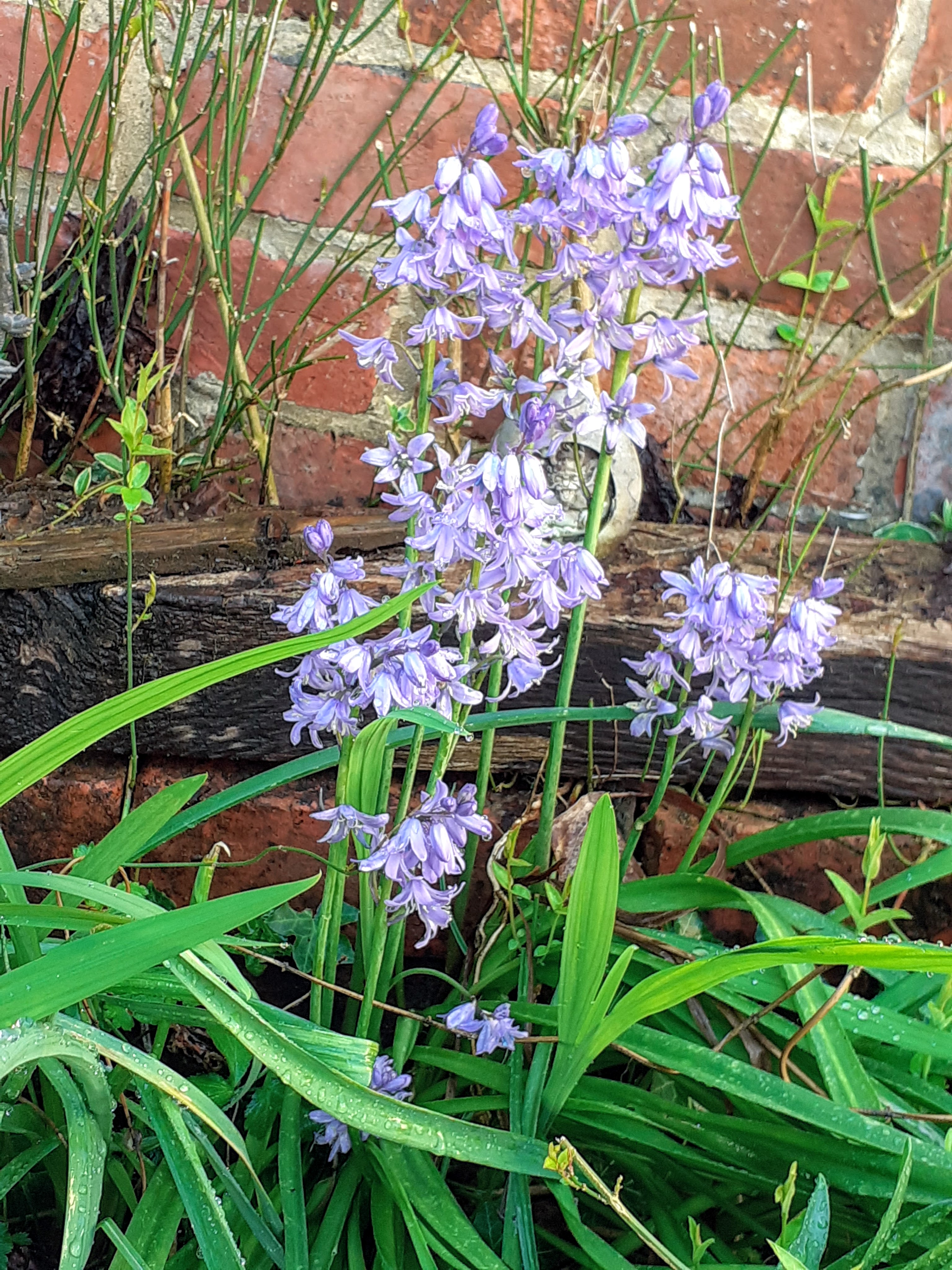
My personal connection with the tree itself is limited. It concerns this time of year and the association with bluebells. Indeed the bluebell is my main focus, with the beech as complementary. If they are separated, I follow the bluebell, and the picture below is a recent one, of the Spanish variety, from our garden. For me, it represents a favourite moment in the year, to be appreciated while it lasts. It reminds me simultaneously of the poignancy of impermanence (including my own) and the beauty of the eternal present (within which I am held).

(1) This mandala is based on my personal experience of trees in the neighbourhood as well as traditional lore. Moving around the summer quarter from Beltane, 1 May, the positions and dates of the four trees are: Hawthorn, south-east, 1-23 May; Beech & Bluebell, south-south-east, 24 May – 15 June; Oak, south, 16 June – 8 July; Gorse, south-south-west, 9 – 31 July. The autumn quarter then starts with Apple at Lughnasadh/Lammas. For a complete list of the sixteen trees, see https://contemplativeinquiry.blog/2020/autumn-equinox-2020-hazel-salmon-awen/

(2) John Matthews & Will Worthington The Green Man Oracle London: Connections, 2003.

EARLY APRIL ENERGY 2021

April has been called the cruellest month. But I am experiencing a much hoped-for kindness right now. I am expansive and energised. Finally, it feels like spring in my neighbourhood. Spring as it is meant to be.

The natural world is changing, and a tentatively recovering human population is beginning to reclaim the outdoors. Now is a moment for celebrating the life force – nwyfre, viriditas, whatever we may want to call it. I find my own feelings reflected back in the vitality and vigour of the world I see around me.

The greening of the trees, and hence much of my local landscape, has started. I hope for a fuller transformation by Beltane – now less than four weeks away.

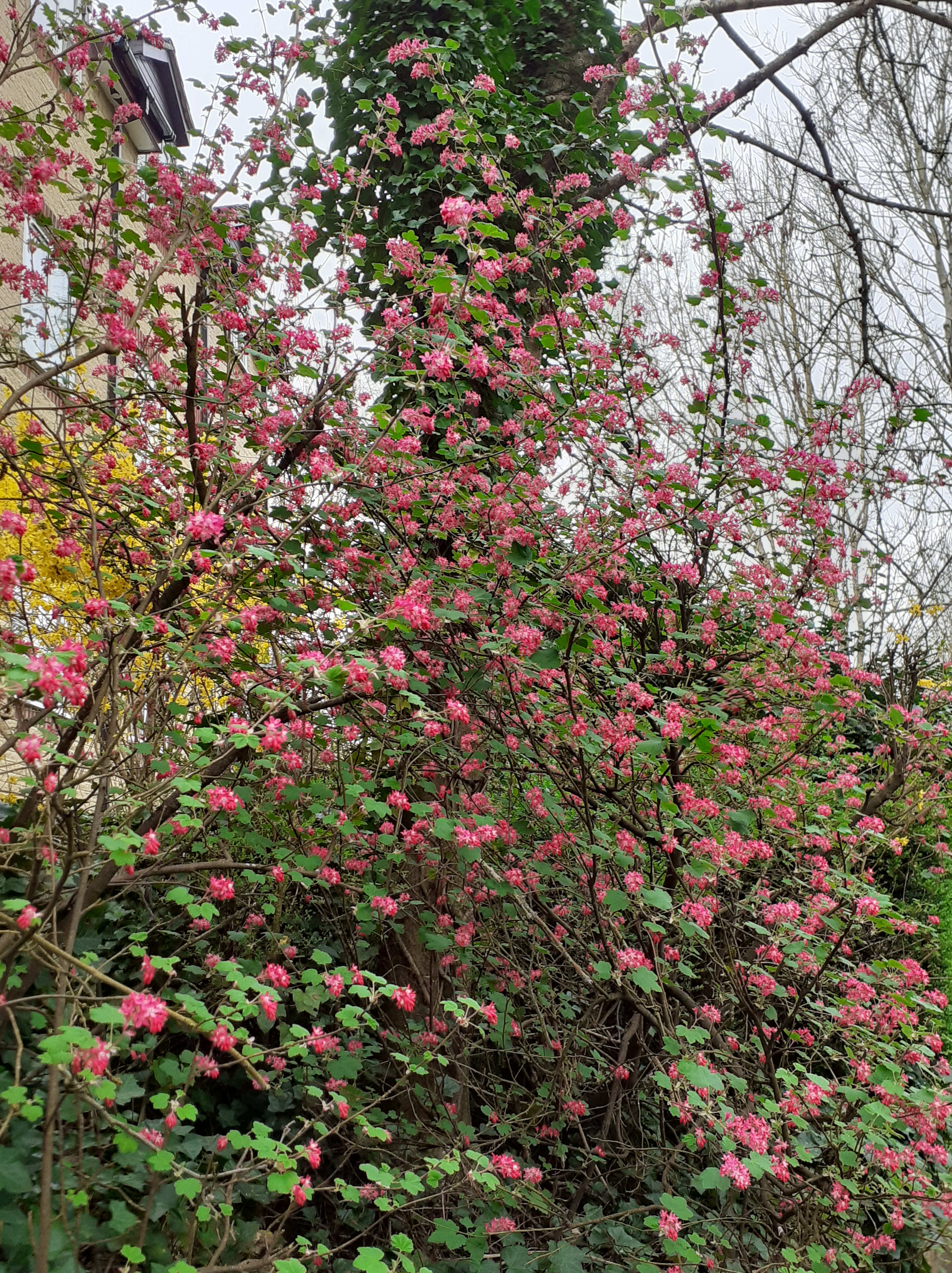
There is an abundance of colour in the woods, with the emphasis changing from the delicate blossoms we have already seen to more robust and stronger coloured flowers.

Even entering a built environment, floral energy arches across the paths.

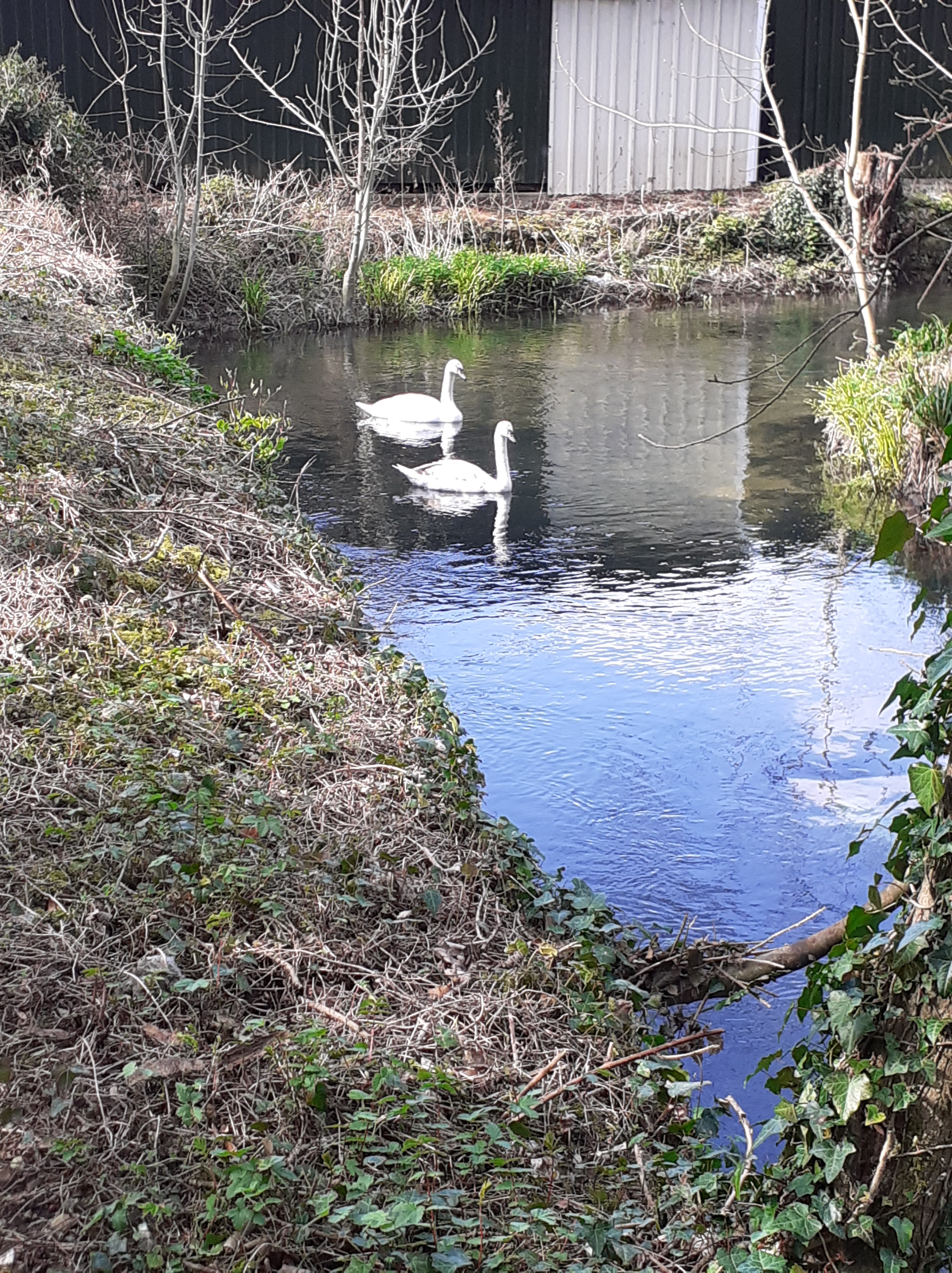
In the animal kingdom, life is stirring too. On the canal, rivers and ponds around me, swans are now pairing and nesting. I hope they have another good year.

It almost hurts to know that life – so fleeting and variable – can be so good.

Earth Eclectic

music that celebrates Earth and speaks to the heart

Sarah Fuhro Star-Flower Alchemy

Follow the Moon's Cycle

Muddy Feet

Meeting nature on nature's terms

Rosher.Net

A little bit of Mark Rosher in South Gloucestershire, England

Becoming Part of the Land

A monastic polytheist's and animist’s journal

selkiewife

Selkie Writing…

Charlotte Rodgers

Images and words set against a backdrop of outsider art.

Prof Jem Bendell

living with metacrisis and collapse

Towint

The pagan path. The Old Ways In New Times

The Druids Garden

Spiritual journeys in tending the living earth, permaculture, and nature-inspired arts

The Blog of Baphomet

a magickal dialogue between nature and culture

This Simple Life

The gentle art of living with less

Musings of a Scottish Hearth Druid and Heathen

Thoughts about living, loving and worshiping as an autistic Hearth Druid and Heathen. One woman's journey.

Wheel of the Year Blog

An place to read and share stories about the celtic seasonal festivals

Walking the Druid Path

Just another WordPress.com site

anima monday

Exploring our connection to the wider world

Grounded Space Focusing

Become more grounded and spacious with yourself and others, through your own body’s wisdom

The Earthbound Report

Good lives on our one planet

Hopeless Vendetta

News for the residents of Hopeless, Maine