Contemplative Inquiry

This blog is about contemplative inquiry

Tag: Imbolc

ALDER (FEARN) PROTECTION

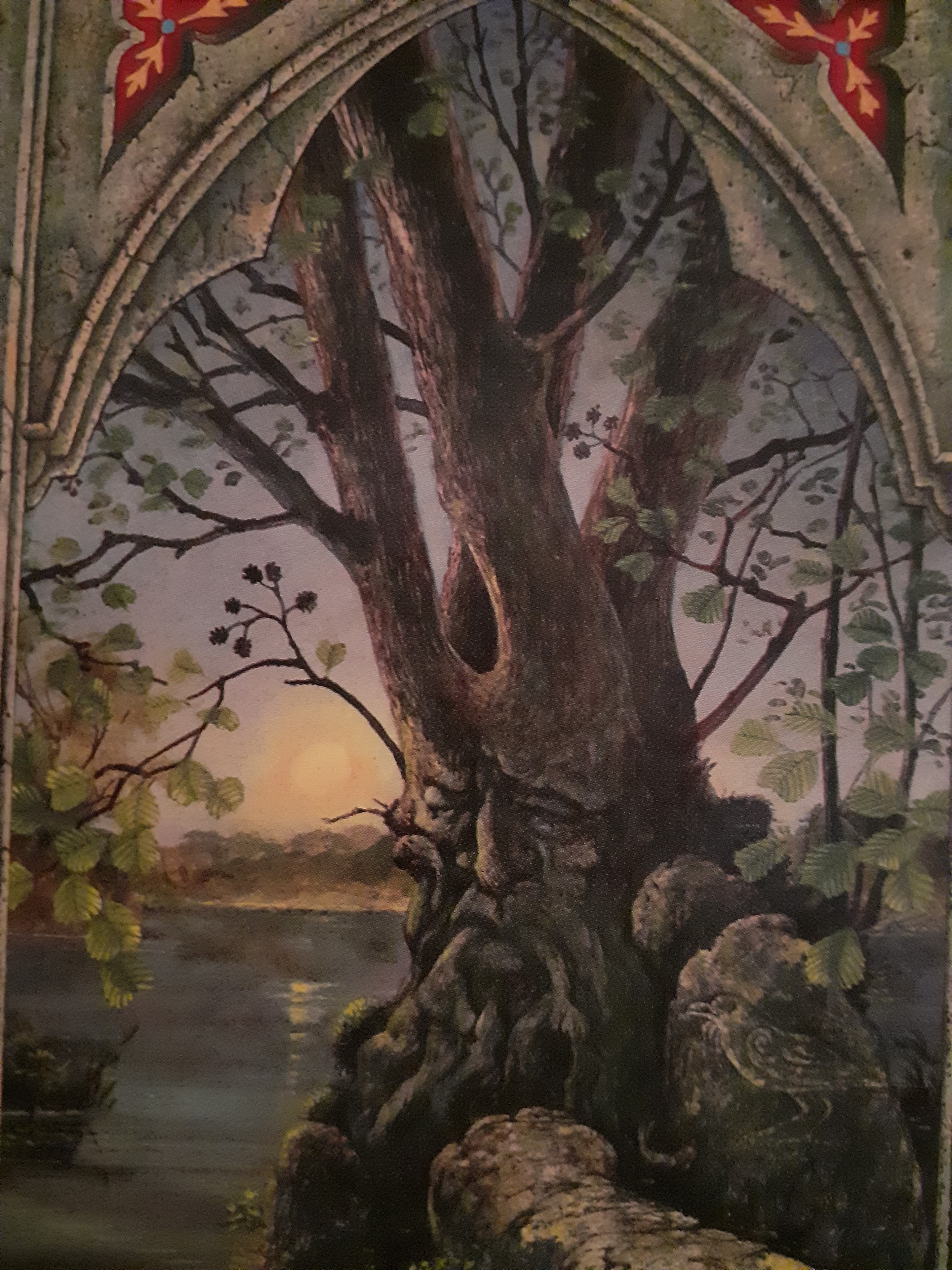
Within my mandala of the year (1) Alder (2) is the fourth and final tree for the winter quarter that begins at Samhain. The overall movement of this quarter, in my world, is through death to regeneration. Alder presides from 8-31 January and links the regenerative aspect to a continuing need for protection already signalled by Holly (3). There is something foundational about protection. The late eighteenth century Druid prayer (4), which set the note for modern Druidry, begins by asking for protection, as the beginning of a journey that leads through the quest for justice to a place of universal love.

I live in a watery place and there are alders around, though – in contrast to willow – I have never been on hugging terms with this tree. But the oily and water resistant timber is well-adapted to its surroundings, and for humans has provided good timber for boats, bridges, and underwater foundations. Many medieval cathedrals were built on alder piling. Although the wood makes poor fuel, it is good for charcoal.

Round alder shields were once used as protection for warriors in Ireland, and “in Celtic myth, we read of palisades of alders that deter invasion of keep prisoners confined, and these fences are sometimes described as being decorated by a row of severed human heads” (2) . The Welsh hero Benedegeit Bran (Bran the Blessed) is reputed to have used his body to span the River Linon, forming a bridge to raise his followers above the dangerous waters, as the wood does when used as a building material. Later, when mortally wounded in a battle against the Irish, he gave them instructions to cut off his head and carry it with them. They were rewarded with song and prophecy from the head over many years.

Much more can be said about Bran (whose name means raven). My overall learning from alder is about a willingness and capacity to hold boundaries Bran adds sensitivity and openness to the larger context in which events are playing out. Placed at the end of the winter quarter, I see alder as guarding the tentative return of spring, as the light slowly returns and we find increasing signs of growth in the natural world. The weeks before Imbolc can be cold and dreary, but life is stirring both outwardly and inwardly. Alder reminds me of the need for protected spaces to nurture a latent abundance.

(1) The image is from: John Matthews & Will Worthington The Green Man Oracle London: Connections, 2003.

(2) This mandala is based on my personal experience of trees in the neighbourhood as well as traditional lore. Moving around the winter quarter from 1 November, the positions and dates of the four trees are: Yew, north-west, 1-23 November; Elder, north-north-west, 24 November – 16 December; Holly, north, 17 December – 7 January; Alder, north-north-east, 8 – 31 January. The spring quarter then starts with birch at Imbolc. For a complete list of the sixteen trees, see https://contemplativeinquiry.blog/2020/autumn-equinox-2020-hazel-salmon-awen/

(3) https://contemplativeinquiry.blog/2020/12/23/holly-tinne-the-turn/

(4) https://contemplativeinquiry.blog/2020/08/27/my-druid-prayer/
LIGHT RENEWED

I have now landed in 2021. I can see the renewal of the light; however tentative it might be. The winter quarter, from Samhain to Imbolc, is a season of dying and regeneration. I have glimpsed regeneration in nature and in myself – potentially in culture too. The collective crisis is deep, and projects remain on hold. But I can sense opportunity, and possibilities for creative change.

I have noticed a major transition in my work. I have entered a phase where contemplative inquiry is a strand in my life rather than a project called ‘Contemplative Inquiry’. I look back and see this transition as an accomplishment of 2020. Certain questions have been answered and won’t need much revisiting. I began an ended the project within a modern Druid orbit – saturnine in distance, perhaps, but still part of the family.

My view, values and practice have largely settled. A lightning-flash experience, or transformative encounter, might cause me to change them, for I retain a commitment to openness. But the project of Contemplative Inquiry will not. I am much less engaged with teachers, teachings and traditions than in former years, whether through literature, groups or events (live and virtual). Instead, I want to work more deeply and congruently within the frameworks I have already learned and developed. I tend to be a solitary practitioner at heart, though I also like some link to companions and community along my spiritually hermit way.

The great gift in this is the opportunity to live a life of ‘abundance in simplicity’ at the level of ideas as well as material goods and activities – to pare down in the very area where I am most tempted to seek variety and feast on new input. There is Sufi story in which the crazy wisdom master Shams persuades the more conventionally trained Rumi to throw all his religious texts down a well. I do not plan to go so far. But I recognise the time for a change in emphasis. As a trade-off, my monkey mind is freed for other subjects. I look forward to seeing how this new direction works, and how it affects this blog.

LIGHT ON TREES

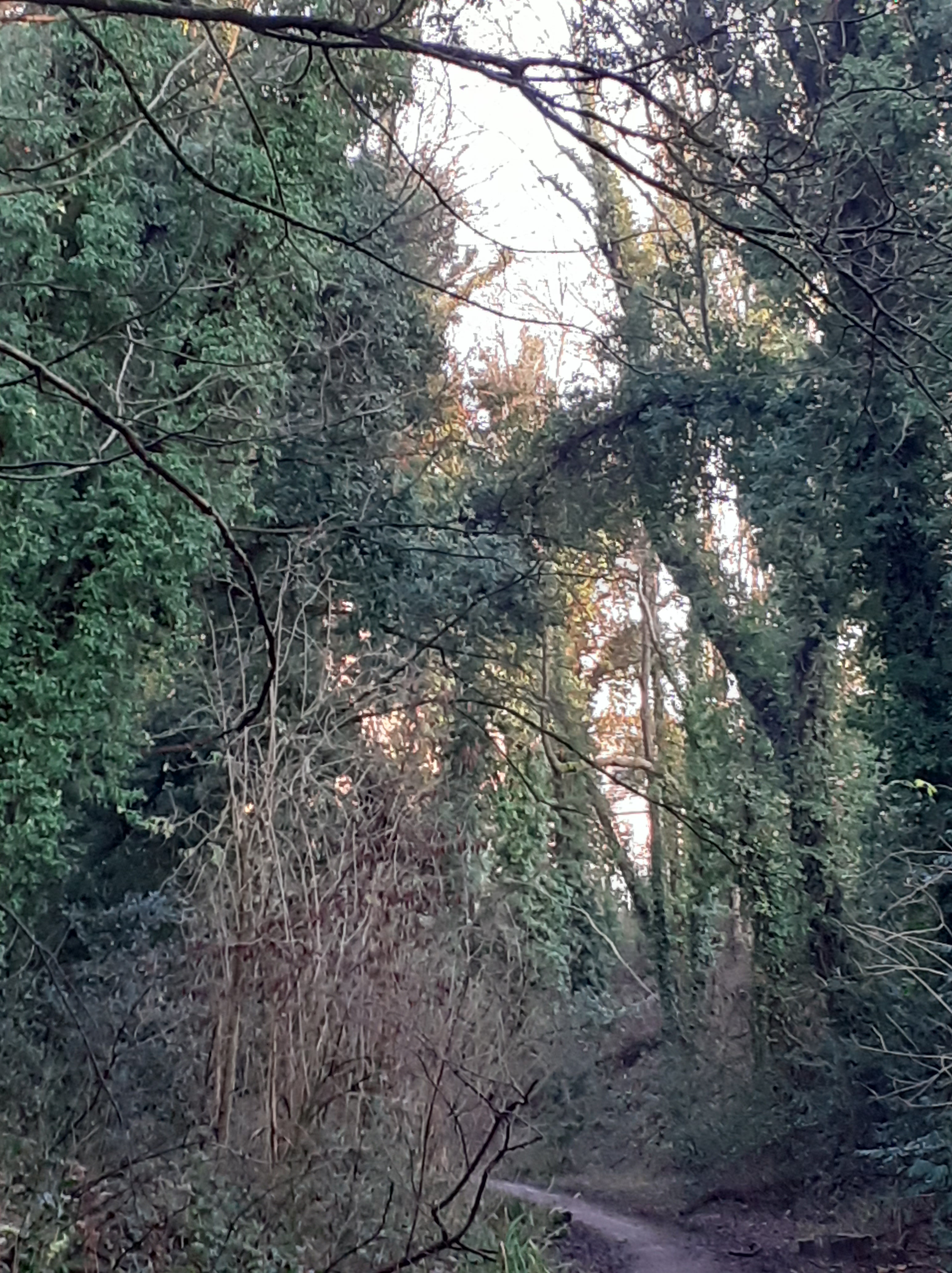
Bright light as a valley experience. Sunlight on trees. February 6, the day I took this picture, provided my first experience of intense sunlight this year. It got through to me even in a shady place. My eyes were dazzled and my head struck by an unexpected warmth.

I noticed mixed feelings. Yes, I celebrated the return of the light. Yes, it was a reference experience for the spring aspect of Imbolc in my part of the world. More visceral than snowdrops, the sun truly reached me and not just my nature-observant sensibilities. It was almost shocking.

Looking out, after that first moment, my world filled up with light on trees. I wondered if they too had any resistance to waking up and being visible and called upon to grow and change and open to the light more fully. I don’t know what it’s like to be a tree. Not really. Withdrawing my projections, I am turned back to my own responses. Parts of me have reservations about immersion in the light. Perhaps they have a wisdom of their own.

IMBOLC 2020

Spaces ‘between’ can be numinous. They feed the soul. Imbolc for me is like a pre-dawn light. I am not yet out of winter, but something else is happening, and palpably growing in strength.

The hierophant of the Wildwood Tarot – the Ancestor – is placed as a power of Imbolc. An antlered figure clothed in reindeer skins and evergreen leaves, she has a resonance of Elen of the Ways, the reindeer goddess who stands for the sovereignty of the land. She calls to us from a deep past where Ice Age hunters followed reindeer through ancient forest, “following the deer trods” (1,2) responsive to the herds and attuned to the landscape. They lived with little personal property and without long hours of alienating work. The Ancestor invites us to wonder what these early ancestors  might have to teach us under our very different conditions.

On the card, the Ancestor is sounding a drum and calling us into another consciousness – one more open and aware of our place within the web of life. In her world, deer and people are kin. She herself is ambiguous – she might be wearing a mask, or she might be a truly theriomorphic figure. I respond to her call by sinking deeply into my felt sense – the embodied life of sensation, feelings and belly wisdom. The call of the Ancestor  is a pathway to greater wholeness and connection, both personally and collectively. As the year wakes up, it is a good call to hear.

(1) Elen Sentier Elen of the Ways: British Shamanism – Following the Deer Trods Arlesford, Hants: Moon Books, 2013 (Shaman Pathways series)

(2) Elen Sentier Following the Deer Trods: A Practical Guide to Working with Elen of the Ways Arlesford, Hants: Moon Books, 2014 (Shaman Pathways series)

See also book review at: https://contemplativeinquiry.blog/2014/06/22/

JANUARY DAYS

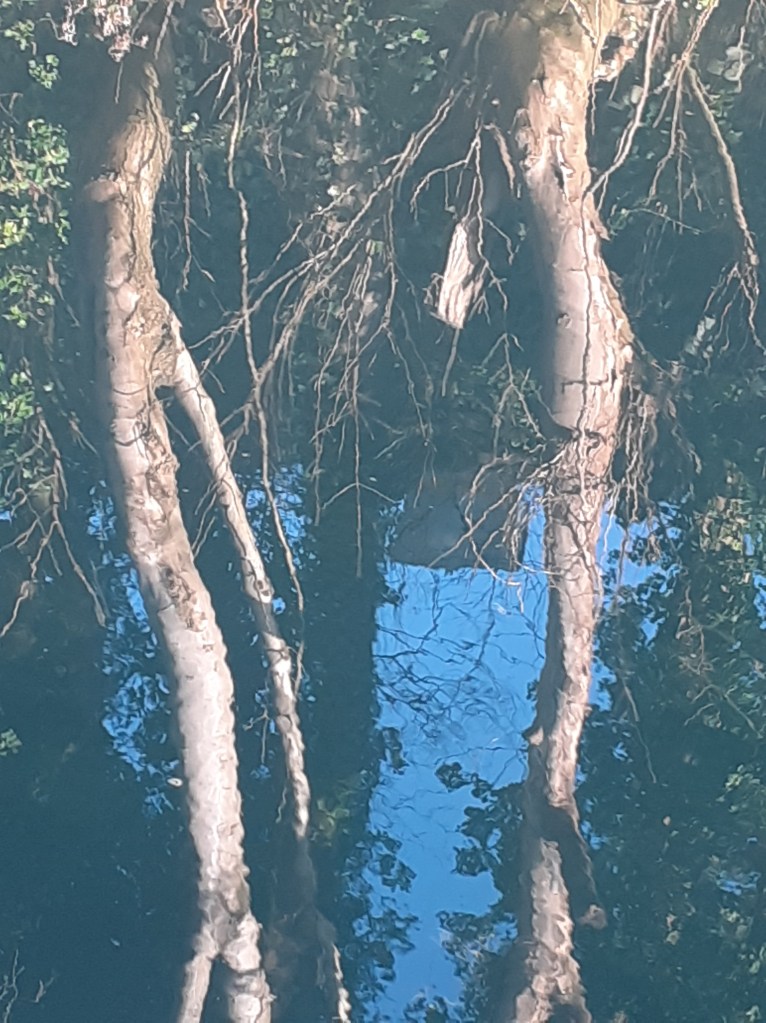
I am conscious now of moving beyond midwinter and towards Imbolc (1 February), the first celebration of returning light. For me, the-mid January period is held in the above image. Tree trunks reflected in water evoke depth rather than height. The image faithfully depicts their withdrawn winter life whilst hinting at other life below the surface, as the world turns over in its sleep.

HOODED HERMIT

Winter in the  Wildwood Tarot lasts from Samhain (1 November) to Imbolc (1 February), whereupon the spring quarter begins. The hooded man, hermit of this deck, is shown as solstice figure whose influence pervades the whole winter. The image depicts a hooded figure, staff in the left hand and lantern in the right, standing by a great oak tree. The lantern illuminates a door in the tree, which itself suggests, through cracks in its timbers, an illuminated space inside. A wren sits on a stone nearby.

There is power in this image. The world tree, standing for life and wisdom, is both source and refuge. The hooded hermit seems to model intention and training, and his lantern and staff are potent tools. The wren once won a contest to be king of the birds by riding on the back of an eagle and thus flying highest. An animal ally, perhaps.

The face of the hooded hermit is hidden: no visible sign of a forest rebel; no sign, specifically, of a man. Does this suggest a talent for invisibility or shape-shifting? Perhaps. But what I chiefly sense is a Zen emptiness, of which Thich Nhat Hanh (2) says: “At first, we think emptiness is the opposite of fullness but, as we saw earlier, emptiness is fullness. You are empty of your separate self, but full of the cosmos.” According to another Zen writer (3), “the Buddha called himself tathagata or ‘that which is thus coming and going’ …a flowing occurrence, and the outward form ,,, was constant, calm, compassionate availability to people who came to him for help.”

I am not a Buddhist and I do not seek to appropriate the hooded hermit for Buddhism. Similar ideas about the emptying out of personality to make room for a greater life can be found in Taoism (4) and Douglas Harding’s Headless Way (5). There’s a reminder here that path and goal are one, and that an emptied fullness of experiencing is available at any point of the journey.

(1) Mark Ryan & John Matthews The Wildwood Tarot Wherein Wisdom Resides London: Connections, 2011. Illustrations by Will Worthington

(2) Thich Nhat Hanh The Other Shore: A New Translation of the Heart Sutra with Commentaries Berkeley, CA: Palm Leaves Press, 2017

(3) Ben Connelly Inside Vasubandhu’s Yogacara: A Practitioner’s Guide Somerville, MA: Wisdom Publications, 2016

(4) Lao Tzu Tao Te Ching: A Book about the Power and the Way Boston & London: Shambhala, 1998 (A new English version by Ursula K. Le Guin, with the collaboration of J.P. Seaton, Professor of Chinese, University of North Carolina, Chapel Hill)

 (5) http://www.headless.org

IMBOLC ADVENT

Erin nighean Brighde* has recently written about ‘Imbolc Advent’. I like this term. Where I live, mid-January could feel cold and dull and flat. It could be a time of post-festive blues, and a very long way from spring. My cure, from the early 1990’s, has been the eight-fold wheel of the year, now lived by many groups within and beyond the modern Pagan community. It has enriched me enormously.

For the last week or so I have been leaning in to Imbolc, the festival that, at the beginning of February (Northern hemisphere), celebrates the return of the light, the appearance of early flowers and traditionally also the birth of lambs. In Druidry, it is strongly linked to the Goddess Brigid. My leaning in to Imbolc this year has been interwoven with the transformation of three initially parched hyacinth bulbs (a late seasonal gift) in a pot of dry earth. The change began when I saw them draw water from a saucer. Its rapid disappearance was like watching a speeded-up film. Within a couple of days, stalks had burst almost alarmingly out of the bulbs, and it was not long before the scented bell-like lavender blue flowers emerged from the spikes. I realize that this was a contrived indoor event, but I have experienced it over the last week as a stunning display of life and growth, and hence an image of Imbolc Advent.

During the life-time of the Druid contemplative group, we tended to meet outside the festival times, partly to avoid clashes with other commitments, and partly to practice tuning into the year at other times. We could do this by taking the previous or following festival as a reference point and notice the mid-term difference, or we could more simply pay attention to the world we were in at the time of meeting. Over time, we developed a greater sensitivity to the rhythms and tides in the year as nature’s unfolding processes, since we were not focusing on the festivals themselves as events. Nonetheless, they remained important markers for our experience. They helped to provide us with a common language and orientation. That being said, I remember something special around Imbolc, out of all the eight festivals. The fire in the hearth, the arrangement and decoration of the space (snowdrops in particular) gave us a powerful experience of Brigid as a presiding energy, making Imbolc one of our most resonant times.

*Erin nighean Brighde https://hereternalflame.wordpress.com/2018/01/14/imbolc-advent-2018/

FUINN

Elaine and I returned from London yesterday afternoon, feeling pleased about our London venture. I’ll say more about that in a later post. Suffice it to say here that we found a ready interest in the possibilities of Contemplative Druidry and hope to return to London later in the year.

We discovered that the fourth CD of the Ceile De Fonn series had been delivered through the mail in our absence. Fonn is a Gaelic word that simultaneously means song, state of mind and the Land. The Fuinn (plural) are sacred chants which “work on many different levels, they harmonise the three parts of us that relate to the three meanings of the word itself – the spiritual, the otherworldly and the physical”. Indeed the Ceile De tradition “uses the imagery of three worlds that, when healthy, blend harmoniously: … the soulful, the spiritual and the physical and are represented here by the Sea, the Sky and the Land. When we are at one with the One we see that these three worlds are also One; our perception has changed and we have discovered ‘the Kingdom of Heaven'”.

The fourth CD was recorded earlier this month, around the time of Imbolc, and has a strong Brighid theme. I bought it in response to my own strong sense of a Brighid current in my own life and practice during the same period – one that goes well beyond the simple acknowledgement that Imbolc is widely seen as Her time. My spiritual note isn’t quite that of the Ceile De, which currently stands as a form of Celtic Christianity in which Brighid is honoured beyond the level of her customary sainthood. But many of the Fuinn, or words from them, presented here can fully support my own Pagan path through chanting, mantra meditation and contemplative prayer. I have worked with Fuinn before, and also have a paidirean (pronounced pahj-urinn) – a set of rosewood prayer beads with (in my case) an equal-armed gnostic cross bound by a circle. Now, with these new chants, I am coming back to them.

For me, experientially, Brighid is the Goddess of inner alchemy and ruthless compassion, and not quite the figure evoked by the Ceile De, though I can respond to Her gentler manifestations as well. But I feel a strong attraction to Gaelic, and Scottish Gaelic in particular, as a sacred language. I like chanting and listening to chants. I like being reminded that ‘contemplation’ in my own practice interweaves meditative, devotional and energetic elements. During recent weeks I have felt a closer connection to Brighid and I will opening myself more systematically to this connection in the coming period.

The Ceile De can be found on http://www.ceilede.co.uk

CONTEMPLATIVE DRUIDRY IN LONDON

This afternoon my partner Elaine and I are travelling to London, and tomorrow we will be joined by our colleague Julie Bond at the Bonnington Centre in Vauxhall, the venue for our Introduction to Contemplative Druidry. It’s a landmark occasion for us, because it’s our first outing under the banner of ‘Contemplative Druid Events’. We are fortunate to have a maturing and deepening local group in Gloucestershire. We have given talks before, based around the book ‘Contemplative Druidry’. But this is the first time we have offered other people an opportunity to share our practice as well as our ideas. We are expecting ten participants as well as ourselves, a good number for us!

This is happening just as I’m experiencing significant shifts in my own spirituality, partly as a result of my personal work, and partly as a result of important moments with others in the course of this month, especially in Imbolc related activities.. I’m not yet sure where it’s going, in precise terms, but it feels rich and fecund. I find myself quite open and sensitive at this time, balancing this out with the demands of a presenter and facilitation role. The result is that I’m feeling a kind of nervous yet deep confidence about engaging with new people in this work.

Our next venture out will be our retreat from 17-19 April, described in http://contemplativedruidevents.tumblr.com/ and on the ‘Contemplative Druid Events’ Facebook page. That will be a further step up, and a focus in coming weeks.

Elaine and I are returning from London on Tuesday, so I won’t be posting again before Wednesday next week.


IMBOLC LIGHTS

I’m reflecting on the difference between ‘Light’ and ‘lights’.  Yesterday evening my partner Elaine and I had an Imbolc ritual. We’ve decided to move through the seasonal festivals in this way, customising a joint practice as we go.

I reflect now on our time in the festive circle as in part a feast of lights. Not ‘Light’, but lights. We can have Light at the throw of a switch, one easy taken-for-granted ‘Let there be Light’ gesture. It’s very powerful and very useful – and effortlessly normal in our culture, at least for the time being.

But it isn’t a feast of lights. A feast of lights requires multiple, small sources. It requires the co-presence of darkness and shadow. It requires variation, degrees of light and darkness. It requires change and play.

We had two basic light sources, during the ritual. The one that attracted my attention most was an array of night lights positioned around the room in various ways. We had nine on the altar (one at the centre, eight at the circumference – with one at each station of the eightfold wheel of the year). And there were others around the room, grouped in threes. Very simple. Very traditional. Very minimal. Very meaningful. Very beautiful. These lights tended to be bright and a high yellow, glinting in some moments, softer and more diffuse at others. Each had its own aura. All tended to flicker in even the smallest current of air. And each had its sphere of influence, fading porously into the surrounding dusk, with no clearly defined or specific boundary – the transitions being so gradual, so gentle. Thus light and darkness were differentiated without being polarised and they cheerfully shared their debatable lands. The play of ambiguity was part of the feast.

The second source was the fire, a wood burner, well-established by the time we began the ritual and happily placed in a north-easterly hearth. Also very traditional. Very simple. Very minimal. Very meaningful. Very beautiful. And for the most part, in this mature phase, a deep red, in a way a dull red, though the word isn’t right. A potent light, a subliminal light, almost a kinaesthetic light. Not a very light sort of light at all. Its presence radiated through the room, bringing our centre of gravity, even in terms of luminosity, closer to the earth.

And that is a feast of lights. It was almost a shock, in the tidying up aftermath of the ritual, to return to the Light.

Earth Eclectic

music that celebrates Earth and speaks to the heart

Sarah Fuhro Star-Flower Alchemy

Follow the Moon's Cycle

Muddy Feet

Meeting nature on nature's terms

Rosher.Net

A little bit of Mark Rosher in South Gloucestershire, England

Becoming Part of the Land

A monastic polytheist's and animist’s journal

selkiewife

Selkie Writing…

Charlotte Rodgers

Images and words set against a backdrop of outsider art.

Prof Jem Bendell

living with metacrisis and collapse

Towint

The pagan path. The Old Ways In New Times

The Druids Garden

Spiritual journeys in tending the living earth, permaculture, and nature-inspired arts

The Blog of Baphomet

a magickal dialogue between nature and culture

This Simple Life

The gentle art of living with less

Musings of a Scottish Hearth Druid and Heathen

Thoughts about living, loving and worshiping as an autistic Hearth Druid and Heathen. One woman's journey.

Wheel of the Year Blog

An place to read and share stories about the celtic seasonal festivals

Walking the Druid Path

Just another WordPress.com site

anima monday

Exploring our connection to the wider world

Grounded Space Focusing

Become more grounded and spacious with yourself and others, through your own body’s wisdom

The Earthbound Report

Good lives on our one planet

Hopeless Vendetta

News for the residents of Hopeless, Maine