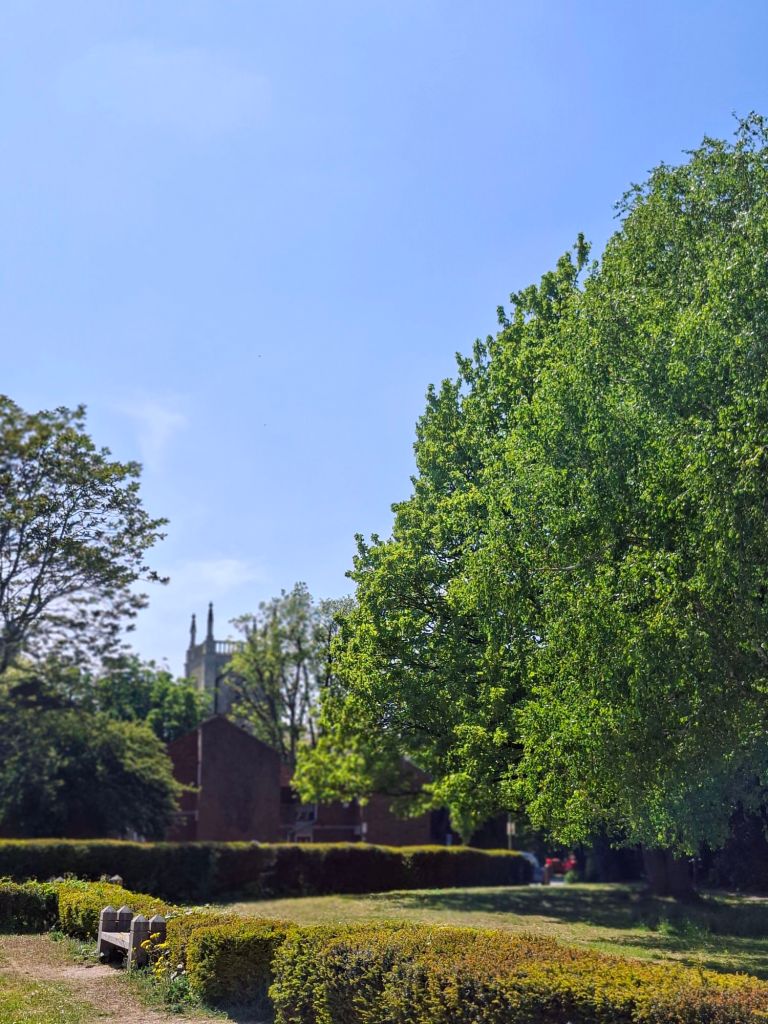
The church of St Mary de Lode, Gloucester, seems to sit among trees. The building salutes the sky without arrogantly trying to reach it. There is a bench towards the foreground of my picture. I am standing in a friendly urban space, a green space. It is one of many made possible by the Churches and Priories of the old city. This space is open to all.
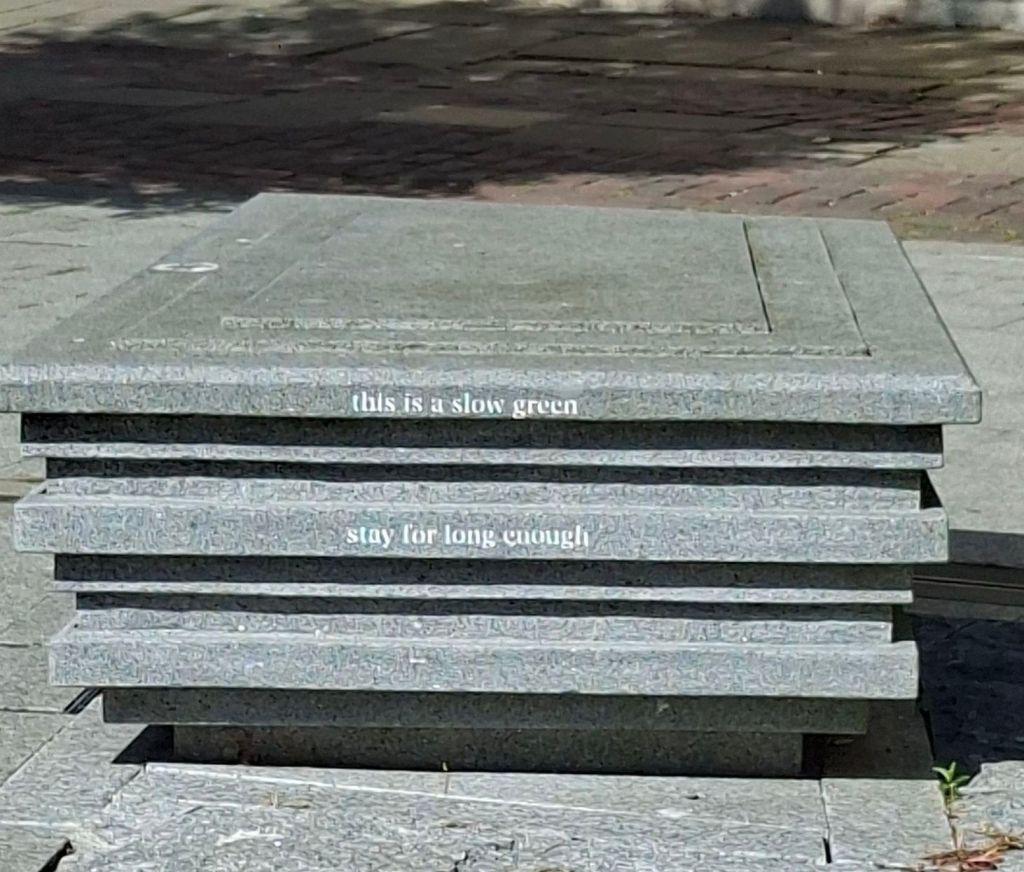
In another such space, on a granite seat close to my home, I recently noticed the words “this is a slow green, stay for long enough”. I have been savouring these words ever since.
They draw me into an easy receptively, not least when the month is May and the day is warm. The riddle of ‘a slow green’ invites immersion and reverie rather than effortful attention or strategies for problem solving. ‘Stay for long enough’ is probably the wisest counsel. Let’s take the time we need gently to befriend such nurturing spaces when we are blessed to find them.
The picture* shows Waterstones in Gloucester, not far from where Elaine and I live. It’s a well-stocked bookshop on two levels. The upstairs includes a cafe. Before Elaine’s hip fracture in April (1,2,3) and its attendant complications, we were frequent visitors. The cafe offers good coffee. It is a pleasant place to be. It hosts both a writers’ group and a book group that we have attended.
Waterstones has been out of bounds to Elaine, and effectively me, since April. Elaine was completely house-bound until the middle of August. Even then, we worried about whether her wheelchair would fit the door of the lift giving access to the upper floor. Would the formal ‘accessibility’ option lead to actual access? I measured the breadth both of Elaine’s wheelchair and the lift doorway. The distances were bothersomely similar, and this had a slightly inhibiting, effect. We didn’t want drama or disappointment.
But on Saturday, 8 September, we lost our hesitation. We wheeled boldly into the shop and put the lift to the test. Lining the chair up carefully, we ascended to the top floor. It was indeed a tight fit, but doable, which is what matters. We reached the cafe, and had our first coffee out together for a long time, happy in the familiar atmosphere of a favourite haunt, knowing too that we would be able to attend its meetings and events. A sweet success!
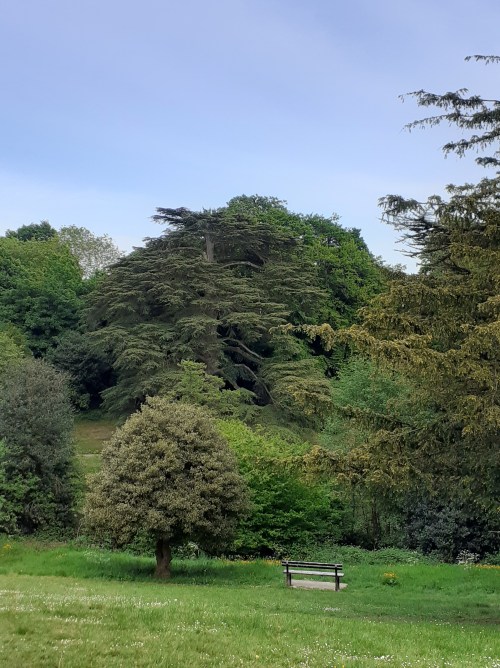
Everyone benefits from healthy spaces. Such spaces may be physical, social or spiritual. They can be all three at the same time. I am glad that here in England park benches, given adequate physical distancing between people, are no longer out of bounds.
Where I live, the early weeks of the late-arriving Covid-19 lockdown seemed to create a fragile nemeton, a collective healthy space in which to take stock amidst empty roads, reduced noise, fresher air and a more reflective existence, all set in a beautiful spring. The circumstances meant that this could not apply to everyone, as those of us enjoying these conditions well knew. But there seemed to be a moment where this sense of an altered space was sufficiently present for a critical mass of people. It was a sacred space, a good space for the blossoming of generosity and compassion. Clapping for health and other key workers has been its brief weekly ritual. An atmosphere of community solidarity in the face of crisis and suffering was tentatively enabled.
The purity of the nemeton period did not last long. Aspects of it have been eroding for a while. But I notice that my personal Druid practice has been subtly influenced it, in a good way, at a time when I have also been considering my own vulnerability and mortality and that of loved ones. I seem to have made a hard-to-describe gain in depth and resiliency.
Although my ‘wheel of the year’ focus for the year from 21 December 2019 is proving very different from my original expectations, I have received an unlooked-for gift. I sense that I am not alone in this, and my hope is that positive influences from the lockdown experience will seed inspirational developments, personal and collective, over time. The human and social costs of the virus continue to be very high due both to the illness and its political mismanagement. Let them at least be honoured through commitments to fostering healthier and more creative ways of being in the future.


 Contemplative Inquiry