Contemplative Inquiry

This blog is about contemplative inquiry

Tag: Harvest

DEEP AUTUMN 2025

“All things ripen and rot that rose up at first,

And so the year runs away in yesterdays many,

And here winter wends again, as by the way of the world it ought,

Until the Michaelmas moon has winters boding brought.” (1)

Even today, deep autumn opens the door to winter. This was even more the case in the North Staffordshire and Derbyshire regions of 14th century England, where Sir Gawain and the Green Knight was written. Even in castles, people were less sheltered from the growing cold and damp than we are. So readers and listeners of the period are reminded that the coming of winter is both natually and divinely ordained.

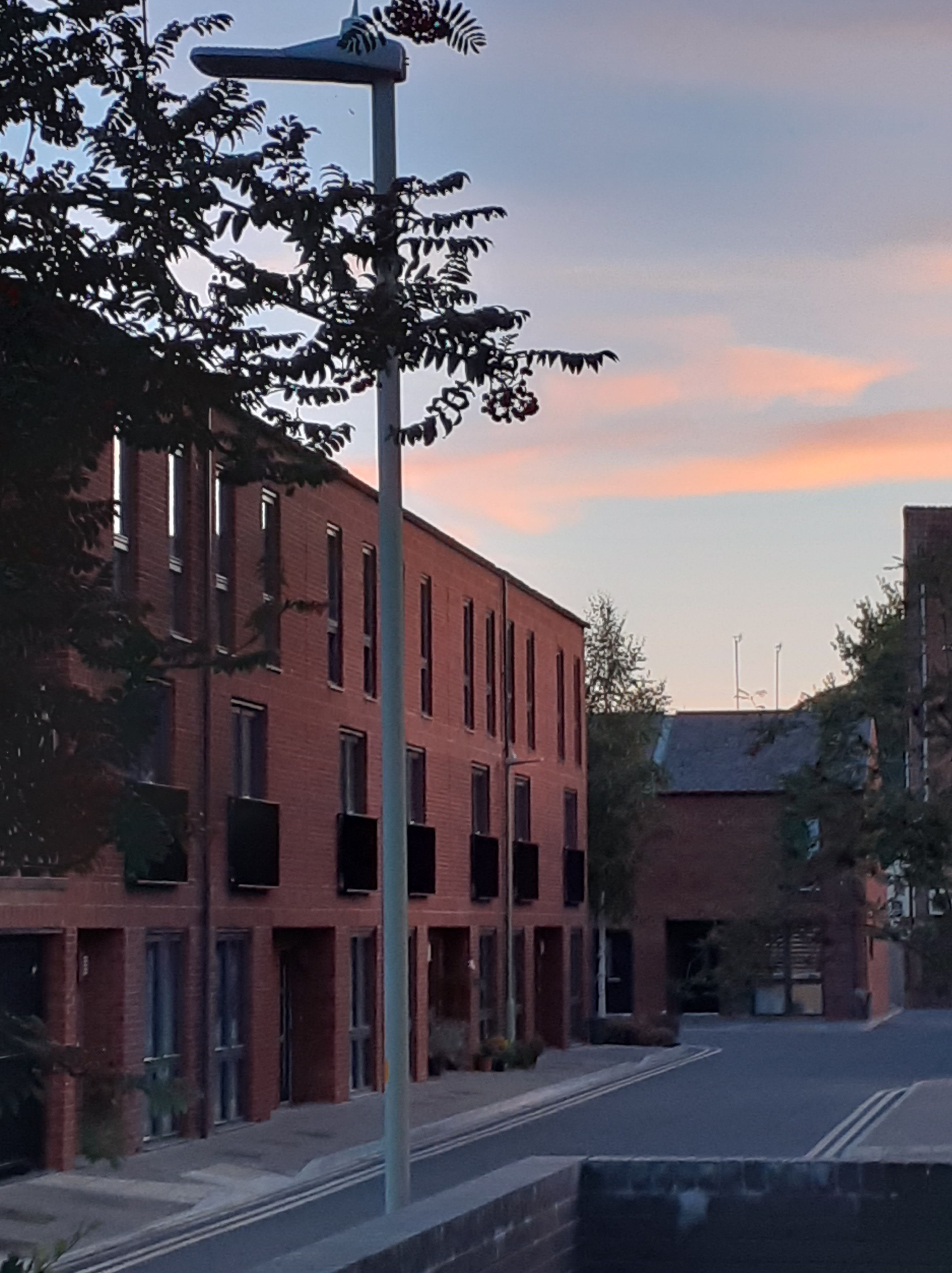
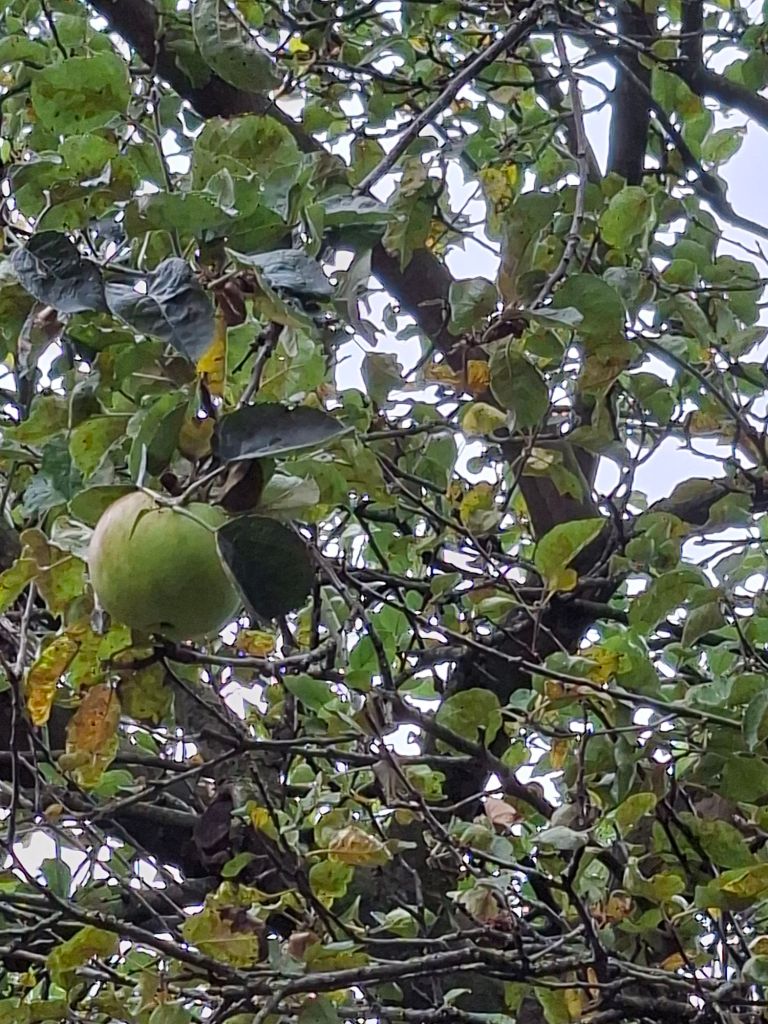
Here and now, the sight of the apple harvest in its later stages (pictured above) seems quite different than in the early ones (2) – less bright, less novel, less shiny. Rotting apples lie on the ground, now fallen outside the wall of  Gloucester Cathedral’s orchard. From Nature’s exuberant perspective, this is all part of the plan.  Waste is built in.

This time draws me further into the declining year. I am in the cathedral’s  grounds, now looking at a yew tree and its associations with death. I’m thinking of the approach of Samhain (aka Halloween/All Hallows) at the turn of the month. Once it marked the 3rd harvest of the year – the blood harvest, where animals were slaughtered in preparation for winter. Now it is more a time to remember our ancestors, and our dead more widely.

Yet the seasonal moment, and the yew, can also be linked to wisdom and transformative change in life. I launched my contemplative inquiry at Samhain 2011. Like many people, I find that this period can be a resonant and creative time.

Below the yew, I have included a section of the cathedral itself. I have old personal associations linking medieval Gothic architecture with the feeling-tone of the declining year. I am also aware that this building is linked to the trees I picture and discuss. Gloucester Cathedral was a monastery when Sir Gawain and the Green Knight was written but many of its features were already in place.
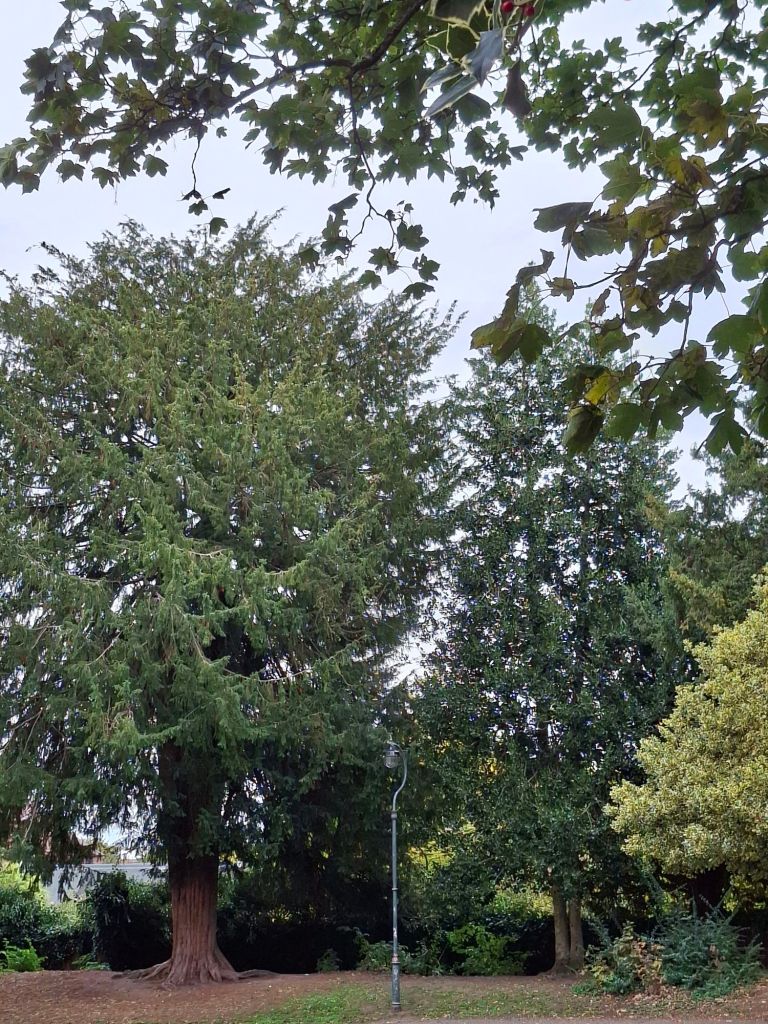
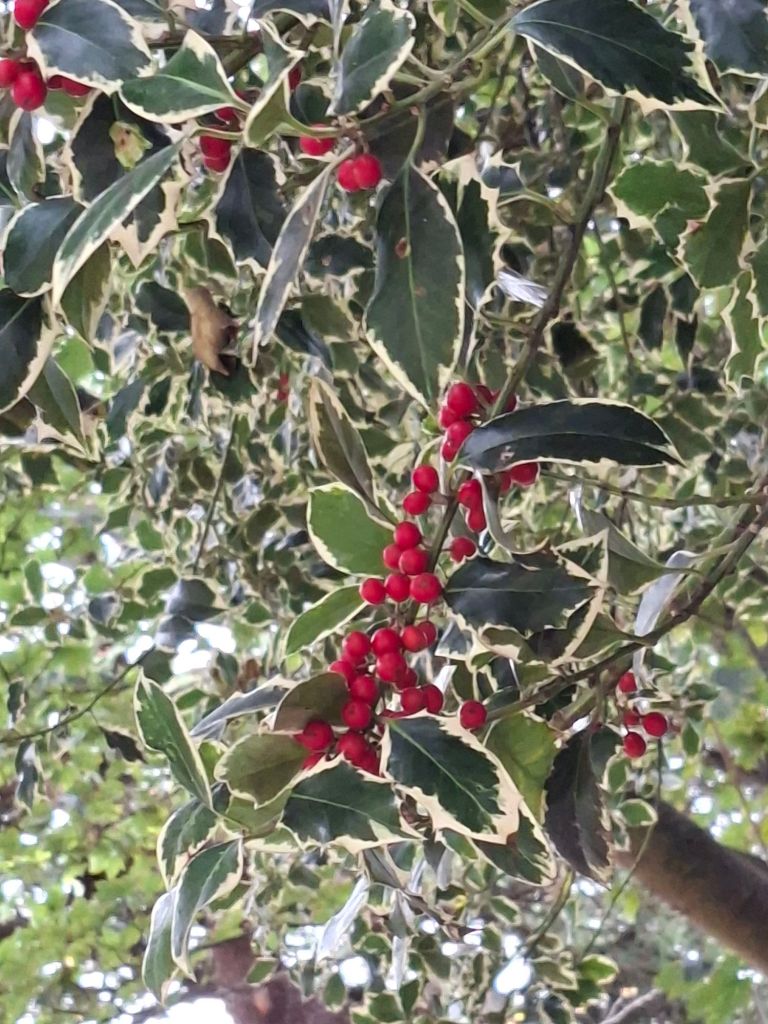
In the same space, I find both holly and ivy, with berries on the holly tree.  I immediately thought of the Christmas carol The Holly and the Ivy. It is an ancient folk carol, which interweaves Christian themes and others that belong with the land. The version which is now popular was collected by Cecil Sharp in 1909 in Gloucestershire from Mary  Clayton.

Many people think that the indigenous Pagan themes are the oldest, and that the central focus here is on the holly. The authors of The Green Man Tree Oracle say: “Holly’s connection with the Green Man is especially strong. In his guise as the Holly King – an ancient giant and symbol of fertility – the Green Man makes a notable appearance in the 14th century poem Gawain and d the Green Knight. Here he takes the form of a fearsome knight, who comes to King Arthur’s court to offer a midwinter challenge, carrying a club of holly and wearing a holly crown (as symbols of his true identity).” This challenge happens every year, where the Green Man/Holly King demands that we encounter him through our dealings with the natural world.

Elaine and I went to the Gloucester Cathedral Close and its surroundings on Saturday afternoon 18 October to outrun an  extended period of gloom, wind and rain. We are now in it, so the lessons of the trees in deep autumn, anticipating the coming of winter, are not lost on us. The dark of the year is on its way.
(1) J.R R. Tolkien (translation of anonymous texts) Sir Gawain and the Green Knight, Pearl, Sir Orfeo New York: Ballantine Books, 1980.

(2) https://contemplativeinquiry.blog/2025/08/22/ (3rd photo)

(3) John Matthews & Will Worthington The Green Man Tree Oracle: Ancient Wisdom from the Greenwood London: Connections, 2003

LATE AUGUST 2025: SETTLING INTO AUTUMN

It is evening and for me autumnal. The sky offers the water a soft light, seemingly pink and grey. The water reflects this back, adding its own hint of mist. It is a tranquil scene.

For the first time this year, I feel a tug towards the Equinox, just under a month away. These canal waters are gentle, but they are drawn from the River Severn, site of the Severn Bore (1). Perhaps the waters are nudging something  – maybe the water – in me.

A little later, facing into the declining sun (below) I see the sunset and its effects. I notice the concentrated power of the orb as it appears to reach the earth, and the way in which this energy disperses into the sky. The colour coding shifts from intense white to yellow to red-orange to an orange becoming increasingly grey. I live at latitude 52 north, and the sunset is getting earlier every day, now 8.15pm. Another autumnal feature.

Autumn is also the season of the fruit harvest. This year, many people are commenting that the fruit harvest is arriving early. Below, against the background of a clear blue daytime sky, an apple tree is fruiting. The tree is close to Gloucester Cathedral and may belong to it. Medieval Gloucester was a place of churches and priories. It was also a place of orchards, many of them cultivated by monks and friars. The picture points to natural and cultural continuity, though the  fruit are early this year. I am no longer at a point tension between seasons. I am already settled in autumn.

(1) The Severn Bore is a natural tide phenomenon occurring in the River Severn in England, where a large wave surges upstream. It’s caused by the Atlantic tide pushing into the Bristol Channel and funneling it into the narrowing Severn Estuary, creating a more powerful wave that can be up to two meters high and a speed of up to 21 km/h. The Bore travels up the Severn Estuary, from Awre to Gloucester, a distance of 25 miles. It is strongest in the equinoxes (especially spring) and a popular challenge for surfers, kayakers and paddleboarders.

HARVESTING INSIGHT

Noticing a single corn stalk under our neighbouring birch trees, I wonder whether the seed simply blew in or was planted by an unknown hand. If the latter, what was their intention? I realise that I will never know.

I do know how much I enjoy its presence in this space at this time. I experience it as a miracle inviting gratitude and it has marked the seasonal moment for me, this first harvest of a now declining year.

With increasing clarity I understand that I do not work well with personified and individualised images of the divine. Something seems subtly off, as if I am failing to sound my own authentic note in the Great Song of the world.

I believe that we are given different gifts in our encounters with the Cosmos, leading to legitimately different understandings. When I lean in to the notion of divine personality – even when using the term ‘Spirit’ in that sense – I am not fully living my own truth. I subtly disempower myself and weaken my connection.

For in my universe, when I rest in my own clarity, there is no separation between nature (including culture) and spirit. In the awkward activity of identification and labelling, I answer to terms like animist, panentheist and nondualist.

These words are approximations, with the power to be distracting and slightly depressing. I can find words that point to my experience well enough. But the explanatory words, the more formal and generalised terms, feel clumsy. There’s a necessary level of unknowing that these isms don’t recognise.

When consciously living in spirit, I am neither alone, as a single human person, nor am I with another being. I am simply in a different dimension of embodied awareness, supported and empowered by the bubbling source from which I spring. For me, Nature is more than the ‘nature’ of dualist spiritualities and of the scientific humanism that grew out of them.

As I harvest the learning, or relearning, of this lesson, I renew my commitment to practice and path, once again revising the beginning and end of the modern Druid’s prayer (1). I move from from ‘Grant, Spirit your protection, and in protection, strength … ‘ to ‘In spirit I find protection, and in protection, strength …’. I end with ‘and in the love of all existences, the love of this radiant Cosmos’ rather than ‘the love of God/Goddess/Spirit and all goodness’. These small changes formalise and anchor my understanding.  For me, they are an important affirmation, illuminating my path.

(1) Traditionally, this prayer runs:

Grant O God/Goddess/Spirit, your protection,

And in protection, strength,

And in strength, understanding,

And in understanding, knowledge,

And in knowledge, the knowledge of justice

And in the knowledge of justice, the love of it

And in the love of it, the love of all existences

And in the love of all existences, the love of God/Goddess/Spirit and all goodness”.

NB Providing the options of God/Goddess/Spirit is I think an OBOD (Order of Bards, Ovates and Druids) innovation. The original version, from the late 18th century, simply said ‘God’. Some modern Druids say ‘God and Goddess’.

NEWS OF A DEATH

When is ‘suicide’ something else? At the age of 80 Satish Kumar’s mother decided that her life was over and her duty done. She began a fast that lasted for five weeks before she died. Although suicide is stigmatised in most cultures, this was an honourable death in her Jain community in Rajasthan, India. Kumar, then already living in England, quotes the letter that gave him the news.

“At the age of eighty your mother felt that she had served the family and fulfilled all her duties and that now it was time for her to meet death. She decided to separate herself from her worn-out body by fasting. She believed that only death could bring new life and that she must die to live again. She went round the town, to family and friends, saying goodbye and asking forgiveness for any wrong she may have done. From the next day’s sunrise she took no more food or drink except a little boiled water. The news of your mother’s fast unto death spread by word of mouth. Monks came to bless her and be blessed, since it is considered to be brave and holy to die in this way – to embrace death rather than let it capture you unaware. Hundreds of people came to have her last darshan and to ask for forgiveness. She didn’t talk much but by her look acknowledged the receiving and giving of forgiveness. People sat outside singing songs and praying. After thirty-five days of fasting, your mother died.” (1)

I have written before about Jain ethics, in a review of Philip Carr-Gomm’s Seek Teachings from Everywhere (2). Both he and his Druid mentor Ross Nicholls had an interest in the Jain path with its values of ahimsa (non-violence/harm), aparigraha (non-attachment/possessiveness/acquisition) and anekant (non-absolutism/many-sidedness/multiple viewpoints). From a Jain perspective, Satish Kumar’s mother was in conformity with these principles when she chose death, with fasting (already a familiar practice) as her method. I value her story for its distinctive lens on a contentious subject. The depth of community support she received is for me the most moving aspect of this voluntary death. It became almost a celebration, and a kind of karmic harvesting for someone who believed that she “must die to live again”.

(1) Satish Kumar No Destination: Autobiography of a Pilgrim Cambridge: Green Books, 2014 (extended 4th edition – first edition 1992)

(2) See: https://contemplativeinquiry.blog/2019/10/02/book-review-seek-teachings-everywhere/

NOTE: “Satish Kumar (born 9 August 1936)[1] is an Indian British activist and speaker. He has been a Jain monk, nuclear disarmament advocate and pacifist.[3]Now living in England, Kumar is founder and Director of Programmes of the Schumacher College international center for ecological studies, and is Editor Emeritus of Resurgence & Ecologist magazine. His most notable accomplishment is the completion, together with a companion, E. P. Menon, of a peace walk of over 8,000 miles in June 1962 for two and a half years, from New Delhi to MoscowParisLondon, and Washington, D.C., the capitals of the world’s earliest nuclear-armed countries.[4][5] He insists that reverence for nature should be at the heart of every political and social debate.” (Wikipedia)

‘I SWIM WITH THE SALMON’

“The hazels are rocking the cups with their nuts

As the harvesters shout when their last leaf is cut;

‘I swim with the salmon says the Green Man,

‘I swim with the salmon’, says he.” (1)

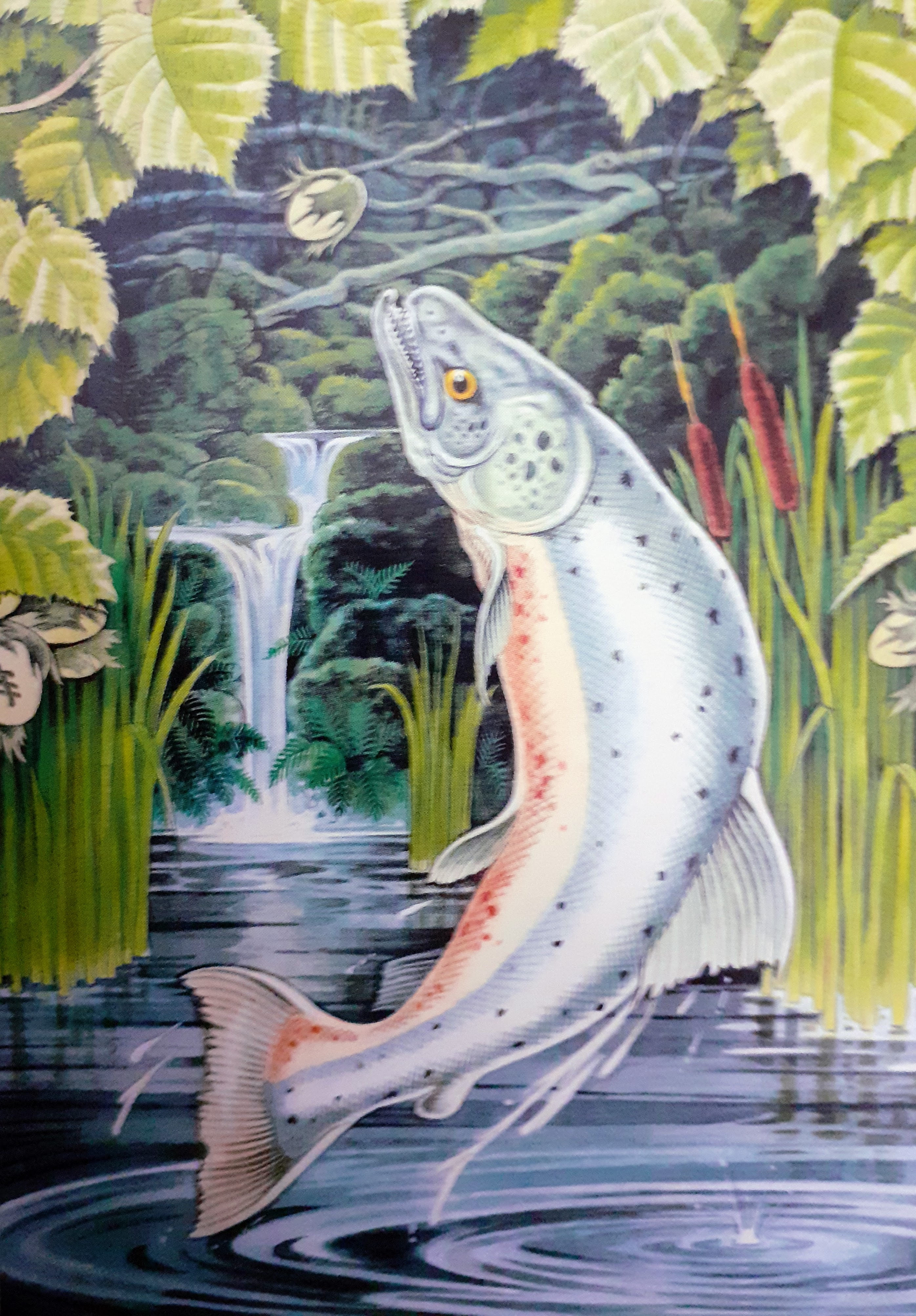
‘I swim with the salmon’ is a bold, clear statement. It evokes powerful images that leap out of their place in the flow of William Anderson’s poem. Green Man as a whole takes us on a wheel-of-the-year journey beginning on 22 December, successively featuring thirteen trees for four weeks each. The hazel is the ninth tree, whose time runs from 3-30 August. As the poem indicates, this is a harvest period, and the last month that fully belongs to the summer. It is also a time when you may find Atlantic salmon swimming home to spawn, though spawning doesn’t begin until October.

In this post I celebrate salmon naturalistically, through an account of their extraordinary life cycle. I am especially aware of the River Tay in Scotland, mostly thanks to a 90 minute documentary The River: a Year in the Life of the Tay (2). My personal experience of the Tay is limited to visits to Dunkeld, Perth and Dundee, where I nonetheless fell in love with the river and its powerful energy.

Salmon begin their lives in mountain streams, as far upstream as their parents have been able to reach in their autumn/early winter spawning period. The new generation undergoes a remarkable series of transformations (3), hatching as alevin or sac fry when the water warms in spring, and growing into parr with camouflaging vertical stripes. They remain in the same environment for two or more years, by which time, as smolts, they have developed a bright silvery colour with scales that easily rub off. Driven by growth hormones, the 10% of smolts who survive to this stage experience the mutations necessary to become salt water fish and make their journey to the ocean.

They spend another two or more years in the North Sea, travelling north into Norwegian waters, becoming sexually mature, with a darkening of the silvery scales, before embarking on their homewards 120 mile journey up the river to its headwaters. They are much larger than they were when on their way out. The largest salmon ever caught in the Tay, in the 1920’s, was over five feet long.

To return to their own birth-place (remembering exactly where they come from) they have to navigate waters that include rapids and waterfalls, evade osprey and human anglers, and achieve the feats of leaping for which they are famous. “The salmon is able to jump upstream not by fighting against the current, but by utilizing its knowledge of the reverse current which flows beneath the surface current” (4). They are returning to their native headwaters in order to spawn and begin the cycle again. 98% of Atlantic salmon spawn only once and die soon afterwards: their adult bodies, equipped for a salt water life, never fully re-adapt to fresh water and this makes them vulnerable.

Swimming with the salmon is not for the faint-hearted. At the present time the population of Tay salmon is in severe decline (70% in the 30 years to 2019) although the river is relatively clean and is now managed to prevent over-fishing. The effects of the climate crisis in the Atlantic are the most likely cause for the decline of Tay salmon, as for Atlantic salmon in general. Yet even in decline they remain magnificent. Long before the Celtic Iron Age, during it, and for long afterwards, they were abundant in the rivers of Britain, Ireland, and other Atlantic maritime countries. With their complex shape-shifting capacity, their far-journeying years at sea, their uncanny homecoming knowledge and their extraordinary leaps, they seem marked out for another life, in human song and story. I would like to think that the salmon’s mythic reputation can help to save it in this interconnected world.

”’I swim with the salmon says the Green Man,

‘I swim with the salmon’, says he.”

(1) From:  William Anderson Green Man: Archetype of our Oneness with the Earth Harper Collins: London & San Francisco, 1990 See also: https://contemplativeinquiry.blog/2017/05/11/poem-green-man/

(2) The River: A Year in the Life of the Tay 90 minute documentary made for BBC4 in 2019. Presented by writer and naturalist Helen MacDonald. See: https://youtu.be/ZEmAXQIrDeg?si=wlaI0bNtM6YWevAf The film is well worth watching, covering the journeys of the salmon and much more.

(3) Salmon Wikipedia

(4) Philp and Stephanie Carr-Gomm The Druid Animal Oracle: Walking with the Sacred Animals of the Druid Traditions Fireside: London, 1994 Illustrated by Will Worthington. The face of their salmon card is pictured at the top of this blog.

LUGNASADH 2023: INQUIRY HARVESTING

A circle is cast on sand. It is almost complete. The image is that of the Wheel, tenth major trump in the Druidcraft Tarot (1). Arianrhod, as Goddess associated with the Wheel and the Milky Way, is casting the Circle of Life. The adjacent cave has resonances of both womb and tomb. The seashore is a liminal space. The Celtic Otherworld is often linked to the sea and what lies underneath its surface. This image as a whole is associated with harvesting. Arianrhod carries a flail as well as a wand and a symbolic eight-spoked wheel.

It is Lugnasadh/Lammas, the first harvest-related festival of 2023. I am sitting with the notion of ‘winnowing’ in my inquiry. In agriculture, winnowing involves blowing a current of air through grain to remove the chaff remaining after threshing. We find a reference to winnowing towards the end of the medieval Welsh poem The Hostile Confederacy from The Book of Taliesin (2):

“I have been a grain discovered,

Which grew on a hill.

He that reaped me placed me,

Into a smoke hole driving me.

Exerting of the hand,

In afflicting me,

A hen received me,

With ruddy claws, (and) parting comb.

I rested nine nights.

In her womb, a child,

I have been matured,

I have been an offering before the Guledig.

I have been dead, I have been alive.

A branch there was to me of ivy,

I have been a convoy.

Before God, I have been poor.”

It seems that winnowing (or being winnowed) is far from an end point to our journeys. The processes of life go on, very likely in unexpected ways. Any state of peace has to be found within these processes, rather than in efforts to halt or break out of them.

At Lughnasadh 2023 I find myself at ease within Druidry, though I do also continue to refine lessons from other paths that enrich my practice of Druidry. The most significant, and the best embedded, is ‘interbeing’ as a spatial relationship and its temporal equivalent ‘impermanence’. It is like a kernel of grain I have winnowed from Mahayana Buddhism to grow into another life in my Druidry. The Druid soil is fertile for this purpose, as indicated through the image of the Wheel drawn on sand, and the passage from The Hostile Confederacy in The Book of Taliesin. For me, Thich Nhat Hanh simply provides a particularly persuasive languaging of this perspective.

He says (3): “The insight of interbeing is that nothing can exist by itself alone, that each thing exists only in relation to everything else … looking from the perspective of space, we call emptiness ‘interbeing’ [NB ’emptiness’ here = empty of a separate self] ; looking from the perspective of time we call it ‘impermanence’ … to be empty is to be alive, to breathe in and breathe out. Emptiness is impermanence, it is change. …When you have a kernel of corn and entrust it to the soil, you hope it will be a tall corn plant. If there is no impermanence, the kernel of corn will remain the kernel of corn forever and you will never have an ear of corn to eat. Impermanence is crucial in the life of everything”.

There is another level to this year’s inquiry harvest. Recently I have engaged more fully with the challenge of Thich Nhat Hanh’s understanding of the Mahayana emptiness teachings, which stand behind the interbeing/impermanence insight. In the light of this understanding he finds neither an individual nor a cosmic self – and hence no ultimate reality or ground of being. “Our notion of emptiness should be removed. It is empty”. Many teachers I have worked with in the past are on the other side of this debate, finding the Divine in ‘Presence’ (Eckhardt Tolle), Pure Awareness (Rupert Spira), and the ‘Clear Awake Space’ of Douglas Harding’s Headless Way. They find God as ‘No-Thing’. For Thich Nhat Hanh, no-thing is simply nothing.

I have been all over the place on this question, developing a language and practices compatible with both views, as I slipped and slid between them. This is fine in its way, but I have wanted some kind of resolution, if only to avoid the energy drain of uncertainty around something that matters to me and to many spiritual traditions. Tomas Sander, co-writing with Greg Goode (4) has also explored the Mahayana ’emptiness’ texts. He reports that “as a person who had been seeking truth and ultimate reality” he finds a “greater sense of ease” in the approach of these texts. Unlike Thich Nhat Hanh, he does not take away an active disbelief in a cosmic ground of being. Instead, he arrives at a relaxed unknowing, a place of ‘joyful freedom’. He says: “spiritual teachings tend to have notions of absolutes, which by their very nature seem to trump everything else. None of them can claim to have an absolute, transcendent truth on their side”.

Tomas Sander finds that “it was a wonderfully freeing moment to recognize that there is no one way that reality ‘really’ is, and therefore no way to miss out on it”. So he adopts different criteria for evaluating spiritual paths. “They need to prove themselves on the level of ordinary, conventional reality with practical questions like: who does the view serve and who is being marginalized? Is the view helpful, compassionate or humane?’ I have known of and entertained this view for some time, but it has only recently clicked with me as a good way of settling this question. Metaphysical speculation will no longer be part of my inquiry. This does indeed feel like winnowing, like blowing away the chaff. The promised harvest? Druidry as joyful freedom.

(1) Philip and Stephanie Carr-Gomm The Druidcraft Tarot: Use the Magic of Wicca and Druidry to Guide Your Life London: Connections, 2004 (Illustrated by Will Worthington)

(2) William F. Skene The Four Ancient Books of Wales Forgotten Books, 2007 (First published in Edinburgh 1868

(3) Thich Nhat Hanh The Other Shore: A New Translation of the Heart Sutra with Commentaries Berkeley, CA: Parallax Press, 2017

(4) Greg Goode and Tomas Sander Emptiness and Joyful Freedom Salisbury: Non-Duality Press, 2013 (Section written by Tomas Sander)

MUIN: “GATHER IN WHAT IS DEAREST TO YOU.”

Muin (Ogham name for Blackberry) is one of four plants that have a place in both The Green Man Tree Oracle (1) and The Druid Plant Oracle (2). In the latter, from which the illustration is taken, it is called Bramble.

Muin is an important plant ally for me. At times I have identified closely with ‘Mr. Bramble’ (3). He is stubbornly resilient, with deep and extensive underground root systems. Above ground, he can create an almost impenetrable barrier of briars. He digs in. He is a survivor. He tests qualities and intentions. He protects the deep earth and undervalued dimensions of being. Yet he also grows abundant tasty fruit, that can be made into wine or gin.

Where I live, Muin’s time traditionally runs from Lammas/Lugnasadh to Michaelmas/Mabon – essentially the calendar months August and September. This year, as this time approaches, I am thinking of Muin as a teacher. The Green Man Tree Oracle offers words of ‘green man wisdom’ for all its trees. Muin’s words are: “gather in what is dearest to you“. I find “gather in” friendly and relational, very good to hear in a world where ‘harvesting’ is often cold, impersonal and mechanistic. Muin’s more warmly relational note is reinforced by the words “dearest to you”. We are invited to consider “riches of the soul and the things that give us inspiration” as our recommended harvest.

There are obvious questions here: what is ‘mine’ to ‘gather in’? what to I choose? what do I let go? But this is not, fundamentally, a questioning and list-making task. It is more about being open to Muin’s magic. This, I believe, is rooted in an unusual combination of qualities: tenacity, challenge, depth, an invitation to pleasure and, indeed, a certain kind of intoxication. Over the coming weeks, I will draw on Muin’s inspiration as I gather this harvest of the soul*.

(1) Philip and Stephanie Carr-Gomm The Druid Plant Oracle: Working with the Flora of Druid Tradition London: Connections, 2007 (Illustrated by Will Worthington)

(2) John Matthews & Will Worthington The Green Man Tree Oracle: Ancient Wisdom from the Greenwood London: Connections, 2003

(3) See: https://contemplativeinquiry.blog/2020/08/30/mr-bramble/

  • I think of soul as a process not an entity, though we don’t have the word ‘souling’.

ALBAN ELFED: A TIME FOR RECEPTIVITY?

Blessings of the season! Where I live, the sun is descending but still has a certain power. We have entered the period of the Autumn Equinox, honoured by modern Druids in the festival of Alban Elfed. Traditionally, the emphasis has been on harvest, but Dana O’Driscoll (1) suggests ‘receptivity’ as a resonant theme, “because with receptivity, rather than cultivating an expectation of what we want and expect to come, we are open to what is and what comes our way”.

She relates her approach to the changes that the world is experiencing now. “It is a counter balance to the effort-reward cultural narrative that is tied to the Fall Equinox and themes of harvest. There is one enormous problem with the effort/reward theme on a larger cultural level. It belongs to a different age. It belongs to the Holocene, an 8,000-11,000 year period of stable climate that allowed humans to develop agriculture, allowed humans to have some predictability about their surroundings, and allowed us to develop symbolic understandings like those drawn upon for the modern wheel of the year. … But we are not in the Holocene any longer, both climate-wise and culturally; we’ve moved on to the Anthropocene … characterized by human-driven planetary changes which destabilize every aspect of our lives.”

I find the call to receptivity challenging. Part of me wants the late Holocene back, in a reformed version – socioeconomically, culturally, technologically. Part of me accepts that it has gone for good but doesn’t want to acknowledge the speed and severity of the transition. Currents of anger, fear and grief cry out for recognition. These are as much part of my life-world as are the climate crisis itself, initiatives for adaptation, and the forces undermining those initiatives. I somehow have to find a receptive space for all of the above, without being overwhelmed.

The good news is that my ‘receptivity’ seems to be sourced by a deep peace at the heart of experience, a peace that grows rather than diminishes with time. In my daily practice as a modern Druid I call for peace in the east, south, west, north, deep earth & underworld [below], and starry heavens [above]. Then I say: “I stand in the peace of the centre, the bubbling source from which I spring, and heart of living presence”. These words are vibrant with life for me however often I declaim them. I experience this deep peace as a fruit of my contemplative inquiry. Perhaps there is a harvest aspect here after all.

Certainly, to stand in such peace empowers my receptivity, linking it to other qualities like reverence, delight and awe. None of this changes the world. But it allows me to contemplate it with an underlying confidence, and to face its challenges in a more resourceful way. I am very happy to mark Alban Elfed as a feast of receptivity.

(1) https://thedruidsgarden.com/ – see Fall Equinox: a Spirit Walk and its internal reference to Equinox on Receptivity

NOTE: Pennsylvania-based Dana O’Driscoll is steeped in Druidry and the US homesteading movement. She is Grand Archdruid of the Ancient Order of Druids in America (AODA) and an OBOD Druid. She is a Mount Haemus scholar, lecturing on Channeling the Awen in 1912.

See also: https://contemplativeinquiry.blog/2021/06/09/book-review-sacred-actions/ )

For AODA, see: https://aoda.org/

INNERWORLD HARVESTING

The Innerworld has its own times and seasons. When I attune myself carefully, it speaks to me through images in the DruidCraft Tarot (1). Today (20 July) I encountered the 7 of Pentacles (above), with its image of winter harvest. A Druid, equipped with a golden sickle, takes mistletoe from a tree. Where is the wisdom here? What am I being told?

‘Take note of the obvious’ is an early thought. ‘Be willing to state it’. After ten years of contemplative inquiry, I am still anchored in Druidry. Yes: my practice forms are idiosyncratic and contemplatively inclined. Yes: my inquiry process is personal and self-directing. Yes: I continue to learn from other traditions and sources outside the traditions. But what I do comes out of an immersive OBOD training of many years and would not be the same without it. I continue to belong to the Order and identify with the modern Druid tradition. Being clear about this is a fruit of my inquiry.

The form of words that we know as the St. Patricks’ Prayer, alternatively as the Cry of the Deer, runs: “I arise today through the strength of heaven, light of sun, radiance of moon, splendour of fire, speed of lightning, swiftness of wind, depth of sea, stability of earth and firmness of rock”. In my own usage I think of ‘heaven’ simply as a sky or firmament word, majestically naturalistic. But my greatest sense of support comes from the words ‘stability of earth and firmness of rock’. The 7 of Pentacles Tarot image includes seven pentacle signs carved on to mossy rock. It is a strongly earth-related image. I feel grounded and affirmed by this powerfully Pagan imagery.

There is much more to be learned from the 7 of Pentacles image, but these obvious recognitions, easily taken for granted and thus overlooked, are a good place to start. They have allowed me to identify some fundamental understandings that my inquiry has provided, and to clarify its direction for the future.

(1) Philip and Stephanie Carr-Gomm The DruidCraft Tarot: Use the Magic of Wicca and Druidry to Guide Your Life London: Connections, 2004 (Illustrated by Will Worthington)

INQUIRY: A 19 YEAR CYCLE

On 1 September 2002 I began a journal, which I have kept up ever since. I was inspired by some advice on the spiritual dimension of life. The gist of it was: stay in contact with supportive companions; live mindfully; meditate; develop a spirit of inquiry; be willing to take risks; find time for supportive reading. My journal was primarily an inquiry tool, and spiritual inquiry has been a leading theme of my life ever since.

My Druid training was, in part, an inquiry. My contemplative exploration has been, in part, an inquiry. My book Contemplative Druidry (1) had an inquiry flavour, offering readers a democratic, multi-vocal, and open approach to the subject. I named this blog Contemplative Inquiry because my personal inquiry has included engagement with other movements and traditions.

Now, 19 years on, inquiry is losing momentum as a guiding principle. It is beginning to feel obsolete. I notice that 19 years is the length of a Metonic cycle (2), roughly the time it takes for the phases of the moon to recur at the same time of year. 19 years also once marked the completion of a formal Druid training. May be there is something in the ancient interest in this lunisolar relationship. Perhaps it has had a subtle influence on me: as above, so below.

I cannot imagine a satisfying life without both contemplation and inquiry, and all of the learning from my dedicated inquiry years stands behind me. But now is a time for an informal harvesting, a process that feels quite different, not a project but a more natural grounding and deepening, and less self-conscious in the conceptual realm. I will continue the blog, and see how it develops and changes in the coming months.

(1) James Nichol , Contemplative Druidry: People, Practice and Potential, Amazon/Kindle, 2014.  https://www.amazon.co.uk/contemplative-druidry-people-practice-potential/dp/1500807206/

(2) The Metonic cycle is named after after the ancient Greek philosopher Meton, who used a 6940-day period as the basis for his lunisolar calendar. Such calendars appear in many cultures, and may have informed the construction of our ancient sacred sites.

Earth Eclectic

music that celebrates Earth and speaks to the heart

Sarah Fuhro Star-Flower Alchemy

Follow the Moon's Cycle

Muddy Feet

Meeting nature on nature's terms

Rosher.Net

A little bit of Mark Rosher in South Gloucestershire, England

Becoming Part of the Land

A monastic polytheist's and animist’s journal

selkiewife

Selkie Writing…

Charlotte Rodgers

Images and words set against a backdrop of outsider art.

Prof Jem Bendell

living with metacrisis and collapse

Towint

The pagan path. The Old Ways In New Times

The Druids Garden

Spiritual journeys in tending the living earth, permaculture, and nature-inspired arts

The Blog of Baphomet

a magickal dialogue between nature and culture

This Simple Life

The gentle art of living with less

Musings of a Scottish Hearth Druid and Heathen

Thoughts about living, loving and worshiping as an autistic Hearth Druid and Heathen. One woman's journey.

Wheel of the Year Blog

An place to read and share stories about the celtic seasonal festivals

Walking the Druid Path

Just another WordPress.com site

anima monday

Exploring our connection to the wider world

Grounded Space Focusing

Become more grounded and spacious with yourself and others, through your own body’s wisdom

The Earthbound Report

Good lives on our one planet

Hopeless Vendetta

News for the residents of Hopeless, Maine