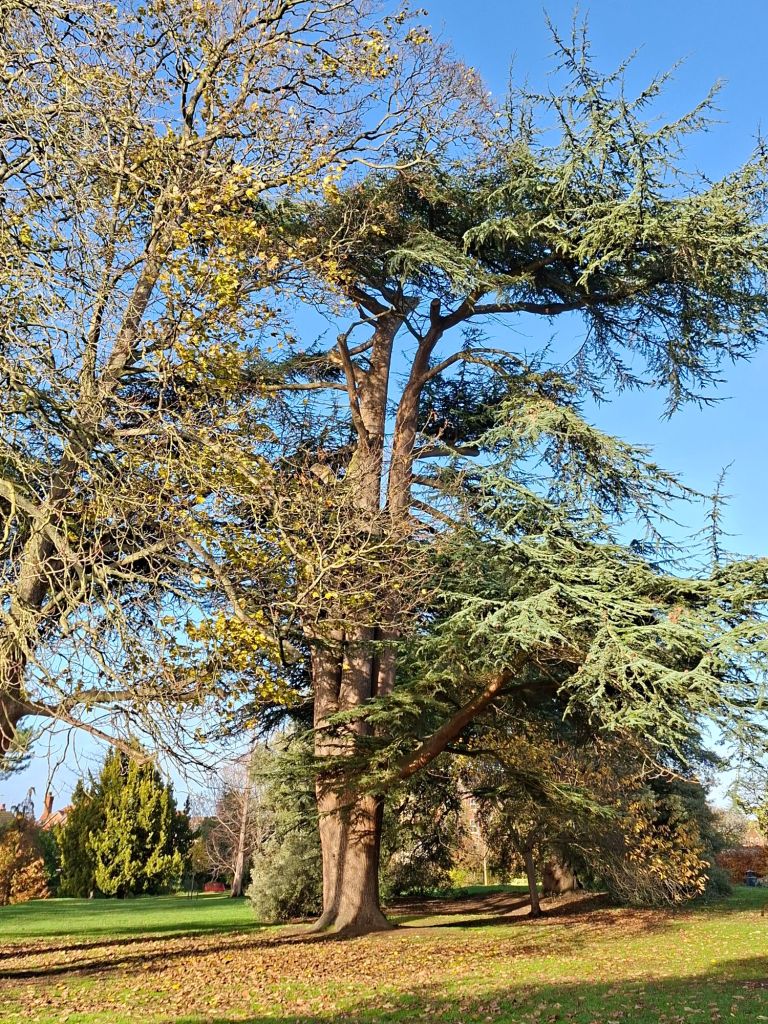
A Scots pine in Hillfield Gardens (1), 28 November, 10.32 am. It stands out both as a tall tree and an evergreen. It asks me to look up and pay attention to it, and beyond it, almost losing sight of its deciduous neighbour. For me, this representative of the ‘eternal green’ has a commanding presence.
The Scots pine is one of the oldest trees native to Britain. It is also one of the trees associated with ogham lore (2), where the Scots pine is linked to the wisdom of overview. According to The Green Man Tree Oracle, ancient shamans of many traditions would literally climb to the top of a central tent pole or tree and “from this vantage point they could see clearly into the spirits’ inner world and come back with knowledge for the tribe or family they served” (2).
For me as for many people, the end of the calendar year is a time for reflection and taking stock. New year resolutions are a possible modern version of this process, but mine never really worked. They were overprescriptive and a way of setting myself up to fail.
‘Overview’ asks for a less driven and more contemplative approach, one more connected with Spirit. This is a good reminder as I start to wonder about how I am going to navigate 2026: divining what my contributions and satisfactions might look like as the Wheel continues to turn.
And here winter wends again, as by the way of the world it ought,
Until the Michaelmas moon has winters boding brought.” (1)
Even today, deep autumn opens the door to winter. This was even more the case in the North Staffordshire and Derbyshire regions of 14th century England, where Sir Gawain and the Green Knight was written. Even in castles, people were less sheltered from the growing cold and damp than we are. So readers and listeners of the period are reminded that the coming of winter is both natually and divinely ordained.
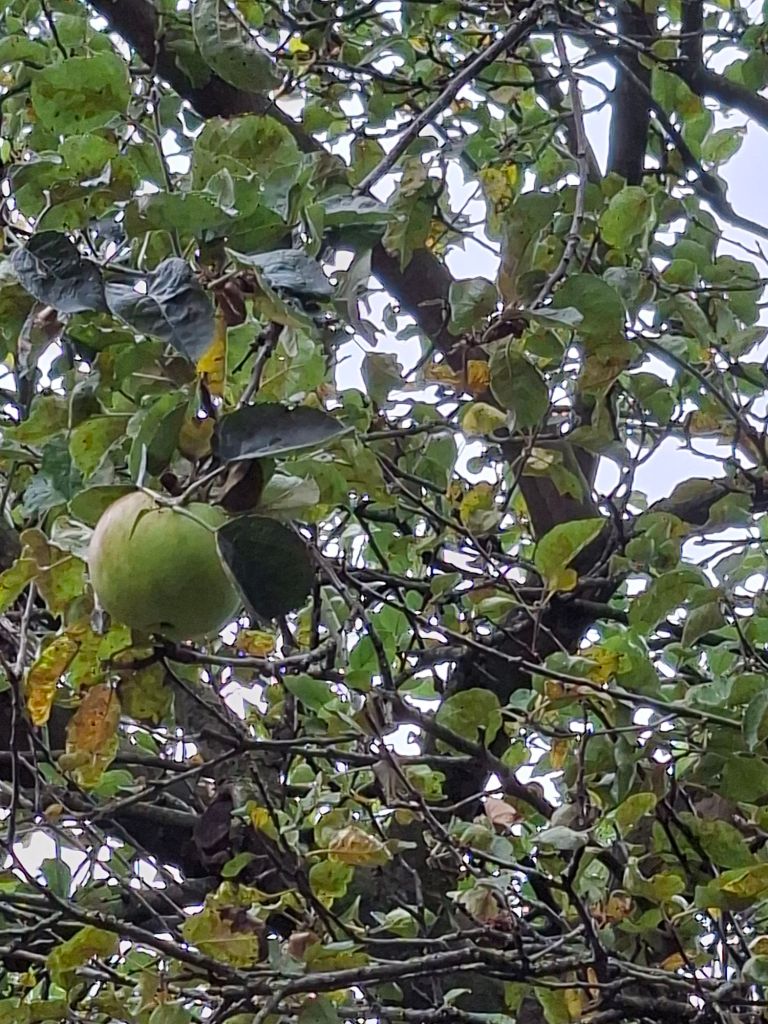
Here and now, the sight of the apple harvest in its later stages (pictured above) seems quite different than in the early ones (2) – less bright, less novel, less shiny. Rotting apples lie on the ground, now fallen outside the wall of Gloucester Cathedral’s orchard. From Nature’s exuberant perspective, this is all part of the plan. Waste is built in.
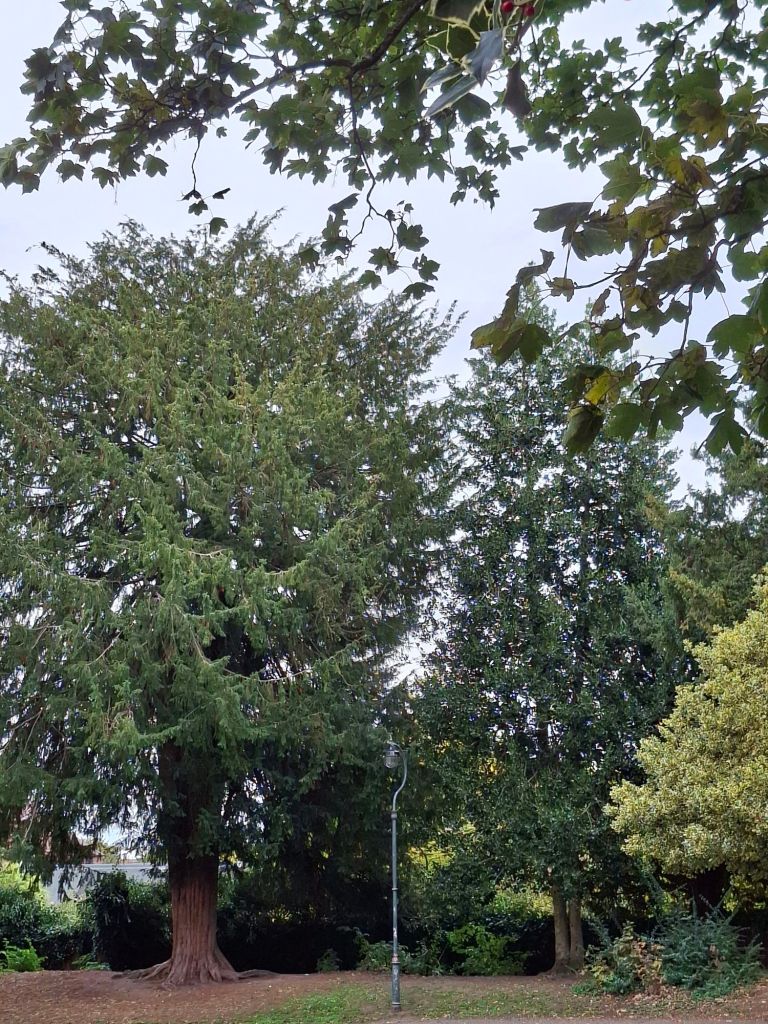
This time draws me further into the declining year. I am in the cathedral’s grounds, now looking at a yew tree and its associations with death. I’m thinking of the approach of Samhain (aka Halloween/All Hallows) at the turn of the month. Once it marked the 3rd harvest of the year – the blood harvest, where animals were slaughtered in preparation for winter. Now it is more a time to remember our ancestors, and our dead more widely.
Yet the seasonal moment, and the yew, can also be linked to wisdom and transformative change in life. I launched my contemplative inquiry at Samhain 2011. Like many people, I find that this period can be a resonant and creative time.
Below the yew, I have included a section of the cathedral itself. I have old personal associations linking medieval Gothic architecture with the feeling-tone of the declining year. I am also aware that this building is linked to the trees I picture and discuss. Gloucester Cathedral was a monastery when Sir Gawain and the Green Knight was written but many of its features were already in place.
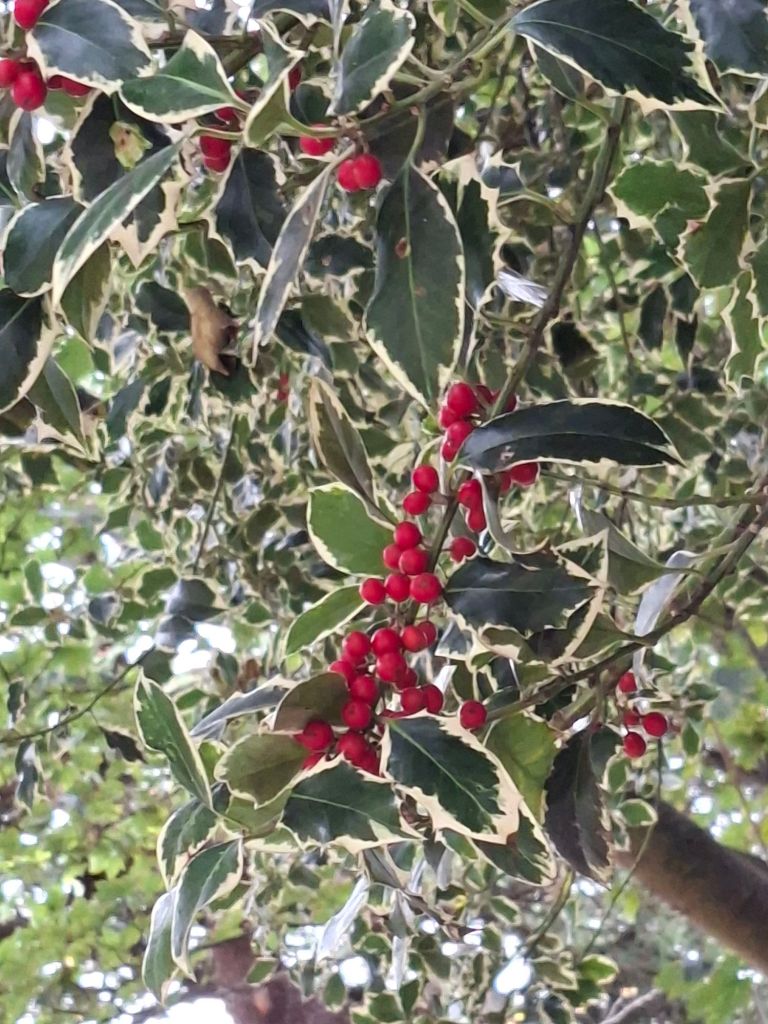
In the same space, I find both holly and ivy, with berries on the holly tree. I immediately thought of the Christmas carol The Holly and the Ivy. It is an ancient folk carol, which interweaves Christian themes and others that belong with the land. The version which is now popular was collected by Cecil Sharp in 1909 in Gloucestershire from Mary Clayton.
Many people think that the indigenous Pagan themes are the oldest, and that the central focus here is on the holly. The authors of The Green Man Tree Oracle say: “Holly’s connection with the Green Man is especially strong. In his guise as the Holly King – an ancient giant and symbol of fertility – the Green Man makes a notable appearance in the 14th century poem Gawain and d the Green Knight. Here he takes the form of a fearsome knight, who comes to King Arthur’s court to offer a midwinter challenge, carrying a club of holly and wearing a holly crown (as symbols of his true identity).” This challenge happens every year, where the Green Man/Holly King demands that we encounter him through our dealings with the natural world.
Elaine and I went to the Gloucester Cathedral Close and its surroundings on Saturday afternoon 18 October to outrun an extended period of gloom, wind and rain. We are now in it, so the lessons of the trees in deep autumn, anticipating the coming of winter, are not lost on us. The dark of the year is on its way.
(1) J.R R. Tolkien(translation of anonymous texts) Sir Gawain and the Green Knight, Pearl, Sir Orfeo New York: Ballantine Books, 1980.
Where I live, late summer is often the warmest time of year, and the driest. This is likely to be the case in 2025, already a warm dry year. But in the sun’s apparent annual journey, it is also a time of waning. Sunrise is an hour later than at the solstice, and sunset is forty-five minutes earlier. This change will accelerate from now on.
I do not see waning as negative. There is power and beauty in this ‘waning’. In the rowan (aka mountain ash) picture above, the berries are moving from tentative orange to bright scarlet, an effect of the seasonal changes in the light. Rowan is an ogham tree, linking a group of indigenous Irish and British trees to an ancient Irish alphabet. Its Gaelic name luis means bright or flame.
Looking at the year as a whole, some of the berries will still be holding on beyond midwinter, by which time the tree, which can live for up to 200 years, will be making its annual comeback. At that time, as described in William Anderson’s justly venerated in Green Man poem (1):
The hungry birds harry the last berries of rowan
But white is her bark in the darkness of rain
‘I rise with the sap’, says the Green Man
‘I rise with the sap’ says he. (1)
The resilience of the tree runs throughout its year and lifetime. In late summer specifially, this resilience is manifested in berries at their brightest, against the backdrop of a still blue evening sky.
Traditionally Rowan has strong associations with protection, spiritual protection not least. According to The Green Man Tree Oracle (2), ‘it can also offer insight into danger through the invocation of higher wisdom’. Ancient Druid shamans were said to breathe in the smoke from rowan fires to initiate a trance state that allowed them to predict coming danger.
The Druids also planted rowan, as well as oak and ash, in their sacred groves. But Celtic Druids were not the only people to place a high value on the rowan tree. Our modern word rowan is probably descended from the Norse runas – narrowly translated as ‘charm’ but in fact bringing the wider runic and Norse traditions with it.
When I encountered the rowan I was strongly moved by it. It stood out from everything else. I had previously decided not to take pictures on my walk, but felt compelled to change my mind. I didn’t need ancient lore to feel more alert and heartened. It’s just that the framing it provides added cultural depth. The encounter with rowan put a spring in my step and was a highlight of my evening.
(1) William Anderson Green Man: archetype of our oneness with the Earth Harper Collins: London & San Francisco, 1990
(2) John Matthews & Will Worthington The Green Man Tree Oracle: ancient wisdom from the greenwood London: Connections, 2003
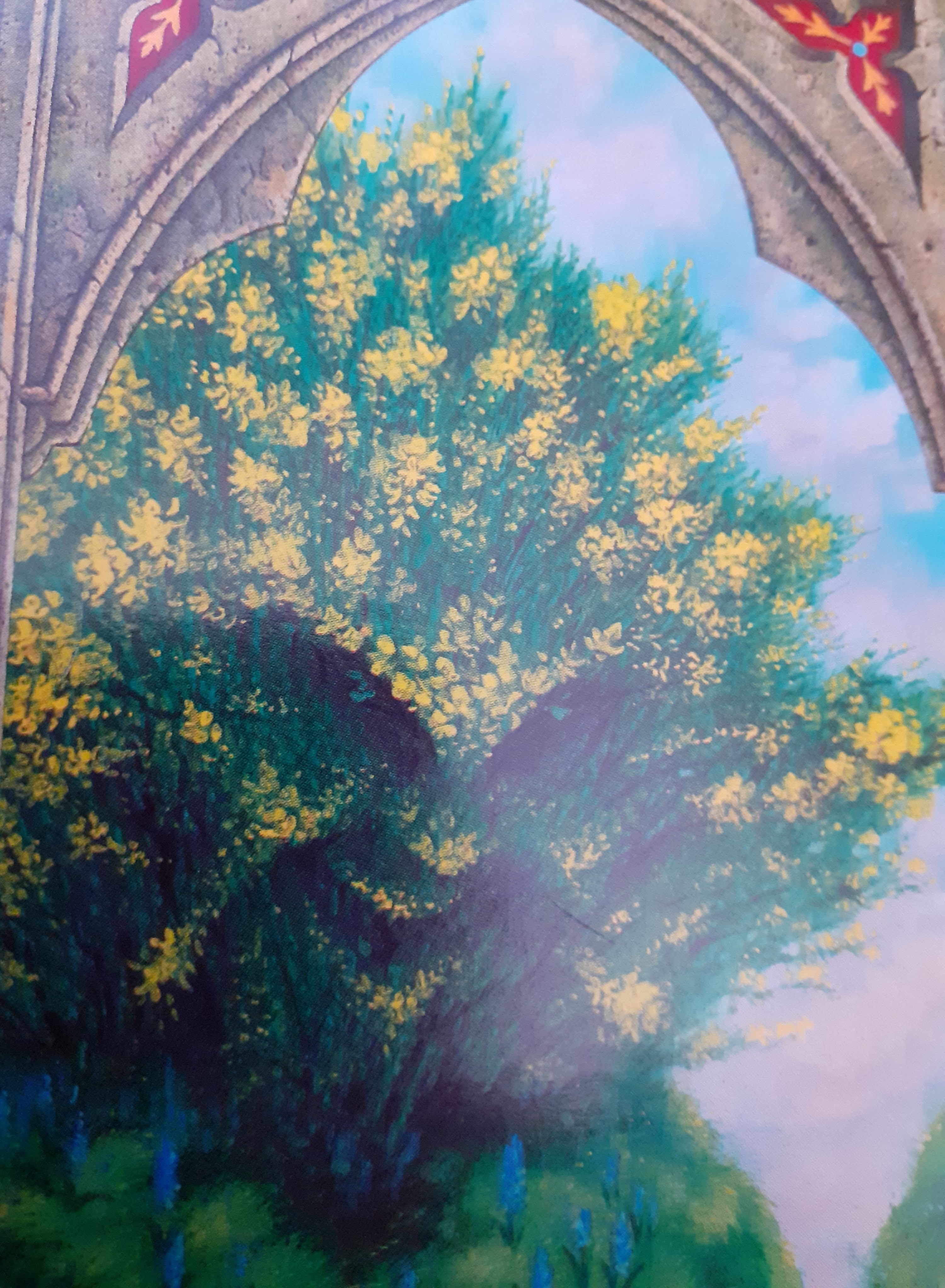
In my wheel of the year tree mandala (1), gorse covers the period from 9-31 July. It is the last tree of the summer quarter, handing over to apple at Lughnasadh/Lammas on 1 August. The illustration is from The Green Man Tree Oracle (2).
I know from my childhood that gorse can make a tame, gently sloping hill seem wild and edgy. Navigating through gorse requires an eye to self-care. Flowering gorse is not confined to summer, but for me it is anchored to summer in memory. Seen from afar, gorse was a vivid harbinger of the summer holidays with days of warmth (rising to heat) and freedom to roam. It carried a hint of adventure and disinhibition. Sometimes the promise was fulfilled. Sometimes there was a hot heavy dullness broken by only storms, and a degree of frustration. July days were unpredictable.
Gorse (ogham name Onn) was sacred to the Irish god Lugh, and thus to light, to all manner of skills, and to the fire in the head of ecstatic creativity. Lugh has a trickster aspect, and can be seen in certain lights as more a god of lightning than of the sun. He has a cousinship with the Brythonic Lleu Llaw Gyffes, the warrior magician of the fourth branch of the Mabinogi. He has also been linked to the Norse Loki, for tricksterism is an aspect of the smouldering fertile mind.
Gorse makes good fuel and so has an obvious role in fire festivals. In Brittany, 1 August was marked by the Festival of the Golden Gorse and gorse has has strong associations with the faery folk. It is a plant of power. We cannot make assumptions about how we stand with it. A wary respect might be wise.
NOTE: This post brings to an end a year in which I have featured the sixteen trees in this mandala. I began on 16 July 2020 with an out-of-sequence Rowan (3), because I had had a vivid encounter with a rowan tree in the woods. (Its time in the mandala is 9-31 October.). Then I moved on to apple(4) and blackberry (5). From the Autumn Equinox (1) the enterprise became more systematic. As a blogger, I won’t be repeating the cycle in the same way in the coming year. Once for the record feels enough.
(1) This mandala is based on my personal experience of trees in the neighbourhood as well as traditional lore. Moving around the summer quarter from Beltane, 1 May, the positions and dates of the four trees are: Hawthorn, south-east, 1-23 May; Beech & Bluebell, south-south-east, 24 May – 15 June; Oak, south, 16 June – 8 July; Gorse, south-south-west, 9 – 31 July. The autumn quarter then starts with Apple at Lughnasadh/Lammas. For a complete list of the sixteen trees, see https://contemplativeinquiry.blog/2020/autumn-equinox-2020-hazel-salmon-awen/
(2) John Matthews & Will Worthington The Green Man Tree Oracle London: Connections, 2003
As its crown forms his mask and its leafage his features;
‘I speak through the oak’, says the Green Man.
‘I speak through the oak says he'” (1)
In my wheel of the year tree mandala (2), oak covers the period from 16 June-8 July and thus includes Alban Hefin, the summer solstice. I am starting to bring it in. The oak has many associations – regal strength, for example – but for me the sense of the green man, the archetype of our oneness with the earth, speaking through the oak, is the most numinous. At Dodona in ancient Greece (3) an oak shrine was “guarded by priestesses who interpreted the future from the rustling of leaves on the great tree, the voice of the sacred spring that rose at its root and the behaviour of birds in its branches”. Celtic tradition describes a number of sacred oak trees, themselves roosting places for sacred birds. I like the sense that the oak does not stand alone and autonomous in these stories. For leaves to rustle, the wind is needed. Birds and springs may also participate in the ecology, of a distributed wisdom – a wisdom of interdependence, of interbeing. The oak’s great branches are matched by still greater roots, and therefore an underground network of communication and exchange that we now know sustains a mature forest (4).
The ogham name for oak, duir, means door in both Sanskrit and Gaelic (5). This can bespeak solidity and protection, for the oak can survive lightning. It was sacred to Taranis, the Celtic god of lightning and storms, to Thor in the Nordic pantheon. and to Zeus among the Greeks. But a door isn’t just defensive. It is there to be opened as well, with a sense of welcome and relationship. Dagda, father god of Ireland, was associated with the oak and never failed to give hospitality to those who asked for it.
For Druids (whose name means ‘oak wisdom’) oak was the central tree in their mysteries. There is a theme, in these mysteries, of communication between worlds, with a sensed Otherworld being less than a heart beat away. The power of the oak combines strength and sensitivity. My mandala links oak to the period in which the light has its greatest expression, and then gives way, at first very slowly, to its necessary descent into the dark. The tree bears witness as the wheel continues to turn.
(1) William Anderson Green Man: Archetype of Our Oneness with the Earth Harper Collins: London & San Francisco, 1990.
(2) This mandala is based on my personal experience of trees in the neighbourhood as well as traditional lore. Moving around the summer quarter from Beltane, 1 May, the positions and dates of the four trees are: Hawthorn, south-east, 1-23 May; Beech & Bluebell, south-south-east, 24 May – 15 June; Oak, south, 16 June – 8 July; Gorse, south-south-west, 9 – 31 July. The autumn quarter then starts with Apple at Lughnasadh/Lammas. For a complete list of the sixteen trees, see https://contemplativeinquiry.blog/2020/autumn-equinox-2020-hazel-salmon-awen/
(3) John Matthews & Will Worthington The Green Man Tree Oracle London: Connections, 2003.
In my wheel of the year tree mandala (1), beech and bluebell together cover the period from 24 May-15 June – taking over from hawthorn and handing on to oak. In this instance, I am drawn by the powerful visual effects of bluebells carpeting woodland in which beech is the dominant tree.
The picture above is an old one. The last year in which Elaine and I went into this space (2018 or 2019) the wood felt weird. Part of it – not quite the area in the picture – was a scene of desolation. A lot of the trees had been taken down, with a kind of ragged insensitivity. It felt like a bad moment in Lord of the Rings. I don’t know the story behind this. Perhaps there was disease, or some other genuine need for a thinning out of trees. It was certainly systematic, with notices about the work being done – the result of management, and not of vandalism, in the conventional usage of our language.
The beech is an elegant tree, and I experience it as having a soft energy. It has been traditionally feminised, and thought of as ‘Queen of the Woods’, sharing the place of honour with the kingly oak according to The Green Man Tree Oracle (2). The same source says that “slivers of beech wood and leaves were once carried as talismans to bring good luck and increase creative energy”. Local British traditions associate the beech (ogham name phagos) with serpents “probably because of its long serpentine root systems”, they add – and I wonder too about the archaic link between the Goddess and serpent power in many cultures.
.
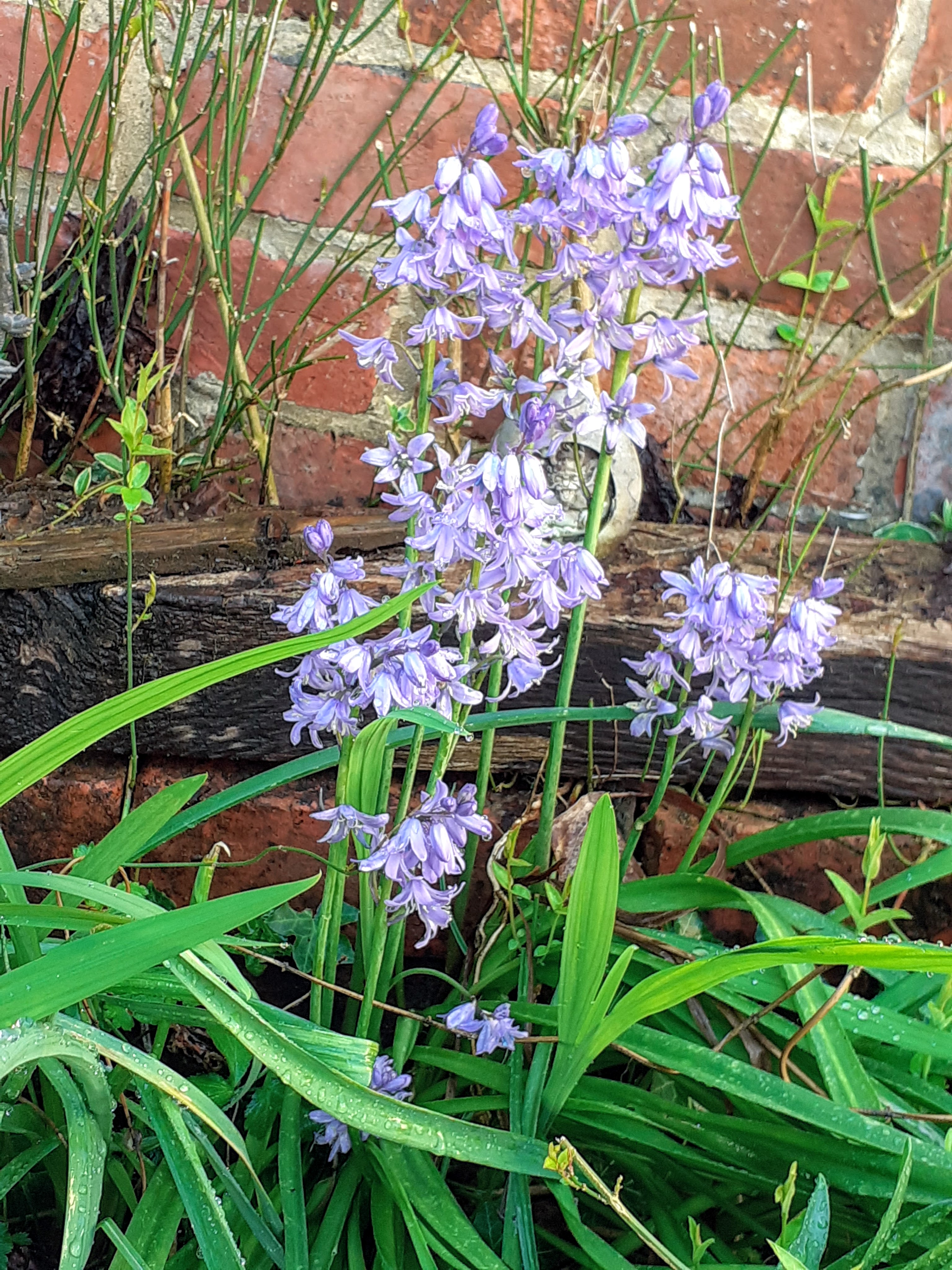
My personal connection with the tree itself is limited. It concerns this time of year and the association with bluebells. Indeed the bluebell is my main focus, with the beech as complementary. If they are separated, I follow the bluebell, and the picture below is a recent one, of the Spanish variety, from our garden. For me, it represents a favourite moment in the year, to be appreciated while it lasts. It reminds me simultaneously of the poignancy of impermanence (including my own) and the beauty of the eternal present (within which I am held).
(1) This mandala is based on my personal experience of trees in the neighbourhood as well as traditional lore. Moving around the summer quarter from Beltane, 1 May, the positions and dates of the four trees are: Hawthorn, south-east, 1-23 May; Beech & Bluebell, south-south-east, 24 May – 15 June; Oak, south, 16 June – 8 July; Gorse, south-south-west, 9 – 31 July. The autumn quarter then starts with Apple at Lughnasadh/Lammas. For a complete list of the sixteen trees, see https://contemplativeinquiry.blog/2020/autumn-equinox-2020-hazel-salmon-awen/
(2) John Matthews & Will Worthington The Green Man Oracle London: Connections, 2003.
In my wheel of the year tree mandala (1), blackthorn (ogham, straif) covers 8-30 April, the final twenty-three days before Beltane. It has a beautiful white flower and elegant sharp thorns. I have seen descriptions of the latter as ‘vicious’, but they only hurt us if we invade the blackthorn’s space. The plant is not a triffid. It doesn’t come after us. So I don’t follow the line of tradition that links blackthorn to harsh fate. Blackthorn doesn’t ask to be turned into guardian hedges or crowns of thorn. That is down to our fellow humans.
The picture above comes from my magic year of 2007, happily well documented, when I was much engaged with trees and Druid study. I felt a pull towards blackthorn, more than towards the generality of hawthorn during that period. (I will write about the Glastonbury Thorn, the exception, at Beltane, my last tree mandala with a ‘memory lane’ theme).
I am drawn particularly to the strand of tradition that links blackthorn to powerfully creative magic – for it was long used in the making of wizards’ staffs. The text of The Green Man Oracle (2) suggests that “we have forgotten the magic that lies within us”. Blackthorn in particular has the ability to “foster waking dreams”. The Oracle adds that, “to access this personal magic, we must step away from busy, surface consciousness, and sink deeply into the ever flowing stream of our magical dreams. The ideas, scenes and presences that throng the deepest levels of our understanding require intense listening” Such magic, the Oracle continues, brings a light into the darkest places. For me that would mean just enough light to illuminate them, and not so much as to dazzle them into negation. How otherwise can the denizens of the dark be offered a welcome home if they want it, and in any event a better understanding?
(1) This mandala is based on my personal experience of trees in the neighbourhood as well as traditional lore. Moving around the spring quarter from 1 February, the positions and dates of the four trees are: Birch, north-east, 1-22 February; Ash & Ivy, east-north-east, 23 February – 16 March; Willow, east, 17 March – 7 April; Blackthorn, east-south-east, 8 – 30 April. The summer quarter then starts with Hawthorn at Beltane. For a complete list of the sixteen trees, see https://contemplativeinquiry.blog/2020/autumn-equinox-2020-hazel-salmon-awen/
(2) John Matthews & Will Worthington The Green Man Oracle London: Connections, 2003.
Within my mandala of the year (1) Birch – Beith in the Irish ogham alphabet (2) – is the first tree for the spring quarter beginning at Imbolc. The overall theme of this quarter, in my world, is one of early growth. Birch presides from 1-22 February and will become one of the first trees to flower in spring, from March onwards. It is also one of the first trees to colonise new ground.
In ogham lore Birch is understood to support new beginnings and to encourage careful preparation, a skilful laying of the ground on which we will build. “In making your spiritual journey with this tree as your guide, remember to concentrate your mind on the uplifting slender whiteness of the tree, a whiteness that stands out clearly from the tangled undergrowth and confusion of shrubs and thorny bushes that cover the floor and, hence, may inhibit an easy journey” (3). The Green Man’s wisdom (1) is that a good beginning leads to a good conclusion.
In runic tradition (4), where Birch (Beorc, Berkana) is also linked to new beginnings, there is specific reference to the young Goddess, sexuality and birth, as well as beauty and creativity more generally. Birch may signal a laying aside of old patterns, whether merely redundant or positively toxic, and a willingness to welcome new, more energising and nourishing ways of being.
For me, this is a welcome shift from the necessary defensiveness and protectiveness of alder. This year, it comes just at the moment where such a shift is possible – as my wife Elaine continues her recovery from major illness and we begin to dream and think our way forward, into a new cycle of life. The wheel turns, and there is a promise of positive change in the air.
(1) The image is from: John Matthews & Will Worthington The Green Man Oracle London: Connections, 2003.
(2) This mandala is based on my personal experience of trees in the neighbourhood as well as traditional lore. Moving around the spring quarter from 1 February, the positions and dates of the four trees are: Birch, north-east, 1-22 February; Ash & Ivy, east-north-east, 23 February – 16 March; Willow, east, 17 March – 7 April; Blackthorn, east-south-east, 8 – 30 April. The summer quarter then starts with Hawthorn at Beltane. For a complete list of the sixteen trees, see https://contemplativeinquiry.blog/2020/autumn-equinox-2020-hazel-salmon-awen/
(3) Liz and Colin Murray The Celtic Tree Oracle: A System of Divination London: Eddison-Sadd, 1988 (Illustrated by Vanessa Card)
(4) Sweyn Plowright The Rune Primer: a Down to Earth Guide to the Runes Rune-Net, 2006








 Contemplative Inquiry