Contemplative Inquiry

This blog is about contemplative inquiry

Tag: Green Man

DEEP AUTUMN 2025

“All things ripen and rot that rose up at first,

And so the year runs away in yesterdays many,

And here winter wends again, as by the way of the world it ought,

Until the Michaelmas moon has winters boding brought.” (1)

Even today, deep autumn opens the door to winter. This was even more the case in the North Staffordshire and Derbyshire regions of 14th century England, where Sir Gawain and the Green Knight was written. Even in castles, people were less sheltered from the growing cold and damp than we are. So readers and listeners of the period are reminded that the coming of winter is both natually and divinely ordained.

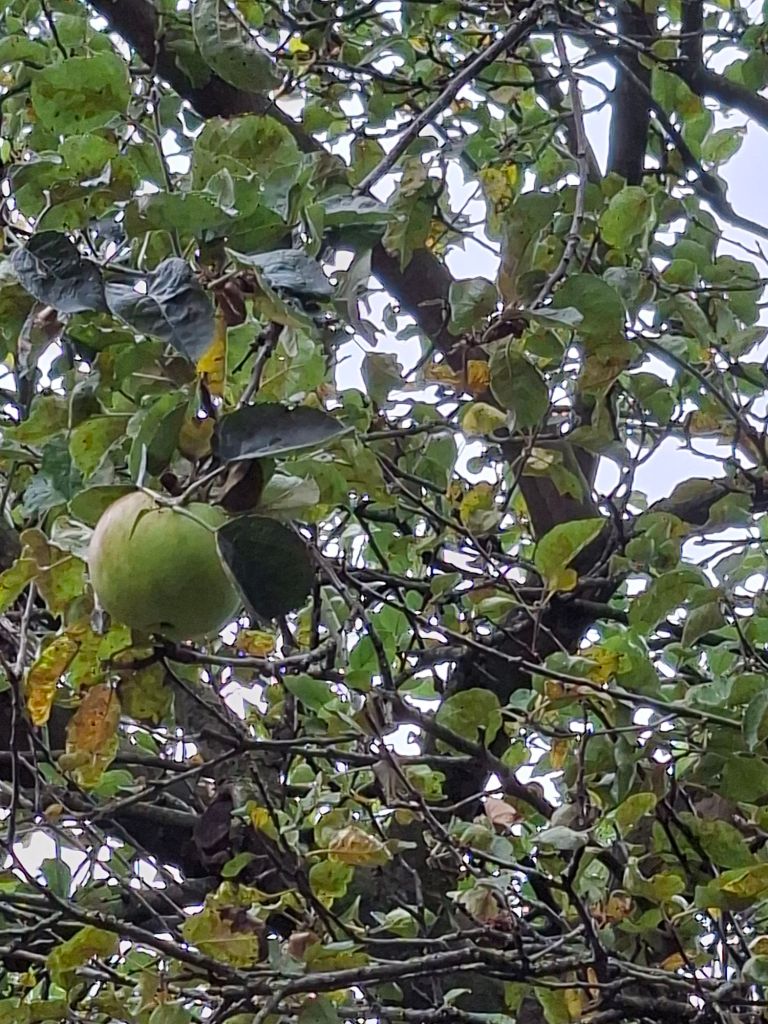
Here and now, the sight of the apple harvest in its later stages (pictured above) seems quite different than in the early ones (2) – less bright, less novel, less shiny. Rotting apples lie on the ground, now fallen outside the wall of  Gloucester Cathedral’s orchard. From Nature’s exuberant perspective, this is all part of the plan.  Waste is built in.

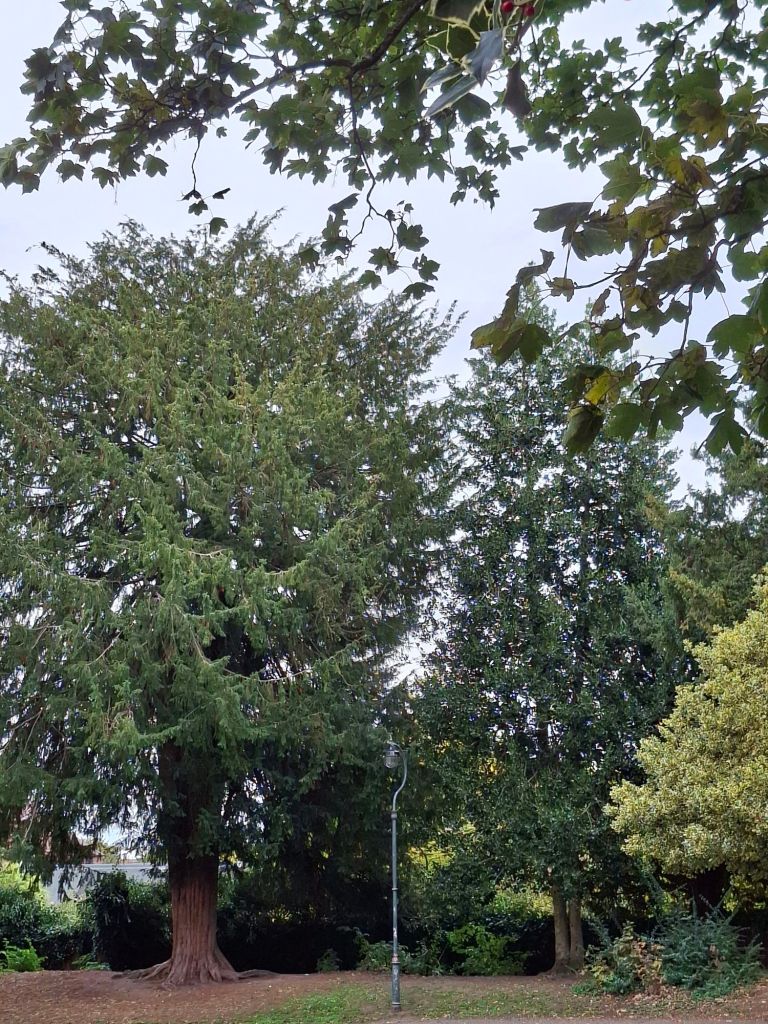
This time draws me further into the declining year. I am in the cathedral’s  grounds, now looking at a yew tree and its associations with death. I’m thinking of the approach of Samhain (aka Halloween/All Hallows) at the turn of the month. Once it marked the 3rd harvest of the year – the blood harvest, where animals were slaughtered in preparation for winter. Now it is more a time to remember our ancestors, and our dead more widely.

Yet the seasonal moment, and the yew, can also be linked to wisdom and transformative change in life. I launched my contemplative inquiry at Samhain 2011. Like many people, I find that this period can be a resonant and creative time.

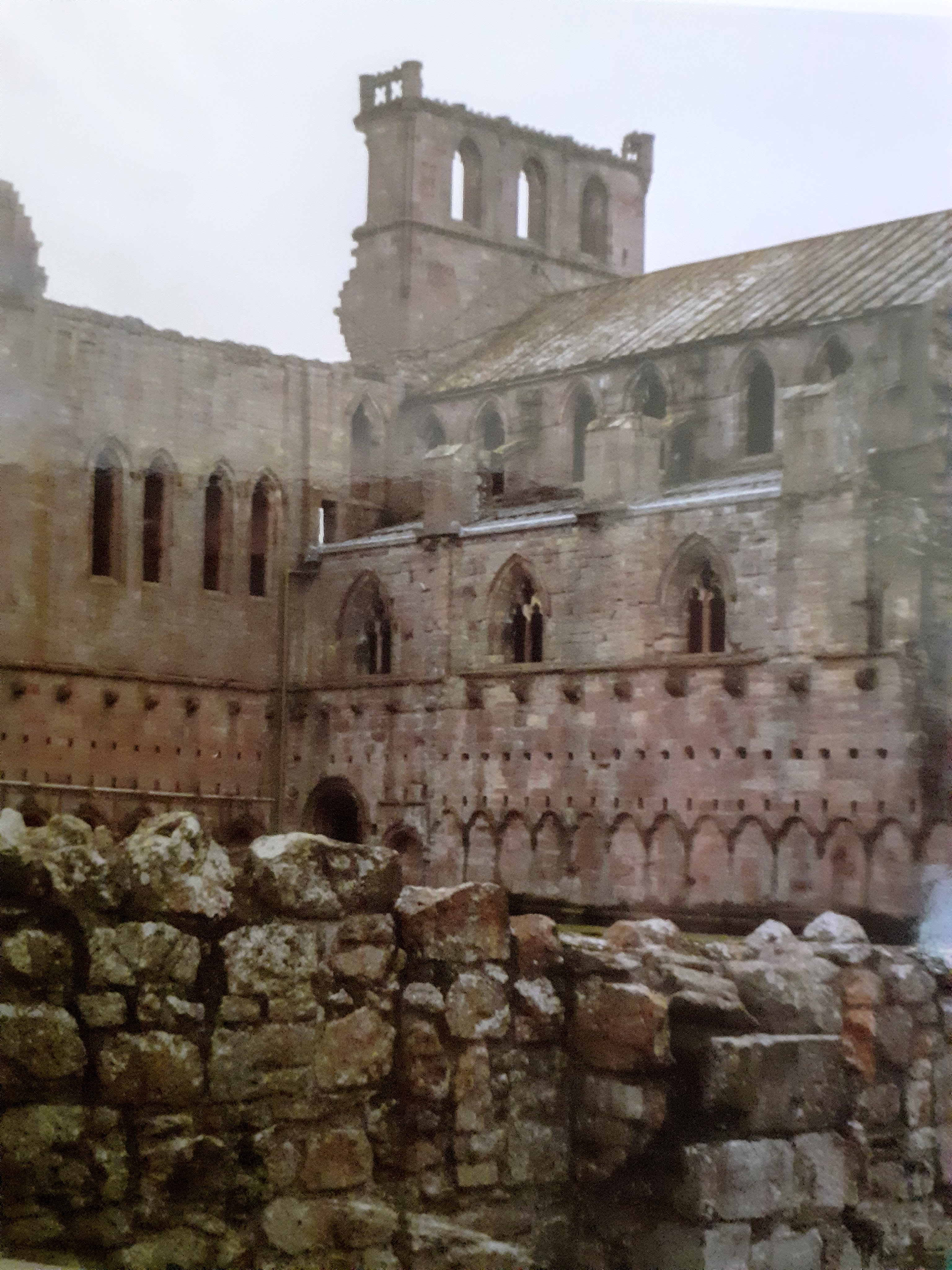
Below the yew, I have included a section of the cathedral itself. I have old personal associations linking medieval Gothic architecture with the feeling-tone of the declining year. I am also aware that this building is linked to the trees I picture and discuss. Gloucester Cathedral was a monastery when Sir Gawain and the Green Knight was written but many of its features were already in place.
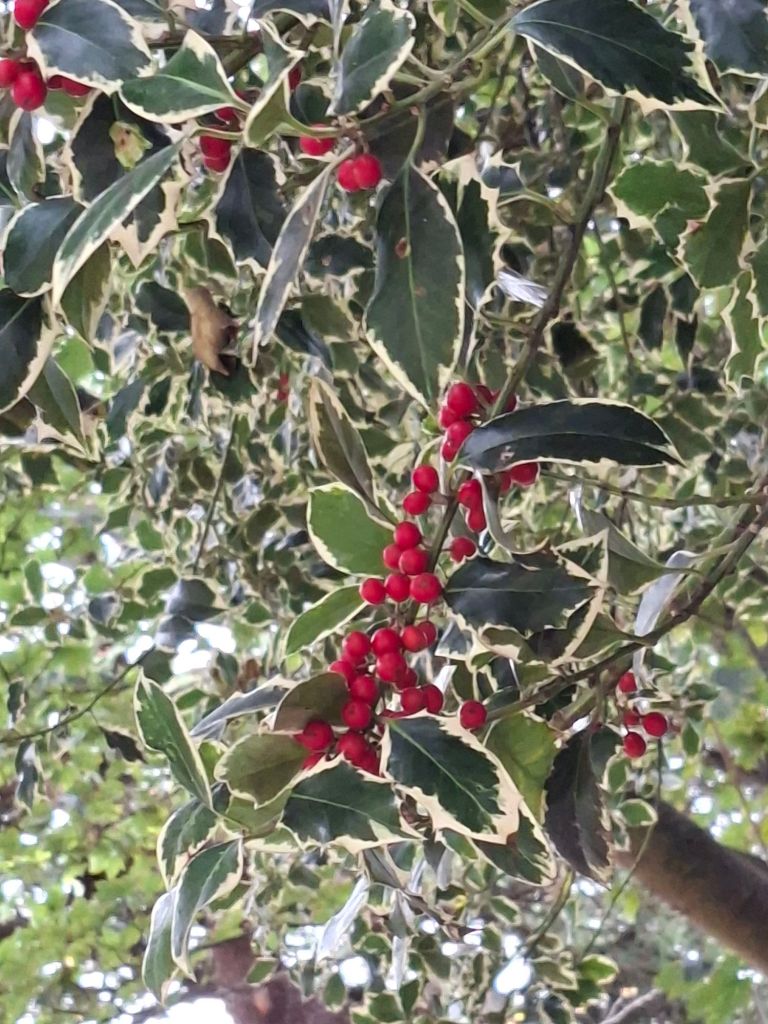
In the same space, I find both holly and ivy, with berries on the holly tree.  I immediately thought of the Christmas carol The Holly and the Ivy. It is an ancient folk carol, which interweaves Christian themes and others that belong with the land. The version which is now popular was collected by Cecil Sharp in 1909 in Gloucestershire from Mary  Clayton.

Many people think that the indigenous Pagan themes are the oldest, and that the central focus here is on the holly. The authors of The Green Man Tree Oracle say: “Holly’s connection with the Green Man is especially strong. In his guise as the Holly King – an ancient giant and symbol of fertility – the Green Man makes a notable appearance in the 14th century poem Gawain and d the Green Knight. Here he takes the form of a fearsome knight, who comes to King Arthur’s court to offer a midwinter challenge, carrying a club of holly and wearing a holly crown (as symbols of his true identity).” This challenge happens every year, where the Green Man/Holly King demands that we encounter him through our dealings with the natural world.

Elaine and I went to the Gloucester Cathedral Close and its surroundings on Saturday afternoon 18 October to outrun an  extended period of gloom, wind and rain. We are now in it, so the lessons of the trees in deep autumn, anticipating the coming of winter, are not lost on us. The dark of the year is on its way.
(1) J.R R. Tolkien (translation of anonymous texts) Sir Gawain and the Green Knight, Pearl, Sir Orfeo New York: Ballantine Books, 1980.

(2) https://contemplativeinquiry.blog/2025/08/22/ (3rd photo)

(3) John Matthews & Will Worthington The Green Man Tree Oracle: Ancient Wisdom from the Greenwood London: Connections, 2003

ROWAN’S LATE SUMMER SIGN

Where I live, late summer is often the warmest time of year, and the driest. This is likely to be the case in 2025, already a warm dry year. But in the sun’s apparent annual journey, it is also a time of waning. Sunrise is an hour later than at the solstice, and sunset is forty-five minutes earlier. This change will accelerate from now on.

I do not see waning as negative. There is power and beauty in this ‘waning’. In the rowan (aka mountain ash) picture above, the berries are moving from tentative orange to bright scarlet, an effect of the seasonal changes in the light. Rowan is an ogham tree, linking a group of indigenous Irish and British trees to an ancient Irish alphabet. Its Gaelic name luis means bright or flame.

Looking at the year as a whole, some of the berries will still be holding on beyond midwinter, by which time the tree, which can live for up to 200 years, will be making its annual comeback. At that time, as described in William Anderson’s justly venerated in Green Man poem (1):

The hungry birds harry the last berries of rowan

But white is her bark in the darkness of rain

‘I rise with the sap’, says the Green Man

‘I rise with the sap’ says he. (1)

The resilience of the tree runs throughout its year and lifetime. In  late summer specifially, this resilience is manifested in berries at their brightest, against the backdrop of a still blue evening sky.

Traditionally Rowan has strong associations with protection, spiritual  protection not least. According to The Green Man Tree Oracle (2), ‘it can also offer insight into danger through the invocation of higher wisdom’. Ancient Druid shamans were said to breathe in the smoke from rowan fires to initiate a trance state that allowed them to predict coming danger.

The Druids also planted rowan, as well as oak and ash, in their sacred groves. But Celtic Druids were not the only people to place a high value on the rowan tree. Our modern word rowan is probably descended from the Norse runas – narrowly translated as ‘charm’ but in fact bringing the wider runic and Norse traditions with it.

When I encountered the rowan I was strongly moved by it. It stood out from everything else.   I had previously decided not to take pictures on my walk, but felt compelled to change my mind. I didn’t need ancient lore to feel more alert and heartened. It’s just that the framing it provides added cultural depth.  The encounter with rowan put a spring in my step and was a highlight of my evening.

(1) William Anderson Green Man: archetype of our oneness with the Earth Harper Collins: London & San Francisco, 1990

(2) John Matthews & Will Worthington The Green Man Tree Oracle: ancient wisdom from the greenwood  London: Connections, 2003

‘I SWIM WITH THE SALMON’

“The hazels are rocking the cups with their nuts

As the harvesters shout when their last leaf is cut;

‘I swim with the salmon says the Green Man,

‘I swim with the salmon’, says he.” (1)

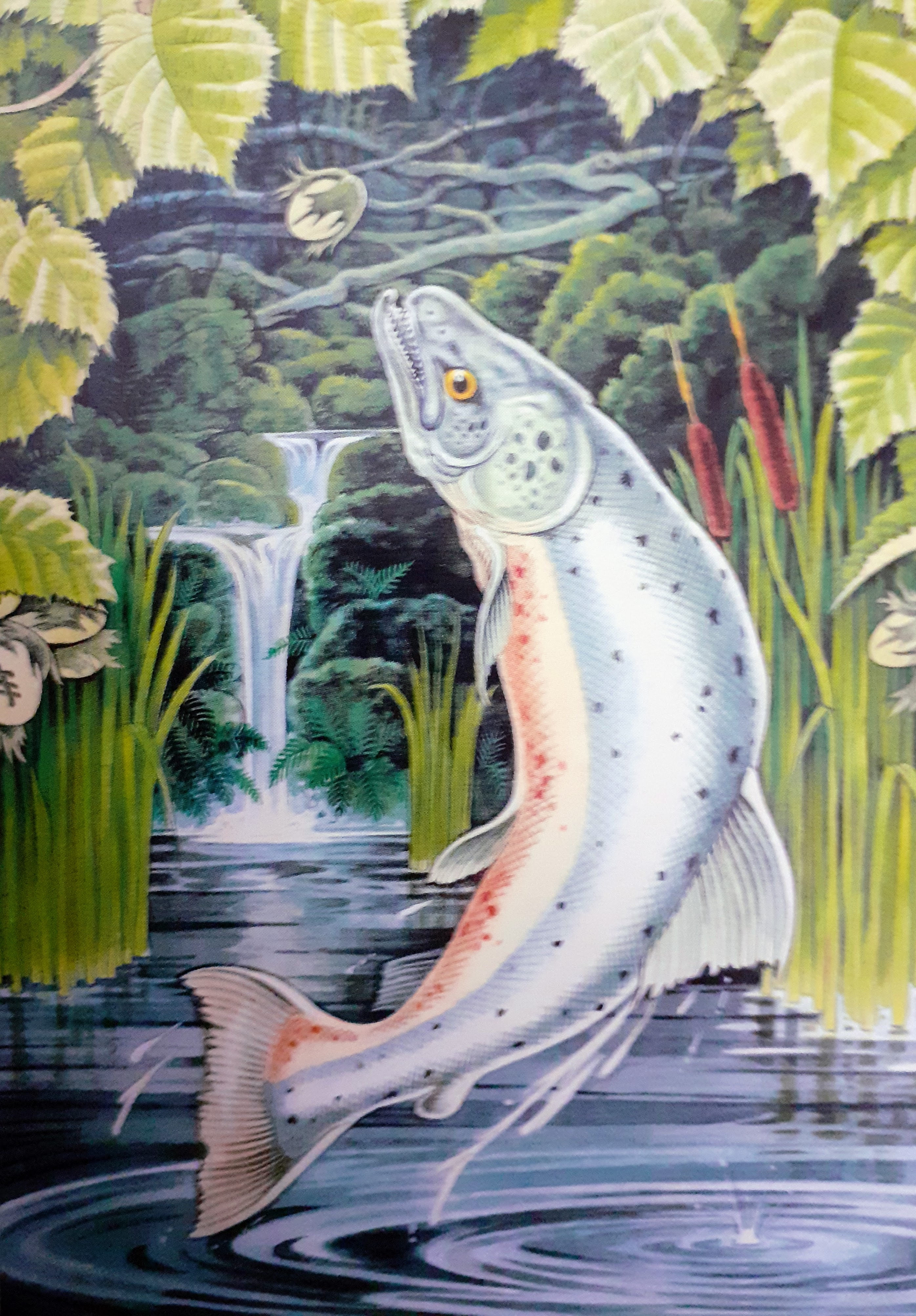
‘I swim with the salmon’ is a bold, clear statement. It evokes powerful images that leap out of their place in the flow of William Anderson’s poem. Green Man as a whole takes us on a wheel-of-the-year journey beginning on 22 December, successively featuring thirteen trees for four weeks each. The hazel is the ninth tree, whose time runs from 3-30 August. As the poem indicates, this is a harvest period, and the last month that fully belongs to the summer. It is also a time when you may find Atlantic salmon swimming home to spawn, though spawning doesn’t begin until October.

In this post I celebrate salmon naturalistically, through an account of their extraordinary life cycle. I am especially aware of the River Tay in Scotland, mostly thanks to a 90 minute documentary The River: a Year in the Life of the Tay (2). My personal experience of the Tay is limited to visits to Dunkeld, Perth and Dundee, where I nonetheless fell in love with the river and its powerful energy.

Salmon begin their lives in mountain streams, as far upstream as their parents have been able to reach in their autumn/early winter spawning period. The new generation undergoes a remarkable series of transformations (3), hatching as alevin or sac fry when the water warms in spring, and growing into parr with camouflaging vertical stripes. They remain in the same environment for two or more years, by which time, as smolts, they have developed a bright silvery colour with scales that easily rub off. Driven by growth hormones, the 10% of smolts who survive to this stage experience the mutations necessary to become salt water fish and make their journey to the ocean.

They spend another two or more years in the North Sea, travelling north into Norwegian waters, becoming sexually mature, with a darkening of the silvery scales, before embarking on their homewards 120 mile journey up the river to its headwaters. They are much larger than they were when on their way out. The largest salmon ever caught in the Tay, in the 1920’s, was over five feet long.

To return to their own birth-place (remembering exactly where they come from) they have to navigate waters that include rapids and waterfalls, evade osprey and human anglers, and achieve the feats of leaping for which they are famous. “The salmon is able to jump upstream not by fighting against the current, but by utilizing its knowledge of the reverse current which flows beneath the surface current” (4). They are returning to their native headwaters in order to spawn and begin the cycle again. 98% of Atlantic salmon spawn only once and die soon afterwards: their adult bodies, equipped for a salt water life, never fully re-adapt to fresh water and this makes them vulnerable.

Swimming with the salmon is not for the faint-hearted. At the present time the population of Tay salmon is in severe decline (70% in the 30 years to 2019) although the river is relatively clean and is now managed to prevent over-fishing. The effects of the climate crisis in the Atlantic are the most likely cause for the decline of Tay salmon, as for Atlantic salmon in general. Yet even in decline they remain magnificent. Long before the Celtic Iron Age, during it, and for long afterwards, they were abundant in the rivers of Britain, Ireland, and other Atlantic maritime countries. With their complex shape-shifting capacity, their far-journeying years at sea, their uncanny homecoming knowledge and their extraordinary leaps, they seem marked out for another life, in human song and story. I would like to think that the salmon’s mythic reputation can help to save it in this interconnected world.

”’I swim with the salmon says the Green Man,

‘I swim with the salmon’, says he.”

(1) From:  William Anderson Green Man: Archetype of our Oneness with the Earth Harper Collins: London & San Francisco, 1990 See also: https://contemplativeinquiry.blog/2017/05/11/poem-green-man/

(2) The River: A Year in the Life of the Tay 90 minute documentary made for BBC4 in 2019. Presented by writer and naturalist Helen MacDonald. See: https://youtu.be/ZEmAXQIrDeg?si=wlaI0bNtM6YWevAf The film is well worth watching, covering the journeys of the salmon and much more.

(3) Salmon Wikipedia

(4) Philp and Stephanie Carr-Gomm The Druid Animal Oracle: Walking with the Sacred Animals of the Druid Traditions Fireside: London, 1994 Illustrated by Will Worthington. The face of their salmon card is pictured at the top of this blog.

OLD MIDSUMMER’S EVE 2024

23 June 2024, around 8.15 pm. I’m enjoying my first contemplative walk for some days. I’m looking at an old wall, once part of the Llanthony Priory estate in Gloucester. The day has been one of rising temperatures and humidity. Even now, as the shadows deepen, I feel an energy and expectancy in the evening light.

The Priory here was for a time the largest landlord in the city and its surrounding district. In those days, midsummer was celebrated on 23/24 June. The Church celebrated the birth of John the Baptist, at the opposite end of the year from that of Jesus. (His beheading is remembered on 29 August). Popular celebrations on the evening/night of 23 June involved bonfires, and local festivities could be attributed to the saint, the season, or both.

In many cultures, the year has been divided into two contending halves, whether at the solstices, the equinoxes, or with the Beltane/Samhain division. Traditional Christianity flirts with this theme. I might think of summer and winter kings, king-slaying and the Goddess. I might also think of John, Jesus, and their respective human fates. In the case of John, Salome and her royal mother Herodias are a presence, along with their fateful demand for his head. These stories are not the same, but in the European Christian imagination they have at times been interwoven.

I might also think of the Green Man maturing to the point where he can “speak through the oak”, as “its crown forms his mask and its leafage his features” (1). To speak through the oak is to speak at another level, or from another dimension, a developmental moment that occurs at the year’s zenith (life’s zenith?) This maturation flows from from a willingness to surrender to a greater power. The purely personal direction can only be towards winter and death. But that’s not the whole story, even to a ‘sacred agnostic’ like me (2.) This is the midsummer evening’s tale that intrigues me the most.

The image below comes from a small patch in Llanthony Priory’s current garden, on the site of the original physic garden. I simply found it beautiful.

(1) Green Man Poem In:  William Anderson Green Man: archetype of our oneness with the Earth Harper Collins: London & San Francisco, 1990 See: https://contemplativeinquiry.blog/2017/05/11/poem-green-man

(2) https://contemplativeinquiry.blog/2024/02/16/sacred-agnosticism

MUIN: “GATHER IN WHAT IS DEAREST TO YOU.”

Muin (Ogham name for Blackberry) is one of four plants that have a place in both The Green Man Tree Oracle (1) and The Druid Plant Oracle (2). In the latter, from which the illustration is taken, it is called Bramble.

Muin is an important plant ally for me. At times I have identified closely with ‘Mr. Bramble’ (3). He is stubbornly resilient, with deep and extensive underground root systems. Above ground, he can create an almost impenetrable barrier of briars. He digs in. He is a survivor. He tests qualities and intentions. He protects the deep earth and undervalued dimensions of being. Yet he also grows abundant tasty fruit, that can be made into wine or gin.

Where I live, Muin’s time traditionally runs from Lammas/Lugnasadh to Michaelmas/Mabon – essentially the calendar months August and September. This year, as this time approaches, I am thinking of Muin as a teacher. The Green Man Tree Oracle offers words of ‘green man wisdom’ for all its trees. Muin’s words are: “gather in what is dearest to you“. I find “gather in” friendly and relational, very good to hear in a world where ‘harvesting’ is often cold, impersonal and mechanistic. Muin’s more warmly relational note is reinforced by the words “dearest to you”. We are invited to consider “riches of the soul and the things that give us inspiration” as our recommended harvest.

There are obvious questions here: what is ‘mine’ to ‘gather in’? what to I choose? what do I let go? But this is not, fundamentally, a questioning and list-making task. It is more about being open to Muin’s magic. This, I believe, is rooted in an unusual combination of qualities: tenacity, challenge, depth, an invitation to pleasure and, indeed, a certain kind of intoxication. Over the coming weeks, I will draw on Muin’s inspiration as I gather this harvest of the soul*.

(1) Philip and Stephanie Carr-Gomm The Druid Plant Oracle: Working with the Flora of Druid Tradition London: Connections, 2007 (Illustrated by Will Worthington)

(2) John Matthews & Will Worthington The Green Man Tree Oracle: Ancient Wisdom from the Greenwood London: Connections, 2003

(3) See: https://contemplativeinquiry.blog/2020/08/30/mr-bramble/

  • I think of soul as a process not an entity, though we don’t have the word ‘souling’.

HOW PAGAN WAS MEDIEVAL BRITAIN?

How Pagan Was Medieval Britain? is the sixth and final lecture in Professor Ronald Hutton’s Gresham College series on early Pagan history in Britain (1). The simple answer, according to Hutton, is: not as much as was widely believed in the twentieth century, by scholars and the lay public alike. Some thought that full medieval Christianity was an upper class faith, with commoners, especially in the countryside, being ‘cheerful semi-Pagans’, Christian by day and following the old ways by night. Others thought that the two religions ran in parallel, with the latter being necessarily clandestine whilst some of its iconography was visible. Green Man and Sheela na Gig images, often present in the churches themselves, seemed to indicate the survival of a Pagan sensibility at the very least – canny concessions by the Church to the people. Witch persecutions were seen as evidence of an active, surviving woman centred nature religion. Indeed, such ideas influenced cultural and religious developments in the twentieth century itself – specifically, the rise of neo-Paganism; more broadly, the Feminist and Green movements that were dynamically emerging at the time.

However, turning to the medieval period itself, Hutton, does not find evidence of actually existing Pagan religion in the available sources. Witch trials have been carefully examined in recent years, and the victims don’t fit the profile. In Anglo-Saxon times, the legal codes and church councils stopped bothering to forbid Christian converts their old ways by 800 CE. The prohibitions reappeared in the tenth century, in relation to Viking settlers, but ceased again by 1030 CE. In the later middle ages there was serious concern over Christian heretics (Lollards) and some concern over ale-house cynics expressing anti-religious views. In medieval society people tended be nosy about other people’s business and there was social pressure to conform. There are court cases that draw on this kind of informal surveillance, but none concerned with Pagan religious practice. Hutton traces Sheela Na Gig images to the Church in France, saying that they had an anti-erotic intent. Likewise, Green Man, Wild Man and Jack in the Green figures have specific historical origins not concerned with any Pagan deity. Hutton quite reasonably offers no comment on their widely perceived role as archetypal images, because these are outside the remit of the empirical historian. His focus is on self-defined and organised Pagan religion during a specific period in Britain.

But it is true, according to Hutton, that the medieval church offered religious continuity in other ways. The veneration of saints, who were very diverse and numerous, allowed polytheist habits of mind to continue, especially in the realm of petitionary prayer. Individual saints might be local, or specialists in specific forms of help. For many people they seemed more approachable than the persons of the trinity. However in Britain there seem to have been no saints who had themselves once been gods*. Likewise Christians had holy wells, but they were different from the old Pagan ones, rather than the same ones repurposed. The temple of Sulis Minerva at Bath, for example, was left alone. Few temples or ancient religious sites became churches, even though Pope Gregory had recommended this approach when he sent his mission to Kent in 597 CE.

Church attendance was not compulsory in the middle ages. It is estimated that only around 50% of parishioners attended regularly, though they did turn up in much larger numbers for the major festivals. During these, ‘secular revelry’ was allowed, even encouraged, and the festivals raised a lot money for Parish churches, enabling them at times to abolish Parish rates. This widely beneficial outcome was seen as ‘cheating the Devil’. Even on normal days, the Church offered spectacle – with the mass, libations and incense. Local priests came from the people, didn’t have to be literate, and didn’t have to preach. That was done by specialist friars with notable performance skills, often very popular. Additionally, many people belonged to guilds linked to their churches, usually focused around a saint. There were lay religious guilds for both women and men, which had a variety of purposes, officered by their own lay members. Craft guilds performed plays at festival times. This form of Christian culture lasted in Britain until the middle of the sixteenth century, when the old church fragmented into a plurality of new ones over hard-fought time. Different kinds of Christian culture, generally even less Pagan friendly, emerged.

(1) https://www.gresham.ac.uk/watch-now/medieval-pagan/

* An exception would be the Gaelic speaking areas in Scotland and Brighid

INQUIRY, IDENTITY AND COMMUNITY

I am looking downwards into water, identifying patterns, on a surface that swirls and moves and changes. I have the same impulse to identify patterns in my contemplative life. In essence, contemplative experience is simple, still, and drawn from wordless depths. But there’s a surface swirl that’s more agitated, largely driven by worries over naming and explaining, clarifying where my inquiry sits within human communities, and accurately representing spiritual philosophies. Here too, I am giving the surface swirl the attention it seeks. I do not ask the swirl to stop swirling, because swirling is what it does. There is value in the swirl.

I centre myself in modern Druidry, but my self-presentation from 2012 as a ‘contemplative Druid’ is slightly misleading – too narrow. I champion the value of a contemplative current within Druidry, and I am happy to describe my blog as a contemplative inquiry. But I also have a strong commitment to the life of the world and opportunities for the flourishing of all beings, within both the constraints and the opportunities of our interconnectedness. I am concerned with our planet and its biosphere; with human history and culture; with ethics and engagement; with beauty as well as truth and goodness; and with issues of wounding and healing. They are part of my inquiry. I cannot separate them from my contemplative commitment.

I also celebrate the influence of ‘nondual’ currents outside Druidry. Nondual is a translation of advaita (not-two) in classical Sanskrit philosophy. It describes the divine/human relationship. Its original home is the Advaita Vedanta path in India, but there are nondualists in other world religions, including the Abrahamic ones: Sufi currents in Islam, Jewish Kabbalah, contemplative Christianity. In Christian terms, you would say that we are all essentially Christs – in a creation of one Light and many lamps. In some interpretations, nonduality does not apply only to humans, but to all lives in the cosmos. Some iterations of nonduality – Mahayana Buddhist and Taoist in particular – avoid the language of divinity, preferring terms like ‘true nature’ or the deliberately undefinable ‘Tao’.

I have engaged with current nondualist teachings for some years, most recently with the Eckhart Tolle community – https://www.eckharttolle.com. I have learned a lot from them. In this blog’s About section, I say: “My inquiry process overall has helped me to discover an underlying peace and at-homeness in the present moment, which, when experienced clearly and spaciously, nourishes and illuminates my life. It is not dependent on belief or circumstance, but on the ultimate acceptance that this is what is given”.

I could maintain this stance as a humanist or existentialist, but my deepest intuition is that the ‘present moment’ (or eternal now), fully experienced, links my passing personal identity to a cosmic one, a ground of being that is my true nature. Belief has come in: ‘willingness to follow one’s deepest intuition’ is one definition of faith, and I have surprised myself by becoming a person of faith in this sense. The purpose of continuing inquiry is to keep me open to new experiences, understandings, and connections, as well as teaching me how best to live from the peace and at-homeness of the centre.

My inquiry is a self-directed enterprise that welcomes input from multiple sources. But I draw on two main centres of community wisdom and support. The first is OBOD Druidry (https://www.druidry.org), with its embrace of the earth and its loyalty to the world of space and time, nature and culture. For many of us this includes the sense of a living cosmos and a divine ground. The second is the specifically nondualist Headless Way, based on the work of the late Douglas Harding (https://www.headless.org). I have started to think of myself as a Headless Druid, in a modern kind of way, whilst also aware of older traditions in which decapitation is indeed the gateway to a larger life:

‘It’s off with my head’, says the Green Man,

‘It’s off with my head’, says he.

Green Man becomes grown man in flames of the oak

As its crown forms his mask and its leafage his features;

‘I speak through the oak’, says the Green Man.

‘I speak through the oak’, says he.

William Anderson Green Man: Archetype of Our Oneness with the Earth Harper Collins: London & San Francisco, 1990.

See also: https://contemplativeinquiry.blog/2021/6/14/tree-mandala-oak and https://contemplativeinquiry.blog/2017/05/11/poem-green-man

A MIDSUMMER DAY’S DREAM

This post is about a midsummer day’s dream in the the Scottish border country, a dream which included a certain kind of waking up. I have written about it before (1,2) but this is the first illustrated version. Fourteen years have passed since that day, which in many ways determined the form which my expression of Druidry would take.

I was near Melrose. The wild rose was one of many on the banks of the Tweed. In this photograph, I am on a riverside path, with my back to the river. I keenly noticed then, as I notice now, the difference between a wild rose and the more familiar cultivated ones. I love both. But I remember feeling a particular delight at the simplicity of the native flower, a sense of easy integration into habitat, and of a plant not committed to being red or white.

Looking more deeply, I have said in my earlier writing how I had a momentary experience in which, gazing at a rose, subject/object distinctions disappeared and it is as if time intersected with eternity. I have identified this with the Seeing experience more systematically explored by Douglas Harding and the community built up around his work (http://www.headless.org). This was the beginning my sense that direct experience of the world, manifesting through a form of nature mysticism, would be my way forward, eventually becoming a contemplative Druidry and the backbone of my contemplative inquiry. I experience this as a direct and simple route to stillness, presence, resting in being., and identifying with source.

My walk amongst the wild roses had a prequel. Firstly, I had already spent time in the well-preserved ruins of Melrose Abbey. It was a building of Green Man carvings, but, sadly, neither the monks who occupied it nor the iconoclasts who abandoned it had access to the Gospel of Thomas (3) or the words:

“His disciples said to him:

‘When will the dead be at rest?’

‘When will the new world come?’

He answered them:

What you are waiting for has already come,

but you do not see it.” (3)

Here I see the abbey as a solid, material buildings, built with love and care. Even today, it belongs in its landscape, as much as the Tweed or the nearby Eildon Hills, with a semi-wild orchard of apple, pear and cherry trees. What I haven’t written before, in times when I was busy making distinctions between available paths, is that time and eternity intersect in this place too. But, on the day in question, I didn’t have that experience in the abbey grounds. I had it only among the wild roses, down by the river.

The Eildon Hills are also part of the same landscape, indeed a more primal one. But they are fairy hills and they can hide themselves. On that day, they hid from me. There was no invitation – or, rather command – from the Queen of Elfland, who had once ridden out to summon Thomas the Rhymer to her service:

“But you maun go wi’ me now Thomas

True Thomas ye maun go with me

For ye maun serve me seven years

Through weel or wae as may change to be.” (4)

At midsummer in 2007 I was looking for a spiritual home that offered both depth and simplicity. The grim half hidden hills were not appealing to me and I was closed to their magic, with an invitation or without one. I did not want to court danger by ascending into their conceivably treacherous mists. The low road by the river was the one for me.

It was a good decision, and good came of it. But I do also understand that on a different day, those hills could be seen in a different light. I do not now feel constrained to make a neat choice between a broad road, a narrow road and a bonny road. Two cycles of seven years on, well rooted in a nourishing life and practice, I find myself in a more open space, wondering what lessons this Otherworld might yet offer.

(1) James Nichol Contemplative Druidry: People, Practice and Potential Amazon/Kindle, 2014 See: https://www.amazon.co.uk/contemplative-druidry-people-practice-potential/dp/1500807206/

(2) https://contemplativeinquiry.blog/2019/07/16/seeing-contemplative-druidry/

(3) The Gospel of Thomas: the Gnostic Wisdom of Jesus (Translation from the Coptic, introduction and commentary by Jean-Yves LeLoup. English translation by Joseph Rowe. Foreword by Jacob Needleman) Rochester, VT: Inner Traditions, 2005

(4) R. J. Stewart The Underworld Initiation: A Journey Towards Psychic Transformation Wellingborough: The Aquarian Press, 1985

TREE MANDALA: OAK

“Green man becomes grown man as flames of the oak

As its crown forms his mask and its leafage his features;

‘I speak through the oak’, says the Green Man.

‘I speak through the oak says he'” (1)

In my wheel of the year tree mandala (2), oak covers the period from 16 June-8 July and thus includes Alban Hefin, the summer solstice. I am starting to bring it in. The oak has many associations – regal strength, for example – but for me the sense of the green man, the archetype of our oneness with the earth, speaking through the oak, is the most numinous. At Dodona in ancient Greece (3) an oak shrine was “guarded by priestesses who interpreted the future from the rustling of leaves on the great tree, the voice of the sacred spring that rose at its root and the behaviour of birds in its branches”. Celtic tradition describes a number of sacred oak trees, themselves roosting places for sacred birds. I like the sense that the oak does not stand alone and autonomous in these stories. For leaves to rustle, the wind is needed. Birds and springs may also participate in the ecology, of a distributed wisdom – a wisdom of interdependence, of interbeing. The oak’s great branches are matched by still greater roots, and therefore an underground network of communication and exchange that we now know sustains a mature forest (4).

The ogham name for oak, duir, means door in both Sanskrit and Gaelic (5). This can bespeak solidity and protection, for the oak can survive lightning. It was sacred to Taranis, the Celtic god of lightning and storms, to Thor in the Nordic pantheon. and to Zeus among the Greeks. But a door isn’t just defensive. It is there to be opened as well, with a sense of welcome and relationship. Dagda, father god of Ireland, was associated with the oak and never failed to give hospitality to those who asked for it.

For Druids (whose name means ‘oak wisdom’) oak was the central tree in their mysteries. There is a theme, in these mysteries, of communication between worlds, with a sensed Otherworld being less than a heart beat away. The power of the oak combines strength and sensitivity. My mandala links oak to the period in which the light has its greatest expression, and then gives way, at first very slowly, to its necessary descent into the dark. The tree bears witness as the wheel continues to turn.

(1) William Anderson Green Man: Archetype of Our Oneness with the Earth Harper Collins: London & San Francisco, 1990.

(2) This mandala is based on my personal experience of trees in the neighbourhood as well as traditional lore. Moving around the summer quarter from Beltane, 1 May, the positions and dates of the four trees are: Hawthorn, south-east, 1-23 May; Beech & Bluebell, south-south-east, 24 May – 15 June; Oak, south, 16 June – 8 July; Gorse, south-south-west, 9 – 31 July. The autumn quarter then starts with Apple at Lughnasadh/Lammas. For a complete list of the sixteen trees, see https://contemplativeinquiry.blog/2020/autumn-equinox-2020-hazel-salmon-awen/

(3) John Matthews & Will Worthington The Green Man Tree Oracle London: Connections, 2003.

(4) https://contemplativeinquiry.blog/2021/05/23/suzanne-simard-finding-the-mother-tree/

(5) Liz & Colin Murray The Celtic Tree Oracle: a System of Divination London: Eddison/Sadd Editions, 1988 (Illustrated by Vanessa Card)

BIRCH: NEW BEGINNINGS

Within my mandala of the year (1) Birch – Beith in the Irish ogham alphabet (2) – is the first tree for the spring quarter beginning at Imbolc. The overall theme of this quarter, in my world, is one of early growth. Birch presides from 1-22 February and will become one of the first trees to flower in spring, from March onwards. It is also one of the first trees to colonise new ground.

In ogham lore Birch is understood to support new beginnings and to encourage careful preparation, a skilful laying of the ground on which we will build. “In making your spiritual journey with this tree as your guide, remember to concentrate your mind on the uplifting slender whiteness of the tree, a whiteness that stands out clearly from the tangled undergrowth and confusion of shrubs and thorny bushes that cover the floor and, hence, may inhibit an easy journey” (3). The Green Man’s wisdom (1) is that a good beginning leads to a good conclusion.

In runic tradition (4), where Birch (Beorc, Berkana) is also linked to new beginnings, there is specific reference to the young Goddess, sexuality and birth, as well as beauty and creativity more generally. Birch may signal a laying aside of old patterns, whether merely redundant or positively toxic, and a willingness to welcome new, more energising and nourishing ways of being.

For me, this is a welcome shift from the necessary defensiveness and protectiveness of alder. This year, it comes just at the moment where such a shift is possible – as my wife Elaine continues her recovery from major illness and we begin to dream and think our way forward, into a new cycle of life. The wheel turns, and there is a promise of positive change in the air.

(1) The image is from: John Matthews & Will Worthington The Green Man Oracle London: Connections, 2003.

(2) This mandala is based on my personal experience of trees in the neighbourhood as well as traditional lore. Moving around the spring quarter from 1 February, the positions and dates of the four trees are: Birch, north-east, 1-22 February; Ash & Ivy, east-north-east, 23 February – 16 March; Willow, east, 17 March – 7 April; Blackthorn, east-south-east, 8 – 30 April. The summer quarter then starts with Hawthorn at Beltane. For a complete list of the sixteen trees, see https://contemplativeinquiry.blog/2020/autumn-equinox-2020-hazel-salmon-awen/

(3) Liz and Colin Murray The Celtic Tree Oracle: A System of Divination London: Eddison-Sadd, 1988 (Illustrated by Vanessa Card)

(4) Sweyn Plowright The Rune Primer: a Down to Earth Guide to the Runes Rune-Net, 2006

Earth Eclectic

music that celebrates Earth and speaks to the heart

Sarah Fuhro Star-Flower Alchemy

Follow the Moon's Cycle

Muddy Feet

Meeting nature on nature's terms

Rosher.Net

A little bit of Mark Rosher in South Gloucestershire, England

Becoming Part of the Land

A monastic polytheist's and animist’s journal

selkiewife

Selkie Writing…

Charlotte Rodgers

Images and words set against a backdrop of outsider art.

Prof Jem Bendell

living with metacrisis and collapse

Towint

The pagan path. The Old Ways In New Times

The Druids Garden

Spiritual journeys in tending the living earth, permaculture, and nature-inspired arts

The Blog of Baphomet

a magickal dialogue between nature and culture

This Simple Life

The gentle art of living with less

Musings of a Scottish Hearth Druid and Heathen

Thoughts about living, loving and worshiping as an autistic Hearth Druid and Heathen. One woman's journey.

Wheel of the Year Blog

An place to read and share stories about the celtic seasonal festivals

Walking the Druid Path

Just another WordPress.com site

anima monday

Exploring our connection to the wider world

Grounded Space Focusing

Become more grounded and spacious with yourself and others, through your own body’s wisdom

The Earthbound Report

Good lives on our one planet

Hopeless Vendetta

News for the residents of Hopeless, Maine