
DEATH (THE APPLE WOMAN)
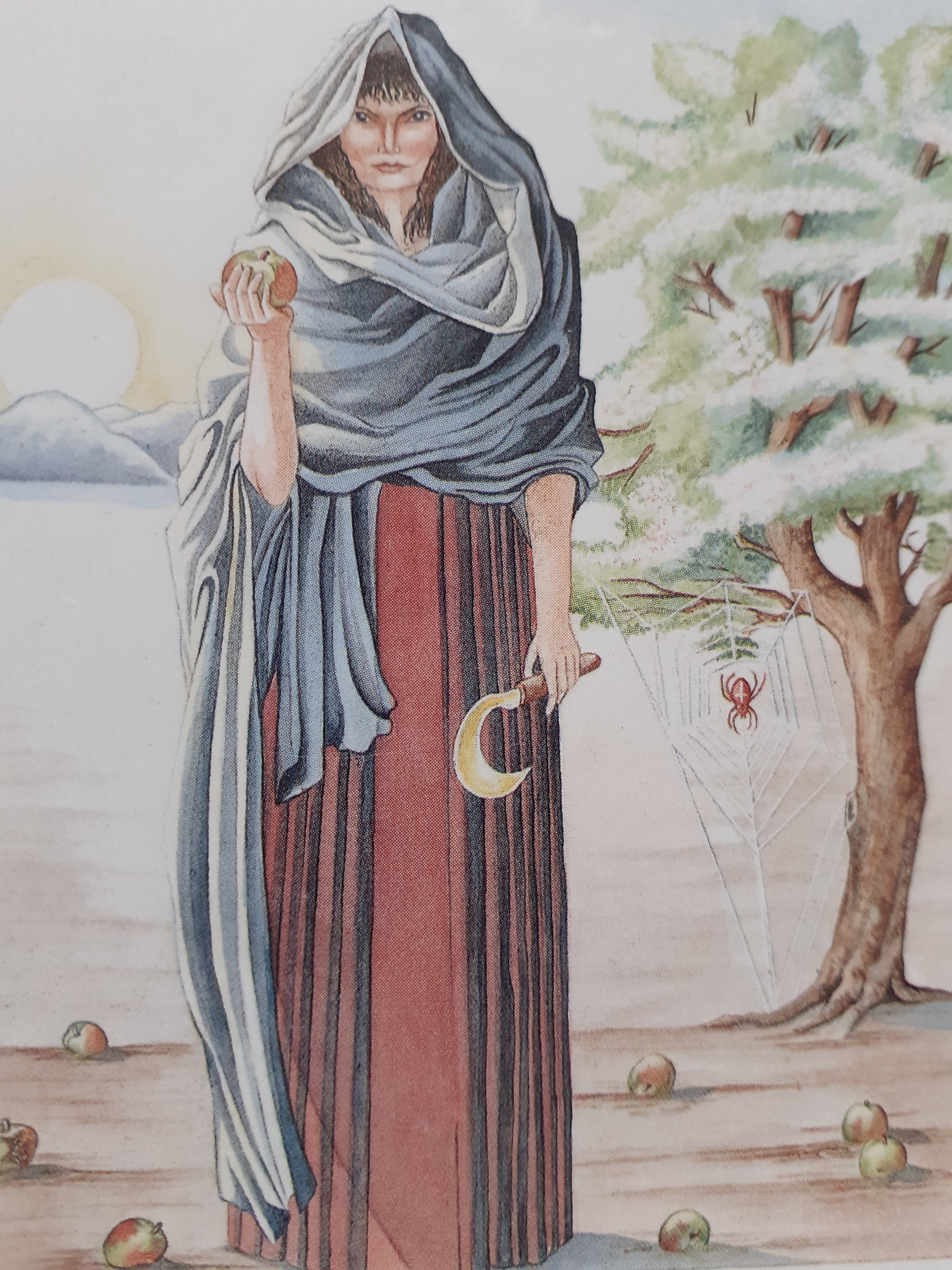
In the approach to Samhain, thoughts turn to death. In R. J. Stewart’s Merlin Tarot (1,2) the Death card has The Apple Woman as an alternate name.
Stewart explains that “the original image for Death is that of the taking or destroying Goddess”, for “who but the creatrix may truly destroy and withdraw created life?” He adds that, in Celtic tradition, she often appears as a female power offering magical fruit.
In his source text, Geoffrey of Monmouth’s Vita Merlini (Life of Merlin), we find a mysterious woman – ex-lover of Merlin – who lays out poisoned apples to entrap him. These apples, arranged “under a tree upon a pleasant green”, are eaten by Merlin’s boon companions: they are either killed or driven insane. Although Merlin escapes the apples, he does not escape his own later insanity in the Caledonian Forest, brought on by the traumatising Battle of Arfderydd.
For Stewart, the Apple Tree is one of the simplest expressions of the Tree of Life. “It is the Otherworld or Underworld Tree that reveals eternal potential, the fusion of ending and beginning in one paradoxical form”. The apples are the fruit of raw, untransformed power. Whereas Merlin’s companions snatch at the apples and eat them greedily, the legendary Thomas Rhymer volunteers to pick magic apples for the Fairy Queen, who recognises his gallantry by giving him the bread and wine that can nourish him. He wins the gift of prophecy and the tongue that cannot lie.
Both lover and killer, the Goddess of Death and Change is young and ancient, weaver and unweaver of a web that is the universe. She is destroyer of hope and giver of hope, for “in her hand she bears the fruit of perpetual life and rebirth, and the razor Sickle that cuts the tread of continuity”.
Stewart ends with this reflection: “perhaps Merlin’s sub-story of The Apple Woman simply means that adulthood is our most deluded period of life. We reject understanding and substitute self-image, habit and even dogma, in our convoluted attempts at survival; the hostility we experience is not that of the Goddess, but our own hostility reflected upon us. Reject love, risk poisoned apples – such fruits are deadly to the greedy and unprepared. But if we accept the fruit or any of its many transformations (such as bread and wine) from the Goddess, she blesses us with gifts of timeless understanding. These gifts may appear in the outer world as prophecy, attuning to the land; death itself is a timeless moment of understanding when all relative interactions cease. Ultimately, we are the fruit”.
(1) R. J. Stewart The Complete Merlin Tarot: Images, Insight and Wisdom from the Age of Merlin London: The Aquarian Press, 1992 . Illustrated by Miranda Grey ISBN 1 85538 091 9 No cards, but a full explanation and discussion of the system and its imagery.
(2) R. J Stewart The Merlin Tarot London: Element, 2003. Illustrated by Miranda Grey ISBN 000 716562 5 (First published by London: The Aquarian Press, 1992). Cards, handbook and notebook for record keeping.

 Clare Cameron (1896 – 1983) was an English poet and mystic, whose life spanned much of the twentieth century. In 1930 her Green Fields of England, centred on footpath travels in the English countryside, was compared to the work of Richard Jefferies and Edward Thomas in the previous generation. At this period, she was involved with the Hermetic Order of the Golden Dawn. For two years the noted occultist Israel Regardie worked for her husband Thomas Burke and wrote the first of his books on the Kabbalah at their home. Later, Clare became associated with the London Buddhist Society under the leadership of Christmas Humphries and formed a friendship with the young Alan Watts, who she succeeded as editor of the journal Buddhism in England (later The Middle Way) when he left for the U.S. in 1938. Gradually Clare moved in a more Christian direction, and for over 20 years she edited The Science of Thought Review, based on the ideas of the mystical teacher Henry Hamblin.
 Throughout all these changes Clare drew on her experience of nature as sacred within a spirituality that emphasized the sanctity of existence and the silent background of being. Politically she championed women’s empowerment, non-violence in both aims and methods, the view that interdependence applies to countries as well as people, and the growing attention to environmental causes. She also supported the early development of interfaith dialogue.
 Contemplative Inquiry