In my Druid circle, I associate the northern quarter with faith. The quality and context of faith are not defined. They could simply mean faith in the practice and path. My contemplative inquiry overall has tended towards a stance of ‘sacred agnosticism’ (1), in which faith is not emphasised. This has served me in many ways. I have avoided mixing up the idea of ‘faith’ with affiliation to authoritarian movements, mandated beliefs, or the surrender of self-responsibility and personal discernment. I have been alert to the metaphysical group think and consensus collusion that can show up in any spiritual movement (other kinds of movement too). I have done my best to gather and evaluate information skilfully, when developing principles about how to live ethically and gracefully in an increasingly scary world.
And yet … this is not the whole story, or I would feel spiritually malnourished. In recent months I have experienced a strong felt sense of the divine. When I describe myself as ‘living presence in a field of living presence in a more than human world’ – an animist identification – the identification now seems more than animist, though the animism is still there. I pray more congruently to the Goddess as Ancient Mother and talk, less anthropomorphically, about the ‘bubbling source from which I spring’. The Divine is beyond name, form or description – and some people prefer a specialist, capitalised use of rather abstract terms like Consciousness, Awareness, Void, Ground of Being. But the ones from my own practice are the ones that work for me. They come from the intuitive heart and the imagination. To me they offer a deeper knowing, though I am personally cautious about the use of the word gnosis. For me, it can reduce the sense of mystery, banishing the creative role of faith itself.
I have become a provisional panentheist, experiencing intimations of a divine which is everywhere and no-where, and from which we are not separate. This partly reprises work I did in the earlier days of my inquiry using the framework of non-duality. Now I find panentheism a better term than non-duality for affirming both the divine and the world. The earth spirituality in the Druid tradition is in no way compromised by a panentheist perspective. If anything it is enhanced.
For more than a decade, my spiritual practice has been mobilised around a contemplative inquiry. For me, this has been successful in its own terms, but I’m conscious now of something missing. It’s as if, for earnest, intelligent and ethical reasons, I have whitewashed the walls in the church of me. Now I want my murals back. So, recently I have started a course correction.
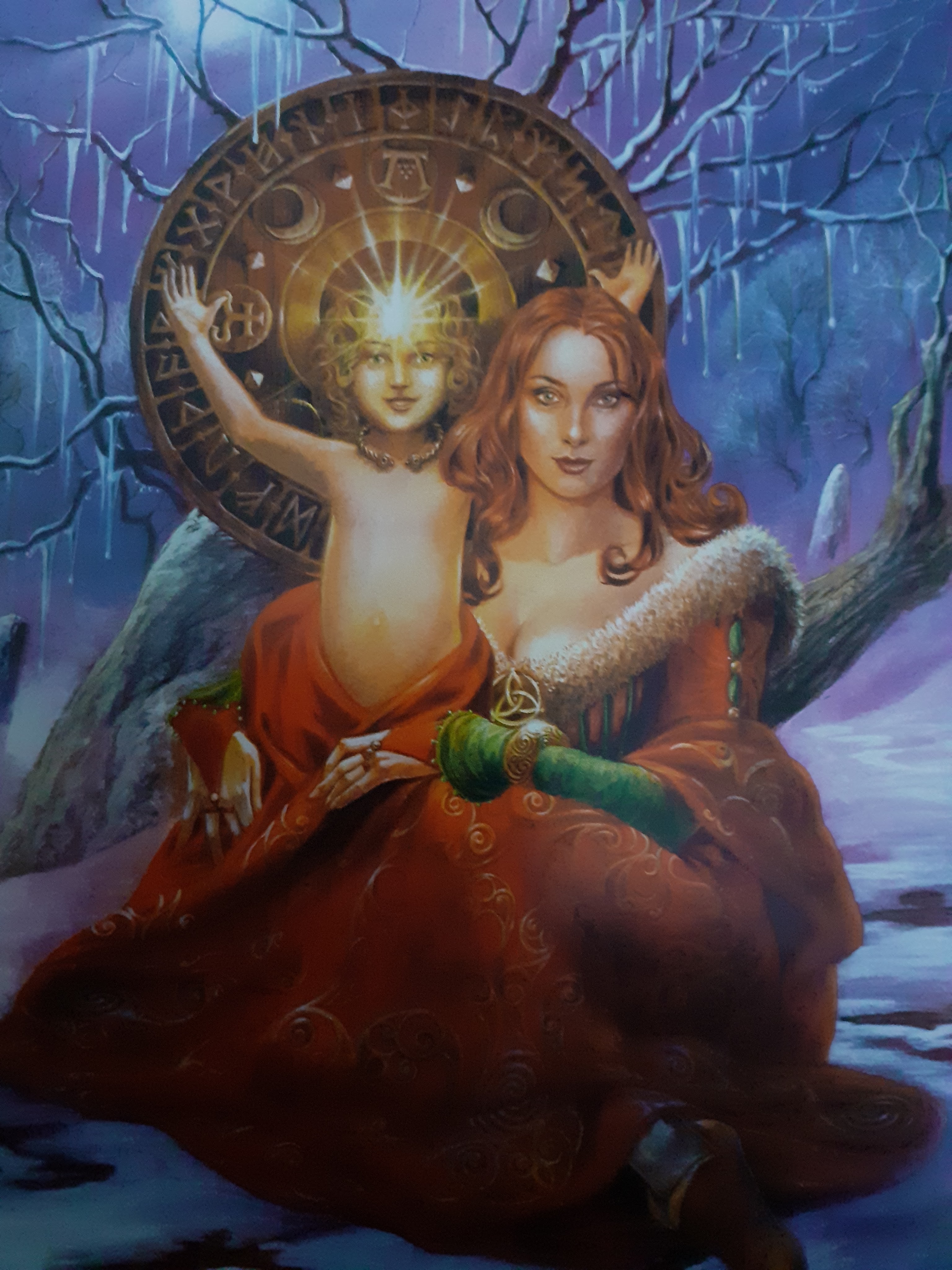
This course correction includes a glance back at my own pre-inquiry practices, happily well documented. The image of Modron and Mabon used to walk with me: Modron as the primal mother and Mabon as the primal child (2). They were archetypal figures, not everyday humans. My understanding was that these names were from a pre-Celtic language, retained in Brythonic speech. I am not sure if this is true, but for me it offered the possibility that even the surviving Celtic stories (3) were not the first. I was free to dream. In this dreaming I was powerfully influenced by the image at the top of this post (received as a midwinter holiday gift from my wife, then partner, Elaine, in 2007) and by the Silver on the Tree song that follows.
I see the child in the image as androgyne, and not in their earliest infancy. In the song, Mabon is not gendered. The mother in the picture is clearly the Goddess as Mother. Different stories can be drawn from this. In my own journey I tilt the child back somewhat to the masculine. In this pairing, She is Zoe, the life eternal. He is Bios, the life that comes and goes and comes again. Like Taliesin (4), transmuting out of his identity as Gwion, Mabon becomes in a sense his own father. So my midwinter picture appears to reference the Christmas story, but in important ways diverges from it. The image shows a magical midwinter child, who will indeed have an illuminating and transformational influence, but who is not exactly a redeemer in the Christian sense. This is drawn out in the Silver in the Tree song, which includes specifically Celtic references and extends beyond them.
Both Mother and Child live strongly within me, in the imaginal realm. I like and use the old language, Modron and Mabon, because of its sense of ancient mystery. But what it points to is universal. Part of my work now is to re-open my contact with them, who after another fashion I also am.
(1) Silver in the Tree in their 1991 album Eye of the Aeon
(2) NOTE: I am aware that there are divergent visions of Mabon. One centred the Autumn Equinox has become powerful and influential in recent years. Happily modern Druidry is not a religion of the Book though it is enriched by its books. This new literature follows the oral tradition practice of allowing stories to evolve and change in divergent directions. I see this as a strength.
(3) Caitlin Matthews Mabon and the Guardians of Celtic Britain: Hero Myths in the Mabinogion Rochester, VT: Inner Traditions, 2002 (Revised edition of Mabon and the Mysteries of Britain, 1987)
(4) If you visit Loch Maben in Dumfriesshire, in south west Scotland, you may find the feeling-tone similar to the much larger Lake Bala, strongly associated with Taliesin, in north Wales.
Recently I have been contemplating both my understanding and my experience of Awen. Above is a picture of my Awen pendant, a modern Druid badge of belonging. It is based on the three ray symbol developed by Iolo Morganwg (Edward Thomas 1747-1826). It also depicts the three drops from Cerridwen’s cauldron in the Taliesin myth. Hanes Taliesin, popularised in Charlotte Guest’s 19th CE English translation of the tale, is now a significant influence on modern Druids.
Ten years ago I published Contemplative Druidry (1), a book based on interviews with active Druids about the place of contemplation within today’s Druidry. It included a chapter on Awen, and revealed a lack of consensus about what Awen actually meant to the interviewees. I wrote: “Awen is classically seen in Druidry as the power of inspiration, and in particular the creative force for poetry and prophecy … Many of the participants in this work uphold the tradition in its conventional form. Others seek to extend the traditional meaning better to express their own experiences and aspirations. Some don’t connect with Awen experientially and treat it as a convention – mainly a shared chant which brings Druids together.”
Since that time (2014), the evolution of modern Druidry has continued apace. In recent years, the most inspirational definition of Awen I have encountered is one by Kristoffer Hughes, Chief of the Anglesey Druid Order and a native Welsh speaker. He describes Awen as (2): “the creative, transformative force of divine inspiration that sings in praise of itself; it is the eternal song that sings all things into existence, and all things call to Awen inwardly”. For him, the personified deity intimately linked with Awen is Cerridwen, for him a goddess of “angular, bending magic” whose cauldron is “a vessel of inspiration, a transformative device, a vessel of testing”.
In a sense Hughes is the Pagan inheritor of the Unitarian Iolo Morganwg, who reframed St. John’s “In the beginning was the Word” (3) as ‘In the beginning was the Song’ – “all the universe leapt together into existence of life, with the triumph of a song of joy … and the sound of the song travelled as far as God and His existence are” (4). Hughes sees Iolo as a model of Awen’s influence in the world: “He carried the seeds of Awen and profoundly influenced a future that he could not imagine … He is testament to Awen’s consistent stream and how it too changed its countenance to meet the needs of different people at different times”. The Romantic period Iolo lived into was “a cauldron of new ideas”, with a new era of bardic tradition in its infancy and “occult fascination among the learned of the time increasing in popularity” (2).
Looking beyond Druidry, I think of the words of Kabir, the Indian 15th century CE poet/singer and mystic: “If you want the truth, I’ll tell you the truth. Listen to the secret sound, the real sound, which is inside you” (5). Kabir was a Muslim who was also heavily influenced by Indian Tantric/Vedantic culture. In this culture, OM is the primal originative sound. AUM (so like Awen) is its feminine form, the creative energy or Shakti of the Cosmos giving shape and substance to the material world. For me it is as if the sound itself holds the power, waiting to be discovered, and transcending any specific cultural context. It seems somehow inherently resonant and inspiring; an anchor for empowering states.
In my current practice I work with Awen both as chant (Aah-ooo-wen) and as mantra (inbreath Aah, outbreath wen). I have done this on and off for many years, and I have fairly recently returned to ‘on’. When I work energetically, I seem to become porous to the world. I experience a lightness and a loosening of boundaries. Reality is not fixed and locked down. Into this space Awen can enter, and I find myself in a place of healing, peace and power. This doesn’t have a direct cause-effect link with creative work in the world, but it does mobilise my capacity for such work. This is now my experience of Awen.
(1) James Nichol Contemplative Druidry: People, Practice and Potential Amazon/KDP, 2014 (Foreword by Philip Carr-Gomm)
(3) Holy Bible: King James Version Green World Classics edition, 2017
(4) J. Williams ab Ithel (editor) The Barddas of Iolo Morganwg: A Collection of Original Documents, Illustrative of the Theology, Wisdom, and Usages of the Bardo-Druidic System of the Isle of Britain Forgotten Books, 2007 (First published 1862, from notes and journals left by Iolo on his death at 79 years of age in 1826).
(5) Sally Kempton Meditation for the Love of It: Enjoying Your Own Deepest Experience Boulder, CO: Sounds True, 2011 (Foreword by Elizabeth Gilbert),
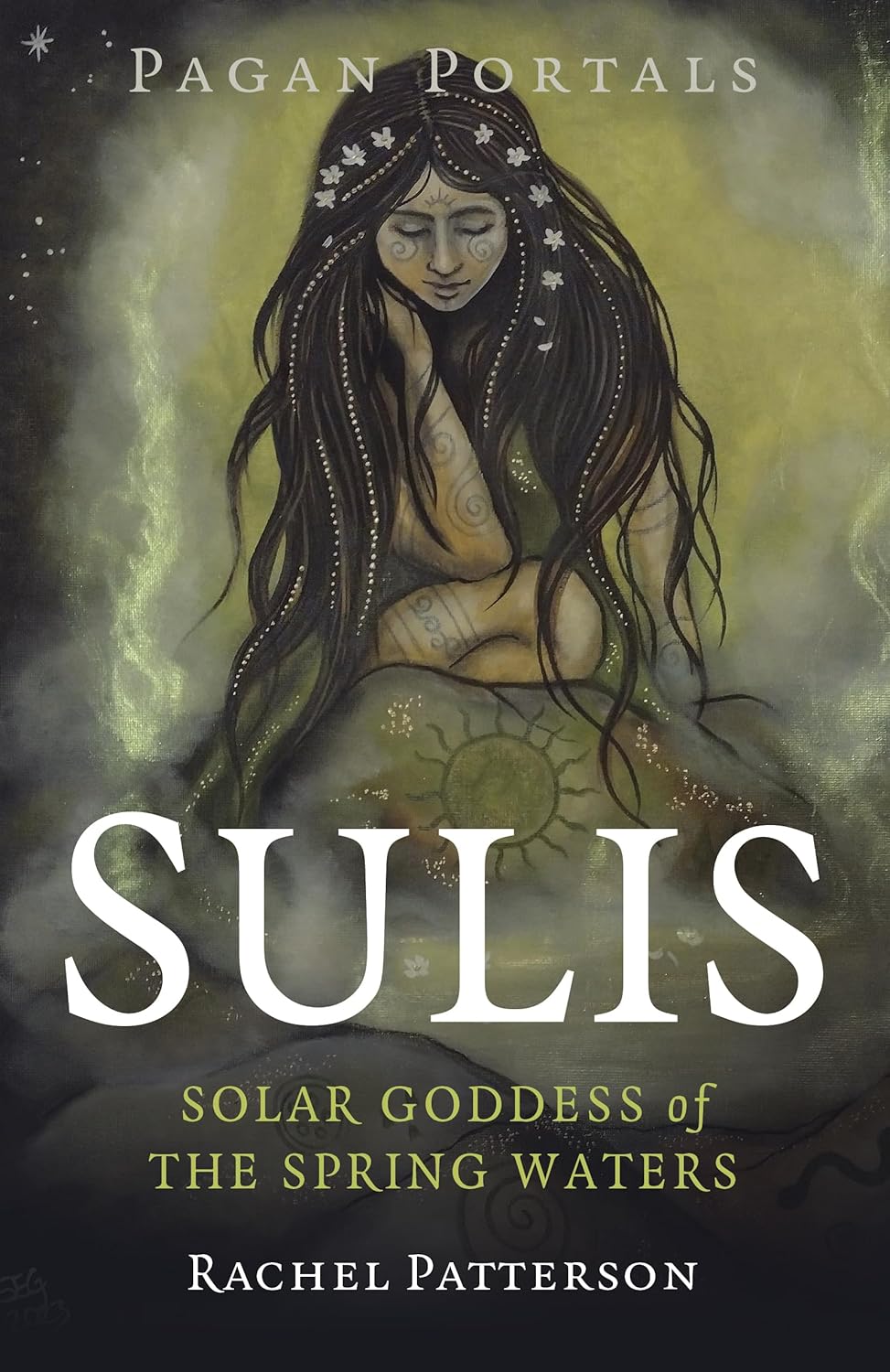
Recommended especially to two overlapping groups: first, readers interested in Sulis (later Sulis-Minerva) the presiding deity of the hot springs at Bath, UK; second, readers interested in polytheist Paganism in Britain, both ancient and modern. Author Rachel Patterson describes her heart as that of an English Kitchen Witch and her craft “a combination of old religion witchcraft, Wicca, hedge witchery and folk Magic”. Hence in this book she focuses not only on the history of Sulis and her springs but also on how to work with Sulis today.
The hot springs at Bath are the only ones in the country, appearing after the last Ice Age around 12,000 years ago. The people who re-settled the land as hunter gatherers began leaving offerings at the springs around 9,500 years ago. They continued to do so for several thousand years until the appearance of farming. We have no record of their beliefs, but for them the numinous power may well have been the living presence of the springs themselves, rather than a presiding deity.
The farmers, when they came, seem to have left the springs alone. But early in the first century CE a causeway of gravel and mud was placed in the main spring pool. Offerings were made, principally of coins minted by the local Celtic tribe, the Dobunni. Pottery was also found but there were no buildings. In 43 CE the Romans invaded Britain and quickly established themselves in the south. The Dobunni chose peace and an accommodation with the Romans, who soon created a spa, building on top of the natural springs. They adopted the local goddess Sulis, now to be known as Sulis Minerva. A town gradually grew up, named Aquae Sulis (The Waters of Sulis). A temple and sanctuary began to be built in 70 CE. The baths are now well-kept after an up-and-down history, and are open to visitors. See http://www.romanbaths.co.uk.
Rachel Patterson describes how the temple worked in the Roman period. Many of the extant records are written curses from people whose clothes and possessions were stolen while they bathed. They asked the Sulis for retributive action in return for offerings and the lost possessions themselves (1). Patterson also describes the decoration of the temple and artifacts from it. The best known was once called the gorgon’s head but is clearly the head of a male figure. He seems to be associated with a god named Belenus, who may in turn be connected with the legendary King Bladud included in Geoffrey of Monmouth’s History of the King’s of Britain (2,3).
The second half of Rachel Patterson’s book is about working with Sulis. It is a thorough and practical guide for readers who may want to go down that path. It includes sections on making candles and altars dedicated to Sulis; on finding Sulis; building a relationship with her; advice on oath-taking; and the development of rituals and meditations dedicated to her. There is relevant advice on the use of herbs, crystals, forms of divination, petitions and curses. There are sections on animal companions and (pigs and wild boar as the Celtic contribution, owls and dolphins related to Minerva). As a Kitchen Witch, Rachel Patterson also provides a number of recipes.
I have lived both the first and most recent 20 years of my life within a forty mile radius of Bath. I don’t go there very often. But I have known it from an early age and bathed in the waters during the more recent period. There is indeed something magical about them. So I’m glad to see Sulis taken more seriously. There is a familiar problem about limited information from the past and Rachel Patterson discusses this in her book But for me there is enough resonance from the old times, here, to dream the myth onwards. I can’t assess the practical guidance offered in Sulis: Solar Goddess of the Spring Waters because I don’t work in the same way. But I do know it is comprehensive and comes from a seasoned practitioner. It feels to me like a timely addition to the Pagan Portals series, and I am grateful to have it.
(1) Further information about religion in Roman Britain, and its rather transactional nature, can be found in Prof- Ronald Hutton’s Gresham College lecture on Paganism in Roman Britain. See https://contemplativeinquiry.blog/22/12/12/paganism-in-roman-britain/ – where a link to the lecture is provided,
(3) For creative treatments of the story of Bladud and the Goddess Sulis, see Kevan Manwaring’s account in The Bardic Handbook and two novels by Moyra Caldecott: The Winged Man and The Waters of Sul
In 1986, at the age of 50, Satish Kumar (1) went on an extended pilgrimage of British sacred sites. When staying overnight as a guest of the Bishop of Lincoln, he initiated a dialogue on divinity. In this discussion, divinity is described as God, and masculine language is used throughout. (In other contexts Satish Kumar has been happy to use Goddess references and language.) My own practice is largely non-theistic, yet I am Pagan enough to have been jolted by this limitation. Diverse images, stories and beliefs about the divine continue to inform my heart, mind and imagination. The two views articulated here (both eco-friendly in their way) point to very different experiences and understandings of the divine, and of the world: dualist and non-dualist in formal terms.
“‘It is with great pleasure that I welcome you, Satish, to Lincoln and my house, the Bishop said. ‘Going on a pilgrimage is an ancient tradition, but walking for four months around Britain to its sacred places is not so common.’
“‘I am honoured to be your guest,’ I said. ‘I have been inspired and renewed by being within many churches and cathedrals, but increasingly I am finding all places sacred and the presence of the divine everywhere.”
“‘The Bishop heard my comment with thoughtful silence, and then said, ‘For us, God is above and beyond his creation. We aspire to reach God, but God and the world are not the same.’
“‘In the Hindu tradition the world is understood to be the dance of the God Shiva, and the yet the dance and the dancer cannot be separated. The world is not like a painting, a finished object which when complete is seen as separate from the painter. The universe is a living dance and God in in the heart of all beings and things. We do not separate God and the world.’
“The Bishop pondered and in a gentle voice said, ‘I believe that the world is God’s creation and therefore it is sacred. Human beings must act as responsible guardians and caring stewards. We must love the land and look after the earth in its glorious diversity. We have no right to plunder, pollute, exploit, destroy, kill or in anyway disrespect God’s creation. Like in a family, God is the Father and we are his children, and all members of the family should live in harmony with each other. God’s family includes the animals and the natural world. If we are sensitive and caring, we can live with nature rather than against it. The advance of science and technology requires that human beings live with greater sensitivity than ever before, since we are now equipped with extremely powerful and destructive tools. This destructive impulse is not part of God. God is good and good only.’
“‘For me, Divinity is neither good nor bad,’ I said. ‘It is like pure water and pure air. The human soul is also pure. Good and bad is a matter of perception. For example, from nature’s point of view creeping buttercups and nettles are fine wherever they are; they will grow where the soil is ripe for them. From the human perspective, however, a gardener struggles to remove the buttercups and nettles; he regards them as weeds, and complains when they overtake flowers. The rose and the thorn are part of the same plant – we cannot have one without the other. The analytical mind attempts to separate the good and evil, the decorative and ugly, the useful and non-useful, the weed and the flower. I have seen during my journey people pulling out foxgloves in one area and carefully planting them in another. If we are to live in harmony with God’s family, we need to love the wilderness, the weeds and the wet.'”
From: Satish Kumar No Destination: Autobiography of a Pilgrim Cambridge: Green Books, 2014 (extended 4th edition – first edition 1992)
(1) “Satish Kumar (born 9 August 1936)[1] is an Indian British activist and speaker. He has been a Jain monk, nuclear disarmament advocate and pacifist.[3]Now living in England, Kumar is founder and Director of Programmes of the Schumacher College international center for ecological studies, and is Editor Emeritus of Resurgence & Ecologist magazine. His most notable accomplishment is the completion, together with a companion, E. P. Menon, of a peace walk of over 8,000 miles in June 1962 for two and a half years, from New Delhi to Moscow, Paris, London, and Washington, D.C., the capitals of the world’s earliest nuclear-armed countries.[4][5] He insists that reverence for nature should be at the heart of every political and social debate.” (Wikipedia)
23 June 2024, around 8.15 pm. I’m enjoying my first contemplative walk for some days. I’m looking at an old wall, once part of the Llanthony Priory estate in Gloucester. The day has been one of rising temperatures and humidity. Even now, as the shadows deepen, I feel an energy and expectancy in the evening light.
The Priory here was for a time the largest landlord in the city and its surrounding district. In those days, midsummer was celebrated on 23/24 June. The Church celebrated the birth of John the Baptist, at the opposite end of the year from that of Jesus. (His beheading is remembered on 29 August). Popular celebrations on the evening/night of 23 June involved bonfires, and local festivities could be attributed to the saint, the season, or both.
In many cultures, the year has been divided into two contending halves, whether at the solstices, the equinoxes, or with the Beltane/Samhain division. Traditional Christianity flirts with this theme. I might think of summer and winter kings, king-slaying and the Goddess. I might also think of John, Jesus, and their respective human fates. In the case of John, Salome and her royal mother Herodias are a presence, along with their fateful demand for his head. These stories are not the same, but in the European Christian imagination they have at times been interwoven.
I might also think of the Green Man maturing to the point where he can “speak through the oak”, as “its crown forms his mask and its leafage his features” (1). To speak through the oak is to speak at another level, or from another dimension, a developmental moment that occurs at the year’s zenith (life’s zenith?) This maturation flows from from a willingness to surrender to a greater power. The purely personal direction can only be towards winter and death. But that’s not the whole story, even to a ‘sacred agnostic’ like me (2.) This is the midsummer evening’s tale that intrigues me the most.
The image below comes from a small patch in Llanthony Priory’s current garden, on the site of the original physic garden. I simply found it beautiful.
A circle is cast on sand. It is almost complete. The image is that of the Wheel, tenth major trump in the Druidcraft Tarot (1). Arianrhod, as Goddess associated with the Wheel and the Milky Way, is casting the Circle of Life. The adjacent cave has resonances of both womb and tomb. The seashore is a liminal space. The Celtic Otherworld is often linked to the sea and what lies underneath its surface. This image as a whole is associated with harvesting. Arianrhod carries a flail as well as a wand and a symbolic eight-spoked wheel.
It is Lugnasadh/Lammas, the first harvest-related festival of 2023. I am sitting with the notion of ‘winnowing’ in my inquiry. In agriculture, winnowing involves blowing a current of air through grain to remove the chaff remaining after threshing. We find a reference to winnowing towards the end of the medieval Welsh poem The Hostile Confederacy from The Book of Taliesin (2):
“I have been a grain discovered,
Which grew on a hill.
He that reaped me placed me,
Into a smoke hole driving me.
Exerting of the hand,
In afflicting me,
A hen received me,
With ruddy claws, (and) parting comb.
I rested nine nights.
In her womb, a child,
I have been matured,
I have been an offering before the Guledig.
I have been dead, I have been alive.
A branch there was to me of ivy,
I have been a convoy.
Before God, I have been poor.”
It seems that winnowing (or being winnowed) is far from an end point to our journeys. The processes of life go on, very likely in unexpected ways. Any state of peace has to be found within these processes, rather than in efforts to halt or break out of them.
At Lughnasadh 2023 I find myself at ease within Druidry, though I do also continue to refine lessons from other paths that enrich my practice of Druidry. The most significant, and the best embedded, is ‘interbeing’ as a spatial relationship and its temporal equivalent ‘impermanence’. It is like a kernel of grain I have winnowed from Mahayana Buddhism to grow into another life in my Druidry. The Druid soil is fertile for this purpose, as indicated through the image of the Wheel drawn on sand, and the passage from The Hostile Confederacy in The Book of Taliesin. For me, Thich Nhat Hanh simply provides a particularly persuasive languaging of this perspective.
He says (3): “The insight of interbeing is that nothing can exist by itself alone, that each thing exists only in relation to everything else … looking from the perspective of space, we call emptiness ‘interbeing’ [NB ’emptiness’ here = empty of a separate self] ; looking from the perspective of time we call it ‘impermanence’ … to be empty is to be alive, to breathe in and breathe out. Emptiness is impermanence, it is change. …When you have a kernel of corn and entrust it to the soil, you hope it will be a tall corn plant. If there is no impermanence, the kernel of corn will remain the kernel of corn forever and you will never have an ear of corn to eat. Impermanence is crucial in the life of everything”.
There is another level to this year’s inquiry harvest. Recently I have engaged more fully with the challenge of Thich Nhat Hanh’s understanding of the Mahayana emptiness teachings, which stand behind the interbeing/impermanence insight. In the light of this understanding he finds neither an individual nor a cosmic self – and hence no ultimate reality or ground of being. “Our notion of emptiness should be removed. It is empty”. Many teachers I have worked with in the past are on the other side of this debate, finding the Divine in ‘Presence’ (Eckhardt Tolle), Pure Awareness (Rupert Spira), and the ‘Clear Awake Space’ of Douglas Harding’s Headless Way. They find God as ‘No-Thing’. For Thich Nhat Hanh, no-thing is simply nothing.
I have been all over the place on this question, developing a language and practices compatible with both views, as I slipped and slid between them. This is fine in its way, but I have wanted some kind of resolution, if only to avoid the energy drain of uncertainty around something that matters to me and to many spiritual traditions. Tomas Sander, co-writing with Greg Goode (4) has also explored the Mahayana ’emptiness’ texts. He reports that “as a person who had been seeking truth and ultimate reality” he finds a “greater sense of ease” in the approach of these texts. Unlike Thich Nhat Hanh, he does not take away an active disbelief in a cosmic ground of being. Instead, he arrives at a relaxed unknowing, a place of ‘joyful freedom’. He says: “spiritual teachings tend to have notions of absolutes, which by their very nature seem to trump everything else. None of them can claim to have an absolute, transcendent truth on their side”.
Tomas Sander finds that “it was a wonderfully freeing moment to recognize that there is no one way that reality ‘really’ is, and therefore no way to miss out on it”. So he adopts different criteria for evaluating spiritual paths. “They need to prove themselves on the level of ordinary, conventional reality with practical questions like: who does the view serve and who is being marginalized? Is the view helpful, compassionate or humane?’ I have known of and entertained this view for some time, but it has only recently clicked with me as a good way of settling this question. Metaphysical speculation will no longer be part of my inquiry. This does indeed feel like winnowing, like blowing away the chaff. The promised harvest? Druidry as joyful freedom.
(1) Philip and Stephanie Carr-Gomm The Druidcraft Tarot: Use the Magic of Wicca and Druidry to Guide Your Life London: Connections, 2004 (Illustrated by Will Worthington)
(2) William F. Skene The Four Ancient Books of Wales Forgotten Books, 2007 (First published in Edinburgh 1868
(3) Thich Nhat Hanh The Other Shore: A New Translation of the Heart Sutra with Commentaries Berkeley, CA: Parallax Press, 2017
(4) Greg Goode and Tomas Sander Emptiness and Joyful Freedom Salisbury: Non-Duality Press, 2013 (Section written by Tomas Sander)
Streatham’s Rookery (1) is a formal garden within Streatham Common, one of south London’s many remarkable green spaces. I made a connection with it in 1992 when living close by.
About a year before I discovered OBOD Druidry, I was working with R. J. Stewart’s The Way of Merlin (2). This taught me, first of all, about sacred space. “Sacred space is space enlivened by consciousness. Let us be in no doubt that all space is sacred, all being. Yet if humans dedicate a zone, a location, something remarkable happens within that defined sphere of consciousness and energy. The space talks back”.
I was an urban seeker and used what the city gave me. From an early age I had been fed by imagery of secret and magical gardens. The Rookery, built in the then Spa village of Streatham (1) became my sacred space. Towards its centre, a wishing well testified to the power of healing waters. It was a good place to begin my journey. The space became more alive, and I, included within the gestalt, became more alive with it.
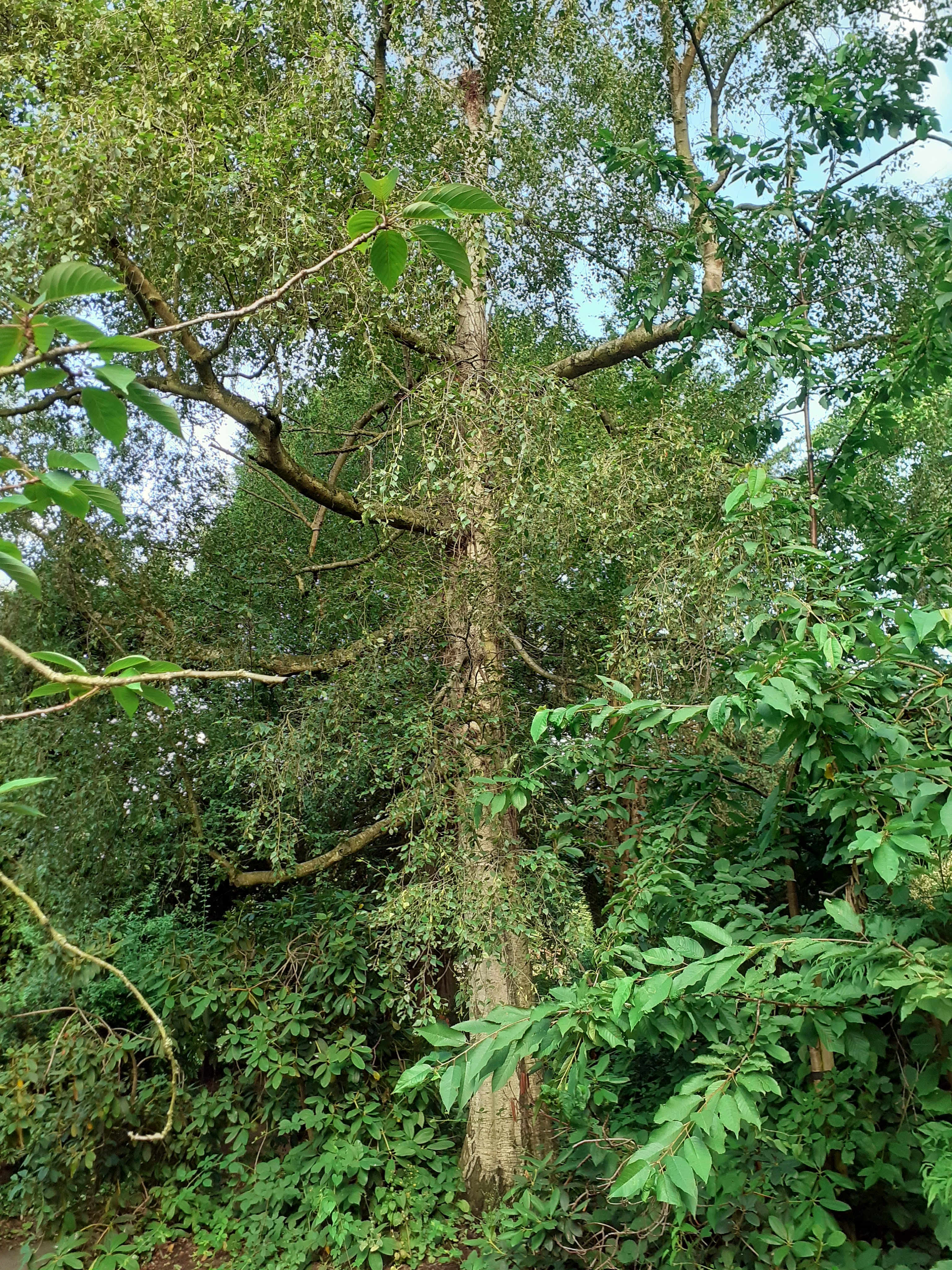
After establishing a sacred space, I was asked to begin a relationship with a spring and a tree. Stewart said: “we need to relate to such locations. This is a physical relationship first and foremost … we are one with the land, and trees, springs and caves are power points that tap into the energies of the land, and then reach into other dimensions altogether”. I found my spring quite easily (above). But there were almost too many trees to choose from, and I recall hesitating about my choice, to the point even of changing trees on my second or third visit. On my recent re-visit – woven into a rare family weekend in London – I found it easy to find the spring again but harder to remember my tree. I settled on the mature birch below, a good choice for a new, Goddess related undertaking (2). But I cannot vouch for it as my choice in 1992.
Sacred space (“the land talks back”), and befriending a spring and a tree: for me, these were the most powerful lessons from R. J. Stewart’s work. They were a helpful preparation for my later Druid training. I was very pleased to revisit this space in July 2023 and share it with family members.
(1) Streatham was in Surrey before becoming part of the County of London in 1889, and then Greater London in 1965. It began as a settlement around the old Roman road (Street Ham) from London to the south coast at Portslade, Brighton, the site a Roman port long lost to erosion. It appears in the Domesday Book of 1086 as Estreham. The village remained largely unchanged until the 18th century, when its natural springs, known as Streatham Wells, were first celebrated for their health-giving properties. The reputation of the spa, and improved turnpike roads, attracted wealthy city of London merchants to build their country residences in Streatham.
The Rookery began as a large private house with its own landscaped gardens. Much later, when the house and gardens were threatened with disposal and redevelopment, it was bought by public subscription and laid out as a formal open space, first opening to the general public in 1913. The Rookery is now one of the London Borough of Lambeth’s Green Flag Award-winning parks, directly managed by Streatham Common Cooperative (SCCoop), a local community-led enterprise.
(2) R. J. Stewart The Way of Merlin: The Prophet, The Goddess and the Land London: The Aquarian Press, 1991
Highly recommended for anyone interested in Brighid, Celtic spirituality and the evolving culture of modern Paganism. In The Torch of Brighid, Erin Aurelia eloquently describes her flame tending path as a devotee of the Goddess Brighid. For her, this is a path of celebration, contemplation, creativity and deep personal change. Her book shares the fruits of a remarkable journey.
The author makes clear that she is not reconstructing a past Pagan practice. No such practice is known. She references a Christian history dating from 480 CE, where nuns maintained a sacred flame at Kildare in Ireland. This was documented as still in place in the later 12th century CE by Gerald of Wales in his History and Topography of Ireland. It was repressed by the English King Henry VIII – who also ruled Ireland – as part of his violent religious revolution of the 1530s and 40s. On 1 February 1993, flame tending was revived both by Catholic Brigantine sisters in Kildare by the neo-Pagan Daughters of the Flame in Vancouver, BC. Both groups were influenced by Gerald of Wales’ description.
Erin Aurelia has been a flame tender for 20 years. She began in the Daughters of the Flame and then founded her own Order, the Nigheanan Brigde Flametending Order, going on to lead it for eight years. The original model involved moving through cycles of twenty days, in which nineteen flame tenders take a day each to tend the flame, leaving the Goddess to take care of the twentieth. Erin found that she wanted an intensified practice and a closer fellowship with other Brighid devotees. During those years, she writes: “Brighid inspired me to develop guided meditations to use during vigils, seasonal feasts, and lunar phases”. Later came “the template for a whole new way to practice flame tending: the way that the flame tending cycle matches with the twenty letters of the traditional Irish tree ogham alphabet, in which each alphabet letter is denoted by a tree and infused with esoteric meaning”. She describes herself as “enthralled and excited” by this discovery, which lead on to daily communing with Brighid and a fuller development of her work.
She found the process transformative, and learned that “growth is not only made through obtaining wisdom, but by implementing it. And Brighid showed me that I can effectively implement it by embodying her own skills as Shaper, Healer, Seer, and Transformer. Through embodying her skills, I became empowered”. In the narrative of her own journey, Erin shows her willingness to innovate, take initiatives, lead when called to do so, and also step back from leadership. Her relationship with ancient culture is to be inspired by it without being bound by it. I see her as modelling the best of modern Pagan practice in these respects.
Erin provides extensive information on her flame tending vigils, and how to set them up. She shares prayers, meditations and path workings. She includes her unique approach to ogham work, and also her own way of working energetically with the traditional ‘three cauldrons’ (of warming, vocation and knowledge). She shares her ways of working through the four Irish fire festivals from Imbolc (1 Feb.) to Bealtaine (1 May} to Lughnasadh (1 Aug.) to Samhain (1 Nov.). She has an Imbolc advent practice centred around the four Sundays prior to Imbolc – because it starts the year in this tradition and is specifically dedicated to Brighid. Her book is a powerful addition to the growing literature about Brighid as a much loved Goddess.
I shall not be put in a cell, I shall not be wounded …
No fire, no sun, no moon shall burn me,
No lake, no water, no sea shall drown me.” (1)
Brigid has a long history, stretching back in Gaelic traditions to at least the pagan Celtic iron age. The words above come from the Western Highlands of Scotland, in this form probably dating to the traumatising early modern period. Caitlin Matthews suggests that, even though the the words are addressed to ‘St. Bride’ rather than the Goddess of poets, they still have the talismanic power to preserve life.
More recently, Brigid has been successfully revived as a Pagan Goddess, where, according to an affirming Imbolc self-dedication story by Morgan Daimler (2) she has lost none of her capacity to protect her devotees.
“When I decided that it was essential for me a self-dedication to the pagan path, just like all my books talked about, I chose Imbolc to do it on. At that point the holiday to me was on the 2nd, the same day as America celebrated Groundhog Day, and was about cleansing and blessing of the self, so it seemed ideal for a self-dedication. I got everything together and when the night of the ritual arrived I was excited to take such a life changing step. At 13, coming from a non-religious background, doing something like this was momentous and I felt like I was ready to commit myself to the spirituality I had been studying.
“I went out alone into the bitter cold, without a winter coat on, and tried to do the ritual the way I had learned how to, but it was hard to focus. February in Connecticut is frigid and the darkness on that particular night was total, without any moon to light my way. It was Brigid’s holiday, so I automatically started calling on her, asking for her help, for the strength to do what I planned to do. At the same time it was almost a reflex to call on a Goddess I associated with warmth a light under those circumstances. It was important to me to make a declaration of my religious path, the books I’d read at that point had emphasized the need to be outdoors, and I was too stubborn to let the cold weather stop me. So I prayed to Brigid.
“It’s funny the way, as children, we simply take experiences in our stride, without considering them at all out of the ordinary. I don’t remember ever feeling Brigid’s presence or having a sense of the numinous, but I prayed and then I was warm. The cold simply ceased to be something I noticed, as if everything around me had become an indoor room temperature. I took the usual half hour or so kneeling on the cold ground to do my ritual, dedicating myself to the Irish Gods and to pagan spirituality. And then I got up, collected my supplies and went back inside, feeling euphoric.
“At the time it never even registered that what I did was dangerous or that I was risking frostbite and hypothermia. And I never stopped and thought that it should seem at all remarkable to pray to Brigid for warmth and then be warm. It all seemed entirely natural and normal.
“We speak, and the Gods really do listen. Sometimes they even answer.” (2)
(1) Alexander Carmichael Carmina Gadelica Edinburgh: Scottish Academic Press, 1972 (Cited in Caitlin Matthews The Element of the Celtic Tradition Shaftesbury: Element Books, 1989)
(2) Morgan Daimler Pagan Portals – Brigid: Meeting the Celtic Goddess of Poetry, Forge, and Healing Well Winchester UK & Washington USA: Moon Books, 2016. Daimler identifies as a reconstructionist polytheist pagan working in the Irish tradition.





 Contemplative Inquiry