My last post was about working with ancient texts. Here I look at the term ‘gnosis’ in the Gospel of Thomas. I am indebted to the commentary of translator Jean-Yves Leloup. Here he reflects on logion 5, whose text I include in a note below.
“Gnosis is not a system, not another ideology through which we are to interpret and understand the world. On the contrary, it means opening our eyes to what we are already looking at, right in front of us, not searching somewhere else.
” … Things are not hidden in themselves; they are open – the veils hiding them are in the habits of our own vision, so crude, so overloaded with memories and assumptions about reality, distorting what is before us …
“Gnosis is a long-term work of recognition, of purity of attention so as really to see what is in front of us. The consequence of this attention is that we become what we see and what we love … If we look at chaos, we will reflect chaos. If we look at light, we will reflect light.” (1)
I am glad that this commentary provides more than scholarly exegesis. Leloup says in his introduction that he wants to offer “a meditation that arises from the tilled earth of our silence. It is my belief that it is from this ground, rather than from mental agitation, that these words can bear their fruit of light “. In this way Leloup dreams the myth onwards for our time, and passes the baton to his readers. Both a blessing, and a responsibility.
(1) Commentary on Logion 5, The Gospel of Thomas: The Gnostic Wisdom of Jesus Rochester, VT: Inner Traditions, 2005
(Text translated from the Coptic with commentary by Jean-Yves Leloup; foreword by Jacob Needleman. English translation by John Rowe Original French edition published 1986).
The translated logion reads:
“Yeshua said:
Recognize what is in front of you, and what is hidden from you will be revealed.
There is nothing hidden that will not be revealed.”
In my Druid circle, I associate the northern quarter with faith. The quality and context of faith are not defined. They could simply mean faith in the practice and path. My contemplative inquiry overall has tended towards a stance of ‘sacred agnosticism’ (1), in which faith is not emphasised. This has served me in many ways. I have avoided mixing up the idea of ‘faith’ with affiliation to authoritarian movements, mandated beliefs, or the surrender of self-responsibility and personal discernment. I have been alert to the metaphysical group think and consensus collusion that can show up in any spiritual movement (other kinds of movement too). I have done my best to gather and evaluate information skilfully, when developing principles about how to live ethically and gracefully in an increasingly scary world.
And yet … this is not the whole story, or I would feel spiritually malnourished. In recent months I have experienced a strong felt sense of the divine. When I describe myself as ‘living presence in a field of living presence in a more than human world’ – an animist identification – the identification now seems more than animist, though the animism is still there. I pray more congruently to the Goddess as Ancient Mother and talk, less anthropomorphically, about the ‘bubbling source from which I spring’. The Divine is beyond name, form or description – and some people prefer a specialist, capitalised use of rather abstract terms like Consciousness, Awareness, Void, Ground of Being. But the ones from my own practice are the ones that work for me. They come from the intuitive heart and the imagination. To me they offer a deeper knowing, though I am personally cautious about the use of the word gnosis. For me, it can reduce the sense of mystery, banishing the creative role of faith itself.
I have become a provisional panentheist, experiencing intimations of a divine which is everywhere and no-where, and from which we are not separate. This partly reprises work I did in the earlier days of my inquiry using the framework of non-duality. Now I find panentheism a better term than non-duality for affirming both the divine and the world. The earth spirituality in the Druid tradition is in no way compromised by a panentheist perspective. If anything it is enhanced.
It is 3 January 2024, around 8.30 am. I repeat my best wishes to all readers for 2024 from inside the new year, as it begins to unfold. I contemplate the sky, uncertain about what this new year may bring. At some level I feel open and uncluttered, free of over-determined intentions. It is as if I have surrendered to a current.
My Contemplative Inquiry, once a formal structured project, has gradually evolved into a simpler and more natural-seeming contemplative inquiry in no need of capitalisation. This inquiry is wired in, no longer in need of much external input or formalised internal effort. I am aware of owing a debt to the formal structured project, with its inputs and efforts, for it enabled this evolution to occur.
The result of the early, more formal, years is recorded in my ABOUT section. It was simultaneously a gnosis and the discovery of a place to stand that felt right and made sense. “My inquiry has been a pathway to greater understanding, healing and peace. In the contemplative moment, I am living presence in a field of living presence, at home in a living world. This is not dependent on belief or circumstance, but on the recognition of what is given, joy and sorrow alike. I find that this simple recognition moves me towards a spirit of openness, a fuller acceptance that nothing stays the same, an ethic of interdependence and a life of abundant simplicity”. My inquiry today is about deepening, and living more congruently and confidently from this place. It is part of me now, and I foresee no end.
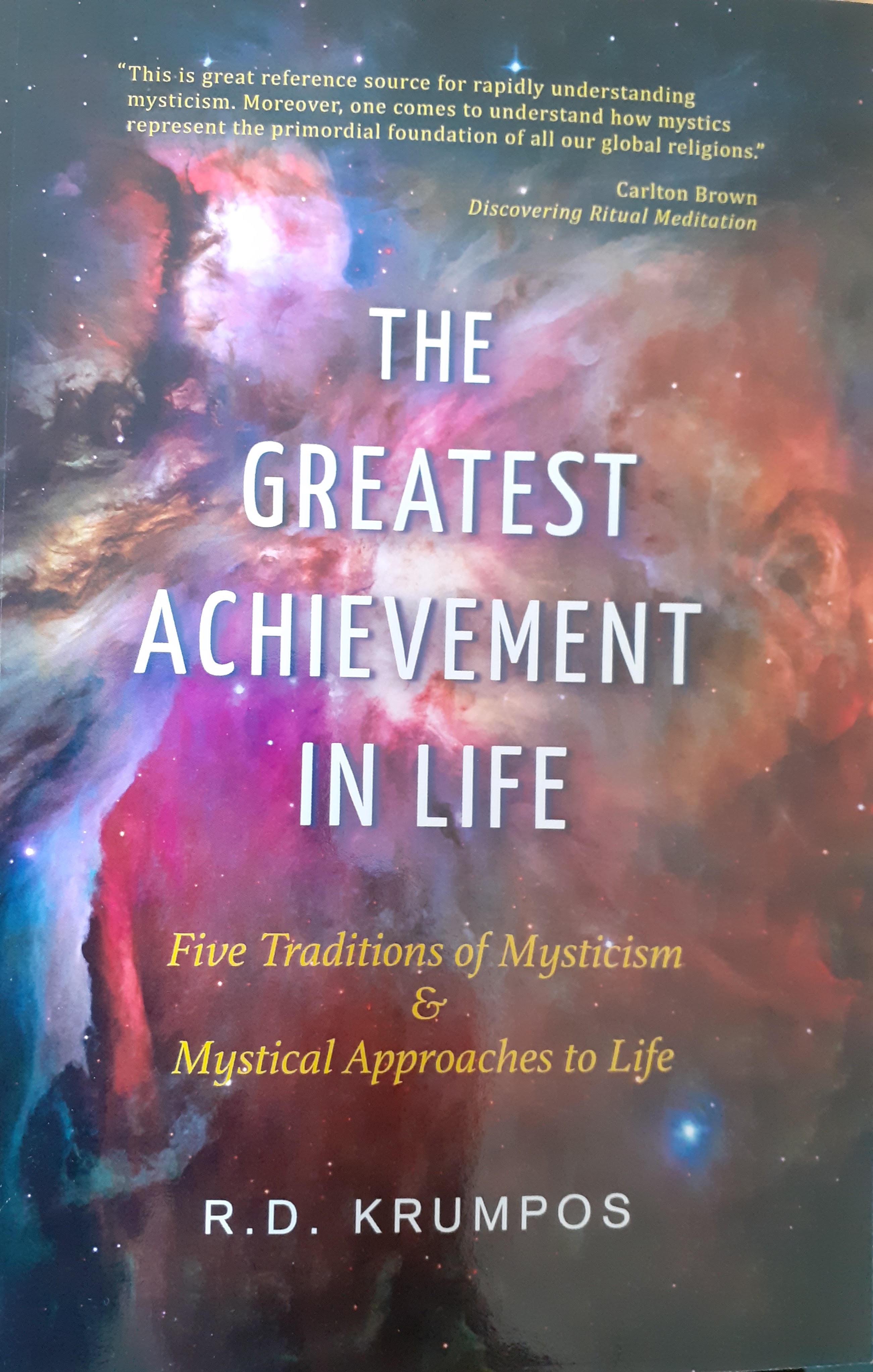
Highly recommended for anyone drawn to contemplative and mystical traditions. R. D. Krumpos’ The Greatest Achievement in Life: Five Traditions of Mysticism & Mystical Approaches to Life (1) is now available in print, in a new revised edition. I like having it now as an old-fashioned physical book that I can leaf through easily both for reference and for inspiration.
The book explores the mystical traditions embedded within Hinduism (Vedanta, Tantra), Buddhism (Zen, Vajrayana), Judaism (Hasidism, Kabbalah), Christianity (Gnostic and Contemplative currents) and Islam (Sufism). Krumpos shows how, underneath their manifold differences, they share an understanding of mysticism as the direct intuition or experience of God, or of an ultimate Reality not conceived as God.
Mystics are described as people whose spiritual lives are grounded “not merely on an accepted belief and practice, but on what they regard as first-hand knowledge”. Krumpos spells out the uncompromising idealism of this project. “Mysticism is the great quest for the ultimate ground of existence, the absolute nature of being itself. True mystics transcend apparent manifestations of the theatrical production called ‘this life’. Theirs is not simply a search for meaning, but discovery of what is i,e, the Real underlying the seeming realities. Their objective is not heaven, gardens, paradise or other celestial places. It is not being where the divine lives, but to be what the divine essence is here and now”.
The book is divided into two main sections: Five Traditions of Mysticism and Mystical Approaches to Life. Within these sections there is a further division into short essays, which can be read either in sequence or independently of the whole. The essays are based both on conversations with mystics and engagement with mystical literatures. Krumpos draws directly on the words of well-known mystics themselves, with 120 quotations interspersed with the essays. He also offers his own commentary and reflections. The book can either be seen as a source and reference book, or as a practitioner aide. It includes sentences and paragraphs that can themselves be used as a basis for formal contemplation. It is not just an ‘about’ book, though it serves that purpose well.
The traditions presented are seen as having much in common at the core, and The Great Achievement bears witness to that commonality. Yet there is enough interior diversity to make it clear that mystics in these traditions are not all the same, or saying the same thing, in the way that is sometimes lazily claimed. Overall Ron Krumpos’ sense of ‘direct experience’ and his definition of gnosis describe a gold standard for what ‘the greatest achievement’ is, based on the accounts of the mystics cited and discussed. In the second half of this book, the focus valuably shifts from the nature of mystical experience itself, to a consideration of its implications for how to live and serve.
For me, the cultural moment in which The Great Achievement has been offered is significant one. Perennialism’s ideas have been popularised and repackaged over the period since World War II at an ever increasing rate. There is now an extraordinary global spiritual hunger at least partly influenced by the spiritual paths that it includes – some, indeed, speak of a ‘spiritual market place’. This is a promising development, yet one with its downside. Krumpos’ work reminds us what these older traditions are and where they stand. For readers in new (or new-old) spiritual traditions with a different approach, the book offers opportunities for comparing and contrasting the fruits of the five traditions with those of their own chosen paths. Krumpos does acknowledge the value of shamanic and indigenous traditions, and practitioners within these traditions, reading this book, might be inspired to develop this conversation further.
(1) R. D. Krumpos The Greatest Achievement in Life: Five Traditions of Mysticism & Mystical Approaches to Life Tucson, AZ: Palomar Print Design, 2022. (Originally a free e-book available from http://www.suprarational.org/ as a printable pdf, published in 2012).
NB This review is a revision of my review of the original edition. See:
I like the way this presentation uses the word ‘knowing’ to point to our underlying condition. This usage is clearly separated from everyday knowledge of or about (something), or even of wisdom and understanding. It also avoids the term ‘consciousness’, which tends to invite metaphysical and scientific debates that lead us away from direct experience. ‘Awareness’ is a noun and so seems like a thing – we don’t generally talk about ‘awareing’. I personally like ‘being’ as an alternative, but it carries philosophical baggage and is not specific enough for the context of this presentation. Current usages within the Western Way of the term ‘gnosis’ do not generally reflect the view discussed here.
It may be true, as the Tao Te Ching says, that the Way that can be named is not the real Way. But we still need language, as a pointer, for that in us which needs to make sense of experience and to share it with others. Here, a skilful choice of words can make a difference, and I think this presentation models the skill. Dzogchen is a tradition within Tibetan Buddhism. ‘Rigpa’ is the Tibetan word used to describe ‘knowing’ in this sense.
The Greatest Achievement in Life is a free e-book available from http://www.suprarational.org/ as a printable pdf, published in 2012. Author R. D. Krumpos looks at five traditions of mysticism, in which mysticism is understood as a direct intuition or experience of God, or of an ultimate Reality not conceived as God. Mystics are described as people whose religion and life are grounded “not merely on an accepted belief and practice, but on what they regard as first-hand knowledge”. Krumpos himself speaks of finding that “preeminent Reality is the holy One in All and All in the wholly One”.
The five mystical traditions examined are those embedded within Hinduism (e.g. Vedanta, Tantra), Buddhism (Zen, Vajrayana), Judaism (e.g. Hasidism, Kabbalah), Christianity (e.g. Gnostic and Contemplative currents) and Islam (e.g. Sufism). I imagine that many people reading this blog will be working outside these traditions. But I recommend the book to anyone with a serious interest in mysticism, however you define it, given that the influence of these traditions is pervasive to the point where it can be virtually unconscious. As a person on a modern Druid path committed to inquiry and with a leaning towards mysticism, I have found Krumpos’ work very helpful in reminding myself of what the ‘five traditions’ are pointing to.
The book is brief and divided into two main sections: Five Traditions of Mysticism and Mystical Approached to Life. Within these sections there is a further division into short chapters, which can be read either in sequence or independently of the whole. Krumpos draws heavily on the words of well-known mystics themselves, as well as offering his own commentary and reflections. The book can either be seen as a source and reference book, or as a practitioner aide. It includes sentences and paragraphs that can themselves be used as a basis for formal contemplation. It is not just an ‘about’ book, though it serves that purpose well.
The traditions presented are seen as having much in common at the core, and The Great Achievement bears witness to that commonality. Yet there is enough interior diversity to make it clear that mystics in these traditions are not all the same, or saying the same thing, in the way that is sometimes lazily claimed. Overall Ron Krumpos’ sense of ‘direct experience’ and his definition of gnosis describe a gold standard for what ‘the greatest achievement’ is, based on the accounts of the mystics cited and discussed. In the second half of this book, the focus valuably shifts from the nature of mystical experience itself, to a consideration of its implications for how to live and serve.
For me, the cultural moment in which The Great Achievement has been offered is significant one. Perennialism’s ideas have been popularised and repackaged over the period since World War II at an ever increasing rate. There is now an extraordinary global spiritual hunger at least partly influenced by the spiritual paths that it includes – some, indeed, speak of a ‘spiritual market place’. This is a promising development, yet one with its downside. Krumpos’ work reminds us what these older traditions are and where they stand. For readers in new (or new-old) spiritual traditions with a different approach, the book offers opportunities for comparing and contrasting the fruits of the five traditions with those of their their own chosen paths. Krumpos does acknowledge the value of shamanic and indigenous traditions, and practitioners within these traditions, reading this book, might be inspired to develop this conversation further.
This post looks at two sentences from the Gospel of Thomas and concludes a series of three posts about this text and how I read it.
“Yeshua said: When you bring forth that within you, then it will save you. If you do not, then that will kill you”. (From saying 70)
What is ‘that’? I could jump in and say the experience of ‘living presence’, in contact with the ‘bubbling source’ discussed in earlier posts on this theme, and this feels right to me. But I also find my understanding extended by translator and commentator Jean-Yves LeLoup, who offers two meanings for that, gnosis and love. Although he doesn’t fully spell it out, the sense I get from him is that they are co-arising and belong together. LeLoup understands gnosis, as Yeshua uses this term, to be “a consciousness that arises directly from knowledge of ourselves, of the ‘Living One’ within us”. He also describes it as “a transparency with regard to the ‘One who Is’ in total innocence and simplicity”. He adds: “this is why the qualities of the gnostic are said to be unconditioned, to resemble those of ‘an infant seven days old'”. Without gnosis, “the universe remains radically alien and incomprehensible”. With gnosis, love is free to flourish. LeLoup describes those who live in gnosis and love as “able to marvel at the vast richness in the tiniest manifestation of being”, graced with what seems like “unreasonable abundance”. In the absence of gnosis and love, we are vulnerable to experiencing life as stale, depleted and desolate. Yeshua is uncompromising on this point. This is the core of his teaching.
When encountering the Yeshua of this text, I have tried to let go of all other associations with the names Yeshua or Jesus. I have striven for a pristine response, as if I had not heard of this teacher before and knew nothing of the points of view claimed for him by the Thomas writer vast numbers of other people over the centuries. I haven’t found this easy. When I succeed, at least relatively, and respond to this text alone, I experience a fiercely and impatiently compassionate teacher who wants to shock people into an awakening to that – gnosis and love, in the sense understood in this text.
Yeshua’s compassion lies in his deep appreciation of the benefits of being awake, and the wish that others would share them. The impatience, perhaps a slightly wounded and bewildered one, comes from the way in which most people seem to be finding endless ways of not joining Yeshua in the sweet place where he dwells. So he uses a hyperbolic language in which that will either save you if you take it on or kill you if you don’t. Commentators say that, as a man of his place and time, Yeshua drew both on his Jewish inheritance and a Greek tradition of radical Stoicism, known as Cynicism (the modern definition is misleading) (2). Both had elements of exasperation with the public and lack of deference to the ruling class. People could be wiser and better than they are. So, why aren’t they? – and what can be done?
Hence the gospel of gnosis and love is not all about the inner life. Saying 3 of Thomas says; “the Kingdom is inside you, and it is outside you”. Jean-Yves LeLoup salutes this as “the wisdom of non-dualist language”: ‘inside’ alone “would give one-sided privilege to inner experiences and meditations. This would encourage us to flee the world, to disregard what is going on around us”. But ‘outside’ alone would encourage us to transform the world and convert others at all costs, “and it would be selfishness to sit in silence and listen to the song of the Living One in our heart”. We are asked to work with both dimensions, in this teaching, for gnosis and love to flourish.
(1) The Gospel of Thomas: the Gnostic Wisdom of Jesus (Translation from the Coptic, introduction and commentary by Jean-Yves LeLoup. English translation by Joseph Rowe. Foreword by Jacob Needleman) Rochester, VT: Inner Traditions, 2005
(2) The Gospel of Thomas: the Hidden Sayings of Jesus (New translation with introduction and notes by Marvin Meyer. Interpretation by Harold Bloom). San Francisco, CA: HarperSanFrancisco, 1992. “The Cynics emerged from the philosophical tradition of Socrates as social critics and popular philosophers who lived a simple life and employed sharp, witty sayings in order to make people raise questions about their own lives. The influence of the Cynics and other Hellenistic thinkers is evident in the Galilee of the first century; Jewish wisdom literature itself bears the marks of Hellenistic concerns.”
“I am no longer your Master, because you have drunk, and become drunken, from the same bubbling source from which I spring.” From Saying 13, Gospel of Thomas (1).
In the Gospel of Thomas, Yeshua begins to treat Thomas as his peer. Asked by Yeshua “to what would you compare me?”, Thomas has replied, “Master, my mouth could never utter what you are like”. This reply contrasts sharply with Peter’s “you are like a righteous angel” and Matthew’s “you are like a wise philosopher”. Thomas has understood. He has dropped all his presuppositions and expectations. He has been able to meet Yeshua in living presence, at source. Whoever wrote this text is asking us to emulate Thomas, and therefore his teacher Yeshua. We all come from the same bubbling source, and are invited both to recognise this and live from the place of recognition. Peter and Matthew may remain constrained by limiting traditional narratives, but Thomas has understood, and two other disciples, Salome and Mary, are portrayed as being on the way.
Recently re-reading this story, I was moved by the force of the words ‘bubbling source from which I spring’. I am grateful to Jean-Yves LeLoup’s translation for this, because the standard academic translation speaks of the “bubbling spring that I have tended” (2), which for me lacks power in comparison. ‘Bubbling source from which I spring’ exactly describes my felt sense of ‘living presence’, recognising it in myself. In my formal practice, I work within a circle framework and I quickly grasped that it should be recognised as the power at the centre. Liturgically, I now greet it is ‘the bubbling source from which I spring and heart of living presence’. This feels right and good. It helps that ‘bubbling source’ is not specifically a water image in this translation. I am free to experience it internally, through my act of recognition, as a shift in energy and attention.
I feel as if I have integrated, or perhaps re-integrated, a depth dimension into the practice, and it feels richer. Since the Winter Solstice I have been closely following the wheel of the year. It represents the inheritance and continuing life of my Druidry. In many ways this is a naturalistic undertaking. But I am now powerfully reminded that my existing commitment to the flowing moment as my true home, and out of which these recent insights came, is not simply about living a slowed down time in a conventionally naturalistic sense. It is that – but it also allows the taste of timelessness and the sense of a primordial nature. The Thomas text reminds me of it. That I can recognise it is also partly thanks to my work in recent years with the practices of the Headless Way (3), the Direct Path (4,5), and Jeff Foster’s community (6). Ultimately this primordial nature is no-thing, but as no-thing it becomes everything, I discover a ‘bubbling source’. I seem to have reached a point where I can both integrate this learning and keep simple. Indeed the one seems to lead to the other. I am grateful that it is so.
(1) The Gospel of Thomas: the Gnostic Wisdom of Jesus (Translation from the Coptic, introduction and commentary by Jean-Yves LeLoup. English translation by Joseph Rowe. Foreword by Jacob Needleman). Rochester, VT: Inner Traditions, 2005
(2) The Gospel of Thomas: the Hidden Sayings of Jesus (New translation with introduction and notes by Marvin Meyer. Interpretation by Harold Bloom). San Francisco, CA: HarperSanFrancisco, 1992
At this strange moment in my life, I want to make my contemplative work more focused and integrated. Communing with the image above led to a deepening, related to the experience of ‘living presence’, and reported in a recent post (1). The process of writing that post has prompted further developments. One of them is a renewal of engagement with ancient wisdom writing.
My favourite books in this genre are the Tao Te Ching (2) and the Gospel of Thomas (3). My work with them has two aspects. One is to understand their cultural contexts, assisted by editors and commentators and further reading. The other is my direct response to the sayings. I am currently focusing on Thomas because some it its sayings influence my practice. Below I summarise contextual information. Each of my next two posts will cover a specific saying.
As a text, Thomas has more resemblance to ancient Jewish Wisdom literature (Proverbs, Ecclesiastes/Sirach) than either the canonical gospels or most Gnostic literature. Numbers of the sayings do also appear in Matthew, Mark and Luke, and Jesus/Yeshua defends Mary Magdalene against Peter – a common Gnostic trope. So there is some relationship with the canonical and Gnostic literatures. But there is no biographical information and no presentation of the teacher as a saviour from a super-celestial realm. There is no sense of the material world as a fallen or evil creation whether undermined by a cosmic adversary or ruled by a false god. Indeed there is no sense of the ‘kingdom of heaven’ being somewhere else at all: rather, it is “spread out over the whole earth, and people do not see it” – Saying 113 (1). Thomas can be seen as Gnostic in its sense of self-knowledge (gnosis) as transformational and because the individual is asked to identify with Jesus rather than ‘believe in’ him (4). The text is about self-transformation through a wisdom teaching that points us to our true nature. This makes it very different in cosmology and emphasis from the Gnostic movement that coalesced in the decades after Thomas was written.
Thomas was probably written in Edessa (now Urfa, a city of two million people in south east Turkey, close to the Syrian border), with the Coptic Nag Hammadi version (our only complete copy) a translation from a Greek or possibly Aramaic original (4). At the time of writing, thought to be the middle of the second century C.E., it was the capital of a Roman satellite state, not counted as within the borders of the empire. It rivalled Alexandria as a centre for book production, but had a different cultural feel – ascetic, contemplative and devotional, less concerned with creative myth-making. Christianities influenced by a Thomas tradition (though not necessarily this text) looked east and for many centuries flourished in the Middle East, Central Asia, China and India. In contrast to Europe, they were not religions of power and had to negotiate with other faiths – leading to significant cross-pollination in ways unimaginable in Constantinople or Rome. For example, they are said to have been an influence on Islamic Sufism, and as late as the thirteenth century, Rumi enjoyed good relations with a local Nestorian monastery (5). These eastern churches have stood by a view of theosis, full participation in the life of God. This is understood to have three stages: first, the purgative way, purification, katharsis; second, illumination, the illuminative way, the contemplative vision of God, theoria; and third, sainthood, the unitive way, theosis.
Essentially, this is a gradual path non-dualism. The Gospel of Thomas itself reads to me like a direct path non-dualism, as it does to other people at the present time – like Douglas Harding (6) and Francis Lucille. However I wouldn’t want to go too far in appropriating this ancient text for the purposes of a modern movement. It should be met, as far as possible, as what it is. I am concerned to respect and respond to it. I don’t need to agree with it or (worse) to make it agree with me.
The saying I want to look at in my next post is:
“I am no longer your Master, because you have drunk, and become drunken, from the same bubbling source from which I spring.” (from Saying 13)
In the following post, I will turn to:
“Yeshua said: when you bring forth that within you, then that will save you; if you do not, then that will kill you.” (Saying 70)
(2) Lao Tzu Tao Te Ching: A Book about the Way and the Power of the Way (A new English version by Ursual K. Le Guin with the collaboration of J. P. Seaton, Professor of Chinese, University of North Carolina, Chapel Hill) Boston & London: Shambhala, 1998
(3) The Gospel of Thomas: the Gnostic Wisdom of Jesus (Translation from the Coptic, introduction and commentary by Jean-Yves LeLoup. English translation by Joseph Rowe. Foreword by Jacob Needleman) Rochester, VT: Inner Traditions, 2005
(4) Nicola Denzey Lewis Introduction to ‘Gnosticism’: Ancient Voices, Christian Worlds New York & Oxford: OUP, 2013
(5) Philip Jenkins The Lost History of Christianity: The Thousand-Year Golden Age of the Church in the Middle East, Africa and Asia – and How It Died HarperCollins e-books, 2008
(6) Douglas Harding A Jesus for Our Time. Chapter 14 in Look for Yourself: the Science and Art of Self-Realisation London: The Shollond Trust 2015 (first published the The Head Exchange in 1996)
“We are always asking for signs and omens so that we may believe. It is as if we want to be compelled from outside ourselves. But Yeshua offers no proofs, omens or explanations. He is what he Is. All who question must encounter him in the present if they want to see.
“He reminds us again that what we are looking for is already
here and now. Here and now are the place and time to recognize, to experience,
to taste the vastness of the present moment in all its dimensions of time, of
space and of beyond space-time.
“The Gnostic is the Child of the Now.”
Jean-Yves Leloup The Gospel of Thomas: The Gnostic Wisdom
of Jesus Rochester, VT: Inner Traditions, 2005 (Translation from the Coptic
and commentary by Jean-Yves Leloup; foreword by Jacob Needleman. English
translation by John Rowe. Original French edition published 1986)




 Contemplative Inquiry