Contemplative Inquiry

This blog is about contemplative inquiry

Tag: Gloucester

STATES OF LIGHT

This is the face of dawn outside my window, just after 6.30 a.m. I welcome the mid September day, appreciating this moment in the year. I like the infusion of pink into grey clouds, and the suggestion of warmth in the old church tower.

I have now grown used to getting up in the dark, and to beginning my morning practice with an awareness of darkness outside. The nurturing dark and enabling light are both part of my experience. A transient time of balance has begun. It feels numinous to me, and a time of great potential. I am energetically alert and alive.

Later, a little before 9 a.m., I am walking by the Gloucester-Sharpness canal. I notice light on leaves, and its influence on the gaps between trunks. The view, here, is over water. But it is the influence of sunlight that makes the greatest impression on me – captured in the picture as well as in real time.

By contrast, the spaces furthest away from the light source are able to show their earthiness, their woodiness and the depth of their green. The light is everywhere, but it is subtle and not over-bearing. It reveals its influence in different ways. Rather than radiating raw power, it allows possibilities in this small, fragile habitat. Contemplating autumnal states of light, as I approach the autumn equinox, I have been shown something about power and its manifestation.

AFTER RAIN

I am in Alney Island again, on the River Severn as it passes through the ancient city of Gloucester. Above, I am looking at the weaker, eastern channel of the river as it flows around the island. After rain, the water level seems adequate if relatively low, and the willows still seem lush. At first glance, as I walk past, the plant life seems healthy in this watery habitat. Stopping to look more closely, the scars of a summer both hot and dry become evident. The horse chestnut leaves, below, are dramatically shrivelled and their conkers are appearing early. Summer is becoming autumn swiftly and abruptly this year.

Much of Alney island is rough water meadow, as below, and it is a joy to see green grass. Normal? No longer a useful word in this, as other, contexts. In a time of climate chaos fatefully intertwined with runaway wealth, ‘normal’ loses shape and definition. Half-reluctantly, I am adjusting to a new, more dislocating and unpredictable reality.

On this walk I discovered a woodland on the island, shown below. It is far from ancient, being planted in 1983 to commemorate the 500th anniversary of a charter given to the people of Gloucester by King Richard III. A rare monument to the monarch in question.

Richard’s Wood is pleasant enough, although subject to somewhat whimsical curation. A decision was first made to plant non-native trees – red oak, turkey oak and horse chestnut; then to add native trees as well; and later still to thin out the trees so as to create a “wood/pasture habitat to contrast with the wetland meadows on the rest of the reserve”. ‘Rare breed’ cattle were introduced, though I have yet to see any.

I may be doing an injustice, but I get a sense of conservation by human taste and fancy, the manufacture of ‘scenery’ on a handy piece of wasteland that isn’t safe to build on. I don’t get any organic sense of the island, its history or its potential. I don’t get any sense of a wondering about what trees might be brought together to create a viable and self-sustaining woodland community, ‘native’ or otherwise. The horse chestnut, imported from Turkey in the sixteenth century, is now a well-loved English tree. The turkey oak is better suited to the southern England of today than the native species. I suspect they are a good choice. But I’m sorry about the thinning out. There’s no shortage of pasture in England. Overall I believe this kind of management to be a relatively innocent manifestation of the very mindset that is killing us.

Perhaps the trees will have a chance to develop in their own way. My feeling on being among them is gentle but muted. If I compare them with the crowded and chaotic wood that has grown up beside the Stroud cycle path, I sense a relative lack of viriditas – Hildegard of Bingen’s word for the green life energy in nature. It is a relative lack, not absolute. But as I go home, I feel a certain sadness all the same.

MIDSUMMER CELEBRATION 2022

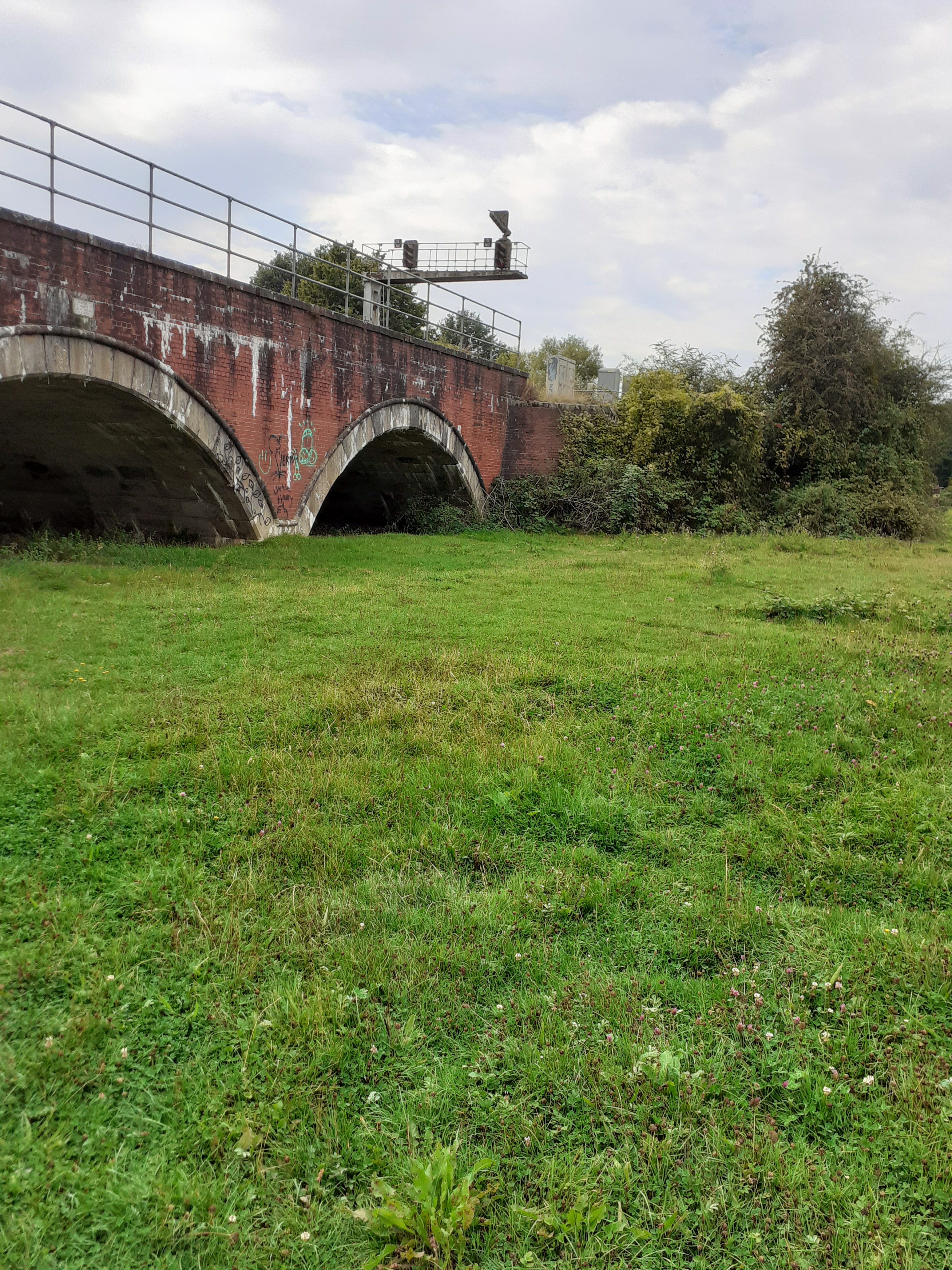
The place is called Lower Parting, though it is actually a joining. The parting is 3km (just under two miles) up river. There, the River Severn divides into two channels, east and west, to flow around Alney Island. When taking the picture above, I was standing near the point where the channels meet again. It was around 9 a.m. on 22 June. I had not been there before.

Although every time and place is ultimately sacred, some times and places are easier for me to honour. In my experience this is partly a property of the times and places, partly down to culture and tradition, and partly to do with my own inner and outer availability.

On this occasion, I was within a midsummer period which for me lasts from a day or so before the solstice until around 25 June. I like to acknowledge the stasis (standstill) element within the solstice experience. It is not just about a point of time. Like its midwinter opposite and twin, my midsummer allows an extended pause before the wheel of the year turns. My walk on 22 June was an intentional celebration of the midsummer stasis, something between an outdoor walking meditation and a miniature festival pilgrimage. It was built around my first encounter with an intuited special place, now that I am fit enough once more to walk the required distance.

I can easily understand why people in many parts of the world have seen water, especially flowing water, as sacred. I am on a quiet part of a quiet island in the middle of Gloucester city. The wetland here is blissfully unfit for development, and now a nature reserve. I was able to stand here and look out at the joining of the waters, under a blue sky, and surrender to a benign spirit of place. I didn’t have to attend to my attention. In this extended, flowing, moment, nature was doing that for me. I found, here, a generous horizon, and a living peace that invites participation. I am glad and grateful to have discovered this place on this day.

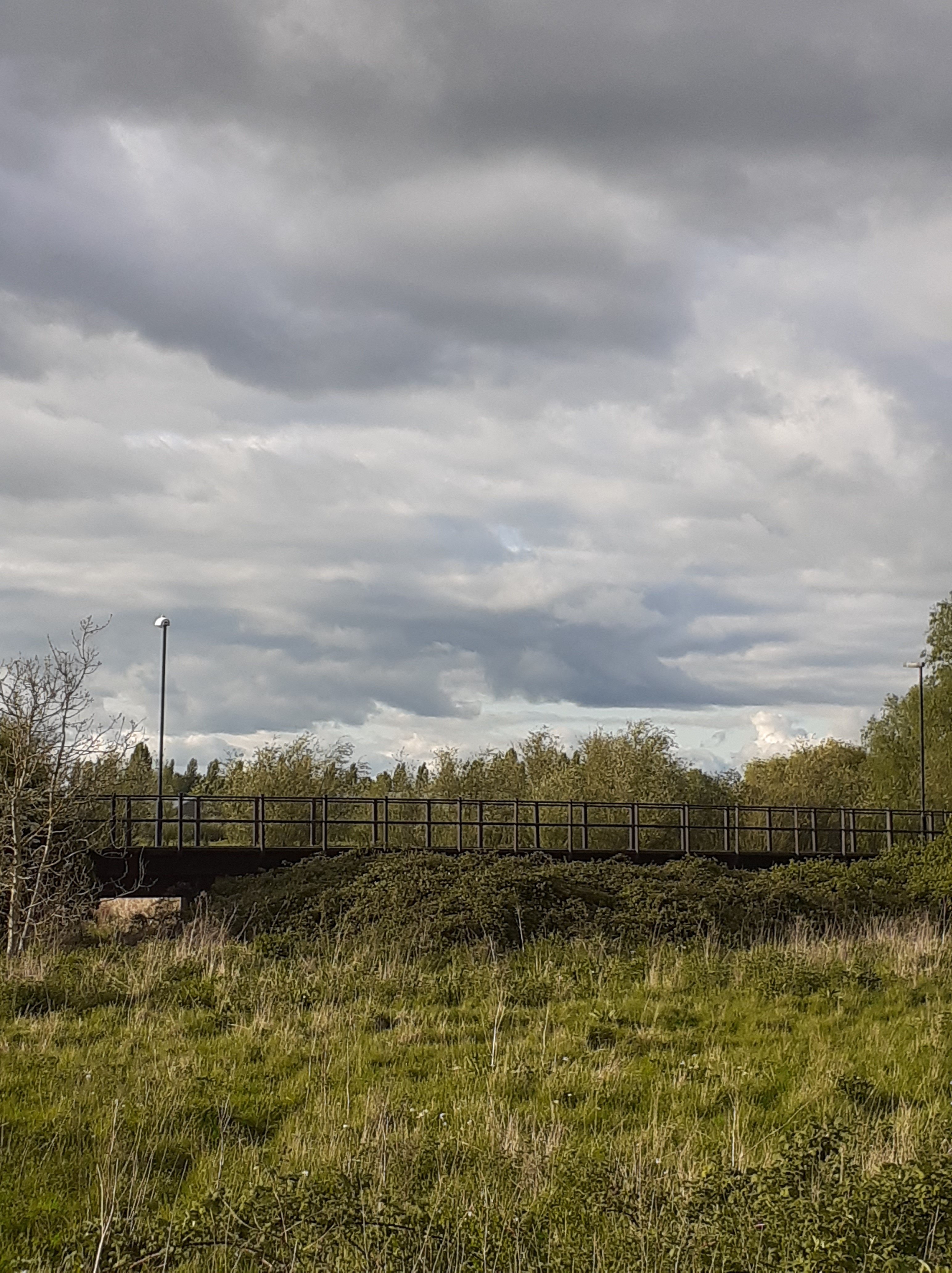
In my tradition, at every seasonal festival, we are asked to think not only of the time we are celebrating, but also of its opposite. Walking back from Lower Parting, I see features in the landscape that help me. My pictures below do not evoke winter, but they do show light and shade within a single image. On planet Earth, the time of my summer is the time of someone else’s winter. These are both ways in which opposites complement each other in an interconnected world.

WATER MEADOW WALK

A water meadow during a dry spell. A secluded space on the fringe of the old city. Luckily for its own life, it facilitates the management of flooding. This space is available to the public, and on this walk it seems less frequented than I would have expected. It is not grandly wild, but feels different from anywhere else I have discovered in easy walking distance from my home. I like its flatness, its greenness, and its openness to the sky.

I walk here in the early evening, grateful for the path, challenging the pollen to do its worst. Lifelong hay fever has made me less of a nature boy than I might have been, certainly at this time of year. But I don’t like feeling restricted, even with my new health complications. Walking in an open space like this, particularly when there is a good breeze, lifts my spirits.

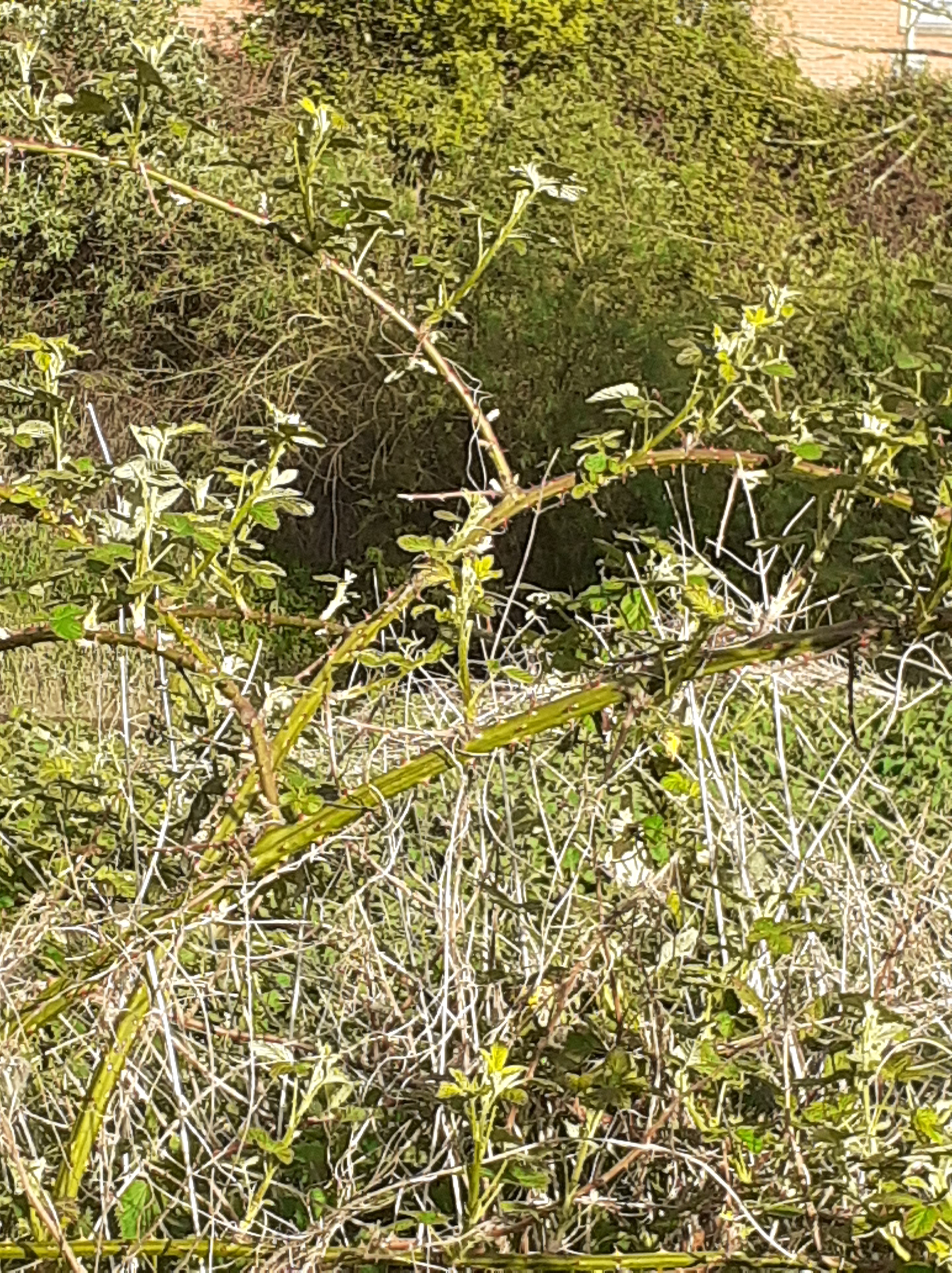
From a contemplative perspective, I am in very friendly territory. My senses relax into a more porous relationship with my surroundings. I begin to disappear into the landscape, losing myself in the experience of the moment. Very briefly, I am the path, the sky and the bramble.

Back in my envelope of skin I see grey above me, and I start to wonder about rain. I am not dressed for it. Luckily, at least for me, no rain falls. I do notice that the riot of life around me might like a good fresh soaking. But I’m conscious of my own interests now. I head for the shelter of my home.

A CELTIC MIRROR

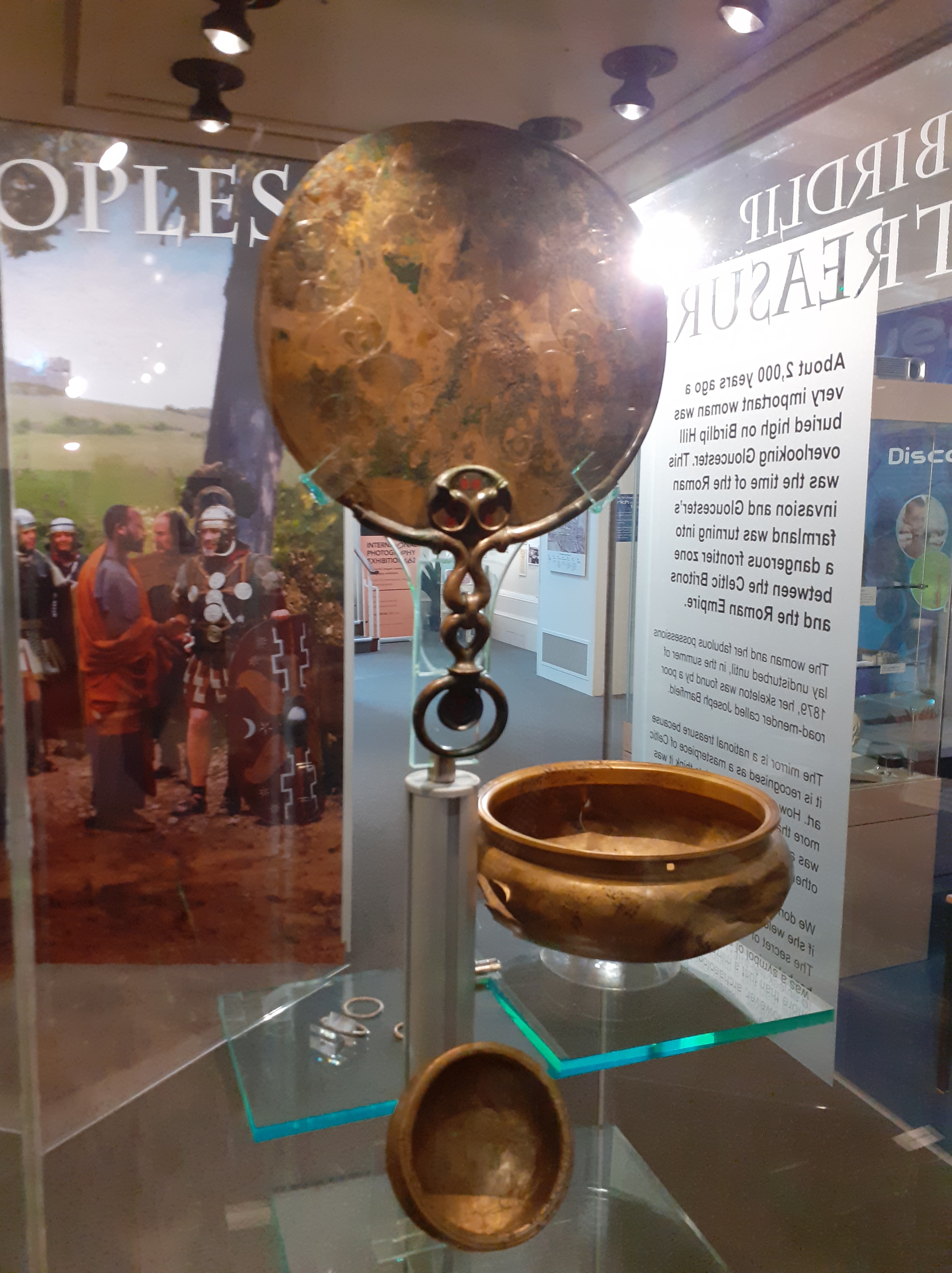
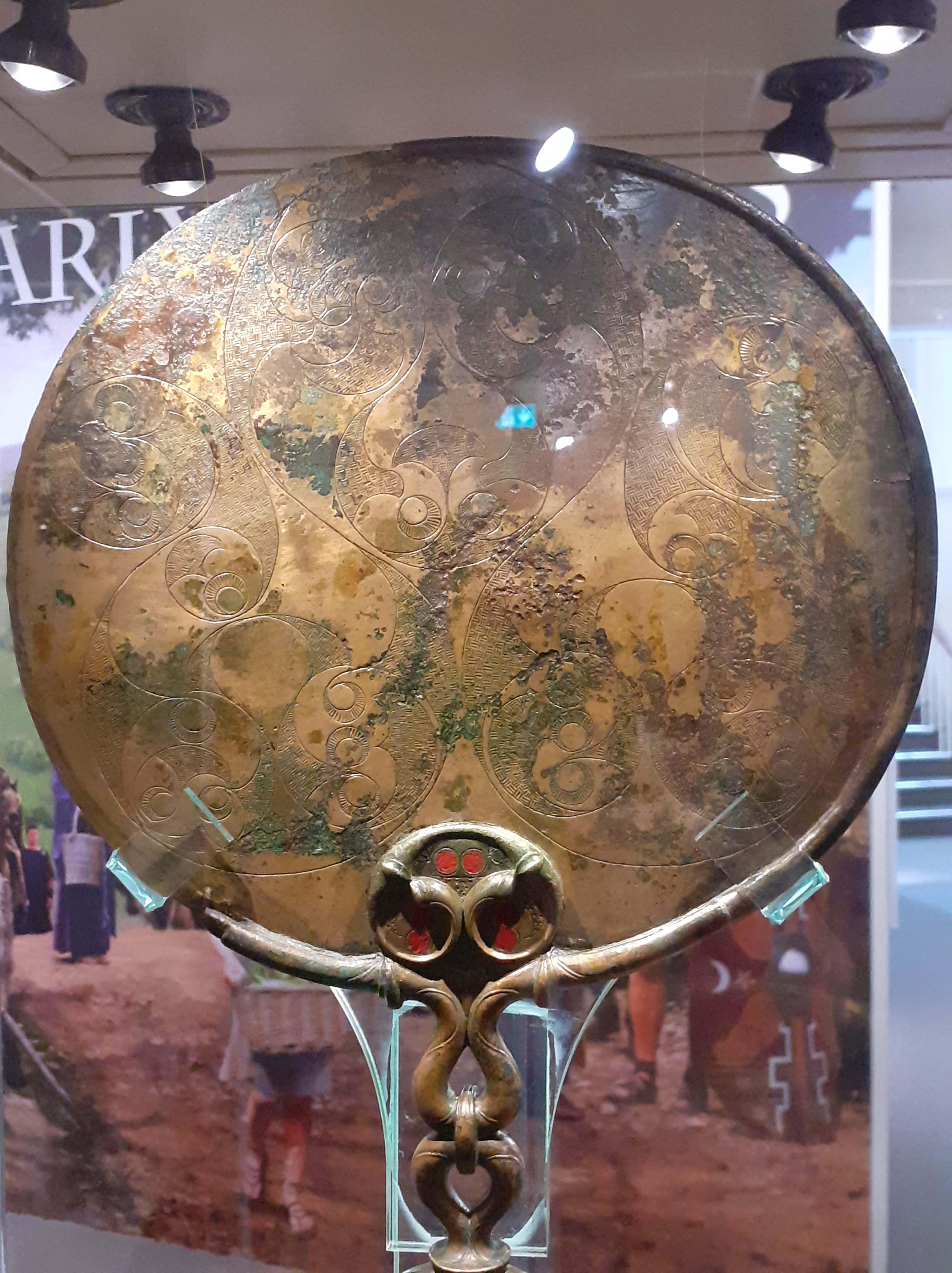
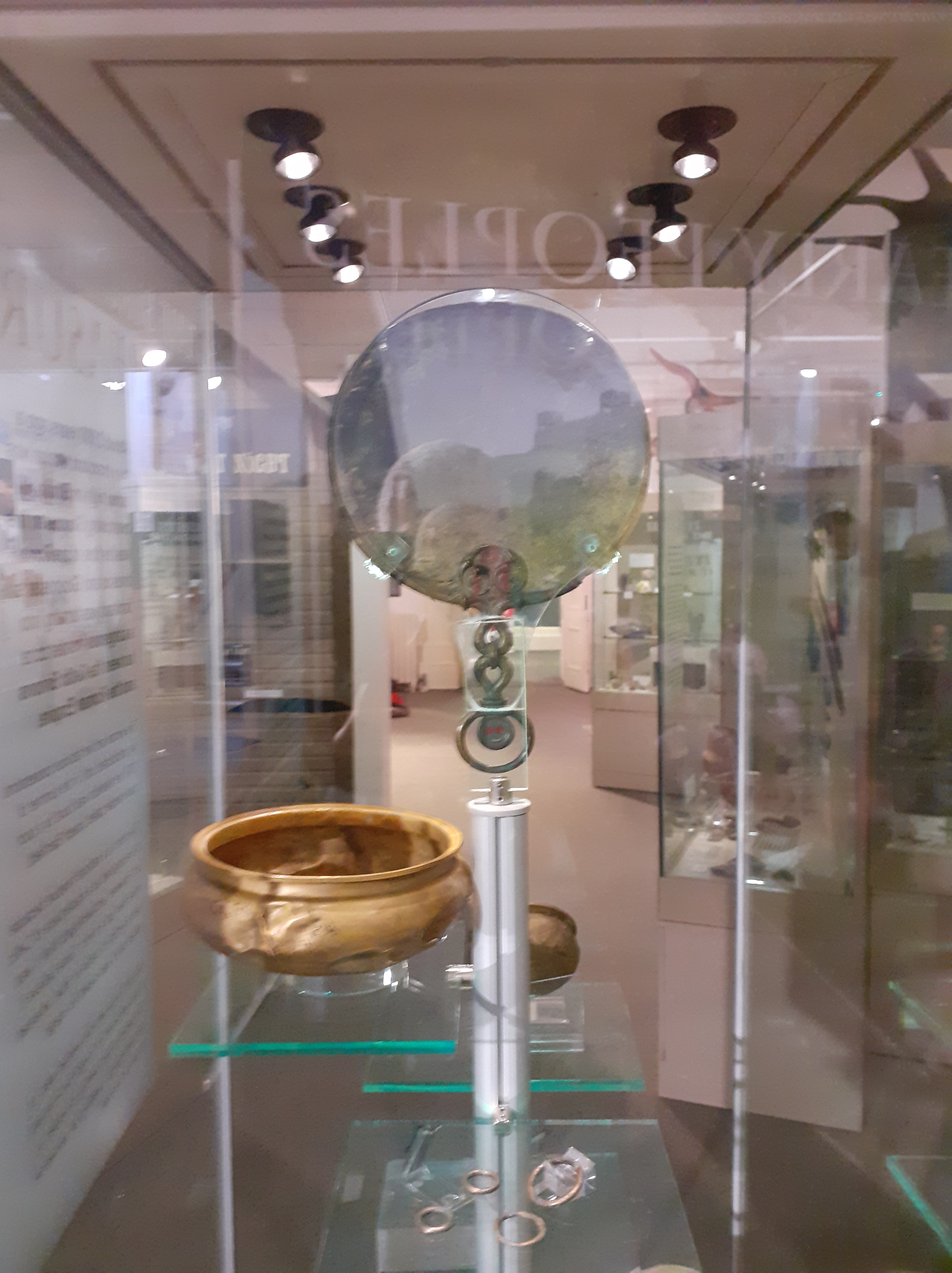
“About 2,000 years ago a very important woman was buried high on Birdlip Hill overlooking Gloucester. This was the time of the Roman invasion and Gloucester’s farmland was turning into a dangerous frontier between the Celtic Britons and the Roman Empire.” The mirror and bowls on display above are part of her grave goods. I used a mirror of my own to read the Gloucester Museum’s information about what has now become an ‘exhibit’.

Naturally enough, people want to know more than this. Stories connect ‘the very important woman’ to Boudicca, whose campaign against the Romans two decades after their initial takeover was well-documented and is well-remembered. But the location and manner of her death after her eventual defeat are not clear and have provided space for all manner of speculation. This gives improbable possibilities a certain amount of traction.

I turn my attention back to the mirror, as the undoubted product of an iron age culture with a wealthy aristocracy who spoke a Brythonic Celtic language. The designs on the back of the mirror (below) reflect the tastes of that culture. To me, they seem almost alive. They give me a tenuous sense of connection with a real person who was in this neighbourhood (and I would guess came from it) 2,000 years ago.

Being connected by place but separated by time is an odd feeling, even more complicated for me than being connected by time and separated by space. I have to be careful not to let my imagination colonise the past. It can be a distorting and invasive mirror. At the same time I do want a relationship with the past. I want to acknowledge it and be open to what it might teach me. In this case, perhaps, a commitment to beauty in a time of turmoil and danger. Or a commitment to different ways of looking, in a world where past and future may not exist in quite the ways that they appear to do.

GREYFRIARS: A SENSE OF PLACE

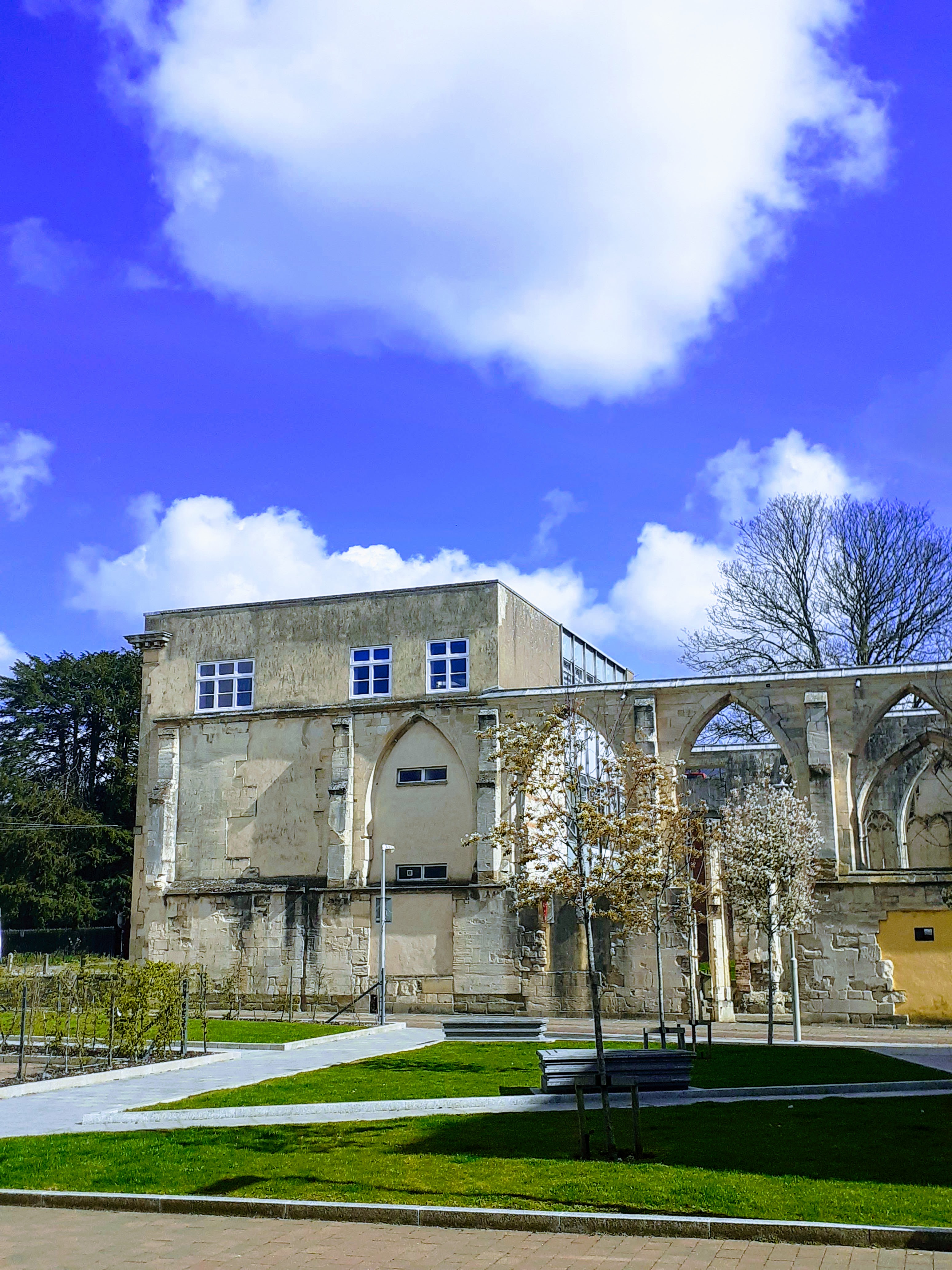
Greyfriars is the shell of a church that once belonged to the Franciscan friary founded in Gloucester, England, around 1231 (1). The friars rebuilt their church in 1519. What is left of it, after a series of violent transitions including its final restoration, is a slightly bleak twentieth century heritage ruin, saved for me by its elegant arches. It does, I find, support an aspect of tranquility in this neighbourhood, along with an active Quaker Meeting House purpose built early in the nineteenth century. I live in a city centre, on a densely populated estate, yet it doesn’t feel that way. Good modern insulation helps, but my sense of place suggests an underlying leaning towards calm.

I notice this because I have been more-or-less housebound since I last wrote, with a further deterioration in my health, until a welcome uptick in the last couple of days. The picture, taken on 9 April doesn’t do the building full justice. It is much more substantial than it looks, with both the nave and north aisle in place. But it is the view from my home. My sense of place within the confines of house, block and estate has sharpened. The Greyfriars ruins nourish me, as do sun, shadow and sky in this urban environment.

I have been processing health concerns: the advantages and limitations of having a label (COPD); dealing with health services and new medications; wondering about lifestyle adjustments; considering risk and resiliency factors, what’s in my power to influence and what isn’t; the ecology of relationship, especially thinking of my wife Elaine and challenges I may pose to her as a person with health issues of her own; feelings of relief that our cynically underfunded health system is holding me well, except at the political level where decision makers want to forget about COVID. (People with COPD are prone to infections, and this would not be a good one.) I also ask myself what role, if any, my spiritual view and practice might play. This is a whole line of inquiry in itself, and one to go into as I stabilise, and find a new ‘normal’.

(1) see https://gloucester500.co.uk/greyfriars/ for more illustrations and further information

LIMITS AND BLESSINGS

In my world, this is a time of laboured breath and limited capacity for walking. While medical investigations are underway, I am constrained in what I can do. But walking outside, taking slow deep breaths, and drinking plenty of water are medically and spiritually recommended. Today I went outside for the first time in some days, water bottle to hand, and a rhythm of slow, deep breathing established.

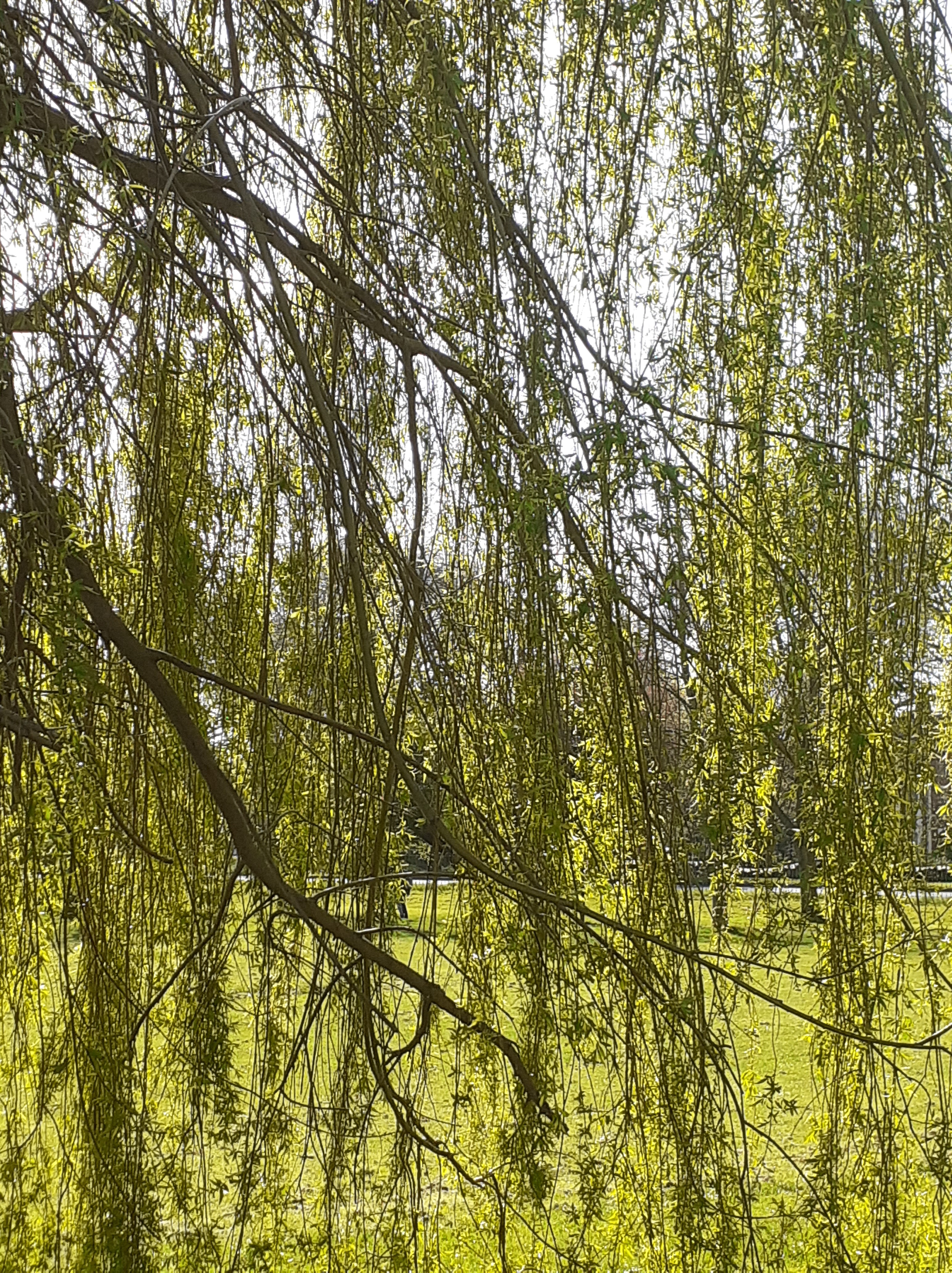
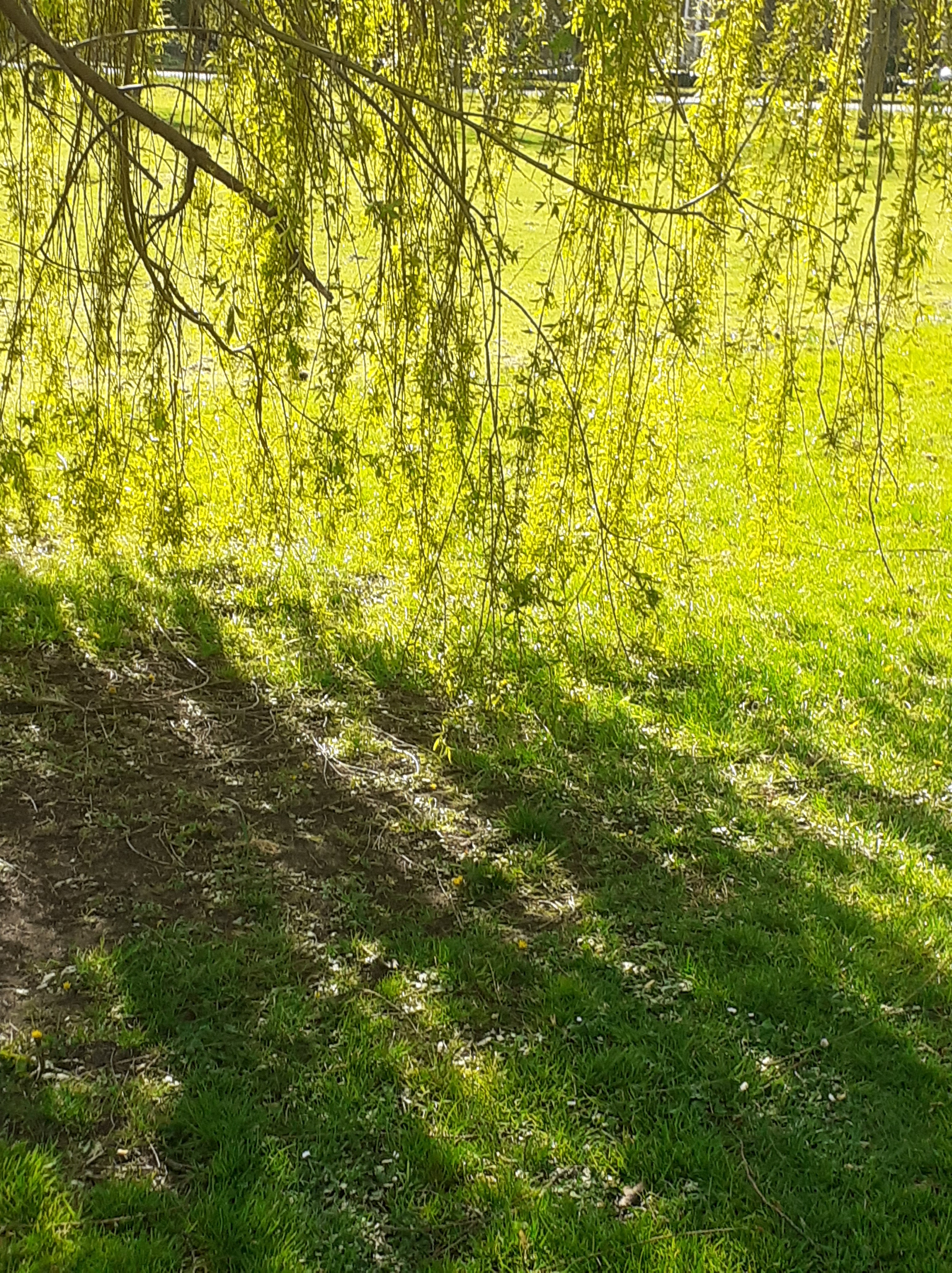
I walked in my neighbourhood and a nearby local park. The picture above is a treescape from that park. For me, it is images solidity and endurance alongside blue sky and spring growth. In itself, it occupies a unique niche in the web of life. I enjoy its company, and the opportunity to record its presence here.

My world may seem, at least for the time being, to have shrunken. My own presence in it, and my perceptions when present to it, do not have to shrink along with the physical distance I can cover. A necessary slowing down contains it own opportunities. I have space and time to enjoy the willows here, their leaves, and the shadows of their leaves. I am constrained to take notice. I appreciate the experience of noticing. I am reminded that I am just outside the period assigned to willow in my personal tree mandala (1,2), but of course it is not too late to connect and commune. There are compensations nested in my unwanted condition.

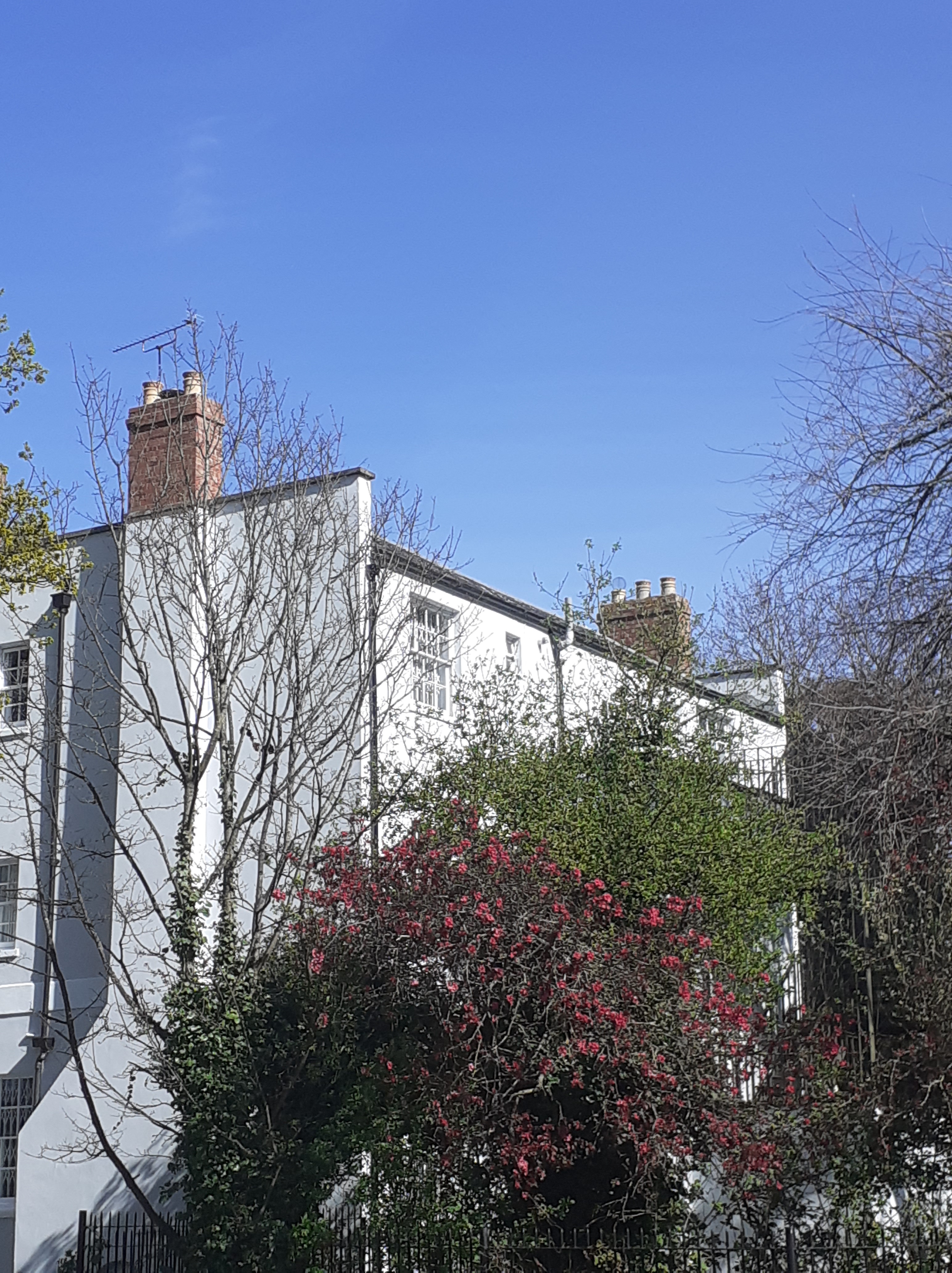
I find the houses and their surrounding plant life photogenic, not least under a blue April sky. The season has been advancing, the equinox now well past. Around me, I find an energetic acceleration towards summer. Hildegard von Bingen called this kind of natural power viriditas. I can recognise and enjoy it even when I’m lagging behind.

Very close to home I encounter the ruins of Gloucester’s Franciscan Priory, sadly with a nondescript mid C20th building tacked on behind them. They are a landmark for me on my return. I’m tired. I’ve about reached my limit. Although I’m sad that my walking distance is so limited, I feel blessed and nourished by what I find within the limitations. I am also glad to sit down and recognise feeling at once refreshed and exhausted.

(1) https://contemplativeinquiry.blog/2021/tree-mandala/willow/

(2) The mandala is based on my personal experience of trees in the neighbourhood as well as traditional lore. Moving around the spring quarter from 1 February, the positions and dates of the four trees for this quarter are: Birch, north-east, 1-22 February; Ash & Ivy, east-north-east, 23 February – 16 March; Willow, east, 17 March – 7 April; Blackthorn, east-south-east, 8 – 30 April. The summer quarter then starts with Hawthorn at Beltane. For a complete list of the sixteen trees, see https://contemplativeinquiry.blog/2020/autumn-equinox-2020-hazel-salmon-awen/

ST DAVID’S DAY 2022: A WALK IN THE PARK

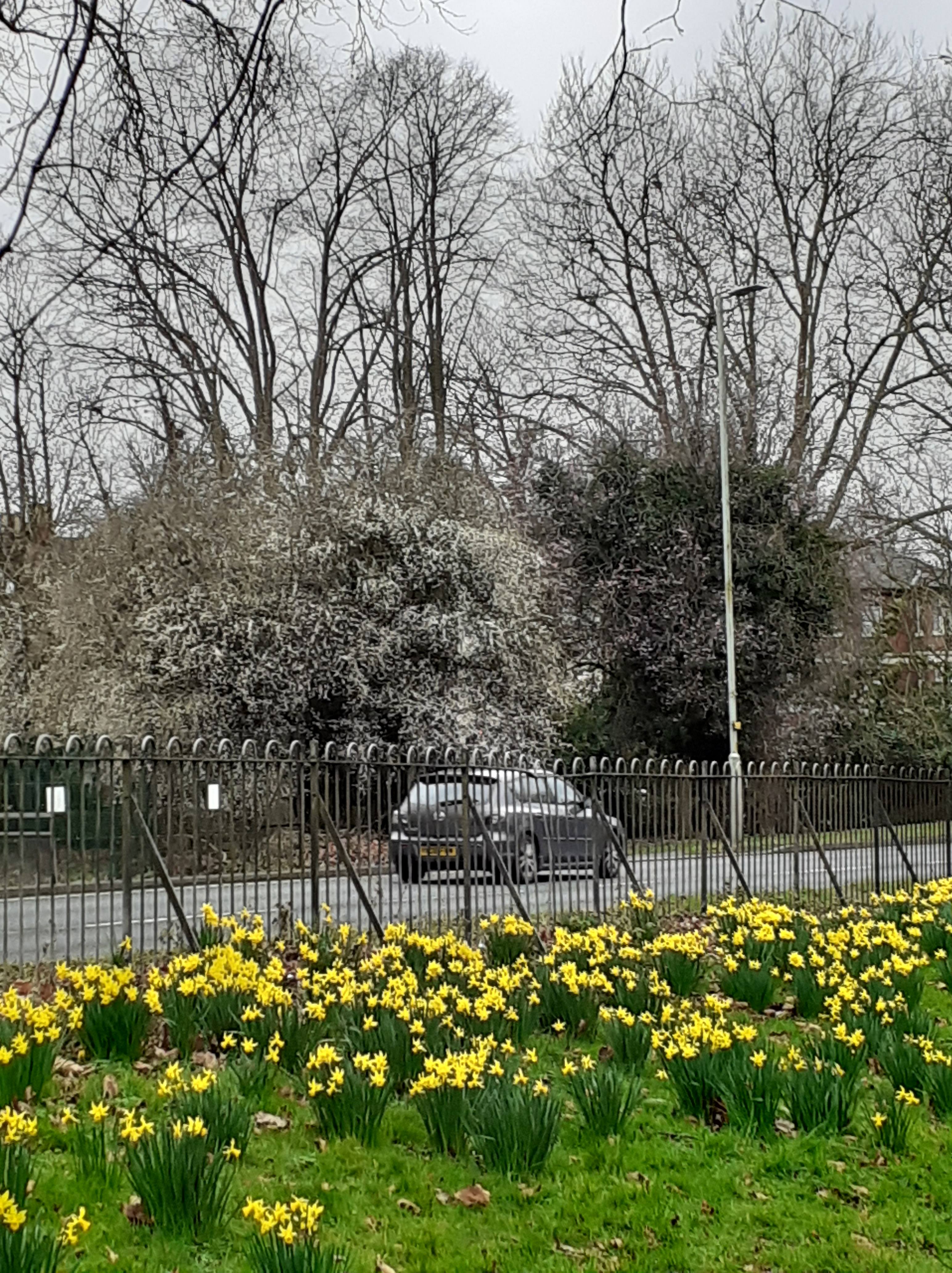
It is 1 March, a mixed day – bringing together grey sky, bare branches, emerging blossoms and vivid daffodils. It is chilly, and rain is likely, though not just yet. Daffodils (here the strongest sign of a changing year) are linked to St. David, the patron saint of Wales. 1 March is his feast day.

David lived during the sixth century CE, a flourishing time for Celtic Christianity. His defining early achievement was the founding of a Celtic monastic community at Glyn Rhosyn (the Vale of Roses) on the west headland of Pembrokeshire (Si Benfro) where St. David’s Cathedral now stands. He went on to become a Christian leader of great authority, and was eventually canonised in the twelfth century, a different historical period with the church under stronger Vatican control and Welsh identity under threat from the English. David became the patron saint of Wales and his day is celebrated in Wales with parades and other public events.

Gloucester is very much an English city, though not so very far from Wales. Today’s weather conditions would not be out of place there. My wife Elaine and I went out on a morning walk with a sense of the saint’s day and how both the day and the coming of March represent a shift in the year. I noticed, too, how I can honour a saint without thinking of sainthood as a model, or even remotely wanting to be one. I acknowledge that I am on different kind of path, less defined, less heroic, and less religious.

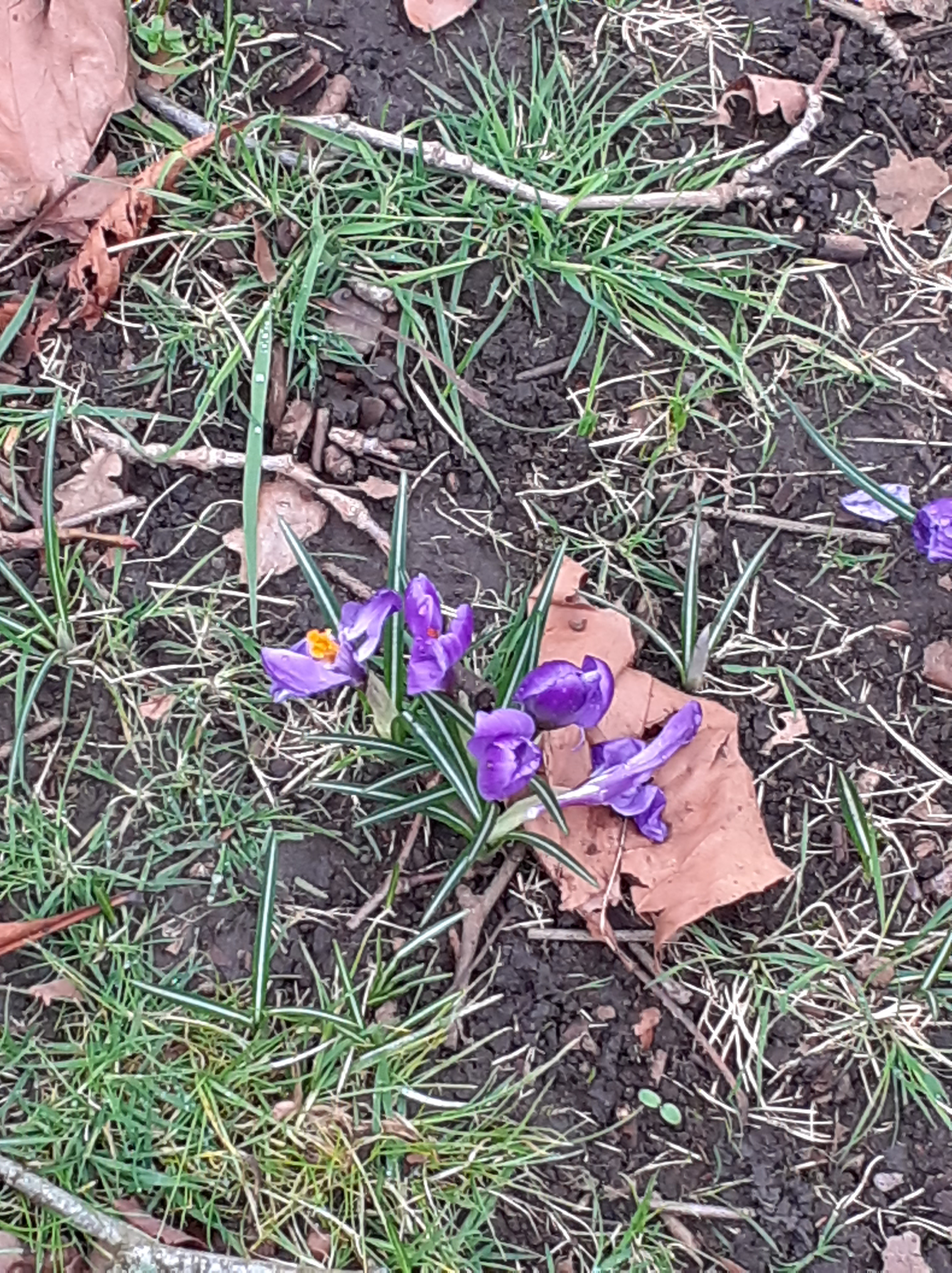
When out walking, I see how the ordinary world seems to transform in the light of a loving gaze. I am looking at the world as it is, not for signs of a creator’s hand or influence or expectations. For me, laid out below – at the micro level – I find grass, earth, twigs, purple crocus and dead leaves. They are simply themselves. All ordinary in an ordinary moment. But an ordinary moment, as we might conventionally call it, is an extraordinary event. It is a small miracle, in its naturalistic way, yet easy to access in a receptive frame of mind.

I do appreciate that a ‘receptive frame of mind’, as a private experience, is facilitated by favourable public conditions, like a well-managed public park. I may not be dependent on such external conditions, but they do make a difference. I am grateful for their current presence in an uncertain world.

WAITING FOR THE STORM

I took this picture from an upstairs window before 9 a.m. on18 February 2022,. It shows blue sky and the tower of St Mary de Crypt, Gloucester. The image is calm, and I enjoy its simple beauty. But I am bracing for a severe storm, officially named ‘Storm Eunice’. We are on red alert, which is very rare in this country. I contemplate the tower, which stands both for longevity and impermanence.

It is 10.15 a.m. now and the wind, at first just playful, has moved into serious gusting. Paper and leaves blow about in a courtyard. The sky is grey and there are raindrops on my window pane. Taking another picture, I notice I have lowered my sights. I have included more material substance, roof tops in particular. The invitation to skyward contemplation, so poignantly encouraged by towers like this, isn’t so present for me in this moment. The theme now is embodied endurance and solidity, weathering the winds of the world. For they don’t seem at all celestial, their current force at least partly the result of our own collective behaviour. Strong walls and a decent roof are the focus of my desire. I am, after all, a Pagan.

I am an urban Druid now, more clearly than before. It gives me a different view of nature. On one hand I am reminded that everything is included in ‘nature’. But in so far as I make a city/country distinction, I do notice a different experience of the elements, seasons, and the varieties of life. In an old and relatively small city (pop. 165,000) it is easier to see the evolution of human culture as a gradual and organic process than in other built environments. Today is a special day because raw and conceivably violent nature is coming on a visit. Whilst I notice fears around this, and am distressed by the notion of harm to anyone, I also find an aspect of Spring, and renewal, in this. I do feel energised, now, just after 11 a.m., and this at least is welcome. I have no idea of how the day is going to play out here, or what I am going to feel about my experience of Storm Eunice at the days end.

OLD CITY, NEW HOME

Above, a city park containing monastic ruins. I am beginning to make sense of a new habitat. The distance door-to-door is only about ten miles from the old one. But it feels very different. Stroud the Cotswold mill town is hilly and hard on the older pedestrian. Gloucester is an old English city on the river Severn, much flatter. The centre, where we now live, has become highly pedestrian friendly in recent years. This was a key motivator for our move and it already feels transformational.

On an exploratory amble on Sunday, Elaine and I were very aware of history. St. Oswald’s Priory, in the picture above, was founded by Lady Aethelflaed of Mercia, daughter of Alfred the Great, around 900. The Priory Church, initially dedicated to St. Peter, was constructed from recycled Roman stones. (The Romans founded the city, as Glevum, in the first century CE, and it never quite died after their departure from Britain). In Aetheflaed’s time it was a bold and unusual move to build a church as there were frequent Viking raids. Quite possibly Aethelflaed and her husband were later interred in the crypt. Archaeological excavations in the 1970s revealed a 10th century fragment of carved slab from the grave of someone of high importance.

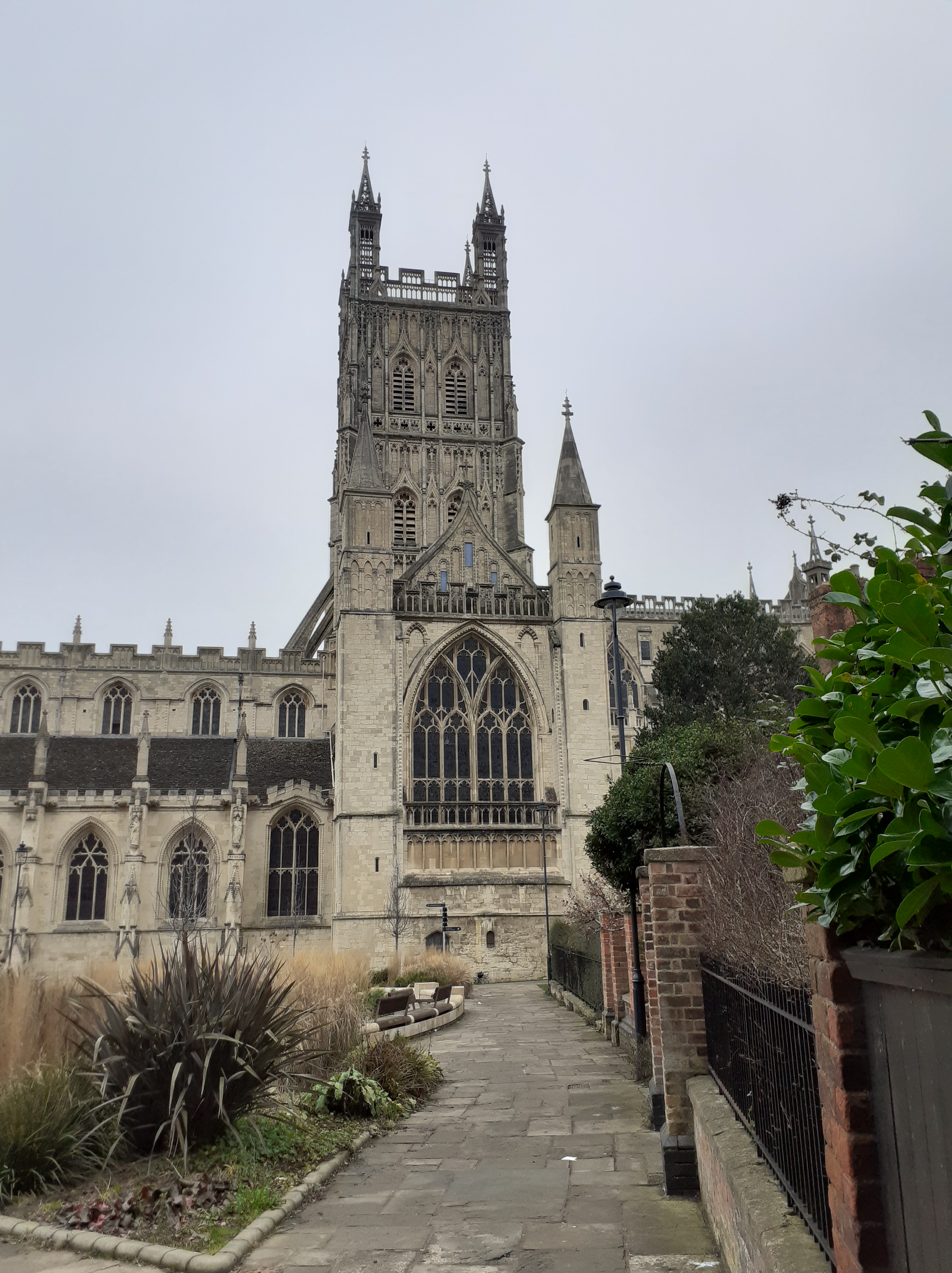
In the centuries that followed St Oswald’s grew rich as a place of pilgrimage and was at the centre of a large parish. But later it declined, as institutions do. It was almost literally in the shadow of the more successful Abbey of St. Peter, now Gloucester Cathedral, where the power of the church was now based. Architecturally, the cathedral (below) still dominates the city.

When Elaine and I were walking together on Sunday, the bells were ringing and we found ourselves enjoying this as an expression of the old city’s identity. As in other old cathedral cities, the cathedral is characteristically approached through narrow, often arched lanes and then appears magnificently in front of us.

We have another church, St. Mary-Le-Crypt (below), even closer to home, and cut through its churchyard to get to a major traditional shopping street. Like the cathedral, it continues to serve Anglican (Episcopalian) worshippers and to be part of the wider community.

I have as yet no idea what effect, if any, living in Gloucester will have on my contemplative inquiry, nested as it is in Druidry and Earth spirituality. It is much too early to tell. From the perspective of the living moment, I am delighted to be soaking in new impressions, aware that this is where I live now. Looking out, this is what I will frequently see. These sights are part of the texture of my daily experience now, and I welcome them as such. It greet a new way of being at home.

Earth Eclectic

music that celebrates Earth and speaks to the heart

Sarah Fuhro Star-Flower Alchemy

Follow the Moon's Cycle

Muddy Feet

Meeting nature on nature's terms

Rosher.Net

A little bit of Mark Rosher in South Gloucestershire, England

Becoming Part of the Land

A monastic polytheist's and animist’s journal

selkiewife

Selkie Writing…

Charlotte Rodgers

Images and words set against a backdrop of outsider art.

Prof Jem Bendell

living with metacrisis and collapse

Towint

The pagan path. The Old Ways In New Times

The Druids Garden

Spiritual journeys in tending the living earth, permaculture, and nature-inspired arts

The Blog of Baphomet

a magickal dialogue between nature and culture

This Simple Life

The gentle art of living with less

Musings of a Scottish Hearth Druid and Heathen

Thoughts about living, loving and worshiping as an autistic Hearth Druid and Heathen. One woman's journey.

Wheel of the Year Blog

An place to read and share stories about the celtic seasonal festivals

Walking the Druid Path

Just another WordPress.com site

anima monday

Exploring our connection to the wider world

Grounded Space Focusing

Become more grounded and spacious with yourself and others, through your own body’s wisdom

The Earthbound Report

Good lives on our one planet

Hopeless Vendetta

News for the residents of Hopeless, Maine