Contemplative Inquiry

This blog is about contemplative inquiry

Tag: Gloucester Cathedral

DEEP AUTUMN 2025

“All things ripen and rot that rose up at first,

And so the year runs away in yesterdays many,

And here winter wends again, as by the way of the world it ought,

Until the Michaelmas moon has winters boding brought.” (1)

Even today, deep autumn opens the door to winter. This was even more the case in the North Staffordshire and Derbyshire regions of 14th century England, where Sir Gawain and the Green Knight was written. Even in castles, people were less sheltered from the growing cold and damp than we are. So readers and listeners of the period are reminded that the coming of winter is both natually and divinely ordained.

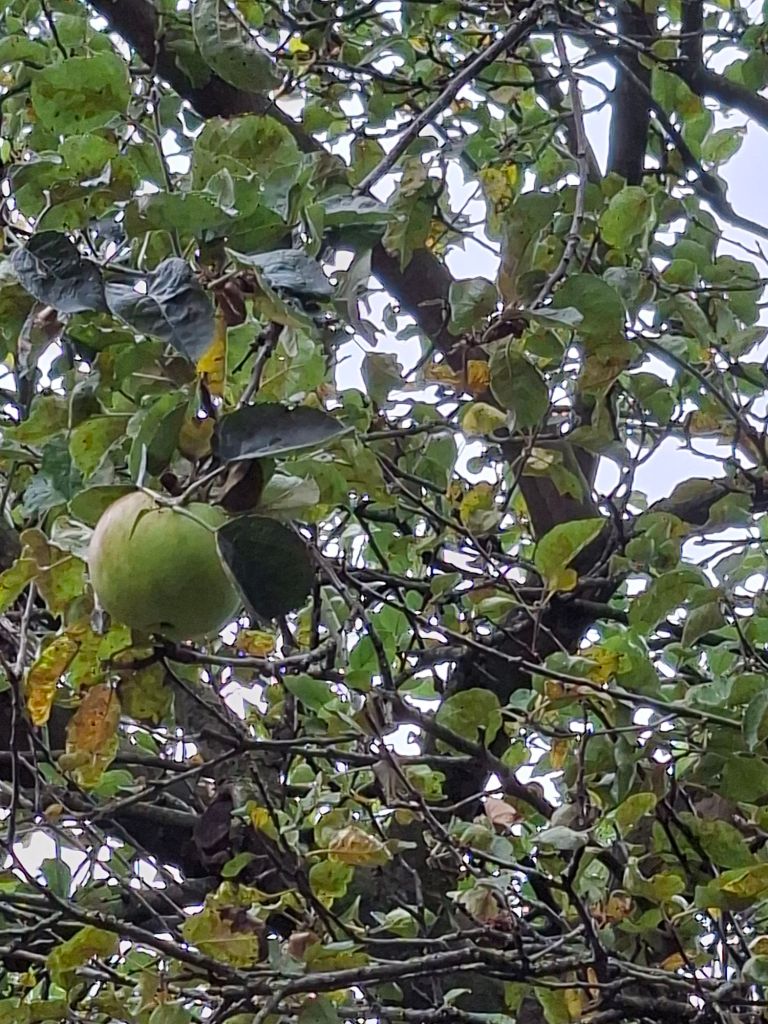
Here and now, the sight of the apple harvest in its later stages (pictured above) seems quite different than in the early ones (2) – less bright, less novel, less shiny. Rotting apples lie on the ground, now fallen outside the wall of  Gloucester Cathedral’s orchard. From Nature’s exuberant perspective, this is all part of the plan.  Waste is built in.

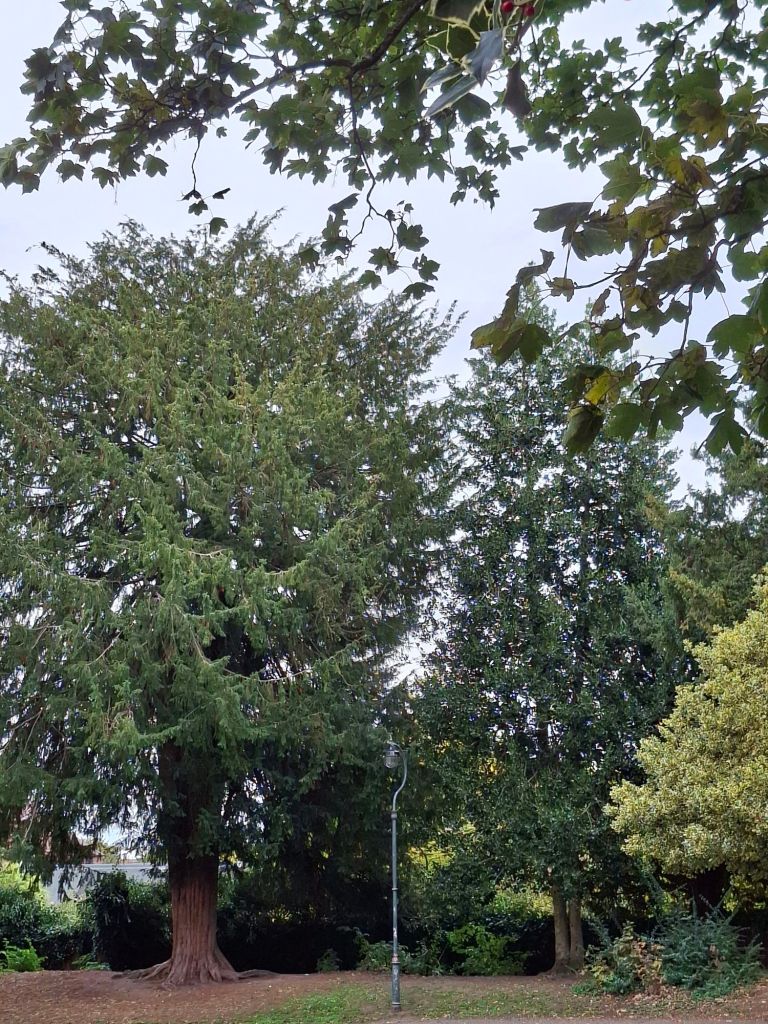
This time draws me further into the declining year. I am in the cathedral’s  grounds, now looking at a yew tree and its associations with death. I’m thinking of the approach of Samhain (aka Halloween/All Hallows) at the turn of the month. Once it marked the 3rd harvest of the year – the blood harvest, where animals were slaughtered in preparation for winter. Now it is more a time to remember our ancestors, and our dead more widely.

Yet the seasonal moment, and the yew, can also be linked to wisdom and transformative change in life. I launched my contemplative inquiry at Samhain 2011. Like many people, I find that this period can be a resonant and creative time.

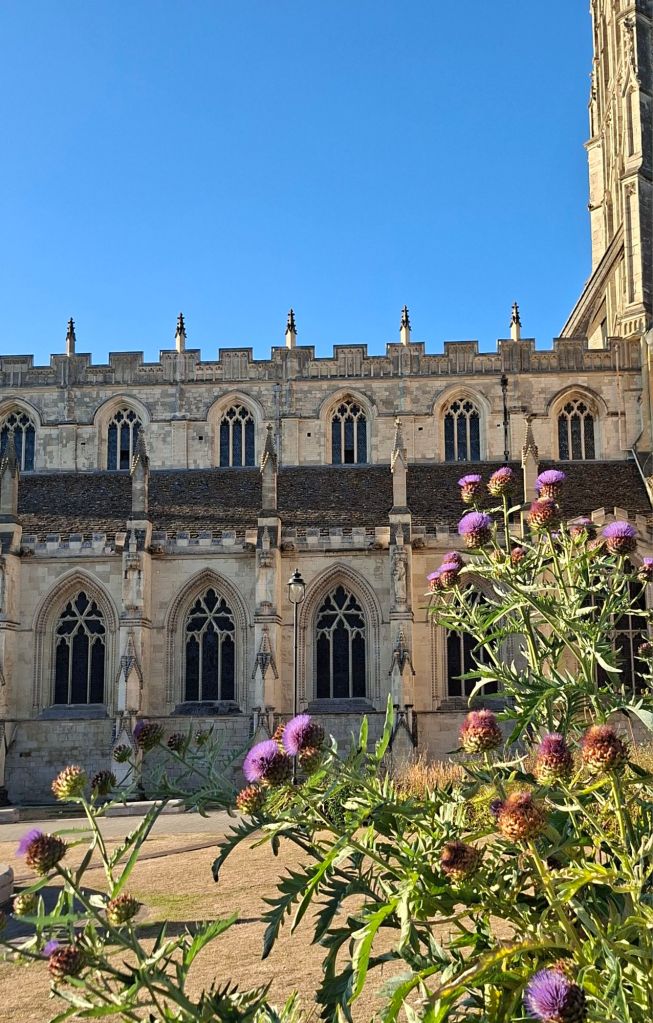
Below the yew, I have included a section of the cathedral itself. I have old personal associations linking medieval Gothic architecture with the feeling-tone of the declining year. I am also aware that this building is linked to the trees I picture and discuss. Gloucester Cathedral was a monastery when Sir Gawain and the Green Knight was written but many of its features were already in place.
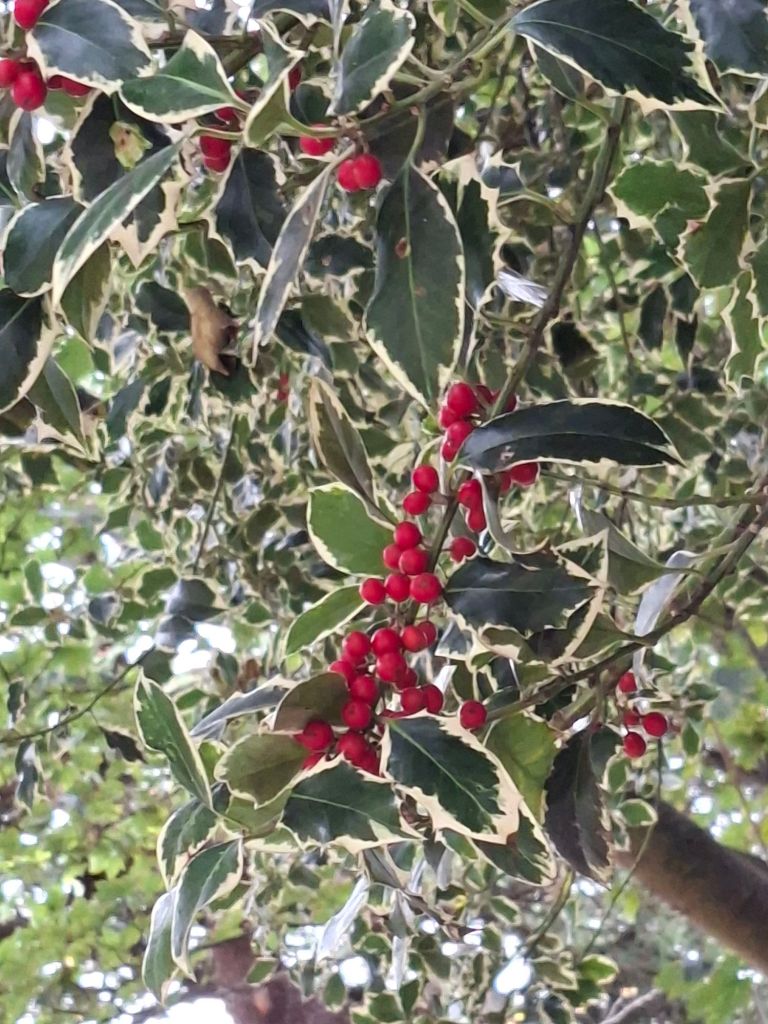
In the same space, I find both holly and ivy, with berries on the holly tree.  I immediately thought of the Christmas carol The Holly and the Ivy. It is an ancient folk carol, which interweaves Christian themes and others that belong with the land. The version which is now popular was collected by Cecil Sharp in 1909 in Gloucestershire from Mary  Clayton.

Many people think that the indigenous Pagan themes are the oldest, and that the central focus here is on the holly. The authors of The Green Man Tree Oracle say: “Holly’s connection with the Green Man is especially strong. In his guise as the Holly King – an ancient giant and symbol of fertility – the Green Man makes a notable appearance in the 14th century poem Gawain and d the Green Knight. Here he takes the form of a fearsome knight, who comes to King Arthur’s court to offer a midwinter challenge, carrying a club of holly and wearing a holly crown (as symbols of his true identity).” This challenge happens every year, where the Green Man/Holly King demands that we encounter him through our dealings with the natural world.

Elaine and I went to the Gloucester Cathedral Close and its surroundings on Saturday afternoon 18 October to outrun an  extended period of gloom, wind and rain. We are now in it, so the lessons of the trees in deep autumn, anticipating the coming of winter, are not lost on us. The dark of the year is on its way.
(1) J.R R. Tolkien (translation of anonymous texts) Sir Gawain and the Green Knight, Pearl, Sir Orfeo New York: Ballantine Books, 1980.

(2) https://contemplativeinquiry.blog/2025/08/22/ (3rd photo)

(3) John Matthews & Will Worthington The Green Man Tree Oracle: Ancient Wisdom from the Greenwood London: Connections, 2003

LATE AUGUST 2025: SETTLING INTO AUTUMN

It is evening and for me autumnal. The sky offers the water a soft light, seemingly pink and grey. The water reflects this back, adding its own hint of mist. It is a tranquil scene.

For the first time this year, I feel a tug towards the Equinox, just under a month away. These canal waters are gentle, but they are drawn from the River Severn, site of the Severn Bore (1). Perhaps the waters are nudging something  – maybe the water – in me.

A little later, facing into the declining sun (below) I see the sunset and its effects. I notice the concentrated power of the orb as it appears to reach the earth, and the way in which this energy disperses into the sky. The colour coding shifts from intense white to yellow to red-orange to an orange becoming increasingly grey. I live at latitude 52 north, and the sunset is getting earlier every day, now 8.15pm. Another autumnal feature.

Autumn is also the season of the fruit harvest. This year, many people are commenting that the fruit harvest is arriving early. Below, against the background of a clear blue daytime sky, an apple tree is fruiting. The tree is close to Gloucester Cathedral and may belong to it. Medieval Gloucester was a place of churches and priories. It was also a place of orchards, many of them cultivated by monks and friars. The picture points to natural and cultural continuity, though the  fruit are early this year. I am no longer at a point tension between seasons. I am already settled in autumn.

(1) The Severn Bore is a natural tide phenomenon occurring in the River Severn in England, where a large wave surges upstream. It’s caused by the Atlantic tide pushing into the Bristol Channel and funneling it into the narrowing Severn Estuary, creating a more powerful wave that can be up to two meters high and a speed of up to 21 km/h. The Bore travels up the Severn Estuary, from Awre to Gloucester, a distance of 25 miles. It is strongest in the equinoxes (especially spring) and a popular challenge for surfers, kayakers and paddleboarders.

THE PLEASURE OF A SUMMER EVENING WALK

It is a little after 7 pm, and the mellowing evening of a hot day. The sky is clear. On 12 July, there are still nearly two and a half hours before sunset. It is about 31C/87.8F with a light breeze. Elaine and I feel comfortable enough to go for a walk in town.

We start quietly in our own neighbourhood. We are, we think, towards the end of a hot period that peaked at 35C/95F. This counts as serious heat in England. For several days, we have been staying indoors for much of the day. There have been quick forays in the mornings, mostly to an air conditioned shopping centre nearby.

We needed to get out at the first opportunity. We are rewarded, in this evening, by a freshness grown unfamiliar, and by powerful contrasts of light and shade as seen in the priory ruins below.

To leave our Greyfriars estate, we walk down a narrow lane that separates a pub from a church. We enter Southgate Street in the old town through an archway. Entering the street, we are conscious again of vivid  blue sky, and the mix of sunlight and shadow. The street is hardly crowded, but it is certainly peopled on this warm summer evening.

At this stage we are not sure of our destination. We just want to be free and mobile and outdoors. We decide to turn right. Soon we will be reaching the cross roads at the centre of the old town. If we turn left, we will  find ourselves in Westgate Street*, with the Cathedral Close (College Green) as our likely destination.

Gloucester Cathedral, and in particular College Green, are a friendly space for us. It is still the dominant set of buildings in the town centre, just a little set apart from the shopping streets. Often a busy place, it is also a contemplative one. As we sit there enjoying the opportunity to be out, we notice that the temperature is cooling as we move towards 8 pm.

Eventually we decide to return home, leaving College Green through another alley, this one a location for shops and restaurants. It’s been a nurturing time in the high summer city.

  • When Gloucester was first established by the Romans in 97 AD as Colonia Glevum, it was built as a walled city with gates in each of the four cardinal directions. Hence the streets Eastgate, Southgate, Westgate and Northgate. I believe that Aethelflaed, Lady of Mercia, brought the street  names back into use in their English form whilst based in Gloucester round about 900 AD.

PLANT POWER IN A CATHEDRAL CLOSE

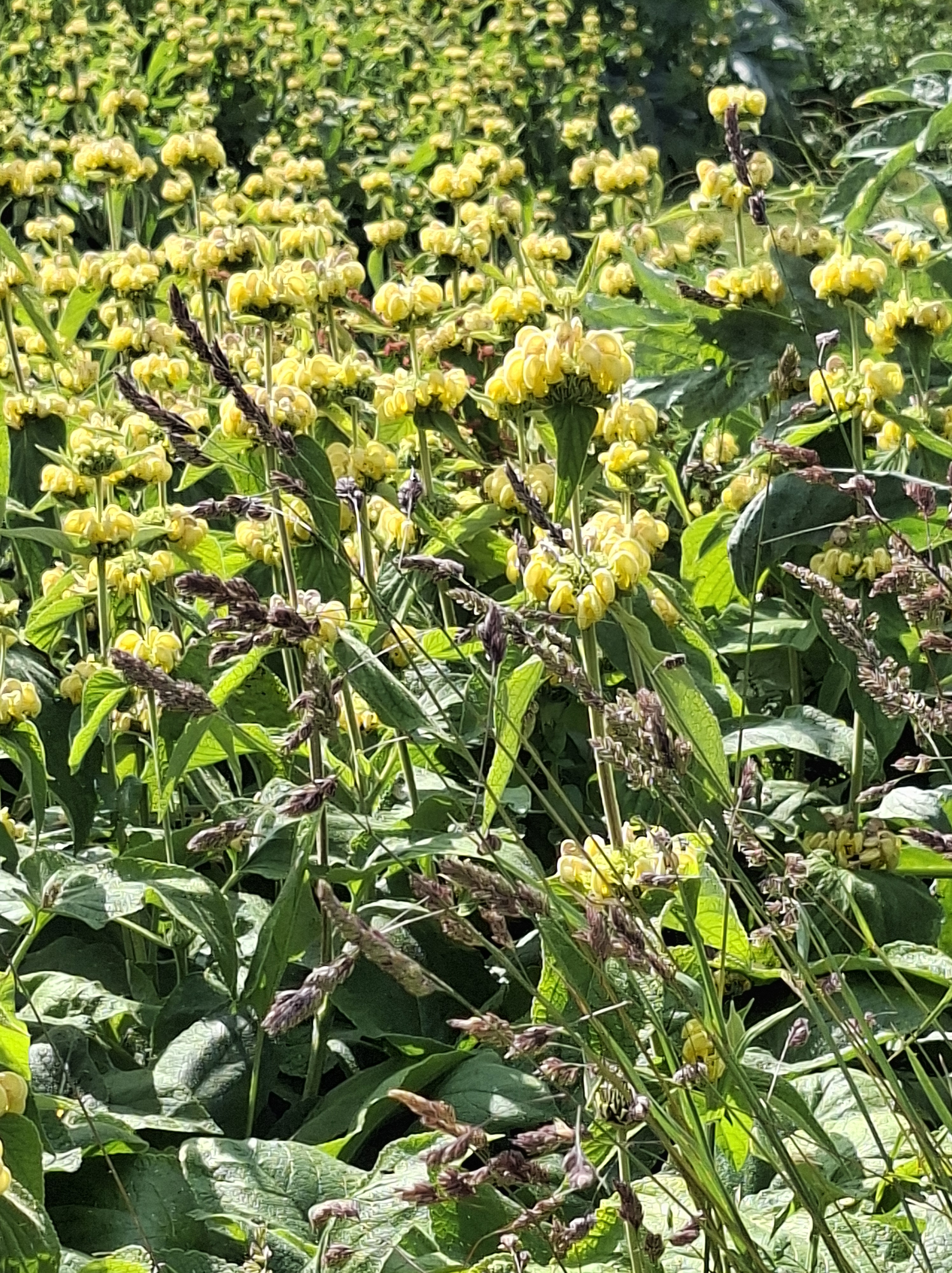
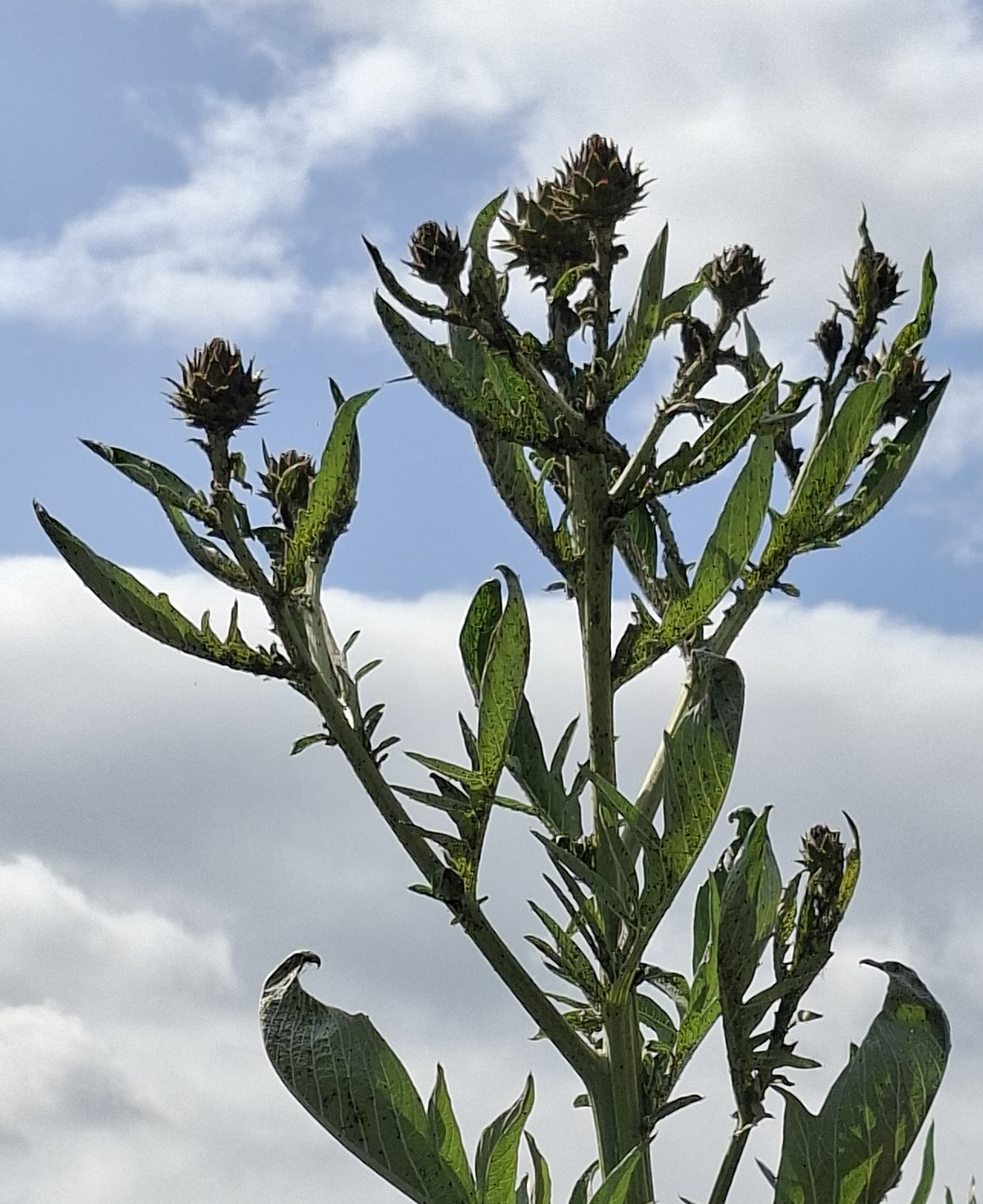
The garden in Gloucester Cathedral’s close is currently a magnificent riot. I was on a walk there with Elaine and we particularly noticed two powerful seeming plants that we couldn’t identify.  We simply sat with them, unnamed, and bathed in their energy. It was a glorious 1 June, the first day of our official meteorological summer, and one to savour and enjoy.  Only later did we do any research.

We are fairly sure that the plant above is yellow archangel and the plant below, looking like a giant thistle, is cardoon (canara cardunculus) aka prickly artichoke. Friendly feedback from readers on these identifications is welcome. If we are right both plants have long been recognised as sources of power and healing.

In our older traditions, yellow archangel was a symbol of harmony between flora and fauna. A custodian of wildlife, it fostered a bond that transcends mere survival. Herbalists still use this plant to relieve gout, sciatica and other pains of the joints and sinews. It has also been used to draw out splinters and thorns, clean and heal persistent sores, and to dissolve tumours. Yellow archangel can be used as food, in salads, soups and teas. In the wheel of our year, yellow archangel flowers  fully after the bluebells die away.

Cardoon is also a plant of power. Traditionally associated with Mars, it has the virtues of strength, protection and abundance. It is has been credited with the power to ward off evil spirits. It is also connected to ideas of nourishment, the riches of nature and, latterly, sustainable gardening. The plant can grow to 2.5 metres in height. Its thick stalks are used as a vegetable. Its full flowering is in late summer and autumn, with thistle-like purple flowers.

These plants, in this garden, are a celebration of values as well as of nature and healing. I see our world through the lens of Modern Druidry and Paganism. The custodians of this space will have a Christian lens. I am happy to note that in this context they seem to be much the same. When in this space, I feel that I am in a beautiful and energising oasis in the city.

‘LIGHT ETERNAL’ AT GLOUCESTER CATHEDRAL

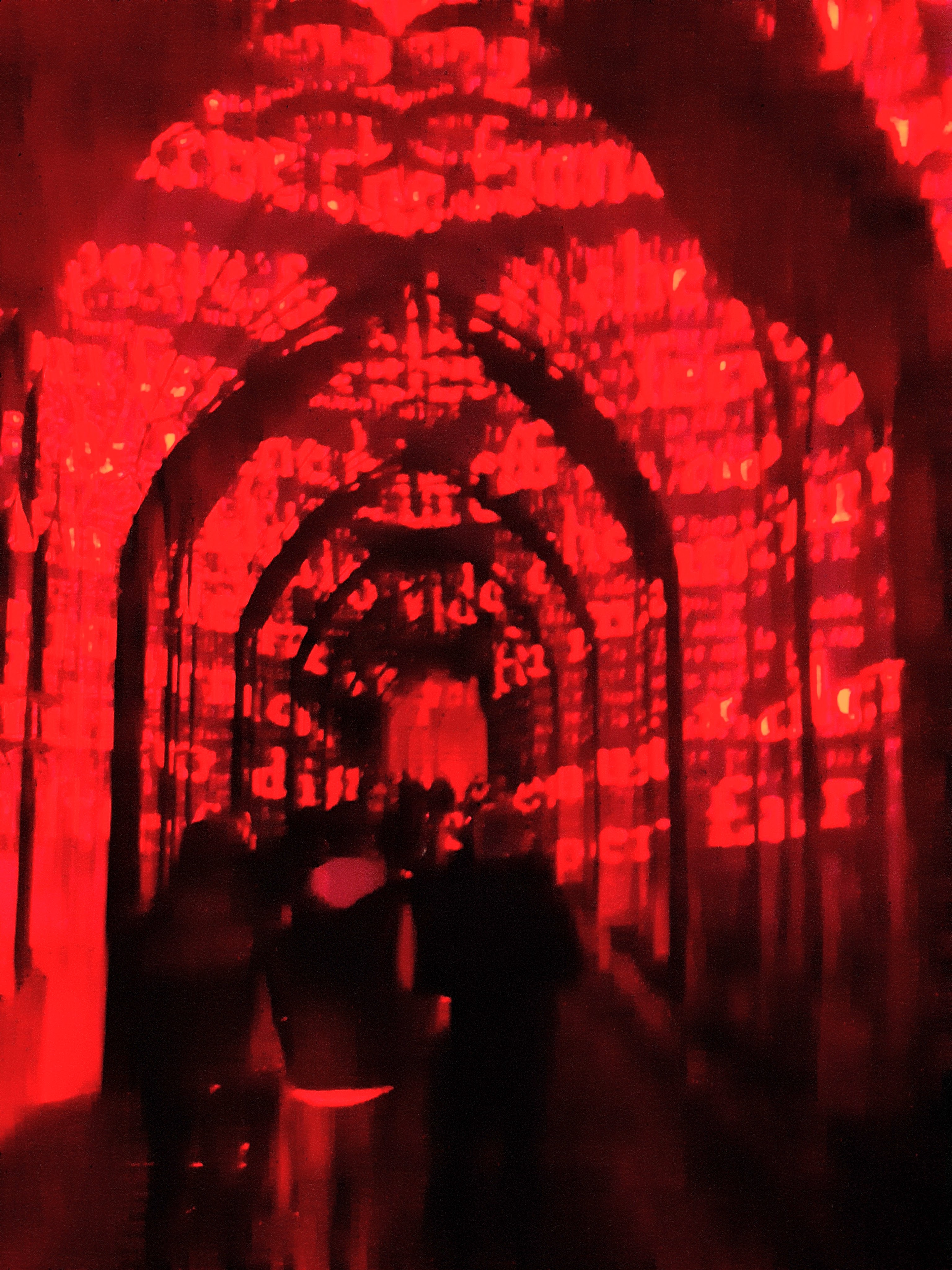
Gloucester Cathedral – https://gloucestercathedral.org.uk – is very good at its public outreach and events. From 19-28 October this year it has allowed the whole building to become an installation, Light Eternal by Luxmuralis – https://projectionartgallery.com.

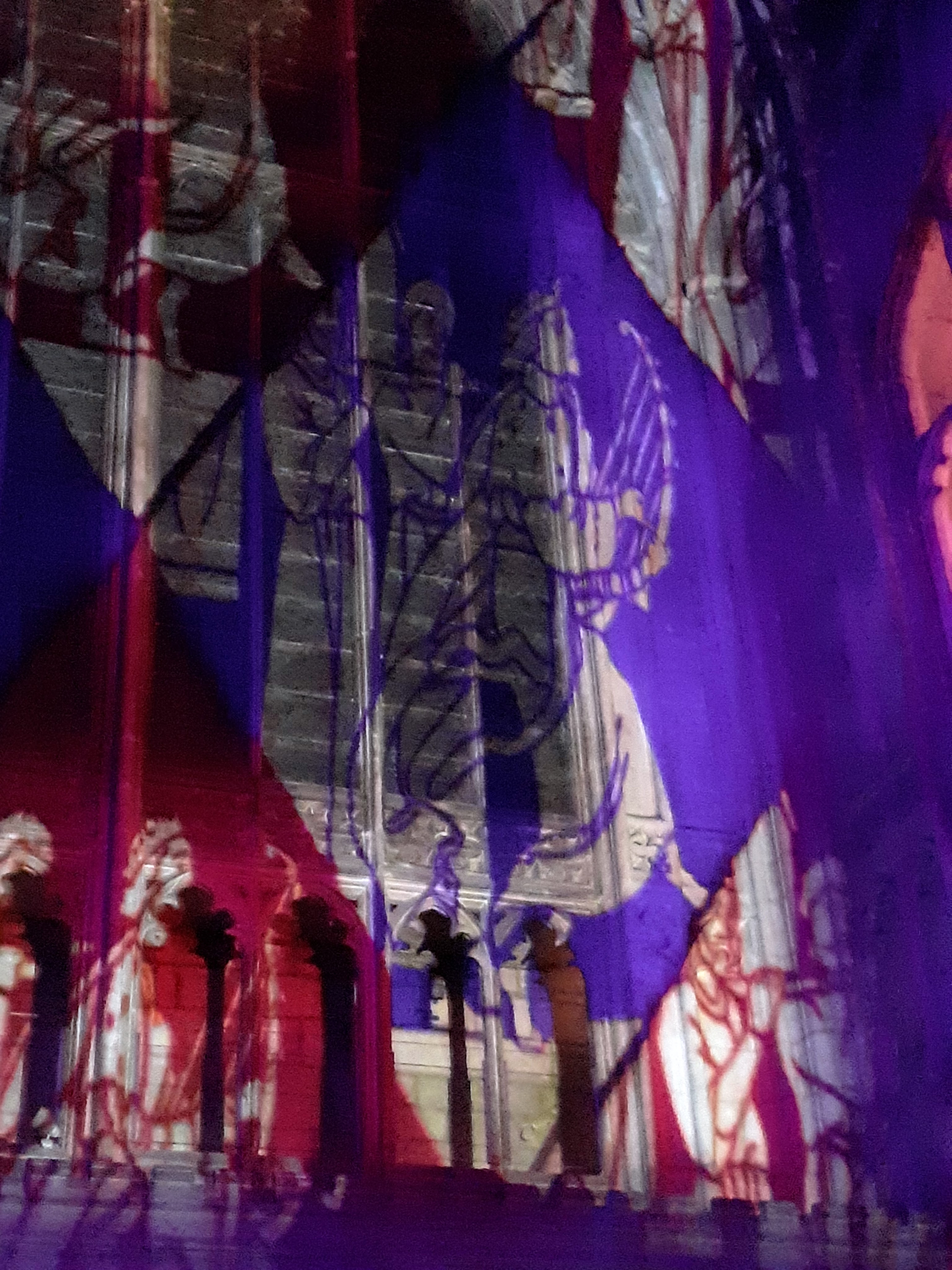
My wife Elaine and I went there early on Sunday evening, 22 October. It was my first visit, her second. She was very happy to repeat the experience. The picture above depicts entry to the building, and a brief walk towards what became a full immersion. The light effects and imagery were accompanied by a soaring and joyful music. The ancient building was packed with people sharing this experience. I was pleased to be held in such a celebratory space.

As I understood, or rather felt it at the time, the two images immediately below seem to show time and materiality coming into existence in an act of creation that speeds almost out of control. Certainly, for me, the rapidly changing sequence of images demonstrated a tremendous movement, power and energy. It looked, in those moments, more like sheer cosmic exuberance and play, than any kind of plan.

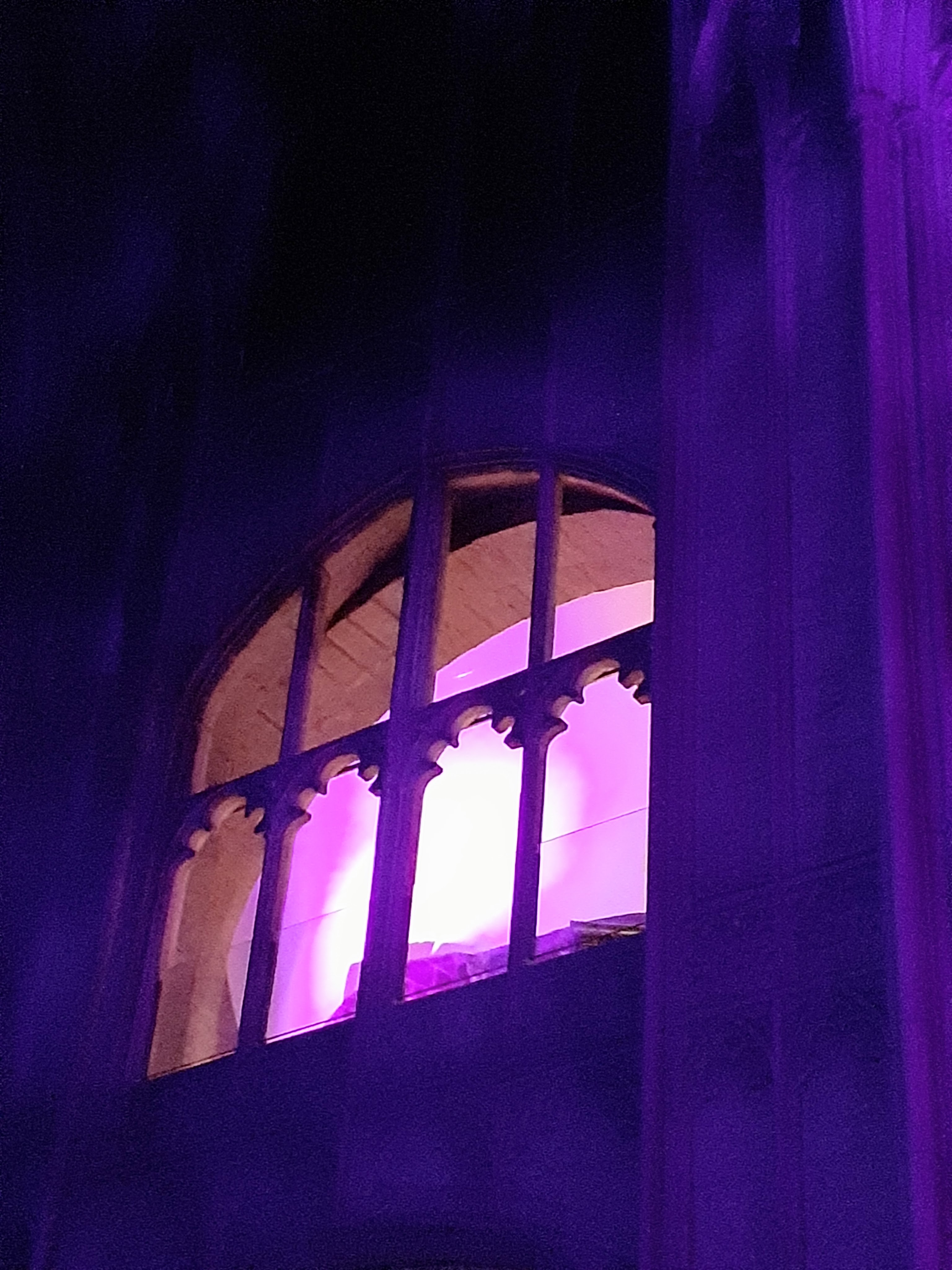
The installation as a whole had still spaces as well. It took advantage of the cathedral’s medieval architecture, where light and their colour could enhance its majestic serenity.

I also noticed the skill with which the installation incorporated medieval iconography, though I confess that it went past me in something of a blur. There was so much going on, and I found that I could not concentrate on individual images, or even identify them, as much as I would have liked. Then I let go, and surrendered to the experience as a gestalt.

Even the nooks and corners of the building that were largely left alone were washed in the magic of the light. I valued being briefly able to focus on them, their very plainess bringing something to the experience.

Finally, below, I show the tree of life, as light. It is an icon about which so many traditions have had so much to say, for such a long time. Certainly, it acted as a spiritual anchor for me, in that space: a comfort to a practising Druid. I loved the almost delicate fecundity of the portrayal. Gratitude to the Cathedral for enabling this installation, and to Projection Art Gallery for providing it.

AN EARLY WINTER TWILIGHT

Winter shows itself though early twilight. The pictures above and below were taken at about 5 pm (GMT, now, with summer time a fading memory). The sky retains a certain diversity of colour – clouds are still visible. But there is a leaning towards indigo. St. Mary le Crypt sits in stillness and tranquillity.

For me, the artificial lighting behind the stained glass is just right for supporting these qualities. It illuminates but does not glare. It feels homely and welcoming. The heavy stone of this medieval church is softened by dusk. Christmas is coming – a friendly period in the church calendar.

Twilight makes space as well for another, more carnival mood. Gloucester holds a lantern procession and Christmas light switch-on every year at approximately this time and date (19 November). It winds through the old town, lights switched on overhead as it passes, to the Cathedral where a carol service is held. This year’s event was very well supported, with large numbers of people either following the procession or lining the route. It was as if everyone was ready for a festive moment, a chance for celebration and fun in a generally tough time.

Local artists had teemed up with local schools to work on an Alice in Wonderland theme for 2022. Hence the Mad Hatter in the shifting and slightly out of focus picture below. I think the makers have successfully created a Tricksterish image for him. Not entirely safe or bland.

In Lewis Carroll’s 1865 book, Alice is annoyed by the twilight zone of the Mad Hatter’s language. It seems to have “no sort of meaning” and yet be “certainly English”. He boasts about the great concert given by the Queen of Hearts, where he sang: “twinkle, twinkle little bat/How I wonder what you’re at/ Up above the world you fly/ Like a tea tray in the sky”.

What is the Mad Hatter bringing to the streets of Gloucester on this early winter’s evening? He is certainly a presence here, if hard to read, for the brief time it takes him to pass through. Winter twilight offers spaces for healing and festivity. As a liminal time, it is an arena for Tricksters too. Many possibilities are latent under this enigmatic sky.

OLD CITY, NEW HOME

Above, a city park containing monastic ruins. I am beginning to make sense of a new habitat. The distance door-to-door is only about ten miles from the old one. But it feels very different. Stroud the Cotswold mill town is hilly and hard on the older pedestrian. Gloucester is an old English city on the river Severn, much flatter. The centre, where we now live, has become highly pedestrian friendly in recent years. This was a key motivator for our move and it already feels transformational.

On an exploratory amble on Sunday, Elaine and I were very aware of history. St. Oswald’s Priory, in the picture above, was founded by Lady Aethelflaed of Mercia, daughter of Alfred the Great, around 900. The Priory Church, initially dedicated to St. Peter, was constructed from recycled Roman stones. (The Romans founded the city, as Glevum, in the first century CE, and it never quite died after their departure from Britain). In Aetheflaed’s time it was a bold and unusual move to build a church as there were frequent Viking raids. Quite possibly Aethelflaed and her husband were later interred in the crypt. Archaeological excavations in the 1970s revealed a 10th century fragment of carved slab from the grave of someone of high importance.

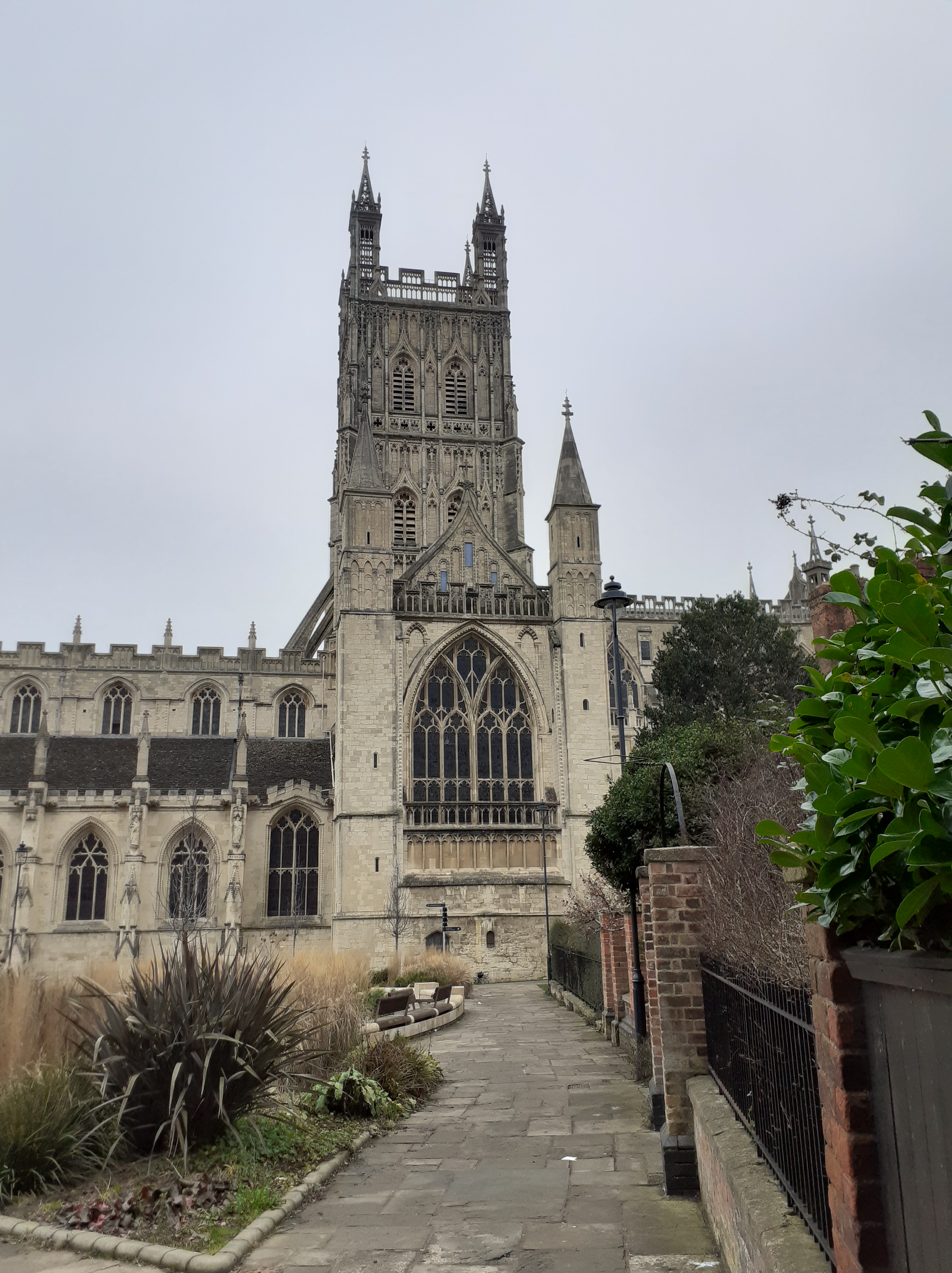
In the centuries that followed St Oswald’s grew rich as a place of pilgrimage and was at the centre of a large parish. But later it declined, as institutions do. It was almost literally in the shadow of the more successful Abbey of St. Peter, now Gloucester Cathedral, where the power of the church was now based. Architecturally, the cathedral (below) still dominates the city.

When Elaine and I were walking together on Sunday, the bells were ringing and we found ourselves enjoying this as an expression of the old city’s identity. As in other old cathedral cities, the cathedral is characteristically approached through narrow, often arched lanes and then appears magnificently in front of us.

We have another church, St. Mary-Le-Crypt (below), even closer to home, and cut through its churchyard to get to a major traditional shopping street. Like the cathedral, it continues to serve Anglican (Episcopalian) worshippers and to be part of the wider community.

I have as yet no idea what effect, if any, living in Gloucester will have on my contemplative inquiry, nested as it is in Druidry and Earth spirituality. It is much too early to tell. From the perspective of the living moment, I am delighted to be soaking in new impressions, aware that this is where I live now. Looking out, this is what I will frequently see. These sights are part of the texture of my daily experience now, and I welcome them as such. It greet a new way of being at home.

CELEBRATING THE MYSTERY

Yesterday my wife Elaine and I went to visit Gloucester Cathedral, where a beautifully crafted model of the moon has been hung in the body of the church. There were many visitors, most of them clearly drawn to this display and enlivened by it. For everyone there was something special about a scientifically accurate depiction of the moon in a medieval Christian building that continues to be an active space for worship. For some, the presence of the moon would also have suggested Pagan and archetypal references to provide a balancing influence in a splendidly patriarchal setting. It also allowed for a sense of only slightly subdued informality and fun, which I don’t generally associate with Church of England cathedrals. People felt free to enjoy themselves, and I give great credit to the organisers for their achievement.

The concept paid tribute to our age-old human search for meaning, and a sense of place within the cosmos. I was reminded of some reading I’d done only a couple of days before, and I’ve checked out the reference. For me, the image above and the words below show the same attractive spirit, one I find an inspiration for my contemplative inquiry.

“Both science and spirituality reflect our human urge to know – that perennial itch to make sense of the world and who we are. This quest is an essential part of being human. We probe reality as best we can with our tools of understanding – structures, models, theories, myths, beliefs, teachings – but those tools of understanding also define the limits of our knowledge. … There is no ultimate truth. No teacher, no scientist will give us all the answers. Let us simply bow to the intelligence of our hearts, drop into not knowing, keep our minds open, cherish the questions, and let the answers arise and evolve, all the while celebrating this mystery called life.”*

*Zia and Maurizio Benazzo On the Mystery of Being: Contemporary Insights on the Convergence of Science and Spirituality Oakland, CA: Reveal Press, 2019. (Reveal Press is an imprint of New Harbinger Press)

Earth Eclectic

music that celebrates Earth and speaks to the heart

Sarah Fuhro Star-Flower Alchemy

Follow the Moon's Cycle

Muddy Feet

Meeting nature on nature's terms

Rosher.Net

A little bit of Mark Rosher in South Gloucestershire, England

Becoming Part of the Land

A monastic polytheist's and animist’s journal

selkiewife

Selkie Writing…

Charlotte Rodgers

Images and words set against a backdrop of outsider art.

Prof Jem Bendell

living with metacrisis and collapse

Towint

The pagan path. The Old Ways In New Times

The Druids Garden

Spiritual journeys in tending the living earth, permaculture, and nature-inspired arts

The Blog of Baphomet

a magickal dialogue between nature and culture

This Simple Life

The gentle art of living with less

Musings of a Scottish Hearth Druid and Heathen

Thoughts about living, loving and worshiping as an autistic Hearth Druid and Heathen. One woman's journey.

Wheel of the Year Blog

An place to read and share stories about the celtic seasonal festivals

Walking the Druid Path

Just another WordPress.com site

anima monday

Exploring our connection to the wider world

Grounded Space Focusing

Become more grounded and spacious with yourself and others, through your own body’s wisdom

The Earthbound Report

Good lives on our one planet

Hopeless Vendetta

News for the residents of Hopeless, Maine