Contemplative Inquiry

This blog is about contemplative inquiry

Tag: Forgiveness

BOOK REVIEW: ELEGANT SIMPLICITY
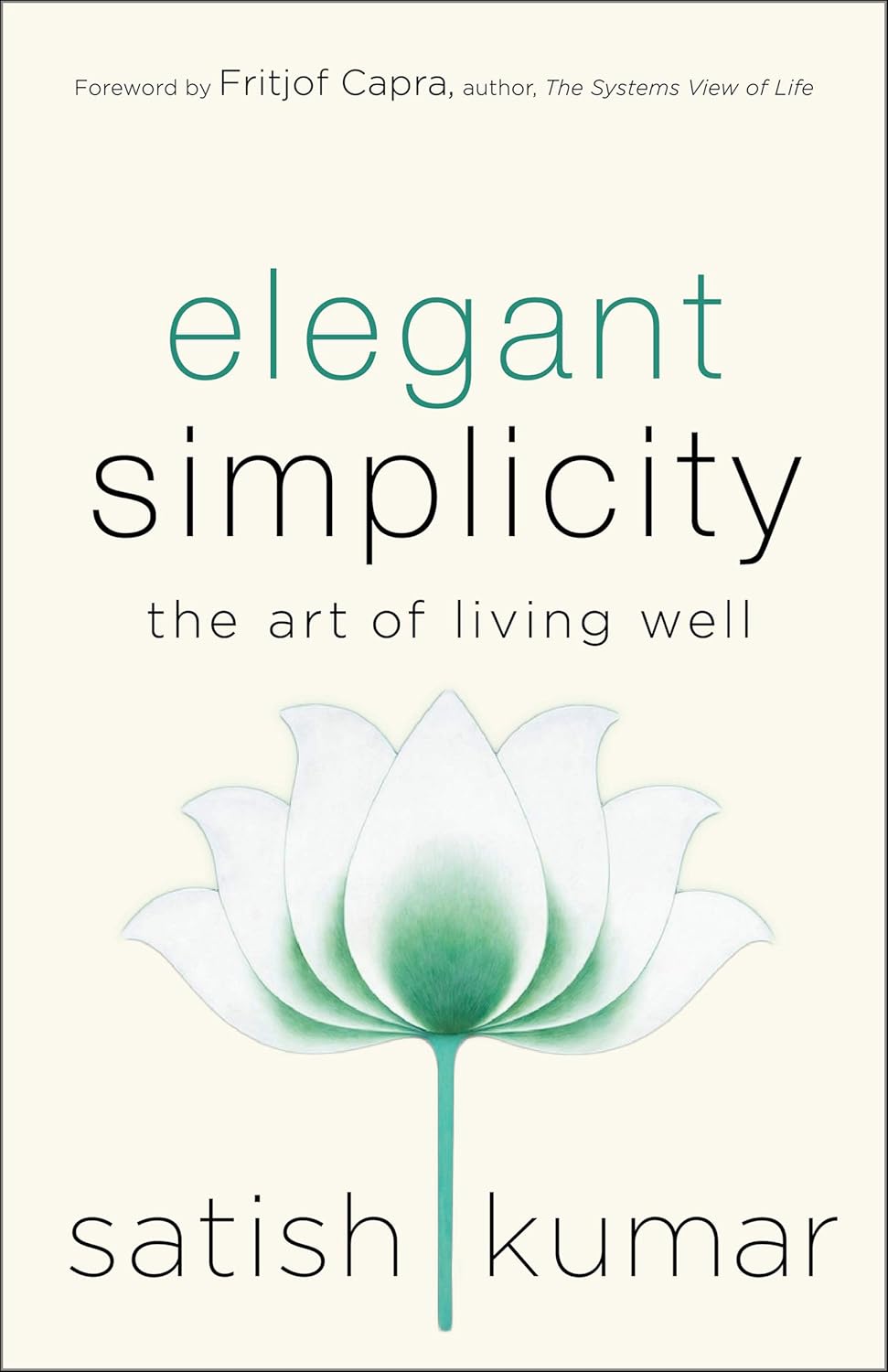
Highly recommended. Satish Kumar (born in 1936) published Elegant Simplicity: the Art of Living Well in 2019 (1). It begins with a foreword by Fritjof Capra and a preface by the author Let’s be Simple which quotes the 1848 Shaker song ‘Tis the gift to be simple, ‘Tis the gift to be free. The book summarises the author’s personal story as well as discussing his values. I have written posts based on some of his other work before (2). I especially recommend this book to anyone interested in knowing more about Satish Kumar’s practice (grounded in Jain spirituality and Gandhi’s non-violent activism) and his influence on deep ecology, creative arts and education.

Elegant Simplicity has a summarising quality, looking back on decades devoted to sacred activism in different forms. It is divided into fourteen chapters: Each is preceded by a brief and relevant quotation from another thinker. The chapter then becomes a meditation on the quote:

1 My Story: Beginnings – ‘True happiness lies in contentment’ Mahatma Gandhi.

2 Simplicity of Walking – ‘All truly great thoughts are conceived by walking’ Friedrich Nietzsche.

3 Life is a Pilgrimage – ‘Faith is not the clinging to a shrine but an endless pilgrimage of the heart’ Abraham Joshua Heschel.

4 Elegant Simplicity – ‘Any fool can make things complicated, it requires a genius to make them simple’ E. F. Schumacher.

5 A Society of Artists – ‘This world is but a canvas to our imagination’ Henry David Thoreau.

6 Yoga of Action – ‘Life is a process not a product’ Brian Goodwin.

7 Learning is Living – ‘Education is not preparation for life; education is life itself’ Thomas Dewey.

8 Right Relationships – ‘We are all related – relationships based on obligation lack dignity’ Wayne Dwyer.

9 Love Unlimited – ‘There is no charm equal to tenderness of the heart’ Jane Austin.

10 Power of Forgiveness – ‘It’s one of the greatest gifts you can give yourself, to forgive. Forgive everybody.’ Maya Angelou.

11 Dance of Opposites – ‘Life and death are one as the river and the sea are one’ Kahlil Gibran.

12 Deep Seeing – ‘To see clearly is poetry, prophecy, and religion, all in one’ John Ruskin.

13 Union of Science and Spirituality – ‘Science is not only compatible with spirituality; it is a profound source of spirituality’ Carl Sagan.

14 Soil, Soul and Society – ‘We live in an interconnected world and in an interconnected time so we need holistic solutions to our interconnected problems‘ Naomi Klein.

Fellow activist and author Vandana Shiva describes Elegant Simplicity as “the distillation” of Satish Kumar’s ideas and actions. “It shows the intimate connections between the inner and the outer world, soil, soul and society, beauty joy and non-violence. It indicates that the solutions to the big problems of our time – climate change, hate, violence, hopelessness and despair – lie in thinking and living with elegant simplicity, reducing our ecological footprint while enlarging our hearts and minds”.

For me, Satish Kumar is an inspiration rather than a direct model. Even in the conditions of the early 1960’s I would not have walked, or aspired to walk, from New Delhi to Washington DC without carrying any money. Yet Satish Kumar and his companion E. P. Menon succeeded and made a huge public impact at the time. Their peace pilgrimage gave oxygen to the campaign for nuclear disarmament. No state gave up its arms, but treaties limiting the numbers and testing of nuclear arms became normalised for some decades. Satish Kumar’s initiatives in deep ecology and education, especially the ‘small school’ and Schumacher College, have changed lives. Directly and indirectly, his influence has awakened many people from the dystopian trance of our dominant cultures. Satish Kumar is a widely revered elder: a peaceful warrior for a more liveable, generous and creative world.

(1) Satish Kumar Elegant Simplicity: The Art of Living Well New Society Publishers (https://www.newsociety.com): Gabriola Island, BC, Canada: 2019

(2) See previous posts:

NEWS OF A DEATH

TWO VIEWS OF THE DIVINE

OUTDOOR WALKING MEDITATION

NOTE: “Satish Kumar (born 9 August 1936)[1] is an Indian British activist and speaker. He has been a Jain monk, nuclear disarmament advocate and pacifist.[3]Now living in England, Kumar is founder and Director of Programmes of the Schumacher College international center for ecological studies, and is Editor Emeritus of Resurgence & Ecologist magazine. His most notable accomplishment is the completion, together with a companion, E. P. Menon, of a peace walk of over 8,000 miles in June 1962 for two and a half years, from New Delhi to MoscowParisLondon, and Washington, D.C., the capitals of the world’s earliest nuclear-armed countries.[4][5] He insists that reverence for nature should be at the heart of every political and social debate.” (Wikipedia)

BOOK REVIEW: FORGIVING HUMANITY

Forgiving Humanity (1) is an extended essay rather than a book. I found it easy to read and hard to work with. Author Peter Russell is highly skilled at distilling data and making his case. His conclusion is that the near term extinction of the human species is inevitable, and not unnatural or to be faulted. “We are coming to the end of our species’ journey, spinning faster and faster into the center of an evolutionary spiral.”

Russell points to what he sees as our our natural-born drive for exponential growth and development. A dance of genetic and behavioural change led us to an enhanced brain, bi-pedal walking, manual dexterity, and a shift in the position of the larynx to enable complex speech. Cultural evolution then led to organised hunting with the throwing spear and, later, the bow. Later still, at an increasing rate of change, came agriculture, metallurgy, the industrial revolution (from steam to atomic power in not much more than a century) and, most recently, the accelerating information revolution now leading to the rise of AI. Quantum computing is on the horizon.

The problem according to Russell is that exponential growth is inherently predestined to run out of control. This is “the curse of exponential change.” Exponential growth is not like the linear growth that we can more comfortably imagine. In the domain of economics, for example, 3% annual growth rate in the world’s GDP, compounded over 100 years, would lead to a consumption of energy and resources at 20 times today’s rate. Russell started thinking about this problem as a young and gifted mathematician at the end of the 1960s. On his analysis, we would be fatally fouling our own nest even without the specific problem of the climate crisis. Climate change simply exacerbates and dramatises our predicament, hastening the process of breakdown.

Russell is aware of systemic injustices in our socio-economic system, but this book does not explore political mitigations. He expects major breakdown in this century. A remnant population in reduced circumstances will carry on for a while longer. But this human triggered extinction event, which has already claimed many other species, will still be rapid in planetary terms. In the immediate future, Russell sees a likelihood of continuing technological breakthroughs for some decades, in the midst of extensive cultural breakdown and a diminishing global population. I am not certain that he is right, but I fear that he may be. And I find him hard to read, trying to imagine what it would be like for different people in different places, and stepping into their boots down here in the trenches where embodied human life is lived until it’s gone.

Whilst the earlier sections of Forgiving Humanity are presented as if from the perspective of a distant cosmic scientist, there is a later turn to human experience and how to live in the new conditions. Peter Russell becomes one of us and shares his long-held view of consciousness and its possibilities, especially the affirmation that: “beneath our day-to-day experience lies a deeper sense of being, unperturbed by the goings on in the world, and our hopes and fears about them … meditative and self-enquiry processes … lead to greater calm and self-awareness, and … the more in touch we are with our inner being, the more considerate, compassionate, and caring we become – qualities that could prove invaluable in meeting the challenges ahead.” I also like his idea of remaining in service to the earth whenever we can, continuing to do our best for it even when knowing that our species is waning and likely to wink out. The notion of persevering with restorative efforts allows for limited local successes, seems like a healing process in itself and preserves a sense of positive agency in hard times. I am sure that people will continue to work in these ways whenever given half a chance.

For Russell, psycho-spiritual practices and communities are a key resiliency factor for navigating through heart-breaking conditions. We need to “find the acceptance that allows us to move into the unknown with courage and an open heart”. Russell says that facing our collective extinction is like facing our personal deaths, only more so because we are looking at the end of our kind. He borrows from a well-known map of how to work through five stages of grief – denial, anger, bargaining and depression – to a final acceptance. I have to note some reservations about schemes based on normative ideas about how we work through distress. People are very different – though many, it is true, are reassured by maps of this kind. I would also not want these suggestions to be misunderstood as an injunction to put on a mask of serenity when something else is going on in our body/mind. For me, the deeper acceptance is to recognise and accept our confusion and turbulence, if confusion and turbulence are what is happening. The spaciousness of deep acceptance then keeps company with them, avoiding both the false mask of serenity on the one hand, and immersed identification with our distress on the other. Nothing is denied.

I am not sure about the suggestion of ‘forgiving humanity’. If I take ‘humanity’ as simply the name of a species, I don’t feel that it’s my place either to forgive or withhold forgiveness from a species of which I am a member. If I take ‘Humanity’ as an idealised abstraction, or construct, then there’s no-one there to forgive outside my own imagination. For me, working as best as I can at deep acceptance and loving kindness, accepting with self-compassion that I will likely be wayward and inconsistent in my endeavours, is the better way to go. It keeps me in the world of lived interactions with other sentient beings and feels like a more engaged and grounded aspiration.

Despite some reservations, I value this work highly and recommend it to anyone concerned with the issues raised in it. We need voices like this, who move beyond deep adaptation to face into the possibility of no adaptation. Forgiving Humanity offers a distinctive lens on the crisis we are in, and it does so in a concise, readable and sadly persuasive way.

(1) Peter Russell Forgiving Humanity: How the Most Innovative Became the Most Dangerous Las Vegas, NV: Elf Rock Productions, 2023

NB Peter Russell studied mathematics and theoretical physics at the University of Cambridge but later changed to experimental psychology. After learning transcendental meditation (TM) with Maharishi Mahesh Yogi in India, he took up the first academic post ever offered in Britain on the psychology of meditation. He also has a postgraduate degree in computer science. In the 1970s he pioneered senior corporate management courses on meditation, creativity, stress management and sustainable development. Later he coined the term ‘global brain’ with the 1980’s best seller of that name in which he predicted the Internet and the impact it would have on humanity. I have reviewed a more recent book Letting Go of Nothing at:

A TAKE ON ‘GENEROSITY’

“Generosity begins in welcome: a hospitality that offers whatever the host has that would meet the need of a guest. The welcome of opening the doors of one’s home signifies the opening of the self to others, including guests who may disrupt and demand. To guests who suffer, the host’s welcome is an initial promise of consolation. If the cosmic creation of life is the founding act of generosity, the human gift of consolation has at least one analogous quality: no reciprocity is required, for indeed none may be possible.

“When the giving of consolation is taken to be the paradigm of generosity, our imagination of what might be a generous relationship moves beyond material gifts and the economy of exchange that material gifts instigate. Generosity transcends any expectation of what the gift may bring back in reciprocity. Generosity implies the host’s trust in the renewable capacity to give; the generous person feels no need to measure what is given against what is received. Generosity does not plan for the giver’s own future. It responds to the guest’s need.

“Yet because what is offered can never meet the guest’s need completely, the welcome that generosity offers contains a plea for forgiveness. The biblical story of Job’s three friends, who arrive to console him and stay to accuse him, reminds us that consolation will always go wrong to some degree, and generosity always falls short.

“Generosity accepts our ultimate human failure to be generous. What counts is continuing to reopen the door of hospitality, welcoming the guest who needs consolation.” (1)

(1) Arthur W. Frank The Renewal of Generosity: Illness, Medicine, and How to Live Chicago & London: University of Chicago Press, 2004 (In the context of the book, Frank advocates a generosity of spirit both to the givers and receivers of care, in systems that tend to be technocratic and subject to resource constraints.)

Earth Eclectic

music that celebrates Earth and speaks to the heart

Sarah Fuhro Star-Flower Alchemy

Follow the Moon's Cycle

Muddy Feet

Meeting nature on nature's terms

Rosher.Net

A little bit of Mark Rosher in South Gloucestershire, England

Becoming Part of the Land

A monastic polytheist's and animist’s journal

selkiewife

Selkie Writing…

Charlotte Rodgers

Images and words set against a backdrop of outsider art.

Prof Jem Bendell

living with metacrisis and collapse

Towint

The pagan path. The Old Ways In New Times

The Druids Garden

Spiritual journeys in tending the living earth, permaculture, and nature-inspired arts

The Blog of Baphomet

a magickal dialogue between nature and culture

This Simple Life

The gentle art of living with less

Musings of a Scottish Hearth Druid and Heathen

Thoughts about living, loving and worshiping as an autistic Hearth Druid and Heathen. One woman's journey.

Wheel of the Year Blog

An place to read and share stories about the celtic seasonal festivals

Walking the Druid Path

Just another WordPress.com site

anima monday

Exploring our connection to the wider world

Grounded Space Focusing

Become more grounded and spacious with yourself and others, through your own body’s wisdom

The Earthbound Report

Good lives on our one planet

Hopeless Vendetta

News for the residents of Hopeless, Maine