Contemplative Inquiry

This blog is about contemplative inquiry

Tag: Faith

WINTER’S END

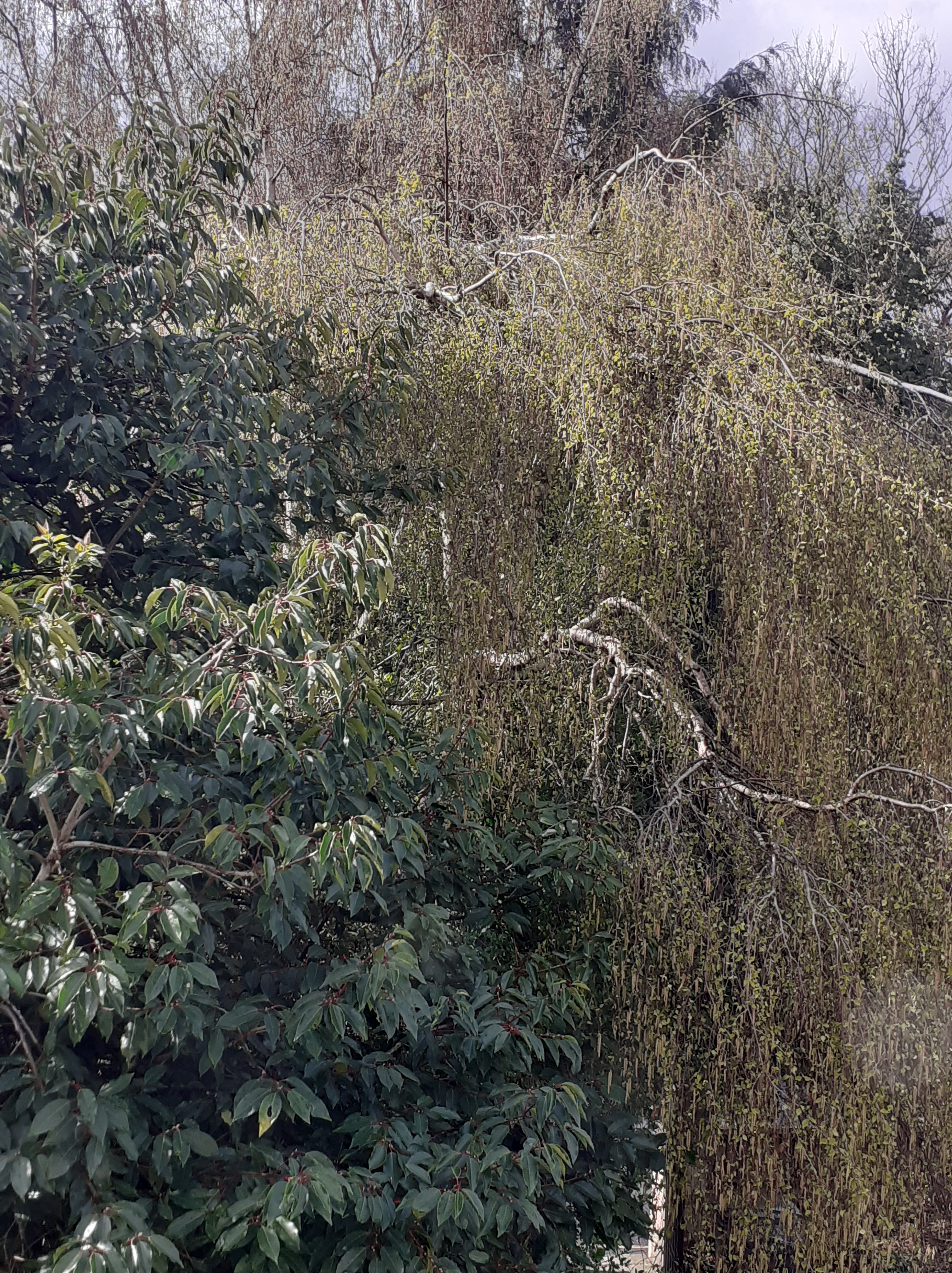
4.30 pm, 25 February 2025. Sunrays are caught in willow branches. The sun is a little stronger today than it was in full winter. The willows have begun a tentative greening. But there is much shadow in this picture. The day has begun its decline.

The world retains a winter feel for me. I aware of the change in my local park, but I do not altogether trust this spring. In the moment of taking this picture, I see a world in shadow, softly darkened. This is partly because of where I have chosen to stand. It is the image I seem to want.

In the brighter picture below, I show daffodils growing among dead leaves. Daffodils are iconic harbingers of spring, yet not my sole focus. Both pictures were taken intuitively and without any mentally registered intent. It seems as if something in me wanted to make a statement.

I know and accept that I am in the winter of my life. In the wheel of my own life, I can’t quite see how my winter will move into spring, certainly in any personal sense. Dissolving into interbeing is easier to imagine.

My customised Druid liturgy names winter as the season of dying and regeneration. It has associations with law and faith. I understand law in a karmic or ‘natural law’ sense. But it can also be an acknowledgement of the nature we see around us. Faith, in part, concerns the willingness to accept dying and regeneration without knowing what they are like. In my last post, I discussed (1) ‘being nobody’. My current reflections take this suggestion a step further. Evidently, I still have much to learn.

(1) https://contemplativeinquiry.blog/2025/02/21/being-nobody

FAITH

In my Druid circle, I associate the northern quarter with faith. The quality and context of faith are not defined. They could simply mean faith in the practice and path. My contemplative inquiry overall has tended towards a stance of ‘sacred agnosticism’ (1), in which faith is not emphasised. This has served me in many ways. I have avoided mixing up the idea of ‘faith’ with affiliation to authoritarian movements, mandated beliefs, or the surrender of self-responsibility and personal discernment. I have been alert to the metaphysical group think and consensus collusion that can show up in any spiritual movement (other kinds of movement too). I have done my best to gather and evaluate information skilfully, when developing principles about how to live ethically and gracefully in an increasingly scary world.

And yet … this is not the whole story, or I would feel spiritually malnourished. In recent months I have experienced a strong felt sense of the divine. When I describe myself as ‘living presence in a field of living presence in a more than human world’ – an animist identification – the identification now seems more than animist, though the animism is still there. I pray more congruently to the Goddess as Ancient Mother and talk, less anthropomorphically, about the ‘bubbling source from which I spring’. The Divine is beyond name, form or description – and some people prefer a specialist, capitalised use of rather abstract terms like Consciousness, Awareness, Void, Ground of Being. But the ones from my own practice are the ones that work for me. They come from the intuitive heart and the imagination. To me they offer a deeper knowing, though I am personally cautious about the use of the word gnosis. For me, it can reduce the sense of mystery,  banishing the creative role of faith itself.

I have become a provisional panentheist, experiencing intimations of a divine which is everywhere and no-where, and from which we are not separate. This partly reprises work I did in the earlier days of my inquiry using the framework of non-duality. Now I find panentheism a better term than non-duality for affirming both the divine and the world. The earth spirituality in the Druid tradition is in no way compromised by a panentheist perspective. If anything it is enhanced.

(1) See https://contemplativeinquiry.blog/2024/02/16/sacred-agnos

BOOK REVIEW: ELEGANT SIMPLICITY

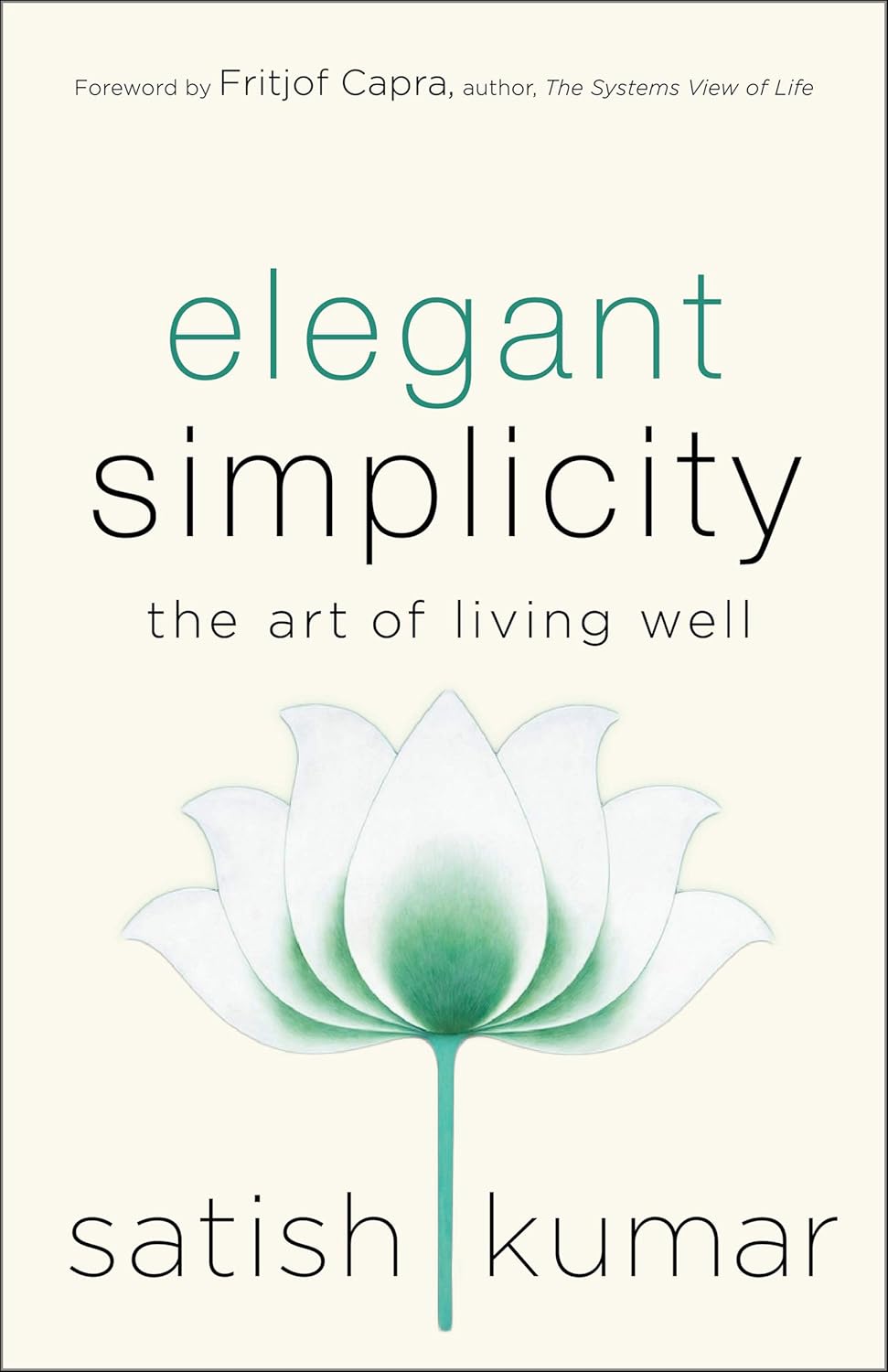
Highly recommended. Satish Kumar (born in 1936) published Elegant Simplicity: the Art of Living Well in 2019 (1). It begins with a foreword by Fritjof Capra and a preface by the author Let’s be Simple which quotes the 1848 Shaker song ‘Tis the gift to be simple, ‘Tis the gift to be free. The book summarises the author’s personal story as well as discussing his values. I have written posts based on some of his other work before (2). I especially recommend this book to anyone interested in knowing more about Satish Kumar’s practice (grounded in Jain spirituality and Gandhi’s non-violent activism) and his influence on deep ecology, creative arts and education.

Elegant Simplicity has a summarising quality, looking back on decades devoted to sacred activism in different forms. It is divided into fourteen chapters: Each is preceded by a brief and relevant quotation from another thinker. The chapter then becomes a meditation on the quote:

1 My Story: Beginnings – ‘True happiness lies in contentment’ Mahatma Gandhi.

2 Simplicity of Walking – ‘All truly great thoughts are conceived by walking’ Friedrich Nietzsche.

3 Life is a Pilgrimage – ‘Faith is not the clinging to a shrine but an endless pilgrimage of the heart’ Abraham Joshua Heschel.

4 Elegant Simplicity – ‘Any fool can make things complicated, it requires a genius to make them simple’ E. F. Schumacher.

5 A Society of Artists – ‘This world is but a canvas to our imagination’ Henry David Thoreau.

6 Yoga of Action – ‘Life is a process not a product’ Brian Goodwin.

7 Learning is Living – ‘Education is not preparation for life; education is life itself’ Thomas Dewey.

8 Right Relationships – ‘We are all related – relationships based on obligation lack dignity’ Wayne Dwyer.

9 Love Unlimited – ‘There is no charm equal to tenderness of the heart’ Jane Austin.

10 Power of Forgiveness – ‘It’s one of the greatest gifts you can give yourself, to forgive. Forgive everybody.’ Maya Angelou.

11 Dance of Opposites – ‘Life and death are one as the river and the sea are one’ Kahlil Gibran.

12 Deep Seeing – ‘To see clearly is poetry, prophecy, and religion, all in one’ John Ruskin.

13 Union of Science and Spirituality – ‘Science is not only compatible with spirituality; it is a profound source of spirituality’ Carl Sagan.

14 Soil, Soul and Society – ‘We live in an interconnected world and in an interconnected time so we need holistic solutions to our interconnected problems‘ Naomi Klein.

Fellow activist and author Vandana Shiva describes Elegant Simplicity as “the distillation” of Satish Kumar’s ideas and actions. “It shows the intimate connections between the inner and the outer world, soil, soul and society, beauty joy and non-violence. It indicates that the solutions to the big problems of our time – climate change, hate, violence, hopelessness and despair – lie in thinking and living with elegant simplicity, reducing our ecological footprint while enlarging our hearts and minds”.

For me, Satish Kumar is an inspiration rather than a direct model. Even in the conditions of the early 1960’s I would not have walked, or aspired to walk, from New Delhi to Washington DC without carrying any money. Yet Satish Kumar and his companion E. P. Menon succeeded and made a huge public impact at the time. Their peace pilgrimage gave oxygen to the campaign for nuclear disarmament. No state gave up its arms, but treaties limiting the numbers and testing of nuclear arms became normalised for some decades. Satish Kumar’s initiatives in deep ecology and education, especially the ‘small school’ and Schumacher College, have changed lives. Directly and indirectly, his influence has awakened many people from the dystopian trance of our dominant cultures. Satish Kumar is a widely revered elder: a peaceful warrior for a more liveable, generous and creative world.

(1) Satish Kumar Elegant Simplicity: The Art of Living Well New Society Publishers (https://www.newsociety.com): Gabriola Island, BC, Canada: 2019

(2) See previous posts:

NEWS OF A DEATH

TWO VIEWS OF THE DIVINE

OUTDOOR WALKING MEDITATION

NOTE: “Satish Kumar (born 9 August 1936)[1] is an Indian British activist and speaker. He has been a Jain monk, nuclear disarmament advocate and pacifist.[3]Now living in England, Kumar is founder and Director of Programmes of the Schumacher College international center for ecological studies, and is Editor Emeritus of Resurgence & Ecologist magazine. His most notable accomplishment is the completion, together with a companion, E. P. Menon, of a peace walk of over 8,000 miles in June 1962 for two and a half years, from New Delhi to MoscowParisLondon, and Washington, D.C., the capitals of the world’s earliest nuclear-armed countries.[4][5] He insists that reverence for nature should be at the heart of every political and social debate.” (Wikipedia)

LIMINAL BEAUTY AND THE FAITH OF A DRUID

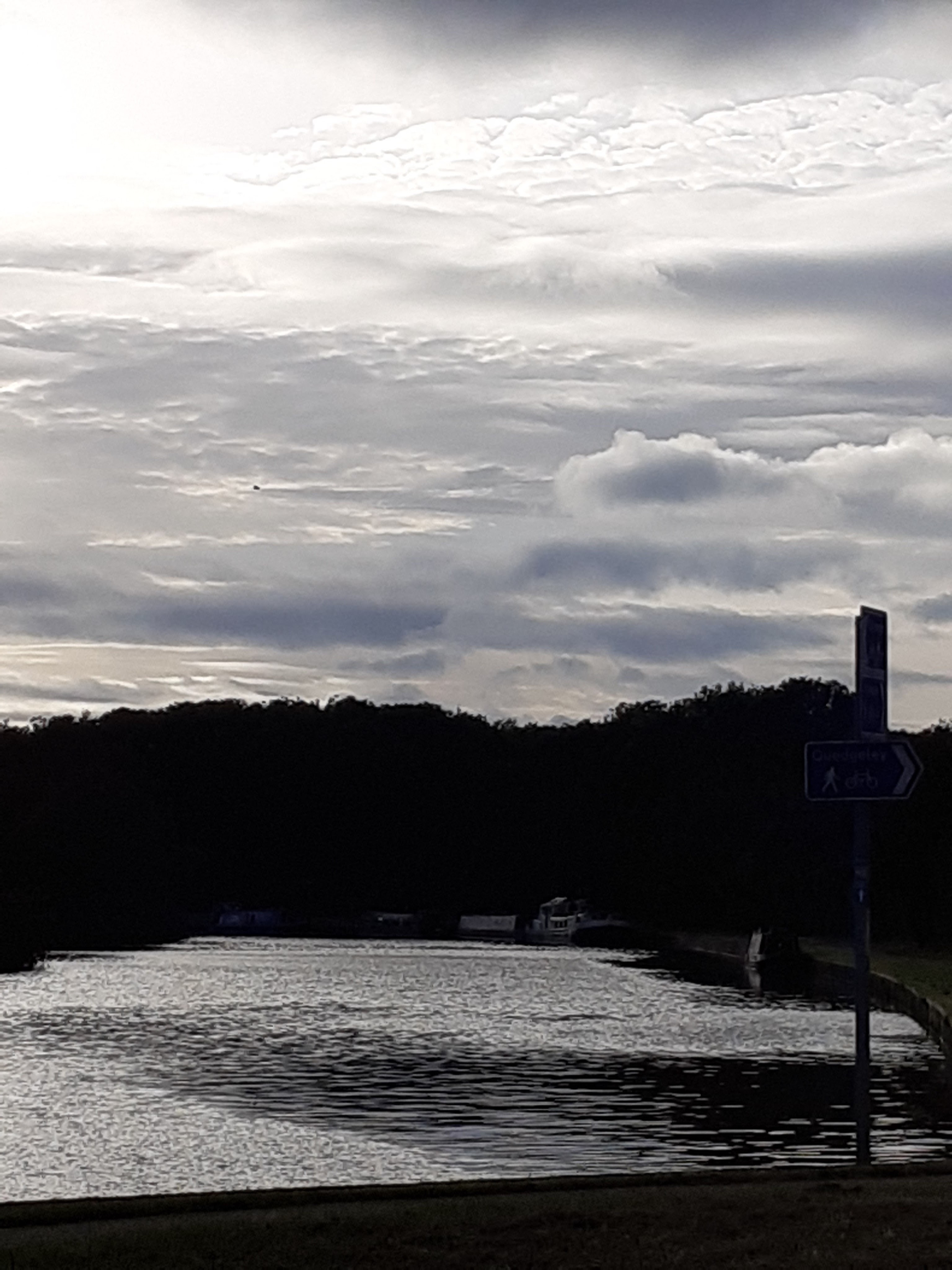
6.15 pm, 6 October 2023. The experience has gone. The images remain. At a surface level, I can use them to trigger memories of my early evening walk. Chiefly, I remember being surprised at how early the twilight was. I hadn’t caught up with the year and was almost shocked. I have caught up now, nearly a week later, as the darkening process speeds up and we approach Samhain. In today’s world, my country will experience a dramatic boost on 29 October as our clocks ‘fall back’. The 6.15 of one day will become the 5.15 of the next.

Looking at the images more deeply, really looking, and giving them time, I can let them nourish me. I connect with their liminal beauty. Both images present me with land, water, sky, and hints of the fiery sun. But they do so in different ways.

In the image above, I am mostly drawn to the energy of water. The variation in shade emphasises movement and different ripple effects. Land, trees, and artifacts are all in silhouette, but the water has light and shade. It is the water that feels most alive. There is variation in the clouds too, with their patterned layers and subtle access to sunlight just above the trees. But they are not as mobile as the water. The sunlight itself seems very subdued. It’s still there, though very much in the background.This is not yet a night sky.

In the image below the water is strong too, but my eyes are drawn above to the clouds, which here are more dramatic. The residual power of waning sunlight is very clearly present. For me, there’s a sense of the tree tops yearning upwards as they reach for the gifts of the sun whilst it still retains a presence. Although I am contemplating images and not immersed in the landscape I have a strong sense of living presence in a field of living presence. In this state I feel a conceivably irrational confidence in life and the world.. A fragile kind of faith, that my heart cannot resist.

ACCEPTING THE ARRIVAL OF WINTER

It was 26 November 2022, 11 a.m. I was at the Gloucester end of the Gloucester-Sharpness canal. I found myself accepting the arrival of winter. I was observing three cygnets, now without their parents but still keeping company with each other. The underlying temperature was around 7 C (44.6 F) and good for walking, But I was feeling the pinch of a cold wind. In memory I am feeling it now. The water and sky looked grey. The trees were starting to feel skeletal, whilst still retaining some leaves. My lingering sense of autumn had finally drained away.

To accept winter’s arrival in the presence of swans felt numinous. Swans are otherworldly birds in Celtic tradition. The three together, not yet in their full adult plumage, seemed auspicious. They suggested coming opportunities for creativity, love and celebration. Winter can be a preparation for renewal, both as season and as state of mind. My acceptance goes with a faith in winter’s regenerative darkness, and the riches this can bring.

REFLECTIONS IN A PRIORY GARDEN

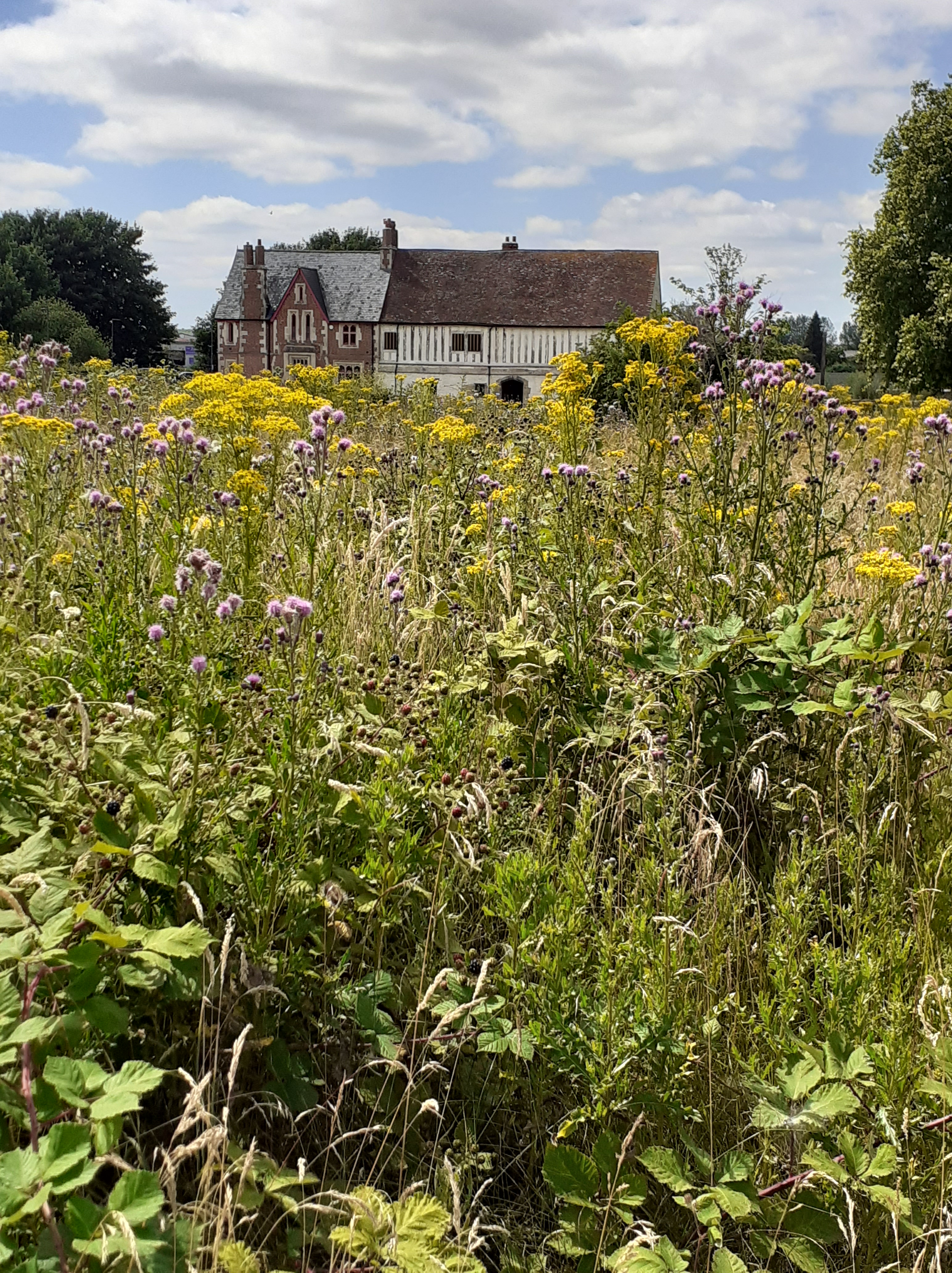
In my formative years, high summer presented me with a world of manicured green. Mown grass dominated both private and public spaces. Garden lawns, parks, tennis courts, cricket grounds, golf courses, bowling greens: all highly managed. Much water was lavished on their severely cropped verdure, given its enhanced tendency to dry up in hot weather.

This is still happening, but fashions have changed to a degree. The photos above and below show the grounds of the Llanthony Secunda priory in Gloucester. In line with new custom, space is now given to a limited urban rewilding. I am inspired by this small miracle of growth and abundance.

This is an odd summer for me. I am at ease in a congenial place. My wife Elaine and I have moved house successfully. I have stabilised after a period of illness. But this is a transitional period. We are not at our destination, and anticipate more upheaval in the second half of the year. I am divided between here-and-now enjoyment of my surroundings, and concern over possible futures, strategising next steps and feeling the tensions of uncertainty.

In the ABOUT section of this blog, I write of “an underlying peace and at-homeness in the present moment, which, when experienced clearly and spaciously, nourishes and illuminates my life”. That statement is a fruit of my inquiry – it wasn’t there at the beginning. That is the nature of contemplative inquiry: my understanding changes over time, in line with deepening experience.

I am finding that my peace and at-homeness have room for both my day-to-day contentment and my anxiety about possible futures, personal and collective. I don’t strip out my ‘future’-based concerns (themselves part of my present time experience) to tidy up my mental and emotional states. That seems like a superficial understanding of here-and-now acceptance. I find, rather, an invitation to embrace the turbulence too, as part of what is given. The peace arising from innermost being makes room for turbulence, for such peace is not just another passing state. In some hard-to-understand way, it has the capacity to be infinitely spacious, and present in the flux of time and events. All I have to do is trust this peace and let it in.

I do not think of myself as a person of faith. I am more of a ‘philosophical’ Druid rather than a religious one, though I don’t believe that we have to choose between the two. But trusting the peace of innermost being is certainly, in part, a matter of faith, where ‘faith’ involves harmonising with my deepest intuition rather than signing up to statements of belief.

OBOD liturgy includes the words: “deep within my innermost being may I find peace”. This resonates powerfully with me, but I have recently let go of the word ‘my’, because ‘innermost being’ no longer feels exactly personal – it seems, experientially, to be more like being resourced from a timeless, unboundaried dimension from which I am not separate. This realisation, if it is a realisation, is now at the core of my spirituality. I am reluctant to make metaphysical truth claims about it, but it is firmly implanted in my experience. The opportunity, now, is to give it the freedom to grow, within my inquiry and my life.

INQUIRY, IDENTITY AND COMMUNITY

I am looking downwards into water, identifying patterns, on a surface that swirls and moves and changes. I have the same impulse to identify patterns in my contemplative life. In essence, contemplative experience is simple, still, and drawn from wordless depths. But there’s a surface swirl that’s more agitated, largely driven by worries over naming and explaining, clarifying where my inquiry sits within human communities, and accurately representing spiritual philosophies. Here too, I am giving the surface swirl the attention it seeks. I do not ask the swirl to stop swirling, because swirling is what it does. There is value in the swirl.

I centre myself in modern Druidry, but my self-presentation from 2012 as a ‘contemplative Druid’ is slightly misleading – too narrow. I champion the value of a contemplative current within Druidry, and I am happy to describe my blog as a contemplative inquiry. But I also have a strong commitment to the life of the world and opportunities for the flourishing of all beings, within both the constraints and the opportunities of our interconnectedness. I am concerned with our planet and its biosphere; with human history and culture; with ethics and engagement; with beauty as well as truth and goodness; and with issues of wounding and healing. They are part of my inquiry. I cannot separate them from my contemplative commitment.

I also celebrate the influence of ‘nondual’ currents outside Druidry. Nondual is a translation of advaita (not-two) in classical Sanskrit philosophy. It describes the divine/human relationship. Its original home is the Advaita Vedanta path in India, but there are nondualists in other world religions, including the Abrahamic ones: Sufi currents in Islam, Jewish Kabbalah, contemplative Christianity. In Christian terms, you would say that we are all essentially Christs – in a creation of one Light and many lamps. In some interpretations, nonduality does not apply only to humans, but to all lives in the cosmos. Some iterations of nonduality – Mahayana Buddhist and Taoist in particular – avoid the language of divinity, preferring terms like ‘true nature’ or the deliberately undefinable ‘Tao’.

I have engaged with current nondualist teachings for some years, most recently with the Eckhart Tolle community – https://www.eckharttolle.com. I have learned a lot from them. In this blog’s About section, I say: “My inquiry process overall has helped me to discover an underlying peace and at-homeness in the present moment, which, when experienced clearly and spaciously, nourishes and illuminates my life. It is not dependent on belief or circumstance, but on the ultimate acceptance that this is what is given”.

I could maintain this stance as a humanist or existentialist, but my deepest intuition is that the ‘present moment’ (or eternal now), fully experienced, links my passing personal identity to a cosmic one, a ground of being that is my true nature. Belief has come in: ‘willingness to follow one’s deepest intuition’ is one definition of faith, and I have surprised myself by becoming a person of faith in this sense. The purpose of continuing inquiry is to keep me open to new experiences, understandings, and connections, as well as teaching me how best to live from the peace and at-homeness of the centre.

My inquiry is a self-directed enterprise that welcomes input from multiple sources. But I draw on two main centres of community wisdom and support. The first is OBOD Druidry (https://www.druidry.org), with its embrace of the earth and its loyalty to the world of space and time, nature and culture. For many of us this includes the sense of a living cosmos and a divine ground. The second is the specifically nondualist Headless Way, based on the work of the late Douglas Harding (https://www.headless.org). I have started to think of myself as a Headless Druid, in a modern kind of way, whilst also aware of older traditions in which decapitation is indeed the gateway to a larger life:

‘It’s off with my head’, says the Green Man,

‘It’s off with my head’, says he.

Green Man becomes grown man in flames of the oak

As its crown forms his mask and its leafage his features;

‘I speak through the oak’, says the Green Man.

‘I speak through the oak’, says he.

William Anderson Green Man: Archetype of Our Oneness with the Earth Harper Collins: London & San Francisco, 1990.

See also: https://contemplativeinquiry.blog/2021/6/14/tree-mandala-oak and https://contemplativeinquiry.blog/2017/05/11/poem-green-man

MADE OF THE SUN, MOON AND STARS

“Just as a wave doesn’t need to go looking for water, we don’t need to go looking for the ultimate. The wave is the water. You already are what you want to become. You are made of the sun, moon and stars. You have everything inside you.”

If I had authored the words above, they would be a clear statement of my stance as a modern Druid. In fact they were written by the Vietnamese Zen monk and peace activist Thich Nhat Hanh, who has spent the latter part of his life making Buddhism accessible to westerners. For me, this shows the wider resonance of his core understanding. Indeed he continues by using the language of a third tradition – the best known to most westerners – to develop his theme.

“In Christianity there is the phrase, ‘resting in God’. When we let go of all seeking and striving, it is as if we are resting in God. We establish ourselves firmly in the present moment; we dwell in the moment. We rest in our cosmic body. Dwelling in the ultimate doesn’t require faith or belief. A wave doesn’t need to believe it is water. The wave is already water in the very here and now.

“To me, God is not outside us or outside reality. God is inside. God is not an external entity for us to seek, for us to believe in or not to believe in. God, nirvana, the ultimate, is inherent in every one of us. The Kingdom of God is available in every moment. The question is whether we are available to it. With mindfulness, concentration and insight, touching nirvana, touching our cosmic body or the Kingdom of God, becomes possible with every breath and every step.”

Thich Nhat Hanh The Art of Living London: Penguin Random House UK, 2017

MORE AT HOME: APRIL 2021

I am feeling more at home in a number of ways. A much loved view through a bedroom window is enough. I can look out and lose myself, holding an image both of continuity and change as the seasons move. One way in which I experience the year is in two halves. Beltane initiates the summer half of a two season year, with Samhain beginning winter.

I often find the extended six months ‘winter’ to be productive for my contemplative inquiry. In the six months now about to end, I have completed an important shift, a shift that reframes an inquiry insight dating from 2018. At that time I said: “I discovered an ‘at-homeness’ in the flowing moment, which nourishes and illuminates my life. Such at-homeness is not dependent on belief or circumstance, but on the ultimate acceptance that this is what is given.”

My view then was that it is best to steer away from metaphysical commitments, as the Buddha is said to have done. “At-homeness in the flowing moment” could work as a dignified existential choice for a humanist, an agnostic or a person with a stance of ‘sustainable nihilism’ (1). It could also work for people firmly based in contemplative versions of monotheist and polytheist spiritual traditions. Indeed it could work for anyone and would be blissfully light on doctrine and opportunities for argument and dissension.

That said, whist still fully embracing the original insight, I now find it incomplete. I have for some time been filled with the sense of a living cosmos, in a way that cuts across the grain of the culture I come from, with its parsimonious definition of ‘life’. I am animist in sharing Thich Nhat Hanh’s understanding of ‘Interbeing’, where everything is interconnected and nothing is really born, lives or dies in a state of separate selfhood (2). Life just changes. Now I have taken to heart the sense that the life which changes has a Source, or ground of Being, in which the whole web of life is embedded.

Hence I am human and I am also that ground of Being. Being cannot be found as an object, but I can apprehend Being in two ways. One is by looking in and finding my primordial and true nature in and as Being. The second is by looking out and finding Being everywhere and in everything. In each case, the inside/outside distinction finally dissolves. Humanly, I am distinct but not separate from Being, temporarily individuated in the world of space and time, as is everything else in this world. At the deepest level, as Being, I am no thing and yet present in and as everything.

I have reached a commitment to this view partly as a result of contemplative inquiry and partly as an act of faith, trusting my deepest understanding. In the wider world, this understanding is called ‘non-dual’ or ‘panentheist’. It is neither demonstrable nor falsifiable as a proposition, and I continue to appreciate that the map is not the territory. All words feel somehow wrong, just as the Tao Te Ching warns when it begins with “the name you can say isn’t the real name” (3). Yet Lao Tzu persisted with his writing, and gave the world one of its most loved scriptures. From time to time, the effort with language has to be made.

Modern movements (4,5) have made the experiential recognition of our true nature, or ultimate divinity, available to ordinary people through skilful means developed for our time. I have made connections with such movements, but I still anchor myself in Druidry. Humanly, a conscious I-I relationship with Source, or dwelling in and as Source, is not everything to me. I am drawn, too, to I-Thou relationship, honouring a devotional need that wants to be expressed. The Indian sages who first developed non-duality as a spiritual philosophy did not challenge or abandon the flourishing polytheism of their culture. They continued the practice of deity yoga. It serves the dance of being and becoming in this world. This, I believe, is the role of the Goddess in my life (6). I have much still to learn here. Meanwhile my at-homeness grows stronger.

(1) http://jonnyfluffypunk.co.uk/

(2) Thich Nhat Hanh The Other Shore: a New Translation of the Heart Sutra with Commentaries Berkeley, CA: Parallax Press, 2017

(3) Lao Tzu Tao Te Ching: A Book About the Way and the Power of the Way Boston & London: Shambhala, 1998 (New English version by Ursula K. Le Guin with the collaboration of J. P. Seaton)

(4) http://www.headless.org/

(5) https://eckharttolle.com/

(6) https://contemplativeinquiry.blog/2021/02/24/who-is-the-goddess-I-pray-to/

CONTEMPLATING BELIEF

Spiritual commitment – faith in the path, and the perspectives underpinning it – need not depend on received understandings of ‘belief’. Buddhist teacher Stephen Batchelor discusses this issue below.

“The views that I hold about the things that really matter to me – meaning, truth, happiness, goodness, beauty – are finely woven tissues of belief and opinion. These views enable me to get by in my workaday world but would not stand up to a great deal of scrutiny from someone who was not sympathetic to them. I am prepared to defend some of them with greater vigor and passion than others. I drift and swim through life on a tide of derivative beliefs that I share with others who belong to the same kind of cultures as myself.

“Most Buddhists throughout Asia are and always have been polytheists. They believe in the existence of a range of spirits and gods whose worlds intersect with our own. These entities do not have a merely symbolic existence: they are real beings with consciousness, autonomy and agency … But since many of these spirits are fickle beings like ourselves, they cannot ultimately be trusted. On formally becoming a Buddhist, one ‘takes refuge’ in the Buddha, Dharma and Sangha, thereby renouncing reliance on those beings. But the spirits and gods are only downgraded, not abolished. They continue to play a role in one’s personal and social life. This is the thought-world one finds throughout the Pali Canon. Siddattha Gotama did not reject the existence of the gods, he marginalised them. He may have mocked their conceits, but he acknowledged their presence. At times they even functioned as inspirational voices that prompted him to act.

“However tempting it is for me to dismiss the existence of gods and spirits as outdated nonsense, I need to be aware of the equally tenuous foundations of my own beliefs. If challenged I would be incapable of persuading someone who does not already share my view of the universe or of human life that my beliefs about them are true. I once spent a couple of hours trying to persuade a learned and intelligent Tibetan lama that the world is spherical in shape – but with little success. I would have had even less success had I tried to convince him of other beliefs I held: those about the Big Bang, evolution by natural selection, or the neural foundations of consciousness. I believed in these on much the same ground as he believed in disembodied gods and spirits. Just as I unquestioningly accepted the authority of distinguished scientists, so he accepted the authority of eminent Buddhist teachers. Just as I trusted that what the scientist claimed to be true can be backed up by observation and experiment, so he trusted that what his teachers claim to be true can be backed up by direct meditational insight. I had to recognize that many of my truth claims were no more or less reasonable than his.

“Following the example of William James, John Dewey and Richard Rorty, I have relinquished the idea that a ‘true’ belief is one that corresponds to something that exists ‘out there’ or is beyond reality somewhere. For pragmatist philosophers such as these, a belief is valued as true because it is useful, because it works, because it brings tangible benefits to human beings and other creatures. Siddattha Gotama’s Four Noble Truths are ‘true’ not because the correspond to something real somewhere, but because, when put into practice, they can enhance the quality of your life. … What draws me to Buddhism is not because it has a more convincing explanation of the nature of reality than other religions, but that it offers a methodology which might actually work in addressing the question of suffering.” (1)

(1) Stephen Batchelor Confession of a Buddhist Atheist New York: Spiegel & Grau, 2011

Earth Eclectic

music that celebrates Earth and speaks to the heart

Sarah Fuhro Star-Flower Alchemy

Follow the Moon's Cycle

Muddy Feet

Meeting nature on nature's terms

Rosher.Net

A little bit of Mark Rosher in South Gloucestershire, England

Becoming Part of the Land

A monastic polytheist's and animist’s journal

selkiewife

Selkie Writing…

Charlotte Rodgers

Images and words set against a backdrop of outsider art.

Prof Jem Bendell

living with metacrisis and collapse

Towint

The pagan path. The Old Ways In New Times

The Druids Garden

Spiritual journeys in tending the living earth, permaculture, and nature-inspired arts

The Blog of Baphomet

a magickal dialogue between nature and culture

This Simple Life

The gentle art of living with less

Musings of a Scottish Hearth Druid and Heathen

Thoughts about living, loving and worshiping as an autistic Hearth Druid and Heathen. One woman's journey.

Wheel of the Year Blog

An place to read and share stories about the celtic seasonal festivals

Walking the Druid Path

Just another WordPress.com site

anima monday

Exploring our connection to the wider world

Grounded Space Focusing

Become more grounded and spacious with yourself and others, through your own body’s wisdom

The Earthbound Report

Good lives on our one planet

Hopeless Vendetta

News for the residents of Hopeless, Maine