
Contemplative Inquiry

This blog is about contemplative inquiry

Tag: Ethics of empathy

BOOK REVIEW: BOURNEBRIDGE OVER TROUBLED WATERS

Highly recommended, especially for readers interested in local initiatives to address the climate crisis. Bournebridge over Troubled Waters (1) is a sequel to Tony Emerson’s Unlikely Alliances, which I reviewed in October 2022  – (https://contemplativeinquiry.blog/2022/10/27/book-review-unlikely-alliances/). Although the new book stands on its own, I think it works best after reading Unlikely Alliances, now republished as Creating Hope in the Valley of the Bourne. The setting continues to be a fictional community  on England’s south coast.

In the new book, we have reached the year 2030. The publisher’s blurb describes it as ‘a story of love and friendship’ as well as commitment to climate action. On my reading, the ways in which people do ‘love and friendship’ are integral to the action itself.

This is shown in a group of leading characters who gradually assemble together in an old rectory building. This is less by design than the need for decent housing and a belief that larger dwellings should be fully occupied. But the rectory evolves into a strong base for its residents’ flourishing.

In many ways they are a diverse group. But they all, sometimes with a little tlc, reveal themselves as naturally affectionate and ethically grounded. The culture of the house nurtures these co-operative qualities.  It is a creative and supportive place to live. As part of the life of the house, the residents develop a system of peer mentoring for their work in the wider world. There’s also a concern, for some of them, about a progressive Christianity that honours the world and the flesh and is ecologically aware. I am reminded of Matthew Fox’s use of the term ‘original blessing’.

As was the case in Unlikely Alliances, the government is committed to climate action. The earlier book describes their Climate Action Plan, which has put  serious wealth taxes in place, rationed fuel and food (especially meat), placed restrictions on air travel, created  a Civilian Community Service Corps to provide training and jobs for the unemployed and 2 years national service for school and college leavers. Housing policy is not all about new build, but also addresses better use of existing resources.

The fields covered by our band of rectory activists and their colleagues include agriculture, hospitality, renewable energy, relevant university research, transport, housing, trades union development, clothing (new and renewed), second hand shops, and renovation, repair and maintenance services of various kinds. These are practical needs and also model a cultural shift away from throwaway consumerism. All of this work is depicted as dynamic and gaining momentum.

Temperatures are continuing to rise, and there is an unprecedented level of flooding to contend with. At the same time, vested interests and violent climate deniers, branded as ‘True Britannia’, continue to undermine the Climate Action Plan. Life goes on. Lovers get together. Children are born. Older people die and are lovingly remembered. Music is made. Rugby is played. Hospitality is exchanged. Events are organised and enjoyed. People maintain contact with family members further away, travelling throughout Britain and Ireland, though rarely further than that. It is not clear what the future will hold, but there are some grounds for optimism.

When I finished reading Bournebridge over Troubled Waters I felt as if pitched back into my own timeline. It’s as though my 2025 couldn’t be the one that led to their 2029-2034. I didn’t feel that way even when I read Unlikely Alliances in 2022. My reading of books like this seems to depend not only on who I am but when I am. If I become timeless, I can respond to these books as parables reminding us that we have the power to be better than we are. We just don’t use it enough. That’s a call to respond to whatever the outward circumstances or likely outcomes.

(1) Tony Emerson Bournebridge over Troubled Waters UK: The Conrad Press, 2O24 (www.the conradpress com)
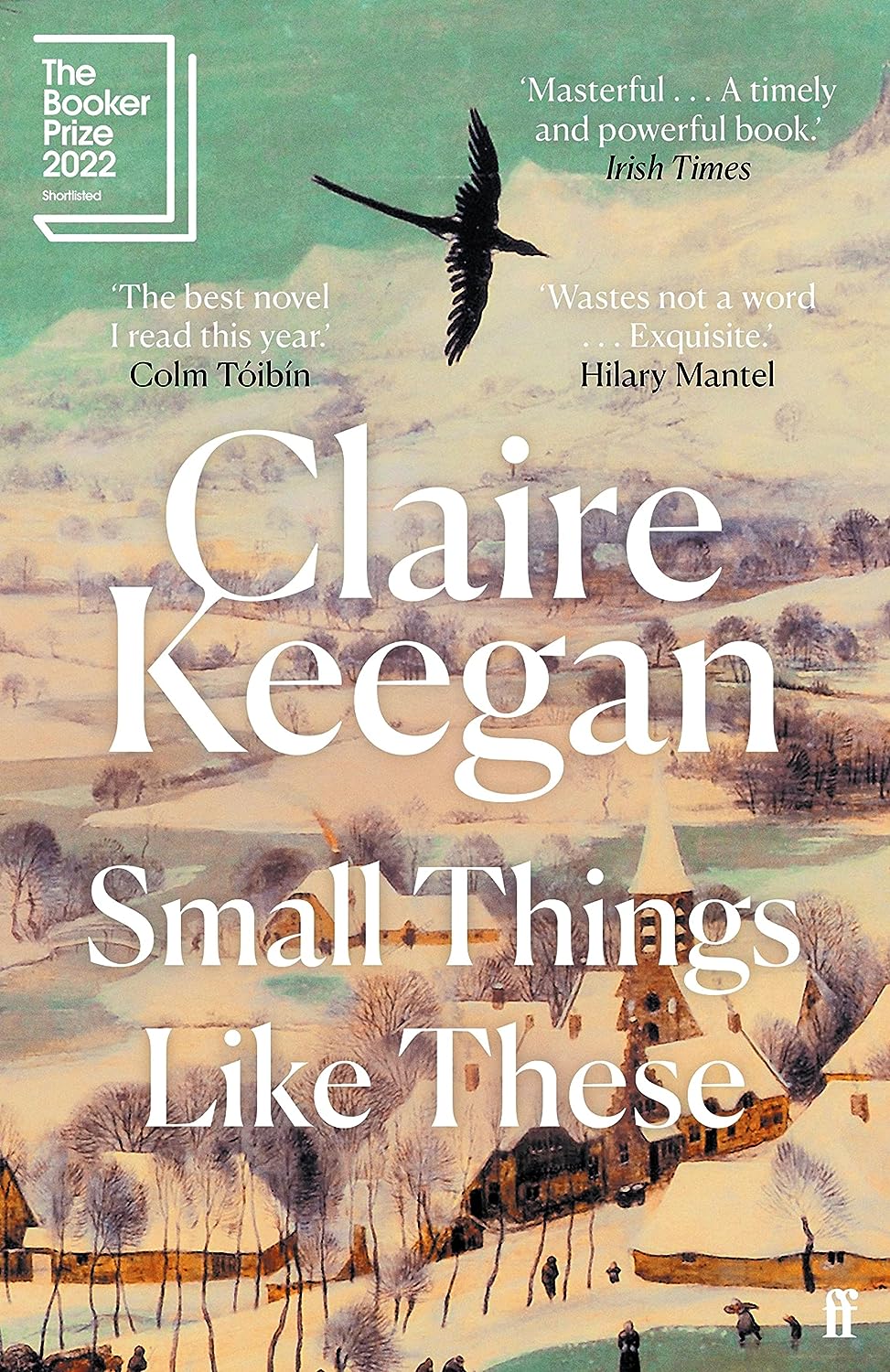
BOOK REVIEW: SMALL THINGS LIKE THESE

Beautifully written, and highly recommended. Claire Keegan’s Small Things Like These (1) is a novella set in the small Irish town of New Ross in the cold December of 1985, “a December of crows”. New Ross is in many ways a strong community, but business is bad. There are closures, poverty and emigration. The central, point-of-view character is Bill Furlong, a coal and timber merchant, adequately prosperous and very busy at this time of year. Born on 1 April 1946, he is a pillar of his community, a regular if tepid church goer, married with five daughters. The older of these are at St. Margaret’s, “the only good school for girls in town”.

But Bill is also something of an outsider. His father is unknown. ‘Furlong’ is his mother’s family name. She herself becomes pregnant at the age of 16, whilst working as a maid for the Protestant widow Mrs. Wilson, comfortable on a military pension and a decent sized farm. Mrs. Wilson chooses to keep her on and takes an interest in the boy. This interest continues after his mother’s sudden death when he is 12. Technical School leads to an opportunity at the coal yard where he works his way up and subsequently becomes the owner. When he gets engaged to Eileen, Mrs. Wilson gives him some thousands of pounds to establish himself. He enjoys being a family man and a good provider. The Christmas season, with its time at home, rich food and present giving is a welcome opportunity to celebrate.

Bill is naturally generous, refuses to judge people harshly and is prone to spontaneous acts of kindness, the “small things like these” of the title. The main action of the novella begins when he personally delivers a Christmas coal and wood order to the local convent, a powerful-looking place on the hill, where the nuns run both a “training”, or possibly “reforming”, school for girls” and a popular laundry business. There is some lack of clarity over the detail. They might be involved in arranging adoptions as well. Although a little set apart, it is one of the major institutions of the town.

Arriving in the dark at the covent coal house door Bill finds the bolt stiff with frost and has to force it open. There he finds a young girl, Sarah, who has clearly been locked in there for some time. She asks him to take her away or at least ask the whereabouts of her 14 month old baby who has been taken from her. The Mother Superior becomes involved and embarks on an unconvincing performance of compassion involving tea and cake for both Bill and the girl, and a story about Sarah’s incarceration as the result of a game with other girls.

Bill, going home, realizes that he forgot to ask about the baby. He recollects the numerous locks in the convent buildings and broken glass on the tops of walls. He is unhappy and misses his way home, fetching up in a remote spot he doesn’t recognize. In one of the novella’s occasional fairytale moments, he asks an old man with a billhook: “will you mind telling me where this road will take me?” The old man replies: “this road will take you wherever you want to go, son”.

On his return he tells Eileen and, separately, two friends his story. They are keen to talk him out of any public comment or further action. The convent is powerful. Other church institutions would rally round it. It is also his largest customer with the capacity to influence others. Bill has worked very hard to get where he is. Why risk financial disaster? But he is strongly affected by his encounter with Sarah. He finds himself becoming reluctant even to attend mass, let alone take the sacrament. He thinks of what Mrs. Wilson did for him, particularly since he is now fairly sure that his father was not one of her own relatives.

Late on Christmas Eve he goes back to the convent on foot, unbolts the coalhouse door, finds Sarah, and begins the walk through town to his home, “the excitement in his heart matched by the fear of what he could not yet see but knew he would encounter”. On this journey, he also recognizes a “fresh, new, unrecognisable joy in his heart … some part of him was going wild, he knew … never once in his whole and unremarkable life had he known a happiness akin to this”. The narrative ends when he reaches the door of his family home. On the other side of that door lies the beginning of another story, and another day.

(1) Claire Keegan Small Things Like These London: Faber & Faber, 2021

The author has dedicated this story to the women and children who suffered time in Ireland’s mother and baby homes and Magdalen laundries. In a note on the text she adds: “Ireland’s last Magdalen laundry was not closed down until 1996. It is not known how many girls and women were concealed, incarcerated and forced to labour in these institutions. Ten thousand is the modest figure; thirty thousand is probably more accurate. Most of the records from the Magdalene laundries were destroyed, lost or made inaccessible. Rarely was any of these girls’ or women’s work recognised or acknowledged in any way. Many girls and women lost their babies. Some lost their lives. Some or most lost the lives they could have had. … These institutions were run and financed by the Catholic Church in concert with the Irish State. No apology was issued by the Irish government until Taoiseach Enda Kelly did so in 2013”.

BOOK REVIEW: UNSEEN BEINGS

Highly recommended. Unseen Beings: How We Forgot the World Is More Than Human (1) is about the many beings we humans have actively ‘unseen’ and the consequences of our human-centric lens. Author Erik Jampa Andersson describes his book as a diagnostic exploration of the roots of the climate crisis, itself an extreme consequence of a much wider malaise. Whereas the common view of ‘saving the planet’ tends to be one of ‘guarding the storehouse’, a better focus would be on ‘supporting the welfare of living beings’.

Andersson has a background in Tibetan Buddhism and Tibetan medicine. In the manner of Buddhism’s Four Noble Truths, and of his medical training, he divides his book into four parts: Diagnosis, Causes and Conditions, Prognosis, Treatment.

Diagnosis concerns “our ecological disease”. Andersson reminds us of what the climate crisis is, how far it has been allowed to go, and the “fanciful stories” with which we have soothed our fears: “full of human exceptionalism, divine protection, techno-fixes and post-apocalyptic salvation”. For Andersson, the foundational root cause is “the sundering of human and non-human beings, and our perceptual separation from ‘Nature’. He refers to “the poison of anthropocentricity”. He reviews the evidence for plant and fungal sentience and awareness as well as that of the animal kingdom. He concludes that Nature is not a place, but “a tightly knit community of interconnected beings, some seen, many unseen, all engaged in their own affairs and with their own experience of reality”. He describes this relational approach to the living world as “what most scholars now call ‘animism’ … neither a religion nor a system of belief, but a paradigm of more-than-human relationship”. He sees this stance toward the world as “our natural state”.

Causes and Conditions A mini-ice age some 13,000 years ago interrupted an early agricultural period in some places and prompted a series of innovations. The domestication of the horse was especially significant. Andersson sees a move away from our ‘natural state’ beginning at this time. But it is not fully evident to us until the age of written philosophy and scripture. The Greek philosophers Plato and Aristotle declare a hierarchy of sentience from plants up to animals and then humans at the top, uniquely endowed with a rational soul. In the Hebrew book of Genesis, God gives dominion over the Earth and its animals to man for his use. In the Western Christianity of the 13th century CE, Thomas Aquinas says that Christians have no duty of charity to non-humans because they are resources, not persons. In the 17th century CE, early in the West European led colonial era, Descartes holds public vivisections of dogs and other animals declaring that they are soulless automata and that their apparent distress is meaningless. In the mid 19th century CE, Darwin restores other beings as our ancestors and cousins, but but without much sense of kinship or empathy.

Prognosis Here Andersson introduces two concepts from Tibetan medicine: ‘provocation’ and ‘spirit illness’. The provocation of other sentient beings is a health risk. He discusses the origins of the recent Covid-19 pandemic in these terms, as human become ever more invasive of our remaining wild spaces. In cases of deforestation, pollution, and any disruption of air, water, soil and trees, there is a price to pay for the wounding of other spirits, whether seen by the eye, seen through a microscope and normally unseen but recognised by tradition. (‘Supernatural’ is an unhelpful word here – everyone is part of nature). In Tibetan tradition, the cultivation of a clear mind is highly prized and works within human psychology, but not for disruptive events like these. There is a need to make amends. Rituals are held in sensitive and damaged places. The damage caused in these circumstances and the resultant chronic collective disease can only be addressed by learning how to care for eachother, non-human beings and the planet itself.

Treatment Using the Buddhist 8-fold path as a structure, Andersson recommends ‘cultivating care’ over a system of rules and regulations aimed at a ‘sustainability’ which tries to restore the old status quo. We cultivate care of the Earth, one another and non-human beings. Hence: 1 right view is a return to our ‘natural state’, as described under Diagnosis; 2 right intention describes commitment to a path of rewilding and regeneration; 3 right speech is the use of “life-affirming language” (e.g. using ‘they’ as an alternative to ‘it’ for non-human beings); 4 right action is causing as little harm as possible to other beings; 5 right livelihood means adopting principles of authentic sustainability and non-exploitation; 6 right diligence is based on “the durability of the heart-felt ethic; 7 right mindfulness means “paying attention to nature’s vitality”; 8 right concentration involves imaging a new future with “authentic myth-making”.

Concerning 8 above, Andersson has been profoundly moved by the work of J. R. R. Tolkien from his later childhood onwards. As a result, he developed a high valuation of authentic myth-making and enchantment. In this realm, the non-human is essential. Tolkien had his own life-changing moment of enchantment when, as a student, he first read the Old English words: Eala earendel engla beorhtast, ofer middangeard monnum sended. (Hail Earendel brightest of angels, above the middle-earth sent unto men). Of this evocation of Venus arising as the morning star, in the old language, Tolkien later wrote: “there was something very remote and strange and beautiful about these words, if I could grasp it, far beyond ancient English”. For Andersson, authentic myth and authentic science work together in support of a redemptive animist vision. By contrast, the form of discourse to worry about is ‘fallacy’ – a complete dissociation from the truth. Andersson again quotes Tolkien: “if men were ever in a state in which they did not want to know or could not perceive truth (facts and evidence) then Fantasy would languish until they were cured. If they ever get into that state (it would not seem at all impossible) Fantasy will perish and become morbid delusion”. For Andersson, this too has become a symptom of our current ecological disease, making the need for honest and healthy communication all the more urgent.

For me, Andersson has made a valuable addition to a growing literature about the current crisis, whose most alarming symptom is climate breakdown. He goes to the root of the problem, offering a clear and coherent view about how to stand in the face of it. It is a well-researched, well-crafted and compassionate contribution to the genre.

(1) Erik Jampa Andersson Unseen Beings: How We Forgot the World is More Than Human Carlsbad, CA & New York City; London; Sydney; New Delhi: Hay House, 2023

I attach a links to conversations between the author and Andrew Harvey below. It adds considerably to what I can present in a review:

BOOK REVIEW: UNLIKELY ALLIANCES

Highly recommended. Unlikely Alliances (1) is set in the years 2029-2033, in a fictional town on England’s south coast. It offers a degree of hope about the climate crisis, presenting a positive response to its challenges at the global, national and, especially, local levels. Towards the close of the book, one of the characters reflects on a benign economic austerity that includes social justice: “limited food in the shops, clothes and shoes having to last many years, trips abroad requiring special license … but look around us, are we really worse off?” The answer is a qualified no, on the grounds that everyday life has become less constrained and less stressful, thanks to the choices that have been made.

Unlikely Alliances offers a gentle, compassionate and good-humoured lens on a subject that can seem grim and edgy. The title refers to the changing political, professional and above all personal relationships of people working on adaptation goals in their Bourne Valley community. They are from a wide variety of backgrounds, including local government, academia, trade unions, churches, the voluntary sector, management consultancy, the hospitality industry, sports organisations and farming. Unexpected synergies are generated. The novel shows how its band of protagonists find themselves, each other and a new sense of purpose in this work. As fiction, the book has the space to be about lives as well as issues. New culture, adapted to new times, is created in the lived experience of friendship, romance and community building.

The Climate Action Plan of a progressive coalition government provides a political framework, drawing on ideas from the US 1930’s New Deal and the UK reconstruction post World War 2. It is in power because of a wake-up call resulting from a huge inundation in the Netherlands and the presence of a large number of Dutch refugees in Britain – a disaster too close to ignore. For the first time since the mid twentieth century, serious wealth taxes are in place. Food and fuel are rationed: everyone gets at least something at an affordable price. There are new approaches to housing. A Civilian Community Service Corps provides training and jobs for the unemployed and a two-years national community service for school and college leavers.

In crisis conditions, this government is broadly popular. Even so, it is vulnerable to defections within its own Parliamentary ranks, the vigorous opposition of vested interests and those who speak for them, and the violence of militant climate denialists on the street. These struggles are not minimised, and they are vividly portrayed in the book. But most of the focus is on resource and resiliency building at the local and regional levels, and on the changes in the lives of the main characters, as they open up to each other’s influence and affection. It is their efforts that prevail, since they come to make practical sense to more and more people.

A brief review cannot do full justice to a book that deals with a civilisation at the edge, presented from a stance of generosity and warm commitment to human flourishing. Tony Emerson has long experience of working with environmental issues and is also an accomplished storyteller. I found Unlikely Alliances heartening and enjoyable to read, and a well-informed glimpse into a possible near future.

(1) Tony Emerson Unlikely Alliances https://FeedARead.com 2021 – e-book created by White Magic Studios – http://www.whitemagicstudios.co.uk 1922. Available on Amazon (UK and USA).

BOOK REVIEW: THE BURNING HOUSE

A highly recommended illustration of spirituality in support of political action. In The Burning House: A Buddhist Response to the Climate and Ecological Emergency (1), author Shantigarbha affirms that ‘the ecological crisis is nothing if not a spiritual crisis, a crisis of meaning and direction for our civilisation’. Most Druids would say the same, and see value in his approach.

Shantigarbha (Seed or Womb of Peace) (2) is a teacher of Buddhism and Nonviolent Communication (NVC). He has also trained members of Extinction Rebellion (XR) in nonviolence and de-escalation skills. He believes that we cannot wait to change our lives before we change the world, or to change the world before we change our lives: we have to do the best we can with both, together, now. He sees the climate crisis as primarily one of ’empathy, connection and community’ and says that ‘when we use our energy to cultivate our own vitality, we naturally use the abundance we discover in the service of life’.

The book title The Burning House references a traditional Buddhist story about a father trying to get his children out of a burning house. There is no time to pick them up individually, so he simply commands them to leave. But they are busy playing with their toys and ignore him. He has to find a skilful means of getting them out. In his anguish (but also inspiration) he tells them that there are even more wonderful and exciting toys outside. In the parable the burning house stands for a life of samsara and unawareness. Outside there is the opportunity for awareness and the tools to develop it.

The book looks first at the climate crisis and ways it can be understood. There follow chapters on how Buddhist ethics support environmental ethics, and how compassionate action based on wisdom can enable the transformation we need. There are chapters on aspects of emotional intelligence. How to transform anger is the first – rather than acting out our anger or repressing it, we can identify and mobilise ‘the life in it’. Hatred, by contrast, is characterised as always toxic and self-harming. There are chapters on ecological grief and its potentially heavy weight – and also on gratitude for what we do still have. There is a beautiful quote from Francis Weller: ‘How much sorrow can I hold? That’s how much gratitude I can give. If I carry only grief, I’ll bend toward cynicism and despair. If I have only gratitude, I’ll become saccharine and won’t develop much compassion for other people’s suffering. Grief keeps the heart fluid and soft, which helps make compassion possible’ (3).

Later chapters focus more specifically on nonviolent social change, on being the change, and on the role of nonviolent disruption in the pursuit of climate justice. Practical examples draw on UK experience in 2019, mostly in London and Bristol. Whilst illuminating, they are limited in place and time. The last chapter, Final thoughts: the beauty and terror, summarises what we can do both individually and collectively. It sees some grounds for hope – if we treat the climate and ecological emergency as an emergency. Shantigarbha draws on Sraddha, ‘the Buddhist equivalent of hope’, better translated as confidence or trust. It is not faith or hope in the ordinary sense. ‘Sraddha represents a higher or broader perspective, our connection with vision. It signifies an emotional response to our ideals. In terms of the burning house it represents the father’s cry of inspiration’. We are invited to have the courage and confidence to do what we can, and let the effects ripple out. It is what we can do, and all we can do.

The Burning House offers valuable perspectives both on Buddhist political engagement and on climate action. Each chapter contains a link to a guided meditation, offered as a resource to readers.

(1) Shantigarbha The Burning House: A Buddhist Response to the Climate and Ecological Emergency Cambridge: Windhorse Publications, 2021 (https://www.windhorsepublications.com)

(2) See: https://www.SeedofPeace.org

(3) See: https://www.thesunmagazine.org/issues/478/the-geography-of-sorrow)

MY DRUID PRAYER

I am fond of the Druid prayer despite my discomfort with petitionary prayer as a genre. This post looks at the prayer and describes a recent reframing for solo use.

The prayer dates back to the eighteenth-century origins of modern Druidry. I first encountered it in 1993 on joining OBOD (1). The custom there is to extend the ‘Grant O God’ opening to include Goddess and Spirit as alternatives.

Grant O God/Goddess/Spirit, your protection,

And in protection, strength,

And in strength, understanding,

And in understanding, knowledge,

And in knowledge, the knowledge of justice

And in the knowledge of justice, the love of it

And in the love of it, the love of all existences

And in the love of all existences, the love of God/Goddess/Spirit and all goodness”.

When using the prayer in group settings I use Goddess as a Pagan statement in a world where most religious movements still lean heavily towards patriarchy. I have noticed that Goddess and Spirit tend to be the preferred options among Druids today, with at least a few people finding time to say God and Goddess. God by himself is somewhat out of fashion.

In most religious movements this petitionary pluralism would likely seem disconcerting, but it is one of the things that I have appreciated in OBOD and Druid culture more widely. At a deeper level, I am not at ease with prayers to higher powers however they are named. I do not find myself standing congruently behind them. I can stay in a gathering and participate, acknowledging the good intentions of the occasion, but I am not 100% there, in the moment of petition.

On the other hand I like the values expressed in the prayer, as it develops from its base-line in hoped-for protection into that quality of strength which leads on to understanding, knowledge, justice, and – through the love of justice – the love of all existences. Protection and strength, as values, are thereby dissociated from ideologies of dominance and submission, or of power-over as the answer to anxieties and problems. Instead, they point to something fuller, where strength becomes the basis for a generous stance in life. The prayer both affirms the web of life and promotes justice within the web. The principles of the prayer call strongly to our own time.

My recent work has made it possible for me to use the prayer in solo practice. The key word is the sense of ‘Oneness’ as an expression of universal interbeing, or connectedness, rather than a singularity or monad: a Oneness (which I am willing to capitalise) that can manifest in ‘no boundary’ experiences yet also has room for the arrival and passing of individuals, collectives and relationships.

I am aware that, within the web, we find built-in elements describable as parasitic and predatory. Sentient life is necessarily stressed. But as a human I can be aware of this and create, of my own volition and with the aid of allies and available cultural resources, a values-based response. For me, the recognition of ‘Oneness’, as I have described it, widens the circle of care. This recognition may begin as intuited or as conceptual. Either way, I find that it changes the breadth and depth of experience – its taste, texture, tone and colouration. The state of ‘at-homeness in the flowing moment’ (2) points me to, and enables, the recognition Oneness in this sense. It opens the way to a form of the Druid prayer that I can fully embrace.

In the recognition of Oneness,

May I find protection,

And in protection, strength,

And in strength, understanding,

And in understanding, knowledge,

And in knowledge, the knowledge of justice

And in the knowledge of justice, the love of it

And in the love of it, the love of all existences

And in the love of all existences, the love of Oneness and all goodness.

In the light of recognition, the phrase ‘May I …’ asks me to take responsibility for my part in the Oneness. In one sense I am small and transient, in another sense timeless and unboundaried. There is something available beyond the little me, and I can affirm an intention in its name.

I notice that this approach to the prayer also reframes ‘goodness’. It loses any after echo of childhood obedience and a child’s hope of reward for being good. Indeed, it is not used here primarily as an ethical term – too vague, for one thing: ethical criteria need to be specified and their implications worked through, as in systems like virtue ethics or Buddhism’s eight-fold path. Although implying an ethics of empathy, this goodness is about flourishing at the personal, relational, collective and universal levels. The point of any ethics is to support this flourishing.

I will use and test this version of the prayer, as part of my inquiry, and see how it works as part of my practice.

(1) Order of Bards, Ovates and Druids: http://www.druidry.org/

(2) https://contemplativeinquiry.blog/2019/08/10/at-homeness-revisited/

XR STORIES

This re-blog, from The Earthbound Report, presents three stories from the recent Extinction Rebellion (XR) action in London. Written from an insider perspective, they illustrate the movement culture that XR seeks to model.

Three little XR stories you won’t read in the papers — The Earthbound Report

REVISED ‘ABOUT’ APRIL 2019

Over the lifetime of this blog I have made frequent revisions of its ‘About’ statement. Most are small. Occasionally, I make a major revision which I also publish as a post. Below is my revised and edited ‘About’ of 19 April 2019.

I am James Nichol and I live in Stroud, Gloucestershire, England. The Contemplative Inquiry blog started in August 2012, and includes personal sharing, discursive writing, poetry and book reviews. It explores contemplative themes and their role in human flourishing within the web of life.

In my own journey, I have found an At-Homeness in a flowing now, not linked to any specific doctrine. For me, this experience and stance enable greater presence, healing and peace. They also support imaginative openness and an ethic of aware interdependence.

I began this work within British Druidry. I continue to follow an earth-centred and embodied spiritual path, ‘secular’ rather than ‘religious’. I draw on diverse traditions, especially resonating with naturalist, eco-existentialist, pantheist and animist currents within and beyond modern Paganism.

I am wary of metaphysical truth claims, including materialist ones, with an ultimate stance of openness and unknowing. At the time of this revision, I am exploring a tradition initiated by the Greek Pagan philosopher Pyrrho of Elis, who developed his own school of contemplative scepticism after a visit to India.

My book, Contemplative Druidry: People, Practice and Potential, was published in 2014.  https://www.amazon.co.uk/contemplative-druidry-people-practice-potential/dp/1500807206/

ETHICS AND ‘CIVILIZATION’

In his Reclaiming Civilization (1), modern Pagan philosopher Brendan Myers asks three questions: What is civilization? What is wrong with it? What should we do about it? As part of his work with the third question, he looks at ethics. He starts with the proposition that a flourishing life is ethically desirable and good. This proposition may seem simple and obvious, yet it has not been a reliable quality of ‘civilization’ as we know and have known it.

Myers goes on to describe virtue ethics as the branch of philosophy that investigates character and identity. To live a flourishing happy life, we need to install ways of understanding, responding to, and acting in the world that will tend to support it. These are the virtues. Through the process of identifying and working with virtues, we reach towards the person we want to be and the world we want to live in. Myers implies a necessary inner work, when he speaks of “the possibility of a greater depth of life-experience that can appear when I am willing to let go of my illusions, willing to risk harm and despair, in pursuit of a more honest relationship with reality”. He then presents his own list, offering his virtues as ways of responding to three ‘immensities’: earth, interpersonal otherness, and solitude/death.

For earth, the virtues are “those ways of being in the world that enable you to look upon the earth, in all its beauty and danger yet feel no need to own it all, nor to destroy it … but to explore it, play with it, know it. Myers recommends “virtues of wonder: including imagination, creativity, open-mindedness, aesthetic taste, and curiosity”. He adds that this does not preclude practices such as farming but does call for them to be “conducted in careful (as in full-of-care), sustainable and co-operative ways”.

For interpersonal otherness, the virtues are “those ways of being that enable you to look upon your neighbor, however strange or different she may be, and feel no need to make her conform to your demands, nor a need to send her away (such as, to her death) … the virtues … enable you to see another earth, in a manner of speaking … your neighbor’s eyes are another way of looking upon the earth … you have another way of exploring it”. Here, Myers recommends “virtues of humanity” – care, courage, friendship, generosity and the “Seven Grandfathers of Wisdom, Truth, Humility, Bravery, Honesty, Love and Respect”.

For “the immensity of solitude, and of death”, the virtues are qualities that contradict any need to avoid solitude and death at “any cost, however destructive to yourself and others”. These, for Myers, are “virtues of integrity: including reason, consistency, dignity, Socratic wisdom, acknowledged vulnerability, forgiveness, mercy, the will to establish a legacy, and the will to let go”.

When I reviewed Reclaiming Civilization last year (2) I knew that I would want to return to it and examine its ethical approach more closely. What I like about this approach is that it avoids both a ‘follow your bliss’ vagueness and a rigid prescriptive system. It fits very well with my sense of a Sophian Way. It suggests principles and a method and then challenges us to develop our own list. Here, we have an ethics that asks for close attention, questioning and (I would suggest) a continuous work of understanding our chosen ‘virtues’ and checking them out in practice. For me, the notion of a flourishing life for ourselves and others has to extend to the biosphere. A purely human approach no longer serves even we humans ourselves. I also like an approach that (without being partisan) has political implications. It is not just an ethics for private life. Myers provides a tool for living the ‘good life’, and perhaps, identifying possible contributions to reclaiming (and re-framing) ‘civilization’ – the central theme of Myers’ book and the context for his ethical discussion.

(1) Brendan Myers Reclaiming Civilization: A Case for Optimism for the Future of Humanity Winchester, UK & Washington, USA: Moon Books, 2017

(2)  https://contemplativeinquiry.wordpress.com/2017/08/24/book-review-recl…ing-civilization/ ‎

BOOK REVIEW: RECLAIMING CIVILIZATION

Publication date 25 August 2017. Highly recommended. Contemporary Pagan philosopher Brendan Myers offers a nuanced and reflective discussion of civilization, its evident dysfunction, and how to respond. Overall, he takes the view that: “civilization is not an unambiguously good thing. The ‘shining city on a hill’ is a mirage. It lessens the suffering of one group by entrenching the suffering of others; and it promises things to the protected and privileged that it can never entirely deliver. Nevertheless, civilization may yet be a salvageable enterprise”.

Reclaiming Civilization: a case for optimism for the future of humanity is a study of the sacred, from a socio-political perspective. The book is presented musically, with an overture leading on to three movements punctuated by interludes. The overture – a ‘meditation upon a lake’ begins with a personal question: ‘why should I return to the city?’ given that this entails going back to debts, responsibilities and ‘absurdities’.

These absurdities go well beyond the personal level. they include: modern working and consumerist lifestyles; rampant economic inequalities; double-speak in politics and religion; a pervasive sense of alienation and division; war and the effects of war; and the accelerating effects of climate change. So Myers’s first, personal, question leads on to three other, general ones: what is civilization? what’s wrong with civilization? What, if anything, should be done for civilization? These questions are explored in the three movements that follow.

To answer the first, Myers looks at human innovations like fixed houses, settled farming and the domestication of animals, and the subsequent appearance of cities and their walls – designed to keep some people out and other people in. He suggests that ‘civilization’ has been a long experiment by which we resolve what it means to be human “not by discovery, but by invention”. Civilized people are those whose qualities are their civilization’s virtues. Myers calls civilization humanity’s ‘most metaphysical project’ – humanity ‘realizing itself’ (for some people) by living up to a ‘civilized’ ideal.

The second, ‘what’s wrong’, question identifies the intensification of social hierarchy and domination with increasing economic surplus overall. Myers discusses the accompanying ideology in terms of “illusions which exalt us” (i.e. those of us who are ‘winners’). These include: the permanent self; notions of ‘higher’ and ‘lower’ men and of the virtuous prince; the devious enemy; the self-made man; a human birthright of dominion over the earth. In part, such illusions enable exploitation with an easy conscience. More deeply, they help to fend off nihilism and despair – themselves not an “existential condition of human life” but “a feature of reason and rationality”. There has been something essentially distressed about civilization as a project. Its distortions aren’t just accidents or mistakes.

Myers’ response to the third question (‘what should be done’) makes political suggestions, supported by the author’s ethical lens. Virtue ethics is the branch of philosophy that investigates character and identity. To live a fulfilling and happy life, according to Myers, we need to install ways of being in the world that support this aim: these are the virtues. For Myers, we develop virtues in the face of existential ‘immensities’. Awakening to the earth, we respond with the virtues of wonder – and take a stance of open-mindedness, curiosity and creativity. Awakening to people and relationship, we respond with humanity – with care, courage, respect and generosity. Awakening to solitude and the certainty of death, we respond with integrity – reason, acknowledged vulnerability, forgiveness and the will to let go.

Myers is encouraged by what he calls four lamps:

  1. Human nature is malleable – so culture and society can and do change.
  2. Empathy, co-operation and compassion are among the qualities that are embedded in our species and have helped to build civilization so far.
  3. Casting away illusions is hard, yet on the other side of despair lies a greater depth and life.
  4. We are already doing most of the things we need to do.

Reclaiming Civilization is a valuable addition to our literature. If the above account has stimulated any interest in the questions, I recommend getting the book. The issues are more fully explored, and Myers also shares something of his personal journey, especially in the Interludes.

Brendan Myers Reclaiming Civilization: a case for optimism for the future of humanity Winchester, UK & Washington, USA: Moon Books, 2017

Earth Eclectic

music that celebrates Earth and speaks to the heart

Sarah Fuhro Star-Flower Alchemy

Follow the Moon's Cycle

Muddy Feet

Meeting nature on nature's terms

Rosher.Net

A little bit of Mark Rosher in South Gloucestershire, England

Becoming Part of the Land

A monastic polytheist's and animist’s journal

selkiewife

Selkie Writing…

Charlotte Rodgers

Images and words set against a backdrop of outsider art.

Prof Jem Bendell

living with metacrisis and collapse

Towint

The pagan path. The Old Ways In New Times

The Druids Garden

Spiritual journeys in tending the living earth, permaculture, and nature-inspired arts

The Blog of Baphomet

a magickal dialogue between nature and culture

This Simple Life

The gentle art of living with less

Musings of a Scottish Hearth Druid and Heathen

Thoughts about living, loving and worshiping as an autistic Hearth Druid and Heathen. One woman's journey.

Wheel of the Year Blog

An place to read and share stories about the celtic seasonal festivals

Walking the Druid Path

Just another WordPress.com site

anima monday

Exploring our connection to the wider world

Grounded Space Focusing

Become more grounded and spacious with yourself and others, through your own body’s wisdom

The Earthbound Report

Good lives on our one planet

Hopeless Vendetta

News for the residents of Hopeless, Maine