Contemplative Inquiry

This blog is about contemplative inquiry

Tag: Ethics

PEACE AS A VIRTUE

I have been thinking of peace, at the personal level, as something other than an energy or state. I am learning to understand it as a virtue to be cultivated, in the sense described by modern Pagan philosopher Brendan Myers. ‘Virtue ethics’, first articulated by the ancient Greeks, is the branch of philosophy that investigates character and identity (1).

To live a fulfilling and happy life, according to Myers, we need to install ways of understanding and being in the world that support our aim: these are the virtues. He specifically talks about the virtues of wonder, such as open-mindedness, curiosity, creativity; the virtues of humanity, such as care, courage, respect and generosity; and the virtues of integrity, like reason, acknowledged vulnerability, forgiveness and the will to let go.

I like Brendan Myers’ approach to virtue ethics. I find it inspiring. I particularly appreciate his account of both the work and rewards of practising virtue ethics: “through the process of identifying and working with virtues, we reach towards the person we want to be and the world we want to live in”. He points to “the possibility of a greater depth of life experience that can appear when I am willing to let go of my illusions, willing to risk harm and despair, in pursuit of a more honest relationship with reality”.

Myers’ approach has influenced my practice, to the extent of creating, working with and revising my own list of personal commitments (2). This is a working document, not a set of commandments or protocols from elsewhere. The commitments are not coterminous with virtues, but virtues are identified and included in them. The first to be named in my list is peace. I say: “I will live from the peace of the centre”. This statement has primacy over the others and is formulated differently. “I will live from …” is different from the “I will cultivate” that begins my other statements. It is linked to my regular use of a (slightly modified) Druid peace prayer: “Deep within my innermost being I find peace; silently, in the stillness of this space, I cultivate peace; heartfully, within the wider web of life, may I stand in peace”. The commitment “I will live from the peace of the centre”, draws on the whole prayer.

I notice that peace, rather than love, is currently the foundation of connection with my innermost being, or the divine within me. Spiritually, heartful peace best describes the reality of my lived experience of non-separation from the divine. This is what I feel moved to take into the world as a form of action (living from). I find this more challenging than finding peace in my innermost being in meditative spaces. Turning outwards, I find often find the world distressed, deluded and difficult to navigate. I am part of this world and therefore obviously vulnerable to my own distress and delusion, and also to a certain ignorance about falling into the mire myself.

Finding and modelling peace are consequently at the top of my list and it is this peace practice that I frame in terms of virtue. The ultimate peace that I experience within is something else, an inspiring gift for which I feel grateful: it is not a personal possession or attainment. Nonetheless, it supports in the work of bringing peace into my daily life.

(1) Brendan Myers Reclaiming Civilization: A Case for Optimism for the Future of Humanity Winchester, UK & Washington, USA: Moon Books, 2017

(2) Personal Commitments (Revised May 2024):

I will live from the peace of the centre.

I will cultivate skilful will and strong will, always within the context of good will, towards self and others.

I will cultivate positive health and well-being, within whatever constraints that may apply.

I will cultivate discernment, creativity and wisdom, to the best of my understanding and capacity.

I will cultivate a life of abundance in simplicity, living lightly on the earth.

NEWS OF A DEATH

When is ‘suicide’ something else? At the age of 80 Satish Kumar’s mother decided that her life was over and her duty done. She began a fast that lasted for five weeks before she died. Although suicide is stigmatised in most cultures, this was an honourable death in her Jain community in Rajasthan, India. Kumar, then already living in England, quotes the letter that gave him the news.

“At the age of eighty your mother felt that she had served the family and fulfilled all her duties and that now it was time for her to meet death. She decided to separate herself from her worn-out body by fasting. She believed that only death could bring new life and that she must die to live again. She went round the town, to family and friends, saying goodbye and asking forgiveness for any wrong she may have done. From the next day’s sunrise she took no more food or drink except a little boiled water. The news of your mother’s fast unto death spread by word of mouth. Monks came to bless her and be blessed, since it is considered to be brave and holy to die in this way – to embrace death rather than let it capture you unaware. Hundreds of people came to have her last darshan and to ask for forgiveness. She didn’t talk much but by her look acknowledged the receiving and giving of forgiveness. People sat outside singing songs and praying. After thirty-five days of fasting, your mother died.” (1)

I have written before about Jain ethics, in a review of Philip Carr-Gomm’s Seek Teachings from Everywhere (2). Both he and his Druid mentor Ross Nicholls had an interest in the Jain path with its values of ahimsa (non-violence/harm), aparigraha (non-attachment/possessiveness/acquisition) and anekant (non-absolutism/many-sidedness/multiple viewpoints). From a Jain perspective, Satish Kumar’s mother was in conformity with these principles when she chose death, with fasting (already a familiar practice) as her method. I value her story for its distinctive lens on a contentious subject. The depth of community support she received is for me the most moving aspect of this voluntary death. It became almost a celebration, and a kind of karmic harvesting for someone who believed that she “must die to live again”.

(1) Satish Kumar No Destination: Autobiography of a Pilgrim Cambridge: Green Books, 2014 (extended 4th edition – first edition 1992)

(2) See: https://contemplativeinquiry.blog/2019/10/02/book-review-seek-teachings-everywhere/

NOTE: “Satish Kumar (born 9 August 1936)[1] is an Indian British activist and speaker. He has been a Jain monk, nuclear disarmament advocate and pacifist.[3]Now living in England, Kumar is founder and Director of Programmes of the Schumacher College international center for ecological studies, and is Editor Emeritus of Resurgence & Ecologist magazine. His most notable accomplishment is the completion, together with a companion, E. P. Menon, of a peace walk of over 8,000 miles in June 1962 for two and a half years, from New Delhi to MoscowParisLondon, and Washington, D.C., the capitals of the world’s earliest nuclear-armed countries.[4][5] He insists that reverence for nature should be at the heart of every political and social debate.” (Wikipedia)

REBLOG: ’10 THINGS I LEARNED FROM EATING VEGAN FOR A YEAR’

I’ve been ‘plant-based’ or ‘mostly vegan’ for several years now, since coming to understand the role of livestock on the climate. But towards the end of 2020, my son asked if he could be properly vegan. I joined him and we have done it together. I haven’t mentioned this before on the blog. I see […]

10 things I learned from eating vegan for a year — The Earthbound Report

WHAT IS GIVEN

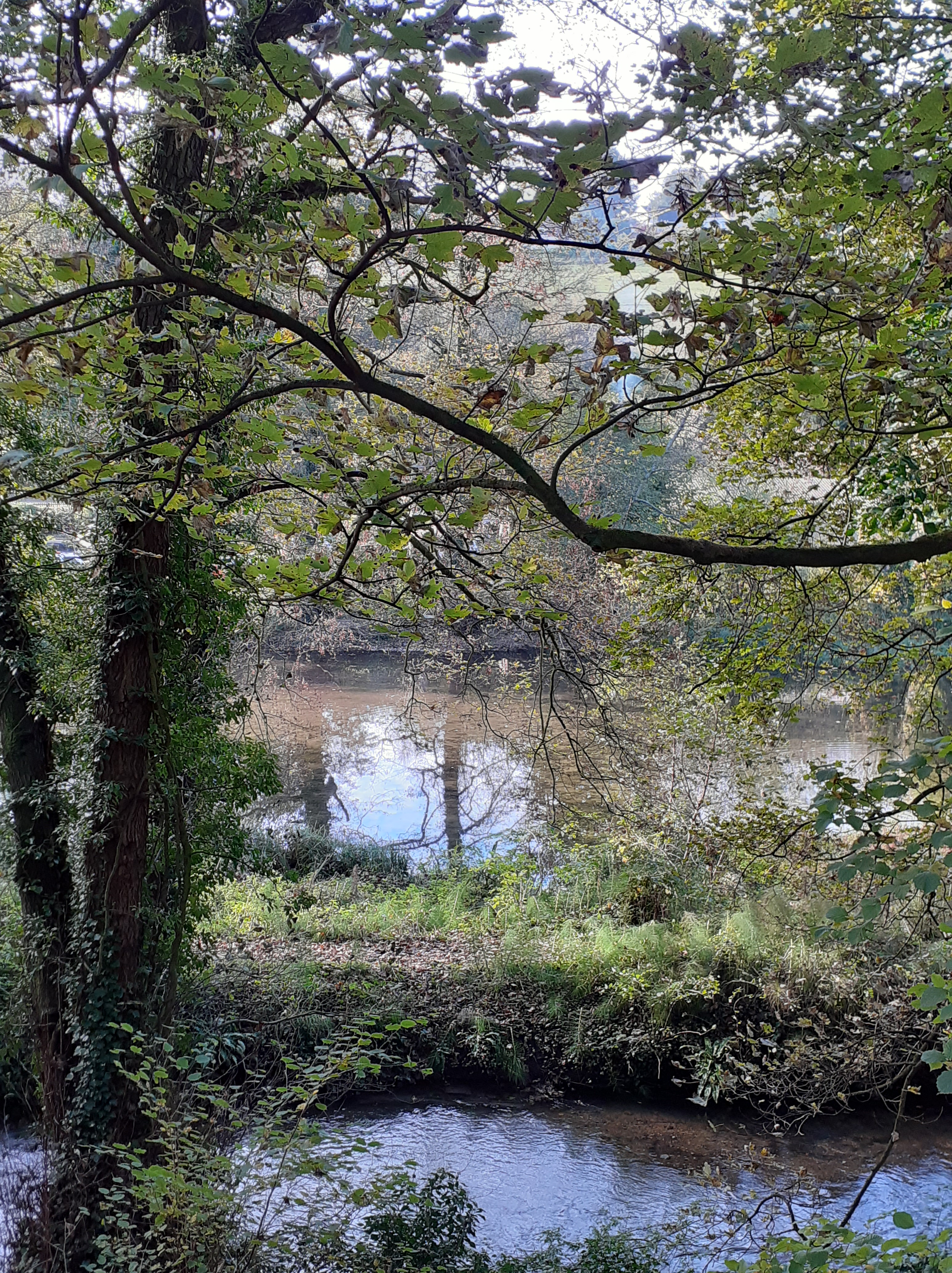
It is colder now, and gloomier indoors for much of the day. But outside, this November keeps on giving. My walking range has increased again with a walk to nearby Nailsworth, a leisurely lunch in this little town, and a walk back again: ten miles. The picture above includes both a stream beside my path and a small lake nearby.

But my attention hasn’t been all on the world around me. I have been reflecting on an old statement about my practice, currently included in my About section, and finding that it still holds. “My inquiry process overall has helped me to discover an underlying peace and at-homeness in the present moment, which, when experienced clearly and spaciously, nourishes and illuminates my life. It is not dependent on belief or circumstance, but on the ultimate acceptance that this is what is given. I find that this perspective supports a spirit of openness, an ethic of interdependence and a life of abundant simplicity.”

There is no reliance on metaphysics here. This allows me a pared down focus on experience and values. My practice has been relatively stable over a long period, whereas my thoughts about metaphysical questions are more volatile. I experience thinking as volatile by nature, and fine within its limits. Over the years this blog has found room for diverse approaches to the meaning, if any, of terms like divinity and consciousness. I have wondered about the possibility (or desirability) of establishing any foundational truth about absolute or indeed conventional ‘reality’. I notice now that when I explore these questions – especially when reading – I am more interested in seeing how people put their worlds together than I am in identifying insights or finding answers to the questions themselves. It has become a human interest rather than a philosophical quest.

I have noticed this especially over recent days when engaging with Carlo Rovelli’s discussion of the Buddhist philosopher Nagarjuna (1,2). My interest was in seeing how a distinguished physicist makes use of Nagarjuna’s emptiness doctrine. I have less stake in assessing the view itself, because my peace and at-homeness are the result of an experiential inquiry, and not of speculative thinking. I continue to find that this perspective supports “a spirit of openness, an ethic of interdependence, and a life of abundant simplicity”, My inquiry focus, if ‘inquiry; is even the right word, is about how best to walk the talk.

(1) Carlo Rovelli Helgoland global.penguinrandomhouse.com 2020 (Translated by Erica Segre & Simon Carnell, 2021). Carlo Rovelli is a theoretical physicist who has made significant contributions to the physics of space and time.

(2) https://contemplativeinquiry.blog/2021/11/08/exploring-emptiness-carlo-rovelli-and-nagarjuna

RENUNCIATION AS ACCUMULATION?

For some time I have committed myself to cultivating “a life of abundance in simplicity, living lightly on the earth”. This has involved a certain amount of decluttering, paring down, and emptying out, which could go further. But ‘abundance’ is still a key term in my commitment, and I don’t see myself as in any way ‘renunciate’. Some people, I know, find themselves and flourish as renunciates, and that is good to know. But I retain reservations about traditional renunciation as a concept, along the lines of the extract below.

“That all the major world religions have a renunciative morality seems at first blush a bit odd since these religions all operate within cultures where accumulating wealth, power and prestige positions people higher on the hierarchy. Accumulating seems to be quite the opposite of renouncing. This seeming enigma is understandable if it is seen as separating the divine from the earthly: Accumulating was the activity that got one ahead in the secular domain; renouncing was the path that got one ahead in the spiritual. Once people’s general mode of thought and behavior became based on the accumulation model, this insidiously got applied to everything, including renunciation, whereby one could accumulate spiritual merit through sacrifice.

“Renunciation is the mirror image of accumulation, with inverted (opposite) values, but with the same structure (hierarchical) and process (striving), and the same measuring, ambitious mentality. The contents (sacrificing versus acquiring) may seem opposite, but this is only on the surface because the form and underlying structure are the same. Accumulation moralities set up standards of purity which serve to measure the quantity of impurity (self-centeredness). They measure how much sin or how much karma has been accumulated (demerits), and then give ways of accumulating merits through sacrifice. So, ironically, renunciate religions are all based on accruing and stockpiling spiritual merit and are accumulative to the core. This is but another example of how either/or frameworks create reactive oppositions that, in an unconscious way, bring about the very thing they are trying to do away with.”

Joel Kramer & Diana Alstad The Guru Papers: Masks of Authoritarian Power Berkeley, CA: Frog Ltd., 1993

BOOK REVIEW: THE BURNING HOUSE

A highly recommended illustration of spirituality in support of political action. In The Burning House: A Buddhist Response to the Climate and Ecological Emergency (1), author Shantigarbha affirms that ‘the ecological crisis is nothing if not a spiritual crisis, a crisis of meaning and direction for our civilisation’. Most Druids would say the same, and see value in his approach.

Shantigarbha (Seed or Womb of Peace) (2) is a teacher of Buddhism and Nonviolent Communication (NVC). He has also trained members of Extinction Rebellion (XR) in nonviolence and de-escalation skills. He believes that we cannot wait to change our lives before we change the world, or to change the world before we change our lives: we have to do the best we can with both, together, now. He sees the climate crisis as primarily one of ’empathy, connection and community’ and says that ‘when we use our energy to cultivate our own vitality, we naturally use the abundance we discover in the service of life’.

The book title The Burning House references a traditional Buddhist story about a father trying to get his children out of a burning house. There is no time to pick them up individually, so he simply commands them to leave. But they are busy playing with their toys and ignore him. He has to find a skilful means of getting them out. In his anguish (but also inspiration) he tells them that there are even more wonderful and exciting toys outside. In the parable the burning house stands for a life of samsara and unawareness. Outside there is the opportunity for awareness and the tools to develop it.

The book looks first at the climate crisis and ways it can be understood. There follow chapters on how Buddhist ethics support environmental ethics, and how compassionate action based on wisdom can enable the transformation we need. There are chapters on aspects of emotional intelligence. How to transform anger is the first – rather than acting out our anger or repressing it, we can identify and mobilise ‘the life in it’. Hatred, by contrast, is characterised as always toxic and self-harming. There are chapters on ecological grief and its potentially heavy weight – and also on gratitude for what we do still have. There is a beautiful quote from Francis Weller: ‘How much sorrow can I hold? That’s how much gratitude I can give. If I carry only grief, I’ll bend toward cynicism and despair. If I have only gratitude, I’ll become saccharine and won’t develop much compassion for other people’s suffering. Grief keeps the heart fluid and soft, which helps make compassion possible’ (3).

Later chapters focus more specifically on nonviolent social change, on being the change, and on the role of nonviolent disruption in the pursuit of climate justice. Practical examples draw on UK experience in 2019, mostly in London and Bristol. Whilst illuminating, they are limited in place and time. The last chapter, Final thoughts: the beauty and terror, summarises what we can do both individually and collectively. It sees some grounds for hope – if we treat the climate and ecological emergency as an emergency. Shantigarbha draws on Sraddha, ‘the Buddhist equivalent of hope’, better translated as confidence or trust. It is not faith or hope in the ordinary sense. ‘Sraddha represents a higher or broader perspective, our connection with vision. It signifies an emotional response to our ideals. In terms of the burning house it represents the father’s cry of inspiration’. We are invited to have the courage and confidence to do what we can, and let the effects ripple out. It is what we can do, and all we can do.

The Burning House offers valuable perspectives both on Buddhist political engagement and on climate action. Each chapter contains a link to a guided meditation, offered as a resource to readers.

(1) Shantigarbha The Burning House: A Buddhist Response to the Climate and Ecological Emergency Cambridge: Windhorse Publications, 2021 (https://www.windhorsepublications.com)

(2) See: https://www.SeedofPeace.org

(3) See: https://www.thesunmagazine.org/issues/478/the-geography-of-sorrow)

BOOK REVIEW: SACRED ACTIONS

Highly recommended. Sacred Actions* is an excellent resource for developing sacred relationship with the earth in dedicated spiritual practice and acts of daily life. Pennsylvania-based author Dana O’Driscoll is steeped in Druidry and the U.S. homesteading movement. She is Grand Archdruid of the Ancient Order of Druids in America (AODA), and an OBOD Druid. She is a Mount Haemus scholar, lecturing on Channeling the Awen Within in 2018. In a recent blog post in Druid’s Garden (https://druidgarden.wordpress.com) she describes Sacred Actions as presenting “a hybridization of nature spirituality, sustainability and permaculture practice”.

The book is built around the wheel of the year and its eight festivals. O’Driscoll begins with the Winter Solstice, where her theme is the ethics of care applied at both the private and public levels. New life practices are supported by specific exercises and rituals. She continues the same approach with the other festivals: Imbolc – “wisdom through oak knowledge and re-skilling”; Spring Equinox – “spring cleaning and disposing of the disposable mindset”; Beltane – “sacred action in our homes”; Summer Solstice – “food and nourishment”; Lughnasadh – “landscapes, gardens and lawn liberation”; Fall Equinox = “earth ambassadorship, community and broader work in the world”; Samhain – “sustainable ritual tools, items and objects”.

To prospective readers I suggest an initial reading, followed by more intensive engagement with the individual chapters, season by season. Use this text to identify what inspires and moves you and has the power to bring a richer sense of ‘sacred actions’ into your own life. Sacred Actions is a powerful source of ecological and ethical inspiration, and a fine addition to Druid literature.

* Dana O’Driscoll Sacred Actions: Living the Wheel of the Year through Earth-Centered Sustainable Practices Altglen, PA: Red Feather, 2021


MY DRUID PRAYER

I am fond of the Druid prayer despite my discomfort with petitionary prayer as a genre. This post looks at the prayer and describes a recent reframing for solo use.

The prayer dates back to the eighteenth-century origins of modern Druidry. I first encountered it in 1993 on joining OBOD (1). The custom there is to extend the ‘Grant O God’ opening to include Goddess and Spirit as alternatives.

Grant O God/Goddess/Spirit, your protection,

And in protection, strength,

And in strength, understanding,

And in understanding, knowledge,

And in knowledge, the knowledge of justice

And in the knowledge of justice, the love of it

And in the love of it, the love of all existences

And in the love of all existences, the love of God/Goddess/Spirit and all goodness”.

When using the prayer in group settings I use Goddess as a Pagan statement in a world where most religious movements still lean heavily towards patriarchy. I have noticed that Goddess and Spirit tend to be the preferred options among Druids today, with at least a few people finding time to say God and Goddess. God by himself is somewhat out of fashion.

In most religious movements this petitionary pluralism would likely seem disconcerting, but it is one of the things that I have appreciated in OBOD and Druid culture more widely. At a deeper level, I am not at ease with prayers to higher powers however they are named. I do not find myself standing congruently behind them. I can stay in a gathering and participate, acknowledging the good intentions of the occasion, but I am not 100% there, in the moment of petition.

On the other hand I like the values expressed in the prayer, as it develops from its base-line in hoped-for protection into that quality of strength which leads on to understanding, knowledge, justice, and – through the love of justice – the love of all existences. Protection and strength, as values, are thereby dissociated from ideologies of dominance and submission, or of power-over as the answer to anxieties and problems. Instead, they point to something fuller, where strength becomes the basis for a generous stance in life. The prayer both affirms the web of life and promotes justice within the web. The principles of the prayer call strongly to our own time.

My recent work has made it possible for me to use the prayer in solo practice. The key word is the sense of ‘Oneness’ as an expression of universal interbeing, or connectedness, rather than a singularity or monad: a Oneness (which I am willing to capitalise) that can manifest in ‘no boundary’ experiences yet also has room for the arrival and passing of individuals, collectives and relationships.

I am aware that, within the web, we find built-in elements describable as parasitic and predatory. Sentient life is necessarily stressed. But as a human I can be aware of this and create, of my own volition and with the aid of allies and available cultural resources, a values-based response. For me, the recognition of ‘Oneness’, as I have described it, widens the circle of care. This recognition may begin as intuited or as conceptual. Either way, I find that it changes the breadth and depth of experience – its taste, texture, tone and colouration. The state of ‘at-homeness in the flowing moment’ (2) points me to, and enables, the recognition Oneness in this sense. It opens the way to a form of the Druid prayer that I can fully embrace.

In the recognition of Oneness,

May I find protection,

And in protection, strength,

And in strength, understanding,

And in understanding, knowledge,

And in knowledge, the knowledge of justice

And in the knowledge of justice, the love of it

And in the love of it, the love of all existences

And in the love of all existences, the love of Oneness and all goodness.

In the light of recognition, the phrase ‘May I …’ asks me to take responsibility for my part in the Oneness. In one sense I am small and transient, in another sense timeless and unboundaried. There is something available beyond the little me, and I can affirm an intention in its name.

I notice that this approach to the prayer also reframes ‘goodness’. It loses any after echo of childhood obedience and a child’s hope of reward for being good. Indeed, it is not used here primarily as an ethical term – too vague, for one thing: ethical criteria need to be specified and their implications worked through, as in systems like virtue ethics or Buddhism’s eight-fold path. Although implying an ethics of empathy, this goodness is about flourishing at the personal, relational, collective and universal levels. The point of any ethics is to support this flourishing.

I will use and test this version of the prayer, as part of my inquiry, and see how it works as part of my practice.

(1) Order of Bards, Ovates and Druids: http://www.druidry.org/

(2) https://contemplativeinquiry.blog/2019/08/10/at-homeness-revisited/

VALUES FOR 2020

I want to give my contemplative inquiry for the next year a strong focus and intent. This includes re-stating the values in which it is grounded, updated after some reflection over the last twelve moths.

I  use the word values where others might choose ethics or virtues. I make commitments rather than resolutions or vows. These commitments commit me to ‘cultivate’ a quality or behaviour. Hence, for example, I say “I will cultivate lovingkindness”. I cannot guarantee acting with lovingkindness as a simple act of will. But I can cultivate this quality and help it grow in the rough and tumble of life. I would like lovingkindness to be my default response in the heat of the given moment.

This year I will work with four commitments, listed below with brief commentaries.

  • I will cultivate lovingkindness towards myself, others and the wider world. I find the Buddhist metta meditation  a good working method for this (1). Lovingkindness is different to what I mean by love, more in the territory of good will. Love involves my spontaneous natural affections and needs to be free.
  • I will cultivate positive health and well-being, within whatever constraints may apply. This includes work with diet and exercise, and resiliency factors for mental and emotional health, such as connecting, being active, taking notice, and continuous learning and giving (2).
  • I will cultivate a life of abundance in simplicity. The dance between these terms creates, for me, a specific quality of richness. More widely, it contributes to living lightly on the earth.
  • I will cultivate openness, creativity and wisdom, learning how better to understand these qualities and how to enact them. I am curious about how they can work together.

The commitments give me a set of value words to work with: lovingkindness, health, well-being, abundance, simplicity, openness, creativity, wisdom and cultivation. Part of the work is to develop my understanding and application of such terms in the light of experience and reflection. Although I am making use of abstract nouns, the process of working with values is dynamic and subject to revision. This post is a record of where I stand on the brink of the 2020s.

(1) We extend lovingkindness to beings in this order: ourselves; a person who has benefited us; a person about whom we have no strong feelings; an ‘enemy’ or person with whom we experience difficulties; all beings without exception. We want to be able to say, congruently: may I/you/we be free of danger; happy; healthy; live with ease. – See: Sharon Salzberg & Joseph Goldstein Insight Meditation Correspondence Course Work Book Boulder, CO: Sounds True, 2004 (First published 1996)

(2) These are explained in detail at adrianharris.org/blog/2018/06/five-steps-to-mental-wellbeing/

XR STORIES

This re-blog, from The Earthbound Report, presents three stories from the recent Extinction Rebellion (XR) action in London. Written from an insider perspective, they illustrate the movement culture that XR seeks to model.

Three little XR stories you won’t read in the papers — The Earthbound Report
Earth Eclectic

music that celebrates Earth and speaks to the heart

Sarah Fuhro Star-Flower Alchemy

Follow the Moon's Cycle

Muddy Feet

Meeting nature on nature's terms

Rosher.Net

A little bit of Mark Rosher in South Gloucestershire, England

Becoming Part of the Land

A monastic polytheist's and animist’s journal

selkiewife

Selkie Writing…

Charlotte Rodgers

Images and words set against a backdrop of outsider art.

Prof Jem Bendell

living with metacrisis and collapse

Towint

The pagan path. The Old Ways In New Times

The Druids Garden

Spiritual journeys in tending the living earth, permaculture, and nature-inspired arts

The Blog of Baphomet

a magickal dialogue between nature and culture

This Simple Life

The gentle art of living with less

Musings of a Scottish Hearth Druid and Heathen

Thoughts about living, loving and worshiping as an autistic Hearth Druid and Heathen. One woman's journey.

Wheel of the Year Blog

An place to read and share stories about the celtic seasonal festivals

Walking the Druid Path

Just another WordPress.com site

anima monday

Exploring our connection to the wider world

Grounded Space Focusing

Become more grounded and spacious with yourself and others, through your own body’s wisdom

The Earthbound Report

Good lives on our one planet

Hopeless Vendetta

News for the residents of Hopeless, Maine