Contemplative Inquiry

This blog is about contemplative inquiry

Tag: Eternal Present

AN UNDERSTANDING OF ‘GNOSIS’

My last post was about working with ancient texts. Here I look at the term ‘gnosis’ in the Gospel of Thomas. I am indebted to the commentary of translator Jean-Yves Leloup. Here he reflects on logion 5, whose text I include  in a note below.

“Gnosis is not a system, not another ideology through which we are to interpret and understand the world. On the contrary, it means opening our eyes to what we are already looking at, right in front of us, not searching somewhere else.

”  … Things are not hidden in themselves; they are open – the veils hiding them are in the habits of our own vision, so crude, so overloaded with memories and assumptions about reality, distorting what is before us …

“Gnosis is a long-term work of recognition, of purity of attention so as really to see what is in front of us. The consequence of this attention is that we become what we see and what we love … If we look at chaos, we will reflect chaos. If we look at light, we will reflect light.” (1)

I am glad that this commentary provides more than scholarly exegesis. Leloup says in his introduction that he wants to offer “a meditation that arises from the tilled earth of our silence. It is my belief that it is from this ground, rather than from mental agitation, that these words can bear their fruit of light “. In this way Leloup dreams the myth onwards for our time, and passes the baton to his readers. Both a blessing, and a responsibility.

(1) Commentary on Logion 5, The Gospel of Thomas: The Gnostic Wisdom of Jesus Rochester, VT: Inner Traditions, 2005

(Text translated from the Coptic with commentary by Jean-Yves Leloup; foreword by Jacob Needleman. English translation by John Rowe  Original French edition published 1986).

The translated logion reads:

“Yeshua said:

Recognize what is in front of you, and what is hidden from you will be revealed.

There is nothing hidden that will not be revealed.”

NOTE: See also

CHILD OF THE NOW

THE ALBION SAILS ON COURSE (NOVEMBER 2016)

“The Albion sails on course. Black script on white wall. The spill-zone around Corbridge Crescent, the painted devil heads and hybrid monsters, the bare-breasted pin-ups from naughtier times mouthing Situationist slogans, are captured and made fit for purpose by film crews and television set-dressers, lighting technicians and catering caravans, responding to dissent as exploitable edge.

“LOADED WITH/ MEMORIES/ I WAS NOT AFRAID/TO SET OFF/ AN ADVENTURE/ ANY MORE.

“14 November 2016: the words I copied into my notebook yesterday are painted over with white undercoat, so that professionals can create rebellion suitable for television. For example, a Worholist head of Che Guevara – CHE GAY – inflated to cover an entire wall, with fake yelps about eating the rich to replace the groundwork of RIP and the Secret Society of Super Villains and Artists. NO PIGS ….

“The outlaw in his shack on the ledge by the canal sleeps through the entire fuss. He learnt his lesson after the first Immigration Enforcement raid. Now his shelter looks like the detritus of a lumberyard. ….

“A young boy cycles uncertainly to school, in the wake of his mother, wearing a silver skull mask. Welcome to the comic world, Hackney. At the base of the image swamp we find the sinister clown: child-catcher, grinning molester. The public joke, the big-haired politician who dissolves into the Joker of DC Comics.

“Extinguish fire with petrol. One of the latest Andrews Road defacements is a poster: SILENT BILL MUSE WANTED. Silence against the noise of imagery? The meditation of a hooded man sitting all day on a bench? Or another who dreams the fading city through all the hours in an Arsenal-branded sleeping bag? ‘Be silent in that solitude,’ said Edgar Allan Poe. ‘Let them come. The restless spirits of the dead are in death around thee’.” (1)

Iain Sinclair has a reputation as a leading figure in the practice of psychogeography, though he has now somewhat distanced himself from the word itself. He is quoted as saying (2) that “I buy into a union of writing and walking” and identifying with “the kind of writers who very definitely have, within their writing, this rhythm of journeys and walks and pilgrimages and quests”.

Sinclair’s work often celebrates London’s neglected and overlooked spaces, and draws on a visionary tradition of London writers from William Blake to Arthur Machen as well as the French situationists who developed psychogeography as a concept. His early reputation rests on the prose poem Lud Heat (1975) which was also influenced by Alfred Watkins and the earth mysteries school that followed in his wake. This work describes lines of force between Hawksmoor’s London churches to reveal the hidden relationship between the city’s financial, political and religious institutions. Peter Ackroyd drew on these themes for his later Hawksmoor (1985).

Last London (2017) is grittier and more concerned with a November 2016 witnessing of social breakdown in Hackney, a London borough that is being simultaneously gentrified. In the UK, it is also the year of the Brexit referendum (the Albion sails on course?) and in the US the month, November, of Donald Trump’s election as president (“at the base of the image swamp we find the sinister clown”).

Why am I drawn to this work? I lived in London for 17 years, from the late 1970s to the mid 1990s: there’s an element of nostalgia, and also of grief. Beyond that, my contemplative inquiry has led me in recent years to a practice of walking and writing. Are there lessons for me in Sinclair’s tradition?

My contemplative inquiry is not just about resting in the eternal moment – it also concerns life in place, time and culture. I’ve always liked walking meditation, mobile and open-eyed. Ideally, the still point and the moving line are both present, together as one. Often I stumble around between them, but that’s part of the journey: learning to be present in a field of living presence. I have a lot to learn.

(1) Iain Sinclair The Last London: True Fictions from an Unreal City London: OneWorld Publications, 2017

(2) Merlin Coverley Psychogeography Harpenden: Oldcastle Books Ltd, 2018 (first edition 2006) In his last chapter, Psychogeography Today, the author devotes a section to Iain Sinclair and the Re-branding of Psychogeography.

TREE MANDALA: BEECH AND BLUEBELL

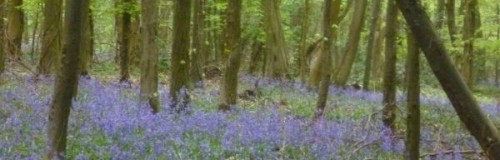
In my wheel of the year tree mandala (1), beech and bluebell together cover the period from 24 May-15 June – taking over from hawthorn and handing on to oak. In this instance, I am drawn by the powerful visual effects of bluebells carpeting woodland in which beech is the dominant tree.

The picture above is an old one. The last year in which Elaine and I went into this space (2018 or 2019) the wood felt weird. Part of it – not quite the area in the picture – was a scene of desolation. A lot of the trees had been taken down, with a kind of ragged insensitivity. It felt like a bad moment in Lord of the Rings. I don’t know the story behind this. Perhaps there was disease, or some other genuine need for a thinning out of trees. It was certainly systematic, with notices about the work being done – the result of management, and not of vandalism, in the conventional usage of our language.

The beech is an elegant tree, and I experience it as having a soft energy. It has been traditionally feminised, and thought of as ‘Queen of the Woods’, sharing the place of honour with the kingly oak according to The Green Man Tree Oracle (2). The same source says that “slivers of beech wood and leaves were once carried as talismans to bring good luck and increase creative energy”. Local British traditions associate the beech (ogham name phagos) with serpents “probably because of its long serpentine root systems”, they add – and I wonder too about the archaic link between the Goddess and serpent power in many cultures.

.

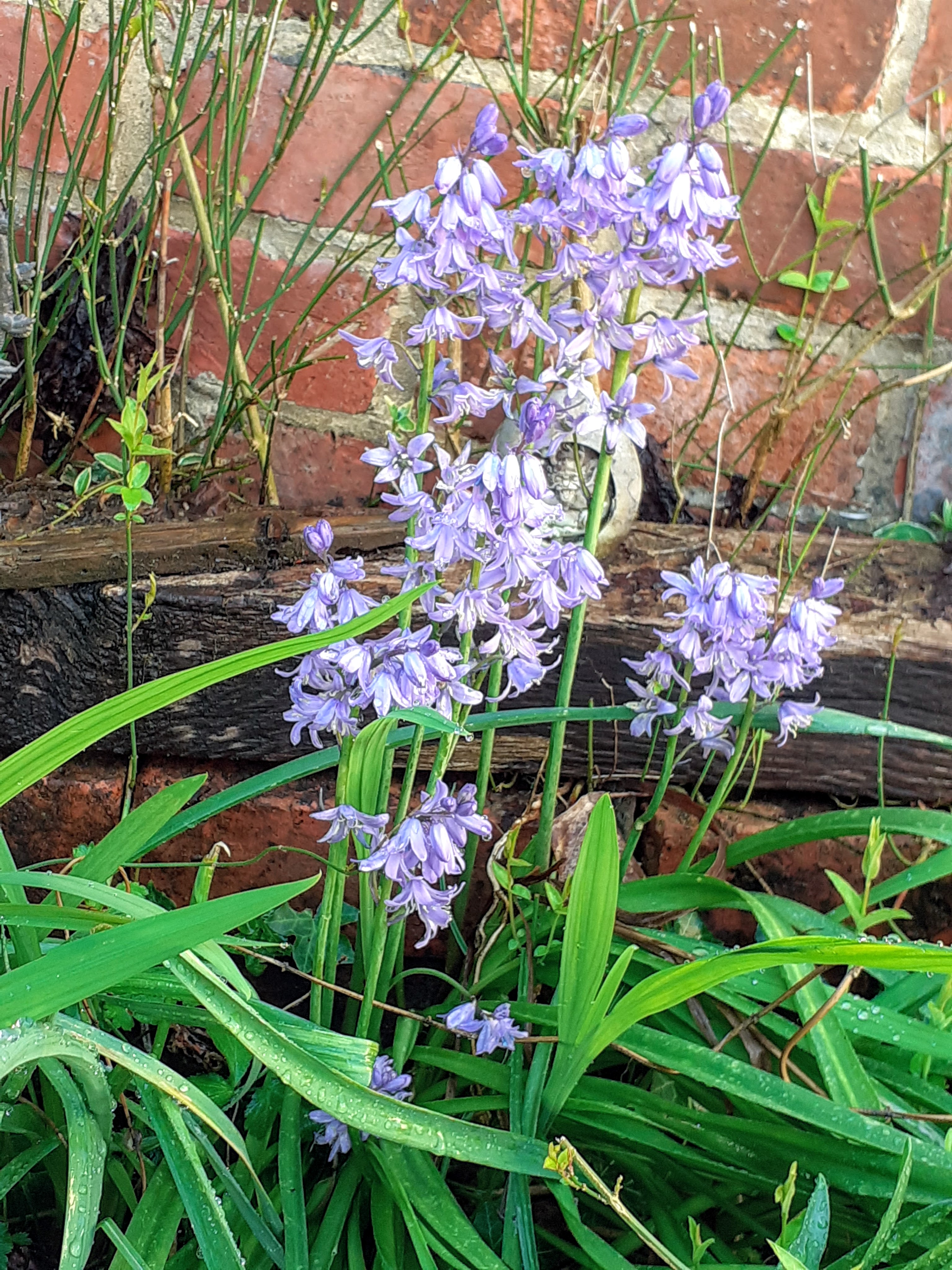
My personal connection with the tree itself is limited. It concerns this time of year and the association with bluebells. Indeed the bluebell is my main focus, with the beech as complementary. If they are separated, I follow the bluebell, and the picture below is a recent one, of the Spanish variety, from our garden. For me, it represents a favourite moment in the year, to be appreciated while it lasts. It reminds me simultaneously of the poignancy of impermanence (including my own) and the beauty of the eternal present (within which I am held).

(1) This mandala is based on my personal experience of trees in the neighbourhood as well as traditional lore. Moving around the summer quarter from Beltane, 1 May, the positions and dates of the four trees are: Hawthorn, south-east, 1-23 May; Beech & Bluebell, south-south-east, 24 May – 15 June; Oak, south, 16 June – 8 July; Gorse, south-south-west, 9 – 31 July. The autumn quarter then starts with Apple at Lughnasadh/Lammas. For a complete list of the sixteen trees, see https://contemplativeinquiry.blog/2020/autumn-equinox-2020-hazel-salmon-awen/

(2) John Matthews & Will Worthington The Green Man Oracle London: Connections, 2003.

Earth Eclectic

music that celebrates Earth and speaks to the heart

Sarah Fuhro Star-Flower Alchemy

Follow the Moon's Cycle

Muddy Feet

Meeting nature on nature's terms

Rosher.Net

A little bit of Mark Rosher in South Gloucestershire, England

Becoming Part of the Land

A monastic polytheist's and animist’s journal

selkiewife

Selkie Writing…

Charlotte Rodgers

Images and words set against a backdrop of outsider art.

Prof Jem Bendell

living with metacrisis and collapse

Towint

The pagan path. The Old Ways In New Times

The Druids Garden

Spiritual journeys in tending the living earth, permaculture, and nature-inspired arts

The Blog of Baphomet

a magickal dialogue between nature and culture

This Simple Life

The gentle art of living with less

Musings of a Scottish Hearth Druid and Heathen

Thoughts about living, loving and worshiping as an autistic Hearth Druid and Heathen. One woman's journey.

Wheel of the Year Blog

An place to read and share stories about the celtic seasonal festivals

Walking the Druid Path

Just another WordPress.com site

anima monday

Exploring our connection to the wider world

Grounded Space Focusing

Become more grounded and spacious with yourself and others, through your own body’s wisdom

The Earthbound Report

Good lives on our one planet

Hopeless Vendetta

News for the residents of Hopeless, Maine