Contemplative Inquiry

This blog is about contemplative inquiry

Tag: emptiness

LUGNASADH 2023: INQUIRY HARVESTING

A circle is cast on sand. It is almost complete. The image is that of the Wheel, tenth major trump in the Druidcraft Tarot (1). Arianrhod, as Goddess associated with the Wheel and the Milky Way, is casting the Circle of Life. The adjacent cave has resonances of both womb and tomb. The seashore is a liminal space. The Celtic Otherworld is often linked to the sea and what lies underneath its surface. This image as a whole is associated with harvesting. Arianrhod carries a flail as well as a wand and a symbolic eight-spoked wheel.

It is Lugnasadh/Lammas, the first harvest-related festival of 2023. I am sitting with the notion of ‘winnowing’ in my inquiry. In agriculture, winnowing involves blowing a current of air through grain to remove the chaff remaining after threshing. We find a reference to winnowing towards the end of the medieval Welsh poem The Hostile Confederacy from The Book of Taliesin (2):

“I have been a grain discovered,

Which grew on a hill.

He that reaped me placed me,

Into a smoke hole driving me.

Exerting of the hand,

In afflicting me,

A hen received me,

With ruddy claws, (and) parting comb.

I rested nine nights.

In her womb, a child,

I have been matured,

I have been an offering before the Guledig.

I have been dead, I have been alive.

A branch there was to me of ivy,

I have been a convoy.

Before God, I have been poor.”

It seems that winnowing (or being winnowed) is far from an end point to our journeys. The processes of life go on, very likely in unexpected ways. Any state of peace has to be found within these processes, rather than in efforts to halt or break out of them.

At Lughnasadh 2023 I find myself at ease within Druidry, though I do also continue to refine lessons from other paths that enrich my practice of Druidry. The most significant, and the best embedded, is ‘interbeing’ as a spatial relationship and its temporal equivalent ‘impermanence’. It is like a kernel of grain I have winnowed from Mahayana Buddhism to grow into another life in my Druidry. The Druid soil is fertile for this purpose, as indicated through the image of the Wheel drawn on sand, and the passage from The Hostile Confederacy in The Book of Taliesin. For me, Thich Nhat Hanh simply provides a particularly persuasive languaging of this perspective.

He says (3): “The insight of interbeing is that nothing can exist by itself alone, that each thing exists only in relation to everything else … looking from the perspective of space, we call emptiness ‘interbeing’ [NB ’emptiness’ here = empty of a separate self] ; looking from the perspective of time we call it ‘impermanence’ … to be empty is to be alive, to breathe in and breathe out. Emptiness is impermanence, it is change. …When you have a kernel of corn and entrust it to the soil, you hope it will be a tall corn plant. If there is no impermanence, the kernel of corn will remain the kernel of corn forever and you will never have an ear of corn to eat. Impermanence is crucial in the life of everything”.

There is another level to this year’s inquiry harvest. Recently I have engaged more fully with the challenge of Thich Nhat Hanh’s understanding of the Mahayana emptiness teachings, which stand behind the interbeing/impermanence insight. In the light of this understanding he finds neither an individual nor a cosmic self – and hence no ultimate reality or ground of being. “Our notion of emptiness should be removed. It is empty”. Many teachers I have worked with in the past are on the other side of this debate, finding the Divine in ‘Presence’ (Eckhardt Tolle), Pure Awareness (Rupert Spira), and the ‘Clear Awake Space’ of Douglas Harding’s Headless Way. They find God as ‘No-Thing’. For Thich Nhat Hanh, no-thing is simply nothing.

I have been all over the place on this question, developing a language and practices compatible with both views, as I slipped and slid between them. This is fine in its way, but I have wanted some kind of resolution, if only to avoid the energy drain of uncertainty around something that matters to me and to many spiritual traditions. Tomas Sander, co-writing with Greg Goode (4) has also explored the Mahayana ’emptiness’ texts. He reports that “as a person who had been seeking truth and ultimate reality” he finds a “greater sense of ease” in the approach of these texts. Unlike Thich Nhat Hanh, he does not take away an active disbelief in a cosmic ground of being. Instead, he arrives at a relaxed unknowing, a place of ‘joyful freedom’. He says: “spiritual teachings tend to have notions of absolutes, which by their very nature seem to trump everything else. None of them can claim to have an absolute, transcendent truth on their side”.

Tomas Sander finds that “it was a wonderfully freeing moment to recognize that there is no one way that reality ‘really’ is, and therefore no way to miss out on it”. So he adopts different criteria for evaluating spiritual paths. “They need to prove themselves on the level of ordinary, conventional reality with practical questions like: who does the view serve and who is being marginalized? Is the view helpful, compassionate or humane?’ I have known of and entertained this view for some time, but it has only recently clicked with me as a good way of settling this question. Metaphysical speculation will no longer be part of my inquiry. This does indeed feel like winnowing, like blowing away the chaff. The promised harvest? Druidry as joyful freedom.

(1) Philip and Stephanie Carr-Gomm The Druidcraft Tarot: Use the Magic of Wicca and Druidry to Guide Your Life London: Connections, 2004 (Illustrated by Will Worthington)

(2) William F. Skene The Four Ancient Books of Wales Forgotten Books, 2007 (First published in Edinburgh 1868

(3) Thich Nhat Hanh The Other Shore: A New Translation of the Heart Sutra with Commentaries Berkeley, CA: Parallax Press, 2017

(4) Greg Goode and Tomas Sander Emptiness and Joyful Freedom Salisbury: Non-Duality Press, 2013 (Section written by Tomas Sander)
WHAT IS GIVEN

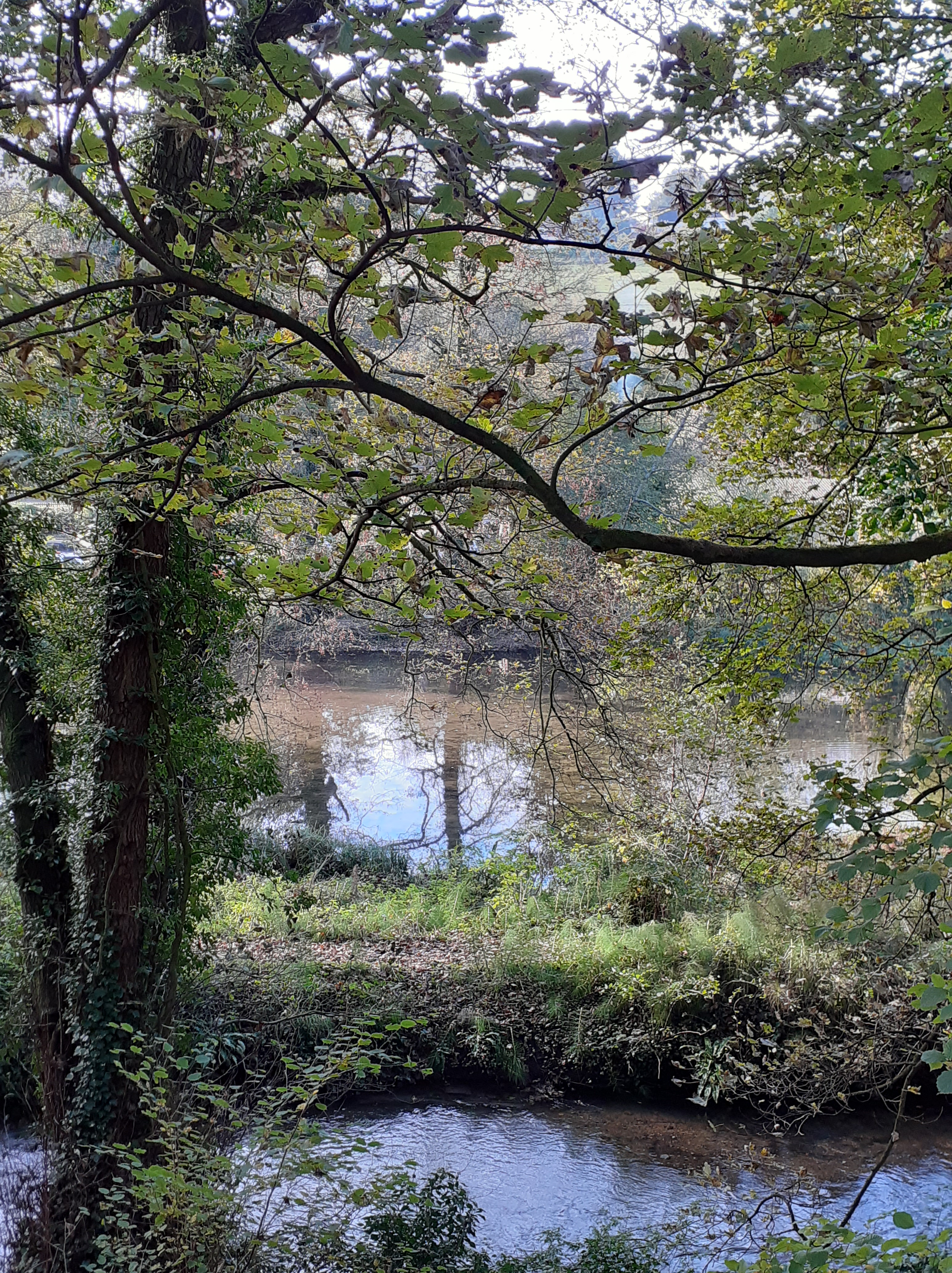
It is colder now, and gloomier indoors for much of the day. But outside, this November keeps on giving. My walking range has increased again with a walk to nearby Nailsworth, a leisurely lunch in this little town, and a walk back again: ten miles. The picture above includes both a stream beside my path and a small lake nearby.

But my attention hasn’t been all on the world around me. I have been reflecting on an old statement about my practice, currently included in my About section, and finding that it still holds. “My inquiry process overall has helped me to discover an underlying peace and at-homeness in the present moment, which, when experienced clearly and spaciously, nourishes and illuminates my life. It is not dependent on belief or circumstance, but on the ultimate acceptance that this is what is given. I find that this perspective supports a spirit of openness, an ethic of interdependence and a life of abundant simplicity.”

There is no reliance on metaphysics here. This allows me a pared down focus on experience and values. My practice has been relatively stable over a long period, whereas my thoughts about metaphysical questions are more volatile. I experience thinking as volatile by nature, and fine within its limits. Over the years this blog has found room for diverse approaches to the meaning, if any, of terms like divinity and consciousness. I have wondered about the possibility (or desirability) of establishing any foundational truth about absolute or indeed conventional ‘reality’. I notice now that when I explore these questions – especially when reading – I am more interested in seeing how people put their worlds together than I am in identifying insights or finding answers to the questions themselves. It has become a human interest rather than a philosophical quest.

I have noticed this especially over recent days when engaging with Carlo Rovelli’s discussion of the Buddhist philosopher Nagarjuna (1,2). My interest was in seeing how a distinguished physicist makes use of Nagarjuna’s emptiness doctrine. I have less stake in assessing the view itself, because my peace and at-homeness are the result of an experiential inquiry, and not of speculative thinking. I continue to find that this perspective supports “a spirit of openness, an ethic of interdependence, and a life of abundant simplicity”, My inquiry focus, if ‘inquiry; is even the right word, is about how best to walk the talk.

(1) Carlo Rovelli Helgoland global.penguinrandomhouse.com 2020 (Translated by Erica Segre & Simon Carnell, 2021). Carlo Rovelli is a theoretical physicist who has made significant contributions to the physics of space and time.

(2) https://contemplativeinquiry.blog/2021/11/08/exploring-emptiness-carlo-rovelli-and-nagarjuna

EXPLORING ‘EMPTINESS’: CARLO ROVELLI AND NAGARJUNA

A modern western humanist learns from an ancient Buddhist philosopher. Carlo Rovelli’s book Helgoland (1) is mostly about the development of quantum mechanics in the early to mid-twentieth century and the scientists who developed it. The title references ‘Werner Heisenberg’s sojourn on the remote island of Helgoland working on the maths. But one chapter concerns the second century CE Buddhist philosopher Nagarjuna, and how his work has helped Rovelli to frame a philosophical understanding of quantum phenomena.

“When speaking about quanta and their relational nature I had frequently met people who asked: Have you read Nagarjuna? … Though not widely read in the West, the work in question is hardly an obscure or minor one: it is one of the most important texts in Buddhist philosophy. … The central thesis of Nagarjuna’s book is simply that there is nothing that exists in itself, independently from something else.

“The resonance with quantum mechanics is immediate. Obviously Nagarjuna knew nothing, and could not have imagined anything, about quanta – that is not the point. The point is that philosophers offer original ways of re-thinking the world, and we can employ them if they turn out to be useful. The perspective offered by Nagarjuna make perhaps make it a little easier to think about the quantum world (2).

“If nothing exists in itself, everything exists only through dependence on something else, in relation to something else. The technical term used by Nagarjuna the absence of independent existence is ‘emptiness’ (sunyata): things are ‘empty’ in the sense of having no autonomous existence. They exist thanks to, as a function of, with respect to, in the perspective of, something else.

“If I look at a cloudy sky – to take a simplistic example – I can see a castle and a dragon. Does a castle and does a dragon really exist, up there in the sky? Obviously not: the dragon and the castle emerge from the encounter between the shape of the clouds and the sensations and thoughts in my head; in themselves they are empty entities, they do not exist. So far, so easy. But Nagarjuna also suggests that the clouds, the sky, sensations, thoughts and my own head are equally things that arise from the encounter with other things: they are empty entities.

“And myself, looking at the star, do I exist? No, not even I. So who is observing the star? No one says Nagarjuna. To see a star is a component of that set of interactions that I normally call my ‘self’. ‘What articulates language does not exist. The circle of thoughts does not exist.’ There is no ultimate or mysterious essence to understand that is the true essence of our being. ‘I’ is nothing other than the vast and interconnected set of phenomena that constitute it, each one dependent on something else. Centuries of Western speculation on the subject, and on the nature of consciousness, vanish like morning mist.

“Like much philosophy and much science, Nagarjuna distinguishes between two levels: conventional, apparent reality with its illusory and perspectival aspects, and ultimate reality. But in this case the distinction takes us in an unexpected direction: the ultimate reality, the essence, its absence, is vacuity. It does not exist.

“If every metaphysics seeks a primary substance, an essence on which everything may depend, the point of departure from which everything follows, Nagarjuna suggests that the ultimate substance, the point of departure … does not exist.

….

“The illusoriness of the world, its samsara, is a general theme of Buddhism; to recognize this is to reach nirvana, liberation and beatitude. For Nagarjuna, samsara and nirvana are the same thing: both empty of their own existence. Non-existent.

“So is emptiness the only reality? Is this, after all, the ultimate reality? No, writes Nagarjuna, in the most vertiginous chapter of the book: every perspective exists only in interdependence with something else, there is never an ultimate reality – and this is the case for his own perspective as well. Even emptiness is devoid of essence: it is conventional. No metaphysics survives. Emptiness is empty.

“Nagarjuna has given us a formidable conceptual tool for thinking about the relationality of quanta: we can think of interdependence without autonomous essence entering the equation, In fact interdependence – and this is the key argument made by Nagarjuna, requires us to forget all about autonomous essences.

“The long search for the ‘ultimate substance’ in physics has passed through matter, molecules, atoms, fields, elementary particles … and has been shipwrecked in the relational complexity of quantum field theory and general relativity. Is is possible that a philosopher from ancient India can provide us with a conceptual tool with which to extricate ourselves?”

“The fascination of Nagarjuna’s thought goes beyond questions raised by contemporary physics. His perspective has something dizzying about it. It resonates with the best of much Western philosophy, both classical and recent. … He speaks about reality, about its complexity and comprehensibility, but he defends us from the conceptual trap of wanting to find it an ultimate foundation.

“His is not metaphysical extravagance: it is sobriety. It recognizes the fact that to inquire about the ultimate foundation of everything is to ask a question that perhaps simply does not make sense.

“This does not shut down investigation. On the contrary, it liberates it. Nagarjuna is not a nihilist negating the reality of the world, and neither is he a sceptic denying that we can know anything about that reality. The world of phenomena is one that we can investigate, gradually improving our understanding of it. We may find general characteristics. But it is a world of interdependence and contingencies, not a world that we should trouble ourselves attempting to derive from an Absolute.

“I believe that one of the greatest mistakes made by human beings is to want certainties when trying to understand something. The search for knowledge is not nourished by certainty: it is nourished by a radical absence of certainty. Thanks to the acute awareness of our ignorance, we are open to doubt and can continue to learn and learn better. This has always been the strength of scientific thinking – thinking born of curiosity, revolt, change. There is no cardinal or final fixed point, philosophical or methodological, with which to anchor the adventure of knowledge.

“I am not a philosopher; I am a physicist: a simple mechanic. And this simple mechanic, who deals with quanta, is taught by Nagarjuna that it is possible to think of the manifestation of objects without having to ask what the object is in itself, independent from its manifestations.

“But Nagarjuna’s emptiness also nourishes an ethical stance that clears the sky of the endless disquietude: to understand that we do not exist as autonomous entities helps us free ourselves from attachments and suffering. Precisely because of its impermanence, because of the absence of any absolute, the now has meaning and is precious.

“For me as a human being, Nagarjuna teaches the serenity, the lightness and the shining beauty of the world: we are nothing but images of images. Reality, including ourselves, is nothing but a thin and fragile veil, beyond which … there is nothing.”

(1) Carlo Rovelli Helgoland global.penguinrandomhouse.com 2020 (Translated by Erica Segre & Simon Carnell, 2021) Carlo Rovelli is a theoretical physicist who has made significant contributions to the physics of space and time.

(2) The Fundamental Wisdom of the Middle Way: Nagarjuna’s Mulamadhyamakakarika: Translation and commentary by Jay L. Garfield. Oxford: The University Press, 1995. Nagarjuna, who lived in South India in approximately the second century CE, is the most important, influential and widely studied Mahayana Buddhist philosopher. At the time of publication Jay L. Garfield was Professor of Philosophy and Director of the Hampshire in India Program, an exchange program with the Tibetan Universities in exile, at Hampshire College, Amherst, Massachusetts. His translation is from a Tibetan, rather than Sanskrit, text.

DOUGLAS HARDING: THE MIRACLE OF EXISTENCE

“Besides the countless particular miracles that we comprise, there is that supreme irregularity – the fact that anything exists at all. Most unnaturally, there is not just Nothing. How adroit for It to happen! How deserving of our congratulations It is, for having arranged its quite impossible existence! After that, what are a few billion universes more or less.”

These words are from Douglas Harding’s epilogue to The Hierarchy of Heaven & Earth (1) published on the recommendation of C. S. Lewis, distinguished scholar and Inkling. Lewis’ introduction places it among “philosophies that have some of the same qualities as works of art”, and he is reminded in that respect of Hermann Hesse’s Glass Bead Game.

Harding describes his work as “an unconventional attempt to discover, for myself and in my own way, what I am and what I amount to in the universe. What am I? That is the question. Let me answer it as honestly and simply as I can, forgetting the ready-made answers.”

Harding also has the courage to declare that he has not found an answer. Instead, he has entered a state of “amazed reverence” that reveals his whole inquiry as both “absurd” and “a needful absurdity”. He finds that “because all my roots are in the Undiscoverable, I also am undiscoverable: I will not bear inspection, and can never make head or tail of myself. Self-knowledge is the smouldering wick that is left after the light of wonder has been put out. … If this book quenches the feeblest flame of awe, of direct awareness, in myself or anyone else, then it were better never to have written it”.

Harding did not end his inquiry with The Hierarchy of Heaven & Earth. Instead, he went on to become a midwife of direct awareness, and The Headless Way (https://www.headless.org) was born. Where The Hierarchy of heaven & Earth is concerned with exuberant yet disciplined system building, Harding’s later work challenges each of us to ‘look for yourself’ using a set of experiments, now accessible on The Headless Way website. I reported an early, intensive experience of them on return from a four day retreat with the Headless Way in 2016 – https://contemplativeinquiry.blog/2016/07/28/look-for-yourself/ Interestingly, my wrap-around commentary, especially the post-workshop phase, would now be a little different from the one in that post, while my report of the direct experience remains the same. In my current practice, I particularly draw on a seven point version of the experiments presented in Head Off Stress (2).

I never met Douglas Harding in person – my discovery of the Headless Way is too recent. But his writing and recorded material show never-ending wonder at the miracle of existence. They also show his passion for facilitating a transformative recognition of who we really are, and then to live from that recognition.

“I certainly don’t find myself

on the brink of a bottomless abyss,

trying to make up my mind

whether to let go and take that dreadful plunge.

I am already clear of the brink

and free-falling,

and have never been otherwise.

To see this,

all I have to do is look for myself,

and fail to find myself, and find instead

the treasure that has no name

in the well

at the world’s end.”

(1) D. E. Harding The Hierarchy of Heaven & Earth London: The Shollond Trust, 2011 Introduction by C. S. Lewis. (Abridged edition – original edition published by Faber & Faber in 1952)

(2) D. E. Harding Head Off Stress: Beyond the Bottom Line London: The Shollond Trust, 2009 (Originally published by Arkana in 1990)

(3) Douglas Harding Everyday Seeing: daily meditations on the One within London: The Shollond Trust, 2019 (Quotations selected by Richard Land)

MUSICAL MEDITATION: THE SHAKUHACHI FLUTE

Shakuhachi flute music is a meditation for players and listeners alike. It is dance of sound and silence, of movement and stillness. Some people call it, ‘blowing Zen’. In this music, a rise and fall of notes gives way to space and stillness, which in turn give way to a rise and fall of notes. Eckhardt Tolle identifies shakuhachi flute music as a portal to the experience of consciousness being conscious of itself – and so a direct realization of what he calls the Deep I.

Bamboo flutes first came to Japan from China in the 7th century CE (1). The current shakuhachi was developed in Japan in the16th century. It is called fuke shakuhachi because of the instrument’s role in the Fuke sect of Japanese Zen Buddhism. Monks known as komusu (priests of nothingness, or emptiness monks) who used the shakuhachi as a spiritual tool. Their songs were paced according to the players’ breathing and were considered meditation as much as music.

Their spiritual practice required them to move from place to place playing the shakuhachi and begging for alms. The monks wore wicker baskets over their heads, as a symbol of their detachment from the world. But the world being the place that it is, it was more like a semi-detachment. Travel around Japan was restricted by the Shogunate at that time, and the Fuke only got their exemption by agreeing to spy for the authorities and allowing the Shogun to send out his own spies in the guise of Fuke monks. In response to these developments, several particularly difficult shakuhachi pieces became known as tests. If you could play them, you were a real Fuke. If you couldn’t, you were probably a spy and might very well be killed in unfriendly territory. With the Meiji Restoration, beginning in 1868, the Fuke sect was abolished along with the Shogunate itself, and shakuhachi playing was banned for a number of years.

The Wikipedia article on shakuhachi (1) provides information about the instrument and its capabilities, as well as its current international popularity and the formal link with Zen broken.. There is an International Shakuhachi Society which maintains a directory of notable professional, amateur and teaching shakuhachi players.

(1) https://en.wkipedia.org/wiki/Shakuhachi/ (NB This reference gets you to a page where you will need to type in Shakuhachi)

DANCING SEAHORSES II

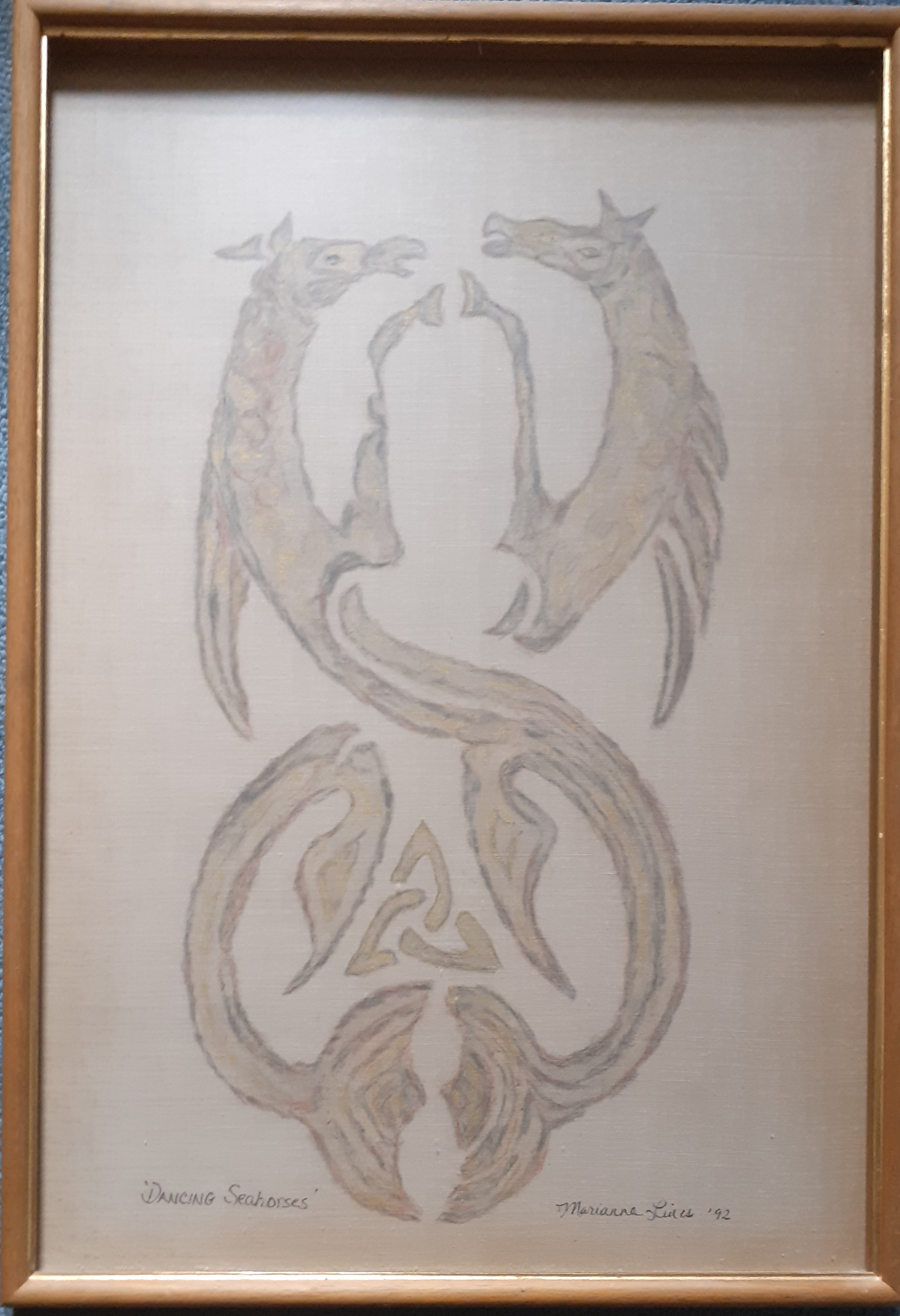
I have already written about the Dancing Seahorses image (1) found on a Pictish stone from Aberlemno in the Scottish county of Angus. After seeing the stone on a visit there, in 1992, I bought Marianne Lines’ painting. I have felt strongly involved with this image ever since. I think of it as a friend and guide. In a sense, this post is about the modern use of archaic images by people, like Druids, who are drawn to them.

I do not know the intentions of the original carver. beyond celebrating beings who are half of this world, half of the otherworld, and who embody powerful water energies for Celtic peoples on the Atlantic coasts of Britain, Ireland and Brittany in ancient times. They are remembered in folklore to this day. I do know that the carving made a strong impression on me, when I first saw it on the stone itself. It stayed in my imagination, and over time has deepened and grown new meanings.

Four years after acquiring the painting, I had the image tattooed on each arm. By that time I knew of the way in which it had influenced the cover design for R. J. Stewart’s The Prophetic Vision of Merlin (2). This variant form was used to refer to the story of the young Merlin at Vortigern’s subsidence prone tower in Snowdonia, prophesying his way out of becoming a human sacrifice, and identifying two contending dragons under the foundations. In the book illustration, there is a yin-yang reference, with a suggestions of interdependent primal forces, each of which already contains the seed of the other, seeking balance and alignment. In the Western Mysteries quest for healing and transfiguration, the energy bodies of the land and of humans are deeply interwoven.

There is another, more recent level of understanding, that I derive from the painting and tattoos, but not evident in The Prophetic Vision of Merlin. I see both the dancing seahorses and a second image, behind and containing the immediately apparent one. As I wrote before, “the space where the horses legs are raised defines a shape, suggesting a head. The very emptiness there is a paradoxical mark of presence. To me it became the head of a goddess, with the seahorses then becoming her body. Still clearly appearing as a water being, her arms – if they are arms – are raised in blessing”. I would now add that in this way, she demonstrates the dance of emptiness and form. They are balanced. Neither is privileged over the other. The Celtic knot points both to interconnection and infinity.

I identified the Goddess whilst gazing directly at the original Dancing Seahorses picture, which hangs of a wall directly above my altar. However I believe I received a subconscious nudge from the High Priestess card in The Druidcraft Tarot (3). She wears the image herself. Her hands are raised. She stands as the Goddess. In the Druidcraft narrative, she “represents the magical power of stillness and depth”. For me, the Goddess in Dancing Seahorses represents the ultimate union of emptiness and form, and the rebirth of the cosmos in each moment. Her representation combines the aware potential of the void and a primal aquatic generativity that can inhabit other elements. The Druidcraft priestess is human, but one who wears an image that bespeaks the divine to me, and her role asks for “stillness and depth”.

In my work, the entry into stillness and depth is, firstly, to enter into I-Thou communion with the primal Goddess (Modron) and then to recognise my own true nature, as (mythically) her divine child (Mabon) – sensitive and busted open to the world. This recognition becomes a prayer of gratitude and a surrender of my passing private concerns to Who I really am.

Words and pictures are not enough, but, cherished and contemplated lovingly over time, together they can point the way..

(1) https://contemplativeinquiry.blog/2020/06/25/dancing-seahorses/

(2) R. J. Stewart The Prophetic Vision of Merlin London & New York: Arkana, 1986

(3) Philip & Stephanie Carr-Gomm The Druidcraft Tarot: Use the Magic of Wicca and Druidry to Guide Your Life London: Connections, 2004 (Illustrated by Will Worthington)

PHILIP CARR-GOMM: DELICIOUS EMPTINESS

I attach a link to Philip Carr-Gomm’s podcast Delicious Emptiness, in his Tea with a Druid series. The series is produced by the Order of Bards Ovates and Druids (OBOD) which Philip led for over thirty years. The podcast beautifully describes meditation as a means of cultivating ‘delicious emptiness’ and its possible fruits. Highly recommended. OBOD can be found on http://www.druidry.org/ .

THE PASSAGE OF TIME

The years roll on, with ever increasing speed. This is me in 1952, sitting to have my picture taken in a photographer’s studio. I just about remember the occasion as a significant event, for which I was carefully dressed and coached. I am pleased to report that this eager, inquisitive (if slightly anxious?) boy has never died, though at times he is hard to find. His image reminds me of the magical, light bringing child in each of us, whatever else we have become. Buried, it may be. Wounded, confined or hiding, in some cases, at some times. But still there, still embodied in old and hidden places, awaiting renewed recognition and love.

This is midwinter and a time of reminiscing and stocktaking. On 20 December 2019 I wrote: “I’m peering in to the 2020s. Calendar numbers might be arbitrary, but they are numbers of power in our culture. They award shape and identity to years and decades. Part of me sees the 2020s as pure science fiction, with an increasingly dystopian tilt. Themes of alarm, determination, resourcing and resilience come up for me at multiple levels”. (https://contemplativeinquiry.blog/2019/12/20/approaching-the-years-turn/).

At that time I undertook to give more attention to the wheel of the year, and to cultivate certain values: lovingkindness; positive health and well-being; a life of abundant simplicity; and a spirit of openness, creativity and wisdom (https://contemplativeinquiry.blog/2019/12/27/values-for-2020). Sometimes during the year I have been on point and sometimes I have not. I do feel overall that these were good choices for the year of Covid-19 and I have at least paid them conscious attention.

I do not approach 2021 with new and different thinking. I expect it to be another challenging year, especially in the early months, no doubt in a slightly different way. I will bring the same approach to 2021 as to 2020, perhaps enhancing the qualities of simplicity and openness, leaning more towards the centre rather than the periphery of the wheel. This could be the role of the elder within. There is room both for youth and age in one person.

DRAGONS, ARCHETYPES & STORYTELLING

Extract in which Ursula K. Le Guin looks at the creative evolution of her six Earthsea books. The focus is on new perspectives in the fourth book, Tehanu.

“In Tehanu, Tenar is brushing her hair on a windy dry morning, so that it crackles and makes sparks, and the one-eyed child Therru is fascinated, seeing what she calls ‘the fire flying out all over the sky’.

“At that moment, Tenar first asked herself how Therru saw her – saw the world – and knew that she did not know; that she could not know what one saw with an eye that had been burned away. And Ogion’s words – ‘they will fear her’ – returned to her, but she felt no fear of the child. Instead, she brushed her hair again, vigorously, so the sparks would fly, and once again, she heard the little husky laugh of delight.

“Soon after this scene, Tenar herself has a moment of double vision, seeing with two different eyes. An old man in the village has a beautiful painted fan; on one side are figures of lords and ladies of the royal court, but on the other side, usually hidden against the wall:

Dragons moved as the folds of the fan moved. Painted faint and fine on the yellowed silk, dragons of pale red, blue, green moved and grouped, as the figures on the other side were grouped, among clouds and mountain peaks.

‘Hold it up to the light’, said old Fan.

She did so, and saw the two sides, the two paintings, made one by the light flowing through the silk, so that the clouds and peaks were the towers of the city, and the men and women were winged, and the dragons looked with human eyes.

‘You see?’

‘I see,’ she murmured.

“What is this double vision, two things seen as one? What can the blinded eye teach the seeing eye? What is the wilderness? Who are the dragons?

“Dragons are archetypes, yes; mind forms, a way of knowing. But these dragons aren’t St. George’s earthly worm, nor are they the Emperor of China’s airy servant. I am not European, not Asian, and I am not a man. These are the dragons of a new world, and the visionary forms of an old woman’s mind. The mythopoeticists err, I think, in using the archetype as a rigid, filled mold. If we see it only as a vital potentiality, it becomes a guide into mystery. Fullness is a fine thing, but emptiness is the secret of it, as Lao Tze said. The dragons of Earthsea remain mysterious to me.”

(1) Ursula K. Le Guin Earthsea Revisited In Books of Earthsea: The Complete Illustrated Edition London: Gollanz, 2018 Illustrated by Charles Vess.

Earthsea Revisited is a printed version of a lecture delivered in 1992, in which Ursula K. Le Guin described the lifelong revisioning of gender and culture which changed her approach to storytelling. This evolution moved her decisively away from the traditional, masculine, ‘hero’s journey’ framework with which she started. Books of Earthsea brings together all six books, with additional stories and authorial reflections from different periods. Some of this work has been familiar to me for a long time, and some is new. I found it helpful to have all of the material collected in one volume.

THICH NHAT HANH ON LIVING BEINGS

In the extract below, Thich Nhat Hanh offers Buddhist thoughts, which seem to me to have considerable resonance for Druids, with their animist and earth-honouring perspective and their support for deep ecology.

“There is no absolute dividing line between animate and inanimate, between living matter and inert matter. In so-called inert matter there is life, and living beings are dependent on so-called inert matter. If we took the so-called inanimate elements out of you and me, we would not be able to live. We are made of non-human elements. This is what is taught in the Diamond Sutra, an ancient Buddhist text that could be considered the world’s first treatise on deep ecology. We cannot draw a hard distinction between human beings and other living beings, or between living beings and inert matter.

There is vitality in everything.

The entire cosmos is radiant with vitality.

“If we see the Earth as just a block of matter lying outside of us, then we have not yet truly seen the Earth. We need to be able to see that we are part of the Earth, and to see that the entire Earth is in us. The Earth is also alive; it has intelligence and creativity. … Looking with the eyes of non-discrimination, we can establish a very close relationship with the Earth. We look at the Earth with our heart and not with the eyes of cold reasoning. You are the planet, and the planet is you. The well-being of your body is not possible without the well-being of the planet. And that is why to protect the well-being of your body, we must protect the well-being of the planet. This is the insight of emptiness*.” (1)

  • To be empty, for Thich Nhat Hanh, is to be empty of a permanent, separate self. Hence ‘to be’ is to ‘inter-be’. He coined the word ‘inter-being’ to emphasise this point in his teaching.

(1) Thich Nhat Hanh The Art of Living London: Rider, 2017

Earth Eclectic

music that celebrates Earth and speaks to the heart

Sarah Fuhro Star-Flower Alchemy

Follow the Moon's Cycle

Muddy Feet

Meeting nature on nature's terms

Rosher.Net

A little bit of Mark Rosher in South Gloucestershire, England

Becoming Part of the Land

A monastic polytheist's and animist’s journal

selkiewife

Selkie Writing…

Charlotte Rodgers

Images and words set against a backdrop of outsider art.

Prof Jem Bendell

living with metacrisis and collapse

Towint

The pagan path. The Old Ways In New Times

The Druids Garden

Spiritual journeys in tending the living earth, permaculture, and nature-inspired arts

The Blog of Baphomet

a magickal dialogue between nature and culture

This Simple Life

The gentle art of living with less

Musings of a Scottish Hearth Druid and Heathen

Thoughts about living, loving and worshiping as an autistic Hearth Druid and Heathen. One woman's journey.

Wheel of the Year Blog

An place to read and share stories about the celtic seasonal festivals

Walking the Druid Path

Just another WordPress.com site

anima monday

Exploring our connection to the wider world

Grounded Space Focusing

Become more grounded and spacious with yourself and others, through your own body’s wisdom

The Earthbound Report

Good lives on our one planet

Hopeless Vendetta

News for the residents of Hopeless, Maine