Contemplative Inquiry

This blog is about contemplative inquiry

Tag: Education

BOOK REVIEW: ELEGANT SIMPLICITY
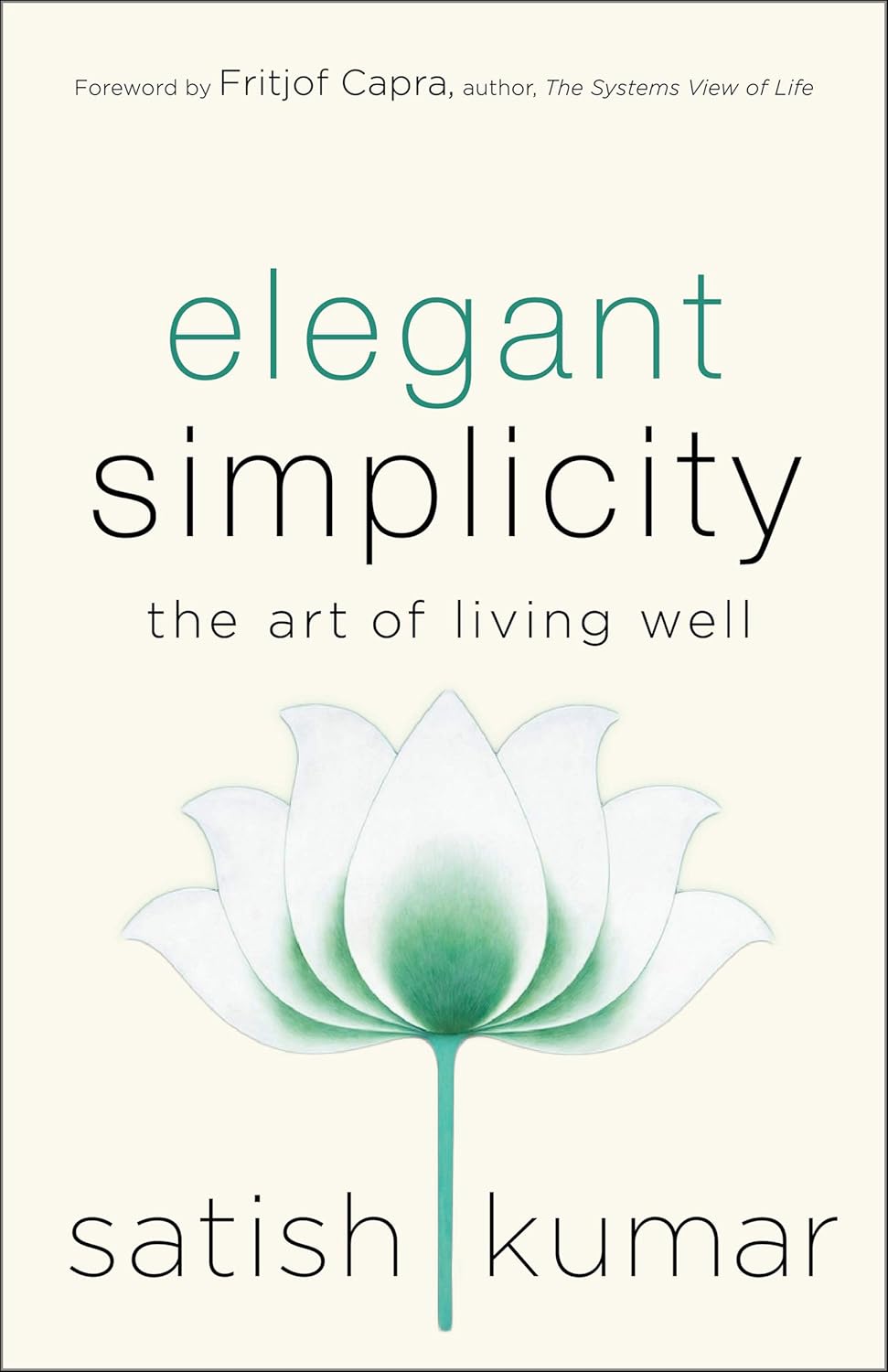
Highly recommended. Satish Kumar (born in 1936) published Elegant Simplicity: the Art of Living Well in 2019 (1). It begins with a foreword by Fritjof Capra and a preface by the author Let’s be Simple which quotes the 1848 Shaker song ‘Tis the gift to be simple, ‘Tis the gift to be free. The book summarises the author’s personal story as well as discussing his values. I have written posts based on some of his other work before (2). I especially recommend this book to anyone interested in knowing more about Satish Kumar’s practice (grounded in Jain spirituality and Gandhi’s non-violent activism) and his influence on deep ecology, creative arts and education.

Elegant Simplicity has a summarising quality, looking back on decades devoted to sacred activism in different forms. It is divided into fourteen chapters: Each is preceded by a brief and relevant quotation from another thinker. The chapter then becomes a meditation on the quote:

1 My Story: Beginnings – ‘True happiness lies in contentment’ Mahatma Gandhi.

2 Simplicity of Walking – ‘All truly great thoughts are conceived by walking’ Friedrich Nietzsche.

3 Life is a Pilgrimage – ‘Faith is not the clinging to a shrine but an endless pilgrimage of the heart’ Abraham Joshua Heschel.

4 Elegant Simplicity – ‘Any fool can make things complicated, it requires a genius to make them simple’ E. F. Schumacher.

5 A Society of Artists – ‘This world is but a canvas to our imagination’ Henry David Thoreau.

6 Yoga of Action – ‘Life is a process not a product’ Brian Goodwin.

7 Learning is Living – ‘Education is not preparation for life; education is life itself’ Thomas Dewey.

8 Right Relationships – ‘We are all related – relationships based on obligation lack dignity’ Wayne Dwyer.

9 Love Unlimited – ‘There is no charm equal to tenderness of the heart’ Jane Austin.

10 Power of Forgiveness – ‘It’s one of the greatest gifts you can give yourself, to forgive. Forgive everybody.’ Maya Angelou.

11 Dance of Opposites – ‘Life and death are one as the river and the sea are one’ Kahlil Gibran.

12 Deep Seeing – ‘To see clearly is poetry, prophecy, and religion, all in one’ John Ruskin.

13 Union of Science and Spirituality – ‘Science is not only compatible with spirituality; it is a profound source of spirituality’ Carl Sagan.

14 Soil, Soul and Society – ‘We live in an interconnected world and in an interconnected time so we need holistic solutions to our interconnected problems‘ Naomi Klein.

Fellow activist and author Vandana Shiva describes Elegant Simplicity as “the distillation” of Satish Kumar’s ideas and actions. “It shows the intimate connections between the inner and the outer world, soil, soul and society, beauty joy and non-violence. It indicates that the solutions to the big problems of our time – climate change, hate, violence, hopelessness and despair – lie in thinking and living with elegant simplicity, reducing our ecological footprint while enlarging our hearts and minds”.

For me, Satish Kumar is an inspiration rather than a direct model. Even in the conditions of the early 1960’s I would not have walked, or aspired to walk, from New Delhi to Washington DC without carrying any money. Yet Satish Kumar and his companion E. P. Menon succeeded and made a huge public impact at the time. Their peace pilgrimage gave oxygen to the campaign for nuclear disarmament. No state gave up its arms, but treaties limiting the numbers and testing of nuclear arms became normalised for some decades. Satish Kumar’s initiatives in deep ecology and education, especially the ‘small school’ and Schumacher College, have changed lives. Directly and indirectly, his influence has awakened many people from the dystopian trance of our dominant cultures. Satish Kumar is a widely revered elder: a peaceful warrior for a more liveable, generous and creative world.

(1) Satish Kumar Elegant Simplicity: The Art of Living Well New Society Publishers (https://www.newsociety.com): Gabriola Island, BC, Canada: 2019

(2) See previous posts:

NEWS OF A DEATH

TWO VIEWS OF THE DIVINE

OUTDOOR WALKING MEDITATION

NOTE: “Satish Kumar (born 9 August 1936)[1] is an Indian British activist and speaker. He has been a Jain monk, nuclear disarmament advocate and pacifist.[3]Now living in England, Kumar is founder and Director of Programmes of the Schumacher College international center for ecological studies, and is Editor Emeritus of Resurgence & Ecologist magazine. His most notable accomplishment is the completion, together with a companion, E. P. Menon, of a peace walk of over 8,000 miles in June 1962 for two and a half years, from New Delhi to MoscowParisLondon, and Washington, D.C., the capitals of the world’s earliest nuclear-armed countries.[4][5] He insists that reverence for nature should be at the heart of every political and social debate.” (Wikipedia)
BOOK REVIEW: STOLEN FOCUS

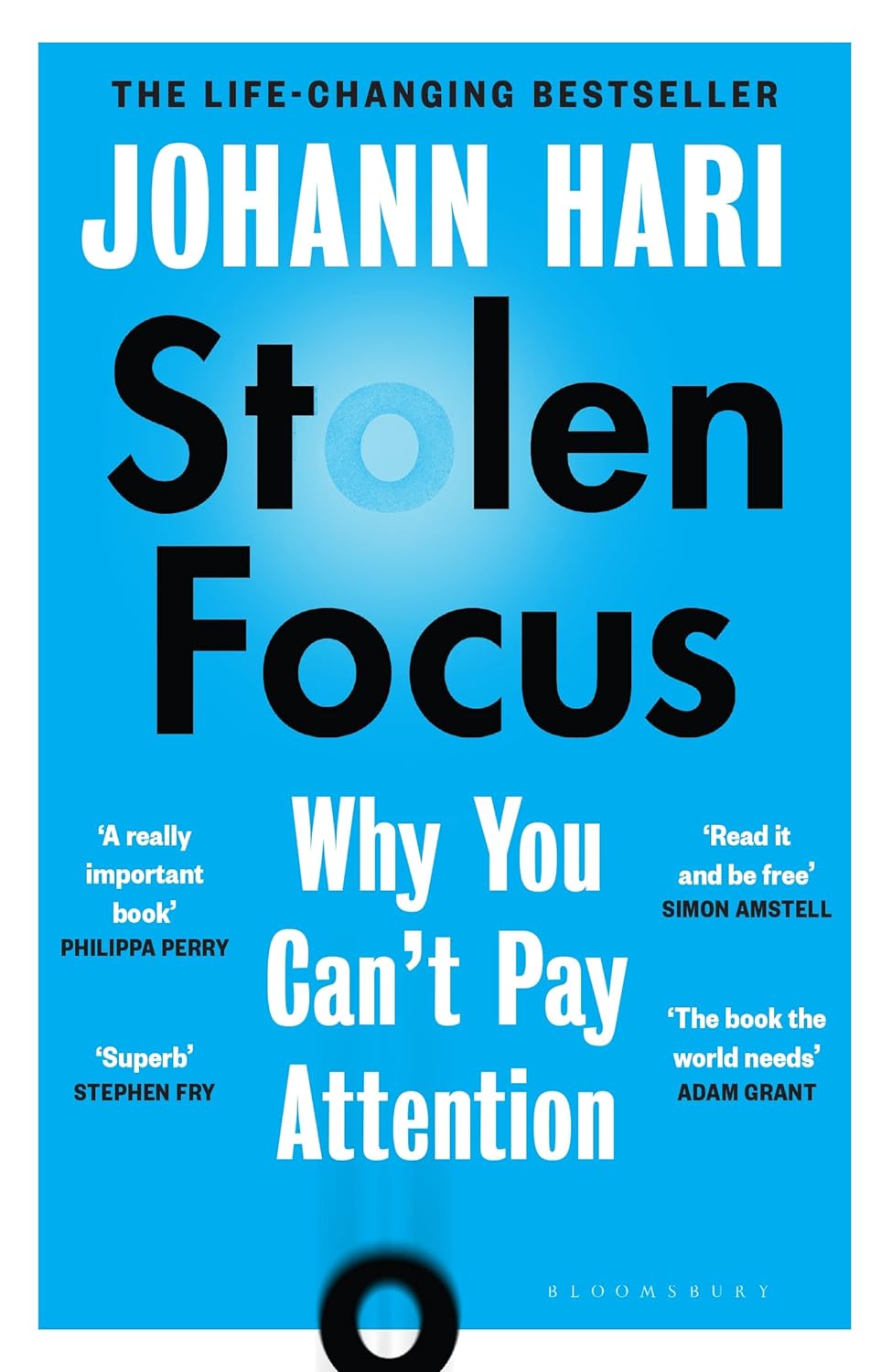
Highly recommended to anyone interested in states of attention, how culture shapes them, and the implications of this shaping. Johann Hari’s Stolen Focus: How You Can’t Pay Attention (1) shows that our diminished capacity to focus is a collective cultural issue and not just a matter of individual willpower. In this book, Hari identifies 12 causes of ‘stolen focus’, developing these themes partly through telling his personal story and partly through conversations with experts in the relevant areas of knowledge. The causes are:

1: Increase in Speed, Switching and Filtering. If we go too fast, and switch between tasks to rapidly, we overload our abilities, and they degrade.

2: Crippling of Flow States Fragmented focus interrupts flow. “Fragmentation makes you … shallower, angrier”, whereas “Flow makes you deeper … calmer”.

3: Rise in Physical and Mental Exhaustion The average amount of time a person sleeps is reducing, damaging our focus. If we stay awake for 19 hours straight we become as cognitively impaired as if drunk.

4: Collapse of Sustained Reading Fewer people are reading books, especially novels. Yet they train focus and encourage empathy. “Very few things worth saying can be explained in 280 characters.”

5: Disruption of Mind-Wandering, seen here not as a form of distraction but as a way of slowly making sense of the world that supports creativity and long-term decisions. Distractions undermine this process.

6: Tec That Can Trap and Manipulate You Big Tec’s business model depends on ‘engagement’ (eyes on screen) to facilitate exposure to advertising and the harvesting of personal data, to be used by the Tec companies themselves and also sold on to other would-be persuaders. Internet services are designed specifically to serve ‘engagement’ in this sense. Traffic is more readily stimulated by exposure to angry rather than calm content. Hence ‘surveillance capitalism’ engineers reactivity, anger and division.

7: Rise of ‘Cruel Optimism‘, a term for offering, in upbeat language, simplistic individual solutions to major social problems – like obesity and addiction. Internet addiction agitation and associated cognitive decline are looked at in the same way.

8: Surge in Stress and Triggering of Vigilance Research shows the top causes of stress for the working population of the USA to be “a lack of health insurance, the constant threat of lay-offs, lack of discretion and autonomy in decision-making, long working hours, low levels of organisational justice and unrealistic demands”. A cause of stolen focus is again linked to powerful external conditions..

9: Deteriorating Diets A widespread switch to supermarket bought processed foods has been “bad for our waistlines and our hearts” and is also “stealing large parts of our ability to pay attention”.

10 Rising Pollution We know that air pollution causes asthma and other breathing problems. There is also “growing evidence to suggest that this pollution is seriously damaging our ability to focus”.

11 ADHD and Our Response to It There has been a huge rise in diagnosed ADHD in school students in the last 30 years. It has been treated largely as a biological disorder, though this is now contested. Personal experiences and environmental conditions are being considered more seriously.

12 Confinement of Children – Physical and Psychological In the western world, children no longer roam free in their own world. Play is indoors and either supervised by adults or located on screens. Schools are largely concerned with preparing and drilling children for tests. This has serious consequences for both learning and focus.

In exploring ‘stolen focus’ and its causes, Johann Hari casts his net wide. In his conclusion, he talks about four levels of now-weakening attention: spotlight, when we focus on immediate actions; starlight, when we focus on projects and longer-term goals; daylight, which makes it possible to know what our longer-term goals are in the first place; and stadium lights, that let us see each other, hear each other, and work together to formulate and fight for common goals. Hari sees all of these lights being dimmed by stolen focus.

Hari advocates for an ‘attention rebellion’ in the manner of XR. Its three main demands would be: to ban surveillance capitalism, because people being “hacked and hooked” can’t focus’; to introduce a four-day week, because people who are chronically exhausted can’t pay attention; rebuild childhood around “letting kids play freely – in their neighbourhoods and at school” to promote a healthy ability to pay attention. He understands that this will be uphill work – the logic of economic growth demands more and more of our time devoted to producing and purchasing. Yet given the crises facing us, especially the climate crisis, we cannot afford the destruction of our attention and ability to think clearly.

This book is not just about big tec and social media. I like the range and quality of the information that Stolen Focus brings to the description and analysis of stolen focus. Hari is clear that self-help solutions – though they may help some people – are not enough. I believe that communities informed by deep ecology, spiritual and therapeutic insights can be oases of sanity and contribute to solutions. But without their being able to influence the mainstream, their impact is bound to be limited. Stolen Focus raises awareness very effectively. Whether or not an ‘attention rebellion’ is the right way forward,, Hari’s recommendations deserve to be taken seriously.

(1) Johann Hari Stolen Focus: Why You Can’t Pay Attention London: Bloomsbury Publishing, 2022 (Kindle edition 2023)

See also: https://contemplativeinquiry.blog/2024/06/13/stolen-focus-speed-switching-and-filtering/

Earth Eclectic

music that celebrates Earth and speaks to the heart

Sarah Fuhro Star-Flower Alchemy

Follow the Moon's Cycle

Muddy Feet

Meeting nature on nature's terms

Rosher.Net

A little bit of Mark Rosher in South Gloucestershire, England

Becoming Part of the Land

A monastic polytheist's and animist’s journal

selkiewife

Selkie Writing…

Charlotte Rodgers

Images and words set against a backdrop of outsider art.

Prof Jem Bendell

living with metacrisis and collapse

Towint

The pagan path. The Old Ways In New Times

The Druids Garden

Spiritual journeys in tending the living earth, permaculture, and nature-inspired arts

The Blog of Baphomet

a magickal dialogue between nature and culture

This Simple Life

The gentle art of living with less

Musings of a Scottish Hearth Druid and Heathen

Thoughts about living, loving and worshiping as an autistic Hearth Druid and Heathen. One woman's journey.

Wheel of the Year Blog

An place to read and share stories about the celtic seasonal festivals

Walking the Druid Path

Just another WordPress.com site

anima monday

Exploring our connection to the wider world

Grounded Space Focusing

Become more grounded and spacious with yourself and others, through your own body’s wisdom

The Earthbound Report

Good lives on our one planet

Hopeless Vendetta

News for the residents of Hopeless, Maine