Contemplative Inquiry

This blog is about contemplative inquiry

Tag: Ecosophy

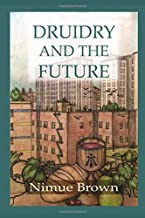
BOOK REVIEW: DRUIDRY AND THE FUTURE

Highly recommended. Druidry and the Future is intended as “antidote to despair” according to author Nimue Brown. She continues:
Druidry & Future 51hWUITk4HL._AC_UY218_ML3_

“This book explores the many ways in which the Druid path can help us to respond to climate chaos, necessary cultural change and political uncertainty. By mixing the spiritual and practical we can be more resilient and resourceful, and aspire to live in regenerative and generous ways.”

An affordably priced and relatively slender volume, Druidry and the Future is full of ideas. It is built around 16 essays covering diverse topics: working with Pagan stories: seasonal living: bardic powers; ‘pragmatic’ animism; working with the elements (three essays); de-colonising your soul; your body is nature; justice and balance; honouring the divine through action; putting ourselves back in the landscape; community solutions; self-care and kindness; trees and wetlands; regeneration and restoration. For me, there is a single overarching theme: enlisting the resources of modern Druid culture to build resilience in the face of climate catastrophe. This resilience includes personal and collective aspects, where humans and their communities are understood as wholly embedded in the wider web of life.

Nimue Brown is clear that “it is not enough to be sustainable”. The crisis invites, or rather requires, a radical change in values and behaviour. Human civilization is ‘just people’ and we have the capacity to live differently. For her, “this is what Druidry means right now. It’s about answering the question of how to put civilization in balance with our living planet. This is Druidry for radical change and I think we’re well placed to take on this work and to inspire others. Philosophy has always been part of Druidry, so has teaching and communication, inspiration and vision. We can, and must make a difference.”

ARNE NAESS AS PHILOSOPHICAL VAGABOND

“Naess embodies the spirit of philosophy in its original sense as being a loving pursuit of wisdom. It is a deep exploration of our whole lives and context in pursuit of living wisely. The essence of Socratic inquiry is to know ourselves. From his work on Pyrrhonian scepticism to his … positive statements on pluralism and possibilism, Naess says he is a ‘philosophical vagabond’ or ‘wandering seeker’, what the ancient Greeks called a zetetic’” (1).

In 1968 Arne Naess (1912-2009) published Scepticism (2) two years before resigning as chair of philosophy at the University of Oslo to devote himself to environmental problems. Part of this book focuses on Sextus Empiricus (150-225 CE), the last recorded Pyrrhonist philosopher in a line going back to Pyrrho of Elis (c360-c272 BCE).

Pyrrhonists, as described by Sextus Empiricus, neither made truth claims nor denied the possibility of making them. Instead, they cultivated a deeply embedded attitude of suspension of judgement (epoche), allowing possibilities to stand open within the process of continuing inquiry. Such a turning away from the drive for intellectual closure enables peace of mind (ataraxia) in our engagement with the richness and diversity of experience. As Naess says, the Pyrrhonist philosopher “leaves questions open, but without leaving the question. He has however given up his original, ultimate aim of gaining peace of mind by finding truth because it so happened that he came by peace of mind in another way.” (2)

Naess was not himself a Pyrrhonist, but clearly valued the Pyrrhonist frame of mind. He took something from it into his later work, as is made clear in Alan Drengson’s introduction to Naess’s Ecology of Wisdom (1):

“… there is never one definitive interpretation of philosophical texts; there is never one description of an event and all processes are complex interactions involving changing forces and relations, internal and external. Experience and the processes around us form changing patterns or gestalts. The nature of reality is multidimensional and creative. … Our spontaneous experience is so rich and deep that we can never give a complete account of it in any language, be it mathematics, science, music or art … As a deep questioner and seeker, Naess remains free of dogmatic and monolithic doctrine about the world … [which]  partly explains why he celebrates a movement supported by diverse people with many world views”.

I enjoy this view of inquiry, and feel inspired to carry it forward more consciously in my own work. My sense is that it will bring my inquiry more into the world, without its losing its contemplative core.

(1) Arne Naess Ecology of Wisdom UK: Penguin Books, 2016 (Penguin Modern Classic. First published 2008)

(2) Arne Naess Scepticism Abingdon, UK: Routledge, 1968

See also:

https://contemplativeinquiry.wordpress.com/2019/04/27/pyrrho-scepticism-arne-naess/

https://contemplativeinquiry.wordpress.com/2019/04/25/spiritual-truth-claims/


FACING EXTINCTION

My survival is on the line, along with any legacy and any memory of me. This applies to everyone I know and care for, and everyone else too. It applies to everything in culture and nature for which I have an affinity or to which I feel connected. Whenever I let this in, really let it in rather than just acknowledging it, I feel freshly shocked. Threat feels immediate. I have no sense of time.

After the first sense of a physical-energetic punch, there comes a pause, followed by a chaos of feelings, thoughts and images that stream for a while through my being. Eventually the storm passes. I regain some equilibrium, and with it a fuller presence in the flowing moment. There is something in the sheer joy of experiencing that remains unsullied and becomes my anchor. But I still need to ask myself how I stand with this awful knowledge, alongside another awful knowledge of the nuclear threat, and the normal knowledge of my own natural death. How do I respond to any of these? How, specifically, do I respond to ecological breakdown? The timescale here isn’t quite the possible ‘anytime’ of the other threats, and I may not be around. But it’s dangerously close, already compromising the life of the wider world. How do I hold this understanding? What do I do?

For me, this points to the value of psycho-spiritual as well as political work in facing the threat of a mass extinction on planet Earth. Last week I attended a promising taster for a forthcoming online course ‘Facing Reality’ (see https://www.livingfocusing.co.uk/ calendar). This will use Focusing methods to look at what ecological breakdown means “for your life, work and relationships. How is it impacting you? What happens when you take it in?”. It starts from the premise that “many of us are feeling overwhelmed and confused but it’s hard to know what to do about it. In response, we often either turn away or dive into action without seriously confronting our reality and giving enough space to feel into our emotional and intuitive response. By finding the courage to turn towards the mess we are in with a like-minded community, we can empower our response in a more authentic way and build personal agency for our creativity, gifts and action”.

The course leaders quote a saying to the effect that we can avoid reality, but not the consequences of avoiding reality. Courses like this are a good way of facing reality in a supportive environment, and I plan to be part of this one. This one is open to the public. You don’t need a Focusing training to take part.

PYRRHO, SCEPTICISM, ARNE NAESS

In my last post  https://contemplativeinquiry.wordpress.com/2019/04/25/spiritual-truth-claims/ ‎I introduced Pyrrho of Elis, a Pagan Greek philosopher who, returning from an extended visit to India, sounded a new note in Greek philosophy. In the Greek cultural context, this was heard as a variant form of Scepticism. Originally a skeptikos was “a seeker, one who inquires or examines, considers, deliberates etc.” (1) though over time Scepticism came to signify a kind of compulsive doubting, as it does now. The extract below shows the distinctiveness of Pyrrho’s project, and its likely debt to Buddhist ideas of the time.

“Pyrrhonism is commonly confused with Scepticism in Western philosophy. But unlike Sceptics, who believe there are no true beliefs, Pyrrhonists suspend judgement about all beliefs, including the belief that there are no true beliefs. Pyrrhonism was developed by a line of ancient Greek philosophers, from its founder Pyrrho of Elis in the fourth century BCE through Sextus Empiricus in the second century CE. Pyrrhonists offer no view, theory or knowledge about the world, but recommend instead a practice, a distinct way of life, designed to suspend beliefs and ease suffering. Since beliefs are attachments to what is not evident, they say, and are therefore distorting, uncertain, and subject to challenge and contradiction, they generate anxiety and fear, compounding suffering. By suspending judgement on beliefs, Pyrrhonists seek to liberate themselves from attachment to things nonevident; having achieved this, they claim a certain tranquillity (ataraxia) follows. Only appearances are evident, they say, these being sensations and thoughts which we cannot help having, which are involuntary, and it is by them rather than by our beliefs that we should live.

“Pyrrhonism bears a striking similarity to some Eastern non-dogmatic soteriological traditions, particularly Madhyamaka Buddhism. Indeed, its origins can plausibly be traced to the contacts between Pyrrho and the sages he encountered in India, where he travelled with Alexander the Great. Even though Pyrrhonism went on to develop in a Greek idiom without reference to Eastern traditions, the similarity is remarkable, suggesting a commonality of insight not much explored. Although Pyrrhonism has not been practised in the West since ancient times, its insights occasionally have been independently recovered, most recently in the work of Ludwig Wittgenstein. They remain relevant, perhaps more than ever, as an antidote to today’s cultures of belief.” (1)

Arne Naess, the Norwegian philosopher now associated with the the deep ecology movement and coiner of the term ‘ecosophy’, was a modern admirer of Pyrrhonism and wrote a book about it in 1968 (2). I intend to follow this up in my continuing inquiry, partly to find out how his engagement with Pyrrho and Greek Scepticism may have informed his later development..

  1. Adrian Kuzminski Pyrrhonism: How the Ancient Greeks Reinvented Buddhism New York: Lexington Books, 2008
  2. Arne Naess Scepticism Abingdon: Routledge, 2015 (First published 1968)

See also:

https://contemplativeinquiry.wordpress.com/2019/05/03/arne-naess-as-philosophical-vagabond/


Earth Eclectic

music that celebrates Earth and speaks to the heart

Sarah Fuhro Star-Flower Alchemy

Follow the Moon's Cycle

Muddy Feet

Meeting nature on nature's terms

Rosher.Net

A little bit of Mark Rosher in South Gloucestershire, England

Becoming Part of the Land

A monastic polytheist's and animist’s journal

selkiewife

Selkie Writing…

Charlotte Rodgers

Images and words set against a backdrop of outsider art.

Prof Jem Bendell

living with metacrisis and collapse

Towint

The pagan path. The Old Ways In New Times

The Druids Garden

Spiritual journeys in tending the living earth, permaculture, and nature-inspired arts

The Blog of Baphomet

a magickal dialogue between nature and culture

This Simple Life

The gentle art of living with less

Musings of a Scottish Hearth Druid and Heathen

Thoughts about living, loving and worshiping as an autistic Hearth Druid and Heathen. One woman's journey.

Wheel of the Year Blog

An place to read and share stories about the celtic seasonal festivals

Walking the Druid Path

Just another WordPress.com site

anima monday

Exploring our connection to the wider world

Grounded Space Focusing

Become more grounded and spacious with yourself and others, through your own body’s wisdom

The Earthbound Report

Good lives on our one planet

Hopeless Vendetta

News for the residents of Hopeless, Maine