
BOOK REVIEW: THE EARTH, THE GODS AND THE SOUL
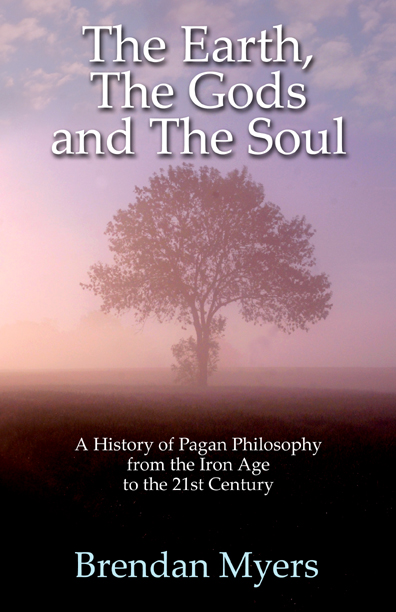 The Earth, the Gods and the Soul: a History of Pagan Philosophy, from the Iron Age to the 21st Century by Brendan Myers fully justifies the ambition of its title. I see it as a must-read for anyone with an interest in pagan ideas and culture – past and present. Part of the author’s mission is to demonstrate that “a pagan culture can be artistically vibrant, environmentally conscious, intellectually stimulating, and socially just”.
Myers provides useful working definitions of both ‘pagan’ and ‘philosophy’, whilst also showing the complexities involved in each term. He limits ‘pagan’ to people in the nations of the west and their predecessor societies in Europe and the Mediterranean, whose religion is non-Abrahamic (not Judaism, Christianity and Islam). This may now be complicated by patterns of migration and the Western impact of dharmic religions, but it works well enough if you are looking for a specific pagan tradition and its origins. Modern paganism, according to Myers, is informed by three families of ideas – pantheism, neo-Platonism, and humanism: these address the “immensities”, respectively, of Earth, Gods and Soul.
‘Philosophy’, for Myers, is an intellectual discipline that seeks answers to the ultimate questions about ‘life, the universe and everything’ using reason rather than the authority of dogma or an intuited divine source. He usefully lists 7 branches of this discipline: logic, ethics, epistemology, metaphysics, phenomenology, aesthetics and the history of ideas. Western philosophy’s origins are in Greece, and linked to the ‘know yourself’ injunction outside the temple of the Delphic Oracle. Myers sees this as a basic ethical demand for an honestly examined life, especially when wishing to enter the presence of a god. It leads to a wider view that self-knowledge heals, enlightens and empowers, though it may also at times judge and condemn.
The book is arranged as if musically, in an overture and six movements. The people chosen for inclusion are in many cases neither philosophers not pagans, and in many others only one of the two. But they have helped to define modern pagan ideas, culture and sensibility. Each movement covers a different historical period:
- A look at the old northern (‘barbarian’) world includes the Anglo-Saxon poem The Wanderer, Iceland’s Elder Edda, early writings about Druids, Irish wisdom texts and the Pelagian heresy (an early Christian heresy popular in the Celtic lands). There is no direct voice from a pagan culture in north west Europe, so Christians with half a foot in the old pagan world, or (in the case of the Druids) Greek and Roman authors are cited.
- A substantial collection of pagan Greek or Greek influenced philosophers from the early pre-Socratic period to the pagan martyr Hypatia of Alexandria. Also included are the Irish Christian neo-Platonist John Scotus Eriugena, and a section on the much later Italian renaissance. The people in this section, up to and including Hypatia, are both pagans (as we use that word today)and philosophers (in the ancient Greek understanding of that term).
- This movement is called ‘Pantheism in the Age of Reason’ and includes 18th century figures like John Toland, Edward Williams (aka Iolo Morganwg) and the Platonist and translator Thomas Taylor – as well as the more famous Jean-Jacques Rousseau. For the nineteenth century, we have Emerson, Thoreau, Whitman, Schopenhauer and Nietzsche.
- A movement on pagan ‘resurgence, reinvention and rebirth’ begins with Helena Blavatsky and the launch of 19th century Theosophy, going on to include J.G. Fraser of The Golden Bough, Robert Graves of The White Goddess, George William (A.E.) Russell of A Vision and Aleister Crowley. It goes on to look at the background to Gerard Gardner’s work and the Book of Shadows, then at the appearance of American Feminist Witchcraft and also at the separate stream of Eco-Spirituality and Deep Ecology.
- The fifth movement comprises ‘living voices’, so Stewart Farrar and Isaac Bonewits are placed at the end of the fourth, whereas Janet Farrar and Gavin Bone appear here. So too do Starhawk, Emma Restall-Orr, John Michael Greer, Vivianne Crowley, Michael York and Gus diZerega. There is also a section on ‘the critique of monotheism’. Myers praises Emma Restall-Orr for her work on ethics, its spirit of critical inquiry and her formal use of philosophical sources.
- Here we find Brendan Myers’ personal commentary. He talks about a hoped-for development of a critical tradition on paganism, and the value of ‘institutions’ in maintaining such a tradition. (He acknowledges that this may go somewhat against the grain of paganism as a dissident culture). He talks about modern to paganism’s history of ‘faulty ideas’, and promotes the development of better ideas for the future. He also celebrates the health of a ‘will to live in an enchanted world’. Myers has ‘no special teachings’ of his own. A declared pagan philosopher, he builds his personal inquiry around four questions: how shall I dwell upon the earth? How shall I converse with all people? How shall I emerge from my loneliness? How shall I face my mortality? He then goes on to discuss what these questions bring up for him.
Myers ends his book by saying: “the best music is made with humanity, integrity and wonder – everyone has instruments to hand … When I hear music I share it … when I make music I share it too … I hope that my people will celebrate with me and play along … when I make dissonant or offending sounds, I trust my people will warm me, so I can make amends … nothing more, perhaps, could be asked of anyone. And, perhaps, nothing less”.
The Earth, the Gods and the Soul is a well-informed and simply written history of pagan ideas, which tells modern pagans a lot about the shoulders we sit on. It is a great reference book. But what it did mostly for me was to get me thinking about my own relationship to philosophy and its working methods. I call my own journey a contemplative inquiry. How could I use tools from philosophy’s toolkit to improve my own inquiry in service of a pagan critical tradition? That’s where there’s an inspiration for me – because I sense an invitation there, from a professional philosopher, to make use of this toolkit. Myers’ forward includes a reference to Clear and Present Thinking, written by him with support from a number of University colleagues for a general audience, and freely downloadable. It’s another good job, and very useful to have.

 Contemplative Inquiry