Contemplative Inquiry

This blog is about contemplative inquiry

Tag: Eco-Spirituality

BOOK REVIEW: SOUL LAND

Highly recommended to anyone who values the poetry of place. Natalia Clarke’s Soul Land: Nature, Scotland, Love (1) is a chapbook featuring 22 poems about her connection with Scottish landscape. That connection is intense, and shared in these poems through a powerful and distinctive voice.

The poet grew up in Siberia, enjoying “immersive life and experiences with nature and magic” (2), before being exposed to “intense emotions of love and loss at a tender age”. Her journey took her to England and its publishing industry with a later shift into the field of psychotherapy and a personal spiritual awakening. This is the context for the visit to Scotland “that changed me on a profound level”. She fell in love with what she came to call her “Soul Land”.

In the poem Love Everlasting, she writes:

“My knees touched the greenness

of your body and in

awe I stood amidst a stone

circle feeling protected and

contained.

I lowered myself into your

cooling stream imagining I

washed myself anew”.

The words have both erotic and mystical resonances: perhaps it misses the point even to make the distinction. In another poem The Land of Me, she talks of the land “stealing my soul” and how this theft feels like “the gentlest fall into paradise”.

This is not a song of life and work within a landscape and the human culture it has shaped, and which has shaped it in turn. It is a personal I-Thou connection with a sacred space that the poet visits from time to time. Natalia Clarke is clear and sensitive about this, as shown in Through the Eyes of A Highlander, where we find a different consciousness of place, and in his case, its human history: “Where I see beauty he sees barren landscape … where I feel silence he shudders with sorrow”. Natalia Clarke knows that her sense of home, in this for her newly discovered land, is bound up with her own life and longing, and what she brings to the encounter.

In the later poems we find a closer observation of detail – “water silky soft and the colour of silver … green pine needles hitting my senses with clean potent fragrance”. The land feels more maternal – even, in a sense grandmaternal. In the poem In My Dreams You Visit Me the poet finds herself “transformed into the old Cailleach walking the hills and mountains with deer by her side”.

Natalia Clarke feels blessed in this wild space: “inhaling paradise, assured, grounded, humble, in your exquisite perfection”. Although led by her intuition and her feelings, she shows how her experience of the Scottish landscape has indeed grounded her.

“’All is well,’ the land whispers

into my soul spreading her

seasons around me”.

In a prose conclusion to the collection, Natalia Clarke also spells out the conceptual basis of her way of experiencing and relating. The key terms are ‘home’, ‘soul’s calling’ and ‘nature’. Home is “our secure ground, safety and knowing” with a feeling-tone that is “contented and contained”. She speaks here as a person who has lost her link with her “original motherland” and has needed to find ‘home’ elsewhere. A soul call is “very impulse driven, animalistic and instinctual”, asking us “to be more, to feel more” and join “something beyond yourself, new, meaningful and expansive”. Nature is not simply about solace. Deep understanding of nature can bring both peace and turmoil into our souls, “as processes are parallel within nature and if we tune into nature’s rhythms, we risk deeper understanding of ourselves”. True homecoming, the homecoming that involves soul, asks us to take risks as well as offering safety. For Natalia Clarke, Nature favours the brave.

(1) Soul Land: Nature – Scotland -Love Kibworth, UK: Matador, 2020

(2) https://rawnaturespirit.com/ (The collection can be ordered from this site by clicking on ‘publications’.)

DOG DAYS

The dog days of summer are by reputation hot, sultry and ill-aspected. As high summer becomes late summer, we can fall out of love with the season. We may find ourselves less comfortable than we would like to be, on the edge of storms that may or may not break. Nature can seem rank and overblown. Insect life is busy, in ways not always to our taste.

Yesterday I walked on the banks of our local canal between Stroud and Brimscombe. I had not done this walk since early March. At the height of the Covid crisis, I decided to leave the narrow towpath alone. For a long stretch of time through spring and summer this section of canal and I have gone our separate ways. It was early in the morning and not especially hot. The canal itself gave me my dog days feeling. What I noticed was a wild, rank fecundity, not conventionally photogenic. It is as if the space were resisting the (interrupted) attempts to make it navigable once again, sustainably beneficial to us. A different ecology had established itself. In my feelings, and imagination, the ‘dog days’ energy became a counterpoint to convenience conservation.

I like convenience, and I like walking on the towpath. I respect the restoration project, and the volunteers who are making it happen. I also respect the ever-renewing power of nature. I look at the picture below, where evidence of canal can barely be seen – just a suggestion on the far bank. I reflect that this stretch of water was once deep and wide enough for trows, traditional canal boats used on the Severn and Wye rivers. Brimscombe Port was as far east as they could go. The canal going on to Lechlade had a narrower gauge, and cargo had to be transferred to Thames barges. That early industrial world has long gone. The new development, whilst making inroads, has not yet ocupied this space. In the meantime, nature is free to be inconvenient, and to some people doubtless unsightly, whether we like it or not.

VARIETIES OF ONENESS

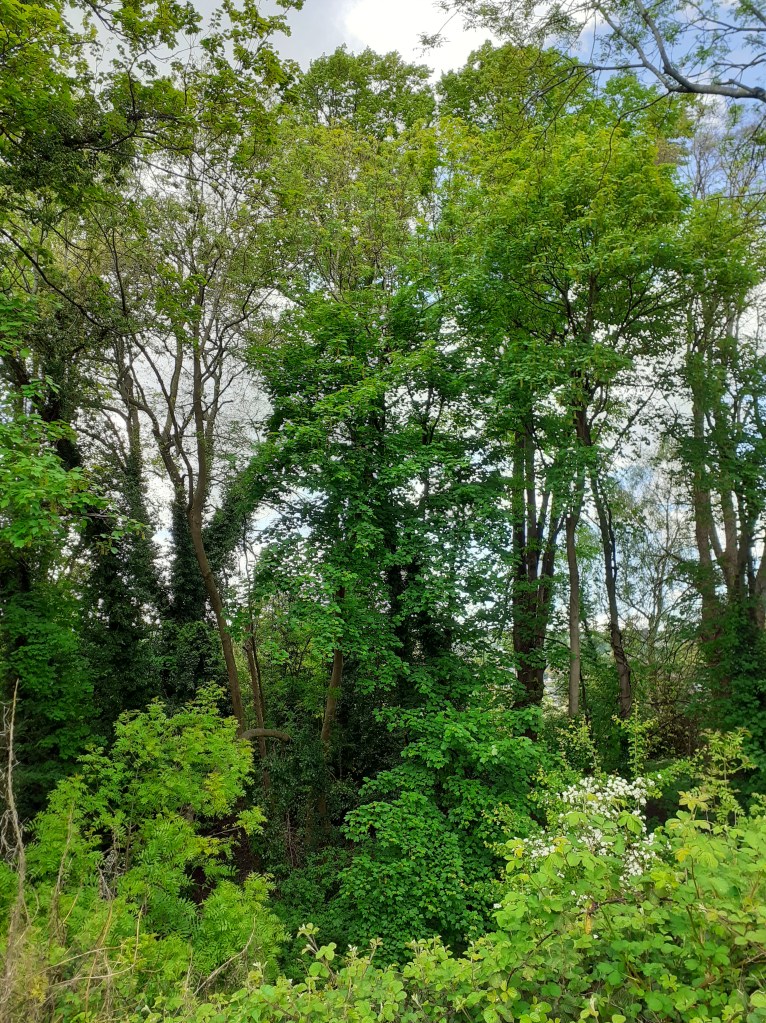
When I say ‘oneness’, I mean interbeing rather than singularity. I am talking about the web of life, the great song, a field of living presence. Singularity allows only an I. Interbeing has room for I and You and We and They. This recent picture of a half-hidden corner in our garden, taken by my wife Elaine, makes the point. The fact that she took it also reminds me that the mature recognition of ‘you’ is the foundation of true relationship.

This oneness of interbeing does not need a myth of origin to sustain it. Interbeing just is. I’m an intuitive idealist, fascinated by metaphysical questions, including questions of origin, and the systems of myth and metaphor which address them. But I am not spiritually dependent on answers. That is the advantage of Druidry as a practice rooted in nature. Today is a day for celebrating the natural side of my path.

A LITTLE BOOK OF THE GREEN MAN

This post presents a poem and extract from The Little Book of the Green Man by Mike Harding, which includes photographs by the author. Most of the images are from English medieval churches, though two are from Paris and some are from different regions of India, from Nepal and from Borneo.

The book was published in 1998 and is still in print. I recommend it to anyone interested in Green Man imagery.

I am the face in the leaves,

I am the laughter in the forest,

I am the king in the wood.

And I am the blade of grass

That thrusts through the stone-cold clay

At the death of winter.

I am before and I am after,

I am always until the end

I am the face in the forest,

I am the laughter in the leaves.

The following extract describes green men in the ends of pews at Bishop’s Lydeard, Somerset, my native county. They were carved in the fifteenth century:

“Unlike many Green Men that are hidden on high in roof bosses or on capitals, the bench ends are close to ground level and would have been immediately on view to everybody entering the church.

“Only in Somerset is this tradition of carved pew-ends so widespread and it would appear that the same carvers worked on a number of churches in the area.

“While I was photographing these images a lady who was in the church arranging flowers came up to me quietly and, making sure that nobody else heard, whispered: ‘It’s nice to see that he’s being accepted again, isn’t it?’”

Mike Harding The Little Book of the Green Man London: Aurum Press, 1998.

PEONIES

Where I live, we are in the last stages of the rising year, the sweet period from Beltane to the Summer Solstice. The sun’s energy is waxing. The days feel abundantly alive and are marked by beauty. It is my favourite time of year, easy to enjoy. It reminds me of my debt to the sun.

Yet this period and its bounty are also fragile and evanescent. They pass soon enough. For me, peonies in a bowl are a perfect representation and celebration of this early summer moment – speaking also to the tender poignancy of impermanence, as the wheel continues to turn.

PRIMARY MATERIALS


“There are seven primary materials of the world: the Blue Bard of the Chair has said it.

“The first, earth, from which are every corporeity and hardness, and every firm foundation;

“The second, water, from which are every humour and freshness;

“The third, air, from which are all respiration and motion;

“The fourth, sun, from which are all heat and light;

“The fifth, nwyfre, from which are all feeling, affection, and wantonness;

“The sixth, the Holy Ghost, from Whom are all understanding, reason, awen, and sciences;

“The seventh, God, from Whom are all life, strength, and support, for ever and ever.

“And from these seven primary materials are every existence and animation; and may the whole be under God’s regulation. Amen.” (1)

The Barddas of Iolo Morganwg,  by J. Williams Ab Ithel, was published in 1862. It was presented as the lore of traditional Welsh Bardistry going back to Druid times, based on the earlier work of Iolo Morganwg (Edward Williams – 1747-1826). Iolo had organised the first Gorsedd of Bards for several hundred years at Primrose Hill, London, on 21 June 1792, thereby initiating the modern Welsh Eisteddfod movement. He was a personal friend of Tom Paine and George Washington subscribed to his first volume of poetry. He is said to have influenced William Blake’s poetry and Robert Graves’ The White Goddess.

Iolo described himself as a Unitarian Quaker in religion, and a revolutionary Welsh nationalist in politics. In the later 1790’s the Glamorgan magistrates sent the yeomanry (a volunteer cavalry force drawn from the property-owning classes) to break up an open-air Gorsedd led by Iolo in that county. The reason given was that it was being conducted in the Welsh language and allegedly included a toast for Napoleon – then admired by radicals as defender of the French revolution. This is also a time of revolt in Ireland and the birth of Irish republicanism.

Culturally, Iolo was, as well as a poet in his own right, “a first-rate forger of literary Welsh; some have commented that his forgeries were as good or better than the real thing. Furthermore, he wrote much of the Barddas under the influence of laudanum (an opium-based medicine which he took for asthma)” (1). In consequence he has been widely dismissed as an embarrassing fraud. My response is more complicated. There is something poignant for me about ‘forgeries’ that are “as good or better than the real thing”. On the forgery question, I am sad that Iolo could not openly be a catalyst for the creation of new culture inspired by an old one, rather than having to pretend, even to himself, that he was recovering an old one as it had been (in his own mind perhaps through psychic means). As for medicinal laudanum, I wonder why this should be stigmatised in Iolo whilst accepted in his contemporary S. T. Coleridge. It may be is because Coleridge’s work was unambiguously original, and therefore seen differently. The issue of new culture creation in Druidry is a significant one to this day and is well discussed in Philip Carr-Gomm’s preface to Contemplative Druidry (2) where the voices of a number of open culture creators are included.

Going back to The Seven Primary Materials of the World, I feel friendly to this text despite its patriarchal language and its statement of a world view significantly different from my own. In my reading, it suggests a seven-step ladder from matter to the divine, with four material elements that point also to non-material qualities, where the the fourth and highest is not on the Earth. Then there are two subtle elements (though the first finds room for ‘wantonness’) and an ultimate ascent to the divine. It is the kind of evolutionary spiritual scheme that many transcendentalists down the ages have related to. Written at the turn of the eighteenth and nineteenth centuries, and edited in mid Victorian times, it seems to me congruent with the outlook of medieval Welsh Bardistry as expressed in The Book of Taliesin (3), and the theology of the ninth century Irish scholar and contemplative mystic John Scotus Eriugena (4). It is a Christian referenced path that is not sin and fear based, and I am sure that many people involved in Druidry and Celtic Spirituality today would be in essential sympathy with it. Made up by Iolo or not, it reads as a clear and simple expression of a universalist and transcendentalist stance within a specific cultural setting. I find nothing fraudulent about it. It is what I would expect from place, time and person.

Indeed, key concepts remain relevant to my own Druid practice. I work with the wheel of the year and with the four classical elements, including fire. I am concerned with the Earth’s relationship to sun and moon. I work with my body and my sense of energy and think of nwyfre as synonymous with prana or chi, now well-known thanks to the popularity of yoga and Chinese energy arts.

At this stage in my personal journey, I am in renewed inquiry with awen. For the Barddas, it is a distinct higher mental faculty, close to the divine source like Coleridge’s primary imagination. In my own work I get a sense of energised and articulated insight. I do not think of awen as a substance in itself, but rather a quality of how we express ourselves when at our most enlivened and ‘on song’. But this inquiry is far from concluded.

Where the Barddas speaks of God, I speak of nature. I think of the web of life, and of our interbeing within it. I also think of the mysteries of quantum events, dimensions that we cannot perceive directly, galaxies flying apart and the possibility of multiple universes. But to me nature’s most extraordinary phenomenon is the gift of aware experiencing, with all the joy and suffering it brings, in the apparent here and now. To this I add the capacity to bear witness to this miracle through words, non-verbal media, silence, celebration and action. Here, I find myself still using most of the key terms from The Seven Primary Materials of the World. In this sense,  I am happy to have The Barddas of Iolo Morganwg as part of my spiritual ancestry.

  1. J. Williams Ab Ithel The Barddas of Ilo Morganwyg, Vol I & II: A Collection of Original Documents, Illustrative of Theology, Wisdom, and Usages of the Bardo-Druidic System of the Isle of Britain Forgotten Books, 2007 www.forgottenbooks.org (First published 1862)
  2. James Nichol Contemplative Druidry: People, Practice and Potential Amazon/Create Space, 2014 (Foreword by Philip Carr-Gomm)
  3. William F. Skene The Four Ancient Books of Wales Forgotten Books, 2007 www.forgottenbooks.org (First published 1868)
  4. https://contemplativeinquiry.blog/2014/07/12/the-eye-of-contemplation/ 

AGNOSTIC BUDDHA: NATURALIST DRUID

“Suppose, Malunkyaputta, a man were wounded by an arrow thickly smeared with poison, and his friends and companions brought a surgeon to treat him, The man would say, ‘I would not pull out the arrow until I know the name and clan of the man who wounded me; whether the bow that wounded me was a long bow or a crossbow; whether the arrow that wounded me was hoof-tipped or curved or barbed’.

“All this would still not be known to that man and in the meanwhile he would die. So too, Maunkyaputta, if anyone should say: ‘I will not lead the noble life under the Buddha until the Buddha declares to me whether the world is eternal or not eternal, finite or infinite; whether the soul is the same as or different from the body; whether an awakened one continues or ceases to exist after death,’ that would still remain undeclared by the Buddha and meanwhile that person would die.” (1)

The Buddhist scholar and teacher Stephen Batchelor, quoting these early words, affirms a Buddha committed to “an existential, therapeutic and liberating agnosticism” concerned “with anguish and the ending of anguish”. He laments the historical tendency of Buddhism to lose this agnostic dimension and to become an institutionalised religion. He believes that “this transformation of Buddhism into a religion obscures and distorts the encounter of the dharma with contemporary agnostic culture. … The dharma in fact might well have more in common with Godless secularism than with the bastions of religion.”

At the same time, the force of the word ‘agnosticism’ has been lost in modern secular culture, becoming complicit with “the attitude that legitimises an indulgent consumerism and and the unreflective conformism dictated by mass media”. T. H. Huxley, who coined the term in 1869, understood agnosticism as “a method realised through the rigorous application of a single principle”. This was to follow our reason as far as it will take us, and not to pretend that conclusions are certain which are not demonstrated or demonstrable. It is a principle that runs through western culture from Socrates to the axioms of modern science. Buddha and Huxley both advocate a method rather than a creed, opening the possibility of a conversation between them.

What does this tell me about my own path now? Contemplative inquiry is a method. It is based on phenomenology as a subjective life-world investigation, and mine tells me that fruitful spiritual practices do not depend on the metaphysical views that are often linked to them. I can interpret and value everything that I have done within a naturalistic framework. It is a significant conclusion for my inquiry.

This does not in itself invalidate the metaphysical views. I have simply withdrawn from my personal engagement with them, except to the extent that they are embedded in the authentic experiences and stories of other people, past and present. I can still value and learn from those. I find imaginative engagement with other points of view quite easy. But in my own spiritual understanding, I seem now to be with Huxley and the Buddha.

Contemplative inquiry is a valued method but I would not call it my path. My path is Druidry, and I have been re-establishing this consciously since the Winter Solstice of 2019. The default position of the Druidry I was trained in is a romantic theosophy, though one in active evolution, rich in variation and re-imagining. In my personal journey, I am now clearly in a naturalistic and secular space, animist in a sense (2) that is “‘naturalist’ rather than metaphysical.” As a result of my inquiry, my Druid note is different than it was before I began.

I am clearer, lighter, more alive. It feels easier to experience the abundance in simplicity that I value. By letting the mystery be, I can immerse myself more deeply in the textured life of the world. Leaning in to naturalistic world view, I expand my sense of ‘at-homeness in the flowing moment’, and my Druid path feels stronger.

(1) Stephen Batchelor Buddhism Without Beliefs: A Contemporary Guide to Awakening London: Bloomsbury, 1998 (First published in the USA in 1997 by Riverhead Books)

(2) Graham Harvey (ed.) The Handbook of Contemporary Animism London & New York: Routledge, 2014 (First published by Acumen in 2013) see also: https://contemplativeinquiry.blog/2020/02/22/

Share this:

GREEN MAY

On 1 May I strode out with a spring in step, for my statutory walk. I was stir crazy and determined to meet the day. I made sure to take my camera with me. I wanted both to savour and record the fresh abundance of the green. Although I was in a familiar landscape, both the look and the feel of it had changed. I was in places I hadn’t been in for a week or more, and the world seemed dynamically verdant with a new intensity. I had a transformative hour of it before returning home.

In his Green Man (1), William Anderson reminds us that the Green Man utters life through his mouth. “His words are leaves, the living force of experience … to redeem our thought and our language”. Anderson’s Green Man speaks for the healthy renewing of of our life in and as nature.

He also suggests that the emerging science of ecology – the study of the house-craft of nature – is one such form of utterance. It gives us a language of inquiry into the interdependence of living things. My sense is that 1960’s images of Earth from space have also provided support to concepts like that of a planetary biosphere, and for the revival of Gaia as an honoured name. As a species, quality knowledge, rooted in quality imagination, is our greatest resource. Anderson’s book was published in 1990, based on ideas that had already been maturing over many years. I am sad that we are where we are in 2020. But the message of hope still stands, and the energy of a green May bears witness to it.

(1) William Anderson Green Man: the Archetype of Our Oneness with the Earth London & San Francisco: HarperCollins, 1990 (Photography by Clive Hicks)

LEARNING FROM THE WATERCOURSE WAY

Alan Watts (1) describes Taoism as the ‘watercourse way’. For him, this ancient philosophy is “a skilful and intelligent following of the course, the current, and grain of natural phenomena – seeing human life as an integral feature of the world process, and not something alien and opposed to it.” It is a point of view that I find of direct relevance to modern Druidry, nature spirituality and ecosophy. (2)

The ancient Taoists themselves said that “true goodness is like water. Water’s good for everything. It doesn’t compete. It goes right down to the low loathly places, and so finds the way”. (3)

Alan Watts continues (1): “Looking at this philosophy with the needs and problems of modern civilisation in mind, it suggests an attitude to the world which must underlie all our efforts towards an ecological technology. The development of such techniques is not just a matter of the techniques themselves, but of the psychological attitude of the technician”.

A detached attitude of objectivity is inadequate for solving the problems we face. Subject and object cannot be separated, for “we and our surroundings are the process of a unified field, which is what the Chinese called Tao”. We have no alternative but to work along with this process by attitudes and methods which could be as technically effective as “judo the ‘gentle Tao’ is effective athletically”. Watts reminds us that human beings have to make the gamble of trusting one another to make any kind of workable community, and concludes that “we must also take the risk of trimming our sails to the winds of nature. For our ‘selves’ are inseparable from this kind of universe, and there is nowhere else to be.”

(1) Alan Watts Tao: the Watercourse Way Souvenir Press: undated Amazon Kindle edition (with the collaboration of Al Chung-Liang Huang ; additional calligraphy by Lee Chih-chang)

(2) Arne Naess Ecology of Wisdom UK: Penguin Books, 2016 (Penguin Modern Classic. First published 2008)

(3) Lao Tzu Tao Te Ching: A Book about the Power and the Way Boston & London: Shambhala, 1998 (A new English version by Ursula K. Le Guin, with the collaboration of J.P. Seaton, Professor of Chinese, University of North Carolina, Chapel Hill)

LUNAR WISDOM

” The moon was the image in the sky that was always changing yet always the same. What endured was the cycle, whose totality could never be seen at any one moment. All that was visible was the constant interplay between light and dark in an ever recurring sequence. Implicitly however, the early people must have come to see every part of the cycle from the perspective of the whole. The individual phases could not be named, nor the relations between them expressed, without assuming the presence of the whole cycle. The whole was invisible, an enduring and unchanging circle, yet it contained the visible phases. Symbolically, it was as if the visible ‘came from’ and ‘returned to’ the invisible – like being born and dying, and being born again.

“The great myth of the bronze age is structured on the distinction between the ‘whole’, personified as the Great Mother Goddess, and the ‘part’, personified as her son-lover or her daughter. She gives birth to her son as the new moon, marries him as the full moon, loses him to the darkness as the waning moon, goes in search of him as the dark moon, and rescues him as the returning crescent. In the Greek myth, in which the daughter plays the role of ‘the part’, the cycle is the same, but the marriage is between the daughter and a god who personifies the dark phase of the moon. The daughter, like the son, is rescued by the mother. In both variations of the myth, The Goddess may be understood as the eternal cycle s a whole: the unity of life and death as a single process. The young goddess or god is her mortal form in time, which, as manifested life, whether plant, animal or human being – is subject to a cyclical process of birth, flowering, decay, death and rebirth.

“The essential distinction between the whole and the part was later formulated in the Greek language by the two different Greek words for life, zoe and bios, as the embodiment of two dimensions co-existing in life. Zoe is infinite, eternal life; bios is finite and individual life. Zoe is infinite ‘being’; bios is the living and dying manifestation of this eternal world in time.”

(1) Anne Baring Anne and Jules Cashford The Myth of the Goddess: Evolution of an Image London: Penguin, Arkana Books, 1993

INQUIRY NOTE: For me this modern interpretation of Bronze Age myth offers a good Pagan way of talking about ‘non-duality’, a strong thread in my inquiry in recent years. In its Sanskrit origin, advaita simply means ‘not two’. It speaks of a unity that is not exactly oneness in the sense of complete assimilation. It points to the sense that we are bios in our transient personal lives yet also zoe the life eternal, both the wave and the ocean. In Western theistic culture this view seems consistent with either pantheism or panentheism. It also fits modern understandings of animism and biocentrism. While I find it useful to know about these models and frameworks, I avoid strong identification with them. There remains an underlying mystery, which is where myth and imagination come into their own.

Earth Eclectic

music that celebrates Earth and speaks to the heart

Sarah Fuhro Star-Flower Alchemy

Follow the Moon's Cycle

Muddy Feet

Meeting nature on nature's terms

Rosher.Net

A little bit of Mark Rosher in South Gloucestershire, England

Becoming Part of the Land

A monastic polytheist's and animist’s journal

selkiewife

Selkie Writing…

Charlotte Rodgers

Images and words set against a backdrop of outsider art.

Prof Jem Bendell

living with metacrisis and collapse

Towint

The pagan path. The Old Ways In New Times

The Druids Garden

Spiritual journeys in tending the living earth, permaculture, and nature-inspired arts

The Blog of Baphomet

a magickal dialogue between nature and culture

This Simple Life

The gentle art of living with less

Musings of a Scottish Hearth Druid and Heathen

Thoughts about living, loving and worshiping as an autistic Hearth Druid and Heathen. One woman's journey.

Wheel of the Year Blog

An place to read and share stories about the celtic seasonal festivals

Walking the Druid Path

Just another WordPress.com site

anima monday

Exploring our connection to the wider world

Grounded Space Focusing

Become more grounded and spacious with yourself and others, through your own body’s wisdom

The Earthbound Report

Good lives on our one planet

Hopeless Vendetta

News for the residents of Hopeless, Maine