October, 2024. Outside, leaves turn and fall. The days shorten, long evening walks no longer part of my day. But six months after her accident in Gran Canaria, my wife Elaine is re-learning to walk. A great blessing – we both wondered if she would.
A gift from Awen – three words tumbling into manifestation with no thinking effort from me: healing, peace power (1). A kind of Druid koan. Easy to see that peace might follow healing, and that healing might be a condition of true peace. But the power following on from that peace? – very different from the kinds of ‘power’ most visible in the world today. What do I need to learn?
I had a dream in which I read a map to get to a school. I arrived at the school and was happy enough with my experience. Then I read the map again and saw that it was the wrong school. The one I should have gone to was further away, to the north-west.
At Samhain, the culmination of October, we think of of the dead, and a loosening divide between the dead and the living. What can we say to them – ancestors and recent dead alike? What might they say to us?
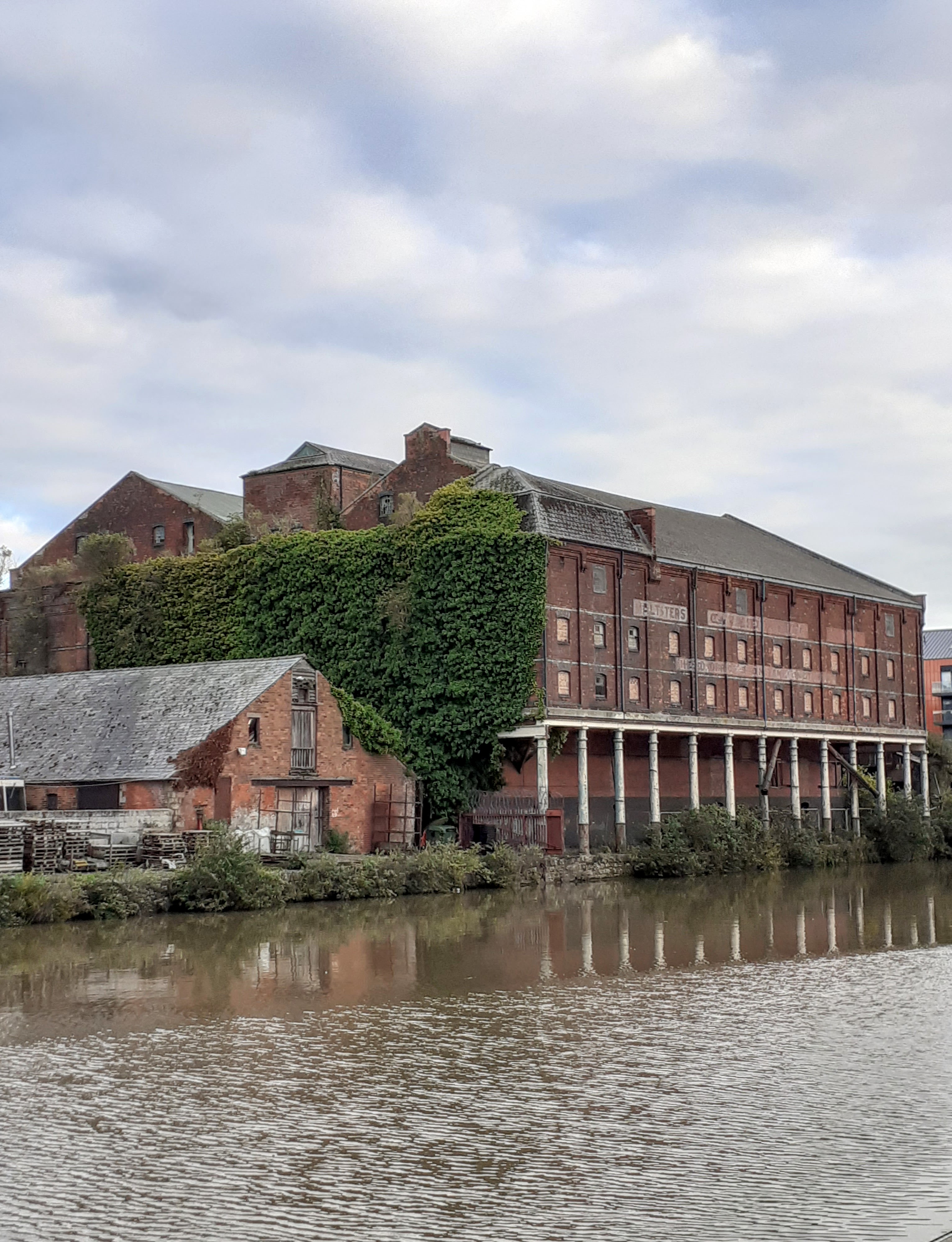
The stretch of water above leads from Gloucester Docks to the Gloucester-Sharpness Canal. The canal was completed in 1827 and the buildings (above) appeared a few years later. The larger, pillared building was known as Downing’s Malthouse and stayed in business until around 1980. For some years thereafter it was used for grain storage. Now it a a Grade II listed building awaiting another life.
From the far side of the canal, the erstwhile malthouse looks tranquil and attractively derelict – solid old brick with greenery on the walls. The forces of decay are relatively slow, and ‘listed’ status provides a degree of human protection. For a few moments I am charmed by by the view. I briefly wish that it could be frozen in time, through a flies-in-aspic form of conservation, admittedly sterile. But the thought doesn’t last. We earthlings experience time and life primarily in change, events and processes – through what happens, interacts and evolves (1). These buildings weren’t designed to be monuments.
So I am glad that people and activity will be returning to Downing’s Malthouse through the building of residential apartments. Housing is in short supply here and I find myself friendly to this kind of development. The shell of Downing’s Malthouse, and its distinctive pillars, will be retained. I dare say that the smaller building will go, and so I’m memorialising it in the picture below.
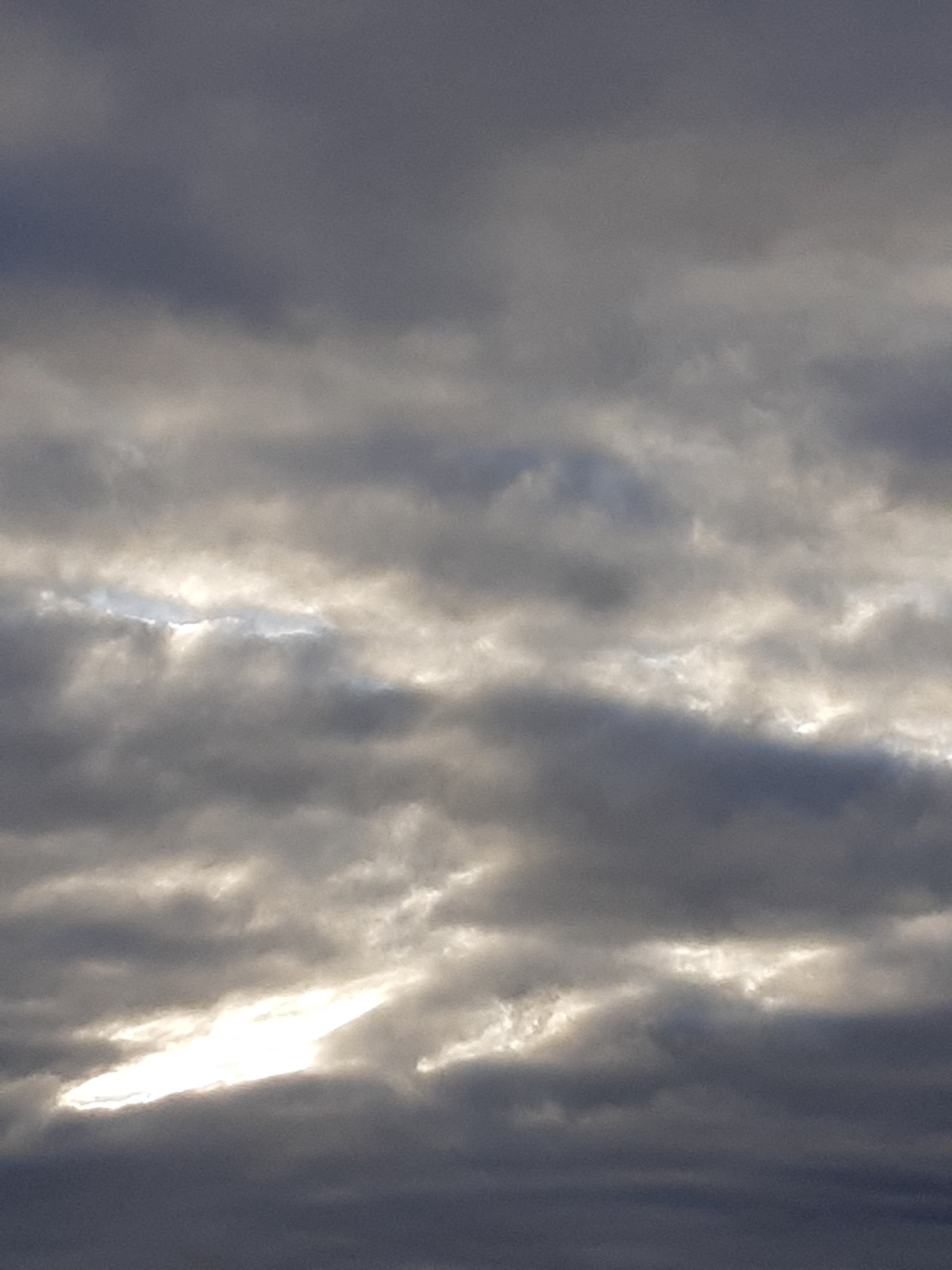
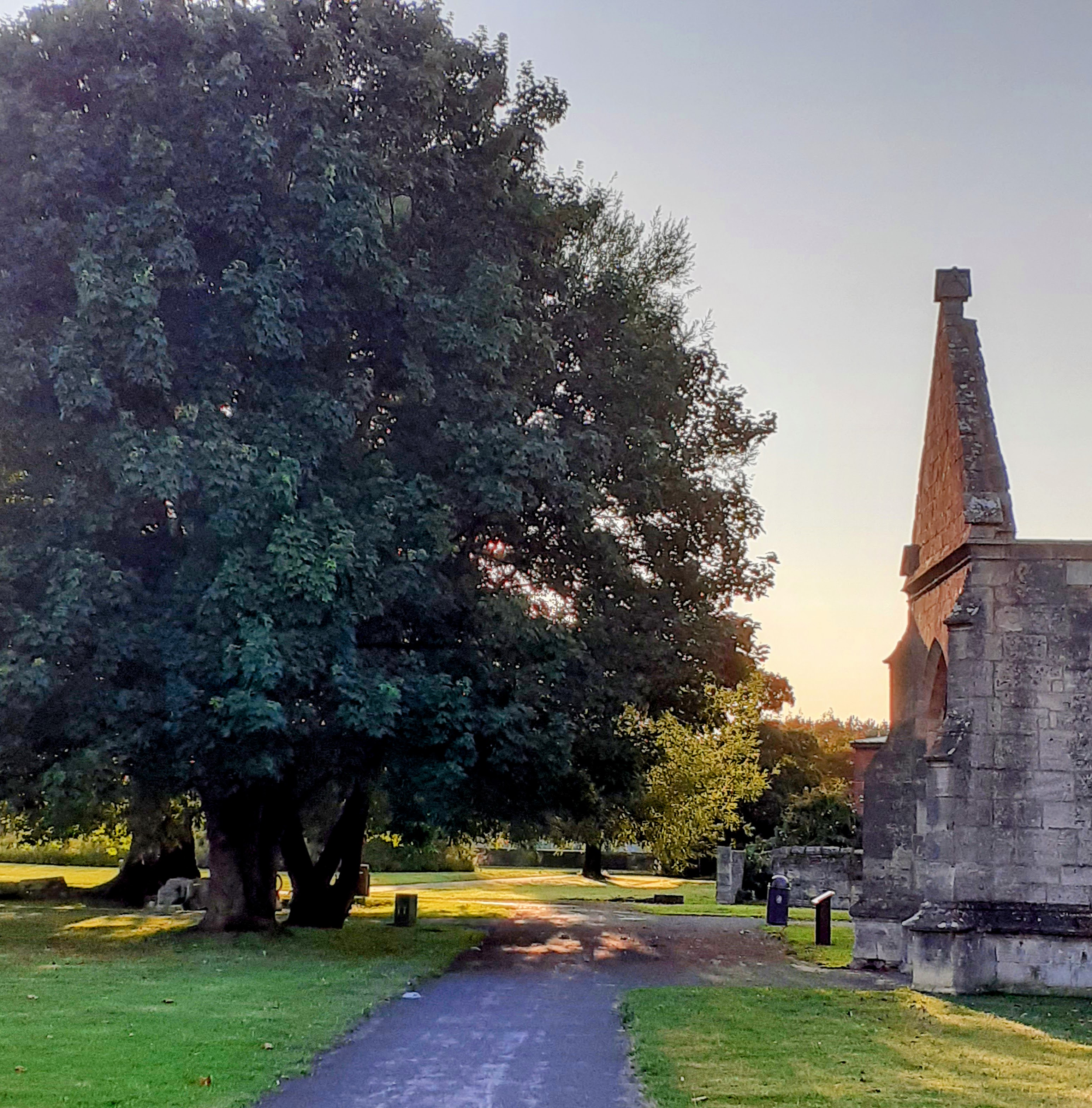
I took these pictures one recent evening in the wetlands of Alney Island, on the River Severn at Gloucester. It felt dark and broody most of the time. There was a threat of rain and storm though not the actuality. The feeling-tone suggested raw nature and remoteness: a place where I as a human didn’t exactly belong. Boggy land and turbulent sky were elementally indifferent to me and my concerns. I was simultaneously inspired and edgy.
Then the sky changed and I changed with it. I noticed the sun. It was declining but that didn’t matter. It was signalling its presence to me from a suitably safe distance. Comfort and familiarity returned. I was on a small reserve in the middle of a city. I had lost a moment of wildness and gained a perceived security. Being human, I both took the deal and wondered about the possibilities I may have abandoned..
In 1986, at the age of 50, Satish Kumar (1) went on an extended pilgrimage of British sacred sites. When staying overnight as a guest of the Bishop of Lincoln, he initiated a dialogue on divinity. In this discussion, divinity is described as God, and masculine language is used throughout. (In other contexts Satish Kumar has been happy to use Goddess references and language.) My own practice is largely non-theistic, yet I am Pagan enough to have been jolted by this limitation. Diverse images, stories and beliefs about the divine continue to inform my heart, mind and imagination. The two views articulated here (both eco-friendly in their way) point to very different experiences and understandings of the divine, and of the world: dualist and non-dualist in formal terms.
“‘It is with great pleasure that I welcome you, Satish, to Lincoln and my house, the Bishop said. ‘Going on a pilgrimage is an ancient tradition, but walking for four months around Britain to its sacred places is not so common.’
“‘I am honoured to be your guest,’ I said. ‘I have been inspired and renewed by being within many churches and cathedrals, but increasingly I am finding all places sacred and the presence of the divine everywhere.”
“‘The Bishop heard my comment with thoughtful silence, and then said, ‘For us, God is above and beyond his creation. We aspire to reach God, but God and the world are not the same.’
“‘In the Hindu tradition the world is understood to be the dance of the God Shiva, and the yet the dance and the dancer cannot be separated. The world is not like a painting, a finished object which when complete is seen as separate from the painter. The universe is a living dance and God in in the heart of all beings and things. We do not separate God and the world.’
“The Bishop pondered and in a gentle voice said, ‘I believe that the world is God’s creation and therefore it is sacred. Human beings must act as responsible guardians and caring stewards. We must love the land and look after the earth in its glorious diversity. We have no right to plunder, pollute, exploit, destroy, kill or in anyway disrespect God’s creation. Like in a family, God is the Father and we are his children, and all members of the family should live in harmony with each other. God’s family includes the animals and the natural world. If we are sensitive and caring, we can live with nature rather than against it. The advance of science and technology requires that human beings live with greater sensitivity than ever before, since we are now equipped with extremely powerful and destructive tools. This destructive impulse is not part of God. God is good and good only.’
“‘For me, Divinity is neither good nor bad,’ I said. ‘It is like pure water and pure air. The human soul is also pure. Good and bad is a matter of perception. For example, from nature’s point of view creeping buttercups and nettles are fine wherever they are; they will grow where the soil is ripe for them. From the human perspective, however, a gardener struggles to remove the buttercups and nettles; he regards them as weeds, and complains when they overtake flowers. The rose and the thorn are part of the same plant – we cannot have one without the other. The analytical mind attempts to separate the good and evil, the decorative and ugly, the useful and non-useful, the weed and the flower. I have seen during my journey people pulling out foxgloves in one area and carefully planting them in another. If we are to live in harmony with God’s family, we need to love the wilderness, the weeds and the wet.'”
From: Satish Kumar No Destination: Autobiography of a Pilgrim Cambridge: Green Books, 2014 (extended 4th edition – first edition 1992)
(1) “Satish Kumar (born 9 August 1936)[1] is an Indian British activist and speaker. He has been a Jain monk, nuclear disarmament advocate and pacifist.[3]Now living in England, Kumar is founder and Director of Programmes of the Schumacher College international center for ecological studies, and is Editor Emeritus of Resurgence & Ecologist magazine. His most notable accomplishment is the completion, together with a companion, E. P. Menon, of a peace walk of over 8,000 miles in June 1962 for two and a half years, from New Delhi to Moscow, Paris, London, and Washington, D.C., the capitals of the world’s earliest nuclear-armed countries.[4][5] He insists that reverence for nature should be at the heart of every political and social debate.” (Wikipedia)
Last Friday afternoon we were at the centre of a big storm. Lightning flashed dramatically just outside our windows. It was scary in the delicious way that can happen when linked to a subjective sense of safety. But we learned later in the day that one of the buildings in our estate had suffered a direct hit which the lightning conductors were unable to hold. There was a leak in the roof and water ran down the stair wells. I understand that the damage is not as severe as it might have been. But is certainly compromises any sense of immunity. It could have been worse and it could have been us.
Now it is Sunday 22 September, generally marked as the Autumn Equinox in these parts. I am in a familiar space (1) but experiencing it in another way. The current clock time is about 7.45 am (an hour after sunrise) and I’m looking out on a distinctly misty morning. The background wooded hills are very sketchy. True, there is clear light and shade in the foreground and I feel calm after a time of storm and rain. But they will likely be back soon. The mist and murk in the east suggest that anything could emerge from the most benign of spaces: the world reveals itself as volatile and shifting.
This is not an exclusively equinoctial phenomenon, but I have always linked the equinoxes – especially in autumn – with this kind of dynamic mutability. The Lightning Flash is a great archetypal symbol, not least for Druids. In antique theory, we are supposed to be able to summon them, though I’ve never tried it myself. I do know how to find the opportunity in disruptive change, though at this time of my life I have ceased to look for it. I much prefer the calm.
The picture* shows Waterstones in Gloucester, not far from where Elaine and I live. It’s a well-stocked bookshop on two levels. The upstairs includes a cafe. Before Elaine’s hip fracture in April (1,2,3) and its attendant complications, we were frequent visitors. The cafe offers good coffee. It is a pleasant place to be. It hosts both a writers’ group and a book group that we have attended.
Waterstones has been out of bounds to Elaine, and effectively me, since April. Elaine was completely house-bound until the middle of August. Even then, we worried about whether her wheelchair would fit the door of the lift giving access to the upper floor. Would the formal ‘accessibility’ option lead to actual access? I measured the breadth both of Elaine’s wheelchair and the lift doorway. The distances were bothersomely similar, and this had a slightly inhibiting, effect. We didn’t want drama or disappointment.
But on Saturday, 8 September, we lost our hesitation. We wheeled boldly into the shop and put the lift to the test. Lining the chair up carefully, we ascended to the top floor. It was indeed a tight fit, but doable, which is what matters. We reached the cafe, and had our first coffee out together for a long time, happy in the familiar atmosphere of a favourite haunt, knowing too that we would be able to attend its meetings and events. A sweet success!
It is September. I am thinking about my Druid name Muin (blackberry). The plant is flourishing as it always does when given half a chance. But the fruits are less plentiful now and fairly small: thin pickings for the wayside walker. In the human world, we have largely moved on to the making of jam and wine from our existing harvest.
Today, I am thinking about my psychic and imaginal connection to Muin, and why I am standing by this name. For me, a Druid name is neither an alter ego nor a simple add-on to my other names. It is the name that calls me into my Druid identity and practice. In this context, I ask myself: as Muin, who am I? what do I stand for? who might I become? As I asked these questions in an imaginatively opened state, these lines came up. In a way, I believe, Muin is talking to James, whilst being an aspect of him (me) and anyone else who wants to listen.
I first registered Contemplative Inquiry on 28 August 2012 and WordPress have sent me 12th anniversary greetings. That’s a long-term project by my historic standards. True, the first two years were tentative and I took an 8 month break in 2018/9. But my contemplative inquiry, both as blog and as practice, now feels like a settled part of my life. I continue to ground it in a form of modern Druidry with, Janus-like, both pagan and universalist faces.
Through my inquiry, I came over the years to understand myself as, at heart, ‘living presence in a field of living presence in a more than human world’. This may sound like something of a formula, but it is at least my own formula, providing a compressed account of my experience and understanding, It is not connected to any particular belief system, and arose through a simple recognition of what seems to be given to us, in joy and sorrow alike.
When I open and deepen to living presence, a gestalt of self-and-world, not just self, reveals itself in a sometimes transfiguring way. It is not complicated to practice or experience. In consequence I have found myself nudged, however haltingly, towards a spirit of openness, an acceptance that nothing stays the same, an ethic of interdependence and a life of abundant simplicity.
I no longer think of the inquiry as a path or journey. It is more like a deepening, or maturation, in place. Looking back at early blog posts I find seeds of my current view right at the beginning of my inquiry. As early as 2 September 2012 I wrote about Satish Kumar’s experience (1,2) of outdoor walking meditation. It made a strong impression on me. The difference today is that I have internalised it and given it my own unique flavour. This year I celebrate a clearer understanding and a more confident voice. I am grateful both to influences like Satish Kumar and to the version of me who launched this inquiry twelve years ago..
After a grey and stormy day came a grey and calm sunset. Facing west, I looked up at the sky. I began to contemplate the clouds and the muted influence of the sun.
As this skyscape became my world, the solid earth became a distant rumour. Physical reality became porous, indefinite, and insubstantial. Dissolving into this space, I briefly became part of it, no longer an external observer. This experience was fleeting in time-bound reality but imprinted itself on my memory.
Then a seagull seemed to emerge out of nowhere, a dynamic edge of creative light shimmering about its newly-minted form. For me this moment was both grey and luminous, filled with subtle light.
The bird embodied a tremendous joy in flying, with an elegance not seen on the roof tops or the ground. It flew fast and I didn’t see it for long. After its disappearance I noticed how easy it was to enjoy a grey sunset that I might otherwise call gloomy.
Every year is unique and I wondered, then, whether the summer of 2024 was breaking up early in my neighbourhood. As I write, on a rainy morning two days later, this remains an open question.
The wheel continues to turn, and I find myself turning to the west, leaning into autumn, embracing this season for what it uniquely is. It is much more than a precursor to winter. Autumn has tended to be my favourite season and the one I find the most conducive to contemplative and visionary states.
In recent days, I have felt, as much as seen, the retreat of daylight in the evenings. It comes earlier and seems more decisive as the year advances. Mostly, indoors, it has led to a soft and gradual increase of dimness and shadow. I often find this pleasurable and delay resorting to artificial light.
But on Friday 16 August I was caught unawares. I had not been paying attention and it felt as if Night had truly fallen for the first time in my waning year, suddenly and assertively. It wasn’t even fully dark, yet I sensed that Night now ruled.
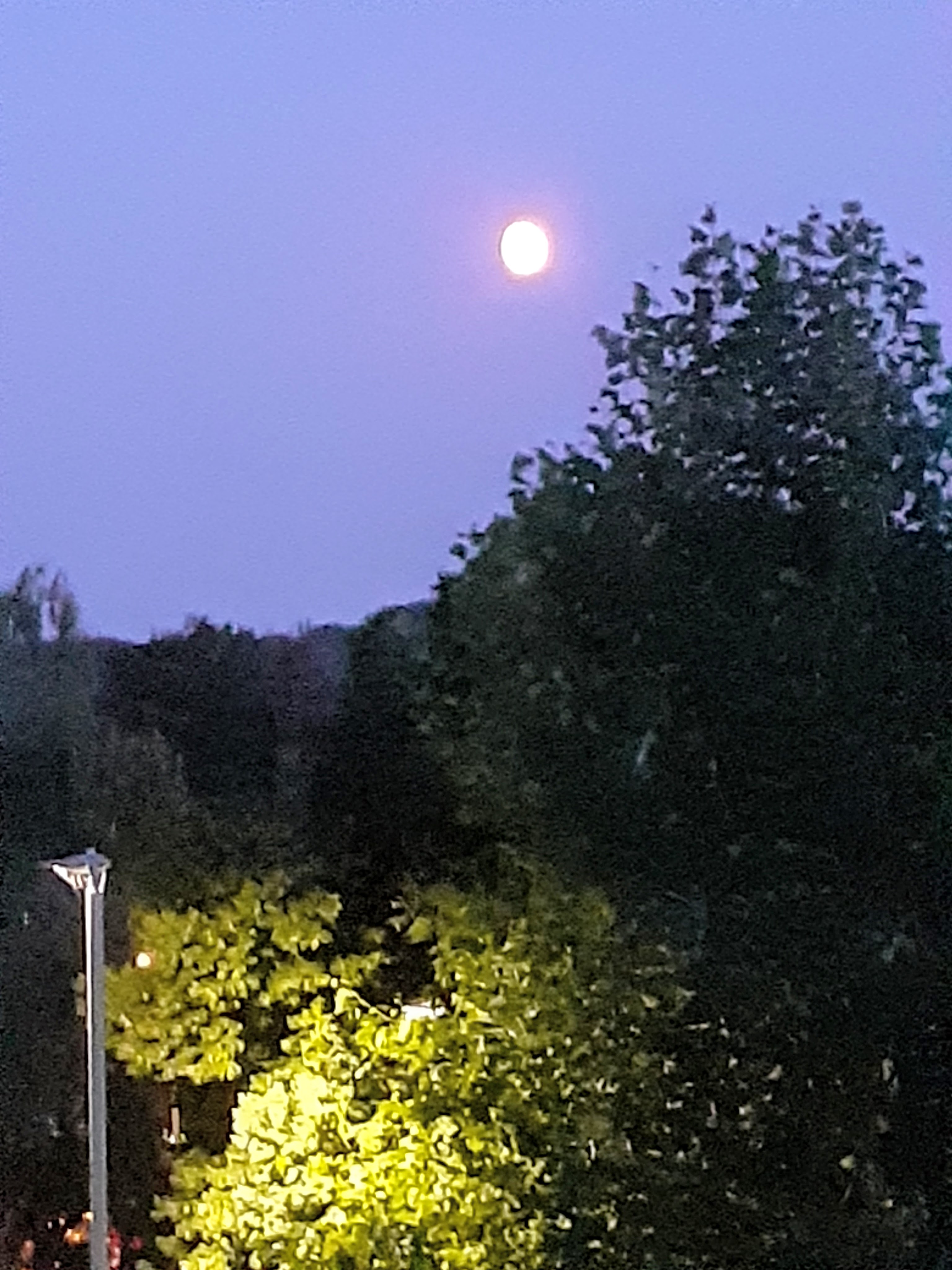
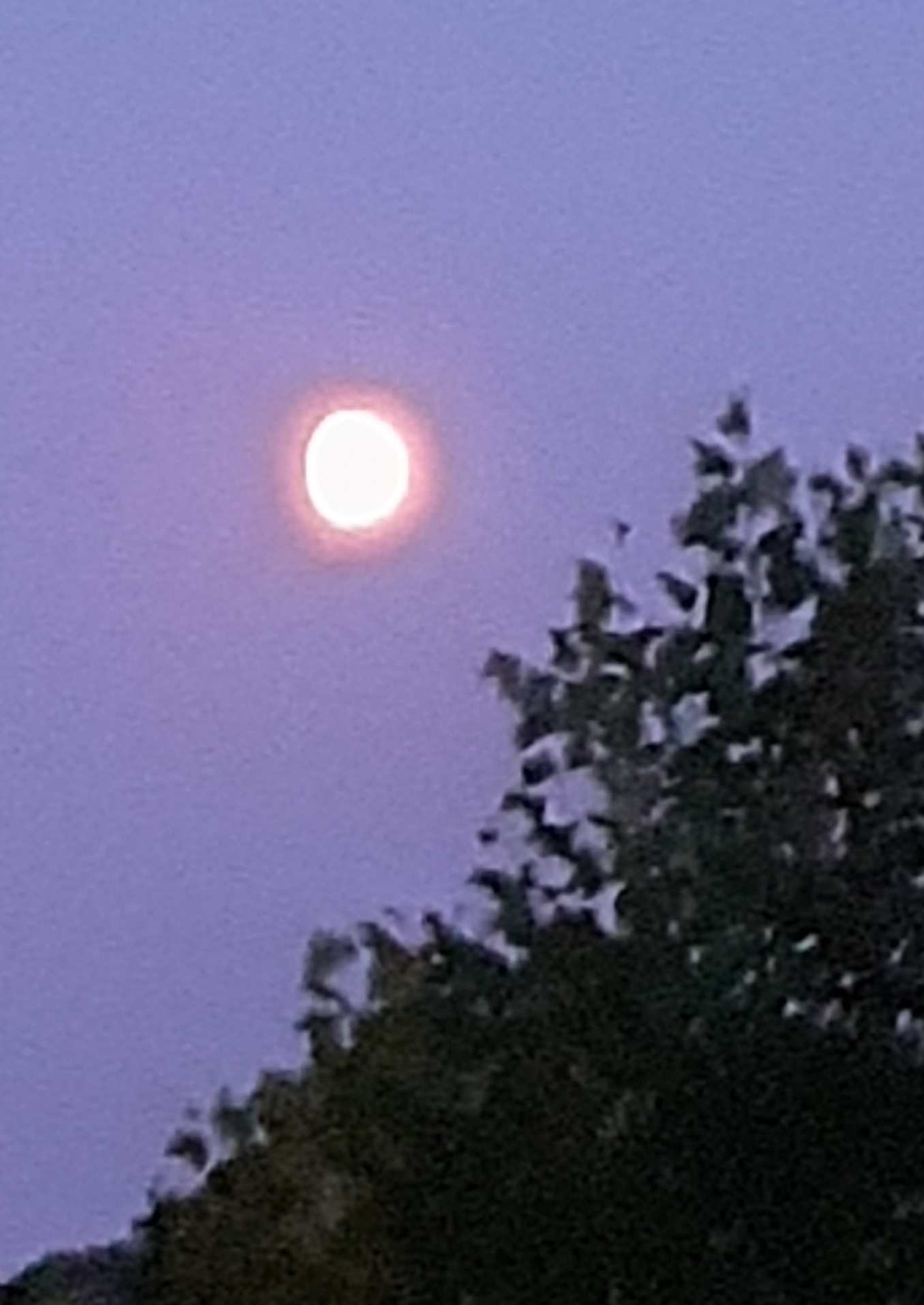
I felt that I was mobilising for a different life. A nocturnal life. To an extent, a lunar life. Standing on an east-facing balcony, I found deep twilight presided over a by a waxing gibbous moon – a super moon, close to the earth, only three days before full.
In the picture above, a street lamp seems to compete in brightness. But as I stood in my balcony it was the moon that drew my eye. Its influence was so much greater. The moon persuaded me to take the picture. Indeed I took a second picture (below) of the moon as the only light source. I needed the “radiance of moon” (1) to stand out clearly, in full contrast to the “light of sun”.
Night isn’t just about darkness. It’s about the world that emerges when the sunlight withdraws. Just over a month before the autumn equinox, I have tasted the ‘dark’ half of the year.
(1) From the St. Patrick’s Prayer/Cry of the Deer: “I arise today through the strength of heaven, light of sun, radiance of moon, splendour of fire, speed of lightning, swiftness of wind, depth of sea, stability of earth and firmness of rock”. I begin and end my regular morning practice with these words.








 Contemplative Inquiry