
REDEMPTION SONG
In December 2010, Swithin Fry interviewed me for Stroud FM Radio. The focus was my spiritual path, combining Druid and Buddhist aspects. A shortened version is available at the OBOD website (1). The format was a bit like Desert Island Discs, and interspersed with music. The first piece I chose was Bob Marley’s Redemption Song, and I drew attention to the lines:
“Emancipate yourselves
from mental slavery.
None but ourselves can
free ours minds.”
Astonished that nearly seven years seem to have passed, I listened to my CD of the broadcast again today. What I noticed was a lot of continuity yet some difference of emphasis. At that time, the Buddhist influence – though strongly affirmed – was a bit sketchy. It was clear to me that Buddhist contemplative methods were a means of freeing the mind and seeing reality more clearly, but I talked much more about Earth spirituality and about Bardistry. These too have power to free the mind.
I see Marley as a major Bard of his generation, with a resonance beyond Rastafarianism and the slave-descended African diaspora in the Caribbean and the Americas. What makes him a Bard for me is his ability to speak for more than himself, and to provide a voice for the voiceless. Or even not exactly voiceless, but for people needing to have their experience reflected for them in a more telling, more powerful way, articulated somehow more fully. If strong enough, the song can potentially resonate for everyone, including those outside the specific cultural experience and heritage being referenced.
This isn’t quite the conventional definition of Bardistry. But it does have the sense of a public and performance oriented art that can influence people’s view of themselves and their world in emancipatory and expansive directions. It contradicts shutting down, isolation and contraction. I could call it a Bardistry for postmodern times, when issues of social and cultural identity are complex and stressed. It’s not about pleasing Chiefs any more, and hasn’t been for quite a while.
This is a thread I haven’t much engaged with since I started to specialize in the contemplative aspects of the path. However, the issues aren’t separate: freeing ourselves from mental slavery is for me the theme that binds them. I am now more fully engaged with specifically Buddhist practices than for a long time. But listening to this broadcast again, I still identify myself as a Dharma Druid rather than Buddhist tout court.
- druidry.org/druid-way/other-paths/druidry-dharma. Scroll down to the bottom and you find it under AUDIO Stroud FM
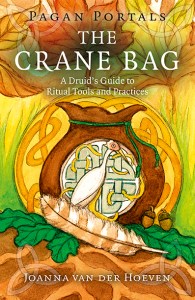 The Crane Bag, Joanna van der Hoeven’s forthcoming book*, offers an introduction to the ritual tools and practices found in the Druid tradition. It achieves this briefly, simply and with a light touch – as books in the Pagan Portals series are designed to do. Yet it much more than a tick box guide. It provides context and meaning, showing the modern evolution of the Druid tradition itself.

