Contemplative Inquiry

This blog is about contemplative inquiry

Tag: Earth spirituality

APRIL AND ‘DRUID MINDFULNESS’

Where I live, April 2023 brings qualities and freshness and new growth. My heart meets the moment as I walk in the bracing breeze. Sunny and overcast periods succeed each other. Moving through this enlivening space, I naturally welcome the energy of change it embodies.

But it’s not quite that simple. There’s an underlying turbulence too, which can easily challenge my balance. Slogans like ‘I am the sky. Everything else is weather’ aren’t enough. I, as natural man, have to ground and embody them. They have be be aligned with my felt sense.

I wasn’t sure how to talk about this when I discovered that someone else had done it for me. Philip Carr-Gomm, who until recently led OBOD (Order of Bards, Ovates and Druids), offers a regular podcast: Tea with a Druid. No 249 is about ‘finding calm in chaos’. It is up on YouTube as: https://www.youtube.com/watch?v=Ew4pD3OJen8

Philip suggests that the best way to deal with chaos, turbulence, or the everyday stress of modern life, is to turn to the stillness inside. Then it becomes possible to stay in the moment whilst expecting nothing. It takes work to get there – to identify ways of finding stability and calm even when all around is unstable and unpredictable.

Philip understands modern Druidry as a tradition of ‘mindfulness in natural settings’, whether real or visualised. The stillness found in those settings isn’t a dead stillness but a living one – leaves rustle, waves crash. The refreshment is somewhat different from that of a more abstract meditation where we sit with thoughts and feelings, finding the space beyond. In the podcast, Philip takes us through a meditation of the kind he describes. I thoroughly recommend it to anyone, whether or not involved in Druidry.

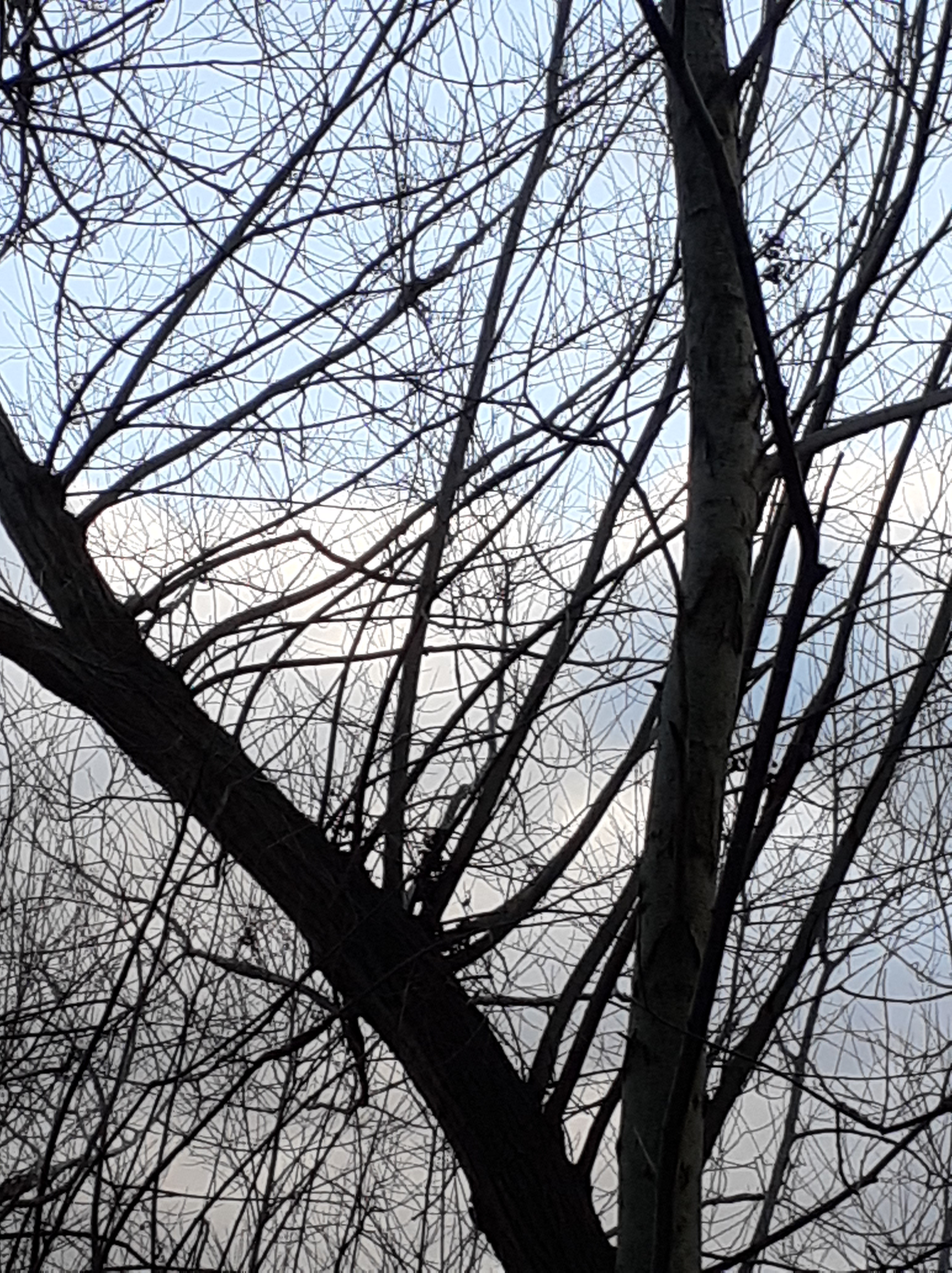
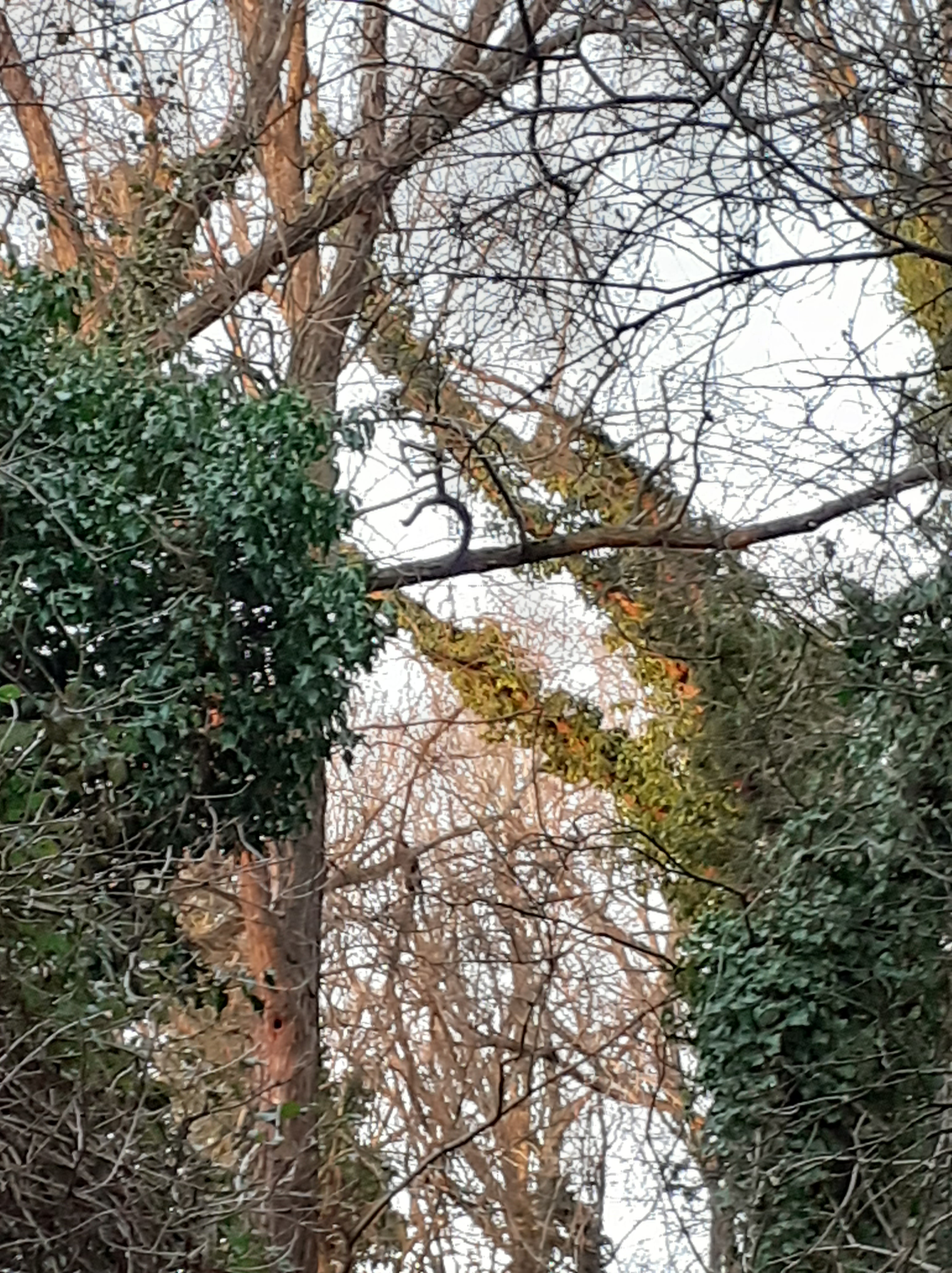
Returning to my recent walk, and the record of it, I see branches, buds and sky. I remember the movement in the sky, and a slight quivering of the wood. Records have their limitations. The stillness wasn’t one of complete stasis, as it may appear below. My current response is complicated by the human gift of memory, which is not the original experience. I am also absorbing someone else’s input. I am in a completely different here and now. But I am held within an enlivened tranquility, not at all that of the ‘tranquiliser’, and this is certainly a wonderful resource. Gratitude to the culture that has enabled it.

GREENING

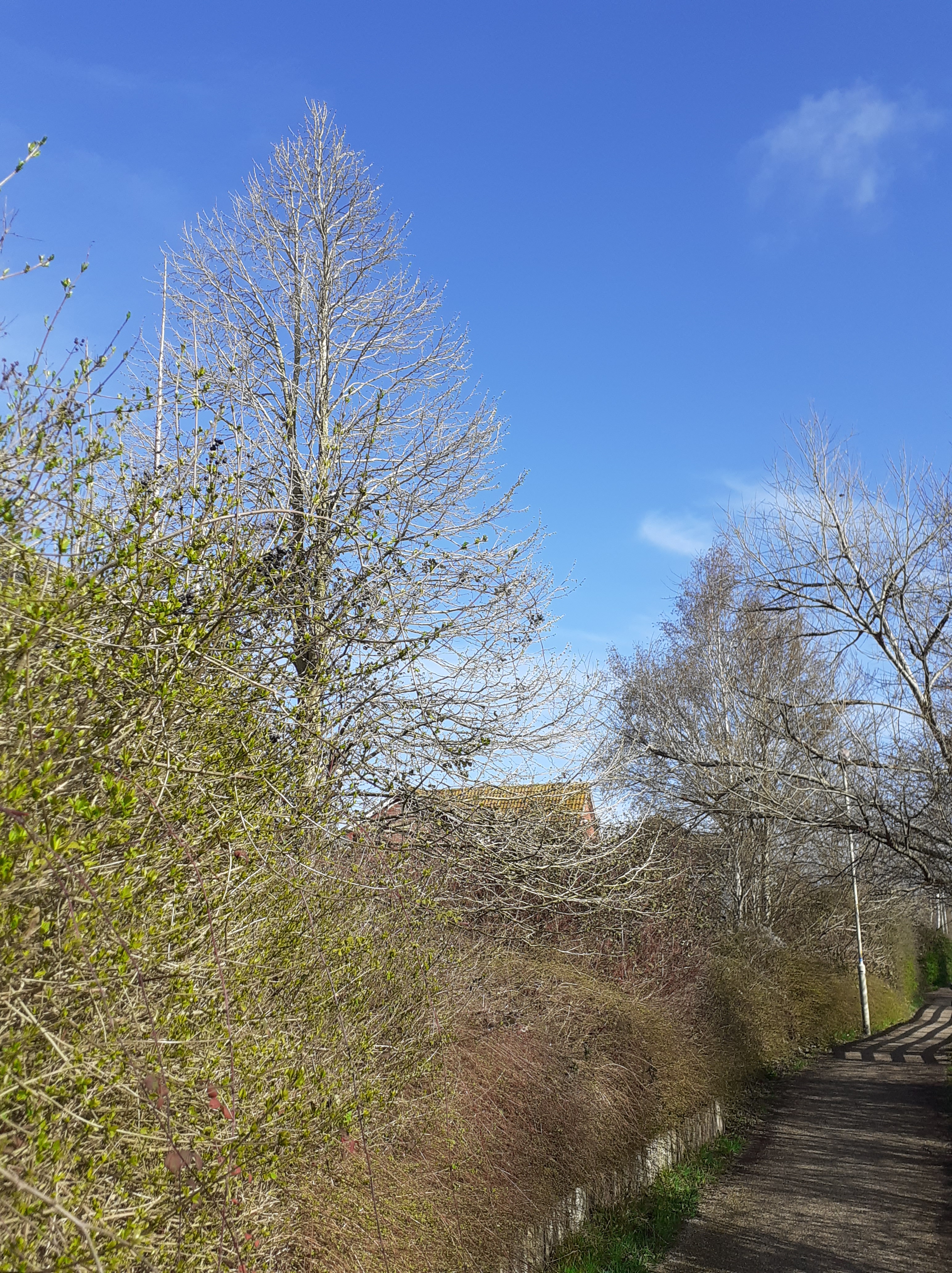
Lately I have been seeing more catkins and leaves amongst the elegant branches of their trees. A vivid green is present on the ground. As yet the changes are tentative. But they hold the promise of new life and growth. There’s a freshness here, enhanced by strong breeze. I notice and feel energised, walking down the path.

The changes have not gone very far, but the trend is now clear. For me, it shows up well against a blue sky. In this changeable season, I see possibilities for my own life, now that I am settled and in good health. These too are in their early stages, showing signs of promise more than accomplishment. My inner wisdom warns me not to move past ‘promise’ into ‘accomplishment’ too speedily or strivingly. Promise has its own season.

EMERSON: ‘IMMORTAL BEAUTY’

“Crossing a bare common, in snow puddles, at twilight, under a clouded sky, without having in my thoughts any occurrence of special good fortune, I have enjoyed a perfect exhilaration. I am glad to the brink of fear. In the woods too, a man casts off his years, as the snake his slough, and at what period soever of life, is always a child. In the woods, is perpetual youth.

“Within these plantations of God, a decorum and sanctity reign, a perennial festival is dressed, and the guest sees not how he should tire of them in a thousand years. In the woods, we return to reason and faith. There I feel that nothing can befall me in life, – no disgrace, no calamity, (leaving me my eyes), which nature cannot repair.

“Standing on the bare ground, – my head bathed by the blithe air, and uplifted into infinite space, – all mean egotism vanishes. I become a transparent eye-ball; I am nothing; I see all; the currents of the Universal Being circulate through me; I am a part or particle of God. The name of the nearest friend sounds then foreign and accidental: to be brothers, to be acquaintances, – master or servant, is then a trifle and a disturbance. I am the lover of an uncontained and immortal beauty.” (1)

In the first paragraph above, I hear my own experience, described in a mid 19th century American voice. I share the sense that the exhilaration comes partly from the land, woods and sky themselves and partly from the continuing life of the child within us.

In the second paragraph, I feel at home with with the overall sentiment, whilst having to work a little with Emerson’s terminology. At the beginning I am not sure what he means by ‘God’. I do understand that ‘plantations of God’ restores innocence, as well as wildness, to the term ‘plantation’. (Emerson was a notable abolitionist.) I also note that the woods are a domain where reason and faith are brought together, in a time and culture where they seemed to be in conflict. Nature isn’t just a word for material reality. Nature is a source of protection and healing that goes beyond the mundane.

The third paragraph makes Emerson’s transcendentalism clear, and with it the true power of contemplation. ‘Standing on the bare ground … uplifted into infinite space – all mean egotism vanishes. I become a transparent eyeball. I am nothing: I see all”. God and Nature become Universal Being, from which ‘I’ am not separate. To be simply present in this space, with no agenda and nothing in mind, is to be “the lover … of an uncontained and immortal beauty”. The nature of our experience is a living nature we perceive, are part of, and relate to – not a reified externality. An open, enlivened receptivity to this reality can allow a deeper awareness (for Emerson, that of the Divine in us) to declare its presence.

(1) Ralph Waldo Emerson Nature Boston, Mass: Thurston, Torry and Company, 1849

NOTE: According to Wikipedia, Ralph Waldo Emerson (1803-82) “was an American essayist, lecturer, philosopher, abolitionist and poet who led the transcendentalist movement of the mid-19th century” who gradually moved away from the religious and social beliefs of his contemporaries, formulating and expressing the philosophy of transcendentalism in his 1836 essay Nature”. He wrote most of his important essays as lectures first and then revised them for print. “Emerson’s ‘nature’ was more philosophical than naturalistic. … Emerson is one of several figures who took a more pantheist or pandeist approach by rejecting the view of God as separate from the world”.

VIKING PAGAN GODS IN BRITAIN

Professor Ronald Hutton’s fourth lecture in the Gresham College series on early Pagan history in Britain (1) is about the Vikings and their spiritual legacy. An overview of the old Norse world shows a people who, expanding beyond their Scandinavian homelands, were notable both as aggressive sea raiders and as traders, farmers and town builders. Travelling to new lands, and often settling in them, they grew familiar with cultures from Britain and Ireland in the west to Russia and the Byzantine Empire in the east. Their name was known in the Islamic world and as far as China. Slaving was a major part of their trade.

The raiding came first – a ‘Viking’ is a raider. They first became known in Britain and Ireland as looters of monasteries, where non-warrior monks lived close to the sea in places noted for their treasure. Monks who were not killed often became slaves. Hutton notes that early Scandinavian literature is largely realistic (relatively sparse in supernatural themes) and shows a tolerance of psychotic violence. A small boy gets bested by larger peers in a ball game and, enraged, drives an axe into another boy’s head. The community wonders what to do with him and steers away from serious punishment. For ‘he has ‘the makings of a real Viking’. Saga heroes are not very religious. Asked by a Christian ruler what he believes in, one replies: ‘I believe in me’. This seems to be the self-reliant ethic of the rootless, adventuring Viking.

Our written knowledge of Viking Pagan gods largely comes from Icelandic sources dating from 150-400 years after Christian conversion. It includes poetry, sagas and scholarly work. According to Hutton, the Pagan poems are no longer fully understood. It is thought that depictions of Paganism in this work are drawn partly from contemporary Baltic and Slav Paganism, better known by the writers than their own past. It is possible that Odin’s sacrifice of self to self, over nine days, on the windy tree is a response to Christianity: Odin is tougher than Christ.

In prose work, goddesses are few and far between. There are more goddess names in the older poems, but we do not know their stories. The gods on record are those still known in modern popular culture: Odin (the leader, god of travel, wisdom, knowledge, war, poetry); Thor (god of sky, weather, farming); Frey (god of fertility, crops, animals); Freya (goddess of love, war, magic); Baldur (handsome, beloved of all); Tyr (heroic god of war); Loki (devious and cunning – with a question around the word ‘evil’?). However, there is some doubt on whether either the warriors’ paradise Valhalla, or the end-of-the-world story of Ragnarok are derived from early Pagan tradition.

The Pagan Viking Gods came to Britain, with serious settlements beginning in the 860s, and they are remembered in place names. Odin, for example, is very well remembered in Orkney. But their worship did not last long, at least officially. The last Pagan ruler was removed in 954. The settlers had always lived among a larger co-existing Christian population. However, King Canute had to pass a law in the early 11th century forbidding the veneration of trees, stones and pools, the use of charms and the worship of sun and moon. Hutton suggests that here we see glimpses of a family and nature oriented religion without priests and temples and so unlikely to leave monuments. There is no archaeological evidence for Viking temples or shrines in Britain, though 34 swords have been found in English rivers in a way that suggests they were placed there as offerings. There are carvings that seem to show Pagan themes on crosses and a slab in the church at Sockburn, County Durham, shows the war god Tyr with Fenris, the wolf who bit his hand off.

Most of the archaeological research focuses on burial sites and grave goods. High status burials in particular included graves goods – on the whole, men had weapons, women had jewellery and both might have horses and dogs. These suggest a belief in another life in which people will want their possessions, but there does not seem to be a consistent narrative about what this afterlife would be. In some cases it is possible that, where more than one person is involved, someone may have been killed in order to accompany the deceased. Norse-settled Scotland and its islands (Both northern and western) are rich in burial sites, as is the Isle of Mann (still constitutionally a Norse lordship under the British crown run by its Parliament the Tynwald). In one ship burial there, an earlier Christian burial site was desecrated to make room for the newcomers. English Viking burial sites include the Henley Woods burials and the large site by the River Trent near Repton in Derbyshire. This is the site of the military camp set up the ‘sons of Ragnar’.

All in all, there is enough to suggest that Viking Paganism once flourished it Britain. But we do not quite catch the subjective life of its adherents. Perhaps people wore their religion lightly; perhaps it was deeply interwoven with material life and not seen as a major specific preoccupation. Soon enough, it was superseded, often for largely political reasons, by Christianity. Enigmatic pointers from literature and archaeology, enduring place names, and the land, the sea, the sky themselves (to borrow the Celtic elements) are what remain.

(1) https://gresham.ac.uk/watch-now/viking-gods/

MARCH 2023: WINTER PUSHES BACK

Where I live, March has so far been a contest between the coming of spring and a winter that won’t let go. The city of Gloucester has been relatively insulated, but we have still had sub zero nights and low day time temperatures. There has been snow that didn’t settle, cold hard rain and occasional high winds. There have also been frequent periods of sunshine – still cold, still rainy, yet a joy to be out in. Underneath this changeability, the period of daylight grows longer.

A canal side walk shows a more subdued world than last year, and a sense of latency, as though life is waiting to see what will happen next. The wheel of the year turns as ever. What to expect on the ground has become less certain. The climate crisis is visibly in process, with the consequence of vast changes in the arctic now making themselves felt here. We could say that the Cailleach is angry and mobilising. But what this means for our day-to-day weather isn’t always clear.

As I experience these shifts (not so dramatic in themselves in the here and now) I can’t help thinking about culture as well as nature. Climate has moved down the formal political agenda – again. Outright denialism and repression of information about relevant topics still aren’t over. Sir David Attenborough, who has been making nature programmes since the beginning of broadcast TV, will not be having his most recent one (6th and last of a new series) shown live by the BBC. It will be available only on iPlayer.

Supported by groups like WWF (World Wildlife Federation) and RSPB (Royal Society for the Protection of Birds), this programme highlights the destruction of nature in Britain and looks at rewilding as part of the solution. There are allegations that the restricted availability of this content stems from a fear of offending Conservative politicians and the right wing press. The BBC has issued denials but I have not seen any other plausible reason put forward. Yet this is about conservation: in older meanings of ‘conservative’, the protection of nature and the exploration of rewilding could readily have become a conservative cause. They have been, in the past – think about Theodore Roosevelt and the National Parks movement in the USA.

From a Druid and Earth spirituality perspective, the desacralisation of nature, and the emergence of a wasteland culture, lie at the heart of this problem. This is not new. It has being going on for a long time, for many reasons – religious, economic and political – driven by people with widely different projects and motivations. I know that there is much creative work going on to develop better understandings and positive projects. But it still saddens me that the balance of power and resources, especially in a renewed time of wars and the threat of wars, remains so troubling.

In my personal life I am happy and optimistic. I can feel sad about what is going on around me without being defined or disabled by my grief. Moments of fear and sparks of anger, too. They need not be driven away. They too have an honoured place at the table. They are part of the larger whole, and, lived with emotional intelligence, a way of bearing witness and a spur to action in the world.

THE VIEW FROM HOME

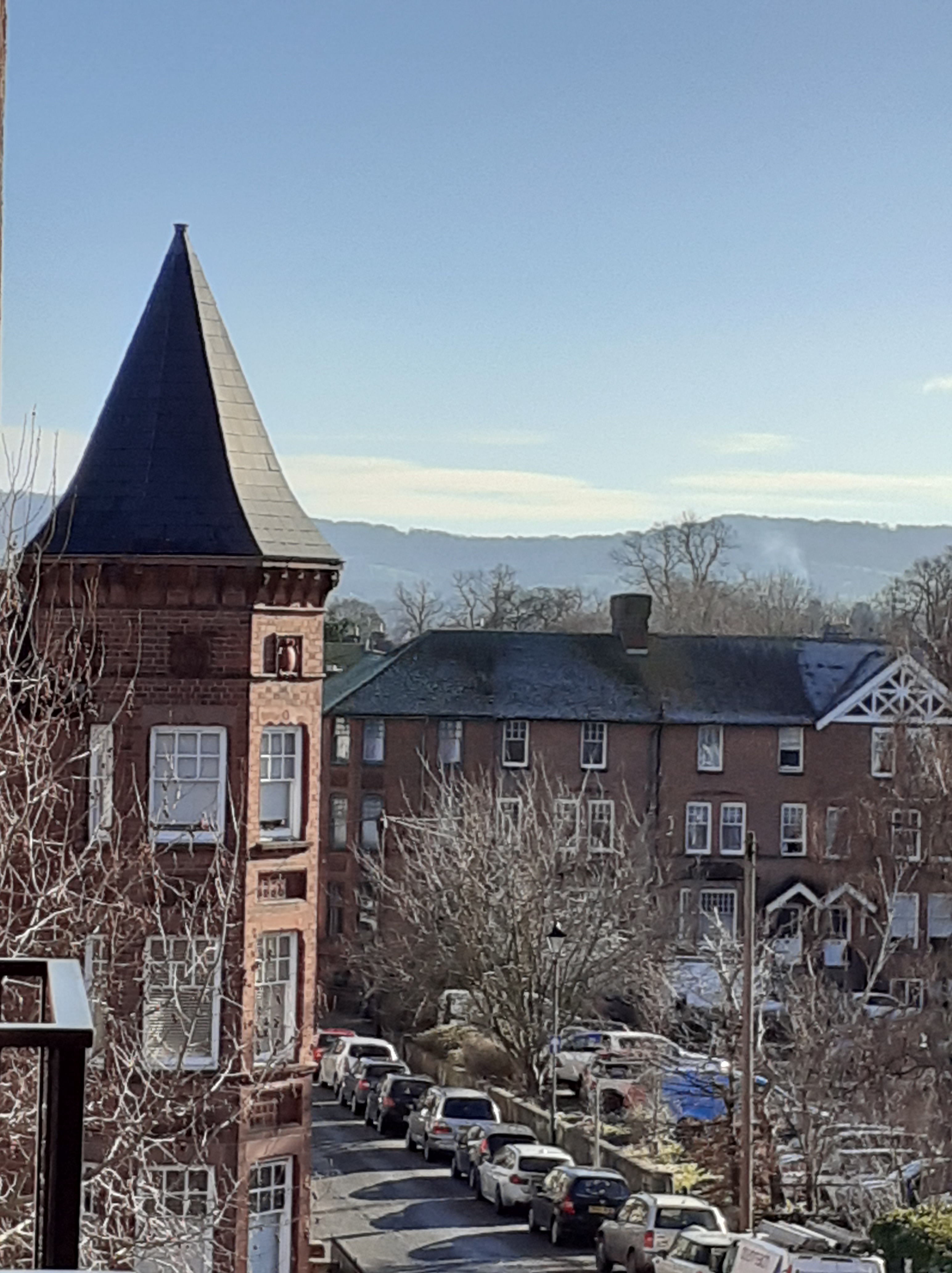
This, now, is our view from home. It helped to sell a compact apartment to us. It is a place of light and sunshine for much of the time, and allows us to see beyond the perimeters of our small historic city. Looking out, I see an expanse of energised space, providing room for the fecundity of nature. A wonderful gift for an old Druid.

Tilting my gaze a little downwards, I have more sense of our neighbourhood and the inevitable presence of cars. There was once an elegant square here, now somewhat sacrificed for a modest amount of parking space. But I do like the sense of an outlook on everyday life. I don’t want to be cut off from it. I’m glad that it’s there.

Elaine and I have not fully moved in as yet. This is a transitional moment. There’s still much work to be done. But there seems to be a shift in gravity now, and the promise of a benign base. As I se it, human flourishing enables the spiritual path too. It supports our capacity to be present in and to the web of life. At times in the journey, deprivation may need to be faced. But it is not a virtue, and in this moment I am glad of a space where the heart can easily open. Feeling gratitude, I wonder how this adventure will unfold.

ALNEY ISLAND IMAGES

Alney Island is surrounded by the River Severn at Gloucester. It is mostly a water meadow and largely free of ‘development’. I have written about it before. I took the pictures on 15 January, greatly moved by this landscape, the water margin feel, and the energy of the river, whose ‘left channel’ flowed past me close by. I’m short on words, today. So I’m letting the pictures speak for me. In a certain light, they are a kind of visual hymn.

JANUARY FEELINGS

My sense of January this year is one of bleakness qualified by promise. I spent the first week of the year grounded by back pain. So it was a pleasure, when the time came, to walk once more among trees. Their very bareness has a certain majesty. Their simple presence suggests the prospect of transformation as the year goes on.

Here, at 3.30 pm on January 9th,, I am noticing the slow lengthening of the day. It would have been twilight at this time three weeks ago. The change has an expansive note. A new lightness and colour are suggested below. They lead me further from the lassitude and brain fog of recent days. They make the world a genuinely felt privilege to be in.

Yet a taste of disenchantment does have its value. More than once, I have experienced it shortly in advance of a creative shift in energy and direction. My wife Elaine and I will soon be moving to the long=term home we have been working towards for some time. We will be setting it up, not just chasing after it, over the coming weeks. Without quite seeing the future, I do feel a returning zest and optimism.

A DIRECTION FOR 2023

I am writing on the last day of 2022. My very best wishes for 2023 to all readers. Many blessings for the year ahead!

The picture above was taken on 26 December (in England called Boxing Day/St. Stephen’s Day) – this year a chilly day of bright blue sky. The truncated spire* of St. Nicholas Church, Gloucester, reaches up towards the vivid sky, despite its history of damage. For me, this image of spire against sky is one of clarity, definition and spaciousness. It is a breath of fresh air.

I don’t know what 2023 will bring. I do want to bring clarity, definition and spaciousness to whatever unfolds. As my contemplative inquiry continues, I find that it subtly modifies its purpose. Discovering and re-discovering the purpose involves an element of divination, since my thinking personality is not exactly in charge.

It is as if authentic clarity and definition come out of the spaciousness itself, not out of cognitive review or ‘brain-storming’. These may be aids, but I have also to wait for signs. When I began this blog, I surprised myself by calling it ‘contemplative inquiry’ rather the ‘contemplative Druidry’. I see now that contemplative inquiry is the root description for my path.

For me, contemplation is a yin quality, an open and receptive engagement with experiences – most especially, with forms of relationship. Inquiry is a yang quality, actively deepening knowledge, refining understanding and seeking meaning. Together they support my path. Druidry is a vehicle that supports spiritual self-direction, and also challenges disastrous social norms concerning both nature and culture. Today I have revised the ABOUT section of this blog, on the eve of 2023, and my key statements are below:

“My contemplative inquiry began in 2012. It is grounded in modern Druidry, though not wholly defined by it. I acknowledge the influence of other sources, especially the wider turn towards an eco-spirituality that meets our historical moment. The inquiry process itself is my core practice, from which others radiate out.

“Over my inquiry years, I have found an underlying peace and at-homeness at the heart of experience. Here, it is as if I am resourced by a timeless, unboundaried dimension from which I am not separate. I find myself guided towards a spirit of openness, an ethic of interdependence and a life of abundant simplicity.”

*NOTE ON ST. NICHOLAS’ SPIRE: the church was first built in 1190 and added to over the centuries. A 200 ft. spire was built in the fifteenth century, but received a direct hit from cannon fire in 1643, during the English Civil War. The final repair waited until 1783, when the spire was reduced in height and capped.

ACCEPTING THE ARRIVAL OF WINTER

It was 26 November 2022, 11 a.m. I was at the Gloucester end of the Gloucester-Sharpness canal. I found myself accepting the arrival of winter. I was observing three cygnets, now without their parents but still keeping company with each other. The underlying temperature was around 7 C (44.6 F) and good for walking, But I was feeling the pinch of a cold wind. In memory I am feeling it now. The water and sky looked grey. The trees were starting to feel skeletal, whilst still retaining some leaves. My lingering sense of autumn had finally drained away.

To accept winter’s arrival in the presence of swans felt numinous. Swans are otherworldly birds in Celtic tradition. The three together, not yet in their full adult plumage, seemed auspicious. They suggested coming opportunities for creativity, love and celebration. Winter can be a preparation for renewal, both as season and as state of mind. My acceptance goes with a faith in winter’s regenerative darkness, and the riches this can bring.

Earth Eclectic

music that celebrates Earth and speaks to the heart

Sarah Fuhro Star-Flower Alchemy

Follow the Moon's Cycle

Muddy Feet

Meeting nature on nature's terms

Rosher.Net

A little bit of Mark Rosher in South Gloucestershire, England

Becoming Part of the Land

A monastic polytheist's and animist’s journal

selkiewife

Selkie Writing…

Charlotte Rodgers

Images and words set against a backdrop of outsider art.

Prof Jem Bendell

living with metacrisis and collapse

Towint

The pagan path. The Old Ways In New Times

The Druids Garden

Spiritual journeys in tending the living earth, permaculture, and nature-inspired arts

The Blog of Baphomet

a magickal dialogue between nature and culture

This Simple Life

The gentle art of living with less

Musings of a Scottish Hearth Druid and Heathen

Thoughts about living, loving and worshiping as an autistic Hearth Druid and Heathen. One woman's journey.

Wheel of the Year Blog

An place to read and share stories about the celtic seasonal festivals

Walking the Druid Path

Just another WordPress.com site

anima monday

Exploring our connection to the wider world

Grounded Space Focusing

Become more grounded and spacious with yourself and others, through your own body’s wisdom

The Earthbound Report

Good lives on our one planet

Hopeless Vendetta

News for the residents of Hopeless, Maine