I am walking among trees, feeling refreshed and renewed after a long winter. This feeling is anchored by the return of leaves. I am present in, and to, the presence of new green. It comes every year, at slightly different times. I’m noticing the beginning of a beautiful verdant period. It’s re-appeared a little early this year and I experience this as a great blessing.
Where I live, the early spring has been wet and windy, often with dull skies. Nature has been alive and active throughout this period, but I have remained wintry in important respects. This weekend has changed me. I am aware of new green leaves and a strengthening sun. The latter may be visually dimmed by frequent of heavy cloud, but the leaves reassure me of its power in the rising year. Although we are still far from a full canopy in the woods, the life-force – in modern Druidry often called nwyfre – is strong. It’s a time for celebration.
I’m walking in my local park. It’s a dull day in the first half of March. There have been many such days, and I could do with more sun. I certainly feel lifted when it comes. At the same time the days are longer and Mother Nature is busy with the work of spring: an abundance of willow catkins is testament to this.
I get my strongest impression of the strength and fecundity of willow when close up. The individual catkins are clearer, more prominent. The colours are stronger. There’s the sense of a rich and vibrant ecosystem, powerfully alive.
Still images don’t provide movement and sound, or indicate the presence of the March wind. I have tried to capture this in my short video below, illustrating another aspect of this moment in the year. It brought up fond childhood memories of Kenneth Grahame’s The Wind in the Willows which begins with spring cleaning and includes the gently Pagan chapter The Piper at the Gates of Dawn.
Willow became important to me in my early study and practice of Druidry. I began a special relationship with a particular willow in Bristol for many years (2), which continued after I left the city and continues sporadically to this day. I also developed a private tradition of following the wheel of the year through a mandala based on 16 trees, all in easy distance of where I lived, with Willow the focus from 17 March to 7 April, hence presiding over the spring equinox (3). Checking in with the willows is a continuing feature of my walks, though I was a little early this year.
(1) Kenneth Grahame The Wind in the Willows London: Dean, in association with Methuen’s Children’s Books, 1991. (Ist ed. 1908. Illustrated by E. H. Shepard)
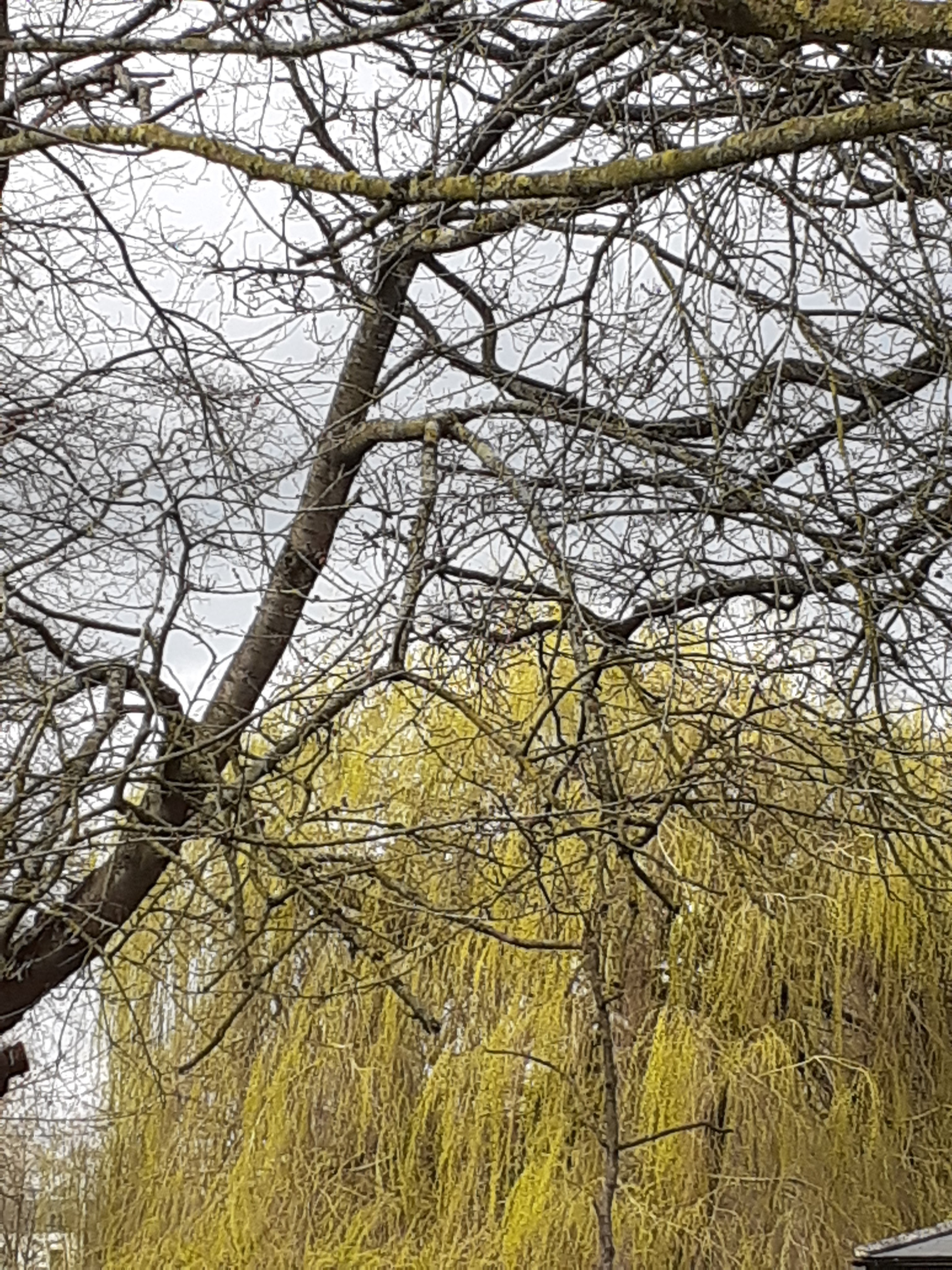
A familiar sight, in a familiar place. I’ve been living in Gloucester for two years now. This is the first February since 2019 in my personal life that I might call ‘normal’. The Covid-19 pandemic and relocations dominated the February’s of 2020-2023. Hyper-vigilant states aren’t such a feature for me in February 2024. My reduced anxiety has allowed a certain laziness and I have found it welcome.
Contemplating the image above, I greet these winter-skeletal trees as friends, today part of my internalised psychic territory. On this occasion, a 9 February walk, I call the afternoon ‘grey’ because of my initial response to the sky. The label has meaning for me as a first impression though it does over-generalise. Looking more closely, I find the sky turbulent and mixed. White hides the afternoon sun. There are indications of movement and change, and hints of blue. A slender branch yearns upwards to the hidden sun, pursuing fresh life and growth. That sun has moved well beyond midwinter. It may not yet be spring, but the days are longer and at times I experience a real warmth.
Moving on and now looking downwards, I discover a different world. Here there is evidence of both sunlight and shadow on the path. Mud and the puddles from refreshing rain too, with vivid green grass beside on the verges..
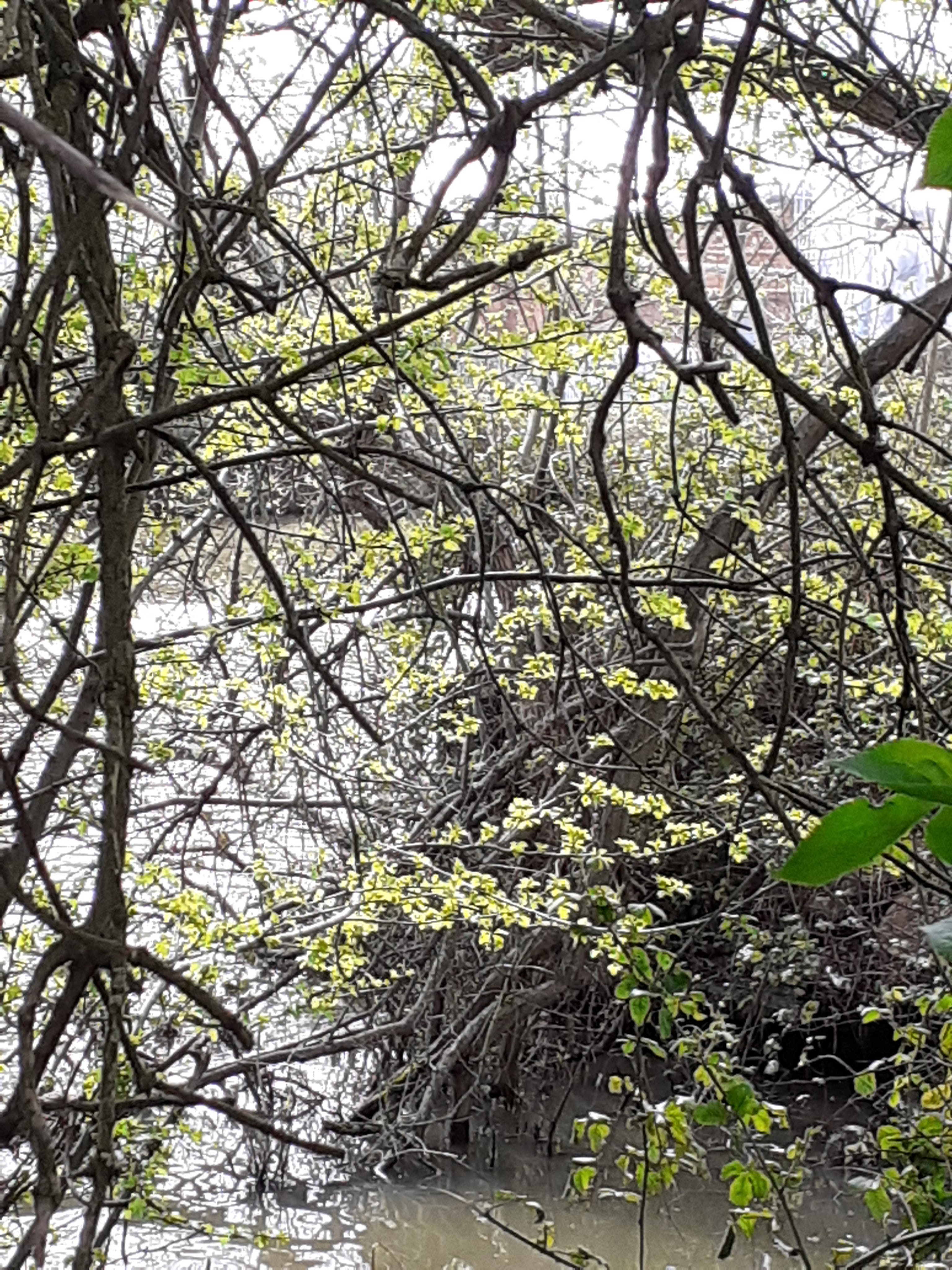
But the the most obviously verdant signs of annual regeneration in February 2024 are in the undergrowth beside the path. Here, in the picture below, is a feast of green freshness. New-appearing nettles are strongly present. They may sting to protect themselves yet they also nourish and heal. They have enriched our lives in many ways for a very long time. When I was ill with respiratory problems at times in 2021 and 2022 I valued them as a tea. I was pleased to meet the rising generation on my walk.
My memory of February 2024 will feature the colours grey and green as strong markers of this intermediate season. A blessing our lives, and a blessing on the land!
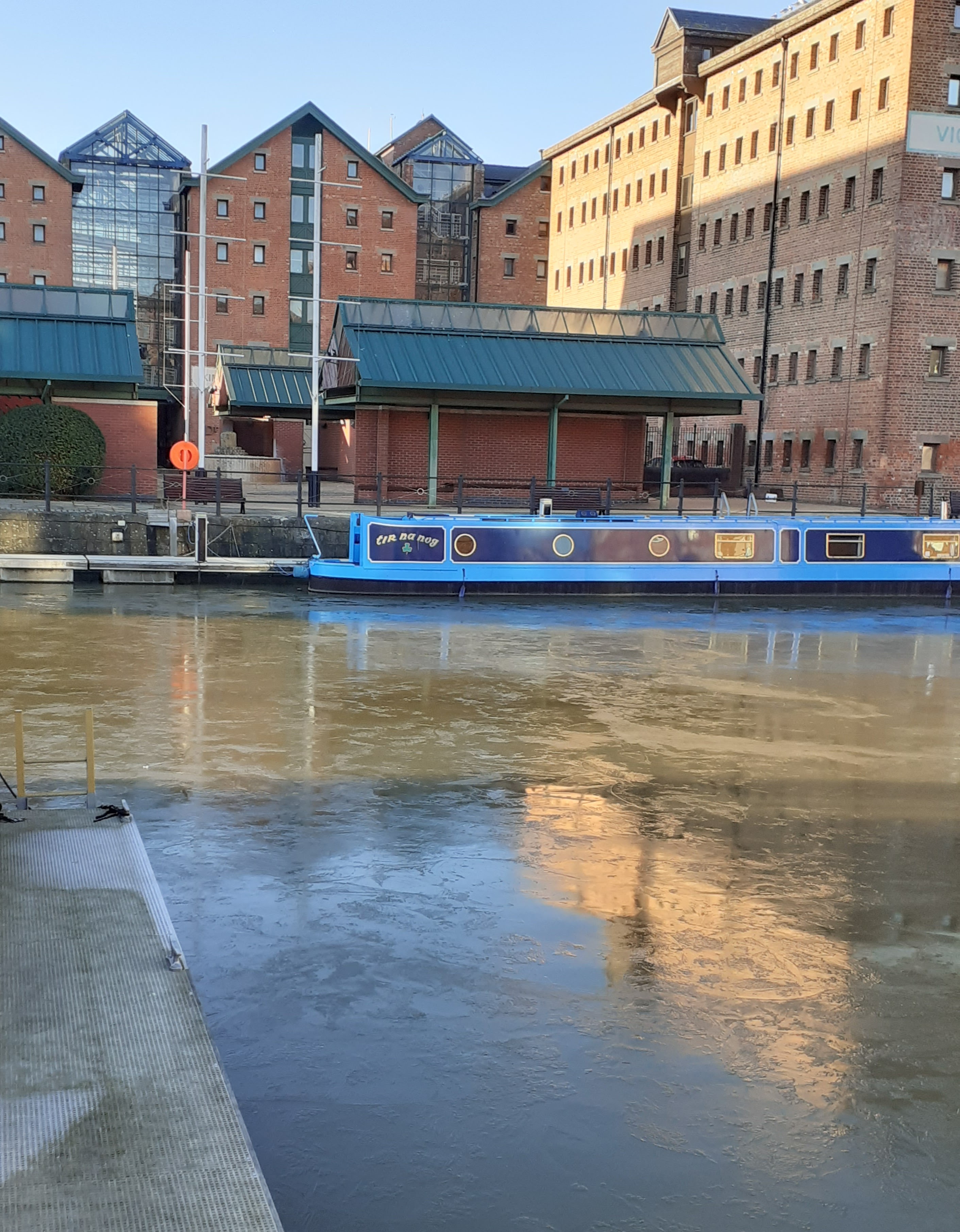
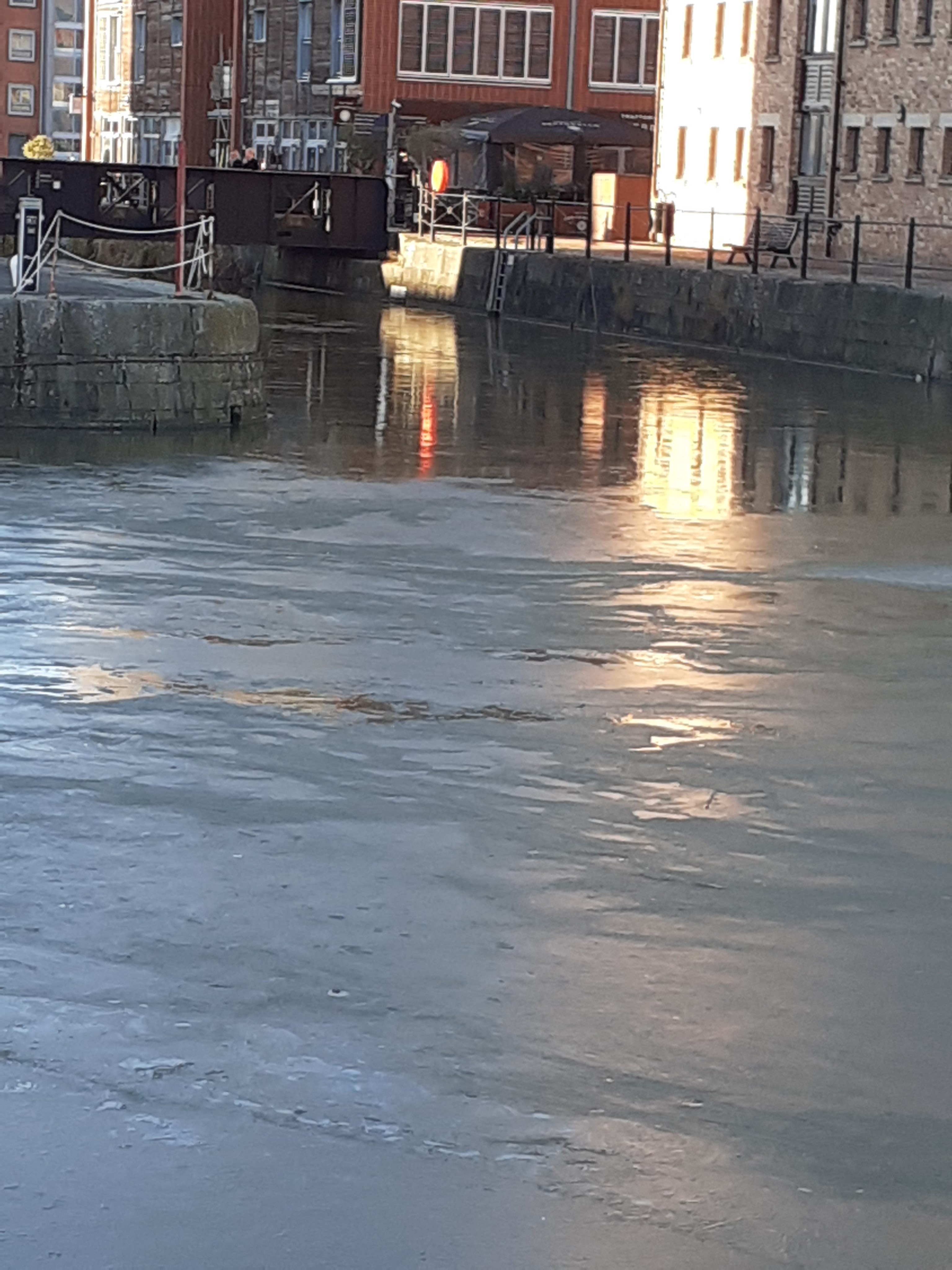
Yesterday – 3.30 pm or so – I was walking home swiftly from a shopping expedition. I was slowed down and halted by the water in Gloucester docks. It drew my eye and asked for a closer look. It had clearly been iced up in the previous cold night, and had been slowly melting in this bracing but above-zero day.
The sky is clear and I experience a strengthening sun now. I recollect that we are now several weeks beyond the solstice. The balance of light, shade, stillness and fluidity sends me into a more deeply meditative state, entirely trumping my original sense of domestic mission and wanting to be home.
Ice and water are made of the same stuff, manifesting in different ways. The patterns on the surface look still but tell a story of transformation – here, from fixed to free. Another drop in temperature could easily end and indeed reverse this process. In this space I see the same essence adopting different forms under different conditions. But here the change is gentle. The contemplative moment extends itself. I am open to the magic of nature. In such beauty, I find peace and stillness within my own being.
It is 3 January 2024, around 8.30 am. I repeat my best wishes to all readers for 2024 from inside the new year, as it begins to unfold. I contemplate the sky, uncertain about what this new year may bring. At some level I feel open and uncluttered, free of over-determined intentions. It is as if I have surrendered to a current.
My Contemplative Inquiry, once a formal structured project, has gradually evolved into a simpler and more natural-seeming contemplative inquiry in no need of capitalisation. This inquiry is wired in, no longer in need of much external input or formalised internal effort. I am aware of owing a debt to the formal structured project, with its inputs and efforts, for it enabled this evolution to occur.
The result of the early, more formal, years is recorded in my ABOUT section. It was simultaneously a gnosis and the discovery of a place to stand that felt right and made sense. “My inquiry has been a pathway to greater understanding, healing and peace. In the contemplative moment, I am living presence in a field of living presence, at home in a living world. This is not dependent on belief or circumstance, but on the recognition of what is given, joy and sorrow alike. I find that this simple recognition moves me towards a spirit of openness, a fuller acceptance that nothing stays the same, an ethic of interdependence and a life of abundant simplicity”. My inquiry today is about deepening, and living more congruently and confidently from this place. It is part of me now, and I foresee no end.
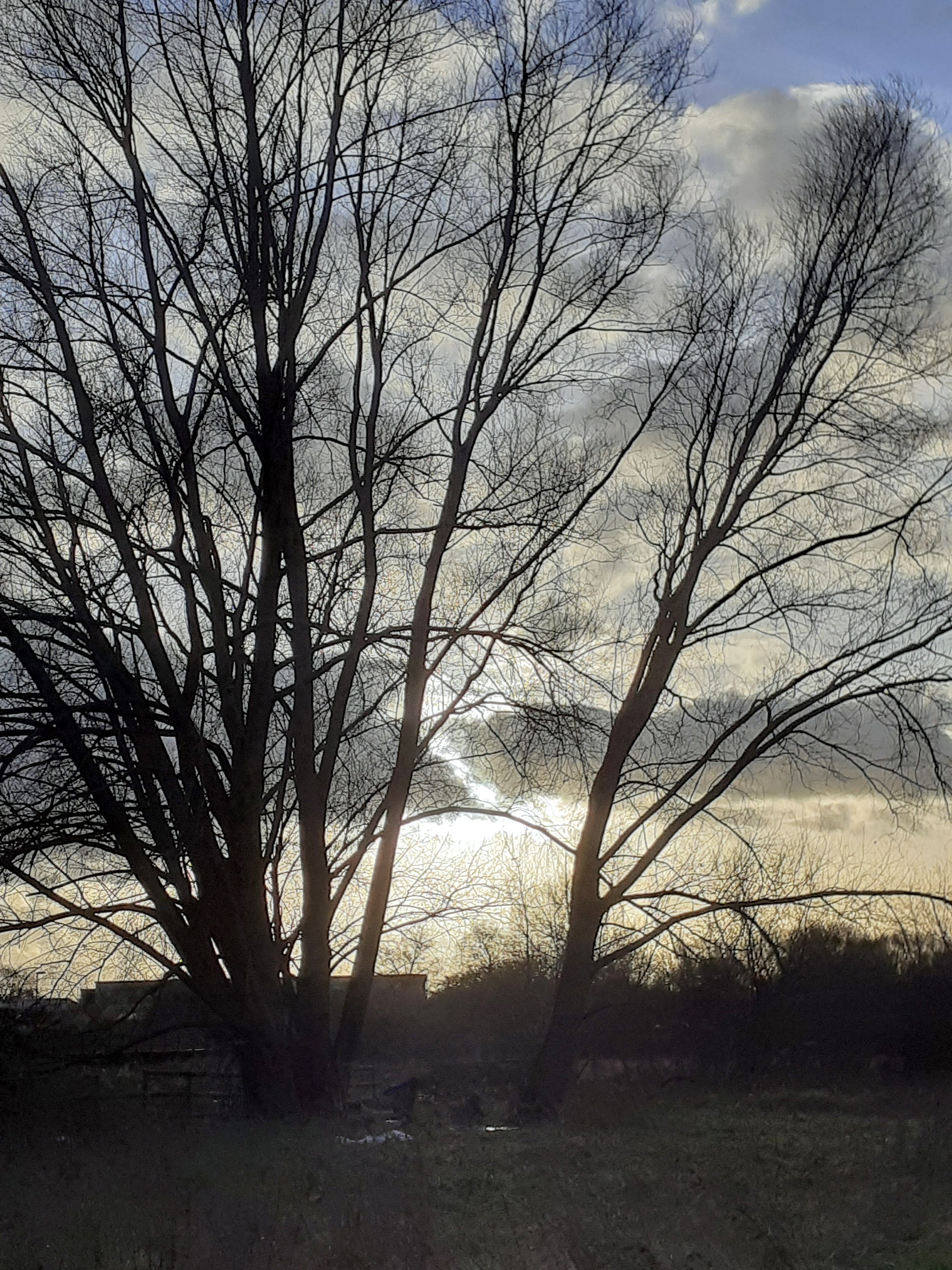
Seasonal Blessings to all readers, and my best wishes for 2024! I took these photos between 2.20 and 2.50 pm on 21 December, the last day before the Solstice, and a little more than an hour before sunset in Southern England.
The location is Alney Island, Gloucester, which I had not been to for some time. I encountered a sun that was low in the sky, clearly sinking, but still having an obvious influence on the landscape. Above, you can see a powerful luminescence behind the starkness of the trees. Immediately below, you can see light effects on the river and the trees themselves.
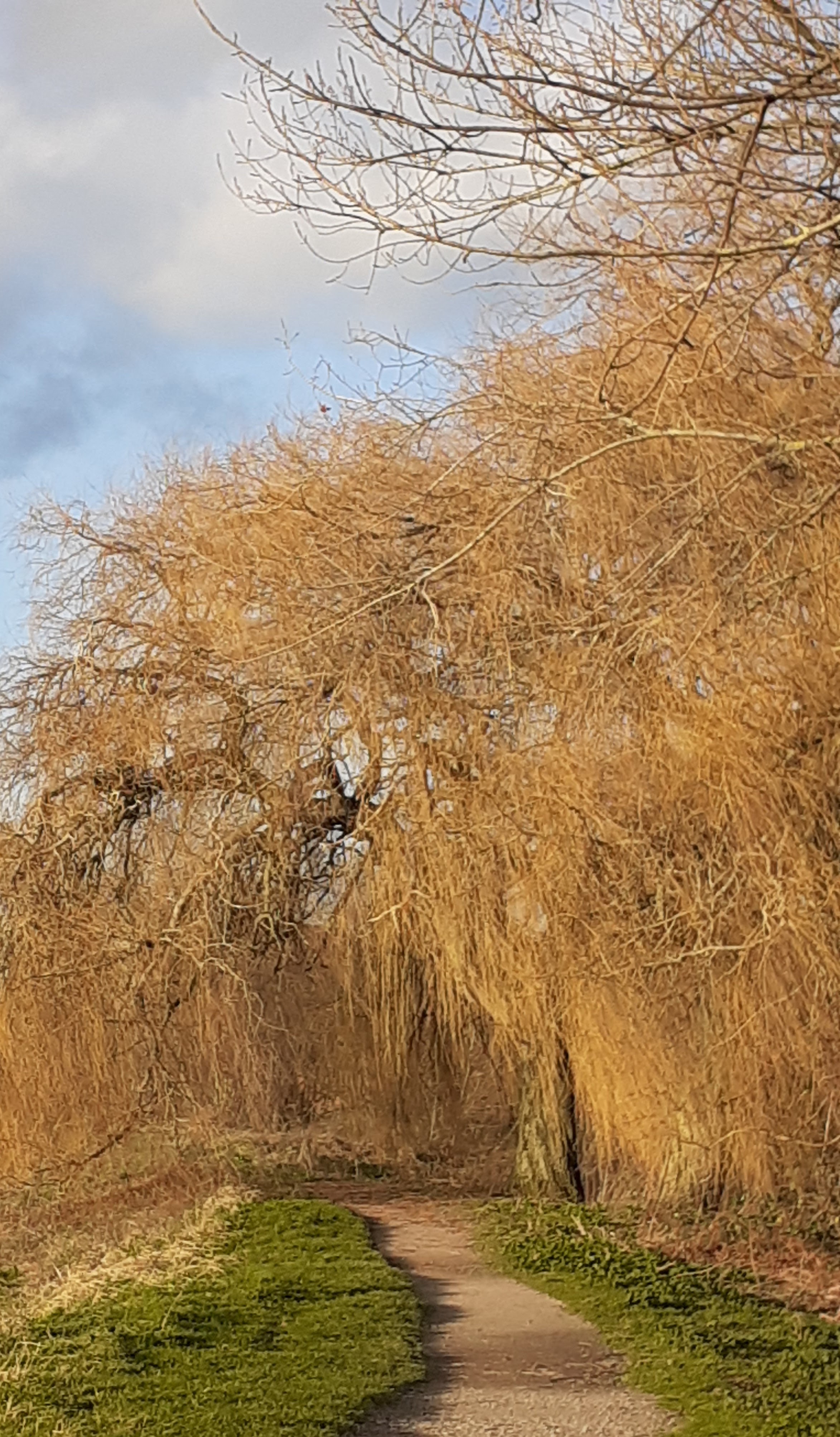
In the picture below, the midwinter sunshine is clearer and stronger. I love the way in which the willows show their vitality and abundance even when they have lost their leaves. The path is relatively dry, yet surrounded by green grass. There is a play of light and shade. There is blue as well as cloud in the sky.
On the ground, in the afternoon, and now in the evening as I write, I am thinking of light and dark, and of waxing and waning, as natural phenomena. I am not thinking in moral or metaphysical terms. These are different considerations, with a tendency moreover towards abstraction and absolutism. In my experience, nature tends to be nuanced. Different things are going on at the same time. Certainly where I live, there is always some balance of light and dark. The balance shifts, but both are always in play.
We treat tomorrow’s sunrise as the beginning of a turn. Here, in 2023, the afternoon before the change seems like a friendly one for an annual nadir of the light. This is also a bit how I am thinking about myself. Towards the end of November, when I last wrote a post of this type, I was celebrating a recovery from illness, and the opportunity of a good day. A good day was about what it was. Many people have pointed out in the last year or so that Covid-19 seems to have a long tail. I have been physically restricted beyond what I think of as normal.
I’m aware of a 75th birthday coming up next year, at which time our government will no longer consider my death as premature. Yet I am in good heart and feeling resilient. Without being presumptuous, I’m leaning in to longevity. I’m checking my capabilities and energy levels, anticipating some adjustments, and noticing the many rays of light which present themselves in my world.
Extract from The Dawn of Everything: A New History of Humanity by David Graeber and David Wengrow (1), exploring the notion of ‘concrete science’. The idea comes from the anthropologist Claude Levi-Strauss, who is quoted as saying that “there are two distinct modes of scientific thought … two strategic levels at which nature is accessible to scientific enquiry: one roughly adapted to that of perception and imagination: the other at a remove from it”. ‘Concrete science’ is the first. The specific focus, in this part of the book, is on the development of Early Neolithic societies in lowland parts of the Fertile Crescent, especially along the valleys of the Jordan and Euphrates rivers.
Graeber and Wengrow write: “It’s important to recall that most of humanity’s greatest scientific discoveries – the invention of farming, pottery, weaving, metallurgy, systems of maritime navigation, monumental architecture, the classification and indeed domestication of plants and animals. and so on” come out of ‘concrete science’. But what does such a science actually look like, in the archaeological record? “The answer lies precisely in its ‘concreteness’. Invention in one domain finds echoes and analogies across a whole range of others, which might otherwise seem completely unrelated”.
“We can see this clearly in early Neolithic cereal cultivation. Recall that flood-retreat farming required people to establish durable settlements in mud-based environments, like swamps and lake margins. Doing so meant becoming intimate with the properties of soils and clays, carefully observing their fertility under different conditions, but also experimenting with them as tectonic materials, or even as vehicles of abstract thought. As well as supporting new forms of cultivation, soil and clay – mixed with wheat and chaff – became basic materials of construction: essential in building the first permanent houses; used to make ovens, furniture and insulation – almost everything, in fact, except pottery, a later invention in this part of the world.
“But clay was also used, in the same times and places, to (literally) model relationships of utterly different kinds, between men and women, people and animals. People started using its plastic qualities to figure out mental problems, making small geometric tokens that many see as direct precursors to later systems of mathematical notation. Archaeologists find these tiny numerical devices in direct association with figurines of herd animals and full-bodied women: the kind of miniatures that stimulate so much speculation about Neolithic spirituality, and which find later echoes in myths about the demiurgic, life-giving properties of clay. As we’ll soon see, earth and clay even come to redefine relationships between the living and the dead.
“Seen this way, the ‘origins of farming’ start to look less like and economic transition and more like a media revolution, which was also a social revolution, encompassing everything from horticulture to architecture, mathematics to thermodynamics, and from religion to the remodelling of gender roles. And while we can’t know who exactly was doing what in this brave new world, it’s abundantly clear that women’s work and knowledge were central to its creation; that the whole process was a fairly leisurely, even playful one, not forced by any environmental catastrophe or demographic tipping point and unmarked by major violent conflict. What’s more, it was all carried out in ways that made radical inequality an extremely unlikely outcome”.
(1) David Graeber and David Wengrow The Dawn of Everything: A New History of Humanity Penguin Books, 2022 (First published in Great Britain by Allen Lane in 2021)
NOTE ABOUT THE AUTHORS David Graeber was a professor of anthropology at the London School of Economics. He is the author of Debt: The First 5,000 Years. As an activist, he also helped to make Occupy Wall Street (2011) an era-defining moment. He died on 2 September 2020. David Wengrow is a professor of comparative archaeology at University College London. He conducts fieldwork in Africa and the Middle East and is the author of What Makes Civilisation? Following David Graeber’s death shortly after the text of The Dawn of Everything was completed, David Wengrow has overseen its publication.
Recently I’ve been unwell and housebound, hardly even watching the world go by. But there came a day when I could go out again, a day that was blessed with sun. It seemed bright and new. I was almost blinded by its luminous presence on a white tree-patterned wall. I had entered late fall, a season with both autumnal and winter features.
The sun shone on trees in Gloucester City Park which retained some of their foliage, but in an end-of-season way that signals austere changes to come. Leaves showed a fragile, lingering beauty, prior to their necessary descent.
The Brunswick Gardens, sitting under a clear blue sky, were home to trees where the leaves had already fallen, leaving the branches as patterns of quiescent arboreal bones. The leaves were on the lawn. Other, managed, flora continued to flourish.
In visual and tactile ways, after an indoor confinement, the neighbourhood was full of reward for me. But I felt cold, and it was indeed the coldest it’s been for many many months. I could not stay out for long. But I had encountered a moment in the year, of interbeing, of living presence – where the wheel is visibly and palpably turning. I was glad to be there, however briefly, available for a nurturing and healing experience.
Highly recommended. Unseen Beings: How We Forgot the World Is More Than Human (1) is about the many beings we humans have actively ‘unseen’ and the consequences of our human-centric lens. Author Erik Jampa Andersson describes his book as a diagnostic exploration of the roots of the climate crisis, itself an extreme consequence of a much wider malaise. Whereas the common view of ‘saving the planet’ tends to be one of ‘guarding the storehouse’, a better focus would be on ‘supporting the welfare of living beings’.
Andersson has a background in Tibetan Buddhism and Tibetan medicine. In the manner of Buddhism’s Four Noble Truths, and of his medical training, he divides his book into four parts: Diagnosis, Causes and Conditions, Prognosis, Treatment.
Diagnosis concerns “our ecological disease”. Andersson reminds us of what the climate crisis is, how far it has been allowed to go, and the “fanciful stories” with which we have soothed our fears: “full of human exceptionalism, divine protection, techno-fixes and post-apocalyptic salvation”. For Andersson, the foundational root cause is “the sundering of human and non-human beings, and our perceptual separation from ‘Nature’. He refers to “the poison of anthropocentricity”. He reviews the evidence for plant and fungal sentience and awareness as well as that of the animal kingdom. He concludes that Nature is not a place, but “a tightly knit community of interconnected beings, some seen, many unseen, all engaged in their own affairs and with their own experience of reality”. He describes this relational approach to the living world as “what most scholars now call ‘animism’ … neither a religion nor a system of belief, but a paradigm of more-than-human relationship”. He sees this stance toward the world as “our natural state”.
Causes and Conditions A mini-ice age some 13,000 years ago interrupted an early agricultural period in some places and prompted a series of innovations. The domestication of the horse was especially significant. Andersson sees a move away from our ‘natural state’ beginning at this time. But it is not fully evident to us until the age of written philosophy and scripture. The Greek philosophers Plato and Aristotle declare a hierarchy of sentience from plants up to animals and then humans at the top, uniquely endowed with a rational soul. In the Hebrew book of Genesis, God gives dominion over the Earth and its animals to man for his use. In the Western Christianity of the 13th century CE, Thomas Aquinas says that Christians have no duty of charity to non-humans because they are resources, not persons. In the 17th century CE, early in the West European led colonial era, Descartes holds public vivisections of dogs and other animals declaring that they are soulless automata and that their apparent distress is meaningless. In the mid 19th century CE, Darwin restores other beings as our ancestors and cousins, but but without much sense of kinship or empathy.
Prognosis Here Andersson introduces two concepts from Tibetan medicine: ‘provocation’ and ‘spirit illness’. The provocation of other sentient beings is a health risk. He discusses the origins of the recent Covid-19 pandemic in these terms, as human become ever more invasive of our remaining wild spaces. In cases of deforestation, pollution, and any disruption of air, water, soil and trees, there is a price to pay for the wounding of other spirits, whether seen by the eye, seen through a microscope and normally unseen but recognised by tradition. (‘Supernatural’ is an unhelpful word here – everyone is part of nature). In Tibetan tradition, the cultivation of a clear mind is highly prized and works within human psychology, but not for disruptive events like these. There is a need to make amends. Rituals are held in sensitive and damaged places. The damage caused in these circumstances and the resultant chronic collective disease can only be addressed by learning how to care for eachother, non-human beings and the planet itself.
Treatment Using the Buddhist 8-fold path as a structure, Andersson recommends ‘cultivating care’ over a system of rules and regulations aimed at a ‘sustainability’ which tries to restore the old status quo. We cultivate care of the Earth, one another and non-human beings. Hence: 1 right view is a return to our ‘natural state’, as described under Diagnosis; 2 right intention describes commitment to a path of rewilding and regeneration; 3 right speech is the use of “life-affirming language” (e.g. using ‘they’ as an alternative to ‘it’ for non-human beings); 4 right action is causing as little harm as possible to other beings; 5 right livelihood means adopting principles of authentic sustainability and non-exploitation; 6 right diligence is based on “the durability of the heart-felt ethic; 7 right mindfulness means “paying attention to nature’s vitality”; 8 right concentration involves imaging a new future with “authentic myth-making”.
Concerning 8 above, Andersson has been profoundly moved by the work of J. R. R. Tolkien from his later childhood onwards. As a result, he developed a high valuation of authentic myth-making and enchantment. In this realm, the non-human is essential. Tolkien had his own life-changing moment of enchantment when, as a student, he first read the Old English words: Eala earendel engla beorhtast, ofer middangeard monnum sended. (Hail Earendel brightest of angels, above the middle-earth sent unto men). Of this evocation of Venus arising as the morning star, in the old language, Tolkien later wrote: “there was something very remote and strange and beautiful about these words, if I could grasp it, far beyond ancient English”. For Andersson, authentic myth and authentic science work together in support of a redemptive animist vision. By contrast, the form of discourse to worry about is ‘fallacy’ – a complete dissociation from the truth. Andersson again quotes Tolkien: “if men were ever in a state in which they did not want to know or could not perceive truth (facts and evidence) then Fantasy would languish until they were cured. If they ever get into that state (it would not seem at all impossible) Fantasy will perish and become morbid delusion”. For Andersson, this too has become a symptom of our current ecological disease, making the need for honest and healthy communication all the more urgent.
For me, Andersson has made a valuable addition to a growing literature about the current crisis, whose most alarming symptom is climate breakdown. He goes to the root of the problem, offering a clear and coherent view about how to stand in the face of it. It is a well-researched, well-crafted and compassionate contribution to the genre.
(1) Erik Jampa Andersson Unseen Beings: How We Forgot the World is More Than Human Carlsbad, CA & New York City; London; Sydney; New Delhi: Hay House, 2023
I attach a links to conversations between the author and Andrew Harvey below. It adds considerably to what I can present in a review:
From the modern animist perspective of his Unseen Beings: How We Forgot the World Is More Than Human, Erik Jampa Andersson looks at what we owe to our canine friends.
“In our own evolution as a species, non-humans have often played crucial roles. Plants and animals weren’t always just our food and possessions – they were are mentors, companions, even our ancestors.
“There’s one non-human, in particular, whose profound impact on our human story warrants far more recognition … They were descended from the beasts of legend – formidable hunters who commanded vast swathes of land with ferocious might. In many of our myths and legends, they were immortalized as guardians of the underworld and crucial intermediaries between the human and non-human domains. Before we had ever tamed a horse, milked a cow, or sown a field of grain, we had befriended a dog.
“… It’s believed that humans and wolves were gradually drawn together during the perilously harsh conditions of the Last Glacial Maximum [20,000+ years ago: JN]. As our paths began to cross more and more frequently in our pursuit of mutual prey, what likely started as a timid sharing of spoils led to an unusual sense of kinship between the two predators. Wolves were drawn into the warmth of human encampments, and ultimately made themselves quite at home at the foot of our beds. They offered us vital protection, companionship, and a natural ‘security alarm’ in a wild and dangerous world, while we provided them with warmth, food, and evidently also emotional satisfaction.
“Studies of canine intelligence have repeatedly attested to dogs’ advanced capacity for memory, social cognition, inferential learning, and even comprehension (and possible use) of human language. But beyond their clear intelligence, what deserves significantly more attention is the very real impact dogs have had on our own evolutionary trajectory.
“Unlike predators who prefer to prey on weaker animals, wolves thrived as persistence hunters, successfully felling giant mammals by stalking them to exhaustion in well-organized packs. As territorial animals, they also went to the great trouble of staking out their own tribal domains, maintaining a distinctly pastoral lifestyle in complex social groups.
“Such practices were wholly foreign to early humans and other simians, but by the time our ancestors found their footing in the Eurasian wilderness, they had become rather formidable and territorial pack hunters themselves. Researchers suggest that these novel human behaviours were at least partially influenced by our burgeoning relationship with canines, who introduced us to their world, taught us their hunting tricks, and afforded us peace of mind by protecting our settlements against less amiable foes.
“The domestication of dogs was one of the key forces that led to the development of fully modern humans, impacting our relationship with one another and the world at large for many millennia to come”.
(1) Erik Jampa Andersson Unseen Beings: How We Forgot the World is More Than Human Carlsbad, CA & New York City; London; Sydney; New Delhi: Hay House, 2023









 Contemplative Inquiry