
BOOK REVIEW: THE 15-MINUTE CITY
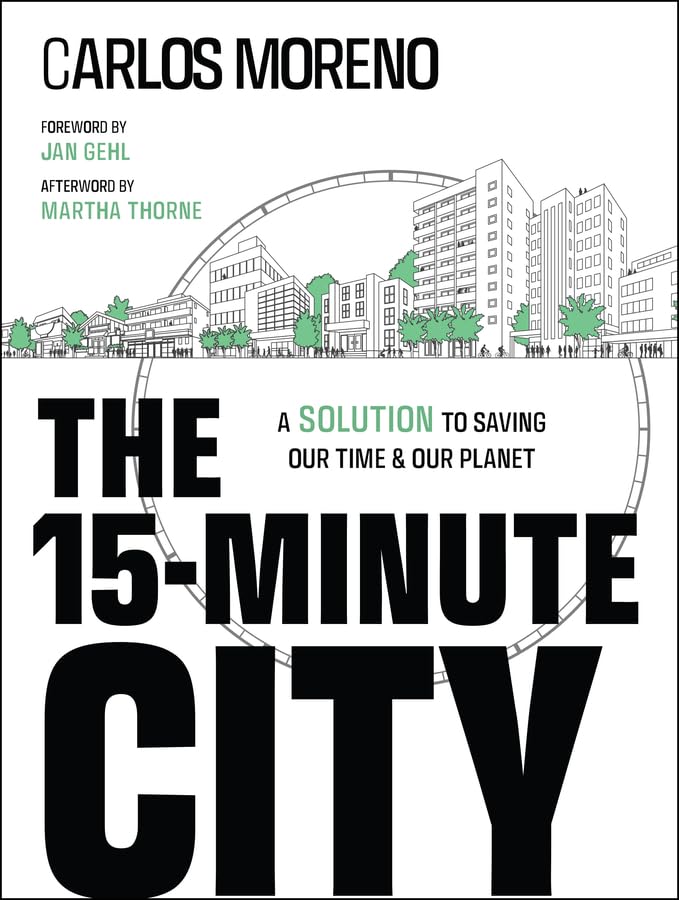
The 15-Minute City: A Solution for Saving Our Time and Our Planet (1) advocates that everyday destinations like schools, stores, and offices should only be a short walk or bike ride away from home. The intention is to make cars far less necessary for contemporary city-dwellers, and thereby “to reinvent our life-styles and rethink our relationship with space and time”. Its key values are proximity, interconnectedness and fulfilment.
This book is about how cities are run, who they are predominantly run for, and how they could be run more inclusively. It provides an inspiring store of information for people concerned with these issues, not least urban Druids. It has 21 chapters:
Chapter 1 is a call to action, emphasising “the urgency of reimagining urban ecosystems in the light of contemporary challenges”.
Chapters 2 to 4 discuss the ‘fragmentation’ of cities over time, especially due to city roads and zoning.
Chapter 5 is about learning lessons for “a more inclusive urban future”.
Chapters 6 & 7 look at changes beginning with the 1973 oil crisis and moving on to the “challenges and realisations of 2020”.
Chapters 8 to 11 focus on Paris, where the ’15-Minute City’ was invented.
Chapters 12 to 19 cover particular locations and their complex histories: Milan, Italy: Portland, Oregon, USA; Cleveland, Ohio, USA; Buenos Aires, Argentina; Sousse, Tunisia; Melbourne, Australia; Busan, South Korea.
Chapter 20 looks at the notion of the 20-Minute Territory as applied in Scotland and on the Ile de France.
Chapters 21 discusses the role of new technologies and summarises the book.
By 2050, 68% of the human population will be urban. Changes are needed in the ways that urban ecosystems work for people’s health and wellbeing, now more than ever because of the climate crisis. Author Carlos Moreno writes, “urban life is the heart of the problem, but it is also the solution if we enable it to be. Never in the history of humanity has survival been so compromised by lifestyle”.
Moreno also believes: “our journey through these cities is also an exploration of ourselves. By offering an urban setting that is conducive to conviviality and proximity, we can rediscover the value of mutual cooperation and sharing. We are nourished by authentic interaction and the solidarity of a reinvented urban life “
It may be that it is now too late to save the kind of civilisation in which we are living. From a seemingly uninvolved and above-the-battle standpoint we may even see advantages in its fall. But I have come to think that it is better to work from the opposite point of view – that there is something worth working for, despite the apparent odds. The work itself can be a spiritual discipline, taken on for its own sake. Carlos Moreno offers us one neighbourly way of addressing our apparent spiral into a dystopian world.
(1) Carlos Moreno The 15-Minute City: A Solution to Saving Our Time and Our Planet Wiley, 2024. Foreword by Jan Gehl. Afterword by Martha Thorne.
 Contemplative Inquiry