Contemplative Inquiry

This blog is about contemplative inquiry

Tag: Druiidry

THE BALANCED CROSS

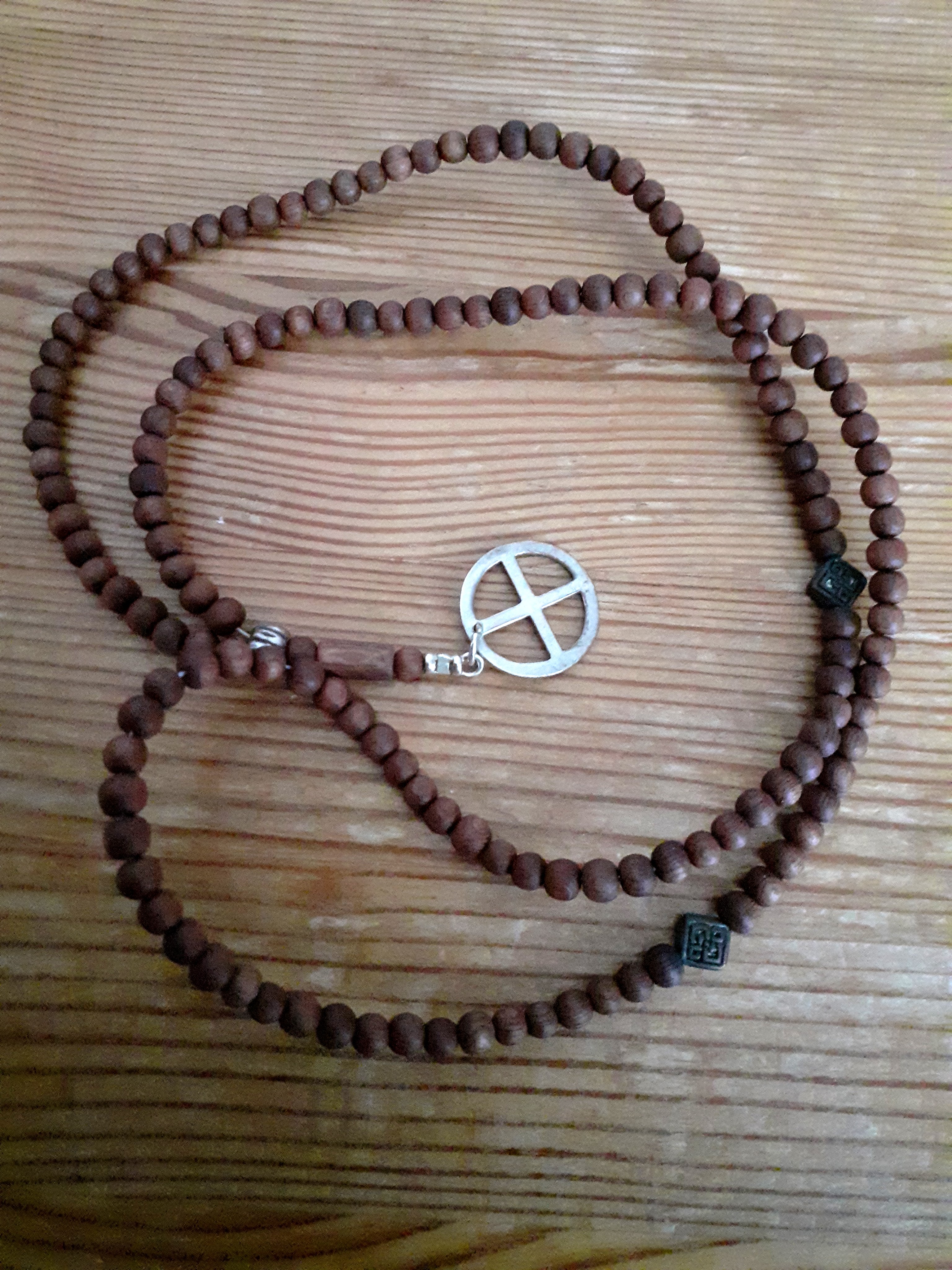
Twelve years ago (1) I wrote about the paidirean (pahj-urinn) prayer beads of the Ceile De or Culdee movement (2). In its current iteration this is a modern monastic order based in Scotland with a lay following in other parts of the world. It looks back to the early Celtic church once influential in Ireland, Scotland and north-east England. The post referenced above (1) describes my relationship with the beads at the time.

Now, coming back to this beautiful artifact, I am principally focused on the cross – an equal armed and circled silver cross that hangs from the beads – at heart level when worn as a necklace. This form of cross is an ancient symbol, sacred to many people in many cultures, often understood as a sun wheel, and not specific to Celtic Christianity. It is sometimes called the balanced, or peaceful, cross.

For me, this cross is a more fundamental image than the awen symbol, which I can also wear as a pendant, appropriately sitting at the level of my throat. The silver cross maps a whole imaginal world: four directions or winds – east, south, west, north; four powers – light, life, love, law; four elements- air, fire, water, earth; four guardians – hawk, stag, salmon, bear; four qualities – vision, purpose, wisdom, faith; four times of day – sunrise, midday, sunset, midnight; four seasons – spring and early growth, summer and ripening, autumn and bearing fruit, winter, dying and regeneration. Having a liturgy to this effect, casting a circle and calling for peace as a regular practice, marinate me in a certain way of spiritual life. Wearing this cross confirms and declares it.

In my light energy work, the disc becomes a radiant sphere that holds me. For there is a vertical dimension. Horizontally I hold my hands out palms raised and the energy flows out from heart through outstretched arms and to my hands. Vertically it flows in both directions from my heart to my feet and the earth and also to my brow and above my head. But the source of this radiance is the energy behind the heart and the still emptiness behind the energy. This flow is an open system. Energy also comes back. My energy sphere is porous to the world. I like the illustration on the bag below because it shows an empty circle at the centre. This does not feature on the pendant itself, but to me empathises the divine power at the centre from which I am not separate. It is good to reconnect with an carrier of healing and insight which I appeared to have left behind. I am grateful that it was still here for me when I was ready to reconnect.

(1) See: https://contemplativeinquiry.blog/2012/12/30/

(2) See: https://www.ceilede.co.uk

SOPHIA, GNOSTICISM AND CONTEMPLATION

When I wrote Contemplative Druidry I said that “in many ways this is a story of neo-Pagan sensibility and its growth since World War Two”. In addition to their Druidry, many of the book’s contributors reported involvement in Witchcraft and/or the indigenous Shamanism of other lands.

I also said in many cases this sensibility was modified by other influences, “most notably Buddhist philosophy and meditation, Christian mysticism and other Western Way paths with Gnostic and Hermetic traditions specifically mentioned”. I made the point that such influences are significant for contemplative practice, because to an extent they provide models. In the book I mostly focused on Buddhist influences, because they were the most common. I also paid  attention to the Christian ones, notably the Ceile De, Anglican mysticism in the tradition of Evelyn Underhill, and the partly Franciscan inspiration behind the (Druid and Pagan) Order of the Sacred Nemeton. I didn’t say much about other Western Way traditions, though I mentioned R. J. Stewart as a personal influence on me and also my training at the London Transpersonal Centre. This was essentially Jungian and thus based on a modern Gnostic psychology.

The key images from my last post, Sailing to Byzantium, were images of Sophia and the Holy Fool from The Byzantine Tarot. They made an intense and (in common sense terms) disproportionate impact on me. For they reminded me of my own Gnosticism, a current that qualifies and modifies my Druidry. I am talking about modern Gnosticism, “based in an affirmation of nature and the world and a positive relationship to embodiment, not the classical Gnosticism of world-denial or pure transcendentalism.  It is a gnosis based on bringing the world fully to life, while also enjoying the state of embodiment and sensual pleasure, without excess or obsessive appetite”*.  Thus far, I could be talking about modern Druidry without any need to look elsewhere.

But, to follow Irwin further, Gnosticism also talks of “visionary awakening” through the power of archetypal imagery. From such a perspective, affirmation of the world also requires an affirmation of the World-Soul as “the primary ground of a living and animate nature”. This can inspire “states of unity and participation in the creative founding of human experience”. The key is the “animating vitality” of images, which can arouse “a cascade of energy and potential surpassing the image and leading into a more luminous condition of being and seeing”.

According to Irwin, the traditional fields for study and practice in Western Gnosticism are neo-Platonism, hermetics, alchemy, kabbalah, mystical theology, comparative theology and meditative disciplines: quite a curriculum. But the essence is quite simple. We are invited to work with Being as embodied (through exercise, body awareness and energy work), imaginal (connected to the mundus imaginalis, open to its power) and illuminated (through contemplative practice and insight).  Much of this is offered within Druidry – for example, to anyone who takes full advantage of the OBOD distance learning course. Yet for me, here and now, once again, it is the image and name of Sophia that gives me my orientation and guides me on my path. I’ll explain that resonance and consequences more fully in later posts. In practical terms, for now, I’ve made two small adjustments in my morning practice. One is to cast my circle specifically in the sacred grove of Sophia. The other is to begin sitting meditation, or contemplative communion, by saying “I open my heart to the Light of Sophia”. It doesn’t seem much, but it shifts my centre of gravity to a place where a feel more empowered and more at home.

  • Irwin, Lee Gnostic Tarot: Mandalas for Spiritual Transformation York Beach, ME, USA, 1998 (There is no pack of cards with this book. It’s a set of interpretations emphasising “spiritual transformation and illumined states of awareness”. The Universal Waite Deck and the Ravenswood Tarot Deck have been used as points of reference.)
Earth Eclectic

music that celebrates Earth and speaks to the heart

Sarah Fuhro Star-Flower Alchemy

Follow the Moon's Cycle

Muddy Feet

Meeting nature on nature's terms

Rosher.Net

A little bit of Mark Rosher in South Gloucestershire, England

Becoming Part of the Land

A monastic polytheist's and animist’s journal

selkiewife

Selkie Writing…

Charlotte Rodgers

Images and words set against a backdrop of outsider art.

Prof Jem Bendell

living with metacrisis and collapse

Towint

The pagan path. The Old Ways In New Times

The Druids Garden

Spiritual journeys in tending the living earth, permaculture, and nature-inspired arts

The Blog of Baphomet

a magickal dialogue between nature and culture

This Simple Life

The gentle art of living with less

Musings of a Scottish Hearth Druid and Heathen

Thoughts about living, loving and worshiping as an autistic Hearth Druid and Heathen. One woman's journey.

Wheel of the Year Blog

An place to read and share stories about the celtic seasonal festivals

Walking the Druid Path

Just another WordPress.com site

anima monday

Exploring our connection to the wider world

Grounded Space Focusing

Become more grounded and spacious with yourself and others, through your own body’s wisdom

The Earthbound Report

Good lives on our one planet

Hopeless Vendetta

News for the residents of Hopeless, Maine