Contemplative Inquiry

This blog is about contemplative inquiry

Tag: Druidry

ROSA DAVIS: A VISION

Rosa Davis is a member of our local contemplative Druid group and a mentor for Bards and Ovates in OBOD (the Order of Bards, Ovates and Druids). She is also an artist who works in felt, and she has agreed to let me post one of her images.  For our group, the contemplative path very much includes contemplative arts. For many of us it also includes subtle energetics and its poetry.

Rosa image 4 crop

BOOK REVIEW: THE AWEN ALONE

jhp53e87afc5058eThe Awen Alone, by Joanna van der Hoeven, is an economically and elegantly written introduction to modern Druidry for readers with a serious interest in practising. I like the use of awen, Druidry’s subtle magic, as the key word in the title. In the way that the author uses the term, it gets us straight to the point of why we practice.

The introduction skilfully builds rapport by bringing us into the rhythm of a normal working day. Only it isn’t quite everybody’s normal – it’s a reframed normal for a re-enchanted world and an intentional relationship with it. Joanna starts, in a matter-of-fact way, with a “Hail to the Day and Days Sons; farewell to Night and her Daughters” and ends with “Farewell to Day and Day’s Sons; hail to night and her Daughters”.  In between, there are grumbles about the price of ethical toiletries alongside an affirmation of their value; a commitment to emotional intelligence amidst the stresses of working life, a noticing of what is going on in the landscape whilst travelling and in the garden at home, a soft threshold prayer to Nemetona, Lady of the Sanctuary, and a period of formal meditation.

The messages I would get from this as an inquiring reader are the intended ones. Druid life is shown to be the same life as anyone else’s, albeit lived with a distinctive quality of wonder and attention. Moreover, it is entirely possible to live such a life without being part of a Druid community.

The book is carefully structured into three parts.

  • The first is about the basics of Druidry. It covers current views of Druid history; looks at what Druidry is; investigates the meaning of the key term awen (more about this below); explores deity in Druidry (some modern Druids are theistic and others not); affirms connection to ancestors (of blood, place and tradition); and describes the eightfold wheel of the year and its celebration.
  • The second is about Druidry in practice. This looks at the roles of meditation, prayer, inner pathworking (guided meditation), outer pathworking (walking with awareness outside); altar creation and sacred space; seasonal rituals and other work connected with the seasons; and craft names.
  • The third is about creating one’s own path and includes chapters on designing Druid ritual, daily practice and a more general consideration of “walking your own path”.

All of this work is well presented and gives a good overview of the way many Druids today think and practice. For me however, the really distinctive feature of this book is its discussion of awen. Awen is classically thought of as creative inspiration in a sudden, lightning flash form. But Joanna links awen, as inspiration, to the breath. The air we breathe is all around us. We take it in and give it back, a little bit changed. “The inspired Druid exhales the inspiration gained”. Awen is right here, in the web of what is, inherently present in the communication and relationships which make our interdependence work, enabling our creative choices and their results. For Joanna, awen is therefore linked also to our responsibility for personal awakening:

“Awake to our own energy and stretching out towards the energy of nature around us, we begin to see just what awen is.  It is the opening of oneself … to see into the nature of all beings and indeed to see into the nature of simply being. … For awen to exist there must be relationship. We cannot be inspired unless we are open and we cannot be open unless we are in relationship, whether that is with the thunder, the blackbird or a god”. Joanna develops this theme further, seeing a cyclical process of giving and receiving at the heart of awen as we release ourselves “into the flow”. Ultimately we can be so attuned to “the threads that connect us all” that we can be inspired all the time – moving into the “bigger picture” of a compassionate and integrated life.

With this view of awen, at least as I understand it from reading the book, Joanna integrates her ‘Zen’ more fully into her Druidry. In the original Zen Druidry book, ground breaking as it was, I still had a sense of their being on parallel tracks. Thus The Awen Alone, although an introductory book, also offers an evolutionary step in the ‘Zen’ iteration of Druidry. For this reason it has importance not only to the inquirer and the newcomer, but to also to any Druid practitioner interested in the questions raised by this valuable work. Highly recommended.

Joanna van der Hoeven (2014) The Awen alone: walking the path of the solitary Druid Winchester: Moon Books

A CONTEMPLATIVE DRUID EVENT

Thanks to the interest generated by Contemplative Druidry, members of the Gloucestershire contemplative group have set up an entity called Contemplative Druid Events. So far we have a blog at http://contemplativedruidevents.tumblr.com/ and a forthcoming retreat.

The retreat is being held on the weekend of 17-19 April 2015 at Anybody’s Barn, Birchwood Hall, Storridge, Nr. Malvern, Worcestershire WR13 5EZ.  Details of the retreat can be found on the blog.

I am excited by this prospect. It provides the opportunity to work with a larger group of people and to learn from them. Contemplative Druidry doesn’t come with a long specific tradition or an inherited set of practices and teachings. As modern Druids, we are engaged in an exploratory and co-creative enterprise. Events will extend the experience and understanding of participants and facilitators alike.

At the same time we do have a vision of what we are offering, and a sense of how the retreat will work. We will use the Friday evening to enter sacred space and move into introductions and a culture setting process. I consider the way in which we enter into relationship with the space and each other to be a highly significant part of the event and not just a warm up or preamble. It does much to determine the quality of living presence in the space, as important as any practice or activity. As for practices and activities – there will be sitting meditations and an introduction to what our existing local group calls “Awen Space”. Other offerings may include chanting, sacred movement, outside walking meditation and ‘lectio divina’ from the book of nature. We will likely make use of a fire pit on the Saturday evening.

The retreat also gives us the chance simply to be, alone and with fellow travellers, in a beautiful nurturing space. (After the opening process, every activity is an invitation to the participants, rather than a demand on them.) We will work with a maximum of sixteen people, including ourselves – there are five of us with facilitator roles from the Gloucestershire group. This is not the full capacity of the centre we are using, for we wanted a spacious environment on the physical as well as other levels.

I have a strong belief in this way of working and look forward to sharing it with new people.

THE FEELING OF TASTE

Juicy apple, pear and banana,

Gooseberry … They all speak of

Death and life in the mouth … I have a presentiment …

Read it from a child’s expression

If she savours them. It comes from far, from far …

Aren’t you slowly becoming aware of something inexpressible in your mouth?

Where a moment ago there were words, a flowing discovery

Is released, startling, from the fruit’s flesh.

Venture to say what your apple is called.

This sweetness, which originally condensed itself,

Spreading out, slowly in being tasted rose up

To achieve a clarity, awake and of transparency,

Resonant of opposites, sunny, earthy, of the here and now – :

Oh the experience of it, the feeling, the joy -, immense!

From Rainer Maria Rilke’s Sonnets to Orpheus, translated by Robert Temple

NATURE LANGUAGE

Philip Carr-Gomm wrote an essay, Deep Peace of the Quiet Earth: the Nature Mysticism of Druidry, as his foreword to Contemplative Druidry (1). Emma Restall Orr talked about her own nature mysticism in a recent radio interview, published on Joanna Vander Hoeven’s Down the Forest Path blog (2). Last year Thich Nhat Hanh, the Vietnamese Buddhist scholar and teacher who leads the ‘Community of Interbeing’ (and is now perhaps near the end of his journey) wrote a deceptively simple-seeming work called Love Letter to the Earth (3), with chapter headings like: We are the Earth, Practices for Falling in Love with the Earth and Ten Love Letters to the Earth.

These prompts have led me to reflect more deeply on how I use Nature language and what, specifically, I mean by it. Thich Nhat Hanh’s starting point (3) is a helpful one: “at this very moment the Earth is above you, below you, all around you, and even inside you. The Earth is everywhere. … The Earth is not just the environment we live in. We are the Earth and we are always carrying her within us. Realizing this, we can see that the Earth is truly alive … we can begin to transform our relationship to the Earth.”  The overall point, familiar enough yet made here with fresh elegance and clarity, is one with which Druids and Buddhists alike can find a ready resonance. But its main effect on me this time round was to get me wondering about the language of Nature.

What do I understand by Nature? For me, the key word is Nature rather than Earth. The Earth is a subset of Nature, larger than you and me who are indeed contained within it, but still a subset. In my understanding, Nature is simply what there is. And ‘what there is’ seems to us, in this culture at this time, to have exploded out of a remarkably fertile emptiness, into the 3D and time-bound reality that our perceptions somewhat mesh with, and of course a great deal more outside our normal range and beyond our range entirely. We humans are wholly natural with all our known and realised potentials – and others too that are but dimly intuited and largely untapped.

We cannot individually encompass the whole of Nature. We must choose, at whatever levels of relative awareness, where to put our efforts and attention. Thich Nhat Hanh is pretty clear about his: he has a strong intent, which involves a mutually sustaining balance of contemplation and action. My key ‘contemplative’ choice, not feeling very accomplished, is to enter more fully into the Heart identity I spoke in my Heart Language post. This seems like a good thing for me, and likely to improve my relationships and connections, particularly with my local world – the Earth and its inhabitants. I could call it extending the human side of human nature, a natural thing for a human to do.

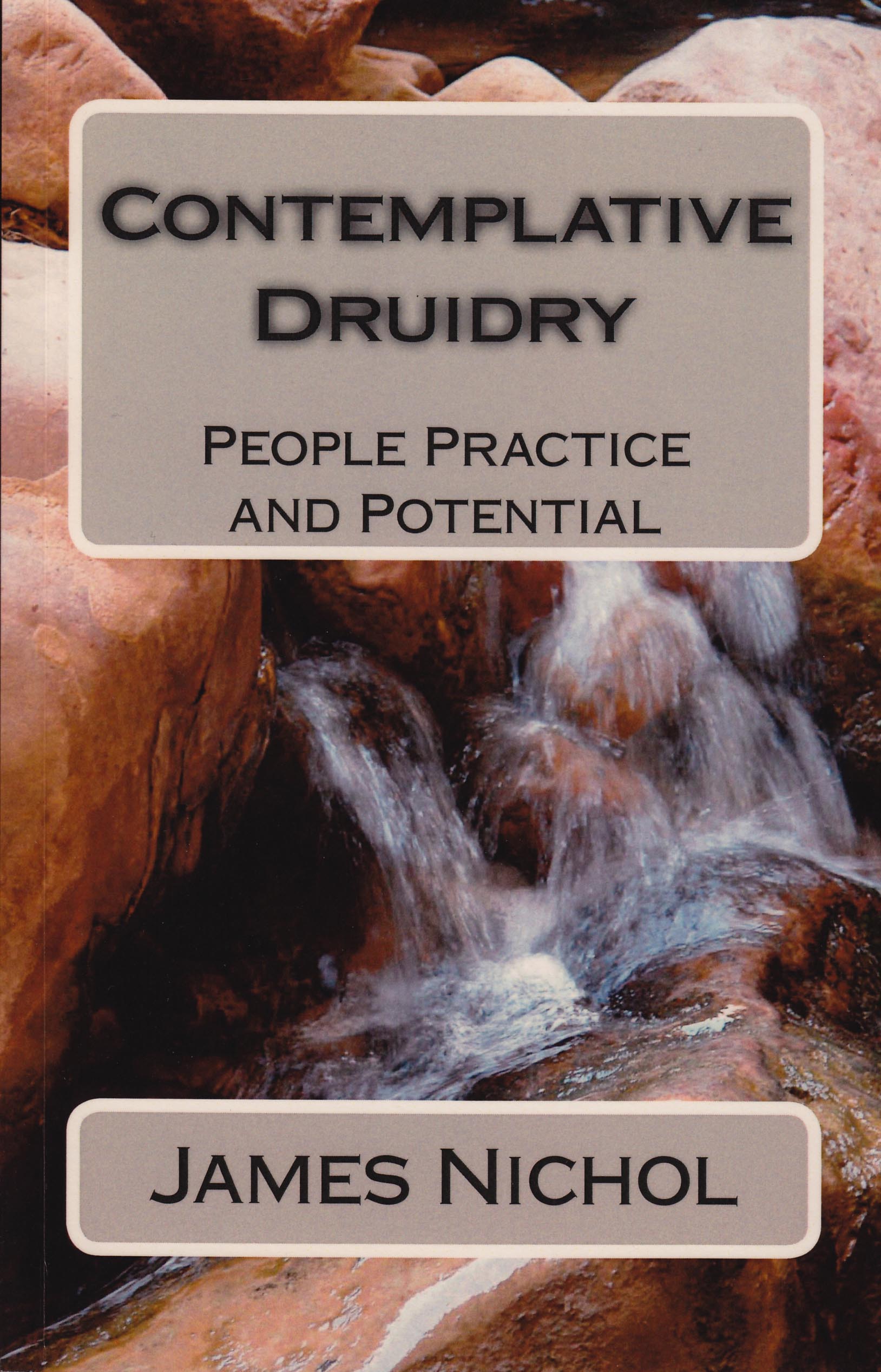
(1) Nichol, James (2014) Contemplative Druidry: People, Practice and Potential Amazon CreateSpace and Kindle Direct Publishing

(2) http://downtheforestpath.wordpress.com/2014/11/07/interview-with-emma-restall-orr/

(3) Thich Nhat Hanh (2013) Love Letter to the Earth Berkeley, California: Parallax Press

ANCESTORS

I generally meditate in a Druid circle sitting in the northern quarter, facing south. It is early morning and my eyes are open, ideally with a soft and panoramic gaze. There is a curtained window in the south east, so I am alerted to the coming of the light. At one level, subtle shifts in the quality of light are just passing phenomena. At another level I experience myself in a liminal, numinous space, not entirely of this world, as I slowly re-engage with daily life.

According to the archaeologist Francis Pryor my positioning, and to an extent perhaps its meaning, is deeply traditional. In the long transition from ‘neolithic’ to ‘bronze age’ culture, north was the direction of the dead and the ancestral realm, and materially marked by stone; south was the domain of the living and the everyday world, and materially marked by wood. So I’m working with a spiritual sense of direction which in some ways echoes theirs, without being the same. It would make sense to me if this were true, for I am here on the same part of the earth, with the same relationship to the sun, as my ancestors of this period.

Talking in more detail about Avebury and Stonehenge specifically, Pryor proposes (1) that the great stone complexes, when fully developed in stone, were a place of the ancestors, of the dead. The place of the living, the place of wood, was to their south. Here is how he describes it:

“The second main period of ritual landscape development at Avebury recalls that at contemporary Stonehenge. Again we see the henge suddenly ‘harden’, with the construction of the great outer circle of massive stones, spaced around the inside of the henge ditch and two (actually three) inner circles of stones. This marks Avebury’s change into a new monument. The domain of the living would have been south of the Kennet, and access to the no man’s land between it and the realm of the ancestors would have been via the river and the great complex of great timber circles and enclosures  recently excavated by a team directed by Alasdair Whittle. From this ‘reception’ area funeral parties would move to the West Kennet Avenue. Turning right, to the south, would bring them to the Sanctuary, which had also ‘hardened’ from a timber to a stone circle by this time. … Most parties visiting the ritual landscape in ancient times would have taken the processional route northwards, leaving the vast bulk of Silbury Hill on the left, a silent outpost on the edge of the next world. Eventually they would pass through the enormous portal stones that still guard Avebury’s southern entrance into the West Kennet Avenue. They were then within the circle of the ancestors.

“If travel, or some form of symbolic progression from one state to another, did play a significant part in the way ritual landscapes were experienced, it may also have been important to look backwards and forwards at the same time: backwards towards previous or existing states of being, and ahead towards worlds that were yet to come. Maybe that was why certain key transitional places, such as the Sanctuary or the King’s Barrow ridge at Stonehenge, were so important. To be able to look both ways can be a humbling experience, but it can also sharpen one’s sense of self and appreciation of the here and now. Archaeologists, in their natural enthusiasm to explain the workings of prehistoric minds and the landscapes they inhabited, should be aware that we will never explain all aspects of past spiritual experiences. There will always be lost dimensions of meaning and mystery – which is one of the things that make the subject so addictive.”

I don’t have the knowledge or standing to say whether Francis Pryor is right in his hypothesis, which as he says himself can only be tentative and provisional. I do deeply appreciate him for being willing to risk using his imagination, whilst informing that imagination with the best evidence that he can muster. He looks back to ancestors who in their turn show a high level of imaginative engagement with their own. We can read what he writes in our here and now and thus, within that here and now, are able to anchor a sense of continuity and connection, through our own imaginative openness. The people who built those monuments were essentially like us. They were mortal like us, and they knew it like us. They had a relationship with the earth, sun and stars like us. They had imagination like us. And they had a relationship with death and the unknown like us. Something to do with these characteristics that we share moved them to change their physical landscape. Those are the things that connect us, more importantly than details of custom or belief – rightfully fascinating though they are.

  1. Pryor, Francis Britain BC: life in Britain and Ireland before the Romans HarperCollins e-books (Hardback first published 2003)

CONTEMPLATIVE DRUIDRY: BOOK REVIEW BY MARIA EDE-WEAVING

I like the way in which the reviewer takes the discussion forward whilst also saying nice things about my book!

ContemplativeDruidry copy

A review by Maria Ede-Weaving of  ‘Contemplative Druidry: People, Practice and Potential’ by James Nichol

Modern Druidry is an evolving spirituality; each of its practitioners is continually adding to the breadth and depth of this path through their experiences. What gives a spirituality its power is it practices and approaches, and these are far from static – they live and breathe, grow and change, as we do. For a path to flourish and mature, it requires that we engage, question and explore, remaining open to the possibilities of change whilst honouring the wisdom already shared. James Nichol’s Contemplative Druidry: People, Practice and Potential is a wonderful example of this process in action.

Nichols has gathered a group of Druids to discuss their experiences of contemplative practice. Fifteen Druids share their thoughts about both their solo and group encounters with contemplative meditation and how these have impacted upon their Druidry and wider lives.

The book is in three main sections: ‘People, Practice and Potential’ with contributors not only reflecting on what drew them to contemplative Druidry and how such is expressed in their spiritual practice, but also posing the question of how such approaches might manifest in the wider Druid community, should they be more readily explored.

It is clear from these accounts that sitting meditation is only one part of this approach; mindful walking, chanting, daily offices, communion with nature/the divine and creative activities also play a part in keeping contributors present and connected. There is a real sense that each – for want of an established Druid-based contemplative framework – has been quietly experimenting, acting as pioneers exploring their own frontiers in order to find what works.  In doing so, they have been planting the seeds of a tradition that could potentially flourish into a valid and inspiring area of Druidry, one that until now has been rather ignored. Many have taken their inspiration from other spiritualities such as Buddhism and Christianity, however, their practices have developed a flavour that is distinctly Druidic. It’s a fascinating read and interesting to see how meditative practices give depth to Druid concepts such as the Awen and Nwyvre;  how Druid contemplation and mindfulness might  help to shape, transform or deepen a connection to life and self.

In the Neo-Pagan movement and the Western Mystery Tradition there has been a dominant focus on what might be perceived to be ‘active’ meditation techniques; the use of visualisation and path-working holding a dominant place. The Eastern approach to meditation has often been assumed to facilitate a removal of self from the world in an attempt to transcend its illusions. As such it might be perceived to be at cross purposes with the Druid world view where life and earthly experiences are celebrated. Most of us understand  Druid spiritual practices to be a gateway to deepen one’s involvement with earthly life, as opposed to escaping it via ascetic disciplines, however, what Nichol’s book illustrates is that the contemplative approach, explored from a Druid perspective, can be a tool that moves us into a richer and deeply felt relationship with nature, community and self.

Reading through the book’s many thought-provoking accounts I had that sense of excitement you get when a long-held suspicion about something is validated by another’s experience. My first encounter with meditation came years ago via the practice of Yoga. For me, regardless of how one might interpret the philosophy of Yoga, what its practices illustrated was that these techniques of mindful movement, breath and contemplation could actually help me to feel more embodied and present on this planet. They were immensely practical and useful , not only in aiding my physical well-being but also in creating a healthier flow between my body, mind and emotions, and in doing so, opening the door to my spiritual journey. The book’s examples makes it clear that I am not alone in my view that these techniques are not ring-fenced by any religion or path but are open for all to use. I see no contradiction in including them as part of my Druid practice. It is true that each spiritual path will approach these techniques through their own spiritual lens – and even each individual within each path will bring their own unique focus to bear – but Nichol’s books suggests that there is a rich seam of spiritual nourishment to explore here, and that even if such practices are not for us, then the debate about them can only deepen and widen what Druidry has to offer.

There is much here that gives food for thought. Contemplative Druidry is a valuable springboard for further discussion and a great starting place for those who are interested in including contemplative meditation in their practice. Nichol’s book encourages us to really think about what a contemplative Druidic practice might be. What is clear from each contributor’s experience is that it is an approach that is nature and body affirming, one that offers us a means to engage more fully with self and the world around us. In time, as this discussion deepens, as more people engage with these practices and share the results, I feel sure that many more benefits will become apparent. All this can only add to the richness and diversity of the Druid path.  – Maria Ede-Weaving

James’ book is available from Amazon and will shortly be available from the OBOD shop.

DRUID CHANTS

Nimue Brown shares a chant that she offered in our Gloucestershire group and talks about chanting more broadly. Her chanting changed the space in the room, as resonant chanting does.

Nimue Brown's avatarDruid Life

Music has always been a big part of my life, and I’m deeply attracted to the bardic threads in the Druidic weave. I’m also interested in meditation and contemplation. Unshockingly, this has led to time spent chanting. I even run the odd workshop on subverting and messing about with chants to make group singing more collaborative and playful. Let’s face it, there’s only so many times a bunch of people can sing ‘we all come from the goddess’ until it tails off in awkward silence. We are more likely to fall into tedium than reverie, if my experience in circles is anything to go by. I’ve long been interested in finding ways of changing that experience, for myself and for those around me.

I’ve been blessed with some excellent chanting experiences, too – most notably those led by JJ Middleway. His ‘enchanting the void’ sessions offer room for creative exploration…

View original post 247 more words

CONTEMPLATIVE DRUID RETREATS

Following the publication of ‘Contemplative Druidry’* I have been working on a residential retreat programme.  It is likely that three of us from the Gloucestershire group (discussed in the book) will be offering a pilot next April, sponsored by OBOD (the Order of Bards, Ovates and Druids).  The proposed venue will take up to 20 people, which will allow us to do some real relationship and community building as well as sharing some of our practices. We don’t simply want to roll out a programme. Indeed, we hope to enrich our own work by learning from participants and extending our circle to include them if they wish it.

For me, the only way to strengthen the contemplative thread in Druidry is to build our work in a spirit of open inquiry and sharing, as well as holding a space for tranquillity and renewal through the practices themselves. This is why we are extending the work cautiously. We also hope to offer something at Druid Camp, Lughnasadh 2015, since many of the people in our local group and in the book are involved in The Druid Network. It’s not just an OBOD thing. Samhain this year will be the third anniversary of my commitment to a contemplative inquiry within Druidry. I’m looking forward to what the fourth year may bring.

*Contemplative Druidry is an Amazon CreateSpace and Kindle Direct Publishing venture, involving me in learning a variety of new skills, and is mostly based on interviews with people involved in Druid contemplative practice. It includes a foreword by OBOD’s Philip Carr-Gomm.

AWEN MANTRA MEDITATION

As part of my solo practice, I sometimes do Awen mantra meditation. Aah comes in with the inbreath and wen goes out with the outbreath. Classically, I have followed these two syllables into a felt sense of what has been called the Shakti of the mantra, the power of the mantra, its inner pulsation and grace. In my embodied poetry of practice, Awen resonates like the primal breath and energy of the Cosmos, a subtle vibration underlying the apparent world, welling from a paradoxically creative emptiness. Visually, if my eyes are shut, the world tends to dissolve into a river of tiny lights, set wide apart from each other. If they are open, my visual experience of space changes and boundaries become more porous. This tends to be a place of deep receptivity and renewal.

Just lately I have been experiencing Awen mantra meditation differently. I believe this relates to being more active in the world – paradoxically through the contemplative Druidry project itself, with its relationship building, writing and now publicising ‘Contemplative Druidry’, and the beginning of plans for retreats beyond the local group level. I like this side of things more than I anticipated, because it connects me in a different way. And I also find that, in these times, the Awen mantra meditation becomes more focused and directional. I start to have the traditional understanding of Awen, as creative inspiration, more in mind.

So working with the mantra takes on a sense of dedication and intent, and also an aspect of invocation. There is still a receptiveness in there, of making myself available to Awen, as a vehicle for it. But it’s not in the manner of possession or channelling, or any obvious sense of psychism. I have to keep my wits absolutely about me, hold my intent actively, use discrimination and make decisions.

When my contemplative work became a project as well as a practice, I feared that I would saw off the meditative branch that I am sitting on, and fall into a sort of repetitive busyness syndrome. Now I see a greater range of possibilities. Life and awareness are always moving, always in process, and require different means of grounding and centring at different times.

Earth Eclectic

music that celebrates Earth and speaks to the heart

Sarah Fuhro Star-Flower Alchemy

Follow the Moon's Cycle

Muddy Feet

Meeting nature on nature's terms

Rosher.Net

A little bit of Mark Rosher in South Gloucestershire, England

Becoming Part of the Land

A monastic polytheist's and animist’s journal

selkiewife

Selkie Writing…

Charlotte Rodgers

Images and words set against a backdrop of outsider art.

Prof Jem Bendell

living with metacrisis and collapse

Towint

The pagan path. The Old Ways In New Times

The Druids Garden

Spiritual journeys in tending the living earth, permaculture, and nature-inspired arts

The Blog of Baphomet

a magickal dialogue between nature and culture

This Simple Life

The gentle art of living with less

Musings of a Scottish Hearth Druid and Heathen

Thoughts about living, loving and worshiping as an autistic Hearth Druid and Heathen. One woman's journey.

Wheel of the Year Blog

An place to read and share stories about the celtic seasonal festivals

Walking the Druid Path

Just another WordPress.com site

anima monday

Exploring our connection to the wider world

Grounded Space Focusing

Become more grounded and spacious with yourself and others, through your own body’s wisdom

The Earthbound Report

Good lives on our one planet

Hopeless Vendetta

News for the residents of Hopeless, Maine