
Contemplative Inquiry

This blog is about contemplative inquiry

Tag: Druidry

HERE-AND-NOW STONE

I am carefully sitting in a balance of warmth and shade. In the palm of my right hand is a small sandy brown stone. My four fingers are gently folded over it, the thumb resting beside them, unobtrusively pointing out. The stone is a good fit and the texture relatively smooth, with just enough variation to offer tactile interest. This is a pleasing stone to hold, as it exchanges warmth with my friendly hand. I feel in relationship with this stone, most likely collected from a beach though I don’t know when and where.

I am doing this as part of a formal exercise – you might think, a Druid one. I can recall ones very like it. But in this case, it is linked to a Mindful Self Compassion programme, research based but with an explicitly Buddhist inspiration. I’m asked to enjoy the stone. After some time I open my hand and gaze at the subtle variations in colour, and a dusting of tiny white crystalline spots. I pick the stone up and rub it against my skin. There’s just enough roughness in the contact to generate a real aliveness.  The taste is slightly salty. I am thoroughly engaged with the stone.

The framers of the exercise link this combination of focus and appreciation with coming home to the present moment, a place with no room for regret or worry, past or future. Their recommendation, going forward, is to keep the stone in my pocket, or somewhere handy. Then, whenever I feel swept up in hurt feelings or distracted ones, I can take myself back home by rubbing the stone with my fingers. I am sure that this is true and I will begin using it this way. Overnight, it can be the first stone on my Guanyin altar.

I also believe that my Druid background adds value. If I treat this action purely as a psychological exercise, it might come to seem a little calculated and Pavlovian. In my universe, I am entering a relationship with an entity from the mineral kingdom, receiving a gift, and hopefully offering one too. I believe that this understanding will add power, beauty and magic to an apparently simple activity.
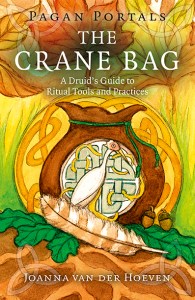
BOOK REVIEW: THE CRANE BAG

The Craane BagThe Crane Bag, Joanna van der Hoeven’s forthcoming book*, offers an introduction to the ritual tools and practices found in the Druid tradition. It achieves this briefly, simply and with a light touch – as books in the Pagan Portals series are designed to do. Yet it much more than a tick box guide. It provides context and meaning, showing the modern evolution of the Druid tradition itself.

The author makes it clear that she wants readers “to develop their own path in their own time in their own fashion”. Re-enchantment is both path and goal. With proper use, the crane bag “can further the Druid in working with the tides of nature, finding his or her own place in the environment, living in balance, harmony and peace”. The movement overall is “toward reintegration with the natural world”.

At its simplest, the crane bag is the container for Druid ritual tools and as such enables the practices. Bag and tools provide the practitioner with “something tangible to express the spiritual”, acting as a portable “map of the soul”. Behind the crane bag lies an ancient Irish story beginning with the contention between two sisters and the transformation of one of them, Aoife, into a crane. The story is beautifully told and its relevance clearly explained in the first chapter of the book.

In ritual, a period of time and an area of space are set apart and dedicated. This is not to create a lasting duality of sacred and mundane, but a step on the way to experiencing everything as sacred. “Ritual helps us to step back from the busyness, into another way of being. It is a change of consciousness, where we can shift our perception away from a singular view to a more plural view, realising that we are part of an ecosystem”. There is a clear preference for working outdoors, where awareness can shift more readily, though this is not insisted on.

A Druid’s tools will vary with the Druid. The book identifies the following: a silver branch; a staff; cups/bowls/cauldrons; drums; a sickle or knife; robes; altars; fire/candles; incense. People may make or buy them. Ethical sourcing of tools and materials is discussed in some detail, in line with the values of The Crane Bag overall.

What goes into a ritual is explored under the headings of call for peace; preparing the nemeton; honouring spirits of place, three worlds, four directions, ancestors, deities; ritual action; prayers and magic; offerings; eisteddfod; sacrifice; feast; closing. There’s encouragement to practitioners to craft what is right for them from within this set of suggestions and beyond it. The author adds, “I have been in circles with Christian Druids and Buddhist monks, as well as other religions from all over the world”. What matters in ritual is being present and performing the ritual with mindfulness, so that “any words that you speak, any gesture or movement you make will flow more easily, be more graceful and filled with meaning”.

There’s a final chapter on ‘altered states’. I don’t use the term myself, because it makes an ‘altered’ vs ‘normal’ distinction that doesn’t really work for me in my own life. But I recognise it as a term that is widely and usefully employed. Here, it facilitates valuable discussions of meditation, drumming, chanting and song, sensory deprivation, sacred landscape and sitting out. Three kinds of meditation are distinguished: calming the mind and re-tuning the body, journeying and problem solving. Guidance is offered on each kind. Different suggestions are also explored within the other topics. For sensory deprivation, there are two. One is the Celtic version of the sweat lodge, called teach an alais. The other is total immersion in darkness for a considerable period before being brought out into the light. The author refers to early medieval accounts of this, where it was done in aid of Bardic inspiration and prophesy: imbhas forosna.

I found The Crane Bag a very useful contribution to its topic and highly recommend it.


Joanna van der Hoeven The Crane Bag: a Druid’s guide to ritual tools and practices Winchester UK & Washington USA: Moon Books, 2017

*According to the publisher, the book is due for release on 28 July, and can be pre-ordered through Amazon US & UK, Indiebound and Hive.

MYSTERY

“We usually describe the world in terms of trees, mountains, rivers, clouds, cars, houses, people, and so on. But a chemist could say: ‘No, this is not how things truly are! The world is basically composed of molecules which are ceaselessly combining one with another at random’. However, a physicist would reply: ‘Not at all! Reality is actually made up of intermingling fields of energy/matter where the dance of waves/particles takes place ceaselessly’.

“Who is right? Who is wrong? All of them are clearly mere conceptual descriptions that can just supply a relative view of reality. We do not actually live in ‘reality’, but rather in a description of it, that is like a ‘bubble’ of concepts and words all around us, which in time builds up a fictitious view of ourselves and the world. Even non-dualism (as any other -ism without exception) is just a conceptual description of reality, that hopelessly tries to point to the unknowable ‘Whatever it is’: in so far as it becomes an ideology that relies on words and thoughts, it is unable to enjoy the taste of Being.

“So we live in concepts without realizing it. We blindly believe that reality is just as our thought represents it. Science gives us an ‘objective’ description of the material world that, to some extent, can be very useful for the improvement of humankind, however relative and incomplete it is. Non-duality – as far as it still relies on words and thoughts – is just another conceptual description of reality, though its understanding of non-separation can dispel a huge amount of suffering in one’s life. Neither of them is more or less right, and both are useful. But as long as we rely merely on them, we remain trapped in the net of concepts.

“Just as the fisherman’s net can catch only fishes, but not the water that passes through it and even supports it, so the thinking mind can grasp only concepts, but not the awareness that perceives it as an object: the ‘water of awareness’ can never be detected by the net of the thinking mind.

“Indeed, awareness is a paradoxical mystery: on the one hand its evidence is undeniable for the very fact that we are aware of objects, but on the other hand it is unknowable, just as the existence of the eye is undeniable for the very fact that we can see objects, though it always remains invisible, outside the picture. However, even ‘awareness’ is just a concept: through it, we are ultimately confronted with the unknown ‘bottom line’ of any human knowledge. No understanding whatsoever can touch the unknowable Source of everything.

“What if any idea about who I am, including even the idea of ‘consciousness’, totally collapses? What if any idea about reality, including even the idea of ‘non-duality’, totally collapses? What if even these very words you are reading now lose any meaning whatsoever and fall away? What remains when every attempt to understand or to know reality reveals its utter futility? Then, out of frustration, the thinking mind cannot help saying “I don’t know” and finally quits.

But when that “I don’t know” plunges off the head into the heart, the philosopher dies and the mystic is born. It is not a process in time. It is a singularity where all the known collapses and disappears. It is a timeless explosion of pure wonder and awe that blows away everything else. And what remains is a wild, free, spontaneous, and utterly unknowable aliveness, within the glowing darkness of the Mystery that we ultimately are.”

Mauro Bergonzi

REBLOG: SCIENCE IN SERVICE TO MOTHER EARTH

Science is, after all, an endeavor of humans and our machines. What would it mean to put this endeavor at the service of Mother Earth? Presumably, our efforts must always be guided by human discernment, in all its fallibility. Who decides what best serves this vision of the Greater Good?

via [A Pedagogy of Gaia] Science in Service to Mother Earth, by Bart Everson — Humanistic Paganism

POEM: GREEN MAN

William Anderson’s classic Green Man poem has thirteen verses of four lines each, and follows the wheel of the year from the Winter Solstice. As I write we have just reached the sixth verse, which has an off with my head theme. The honey of love is over and speaking through the oak is yet to come.

Like antlers, like veins in the brain, the birches

Mark patterns of mind on the red winter sky;

‘I am thought of all plants’, says the Green Man,

‘I am thought of all plants’, says he.

The hungry birds harry the last berries of rowan

But white is her bark in the darkness of rain;

‘I rise with the sap’, says the Green Man,

‘I rise with the sap’, says he.

The ashes are clashing their boughs like sword-dancers

Their black buds are tracing wild faces in the clouds;

‘I come with the wind’, says the Green Man.

‘I come with the wind’, says he.

The alders are rattling as though ready for battle

Guarding the grove where she waits for her lover;

‘I burn with desire’, says the Green Man,

‘I burn with desire’, says he.

In and out of the yellowing wands of the willow

The pollen-bright bees are plundering the catkins;

‘I am honey of love’, says the Green Man,

‘I am honey of love’, says he.

The hedges of quick are thick with may-blossom

As the dancers advance on their leaf-covered king;

‘It’s off with my head’, says the Green Man,

‘It’s off with my head’, says he.

Green Man becomes grown man in flames of the oak

As its crown forms his mask and its leafage his features;

‘I speak through the oak’, says the Green Man,

‘I speak through the oak’, says he.

The holly is flowering as hay fields are rolling

Their gleaming long grasses like waves of the sea;

‘I shine with the sun’, says the Green Man,

‘I shine with the sun’, says he.

The hazels are rocking the cups with their nuts

As the harvesters shout when the last leaf is cut;

‘I swim with the salmon’, says the Green Man,

‘I swim with the salmon’, says he.

The globes of the grapes are robing with bloom

Like the hazes of autumn, like the Milky Way’s stardust;

‘I am crushed for your drink’, says the Green Man,

‘I am crushed for your drink’, says he.

The aspen drops silver on leaves of earth’s salver

And the poplars shed gold on the young ivy flower heads;

‘I have paid for your pleasure’, says the Green Man,

‘I have paid for your pleasure’, says he.

The reed beds are flanking in silence the islands

Where meditates Wisdom as she waits and waits;

‘I have kept her secret’, says the Green Man,

‘I have kept her secret’, says he.

The bark of the elder makes whistles for children

To call to the deer as they rove over the snow;

‘I am born in the dark’, says the Green Man,

‘I am born in the dark’, says he.

From:  William Anderson Green Man: archetype of our oneness with the Earth Harper Collins: London & San Francisco, 1990

ORDINARY ECSTASY

You do not need to leave your room …

Remain sitting at your table and listen.

Do not even listen, simply wait. Do not even wait,

be quite still and solitary. The world will freely

offer itself to you to be unmasked. It has no choice.

It will roll in ecstasy at your feet.


Franz Kafka

WORD POWER

“In Hebrew, the word davar … means word and thing. No distinction. We see and hear the world with our minds, with words, in categories, not in raw sensory data.   I believe in holiness because I experience it. I don’t view it as a personal presence, but holiness is as vivid as sexual pleasure or hunger.”

The words are spoken by Malkah, the central and anchoring figure in Marge Piercy’s He, She and It (1) and one of two given prominence as a point of view character. The other is her granddaughter Shira. Their spiritual lens is Jewish and they live in a 2059 imagined by the author in 1991. This world has experienced social breakdown, massive population loss and partial desertification due to the co-arising phenomena of corporate oligarchy and unchecked climate change.

I read this book again last week because I half remembered it and wanted to refresh myself. I had no other agenda. But as I went on it seemed to be contributing to my inquiry about the meaning of ‘creativity’ and ‘magic’  (Druidry’s Awen) in a context where material and social forces need to be addressed at their own level. For me, He, She and It also shows how speculative fiction may itself be a creative cultural force.

Malkah asserts that, “in fascination with the power of the word and a belief that the word is primary over matter, you may be talking nonsense about physics, but you’re telling the truth about people.    A person reacts and decides what’s good or bad. For us the word is primary and paramount. We can curse each other to death or cure with words. With words we court each other, with words we punish each other. We construct the world out of words. The mind can kill or heal because it is the body.”

Hence, the creative word is always “perilous”, giving true life to what has been inchoate and voice to what has been dumb. “It makes known what has been unknown, that perhaps we were more comfortable not knowing.” What we cannot name, we cannot talk about. When we do name something, we empower it, and the naming has consequences – “as when we call an itch love, or when we call our envy righteous”. More creatively, “we may empower ourselves” for if “we can think about and talk about what is hurting us”, then “we may come together with others who have felt this same pain,” and try to do something about it.

Malkah likes to tell the story of the Maharal of Prague*, who in 1600 defended the Jewish Ghetto there against anti-Semitic attack through the creation of a golem, a man of clay, large and strong, animated through Kabbalist magic. It becomes a second timeline in the book, though always in the form of Malkah telling the story. She describes the creation of Joseph, the golem, with relish.

The face of the Maharal is pale with ecstasy. He feels the power coming through him. It is the power of creation. It is always dangerous, it is lightning striking the tower and the world set on end. Word into matter and everything born again. He feels the energy of something strange and new and terrible and focused to a spear piercing through him and into the clay before him. He sees his own hands shining with a blue-white radiance. His hands are crackling. His hair stands up with electricity.

All the combinations of letters and vowels he chants, and the hidden name of G-d he speaks, and the sacred numbers that built the atoms of the universe. He has become transparent with power that is pouring through him. His flesh is blackened like glass that has stood in a fire. His eyes are silver as the moon, without pupils or iris. He knows in that moment more than he has ever known in his life and more than he will know in five minutes.

But we also know that power like this, even within the mythos,  is a rare and precious gift. When the assault on the ghetto comes, developing out of a Good Friday procession, the strong but simple Joseph says to the Maharal, “’your prayers as strong as my fists’”. The Maharal demurs. “’Prayer doesn’t work that way’, the Maharal says quietly and sadly. ‘It makes the heart and mind strong in belief, but it doesn’t keep one leaf falling from the tree. Still, I will pray’”. The ghetto defence is successful, though with many losses and much destruction. The aggressors are turned back. This is partly down to Joseph directly and partly because he inspires the community to rally. The Christian state levies reparations on the Jewish community for all the trouble that’s been caused, and life goes on. Survival – but with no change in underlying conditions. Joseph, who has an inbuilt tendency to violence, is put to back to sleep (though not destroyed) by the very magician who made him that way.

The same is true of 2059. The people there are vulnerable and have enemies. They live in harsh physical conditions, though without losing the capacity to recognise and create beauty. They too wrestle with the ethics and politics of what we now call artificial intelligence, which in their world has become, and in our world is becoming, a realistic proposition.

Malka’s conclusion seems to be that we can sometimes access resources beyond our little selves, though we don’t really own them, and can’t rely on them to exempt or rescue us from things we don’t like or want. But they do have a role to play and can at times make a difference. “We partake in creation with ha-Shem, the Name, the Word that speaks us, the breath that sings life through us. We are tool and vessel and will. We connect with powers beyond our own fractional consciousness to the rest of the living being we all make up together. The power flows through us just as it flows through the tiger and through the oak and through the river breaking over its rocks, and we know in our core the fire that fuels the sun.”

(1) Marge Piercy He, She and It (Kindle edition). First published in 1991 (as Body of Glass outside the USA). 1993 Winner of the Arthur C. Clarke Award for Best Science Fiction Novel.

*The Maharal was an historical figure, the title being the Hebrew acronym of Moreinu Ha-Ra Loew, used for Judah Loew be Bezalel,1512/26? -1609) and widely known to scholars as the Maharal of Prague. In 1592, he was granted an audience with Rudolf II, the mystically inclined Holy Roman Emperor. This was probably to discuss Kabbalah. The legend concerning his creation of a golem to defend the Prague ghetto from anti-Semitic attacks is thought to be a German literary invention of the early nineteenth century.

BOOK REVIEW: LESSONS IN MAGIC


In a seemingly artless little book*, Philip Carr-Gomm celebrates a kind of magic that is “supremely natural”, like conceiving a child or planting seeds in the earth. He defines it as “the art and science of bringing ideas into form, of making what is intangible tangible. It is, in essence, the creative process – but informed with spiritual understanding”.

Lessons in Magic is organized into six chapters and ends with a list of resources. The first chapter, Apprenticed to Magic, describes the author’s own journey and sets the tone for what follows. The other five are a series of lessons. The resources include poems, songs, films, books and meditations.

The author describes his life-long attraction to magic, beginning in childhood, and nourished in youth by apprenticeship to the Druid magician Ross Nichols. His understanding was later extended by Jungian analysis, the study and practice of esoteric spiritualities from around the world and a training in modern psychology. To capture the essence of life lived magically, he quotes Fiona Macleod: “there are moments when the soul takes wing; what it has to remember, it remembers; what it loves, it loves still more; what it longs for, to that it flies”.

The stance is unrepentantly romantic and transcendentalist, whilst earth and life loving as well: we are here because we are meant to be. This is our theatre of becoming. Thus, the five ‘how to’ chapters show us how to align ourselves with what our soul wants, rather than what we think we want as average sensual folk. How do we tell the difference? One suggestion is to draw up lists of what we want to have, to do and to be – and then reverse cultural custom and tackle them in the order of be, do, and have. Going first for what we want to be may save distracting levels of concern with doing and, more especially, having. Another recommendation is to look for unsuspected strengths in our apparent weaknesses and failures. They may be the key to our flourishing.

Through such means, the book suggests, we find passion and purpose. Following our bliss, in this sense, is experienced as the best and most natural way of serving a higher purpose, and of bringing healing and joy into the world. To achieve this, we will need to draw both on an open receptive capacity and on the powers of focus and intention. The author takes us through the processes of finding and establishing our magical purpose, letting it gestate and grow, and asking for help at all levels (including prayer and divination). We are also warned not to over-specify outcomes once the work is under way. In this magic, we are always serving a higher purpose as well as our own. We are working in a larger context than we can expect wholly to own or control. Eventually we find that magic is happening around us. Unsuspected possibilities present themselves. The quality of our experience changes. We are in partnership with the living cosmos.

Philip Carr-Gomm speaks with the authority of someone who has walked the talk. Just under thirty years ago he re-founded the Order of Bards Ovates and Druids (OBOD) [1] based on a visionary prompting. It has been a highly successful venture, both itself and as a catalyst for others, playing a major role in the modern Druid and Pagan revival. One of OBOD’s key offerings has been the distance learning course offered to its members. This isn’t just a training in knowledge and skills about Druidry. It includes a thread of personal development work understood in magical terms, which students may follow at their own pace and in accordance with their own inclinations. A kind of apprenticeship, made more widely accessible, to meet modern needs in modern conditions.

Although this book is an introduction, it clearly presents a significant lens on magic, as understood by Philip Carr-Gomm and within OBOD Druidry. Highly recommended to anyone with even a passing interest in the subject.

*Philip Carr-Gomm Lessons in magic: a guide to making your dreams come true Lewes, East Sussex, England: Oak Tree Press, 2016

[1] www.druidry.org

CONTEMPLATIVE DRUIDRY

Yesterday we closed down the Druid contemplative group in Stroud,, Gloucestershire, England launched in 2012. It’s not easy to judge the life-cycle of a group. In this case, people (including me) were beginning to move on in their various directions. We made an intentional ending at the right time. I celebrate that group, it’s members and its life, and take many riches with me.

Nimue Brown's avatarDruid Life

I first joined Contemplative Druidry as a facebook group, but by happy chance I moved to Stroud, which was the location for physical meetings, so about four years ago, I started going to those as well. It brought me into contact with many likeminded people locally. The monthly opportunity to sit in contemplation with others was a tremendously valuable experience. The habit of looking at where I am in my life and being witnessed in a held space has been good for me too.

Yesterday was the final session. It struck me how rare a privilege it is to close something with care and attention. How often the last time we do something, we only know in hindsight. Consciously and deliberately bringing something to an end, honouring its history, and letting it go is a beautiful thing to get to do, and very much in keeping with my experience of…

View original post 291 more words

MODRON

An unlocatable darkness, beyond deep time, beyond even the metaphysics of origin. Almost detecting, or so it seems, an ultimate motherhood. A motherhood beyond name and gender, beyond being, beyond even latency. The possibility, perhaps, of Modron. No Word. No Bang. No Mabon.

When Mabon ap Modron (Youth, Son of Mother) appears in Celtic culture, he is in fact already archaic. He can only be traced at all through the memory of the oldest animal – the Salmon of Llyn Lliw (1). Mabon and Modron are embedded in the old Brythonic language, but pre-date it. They may well come from a time when paternity was unknown, and the male primarily recognized as a son.

In a previous post (2) I have described working with prayer beads and saying Ama-Aima. This is an Aramaic phrase, which I got from the Sophian Fellowship (Ecclesia Pistis Sophia). For them, as Christian gnostic kabbalists, there is a reference to Sophia as Binah on the tree. As Ama, – not quite Goddess, not quite Shekinah – she is in her maiden, or latent state; as Aima, she becomes the one who is impregnated, bringing form into being.

Working with the beads, I find myself losing this mythic structure and separating Ama-Aima from Sophia. Both name and experience feel more primal. I take ‘Ama’ to belong to a simple and culturally widespread family of sounds like ‘Ma’ and ‘Mama.’ I don’t feel infantilized by using the term. But it does take the practice beyond meditation, beyond prayer, beyond even devotion. It seems, rather, like an act of recognition, or alignment, and a will to relate to a source beyond existence itself. At a more personal and animal level, I suspect that I am also aligning my conscious self with pre-linguistic and ultimately pre-natal levels of being. These do form part of my physical existence and, however remotely, memory. Here I am at cause with the mystery and miracle of the life I have woken into, often in a simple state of gratitude for the opportunity to be human.

If there is a Sophian connection here, it is indicated in images like ‘The Maiden’ in R.J. Stewart’s Dreampower Tarot (3). As Maiden, she who appears in translucent white, as “the still and pure potential which is ever renewed out of the Mother Deep”, her virginity “a spirit of renewal rather than a physical condition”. The primal Mother within The Maiden, from whom she comes, is shown by a Sheela-na-gig behind her. It is a very faint figure, barely visible, but it seems as if the translucent maiden has appeared out of the vagina. This old image is found in Celtic regions, carved upon stones and early churches. “It is an ancient representation of the Mother of All, with her open vagina from which all comes forth and into which all enters and returns.”

In a sense, Sophia is the whole image. But for me Ama-Aima is more the Sheela-na-gig, herself dissolving into empty invisibility. Sophia is more like Stewart’s Maiden, mostly concerned with “stilling and guarding life energies” and learning to direct them inwardly in new forms of illuminating capacity. This is very much the Wisdom I am working with at the present phase of my life

  • The Mabinogion Sioned Davies (translator) Oxford: OUP, 2007 (The reference is to How Culhwch Won Olwen.)


  • J. Stewart The Dreampower Tarot London: Aquarian Press, 1993 (Paintings by Stuart Littlejohn)
Earth Eclectic

music that celebrates Earth and speaks to the heart

Sarah Fuhro Star-Flower Alchemy

Follow the Moon's Cycle

Muddy Feet

Meeting nature on nature's terms

Rosher.Net

A little bit of Mark Rosher in South Gloucestershire, England

Becoming Part of the Land

A monastic polytheist's and animist’s journal

selkiewife

Selkie Writing…

Charlotte Rodgers

Images and words set against a backdrop of outsider art.

Prof Jem Bendell

living with metacrisis and collapse

Towint

The pagan path. The Old Ways In New Times

The Druids Garden

Spiritual journeys in tending the living earth, permaculture, and nature-inspired arts

The Blog of Baphomet

a magickal dialogue between nature and culture

This Simple Life

The gentle art of living with less

Musings of a Scottish Hearth Druid and Heathen

Thoughts about living, loving and worshiping as an autistic Hearth Druid and Heathen. One woman's journey.

Wheel of the Year Blog

An place to read and share stories about the celtic seasonal festivals

Walking the Druid Path

Just another WordPress.com site

anima monday

Exploring our connection to the wider world

Grounded Space Focusing

Become more grounded and spacious with yourself and others, through your own body’s wisdom

The Earthbound Report

Good lives on our one planet

Hopeless Vendetta

News for the residents of Hopeless, Maine