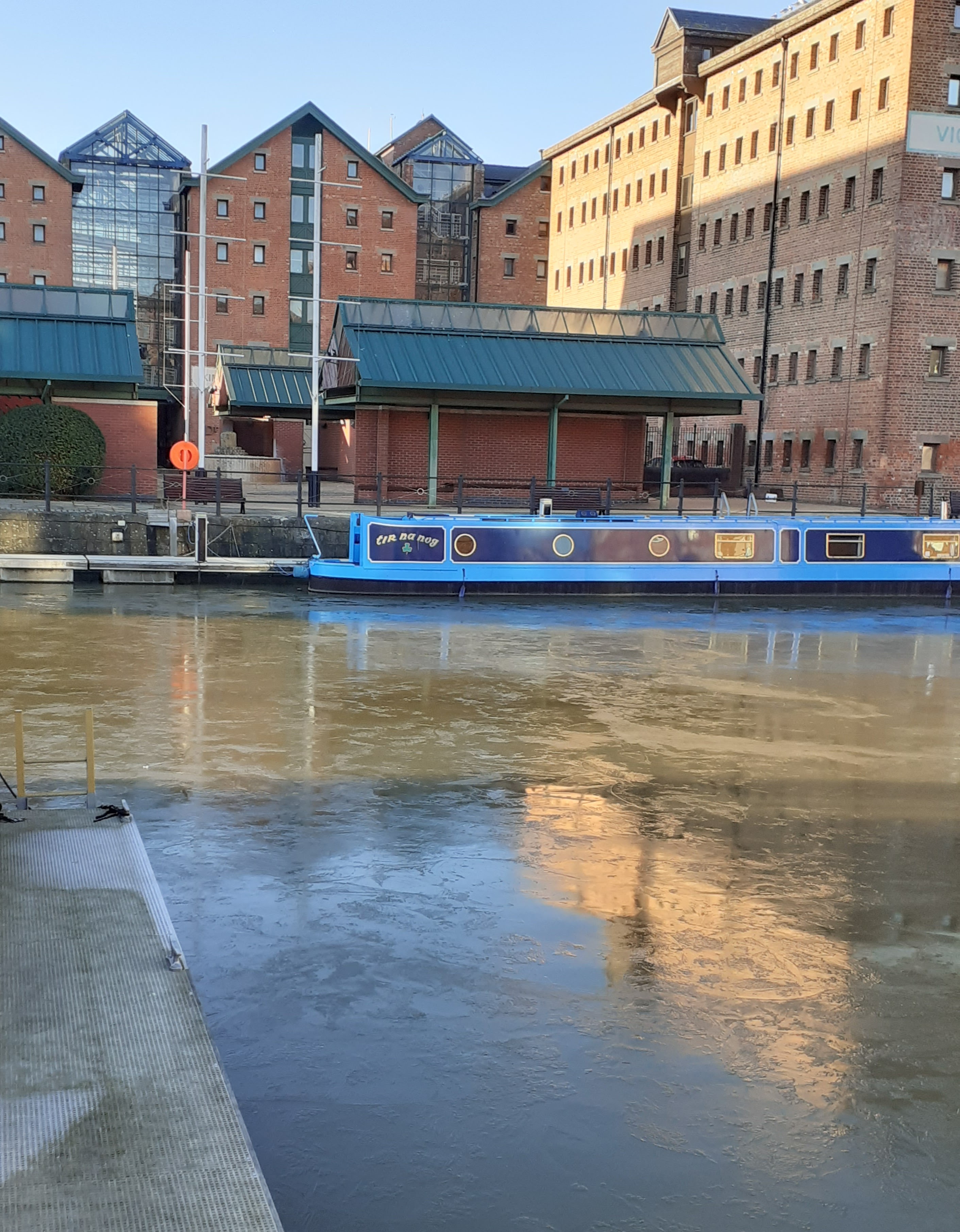
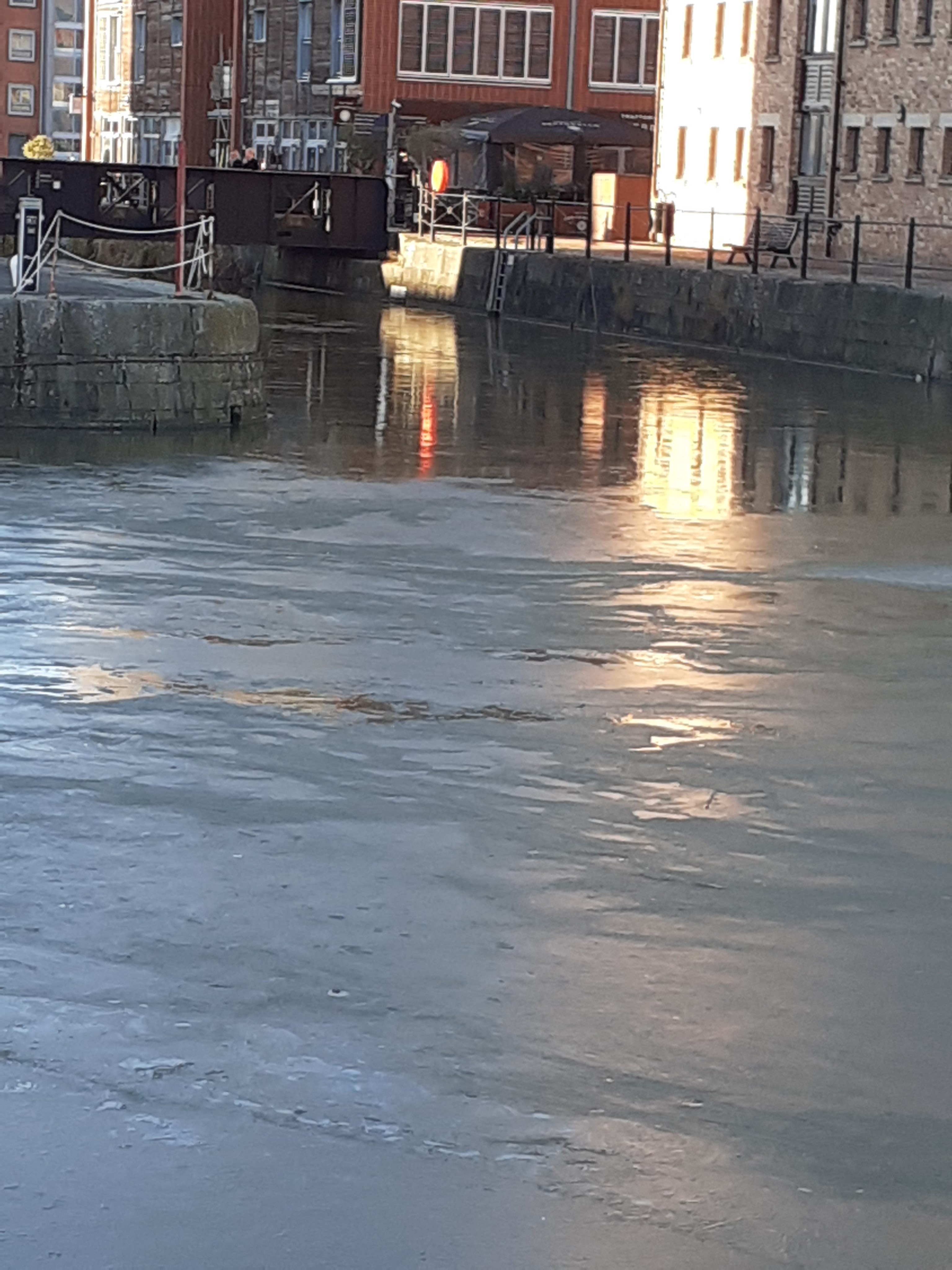
Yesterday – 3.30 pm or so – I was walking home swiftly from a shopping expedition. I was slowed down and halted by the water in Gloucester docks. It drew my eye and asked for a closer look. It had clearly been iced up in the previous cold night, and had been slowly melting in this bracing but above-zero day.
The sky is clear and I experience a strengthening sun now. I recollect that we are now several weeks beyond the solstice. The balance of light, shade, stillness and fluidity sends me into a more deeply meditative state, entirely trumping my original sense of domestic mission and wanting to be home.
Ice and water are made of the same stuff, manifesting in different ways. The patterns on the surface look still but tell a story of transformation – here, from fixed to free. Another drop in temperature could easily end and indeed reverse this process. In this space I see the same essence adopting different forms under different conditions. But here the change is gentle. The contemplative moment extends itself. I am open to the magic of nature. In such beauty, I find peace and stillness within my own being.
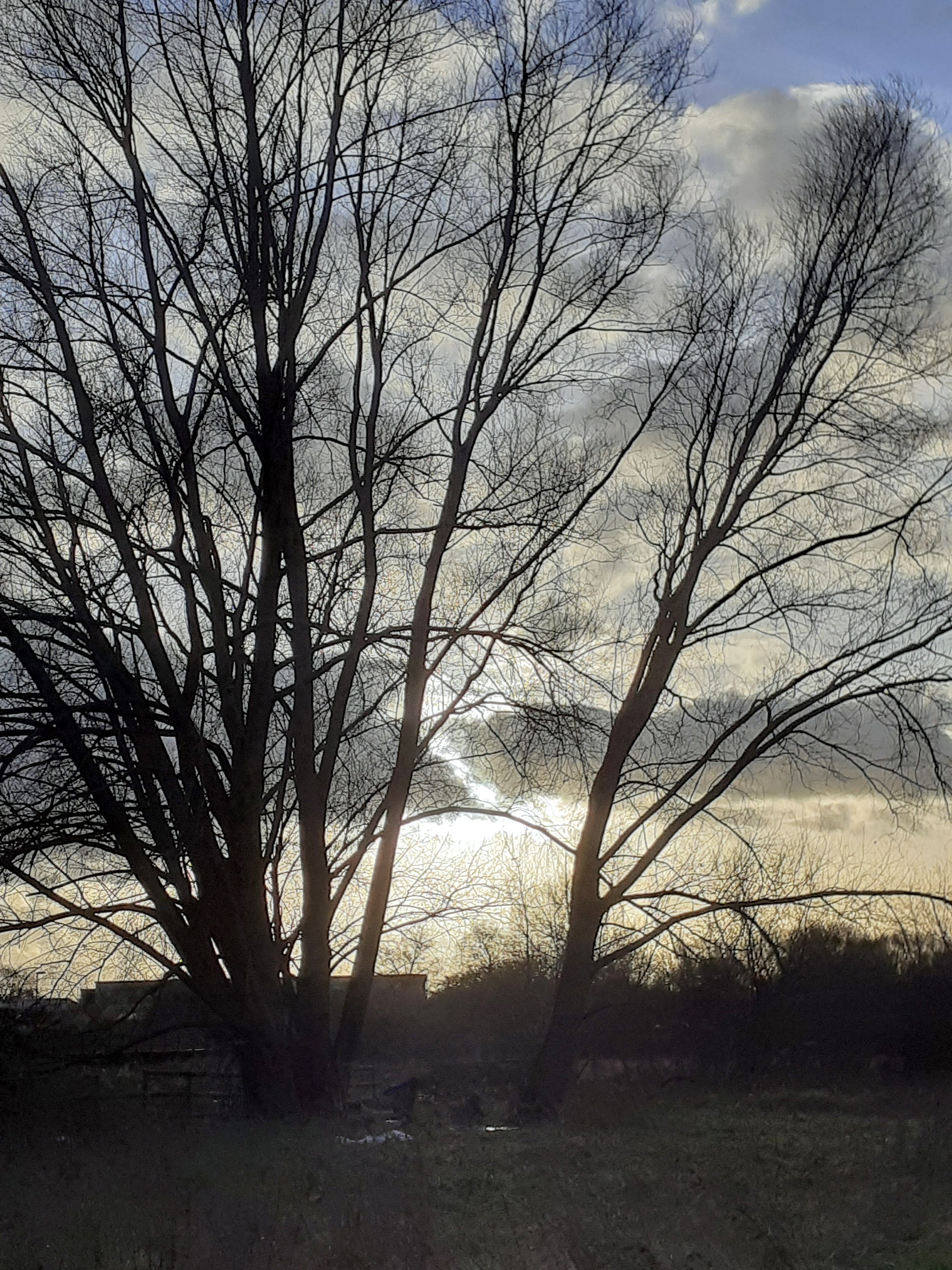
It is 3 January 2024, around 8.30 am. I repeat my best wishes to all readers for 2024 from inside the new year, as it begins to unfold. I contemplate the sky, uncertain about what this new year may bring. At some level I feel open and uncluttered, free of over-determined intentions. It is as if I have surrendered to a current.
My Contemplative Inquiry, once a formal structured project, has gradually evolved into a simpler and more natural-seeming contemplative inquiry in no need of capitalisation. This inquiry is wired in, no longer in need of much external input or formalised internal effort. I am aware of owing a debt to the formal structured project, with its inputs and efforts, for it enabled this evolution to occur.
The result of the early, more formal, years is recorded in my ABOUT section. It was simultaneously a gnosis and the discovery of a place to stand that felt right and made sense. “My inquiry has been a pathway to greater understanding, healing and peace. In the contemplative moment, I am living presence in a field of living presence, at home in a living world. This is not dependent on belief or circumstance, but on the recognition of what is given, joy and sorrow alike. I find that this simple recognition moves me towards a spirit of openness, a fuller acceptance that nothing stays the same, an ethic of interdependence and a life of abundant simplicity”. My inquiry today is about deepening, and living more congruently and confidently from this place. It is part of me now, and I foresee no end.
Seasonal Blessings to all readers, and my best wishes for 2024! I took these photos between 2.20 and 2.50 pm on 21 December, the last day before the Solstice, and a little more than an hour before sunset in Southern England.
The location is Alney Island, Gloucester, which I had not been to for some time. I encountered a sun that was low in the sky, clearly sinking, but still having an obvious influence on the landscape. Above, you can see a powerful luminescence behind the starkness of the trees. Immediately below, you can see light effects on the river and the trees themselves.
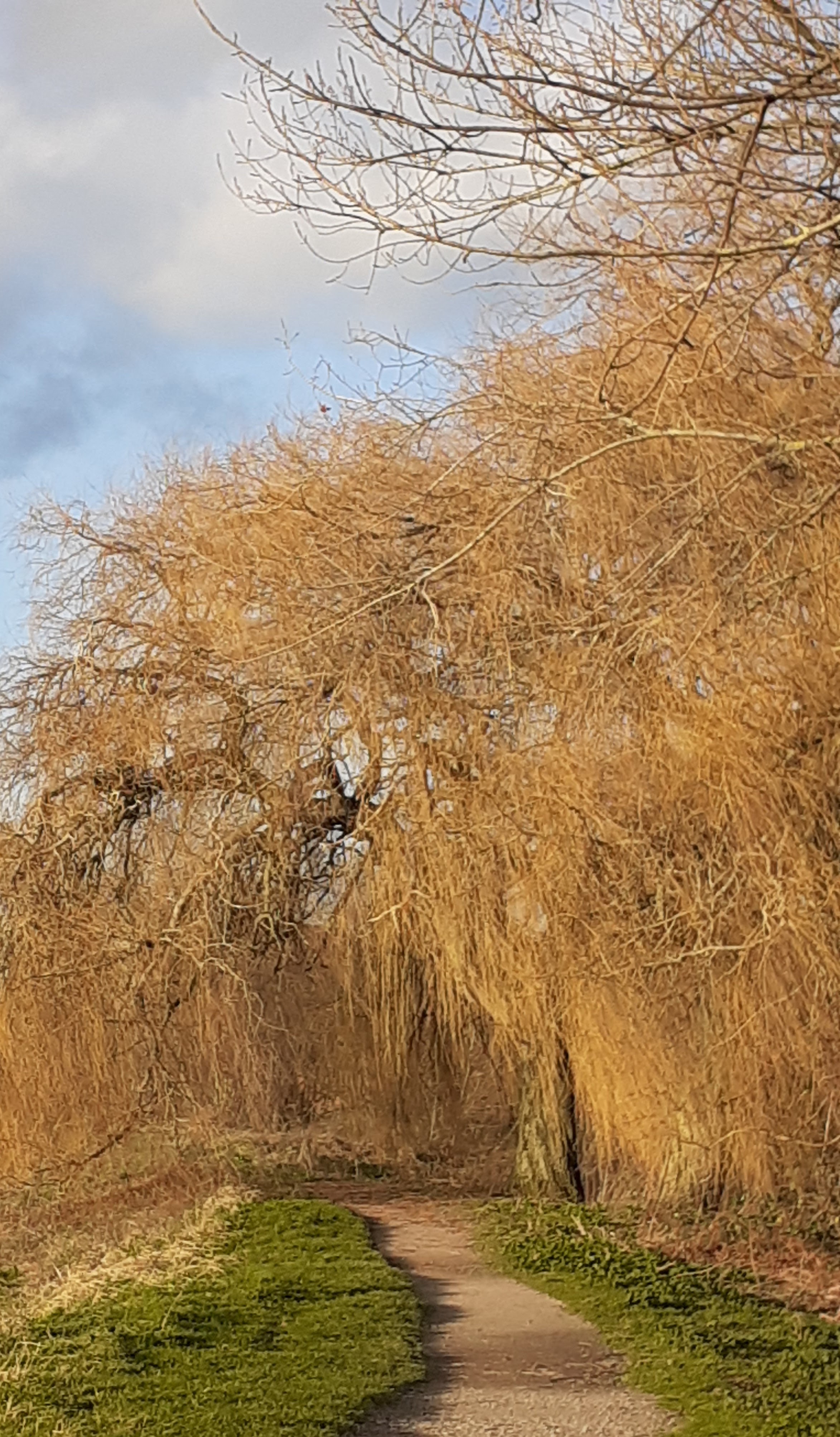
In the picture below, the midwinter sunshine is clearer and stronger. I love the way in which the willows show their vitality and abundance even when they have lost their leaves. The path is relatively dry, yet surrounded by green grass. There is a play of light and shade. There is blue as well as cloud in the sky.
On the ground, in the afternoon, and now in the evening as I write, I am thinking of light and dark, and of waxing and waning, as natural phenomena. I am not thinking in moral or metaphysical terms. These are different considerations, with a tendency moreover towards abstraction and absolutism. In my experience, nature tends to be nuanced. Different things are going on at the same time. Certainly where I live, there is always some balance of light and dark. The balance shifts, but both are always in play.
We treat tomorrow’s sunrise as the beginning of a turn. Here, in 2023, the afternoon before the change seems like a friendly one for an annual nadir of the light. This is also a bit how I am thinking about myself. Towards the end of November, when I last wrote a post of this type, I was celebrating a recovery from illness, and the opportunity of a good day. A good day was about what it was. Many people have pointed out in the last year or so that Covid-19 seems to have a long tail. I have been physically restricted beyond what I think of as normal.
I’m aware of a 75th birthday coming up next year, at which time our government will no longer consider my death as premature. Yet I am in good heart and feeling resilient. Without being presumptuous, I’m leaning in to longevity. I’m checking my capabilities and energy levels, anticipating some adjustments, and noticing the many rays of light which present themselves in my world.
Recently I’ve been unwell and housebound, hardly even watching the world go by. But there came a day when I could go out again, a day that was blessed with sun. It seemed bright and new. I was almost blinded by its luminous presence on a white tree-patterned wall. I had entered late fall, a season with both autumnal and winter features.
The sun shone on trees in Gloucester City Park which retained some of their foliage, but in an end-of-season way that signals austere changes to come. Leaves showed a fragile, lingering beauty, prior to their necessary descent.
The Brunswick Gardens, sitting under a clear blue sky, were home to trees where the leaves had already fallen, leaving the branches as patterns of quiescent arboreal bones. The leaves were on the lawn. Other, managed, flora continued to flourish.
In visual and tactile ways, after an indoor confinement, the neighbourhood was full of reward for me. But I felt cold, and it was indeed the coldest it’s been for many many months. I could not stay out for long. But I had encountered a moment in the year, of interbeing, of living presence – where the wheel is visibly and palpably turning. I was glad to be there, however briefly, available for a nurturing and healing experience.
Highly recommended. Unseen Beings: How We Forgot the World Is More Than Human (1) is about the many beings we humans have actively ‘unseen’ and the consequences of our human-centric lens. Author Erik Jampa Andersson describes his book as a diagnostic exploration of the roots of the climate crisis, itself an extreme consequence of a much wider malaise. Whereas the common view of ‘saving the planet’ tends to be one of ‘guarding the storehouse’, a better focus would be on ‘supporting the welfare of living beings’.
Andersson has a background in Tibetan Buddhism and Tibetan medicine. In the manner of Buddhism’s Four Noble Truths, and of his medical training, he divides his book into four parts: Diagnosis, Causes and Conditions, Prognosis, Treatment.
Diagnosis concerns “our ecological disease”. Andersson reminds us of what the climate crisis is, how far it has been allowed to go, and the “fanciful stories” with which we have soothed our fears: “full of human exceptionalism, divine protection, techno-fixes and post-apocalyptic salvation”. For Andersson, the foundational root cause is “the sundering of human and non-human beings, and our perceptual separation from ‘Nature’. He refers to “the poison of anthropocentricity”. He reviews the evidence for plant and fungal sentience and awareness as well as that of the animal kingdom. He concludes that Nature is not a place, but “a tightly knit community of interconnected beings, some seen, many unseen, all engaged in their own affairs and with their own experience of reality”. He describes this relational approach to the living world as “what most scholars now call ‘animism’ … neither a religion nor a system of belief, but a paradigm of more-than-human relationship”. He sees this stance toward the world as “our natural state”.
Causes and Conditions A mini-ice age some 13,000 years ago interrupted an early agricultural period in some places and prompted a series of innovations. The domestication of the horse was especially significant. Andersson sees a move away from our ‘natural state’ beginning at this time. But it is not fully evident to us until the age of written philosophy and scripture. The Greek philosophers Plato and Aristotle declare a hierarchy of sentience from plants up to animals and then humans at the top, uniquely endowed with a rational soul. In the Hebrew book of Genesis, God gives dominion over the Earth and its animals to man for his use. In the Western Christianity of the 13th century CE, Thomas Aquinas says that Christians have no duty of charity to non-humans because they are resources, not persons. In the 17th century CE, early in the West European led colonial era, Descartes holds public vivisections of dogs and other animals declaring that they are soulless automata and that their apparent distress is meaningless. In the mid 19th century CE, Darwin restores other beings as our ancestors and cousins, but but without much sense of kinship or empathy.
Prognosis Here Andersson introduces two concepts from Tibetan medicine: ‘provocation’ and ‘spirit illness’. The provocation of other sentient beings is a health risk. He discusses the origins of the recent Covid-19 pandemic in these terms, as human become ever more invasive of our remaining wild spaces. In cases of deforestation, pollution, and any disruption of air, water, soil and trees, there is a price to pay for the wounding of other spirits, whether seen by the eye, seen through a microscope and normally unseen but recognised by tradition. (‘Supernatural’ is an unhelpful word here – everyone is part of nature). In Tibetan tradition, the cultivation of a clear mind is highly prized and works within human psychology, but not for disruptive events like these. There is a need to make amends. Rituals are held in sensitive and damaged places. The damage caused in these circumstances and the resultant chronic collective disease can only be addressed by learning how to care for eachother, non-human beings and the planet itself.
Treatment Using the Buddhist 8-fold path as a structure, Andersson recommends ‘cultivating care’ over a system of rules and regulations aimed at a ‘sustainability’ which tries to restore the old status quo. We cultivate care of the Earth, one another and non-human beings. Hence: 1 right view is a return to our ‘natural state’, as described under Diagnosis; 2 right intention describes commitment to a path of rewilding and regeneration; 3 right speech is the use of “life-affirming language” (e.g. using ‘they’ as an alternative to ‘it’ for non-human beings); 4 right action is causing as little harm as possible to other beings; 5 right livelihood means adopting principles of authentic sustainability and non-exploitation; 6 right diligence is based on “the durability of the heart-felt ethic; 7 right mindfulness means “paying attention to nature’s vitality”; 8 right concentration involves imaging a new future with “authentic myth-making”.
Concerning 8 above, Andersson has been profoundly moved by the work of J. R. R. Tolkien from his later childhood onwards. As a result, he developed a high valuation of authentic myth-making and enchantment. In this realm, the non-human is essential. Tolkien had his own life-changing moment of enchantment when, as a student, he first read the Old English words: Eala earendel engla beorhtast, ofer middangeard monnum sended. (Hail Earendel brightest of angels, above the middle-earth sent unto men). Of this evocation of Venus arising as the morning star, in the old language, Tolkien later wrote: “there was something very remote and strange and beautiful about these words, if I could grasp it, far beyond ancient English”. For Andersson, authentic myth and authentic science work together in support of a redemptive animist vision. By contrast, the form of discourse to worry about is ‘fallacy’ – a complete dissociation from the truth. Andersson again quotes Tolkien: “if men were ever in a state in which they did not want to know or could not perceive truth (facts and evidence) then Fantasy would languish until they were cured. If they ever get into that state (it would not seem at all impossible) Fantasy will perish and become morbid delusion”. For Andersson, this too has become a symptom of our current ecological disease, making the need for honest and healthy communication all the more urgent.
For me, Andersson has made a valuable addition to a growing literature about the current crisis, whose most alarming symptom is climate breakdown. He goes to the root of the problem, offering a clear and coherent view about how to stand in the face of it. It is a well-researched, well-crafted and compassionate contribution to the genre.
(1) Erik Jampa Andersson Unseen Beings: How We Forgot the World is More Than Human Carlsbad, CA & New York City; London; Sydney; New Delhi: Hay House, 2023
I attach a links to conversations between the author and Andrew Harvey below. It adds considerably to what I can present in a review:
From the modern animist perspective of his Unseen Beings: How We Forgot the World Is More Than Human, Erik Jampa Andersson looks at what we owe to our canine friends.
“In our own evolution as a species, non-humans have often played crucial roles. Plants and animals weren’t always just our food and possessions – they were are mentors, companions, even our ancestors.
“There’s one non-human, in particular, whose profound impact on our human story warrants far more recognition … They were descended from the beasts of legend – formidable hunters who commanded vast swathes of land with ferocious might. In many of our myths and legends, they were immortalized as guardians of the underworld and crucial intermediaries between the human and non-human domains. Before we had ever tamed a horse, milked a cow, or sown a field of grain, we had befriended a dog.
“… It’s believed that humans and wolves were gradually drawn together during the perilously harsh conditions of the Last Glacial Maximum [20,000+ years ago: JN]. As our paths began to cross more and more frequently in our pursuit of mutual prey, what likely started as a timid sharing of spoils led to an unusual sense of kinship between the two predators. Wolves were drawn into the warmth of human encampments, and ultimately made themselves quite at home at the foot of our beds. They offered us vital protection, companionship, and a natural ‘security alarm’ in a wild and dangerous world, while we provided them with warmth, food, and evidently also emotional satisfaction.
“Studies of canine intelligence have repeatedly attested to dogs’ advanced capacity for memory, social cognition, inferential learning, and even comprehension (and possible use) of human language. But beyond their clear intelligence, what deserves significantly more attention is the very real impact dogs have had on our own evolutionary trajectory.
“Unlike predators who prefer to prey on weaker animals, wolves thrived as persistence hunters, successfully felling giant mammals by stalking them to exhaustion in well-organized packs. As territorial animals, they also went to the great trouble of staking out their own tribal domains, maintaining a distinctly pastoral lifestyle in complex social groups.
“Such practices were wholly foreign to early humans and other simians, but by the time our ancestors found their footing in the Eurasian wilderness, they had become rather formidable and territorial pack hunters themselves. Researchers suggest that these novel human behaviours were at least partially influenced by our burgeoning relationship with canines, who introduced us to their world, taught us their hunting tricks, and afforded us peace of mind by protecting our settlements against less amiable foes.
“The domestication of dogs was one of the key forces that led to the development of fully modern humans, impacting our relationship with one another and the world at large for many millennia to come”.
(1) Erik Jampa Andersson Unseen Beings: How We Forgot the World is More Than Human Carlsbad, CA & New York City; London; Sydney; New Delhi: Hay House, 2023
An old man, left handed like me, pauses over his writing. He is held in his concentration, and somewhat lost to the world. He faces away from the sky and the crescent moon. He relies on an interior candle to light him. But the moon sees and influences him anyway. None of the seven swords is drawn for martial combat. He wields a quill instead: the metaphorical sword of discrimination is an essential feature of thinking and writing, and sometimes it can bite. The number seven suggests a level of experience and resource, perhaps also a creative pleasure in his task. He’s been around a bit, taken a few knocks, and had his epiphanies as well. He perseveres on the journey, come what may.
The image comes from the first of a three card Druidcraft Tarot (1) reading. I did it on 26 October, early in the run up to Samhain and before the October moon was full. I had just completed a ritual that ended my formal contemplative inquiry within and beyond Druidry. I am still a Druid. I am still temperamentally inclined to contemplation and inquiry, both separately and together. There will be a great of deal continuity in my practice. But the structure of a dedicated project has quietly disintegrated, now redundant, and this needed a formal recognition. The image above reveals a constellation of consciousness, energy and activity that is now in the background. There, it has a continuing presence and influence – as a kind of internal ancestry. In the foreground, something new has the freedom to emerge.
The card below indicates how I stand now. Whereas I found it easy to identify with the Seven of Swords image, the Prince of Pentacles came as a shock. But the teaching behind the Tarot is that time runs differently in the psychic realms and doesn’t exist in the causal. Child and youthful parts of me still live. The young adult depicted here is at home and confident in the material world. He is not a compulsive warrior like some of his brothers but will take a stand when needed, using skilful means. He is an Earth defender. Health, home and material security matter to him and in these domains he leans toward practicality and realism about the world he is living in. He turns towards this world, not away from it, and does not position himself as above the battle. He is a counterweight to some of the spiritual movements I have explored in my inquiry, which would think of him as ‘unevolved’. He has, however, been an active presence over my last couple of years of relocation and now steps forward to reclaim an acknowledged space in my life.
The third card of the triad is the Six of Wands, and traditionally indicates what may be emerging. The sixes are all auspicious, suggestive of balance, union, and integration. In the active energised fire element, it suggests success, through the image of a landowner and his servants returning home after a successful outing with his hawk. The card seems to ask me what I understand by success at this time in my life, and how much I value it. What motivates and energises me to be successful by my current criteria? What skills, resources and help might I need to achieve successful outcomes? What role might magic play?
I notice, here and now, an unfamiliarity with this way of approaching life. I have thought of myself as too old, with no worldly ambition and nothing I need to prove. This card may be challenging me to review those understandings. Have I lapsed into limiting self-caricature? Have I overdone retirement? Asking those questions I find that I do still have energy and resources, and that I am also concerned about overestimating them. Balance and proportion matter, and I do not want to be consumed or over-taxed by a new project. Nonetheless, this reading opens up space and potential for new active ventures in the world. This reading, overall, has facilitated a significant Samhain shift in my sense of possible futures. For this is a season of not only endings, but of beginnings too.
(1) Philip and Stephanie Carr-Gomm The Druidcraft Tarot: Use the Magic of Wicca and Druidry to Guide Your Life London: Connections, 2004 (Illustrated by Will Worthington)
I was moved and inspired by Philip Carr-Gomm’s recent Peacemaking podcast on his Tea with a Druid. In the first five minutes he checks in with his live viewers, as is his custom, and finds a theme of anxiety and distress about world events. He speaks of the need for ‘islands of sanity’ – enclosures of calm and peace. He introduces the hope that the people gathered together by the podcast itself can become one. A guided meditation later in the podcast does the job. The gathering becomes an enclosure of calm and peace in real time. It still worked for me well after the event. Such is the magic of Druidry.
Before the meditation, Philip explains the role of Druids, ancient and modern, as peacemakers. The ancient Druids were exempted from military service and had a pan-Celtic authority. A Roman author depicts Druids as walking between warring tribes, urging calm and asking the fighters to put down their weapons: they were “shaming Mars before the Muses”. The God of war and destruction had to bow down before the Goddesses of creativity and inspiration. The Druids of that time were also lawmakers and judges. In Ireland, St. Patrick valued their Brehon Laws so highly that they were written down and continued in force. Peacemaking, peacekeeping and jurisprudence worked together.
In modern Druidry, Philip emphasises the attention given to peace in ritual, where the intention is to begin and end in peace both inward and outward. Our Druid prayer asks for justice, because where there is justice in the world there is also peace. Justice isn’t about killing. It’s about peace: right action, right speech, right thought, right behaviour. We trust the power of prayer and of consciousness directed by love. Sitting in meditation or prayer influences the people involved, and creates a field of consciousness and energy which acts as a patch of calm and peace in bad psychic weather.
I recommend readers to watch the video and, if you are willing, enter into its meditative space. I also include The Modron Prayer (Modron being the Ancient Mother) in this post, as a way of ending it:
“Deep within the still centre of our being,
May we find peace.
Silently, within the quiet of the Grove,
May we share peace.
Powerfully, within the greater circle of humankind,
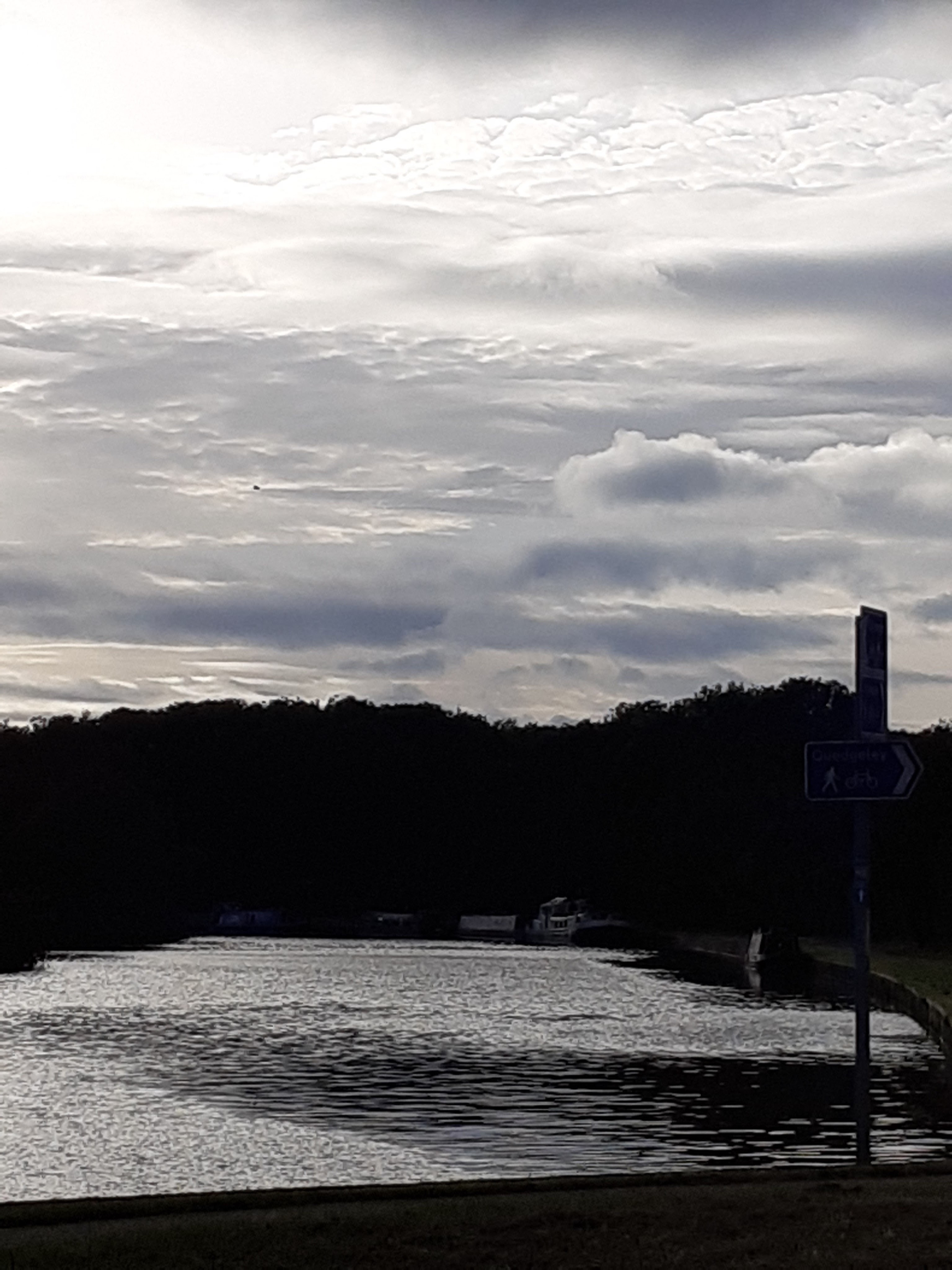
6.15 pm, 6 October 2023. The experience has gone. The images remain. At a surface level, I can use them to trigger memories of my early evening walk. Chiefly, I remember being surprised at how early the twilight was. I hadn’t caught up with the year and was almost shocked. I have caught up now, nearly a week later, as the darkening process speeds up and we approach Samhain. In today’s world, my country will experience a dramatic boost on 29 October as our clocks ‘fall back’. The 6.15 of one day will become the 5.15 of the next.
Looking at the images more deeply, really looking, and giving them time, I can let them nourish me. I connect with their liminal beauty. Both images present me with land, water, sky, and hints of the fiery sun. But they do so in different ways.
In the image above, I am mostly drawn to the energy of water. The variation in shade emphasises movement and different ripple effects. Land, trees, and artifacts are all in silhouette, but the water has light and shade. It is the water that feels most alive. There is variation in the clouds too, with their patterned layers and subtle access to sunlight just above the trees. But they are not as mobile as the water. The sunlight itself seems very subdued. It’s still there, though very much in the background.This is not yet a night sky.
In the image below the water is strong too, but my eyes are drawn above to the clouds, which here are more dramatic. The residual power of waning sunlight is very clearly present. For me, there’s a sense of the tree tops yearning upwards as they reach for the gifts of the sun whilst it still retains a presence. Although I am contemplating images and not immersed in the landscape I have a strong sense of living presence in a field of living presence. In this state I feel a conceivably irrational confidence in life and the world.. A fragile kind of faith, that my heart cannot resist.
I wrote this piece some months ago, still digesting the experience of the Covid 19 pandemic, the public health response to it, and the continuing presence of the virus in our world. I had also been reflecting on formal political messaging – government as public relations and media theatre, the intense pre-occupation with opinion polls and beauty contest elections – together with halting and inconsistent approaches to real-world problem-solving.
Writing of this kind is part of my Druid path and not a separate activity. My practice might have a contemplative foundation, but contemplation isn’t everything. The inheritance of Bardistry, and engagement with the wider world also matter. Currently, I feel a pull towards working for the healthy use of language, and challenging its corrupt and unhealthy deployments. T. S. Eliot once talked about poets being tasked to ‘purify the dialect of the tribe’. That’s not quite my language, but I can appreciate what he is pointing to.
I have recently been given another nudge, by Naomi Klein’s book Doppelganger: A Trip into the Mirror World (1) where she talks about the rise of ‘conspiracy influencers’ in a world where governments and corporations have deservedly lost our trust. “Conspiracy influencers perform what I have to think of as a doppelganger of investigative journalism, including many of its stylistic conventions, while hopping over its accuracy guardrails”. She goes on to say that “the end result of being surrounded by this kind of discourse is … a state of continuous disbelief” that replaces real threats with distorted versions of themselves. Hence the belief that “the problem with Covid was not a highly infectious disease being fought half-heartedly by for-profit drug companies and hollowed-out states, but an app that wanted to turn you into a slave”.
Klein also helps me to see a connection between the defence of language and contemplative spirituality. She speaks of calm as form of shock resistance. “When people and societies enter into a state of shock, they lose their identities and footing”. In the midst of such break down, the effect of conspiracy culture is to maintain panic and confusion. She suggests that some conspiracy culture influences are simply part of the panic and confusion. Others, more knowingly, manipulate it for ulterior ends. If shock induces a loss of identity, calm returns us to ourselves. “I write to tame the chaos in my surroundings, in my own mind, and – I hope – in the minds of my readers as well. The information is almost always distressing, and, for many, shocking, but in my view the goal should never be to put readers into a state of shock. It should be to pull them out of it”. Of her chosen work overall she says: “the role of the researcher-analyst is plain: to try and create some sense, some ordering of events, maps of power”. Clarity, calm and purpose support each other.
(1) Naomi Klein Doppelganger:A Trip into the Mirror World London: Penguin Random House, 2023






 Contemplative Inquiry