Contemplative Inquiry

This blog is about contemplative inquiry

Tag: Deep Ecology

BOOK REVIEW: BOURNEBRIDGE OVER TROUBLED WATERS

Highly recommended, especially for readers interested in local initiatives to address the climate crisis. Bournebridge over Troubled Waters (1) is a sequel to Tony Emerson’s Unlikely Alliances, which I reviewed in October 2022  – (https://contemplativeinquiry.blog/2022/10/27/book-review-unlikely-alliances/). Although the new book stands on its own, I think it works best after reading Unlikely Alliances, now republished as Creating Hope in the Valley of the Bourne. The setting continues to be a fictional community  on England’s south coast.

In the new book, we have reached the year 2030. The publisher’s blurb describes it as ‘a story of love and friendship’ as well as commitment to climate action. On my reading, the ways in which people do ‘love and friendship’ are integral to the action itself.

This is shown in a group of leading characters who gradually assemble together in an old rectory building. This is less by design than the need for decent housing and a belief that larger dwellings should be fully occupied. But the rectory evolves into a strong base for its residents’ flourishing.

In many ways they are a diverse group. But they all, sometimes with a little tlc, reveal themselves as naturally affectionate and ethically grounded. The culture of the house nurtures these co-operative qualities.  It is a creative and supportive place to live. As part of the life of the house, the residents develop a system of peer mentoring for their work in the wider world. There’s also a concern, for some of them, about a progressive Christianity that honours the world and the flesh and is ecologically aware. I am reminded of Matthew Fox’s use of the term ‘original blessing’.

As was the case in Unlikely Alliances, the government is committed to climate action. The earlier book describes their Climate Action Plan, which has put  serious wealth taxes in place, rationed fuel and food (especially meat), placed restrictions on air travel, created  a Civilian Community Service Corps to provide training and jobs for the unemployed and 2 years national service for school and college leavers. Housing policy is not all about new build, but also addresses better use of existing resources.

The fields covered by our band of rectory activists and their colleagues include agriculture, hospitality, renewable energy, relevant university research, transport, housing, trades union development, clothing (new and renewed), second hand shops, and renovation, repair and maintenance services of various kinds. These are practical needs and also model a cultural shift away from throwaway consumerism. All of this work is depicted as dynamic and gaining momentum.

Temperatures are continuing to rise, and there is an unprecedented level of flooding to contend with. At the same time, vested interests and violent climate deniers, branded as ‘True Britannia’, continue to undermine the Climate Action Plan. Life goes on. Lovers get together. Children are born. Older people die and are lovingly remembered. Music is made. Rugby is played. Hospitality is exchanged. Events are organised and enjoyed. People maintain contact with family members further away, travelling throughout Britain and Ireland, though rarely further than that. It is not clear what the future will hold, but there are some grounds for optimism.

When I finished reading Bournebridge over Troubled Waters I felt as if pitched back into my own timeline. It’s as though my 2025 couldn’t be the one that led to their 2029-2034. I didn’t feel that way even when I read Unlikely Alliances in 2022. My reading of books like this seems to depend not only on who I am but when I am. If I become timeless, I can respond to these books as parables reminding us that we have the power to be better than we are. We just don’t use it enough. That’s a call to respond to whatever the outward circumstances or likely outcomes.

(1) Tony Emerson Bournebridge over Troubled Waters UK: The Conrad Press, 2O24 (www.the conradpress com)
BOOK REVIEW: ELEGANT SIMPLICITY

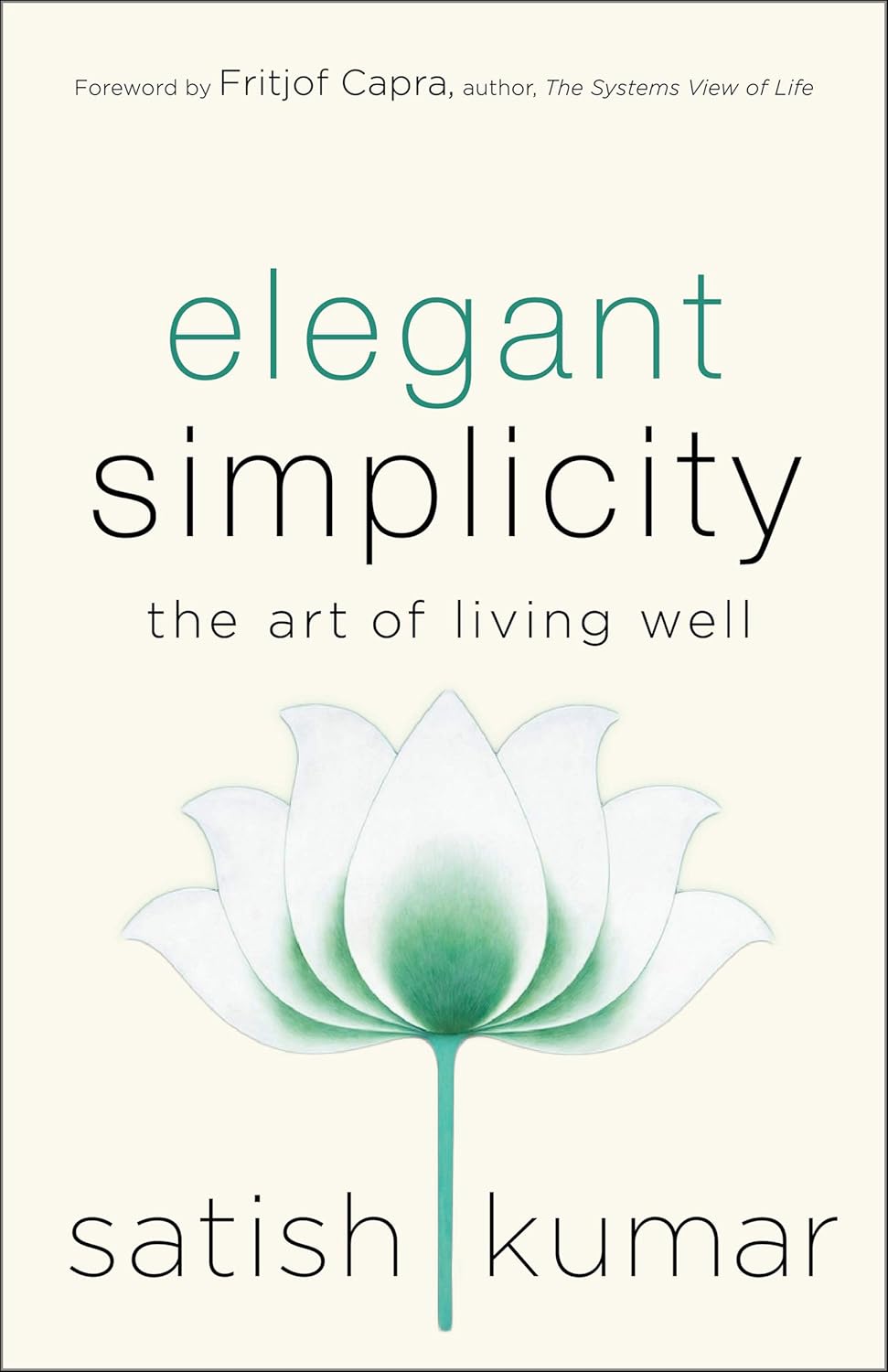
Highly recommended. Satish Kumar (born in 1936) published Elegant Simplicity: the Art of Living Well in 2019 (1). It begins with a foreword by Fritjof Capra and a preface by the author Let’s be Simple which quotes the 1848 Shaker song ‘Tis the gift to be simple, ‘Tis the gift to be free. The book summarises the author’s personal story as well as discussing his values. I have written posts based on some of his other work before (2). I especially recommend this book to anyone interested in knowing more about Satish Kumar’s practice (grounded in Jain spirituality and Gandhi’s non-violent activism) and his influence on deep ecology, creative arts and education.

Elegant Simplicity has a summarising quality, looking back on decades devoted to sacred activism in different forms. It is divided into fourteen chapters: Each is preceded by a brief and relevant quotation from another thinker. The chapter then becomes a meditation on the quote:

1 My Story: Beginnings – ‘True happiness lies in contentment’ Mahatma Gandhi.

2 Simplicity of Walking – ‘All truly great thoughts are conceived by walking’ Friedrich Nietzsche.

3 Life is a Pilgrimage – ‘Faith is not the clinging to a shrine but an endless pilgrimage of the heart’ Abraham Joshua Heschel.

4 Elegant Simplicity – ‘Any fool can make things complicated, it requires a genius to make them simple’ E. F. Schumacher.

5 A Society of Artists – ‘This world is but a canvas to our imagination’ Henry David Thoreau.

6 Yoga of Action – ‘Life is a process not a product’ Brian Goodwin.

7 Learning is Living – ‘Education is not preparation for life; education is life itself’ Thomas Dewey.

8 Right Relationships – ‘We are all related – relationships based on obligation lack dignity’ Wayne Dwyer.

9 Love Unlimited – ‘There is no charm equal to tenderness of the heart’ Jane Austin.

10 Power of Forgiveness – ‘It’s one of the greatest gifts you can give yourself, to forgive. Forgive everybody.’ Maya Angelou.

11 Dance of Opposites – ‘Life and death are one as the river and the sea are one’ Kahlil Gibran.

12 Deep Seeing – ‘To see clearly is poetry, prophecy, and religion, all in one’ John Ruskin.

13 Union of Science and Spirituality – ‘Science is not only compatible with spirituality; it is a profound source of spirituality’ Carl Sagan.

14 Soil, Soul and Society – ‘We live in an interconnected world and in an interconnected time so we need holistic solutions to our interconnected problems‘ Naomi Klein.

Fellow activist and author Vandana Shiva describes Elegant Simplicity as “the distillation” of Satish Kumar’s ideas and actions. “It shows the intimate connections between the inner and the outer world, soil, soul and society, beauty joy and non-violence. It indicates that the solutions to the big problems of our time – climate change, hate, violence, hopelessness and despair – lie in thinking and living with elegant simplicity, reducing our ecological footprint while enlarging our hearts and minds”.

For me, Satish Kumar is an inspiration rather than a direct model. Even in the conditions of the early 1960’s I would not have walked, or aspired to walk, from New Delhi to Washington DC without carrying any money. Yet Satish Kumar and his companion E. P. Menon succeeded and made a huge public impact at the time. Their peace pilgrimage gave oxygen to the campaign for nuclear disarmament. No state gave up its arms, but treaties limiting the numbers and testing of nuclear arms became normalised for some decades. Satish Kumar’s initiatives in deep ecology and education, especially the ‘small school’ and Schumacher College, have changed lives. Directly and indirectly, his influence has awakened many people from the dystopian trance of our dominant cultures. Satish Kumar is a widely revered elder: a peaceful warrior for a more liveable, generous and creative world.

(1) Satish Kumar Elegant Simplicity: The Art of Living Well New Society Publishers (https://www.newsociety.com): Gabriola Island, BC, Canada: 2019

(2) See previous posts:

NEWS OF A DEATH

TWO VIEWS OF THE DIVINE

OUTDOOR WALKING MEDITATION

NOTE: “Satish Kumar (born 9 August 1936)[1] is an Indian British activist and speaker. He has been a Jain monk, nuclear disarmament advocate and pacifist.[3]Now living in England, Kumar is founder and Director of Programmes of the Schumacher College international center for ecological studies, and is Editor Emeritus of Resurgence & Ecologist magazine. His most notable accomplishment is the completion, together with a companion, E. P. Menon, of a peace walk of over 8,000 miles in June 1962 for two and a half years, from New Delhi to MoscowParisLondon, and Washington, D.C., the capitals of the world’s earliest nuclear-armed countries.[4][5] He insists that reverence for nature should be at the heart of every political and social debate.” (Wikipedia)

TWO VIEWS OF THE DIVINE

In 1986, at the age of 50, Satish Kumar (1) went on an extended pilgrimage of British sacred sites. When staying overnight as a guest of the Bishop of Lincoln, he initiated a dialogue on divinity. In this discussion, divinity is described as God, and masculine language is used throughout. (In other contexts Satish Kumar has been happy to use Goddess references and language.) My own practice is largely non-theistic, yet I am Pagan enough to have been jolted by this limitation. Diverse images, stories and beliefs about the divine continue to inform my heart, mind and imagination. The two views articulated here (both eco-friendly in their way) point to very different experiences and understandings of the divine, and of the world: dualist and non-dualist in formal terms.

“‘It is with great pleasure that I welcome you, Satish, to Lincoln and my house, the Bishop said. ‘Going on a pilgrimage is an ancient tradition, but walking for four months around Britain to its sacred places is not so common.’

“‘I am honoured to be your guest,’ I said. ‘I have been inspired and renewed by being within many churches and cathedrals, but increasingly I am finding all places sacred and the presence of the divine everywhere.”

“‘The Bishop heard my comment with thoughtful silence, and then said, ‘For us, God is above and beyond his creation. We aspire to reach God, but God and the world are not the same.’

“‘In the Hindu tradition the world is understood to be the dance of the God Shiva, and the yet the dance and the dancer cannot be separated. The world is not like a painting, a finished object which when complete is seen as separate from the painter. The universe is a living dance and God in in the heart of all beings and things. We do not separate God and the world.’

“The Bishop pondered and in a gentle voice said, ‘I believe that the world is God’s creation and therefore it is sacred. Human beings must act as responsible guardians and caring stewards. We must love the land and look after the earth in its glorious diversity. We have no right to plunder, pollute, exploit, destroy, kill or in anyway disrespect God’s creation. Like in a family, God is the Father and we are his children, and all members of the family should live in harmony with each other. God’s family includes the animals and the natural world. If we are sensitive and caring, we can live with nature rather than against it. The advance of science and technology requires that human beings live with greater sensitivity than ever before, since we are now equipped with extremely powerful and destructive tools. This destructive impulse is not part of God. God is good and good only.’

“‘For me, Divinity is neither good nor bad,’ I said. ‘It is like pure water and pure air. The human soul is also pure. Good and bad is a matter of perception. For example, from nature’s point of view creeping buttercups and nettles are fine wherever they are; they will grow where the soil is ripe for them. From the human perspective, however, a gardener struggles to remove the buttercups and nettles; he regards them as weeds, and complains when they overtake flowers. The rose and the thorn are part of the same plant – we cannot have one without the other. The analytical mind attempts to separate the good and evil, the decorative and ugly, the useful and non-useful, the weed and the flower. I have seen during my journey people pulling out foxgloves in one area and carefully planting them in another. If we are to live in harmony with God’s family, we need to love the wilderness, the weeds and the wet.'”

From: Satish Kumar No Destination: Autobiography of a Pilgrim Cambridge: Green Books, 2014 (extended 4th edition – first edition 1992)

(1) “Satish Kumar (born 9 August 1936)[1] is an Indian British activist and speaker. He has been a Jain monk, nuclear disarmament advocate and pacifist.[3]Now living in England, Kumar is founder and Director of Programmes of the Schumacher College international center for ecological studies, and is Editor Emeritus of Resurgence & Ecologist magazine. His most notable accomplishment is the completion, together with a companion, E. P. Menon, of a peace walk of over 8,000 miles in June 1962 for two and a half years, from New Delhi to MoscowParisLondon, and Washington, D.C., the capitals of the world’s earliest nuclear-armed countries.[4][5] He insists that reverence for nature should be at the heart of every political and social debate.” (Wikipedia)

‘MYSTERY’ IN A MORE THAN HUMAN WORLD

“Half-way between the certainty of science on one hand, and the supernatural on the other, is mystery …. Mystery is central to enchanted experience because enchantment is not a rational process of recognition, categorization, knowledge, facts or rationalizations. It is, instead, a pure experience of sensing and being.” (1)

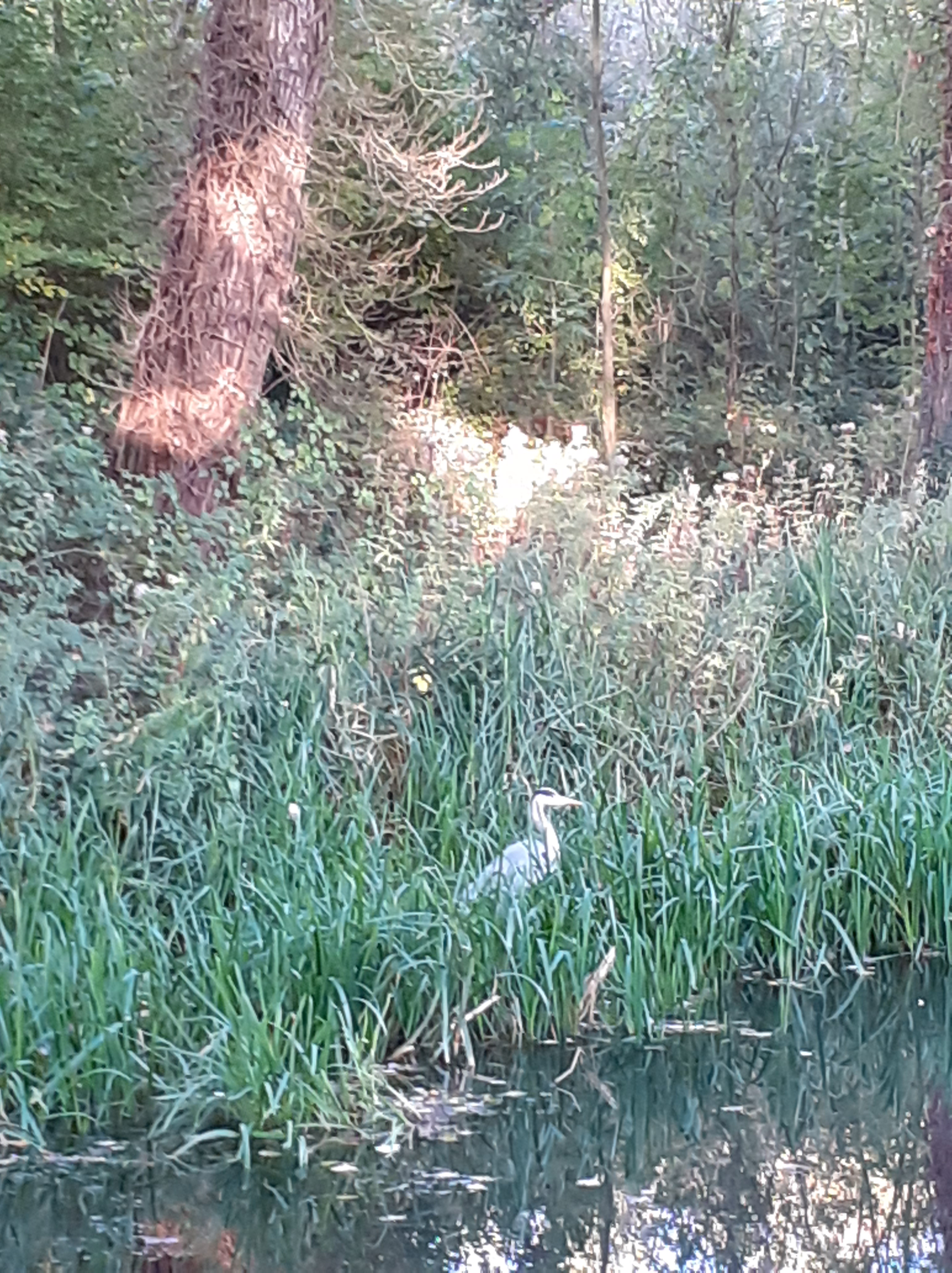
I saw the heron on 11 October 2020, in the first year of the pandemic and just a little after dawn. I had been walking for about forty minutes, beginning in near darkness and experiencing the gradual coming of the light. I described this walk at the time as an “enchanted meander” at a liminal point in that day (2).

My encounter with the heron was unexpected and I responded with “delighted surprise”. Four years later, reflecting on the memory, I note that I was able to experience delighted surprise from within stillness. In that moment I was a still human sharing space with a still heron on a still early morning. So the heron stayed in place, not needing to fly away. Beyond that there was no communing, but this was somehow blessing enough. Stillness of this kind, in contact with our more than human world, allows space for an enhanced bandwidth of experience. It is, perhaps, an opening to what Arran Stibbe calls “mystery”.

On that morning, my enhanced experience was partly displaced into the taking of a picture and also the wider purpose of my walk. That’s fine, a good enough choice. But I wonder what would have happened if I, like the heron, had stayed in place.

(1) Arran Stibbe Econarrative: Ethics, Ecology and the Search for New Narratives to Live By London: Bloomsbury Academic, 2024

(2) https://contemplativeinquiry.blog/2020/10/14/walking-towards-sunrise/

BOOK REVIEW: UNSEEN BEINGS

Highly recommended. Unseen Beings: How We Forgot the World Is More Than Human (1) is about the many beings we humans have actively ‘unseen’ and the consequences of our human-centric lens. Author Erik Jampa Andersson describes his book as a diagnostic exploration of the roots of the climate crisis, itself an extreme consequence of a much wider malaise. Whereas the common view of ‘saving the planet’ tends to be one of ‘guarding the storehouse’, a better focus would be on ‘supporting the welfare of living beings’.

Andersson has a background in Tibetan Buddhism and Tibetan medicine. In the manner of Buddhism’s Four Noble Truths, and of his medical training, he divides his book into four parts: Diagnosis, Causes and Conditions, Prognosis, Treatment.

Diagnosis concerns “our ecological disease”. Andersson reminds us of what the climate crisis is, how far it has been allowed to go, and the “fanciful stories” with which we have soothed our fears: “full of human exceptionalism, divine protection, techno-fixes and post-apocalyptic salvation”. For Andersson, the foundational root cause is “the sundering of human and non-human beings, and our perceptual separation from ‘Nature’. He refers to “the poison of anthropocentricity”. He reviews the evidence for plant and fungal sentience and awareness as well as that of the animal kingdom. He concludes that Nature is not a place, but “a tightly knit community of interconnected beings, some seen, many unseen, all engaged in their own affairs and with their own experience of reality”. He describes this relational approach to the living world as “what most scholars now call ‘animism’ … neither a religion nor a system of belief, but a paradigm of more-than-human relationship”. He sees this stance toward the world as “our natural state”.

Causes and Conditions A mini-ice age some 13,000 years ago interrupted an early agricultural period in some places and prompted a series of innovations. The domestication of the horse was especially significant. Andersson sees a move away from our ‘natural state’ beginning at this time. But it is not fully evident to us until the age of written philosophy and scripture. The Greek philosophers Plato and Aristotle declare a hierarchy of sentience from plants up to animals and then humans at the top, uniquely endowed with a rational soul. In the Hebrew book of Genesis, God gives dominion over the Earth and its animals to man for his use. In the Western Christianity of the 13th century CE, Thomas Aquinas says that Christians have no duty of charity to non-humans because they are resources, not persons. In the 17th century CE, early in the West European led colonial era, Descartes holds public vivisections of dogs and other animals declaring that they are soulless automata and that their apparent distress is meaningless. In the mid 19th century CE, Darwin restores other beings as our ancestors and cousins, but but without much sense of kinship or empathy.

Prognosis Here Andersson introduces two concepts from Tibetan medicine: ‘provocation’ and ‘spirit illness’. The provocation of other sentient beings is a health risk. He discusses the origins of the recent Covid-19 pandemic in these terms, as human become ever more invasive of our remaining wild spaces. In cases of deforestation, pollution, and any disruption of air, water, soil and trees, there is a price to pay for the wounding of other spirits, whether seen by the eye, seen through a microscope and normally unseen but recognised by tradition. (‘Supernatural’ is an unhelpful word here – everyone is part of nature). In Tibetan tradition, the cultivation of a clear mind is highly prized and works within human psychology, but not for disruptive events like these. There is a need to make amends. Rituals are held in sensitive and damaged places. The damage caused in these circumstances and the resultant chronic collective disease can only be addressed by learning how to care for eachother, non-human beings and the planet itself.

Treatment Using the Buddhist 8-fold path as a structure, Andersson recommends ‘cultivating care’ over a system of rules and regulations aimed at a ‘sustainability’ which tries to restore the old status quo. We cultivate care of the Earth, one another and non-human beings. Hence: 1 right view is a return to our ‘natural state’, as described under Diagnosis; 2 right intention describes commitment to a path of rewilding and regeneration; 3 right speech is the use of “life-affirming language” (e.g. using ‘they’ as an alternative to ‘it’ for non-human beings); 4 right action is causing as little harm as possible to other beings; 5 right livelihood means adopting principles of authentic sustainability and non-exploitation; 6 right diligence is based on “the durability of the heart-felt ethic; 7 right mindfulness means “paying attention to nature’s vitality”; 8 right concentration involves imaging a new future with “authentic myth-making”.

Concerning 8 above, Andersson has been profoundly moved by the work of J. R. R. Tolkien from his later childhood onwards. As a result, he developed a high valuation of authentic myth-making and enchantment. In this realm, the non-human is essential. Tolkien had his own life-changing moment of enchantment when, as a student, he first read the Old English words: Eala earendel engla beorhtast, ofer middangeard monnum sended. (Hail Earendel brightest of angels, above the middle-earth sent unto men). Of this evocation of Venus arising as the morning star, in the old language, Tolkien later wrote: “there was something very remote and strange and beautiful about these words, if I could grasp it, far beyond ancient English”. For Andersson, authentic myth and authentic science work together in support of a redemptive animist vision. By contrast, the form of discourse to worry about is ‘fallacy’ – a complete dissociation from the truth. Andersson again quotes Tolkien: “if men were ever in a state in which they did not want to know or could not perceive truth (facts and evidence) then Fantasy would languish until they were cured. If they ever get into that state (it would not seem at all impossible) Fantasy will perish and become morbid delusion”. For Andersson, this too has become a symptom of our current ecological disease, making the need for honest and healthy communication all the more urgent.

For me, Andersson has made a valuable addition to a growing literature about the current crisis, whose most alarming symptom is climate breakdown. He goes to the root of the problem, offering a clear and coherent view about how to stand in the face of it. It is a well-researched, well-crafted and compassionate contribution to the genre.

(1) Erik Jampa Andersson Unseen Beings: How We Forgot the World is More Than Human Carlsbad, CA & New York City; London; Sydney; New Delhi: Hay House, 2023

I attach a links to conversations between the author and Andrew Harvey below. It adds considerably to what I can present in a review:

DEEP ADAPTATION AND CRITICAL WISDOM

In recent months I have felt an increasing pull towards better understanding our current ecological, cultural and political crises. From a Druid perspective, I am mindful of my commitments to nature and all beings, and accountability to all our ancestors and descendants. From a contemplative perspective, I am bearing witness to the world in which I breathe: any ‘beyond’ is accessible only from within. From an inquiry perspective there is much to inquire about.

So Jem Bendall’s new book, Breaking Together: a Freedom Loving Response to Collapse (1), is important for me both to learn from and to write about. In this post I describe two concepts that I see as driving the book: ‘deep adaptation’ and ‘critical wisdom’. Bendall explains these concepts in a way that gives me questions to ask and tools to use. Boiled down, they are not complicated. The words that follow are his, not mine.

Deep Adaptation

“Deep Adaptation refers to the personal and collective changes that might help us to prepare for – and live with – a collapse of the societies we live within. Unlike mainstream work on adaptation to ecological and climate change, it doesn’t assume that our current economic, social and political systems can be resilient in the face of rapid climate change. The ethos is one of curious and compassionate engagement with this new reality, seeking to reduce harm and learn from the process, rather than turn away from the suffering of others and nature.

“There is an emphasis on dialogue, with four questions to help people explore how to be and what to do if they have this deep outlook on the future.

“What do we want to keep and how is a question of resilience.

“What do we need to let go of, so as not to make matters worse, is a question of relinquishment.

“What could we bring back to help us with these difficult times, is a question of restoration.

“With what and who shall we make peace as we awaken to our mutual mortality, is a question of reconciliation.”

Critical Wisdom

“What I term ‘critical wisdom’ is the elusive capability for understanding oneself in the world that combines insight from mindfulness, rationality, critical literacy, and intuition.

“A capability for mindfulness involves our awareness of the motivations for our thought, including our mind states, emotional reactions and why we might want to ‘know’ about phenomena.

“A capability for rationality involves an awareness of logic, logical fallacies and forms of bias.

“A capability for critical literacy involves awareness of how the tools by which we think, including linguistically constructed concepts and stories, are derived from, and reproduce, culture, including relationships of power.

“A capability for intuition involves awareness of insights from non-conceptual experiences including epiphanies and insights from non-ordinary states of consciousness.”

For me, Jem Bendall provides an invaluable set of questions to ask and tools to use under the headings of Deep Adaptation and Critical Wisdom. The questions refine my understanding of Deep Adaptation. The combination of understandings that lead to wisdom are, as a set, new to me, though I was already aware of the individual elements. ‘Critical Wisdom’ reframes my sense of wisdom, more clearly experienced as a dynamic processes of wise-ing.

(1) Jem Bendell Breaking Together: A Freedom-Loving Response to Collapse Bristol: Good Works, 2023 (Good Works is an imprint of the Schumacher Institute – see also https://www.schumacherinstitute.org.uk). I can certainly recommend this book now, on the grounds of both its wide knowledge and deep wisdom. I may write a full review in future.

NB: Jem Bendell is a world-renowned scholar on the break-down of modern societies due to environmental change. A full Professor with the University of Columbia, he is a sociologist specialising in critical integrative interdisciplinary research analysis on topics of major social concern. His Deep Adaptation paper influenced the growth of the EXtinction Rebellion movement in 2018, and he created a global network to reduce harm in the face of societal collapse (the Deep Adaptation Forum). Although recognised as a Young Global Leader by the World Economic Forum in 2012, Bendell has been increasingly critical of the globalist agenda on sustainable development.”

THE WISDOM OF COMPASSION

“Toward all beings maintain unbiased thoughts and speak unbiased words. Toward all beings give birth to thoughts and words of kindness instead of anger, compassion instead of harm, joy instead of jealousy, equanimity instead of prejudice, humility instead of arrogance, sincerity instead of deceit, compromise instead of stubbornness, assistance rather than avoidance, liberation instead of obstruction, kinship instead of animosity.” (1,2)

Humanism extends our circle of care to all humans, clearly a high bar in our current state of culture. Druidry, certainly an animist Druidry embracing deep ecology, asks us to extend it further – to all beings. At first glance, it seems like a complicated and demanding ask in a world where life lives off other life, and where cooperation and competition necessarily co-arise. Yet for some people this stance towards the world is (or becomes) natural.

The passage in my first paragraph offers guidance on the Bodhisattva path in Mahayana Buddhism. Followers of the path let go of any quest for personal liberation to work for the liberation of all beings. Sometimes this is understood as a postponement of personal liberation, but the deeper insight is that ‘personal’ liberation makes no sense. In an interconnected and interdependent cosmos, only the liberation of all counts as any liberation at all.

In the Diamond Sutra (3) the definition of ‘beings’, put into the mouth of the Buddha himself, is as broad and inclusive as possible: “however many species of living beings there are – whether born from eggs, from the womb, from moisture, or spontaneously; whether they have form or no form; whether they have perceptions or do not have perceptions, we must lead all these beings to the ultimate nirvana so that they can be liberated.” Then the Buddha adds: “And when this innumerable, immeasurable, infinite number of beings has become liberated, we do not in truth think that a single being has been liberated”.

Thich Nhat Hanh (3) understands this last statement as saying “a true practitioner helps all living beings in a natural and spontaneous way, without distinguishing the one who is helping from the one who is being helped. When our left hand is injured, our right hand takes care of it right away. It doesn’t stop to say: ‘I am taking care of you. You are benefitting from my compassion’. The right hand knows very well that the left hand is also the right hand. There is no distinction between them. This is the principle of interbeing – co-existence, or mutual interdependence. ‘This is because that is’.”

I am not a Buddhist. I do not share the classical Buddhist views of karma and reincarnation. I do not associate final physical death with the term ‘liberation’. But I am aware of not, ever, being on my own – even when being, in the world’s terms, solitary. Apparent boundaries between me and my world are too soft: relationships are happening all the time. With this sense of the world in mind, the words below, repeated from the first paragraph, seem like common sense.

“Toward all beings maintain unbiased thoughts and speak unbiased words. Toward all beings give birth to thoughts and words of kindness instead of anger, compassion instead of harm, joy instead of jealousy, equanimity instead of prejudice, humility instead of arrogance, sincerity instead of deceit, compromise instead of stubbornness, assistance rather than avoidance, liberation instead of obstruction, kinship instead of animosity.” (1,2)

(1) From the Perfection of Wisdom in Twenty-five Thousand Lines translated into English by Edward Conze, Large Sutra on Perfect Wisdom Berkeley, CA: University of California Press, 1975 and cited in (2), below

(2) Red Pine, The Diamond Sutra: the Perfection of Wisdom. Text and Commentaries translated from Sanskrit and Chinese Berkeley, CA: Counterpoint, 2001 See: https://www.counterpointpress.com

(3) Thich Nhat Hanh The Diamond That Cuts Through Illusion: Commentaries on the Prajnaparamita Diamond Sutra Berkeley, CA Parallax Press, 201

NOTE: Versions of the Diamond Sutra appeared as written texts in Sanskrit in the 2nd century C.E. and this version was translated from Sanskrit into Chinese in the early 5th century C.E. Works of this kind were used more for recitation and chanting in monastic settings than they were for silent reading.

COLOURS OF AUGUST, 2023

The haws are red and shiny on their hawthorn bushes. Blackberry remains tentative, its pale green fruit visible but still unripe. I see green leaves now leaning towards yellow. I am walking in a scrap of local woodland, bounded by a canal* on my left and housing some distance to my right. It is around 7.30 pm on 13 August, and I am opening up to the colours of late summer as they show themselves this year.

Looking up, I see a healthy crop of crab apples at different stages of ripening on their tree. The ripest apples are red, though their red is softer than that of the haws. The leaves of the apple tree are shinier than those in the background. I am aware of a light grey sky.

Nature in various forms finds a niche everywhere. This time has its own flowers, and again I see yellow. I am not the greatest botanist. and I cannot name with certainty these plucky if slightly battered blooms, saying hello from behind a fence. But I imagine them as poor relations of even the lesser celandine, and therefore almost certainly official weeds**. I hope and pray they remain safe here in these woods.

Below, looking at tangled leaves, I find a truly autumnal scene, in the yellowing and browning of leaves. It feels a bit early for this neighbourhood. The wheel of the year is still following its seasonal course, so far, but is becoming more erratic and unpredictable than in the past. I wonder about the future of the jet stream – and indeed the Gulf stream too. But in the moment, my heart opens and I love this pattern of plant life moving through its cycle and gradually, subtly, changing in appearance.

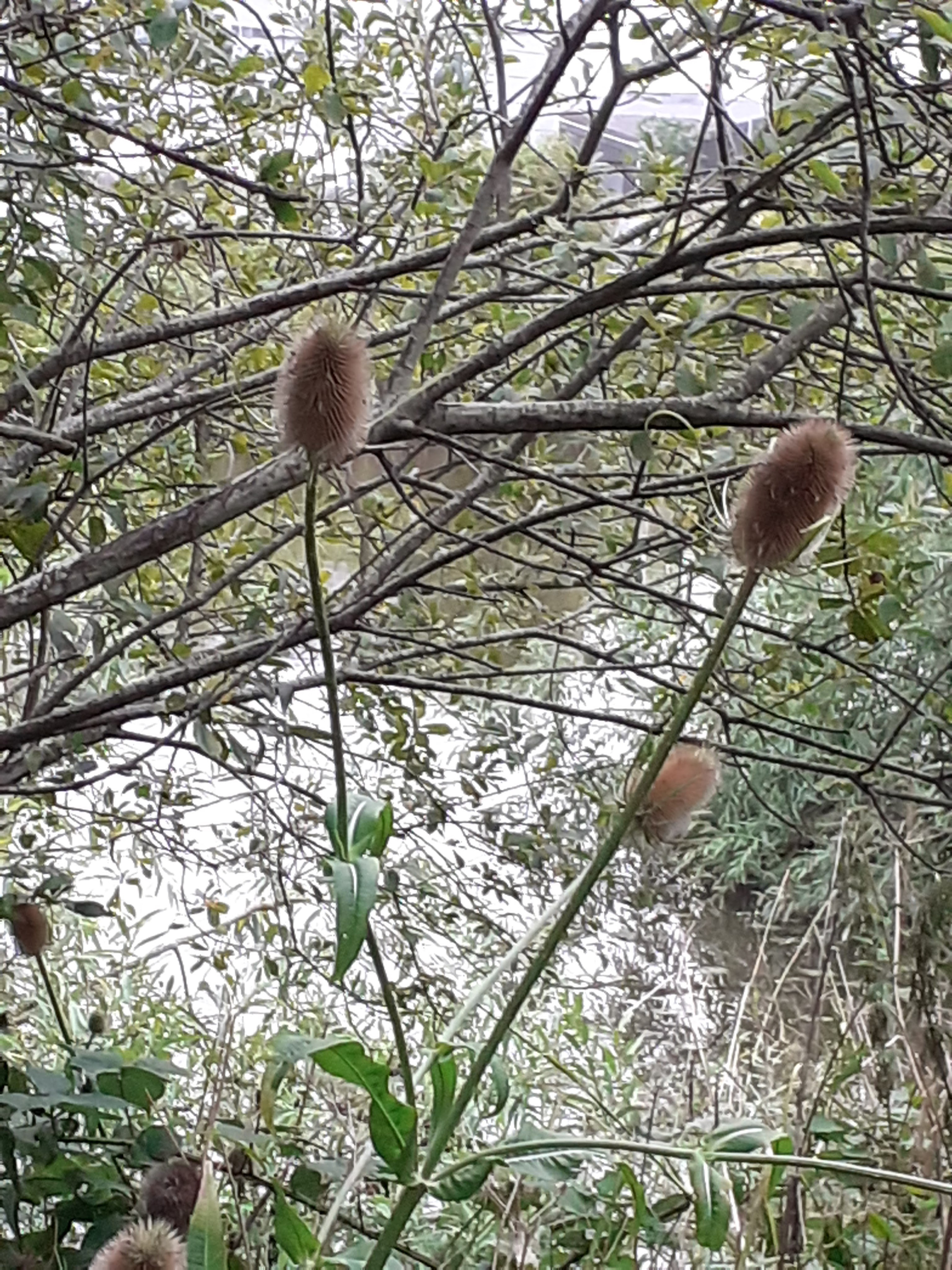
I photograph two teazel stalks, below, because I enjoy their shapes, because they are a further illustration of the browning theme, and also because of the visibility of the canal behind them. They don’t live in the canal, like bullrushes, but they like to be close. The image also includes an almost ghostly barge on the water below.

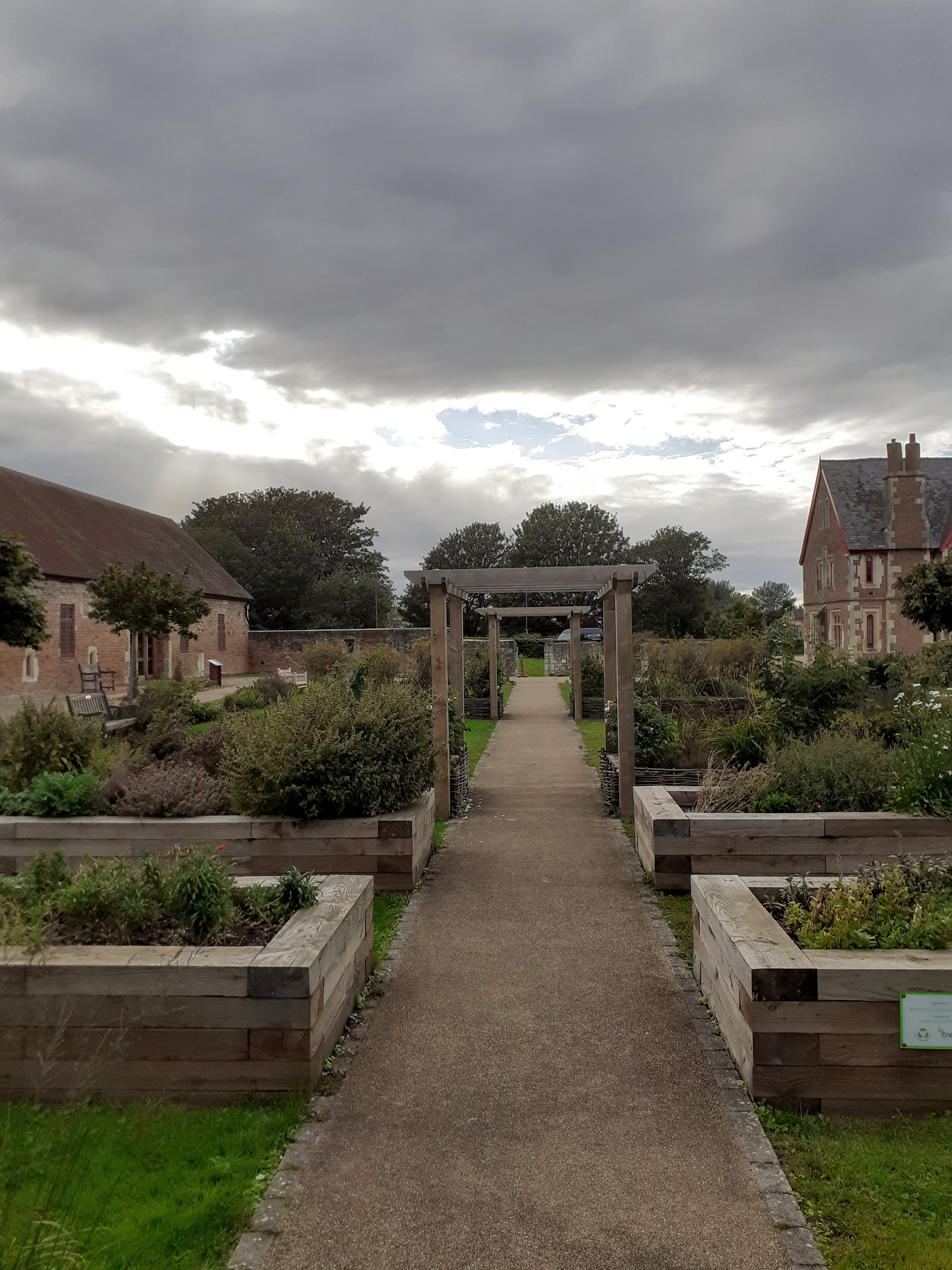
After leaving the woods, I am confronted (below) with the sky. I am facing west, across the Llanthony Priory gardens. I see dark stormy clouds, whose edgy brooding energy is somewhat modified by a blue opening in the distance. This dark grey, and the rain and storm it sometimes brings, have certainly been a feature of summer this year. There’s a strong contrast with last year at this time, when there was a heat wave, which for us still means C 30-35/F 86-95 with anything more being exceptional. In July 2022 part of the country briefly reached over C40/F 104 for the first time since records began. This year the grass is still green. Last year it burned up and the ground was parched and cracked.

Following the wheel of the year carefully, as it turns, is a valuable discipline for modern Druids, among others concerned with deep ecology (sacred ecology?) and the climate crisis. We don’t confine ourselves to celebrating our seasonal festivals, though we enjoy them too. For we now know experientially that the world is changing. The traditional rhythms of nature are not an eternal verity to rely on.

In some ways I find small personal observations emotionally more impactful than my limited knowledge of climate science and deep time geology. These are very helpful for context and framing, but personal experience is more immediate than these. It is also more deeply immediate, though less dramatic and disturbing, than reports of disaster elsewhere. Following the wheel of the year, we are doing more than making observations. We are celebrating and bearing witness to the life that surrounds us, offering our attention and energy to its continued flourishing. Blessings on the land.

*The Gloucester-Sharpness canal, England. Beyond the Gloucester docks, but not yet out of the city.

** A reader comments: “I think your mystery plant is ragwort, a much maligned ‘weed’ the destruction of which is encouraged by the UK government as it can be harmful to grazing animals yet is actually one of the best forage plants for pollinators”.

HOW PAGAN WAS MEDIEVAL BRITAIN?

How Pagan Was Medieval Britain? is the sixth and final lecture in Professor Ronald Hutton’s Gresham College series on early Pagan history in Britain (1). The simple answer, according to Hutton, is: not as much as was widely believed in the twentieth century, by scholars and the lay public alike. Some thought that full medieval Christianity was an upper class faith, with commoners, especially in the countryside, being ‘cheerful semi-Pagans’, Christian by day and following the old ways by night. Others thought that the two religions ran in parallel, with the latter being necessarily clandestine whilst some of its iconography was visible. Green Man and Sheela na Gig images, often present in the churches themselves, seemed to indicate the survival of a Pagan sensibility at the very least – canny concessions by the Church to the people. Witch persecutions were seen as evidence of an active, surviving woman centred nature religion. Indeed, such ideas influenced cultural and religious developments in the twentieth century itself – specifically, the rise of neo-Paganism; more broadly, the Feminist and Green movements that were dynamically emerging at the time.

However, turning to the medieval period itself, Hutton, does not find evidence of actually existing Pagan religion in the available sources. Witch trials have been carefully examined in recent years, and the victims don’t fit the profile. In Anglo-Saxon times, the legal codes and church councils stopped bothering to forbid Christian converts their old ways by 800 CE. The prohibitions reappeared in the tenth century, in relation to Viking settlers, but ceased again by 1030 CE. In the later middle ages there was serious concern over Christian heretics (Lollards) and some concern over ale-house cynics expressing anti-religious views. In medieval society people tended be nosy about other people’s business and there was social pressure to conform. There are court cases that draw on this kind of informal surveillance, but none concerned with Pagan religious practice. Hutton traces Sheela Na Gig images to the Church in France, saying that they had an anti-erotic intent. Likewise, Green Man, Wild Man and Jack in the Green figures have specific historical origins not concerned with any Pagan deity. Hutton quite reasonably offers no comment on their widely perceived role as archetypal images, because these are outside the remit of the empirical historian. His focus is on self-defined and organised Pagan religion during a specific period in Britain.

But it is true, according to Hutton, that the medieval church offered religious continuity in other ways. The veneration of saints, who were very diverse and numerous, allowed polytheist habits of mind to continue, especially in the realm of petitionary prayer. Individual saints might be local, or specialists in specific forms of help. For many people they seemed more approachable than the persons of the trinity. However in Britain there seem to have been no saints who had themselves once been gods*. Likewise Christians had holy wells, but they were different from the old Pagan ones, rather than the same ones repurposed. The temple of Sulis Minerva at Bath, for example, was left alone. Few temples or ancient religious sites became churches, even though Pope Gregory had recommended this approach when he sent his mission to Kent in 597 CE.

Church attendance was not compulsory in the middle ages. It is estimated that only around 50% of parishioners attended regularly, though they did turn up in much larger numbers for the major festivals. During these, ‘secular revelry’ was allowed, even encouraged, and the festivals raised a lot money for Parish churches, enabling them at times to abolish Parish rates. This widely beneficial outcome was seen as ‘cheating the Devil’. Even on normal days, the Church offered spectacle – with the mass, libations and incense. Local priests came from the people, didn’t have to be literate, and didn’t have to preach. That was done by specialist friars with notable performance skills, often very popular. Additionally, many people belonged to guilds linked to their churches, usually focused around a saint. There were lay religious guilds for both women and men, which had a variety of purposes, officered by their own lay members. Craft guilds performed plays at festival times. This form of Christian culture lasted in Britain until the middle of the sixteenth century, when the old church fragmented into a plurality of new ones over hard-fought time. Different kinds of Christian culture, generally even less Pagan friendly, emerged.

(1) https://www.gresham.ac.uk/watch-now/medieval-pagan/

* An exception would be the Gaelic speaking areas in Scotland and Brighid

BOOK REVIEW: THE CIRCLE OF LIFE IS BROKEN

Highly recommended. Brendan Myers’ The Circle of Life is Broken (1) is subtitled “an eco-spiritual philosophy of the climate crisis”. Myers is a Pagan identified author and a professional philosopher who teaches at Heritage College, Gatineau, Quebec. His Paganism is naturalistically oriented, and animist in a sense that “the things of the natural world are in some hard-to-express manner alive and spiritually present”.

The book begins with an view of the Earth from outside, through the loving eyes and words of astronauts. “It is as if the Earth as a whole was only discovered in 1968, when Apollo-8 astronaut William Anders shot the famous Earthrise photograph; the image of the Earth coming out from behind the edge of the moon”. This ‘overview effect’ is balanced at the end of the book by an invitation to immerse ourselves more fully and awarely within the world, through the practices of a weekly green sabbatical and an annual ecological pilgrimage.

Between this beginning and ending there are three main sections, each addressing a ‘root question’. Each question is rigorously explored, before receiving a carefully formulated answer.

The first question asks: what is the circle of life? A key understanding is that ecologists today do not see the Earth as “an aggregate of individuals competing for resources and survival”. Rather, they “are teaching us to see the Earth as a complex system in which everything is directly or indirectly involved in all the life around it, and in which symbiosis and cooperation, across multiple levels, keep the system as a whole flourishing”. This is the circle of life that is now breaking down. “It isn’t simply changing form. It is also short-circuiting; it is falling apart”.

The second root question asks: who faces the circle of life? This concerns humans and how we deal with realities of a higher order than our own. The exploration includes a look at how people see the world at different life stages. Myers wants to know “what becomes of the human reality when cast in terms of the encounter with the Circle of Life as the ultimate reality?” He notes that the Circle goes almost unmentioned in the history of Western philosophy, and also explores a perceived a tension between our ‘being-ecological’ and our ‘being-free’.

The third root question asks: can the circle be healed? Myers quotes a saying of the philosopher Hegel: “the owl of Minerva takes its flight only when the shades of night are gathering”. When things are bad, new ideas and possibilities can emerge and philosophers especially are challenged to think big. Myers looks at the political and cultural obstacles to any healing process, with good sections on ‘eco-fascism’ and the ‘gatekeepers of human nature’. He also makes a number of specific positive proposals.

Although written in plain English as far as possible, The Circle is Broken is not a book to read in one sitting. Myers’ thinking is holistic, with room for scientific information, complex argument, deep feeling, contemplation and engagement. It is written with love and a sense of wonder, generously drawing on personal experience. I think of it as a long-term companion, a gift to anyone concerned with the climate crisis and creative responses to it.

(1) Brendan Myers The Circle of Life is Broken: An Eco-Spiritual Philosophy of the Climate Crisis Winchester UK & Washington USA: Moon Books 2022 (Earth Spirit series)

(2) For other posts about Brendan Myers’ work, see:

https://contemplativeinquiry.blog/2015/05/22/the-worship-of-the-gods-is-not-what-matters/ (Reblog from Naturalistic Paganism)

BOOK REVIEW: THE EARTH, THE GODS AND THE SOUL

BOOK REVIEW: RECLAIMING CIVILIZATION

ETHICS AND ‘CIVILIZATION’

BRENDAN MYERS: A FOREST ENCOUNTER

Earth Eclectic

music that celebrates Earth and speaks to the heart

Sarah Fuhro Star-Flower Alchemy

Follow the Moon's Cycle

Muddy Feet

Meeting nature on nature's terms

Rosher.Net

A little bit of Mark Rosher in South Gloucestershire, England

Becoming Part of the Land

A monastic polytheist's and animist’s journal

selkiewife

Selkie Writing…

Charlotte Rodgers

Images and words set against a backdrop of outsider art.

Prof Jem Bendell

living with metacrisis and collapse

Towint

The pagan path. The Old Ways In New Times

The Druids Garden

Spiritual journeys in tending the living earth, permaculture, and nature-inspired arts

The Blog of Baphomet

a magickal dialogue between nature and culture

This Simple Life

The gentle art of living with less

Musings of a Scottish Hearth Druid and Heathen

Thoughts about living, loving and worshiping as an autistic Hearth Druid and Heathen. One woman's journey.

Wheel of the Year Blog

An place to read and share stories about the celtic seasonal festivals

Walking the Druid Path

Just another WordPress.com site

anima monday

Exploring our connection to the wider world

Grounded Space Focusing

Become more grounded and spacious with yourself and others, through your own body’s wisdom

The Earthbound Report

Good lives on our one planet

Hopeless Vendetta

News for the residents of Hopeless, Maine