Contemplative Inquiry

This blog is about contemplative inquiry

Tag: Death

DEEP AUTUMN 2025

“All things ripen and rot that rose up at first,

And so the year runs away in yesterdays many,

And here winter wends again, as by the way of the world it ought,

Until the Michaelmas moon has winters boding brought.” (1)

Even today, deep autumn opens the door to winter. This was even more the case in the North Staffordshire and Derbyshire regions of 14th century England, where Sir Gawain and the Green Knight was written. Even in castles, people were less sheltered from the growing cold and damp than we are. So readers and listeners of the period are reminded that the coming of winter is both natually and divinely ordained.

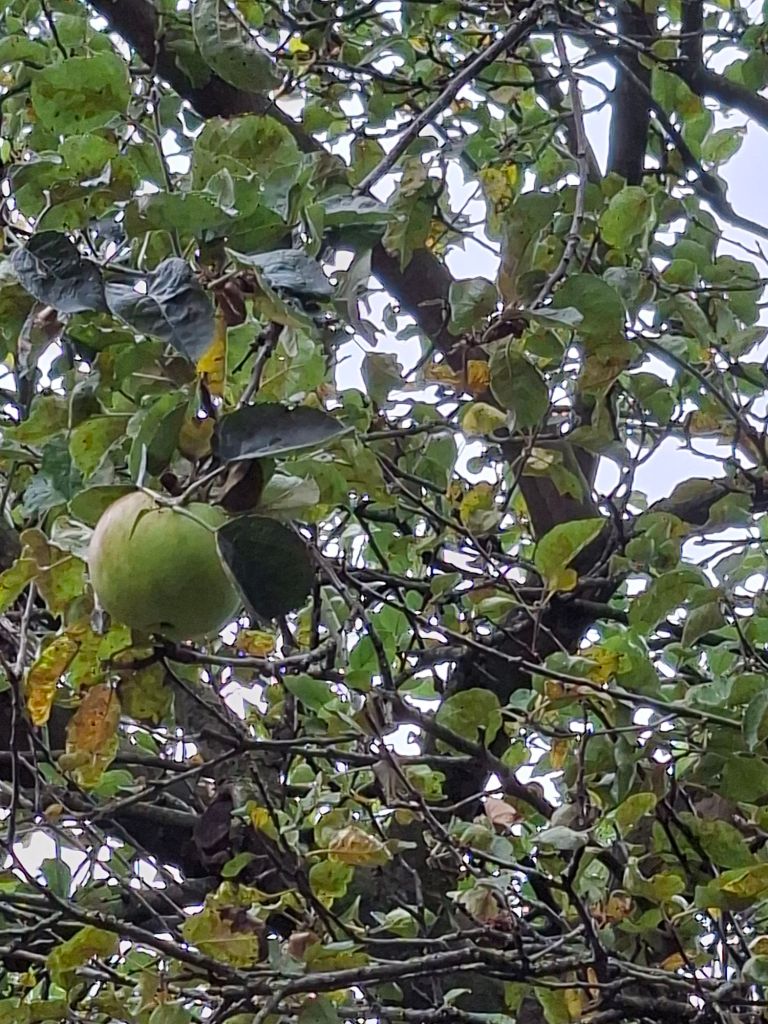
Here and now, the sight of the apple harvest in its later stages (pictured above) seems quite different than in the early ones (2) – less bright, less novel, less shiny. Rotting apples lie on the ground, now fallen outside the wall of  Gloucester Cathedral’s orchard. From Nature’s exuberant perspective, this is all part of the plan.  Waste is built in.

This time draws me further into the declining year. I am in the cathedral’s  grounds, now looking at a yew tree and its associations with death. I’m thinking of the approach of Samhain (aka Halloween/All Hallows) at the turn of the month. Once it marked the 3rd harvest of the year – the blood harvest, where animals were slaughtered in preparation for winter. Now it is more a time to remember our ancestors, and our dead more widely.

Yet the seasonal moment, and the yew, can also be linked to wisdom and transformative change in life. I launched my contemplative inquiry at Samhain 2011. Like many people, I find that this period can be a resonant and creative time.

Below the yew, I have included a section of the cathedral itself. I have old personal associations linking medieval Gothic architecture with the feeling-tone of the declining year. I am also aware that this building is linked to the trees I picture and discuss. Gloucester Cathedral was a monastery when Sir Gawain and the Green Knight was written but many of its features were already in place.
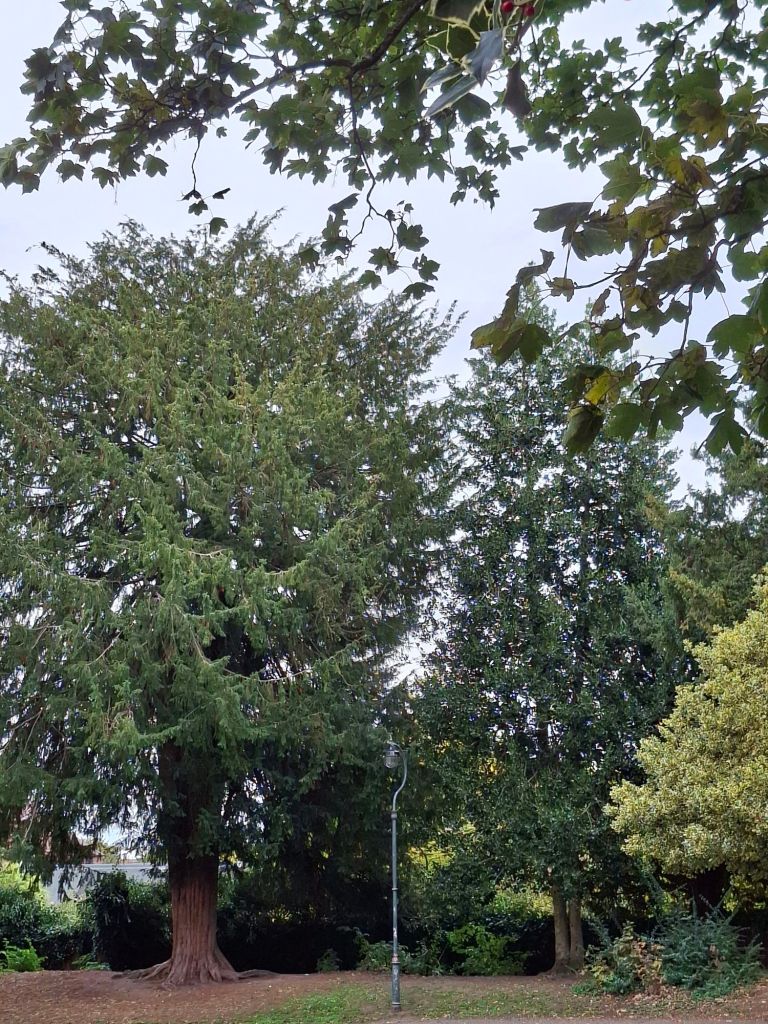
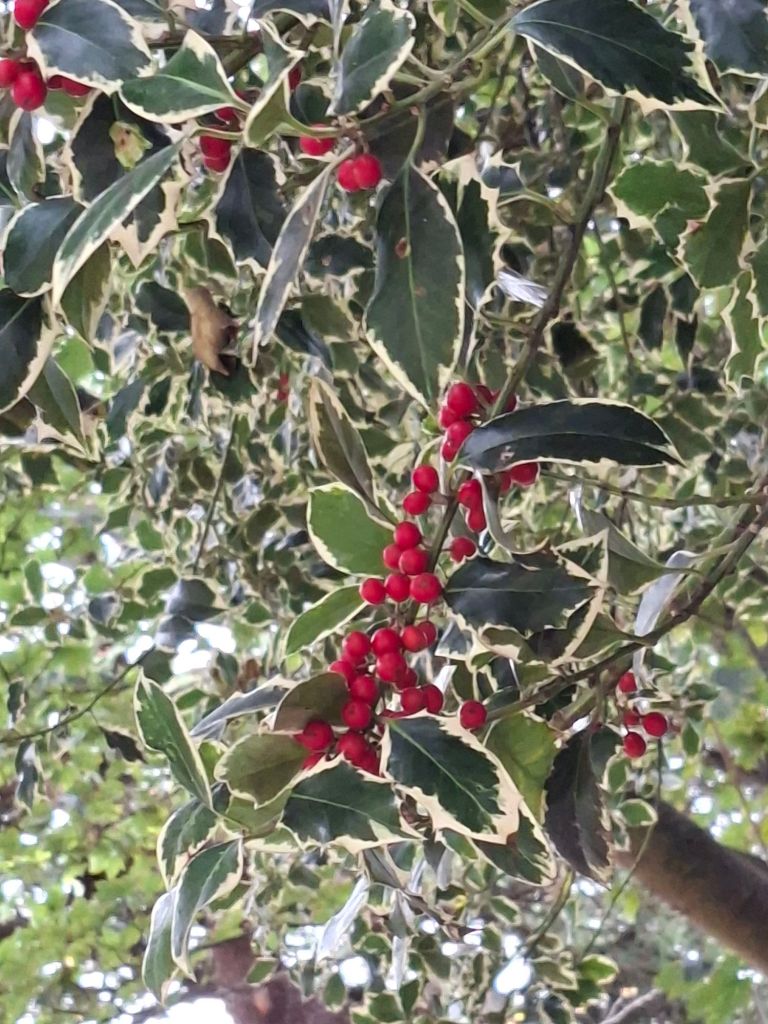
In the same space, I find both holly and ivy, with berries on the holly tree.  I immediately thought of the Christmas carol The Holly and the Ivy. It is an ancient folk carol, which interweaves Christian themes and others that belong with the land. The version which is now popular was collected by Cecil Sharp in 1909 in Gloucestershire from Mary  Clayton.

Many people think that the indigenous Pagan themes are the oldest, and that the central focus here is on the holly. The authors of The Green Man Tree Oracle say: “Holly’s connection with the Green Man is especially strong. In his guise as the Holly King – an ancient giant and symbol of fertility – the Green Man makes a notable appearance in the 14th century poem Gawain and d the Green Knight. Here he takes the form of a fearsome knight, who comes to King Arthur’s court to offer a midwinter challenge, carrying a club of holly and wearing a holly crown (as symbols of his true identity).” This challenge happens every year, where the Green Man/Holly King demands that we encounter him through our dealings with the natural world.

Elaine and I went to the Gloucester Cathedral Close and its surroundings on Saturday afternoon 18 October to outrun an  extended period of gloom, wind and rain. We are now in it, so the lessons of the trees in deep autumn, anticipating the coming of winter, are not lost on us. The dark of the year is on its way.
(1) J.R R. Tolkien (translation of anonymous texts) Sir Gawain and the Green Knight, Pearl, Sir Orfeo New York: Ballantine Books, 1980.

(2) https://contemplativeinquiry.blog/2025/08/22/ (3rd photo)

(3) John Matthews & Will Worthington The Green Man Tree Oracle: Ancient Wisdom from the Greenwood London: Connections, 2003

WALKING IN ARNOS VALE CEMETERY

Above, through the trees, we can see one of the chapels belonging to the Arnos Vale Cemetery in Bristol, England. It was built as a  garden cemetery extending over 45 acres in 1839, as the city’s old parish graveyards were becoming overcrowded and a health hazard. The new venture was designed to be spacious, with sunlight, fresh air, trees and shrubs.

It worked well for nearly 150 years. But in 1987 the owners announced their intention to clear a large section for ‘development’. An Association for the Preservation of Arnos Vale Cemetery swiftly sprang up. It fought successfully for a safe future for the site, gaining the support of the Bristol City Council, Bristol citizens and many people worldwide.

Now, as the Friends of Arnos vale, they continue to manage what they describe as “a hillside Victorian cemetery and conservation park, with heritage and wild life tours, plus a café”. It takes a lot of effort and activity to keep this precious space going, yet on my occasional visits I still find it tranquil and unspoilt.

For me it is a magical place, largely because the graves are being allowed to sink back into the land. There is something primal about the cross above, rough hewn, almost equal armed, and decorated with foliage. Still a cemetery, Arnos Vale has become something wilder than a garden. At this time of year, the paths become green tunnels, deftly concealing their destinations.

Yesterday I walked in Arnos Vale with a friend, and our direction of travel required a descent towards the main buildings. The steps we went down were not as overgrown as the ones below, but l found them challenging enough. The imagery and effortful activity of descent give me the feeling of a deep earth and underworld journey, and the sense of enchantment that goes with it.

Towards the bottom of the slope, my recognition of a re-enchanted space in a largely disenchanted world is further strengthened. A cross again. Evergreen ivy growing up it. Vivid summer blooms behind and in front. Tall wild grass. Trees in the background. Green abundance enhancing the gravestone rather than diminishing it. Life and death companioning each other without drama or fuss. Contemplating this natural harmony, I feel heartened and refreshed.

WINTER’S END

4.30 pm, 25 February 2025. Sunrays are caught in willow branches. The sun is a little stronger today than it was in full winter. The willows have begun a tentative greening. But there is much shadow in this picture. The day has begun its decline.

The world retains a winter feel for me. I aware of the change in my local park, but I do not altogether trust this spring. In the moment of taking this picture, I see a world in shadow, softly darkened. This is partly because of where I have chosen to stand. It is the image I seem to want.

In the brighter picture below, I show daffodils growing among dead leaves. Daffodils are iconic harbingers of spring, yet not my sole focus. Both pictures were taken intuitively and without any mentally registered intent. It seems as if something in me wanted to make a statement.

I know and accept that I am in the winter of my life. In the wheel of my own life, I can’t quite see how my winter will move into spring, certainly in any personal sense. Dissolving into interbeing is easier to imagine.

My customised Druid liturgy names winter as the season of dying and regeneration. It has associations with law and faith. I understand law in a karmic or ‘natural law’ sense. But it can also be an acknowledgement of the nature we see around us. Faith, in part, concerns the willingness to accept dying and regeneration without knowing what they are like. In my last post, I discussed (1) ‘being nobody’. My current reflections take this suggestion a step further. Evidently, I still have much to learn.

(1) https://contemplativeinquiry.blog/2025/02/21/being-nobody

MY OCTOBER 2024

October, 2024. Outside, leaves turn and fall. The days shorten, long evening walks no longer part of my day. But six months after her accident in Gran Canaria, my wife Elaine is re-learning to walk. A great blessing – we both wondered if she would.

A gift from Awen – three words tumbling into manifestation with no thinking effort from me: healing, peace power (1). A kind of Druid koan. Easy to see that peace might follow healing, and that healing might be a condition of true peace. But the power following on from that peace? – very different from the kinds of ‘power’ most visible in the world today. What do I need to learn?

I had a dream in which I read a map to get to a school. I arrived at the school and was happy enough with my experience. Then I read the map again and saw that it was the wrong school. The one I should have gone to was further away, to the north-west.

At Samhain, the culmination of October, we think of of the dead, and a loosening divide between the dead and the living. What can we say to them – ancestors and recent dead alike? What might they say to us?

(1) see: https://contemplativeinquiry.blog/2024/10/17/awen

NEWS OF A DEATH

When is ‘suicide’ something else? At the age of 80 Satish Kumar’s mother decided that her life was over and her duty done. She began a fast that lasted for five weeks before she died. Although suicide is stigmatised in most cultures, this was an honourable death in her Jain community in Rajasthan, India. Kumar, then already living in England, quotes the letter that gave him the news.

“At the age of eighty your mother felt that she had served the family and fulfilled all her duties and that now it was time for her to meet death. She decided to separate herself from her worn-out body by fasting. She believed that only death could bring new life and that she must die to live again. She went round the town, to family and friends, saying goodbye and asking forgiveness for any wrong she may have done. From the next day’s sunrise she took no more food or drink except a little boiled water. The news of your mother’s fast unto death spread by word of mouth. Monks came to bless her and be blessed, since it is considered to be brave and holy to die in this way – to embrace death rather than let it capture you unaware. Hundreds of people came to have her last darshan and to ask for forgiveness. She didn’t talk much but by her look acknowledged the receiving and giving of forgiveness. People sat outside singing songs and praying. After thirty-five days of fasting, your mother died.” (1)

I have written before about Jain ethics, in a review of Philip Carr-Gomm’s Seek Teachings from Everywhere (2). Both he and his Druid mentor Ross Nicholls had an interest in the Jain path with its values of ahimsa (non-violence/harm), aparigraha (non-attachment/possessiveness/acquisition) and anekant (non-absolutism/many-sidedness/multiple viewpoints). From a Jain perspective, Satish Kumar’s mother was in conformity with these principles when she chose death, with fasting (already a familiar practice) as her method. I value her story for its distinctive lens on a contentious subject. The depth of community support she received is for me the most moving aspect of this voluntary death. It became almost a celebration, and a kind of karmic harvesting for someone who believed that she “must die to live again”.

(1) Satish Kumar No Destination: Autobiography of a Pilgrim Cambridge: Green Books, 2014 (extended 4th edition – first edition 1992)

(2) See: https://contemplativeinquiry.blog/2019/10/02/book-review-seek-teachings-everywhere/

NOTE: “Satish Kumar (born 9 August 1936)[1] is an Indian British activist and speaker. He has been a Jain monk, nuclear disarmament advocate and pacifist.[3]Now living in England, Kumar is founder and Director of Programmes of the Schumacher College international center for ecological studies, and is Editor Emeritus of Resurgence & Ecologist magazine. His most notable accomplishment is the completion, together with a companion, E. P. Menon, of a peace walk of over 8,000 miles in June 1962 for two and a half years, from New Delhi to MoscowParisLondon, and Washington, D.C., the capitals of the world’s earliest nuclear-armed countries.[4][5] He insists that reverence for nature should be at the heart of every political and social debate.” (Wikipedia)

AN TUAGH: HELVEGEN

An Tuagh celebrate early Norse as well as Gaelic traditions in northern Scotland. Not only Orkney and Shetland, but also the Western Isles and part of the Scottish mainland were officially in Norway for over two centuries in the early middle ages. Above is the An Tuagh version of Helvegen, featuring the voice of Chris Corrigan.

In an An Tuagh Facebook post on 20 march 2024, and also in a note appended to their YouTube video, Corrigan explains: “Bards and Skalds of ancient times sang songs for others’ birthdays, weddings, funerals and everything in between. This song asks a then pertinent question. Who will sing me (the bard) over to the other side when it is my turn to pass over?” Corrigan’s post includes a personal dedication and Norwegian and English versions of the lyrics.

A chill in the air today reminded me of Helvegen. In April of this year I posted An Tuagh’s version of The Song of Amergin in Old Irish (1). Here I add a representation of the Norse aspect of Scottish tradition as well, though Helvegen is not itself an old song. It was written by Einar Selvik in modern Norwegian in 2013, but using traditional themes. It became widely known through its appearance in the Vikings TV drama series on Netflix.

(1) https://contemplativeinquiry.blog/2024/04/14/an-tuagh-song-of-amergin/

‘SACRED AGNOSTICISM’

In the later stages of a post mostly about the spiritual benefits of ‘deep adaptation’ (1), Jem Bendell discusses “sacred agnosticism, where the mystery of consciousness is surrendered”. I wish that I had come up with ‘sacred agnosticism’ myself, and the use of ‘surrendered’ in that context. I see it as a highly skilful use of language, that tricky medium, and resonant in the present stage of my own life and practice.

Describing his journey to this position, Bendall says: “for many years, I’d ditched religious stories of a soul that exists, like my current consciousness, in an afterlife. I’d also realised that aspects of reality and consciousness are ineffable. Meaning, once we use concept and language to describe the ultimate truth, we are moving away from reality.”

However, he goes on to acknowledge that: “I still had part of me that wanted to know. Will I still be conscious after death? Will I merge, will I reincarnate, will I experience nothing? Will I leave no trace in the universal information field or akashic record? Did I even exist much in the first place?”

Through reflection and meditation Bendall discovered that any narrative of this kind would, for him, “have originated in fear, where the ego needs to map, order and control reality and assert that to others”. In the absence of such stories he suggests that “the mystery itself is an invitation to transcend the ego.” So he decided that: “I wanted to cultivate a way of being where I will actually celebrate that ‘not-knowingness’ and would naturally feel that way at the time of dying”.

The content of the reflections isn’t new to me. Yet I do strongly feel that I’ve been gifted the right words at the right time. I am grateful to Jem Bendall for his post.

(1) https://jembendell.com/2024/02/13/major-life-changes-become-the-least-risky-option/

FALLING: 2022

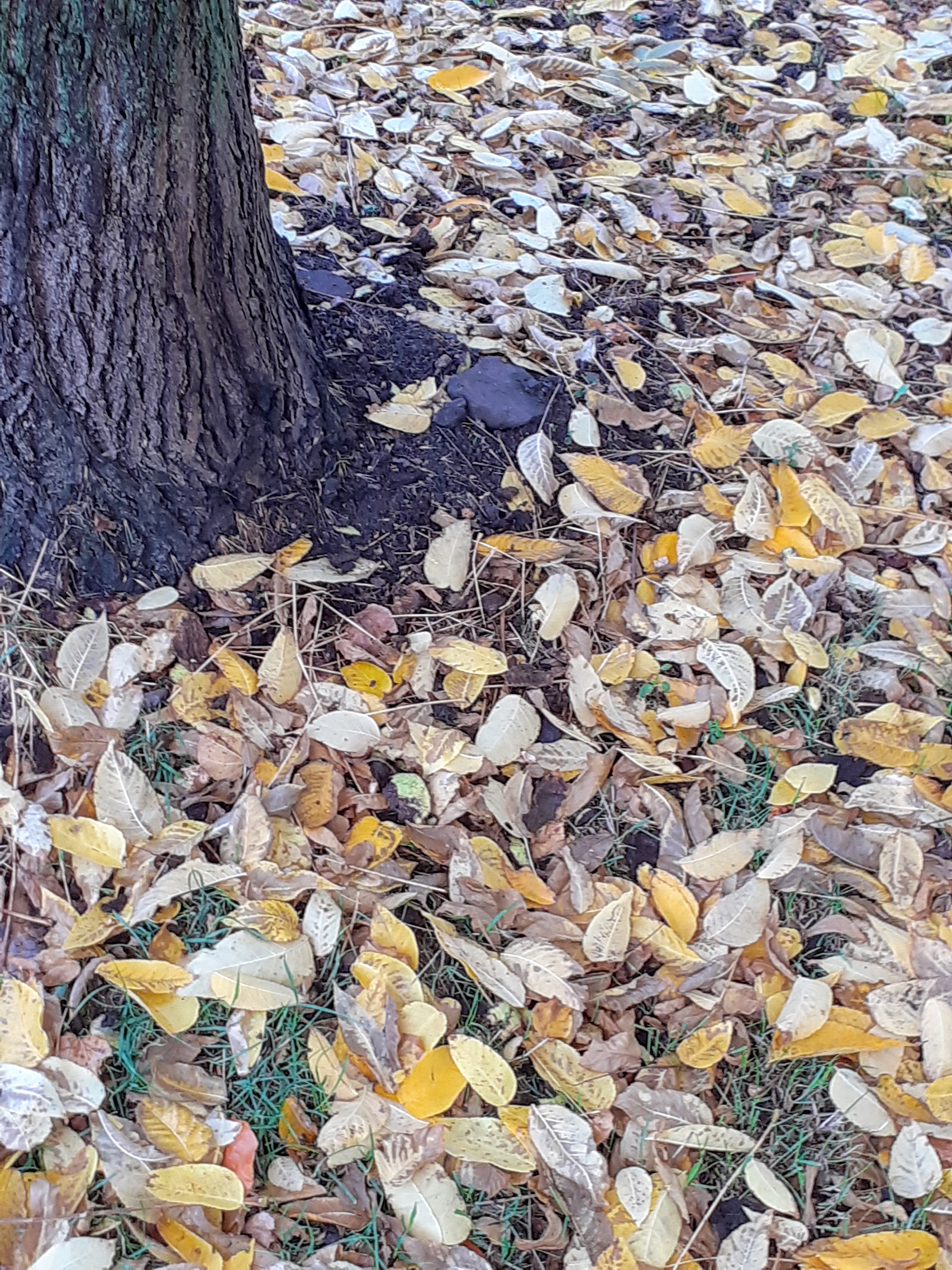
Vivid autumn colour signals a fall. Where I live, we are early in the process as yet. These leaves seem poignantly glorious to me. I respond to a beauty that I know will be short-lived. The tree is immersed in a cycle of dying and regeneration that furthers its larger life. Any sense of poignancy, glory and beauty is about me, being human.

I think of the last thirty years, and my own small deaths and regenerations over this period as I journeyed from my early forties to my early seventies. At the beginning I sensed a pull towards new priorities, which roughly fitted the Jungian notion of the second half of life as having different goals from the first. I experienced a nudge towards an inward, psycho-spiritual turn. I developed interests in experiential inquiry, Druidry/Western Mysteries, and contemplative spirituality, as part of this mid-life nudge.

This reduced my interest in career, acquisition and influence – though such interest had always been limited. In the nineties and noughties, I didn’t need a lot of money both to live well, if modestly, and accrue a reasonable retirement income. It would be much harder now. I am grateful to have experienced (relatively) favourable times, though of course the seeds of our current crises were already being sown.

Now I am ready for a new chapter, as my wife Elaine and I get ready to move to a new place of our own in Gloucester. The next move is into a smaller, more manageable space, and will involve elements of de-cluttering. I am the same tree but I will be shedding leaves and waiting for new ones to grow next year. In the moment I feel fragile, though my unknowing about the future also has an edge of wonder about the magic that may unfold. Falling is an oddly potent process at a special time of year.

WISDOM’S HOUSE

Two people hold each other in mutual gaze. Both their mutuality and their individuality are very clear. The space between them defines a chalice, or grail. In stillness they are present to each other, within a dynamic field of I-Thou relationship. The gestalt is one of communion. Their world has come alive.

Eckhart Tolle speaks of a wisdom that is not the product of thought, and which comes with the ability to be still. “Just look and listen. No more is needed. Being still, looking and listening activates the non-conceptual intelligence within you. Let stillness direct your words and actions” (1).

He goes on: “wisdom is not the product of thought. The deep knowing that is wisdom arises through the simple act of giving someone or something your full attention. Attention is primordial intelligence, consciousness itself. It dissolves the barriers created by conceptual thought, and with it comes the recognition that nothing exists in and by itself. It joins the perceiver and the perceived in a unifying field of awareness. It is the healer of separation”.

I think of wisdom, in this sense, as the healer in the heart. Not the organ that continues to pump at a not-too-elevated rate when my blood oxygen declines, and therefore a resiliency factor for my physical health. It is, rather, the heart of awareness – personified again as it has been before by a Goddess of Wisdom. She came to me, at night, at a wakeful time when my breathing was particularly laboured and I felt like a freshly landed fish. She acted as a discreetly background presence, pointing me to the vision of a radiant grail, palpably emanating the energy and resources of all four elementary powers.

Pragmatically I felt empowered to weather a challenging experience. Beyond that, the Goddess invites me to let go of identification with the mind-made ‘little me’ as a limited and confining construct. The reward is an expansion into love, joy, creativity and inner peace. I have bounced back from my COPD flare-up in the last few days and will do what I can to rebuild my physical capacity. But the lesson, that healing is not the same as being physically fixed, and asks for a different kind of commitment, applies both in bad times and good.

(1) Eckhart Tolle Stillness Speaks Novato, CA, USA: New World Library & Vancouver, BC, Canada: Namaste Publishing, 2003

ALDER (FEARN) PROTECTION

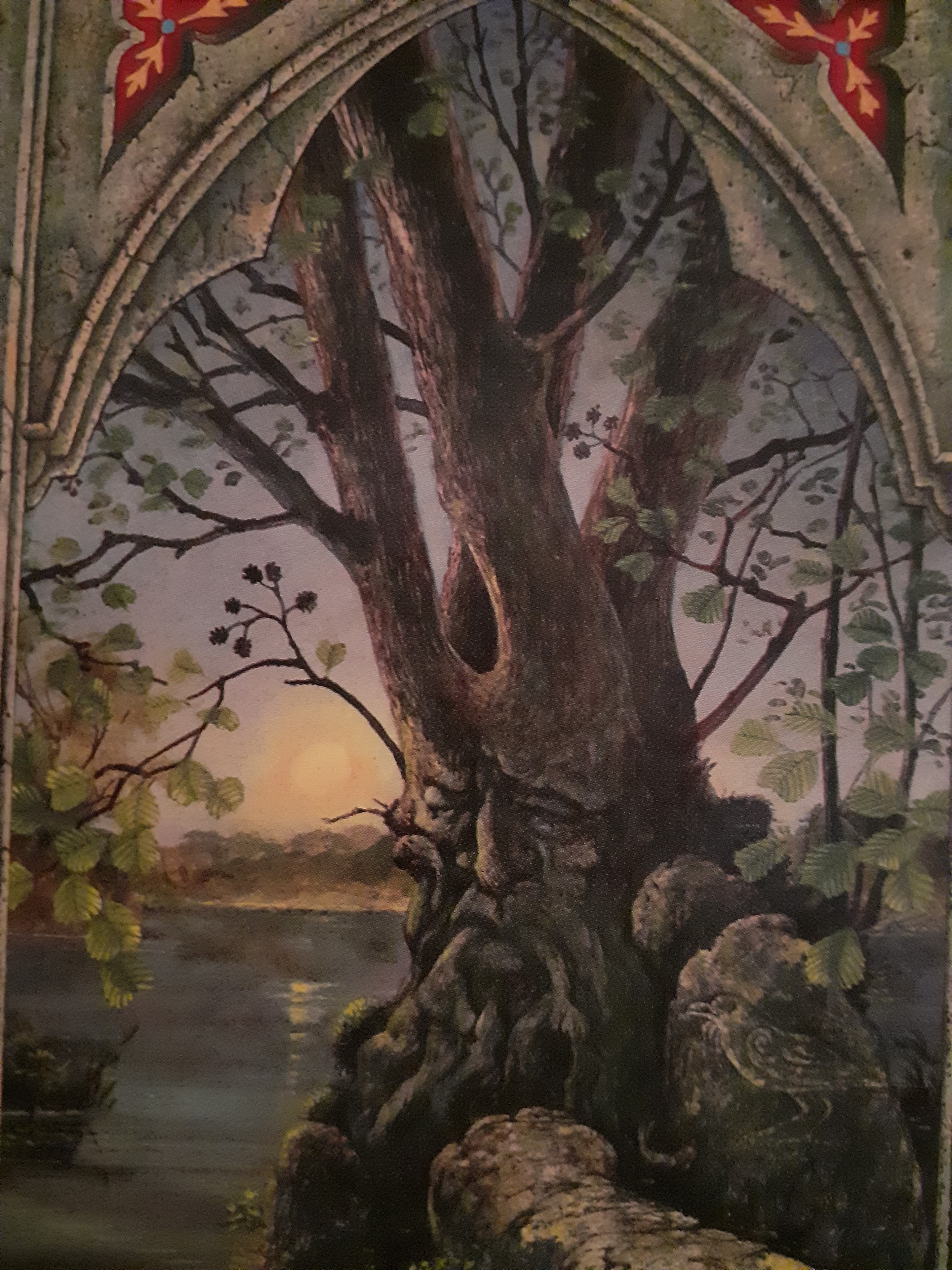
Within my mandala of the year (1) Alder (2) is the fourth and final tree for the winter quarter that begins at Samhain. The overall movement of this quarter, in my world, is through death to regeneration. Alder presides from 8-31 January and links the regenerative aspect to a continuing need for protection already signalled by Holly (3). There is something foundational about protection. The late eighteenth century Druid prayer (4), which set the note for modern Druidry, begins by asking for protection, as the beginning of a journey that leads through the quest for justice to a place of universal love.

I live in a watery place and there are alders around, though – in contrast to willow – I have never been on hugging terms with this tree. But the oily and water resistant timber is well-adapted to its surroundings, and for humans has provided good timber for boats, bridges, and underwater foundations. Many medieval cathedrals were built on alder piling. Although the wood makes poor fuel, it is good for charcoal.

Round alder shields were once used as protection for warriors in Ireland, and “in Celtic myth, we read of palisades of alders that deter invasion of keep prisoners confined, and these fences are sometimes described as being decorated by a row of severed human heads” (2) . The Welsh hero Benedegeit Bran (Bran the Blessed) is reputed to have used his body to span the River Linon, forming a bridge to raise his followers above the dangerous waters, as the wood does when used as a building material. Later, when mortally wounded in a battle against the Irish, he gave them instructions to cut off his head and carry it with them. They were rewarded with song and prophecy from the head over many years.

Much more can be said about Bran (whose name means raven). My overall learning from alder is about a willingness and capacity to hold boundaries Bran adds sensitivity and openness to the larger context in which events are playing out. Placed at the end of the winter quarter, I see alder as guarding the tentative return of spring, as the light slowly returns and we find increasing signs of growth in the natural world. The weeks before Imbolc can be cold and dreary, but life is stirring both outwardly and inwardly. Alder reminds me of the need for protected spaces to nurture a latent abundance.

(1) The image is from: John Matthews & Will Worthington The Green Man Oracle London: Connections, 2003.

(2) This mandala is based on my personal experience of trees in the neighbourhood as well as traditional lore. Moving around the winter quarter from 1 November, the positions and dates of the four trees are: Yew, north-west, 1-23 November; Elder, north-north-west, 24 November – 16 December; Holly, north, 17 December – 7 January; Alder, north-north-east, 8 – 31 January. The spring quarter then starts with birch at Imbolc. For a complete list of the sixteen trees, see https://contemplativeinquiry.blog/2020/autumn-equinox-2020-hazel-salmon-awen/

(3) https://contemplativeinquiry.blog/2020/12/23/holly-tinne-the-turn/

(4) https://contemplativeinquiry.blog/2020/08/27/my-druid-prayer/

Earth Eclectic

music that celebrates Earth and speaks to the heart

Sarah Fuhro Star-Flower Alchemy

Follow the Moon's Cycle

Muddy Feet

Meeting nature on nature's terms

Rosher.Net

A little bit of Mark Rosher in South Gloucestershire, England

Becoming Part of the Land

A monastic polytheist's and animist’s journal

selkiewife

Selkie Writing…

Charlotte Rodgers

Images and words set against a backdrop of outsider art.

Prof Jem Bendell

living with metacrisis and collapse

Towint

The pagan path. The Old Ways In New Times

The Druids Garden

Spiritual journeys in tending the living earth, permaculture, and nature-inspired arts

The Blog of Baphomet

a magickal dialogue between nature and culture

This Simple Life

The gentle art of living with less

Musings of a Scottish Hearth Druid and Heathen

Thoughts about living, loving and worshiping as an autistic Hearth Druid and Heathen. One woman's journey.

Wheel of the Year Blog

An place to read and share stories about the celtic seasonal festivals

Walking the Druid Path

Just another WordPress.com site

anima monday

Exploring our connection to the wider world

Grounded Space Focusing

Become more grounded and spacious with yourself and others, through your own body’s wisdom

The Earthbound Report

Good lives on our one planet

Hopeless Vendetta

News for the residents of Hopeless, Maine