High summer becomes late summer, in my world, with a gentle movement into the evening of the year. In the picture above, taken a little after 8 pm, I at first feel, as much as see, a suggestion of muting light. On looking up, the blue of the sky seems influenced by a subtle greying effect that is independent of the clouds. Looking down, the buildings are shadowy and their reflections in the water are set within a gathering darkness.
The picture below was taken at 9 pm on the following day. The grey in the sky owes everything to clouds, whereas the orange and yellow are connected to sunset. The latter is reflected in the water, and electric lighting is now also present. The day is changing, but not yet into night. This is an in-between time, twilight. It is its own, extended moment, quietly shifting in the physical world, profoundly influential in my psychic world.
I feel joy with an edge of melancholy. It is a familiar feeling that stretches deeply into my early life, prior to language, older than memory itself. It seems to come from deep time, and to be pre-personal, not just about ‘me’. I am any finite being, moving from day towards night, from summer towards winter, from life towards death. Having shifted decisively away from the zenith, I find myself, for now, in a beautiful moment. The Gloucester docks provide me with a magical space for walking, standing still, experiencing and recording this time.
I was on a train and had reached my destination. Descending onto the platform at 5.30 pm, I found myself in complete darkness. It might as well have been midnight. I understood that winter had come.
The Goddess in her cailleach, or crone, aspect presides over this time. She it is who determines the length and severity of winter. She is also embodied in the dark woman of knowledge who facilitates both death and transformation (1).
In the context of my contemplative inquiry/blog, I am experiencing a process of this kind, seemingly in a minor key. I want to call it ‘hibernation and renewal’, though I cannot predict how it will really be. In any event, I have decided to do no more posting until the new year. What happens then depends on what I am inspired to do at the time. But now is a time for surrender to endarkenment and sleep.
(1) Philip and Stephanie Carr-Gomm The DruidCraft Tarot: Use the Magic of Wicca and Druidry to Guide Your Life London: Connections, 2004. Illustrated by Will Worthington.
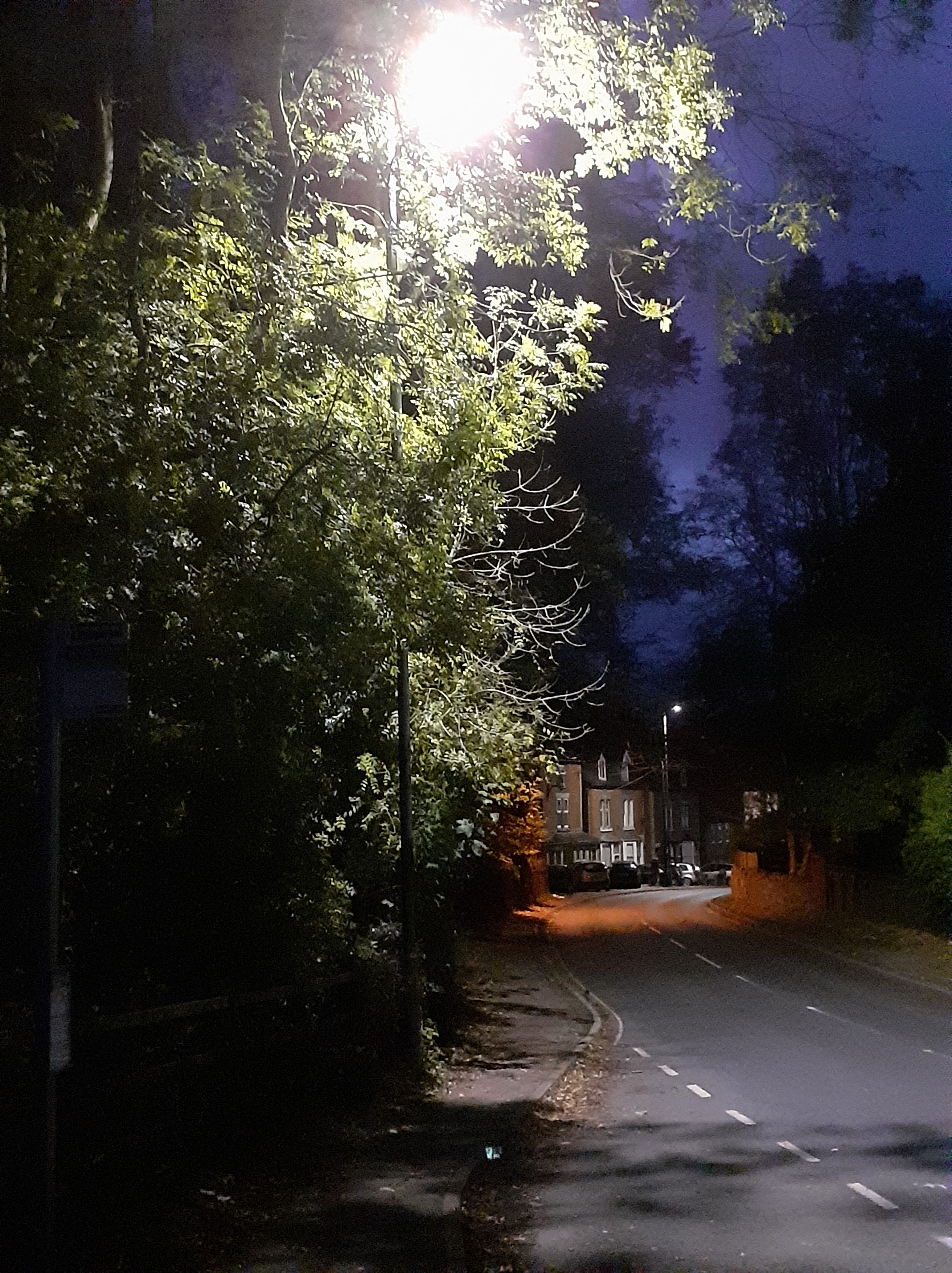
Sunday, 11 October, 6.40 am. My plan is to walk towards the dawn of a new day, but I take time to stop and photograph this liminal moment. It is still, on this normally busy road. It makes me almost nostalgic for the early days of lockdown in the spring.
In this moment, there are no cars and no other people. I am fine with the artificial light. I like the contrast of the street lights (bright and focused) with the softer light in the sky, dim yet with a promise of expansiveness. I enjoy the shadows and the presence, too, of outright darkness at this stage of my walk.
It takes me twenty minutes of enchanted meander to reach my next point, pictured above. The scene is inherently more spacious. Water and sky are prominent. It takes notable artefacts to make their presence felt. The main theme of the picture, as I look in a generally eastern direction, is the coming of the light. Clouds do not obscure it. The buildings have become more than silhouettes. There are the beginnings of colour and the detail it brings. I judge it OK to walk on the canal path itself, just visible on my right.
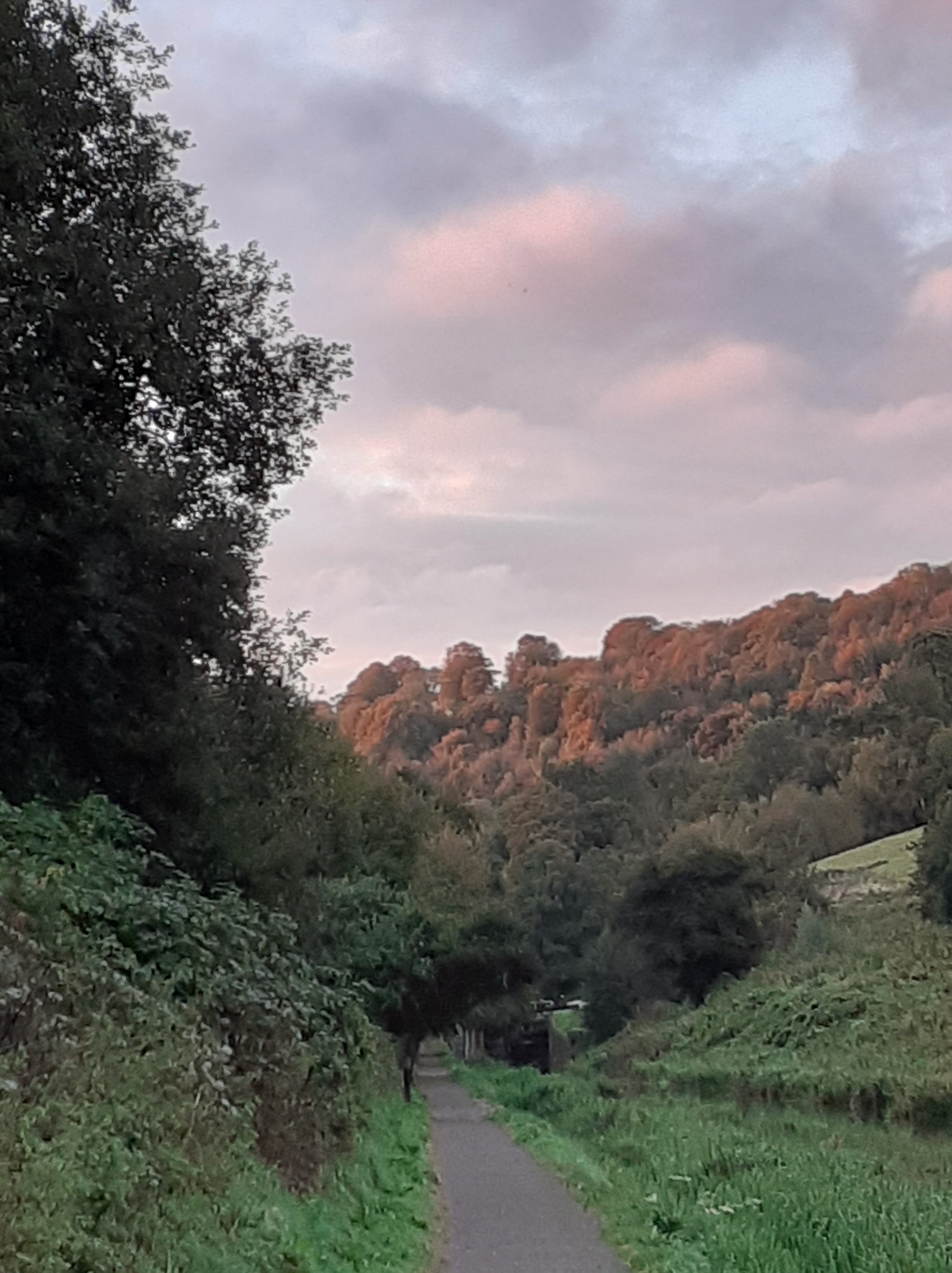
Another twenty minutes and the light seems to predominate, though I am not yet in full daylight. I am on the canal path. Even though the surroundings of the towpath are lushly green, the world I stand in is a little dusky, or dawny if there were such a word. Crepuscular. Looking up, I see pinkness in the sky, white clouds, hints of blue. I feel heartened and strangely moved by the effects of light on the autumn trees. They give me a warm sense of walking towards the sunrise, and encourage me to move on.
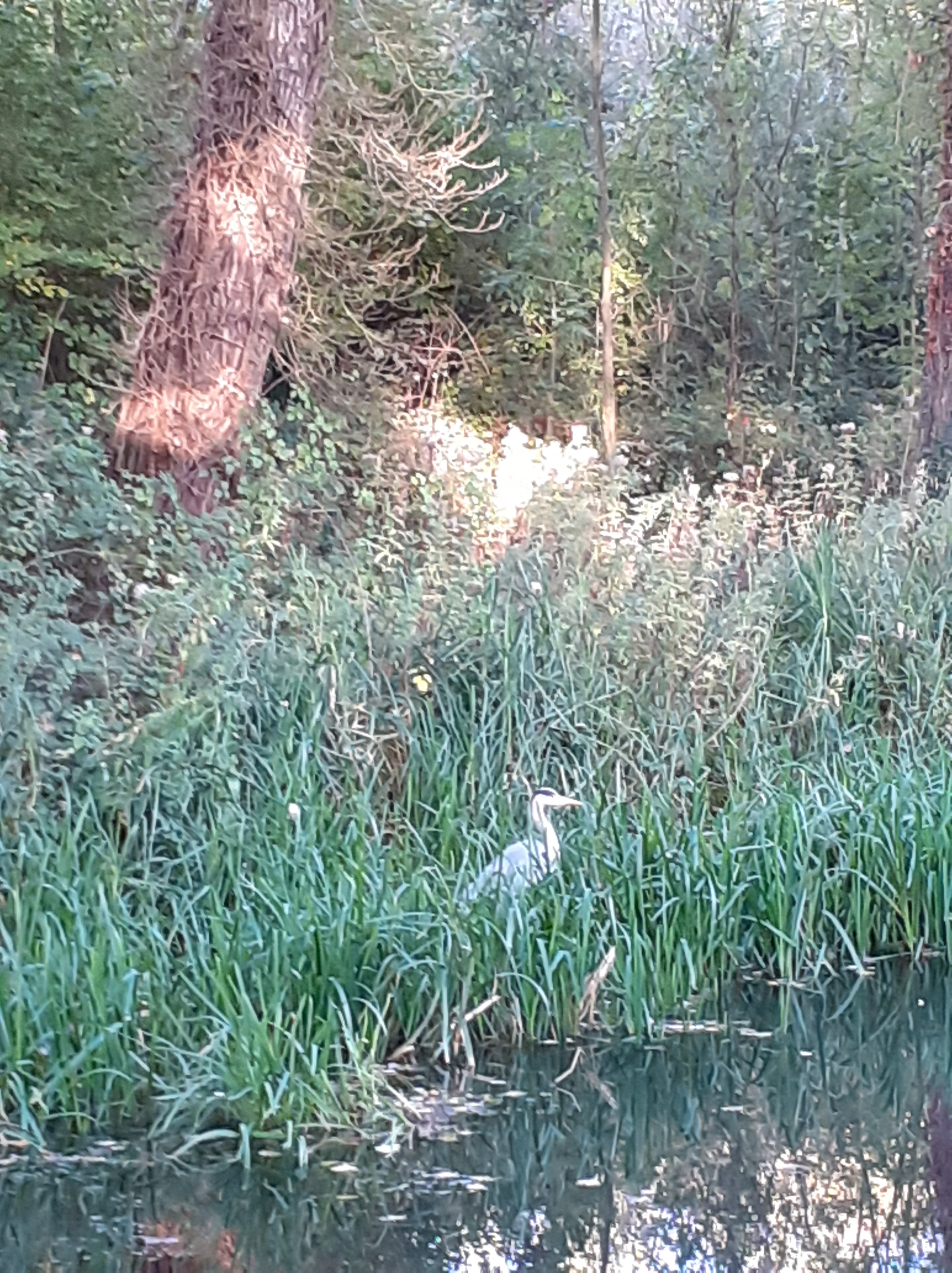
The picture immediately above is not part of my plan. It stems from delighted surprise followed by purposeful calm. Knowing about the heron in advance, I would likely have botched my picture in an anxious, clumsy effort to put the bird on record. I always have before. I think that herons fly away from me out of disdain rather than fear. This time I am a quiet human in a quiet world. I stand still for awhile and am almost elegant in my use of the phone. I wait for an intuited ‘right time’ before pressing the button. There is no drama at all. I do not know if the heron even notices me. The whole incident feels like a blessing of the still early morning.
Now, further on in my walk, the sun is on its ascent through the sky and I can picture it indirectly. The contrast between the sun kissed light areas and the shady ones is strong and vivid. I notice that, as the fading trees accept that their season is over, the ‘parasitic’ mistletoe – even the Druid Plant Oracle (1) calls it that – is gleefully green.
Now I am on my way back home. What draws my attention, after a little exploration, is the white owl. To me it looks very present and collected, situated just where it wants to be. It seems also to be acting as gatekeeper for its own arch.
I make stream of consciousness connections. I began my walk on the Bath Road. Bath is less than 30 miles away. There, the Romans turned a Celtic shrine into a city and called it Aquae Sulis (see http://www.romanbaths.co.uk/), acknowledging Sulis the Celtic goddess of the shrine. She was concerned with its waters and their healing potential whilst doubling up as a solar deity as well. The Romans called her Sulis Minerva, and that links her with owl wisdom. The white owl has a rich hinterland of associations for me. It makes the encounter significant. I note that two resonant avian images have met me on this walk into the sunrise, offering avenues for further contemplation.
(1) Philip & Stephanie Carr-Gomm The Druid Plant Oracle: Working with the Magical Flora of the Druid Tradition London: Connections, 2007. Illustrated by Will Worthington.





 Contemplative Inquiry