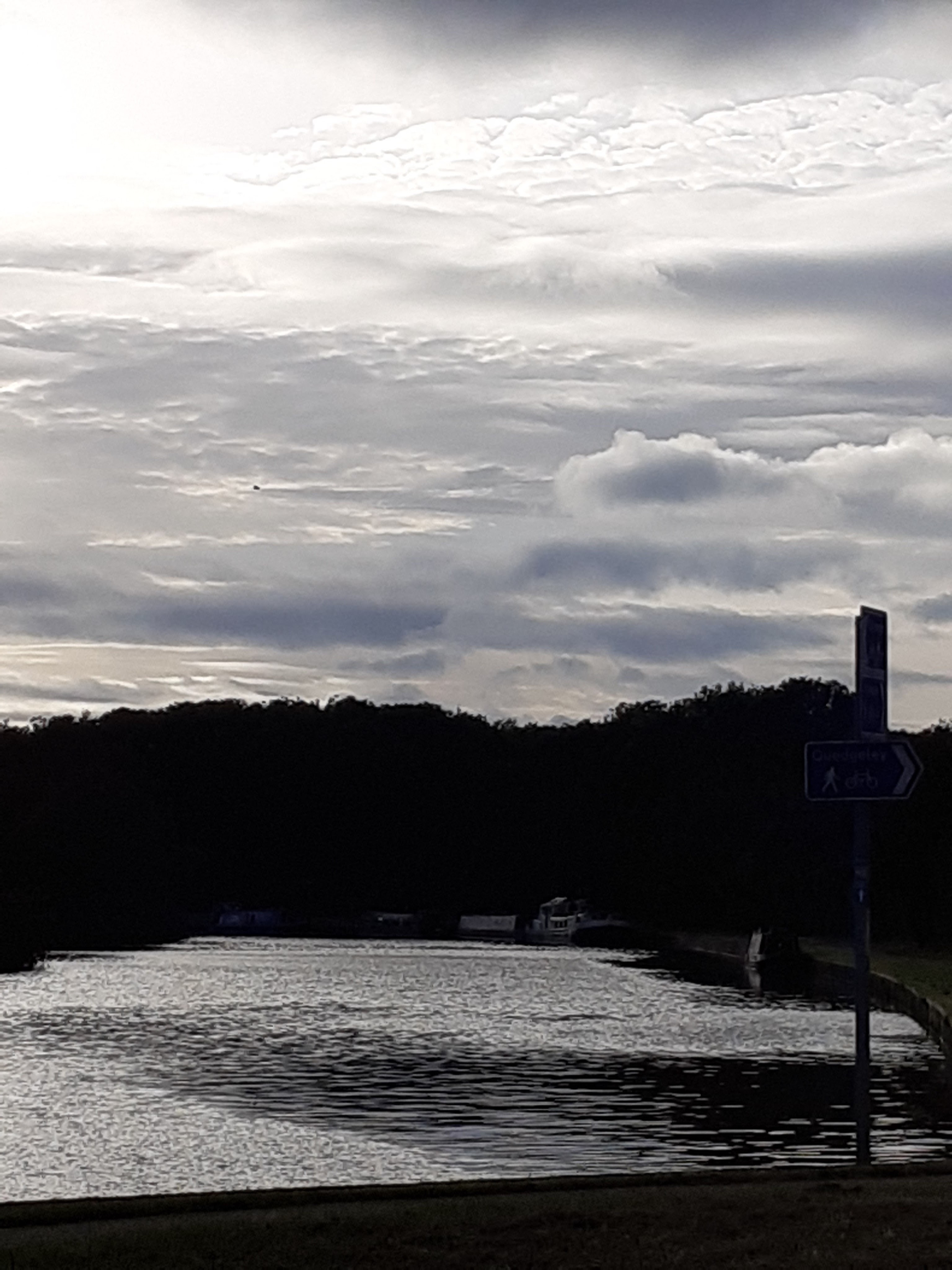
Contemplative Inquiry

This blog is about contemplative inquiry

Tag: Darkness

LIGHTS IN DARKNESS

Stars in a night sky. Candles in a dark room. Cleverly crafted decorations for Yule. These, for me, are ideal images of light in winter. When I came into Druidry, I was moved by the liturgical use of the phrase ‘the illumination of lights’. In a reality of many lights, which can also be a reality of one light and many lamps, the light is not overwhelming.

Darkness makes light bearable when containing a plurality of lights. There is space for freedom here, and likewise space for relationship and connection. This winter, I am not energetically hibernating, as I sometimes do. I find myself going deeply into Innerworld landscapes and connections in a way I have become unused to in recent years. Yet I do not feel alone or self-absorbed. I feel like a little light in a field of lights, each contributing its own individual illumination to the field, whist nested in a nurturing dark. It feels like the right focus for the time of year, and the end of 2024.

NOCTURNE: RADIANCE OF MOON

In recent days, I have felt, as much as seen, the retreat of daylight in the evenings. It comes earlier and seems more decisive as the year advances. Mostly, indoors, it has led to a soft and gradual increase of dimness and shadow. I often find this pleasurable and delay resorting to artificial light.

But on Friday 16 August I was caught unawares. I had not been paying attention and it felt as if Night had truly fallen for the first time in my waning year, suddenly and assertively. It wasn’t even fully dark, yet I sensed that Night now ruled.

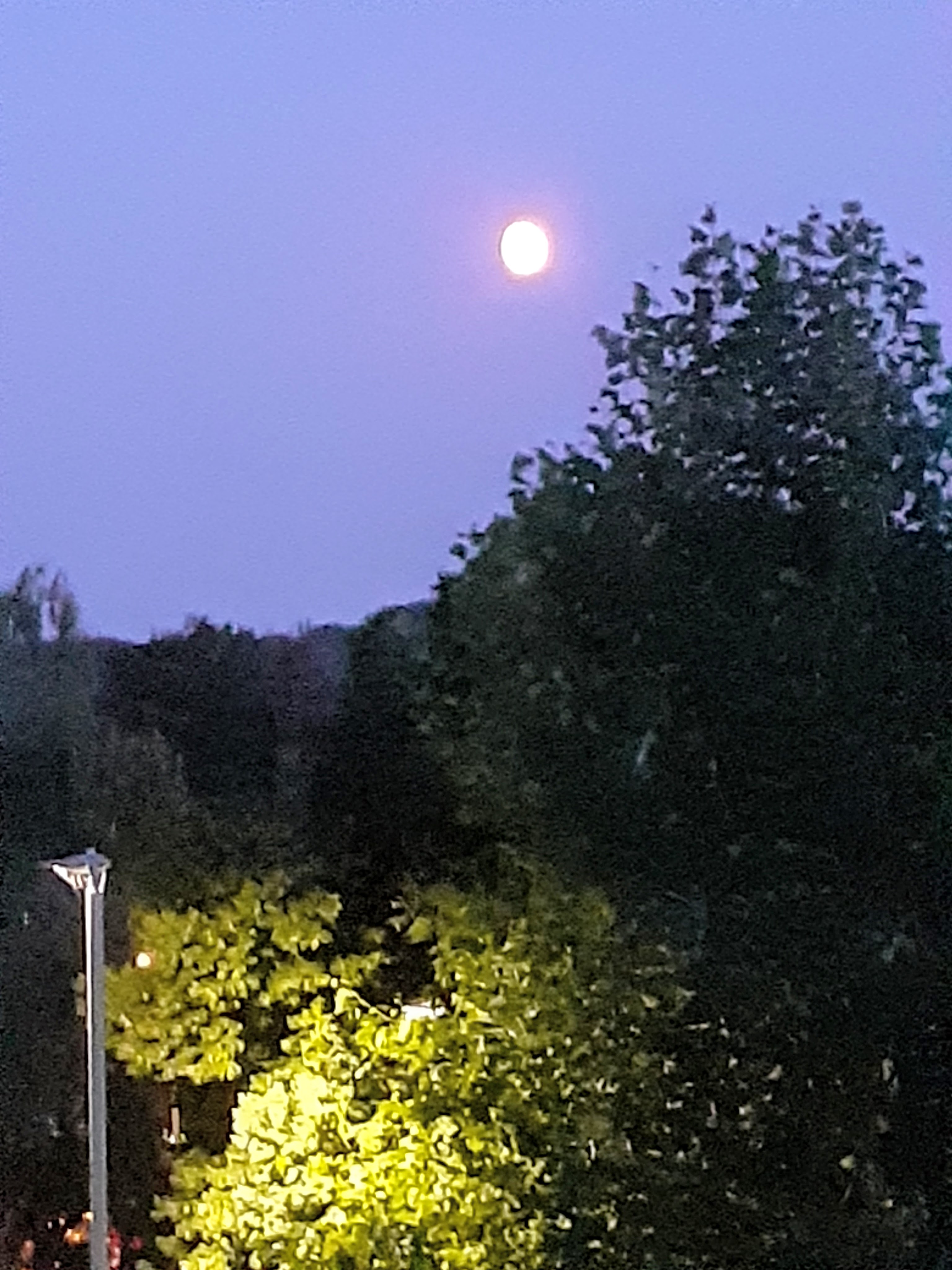
I felt that I was mobilising for a different life. A nocturnal life. To an extent, a lunar life. Standing on an east-facing balcony, I found deep twilight presided over a by a waxing gibbous moon – a super moon, close to the earth, only three days before full.

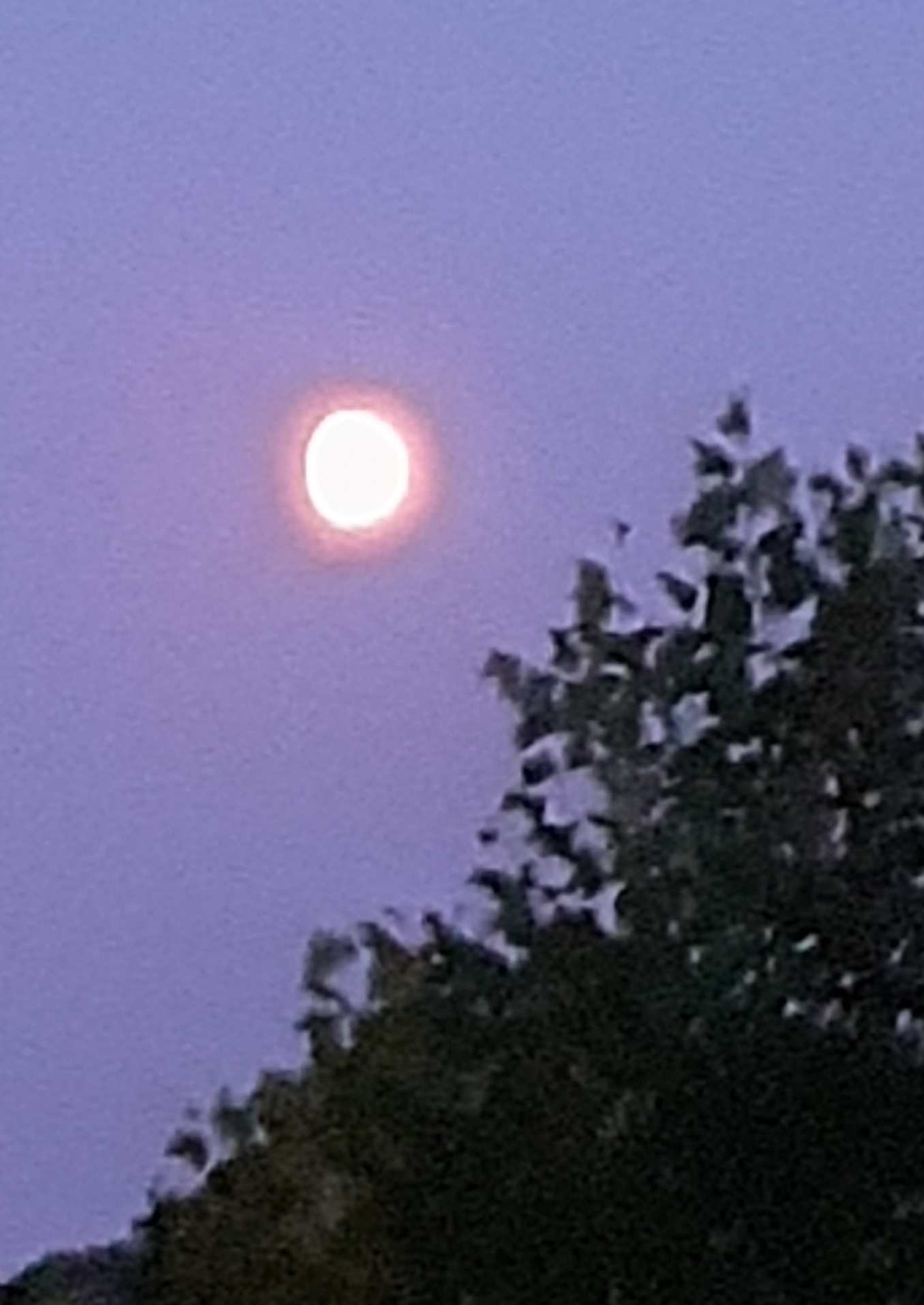
In the picture above, a street lamp seems to compete in brightness. But as I stood in my balcony it was the moon that drew my eye. Its influence was so much greater. The moon persuaded me to take the picture. Indeed I took a second picture (below) of the moon as the only light source. I needed the “radiance of moon” (1) to stand out clearly, in full contrast to the “light of sun”.

Night isn’t just about darkness. It’s about the world that emerges when the sunlight withdraws. Just over a month before the autumn equinox, I have tasted the ‘dark’ half of the year.

(1) From the St. Patrick’s Prayer/Cry of the Deer: “I arise today through the strength of heaven, light of sun, radiance of moon, splendour of fire, speed of lightning, swiftness of wind, depth of sea, stability of earth and firmness of rock”. I begin and end my regular morning practice with these words.

MIDWINTER LIGHT IN 2023

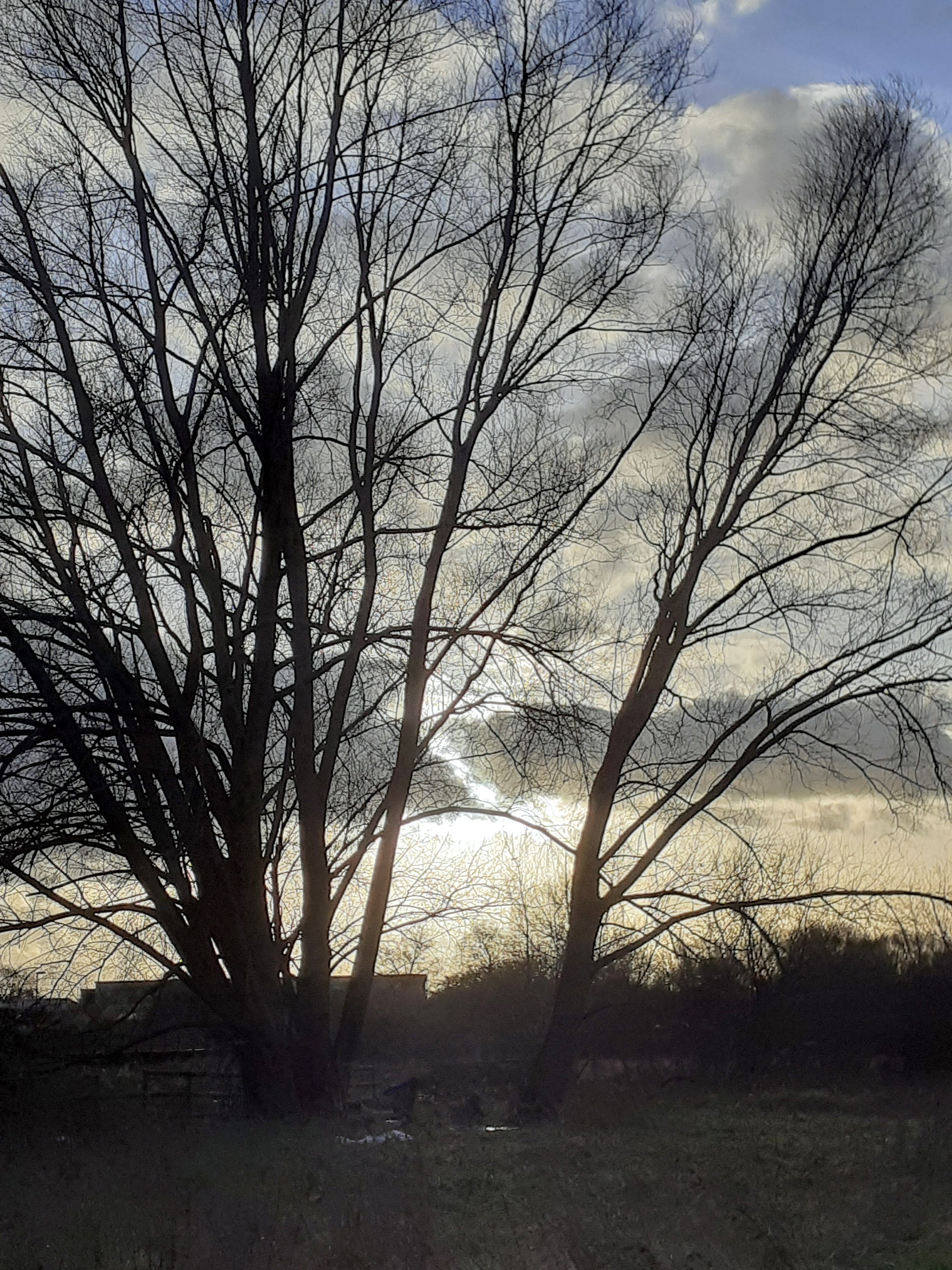
Seasonal Blessings to all readers, and my best wishes for 2024! I took these photos between 2.20 and 2.50 pm on 21 December, the last day before the Solstice, and a little more than an hour before sunset in Southern England.

The location is Alney Island, Gloucester, which I had not been to for some time. I encountered a sun that was low in the sky, clearly sinking, but still having an obvious influence on the landscape. Above, you can see a powerful luminescence behind the starkness of the trees. Immediately below, you can see light effects on the river and the trees themselves.

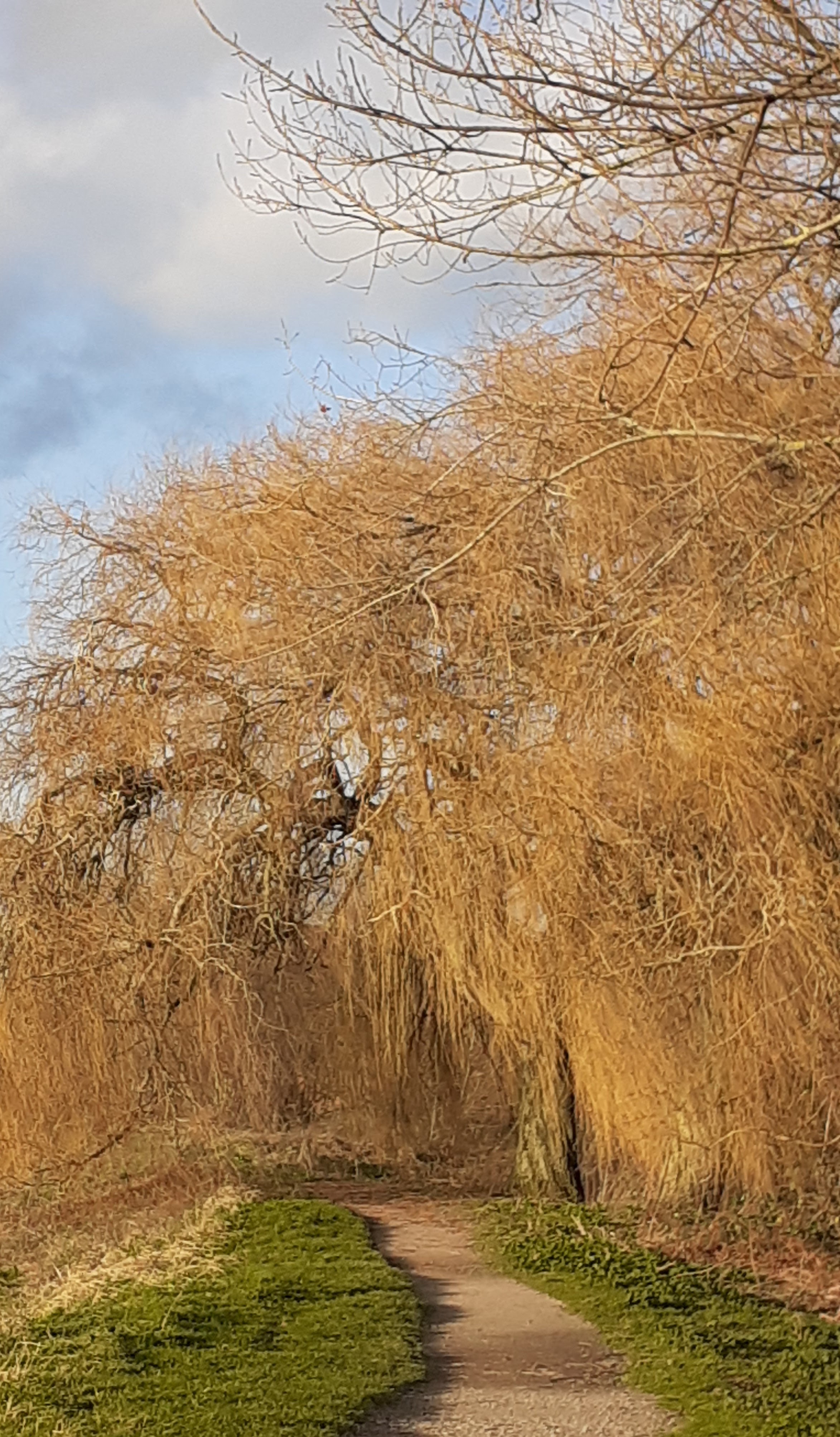
In the picture below, the midwinter sunshine is clearer and stronger. I love the way in which the willows show their vitality and abundance even when they have lost their leaves. The path is relatively dry, yet surrounded by green grass. There is a play of light and shade. There is blue as well as cloud in the sky.

On the ground, in the afternoon, and now in the evening as I write, I am thinking of light and dark, and of waxing and waning, as natural phenomena. I am not thinking in moral or metaphysical terms. These are different considerations, with a tendency moreover towards abstraction and absolutism. In my experience, nature tends to be nuanced. Different things are going on at the same time. Certainly where I live, there is always some balance of light and dark. The balance shifts, but both are always in play.

We treat tomorrow’s sunrise as the beginning of a turn. Here, in 2023, the afternoon before the change seems like a friendly one for an annual nadir of the light. This is also a bit how I am thinking about myself. Towards the end of November, when I last wrote a post of this type, I was celebrating a recovery from illness, and the opportunity of a good day. A good day was about what it was. Many people have pointed out in the last year or so that Covid-19 seems to have a long tail. I have been physically restricted beyond what I think of as normal.

I’m aware of a 75th birthday coming up next year, at which time our government will no longer consider my death as premature. Yet I am in good heart and feeling resilient. Without being presumptuous, I’m leaning in to longevity. I’m checking my capabilities and energy levels, anticipating some adjustments, and noticing the many rays of light which present themselves in my world.

LIMINAL BEAUTY AND THE FAITH OF A DRUID

6.15 pm, 6 October 2023. The experience has gone. The images remain. At a surface level, I can use them to trigger memories of my early evening walk. Chiefly, I remember being surprised at how early the twilight was. I hadn’t caught up with the year and was almost shocked. I have caught up now, nearly a week later, as the darkening process speeds up and we approach Samhain. In today’s world, my country will experience a dramatic boost on 29 October as our clocks ‘fall back’. The 6.15 of one day will become the 5.15 of the next.

Looking at the images more deeply, really looking, and giving them time, I can let them nourish me. I connect with their liminal beauty. Both images present me with land, water, sky, and hints of the fiery sun. But they do so in different ways.

In the image above, I am mostly drawn to the energy of water. The variation in shade emphasises movement and different ripple effects. Land, trees, and artifacts are all in silhouette, but the water has light and shade. It is the water that feels most alive. There is variation in the clouds too, with their patterned layers and subtle access to sunlight just above the trees. But they are not as mobile as the water. The sunlight itself seems very subdued. It’s still there, though very much in the background.This is not yet a night sky.

In the image below the water is strong too, but my eyes are drawn above to the clouds, which here are more dramatic. The residual power of waning sunlight is very clearly present. For me, there’s a sense of the tree tops yearning upwards as they reach for the gifts of the sun whilst it still retains a presence. Although I am contemplating images and not immersed in the landscape I have a strong sense of living presence in a field of living presence. In this state I feel a conceivably irrational confidence in life and the world.. A fragile kind of faith, that my heart cannot resist.

EQUINOX TRANSITIONS 2023

I am grateful to the Druid community for its varied ways of working with the 8-fold wheel of the year – especially when the festivals are placed in the context of the gradually turning wheel. Within that patterning of both nature and experience, I find the equinoctial periods and my response to them the least predictable of times.

The picture above shows a pre-equinoctial evening in Weymouth harbour, Dorset, England, round about 6 pm. I found this moment gentle and relaxing. The soft sunlight on the houses, boats and water seemed like a welcome home. I was born only 30 miles from Weymouth and it is part of my childhood landscape, my motherland. I took the picture on 18 September, the first day of my first visit for decades. I felt as if I was in a final afterglow of summer, content on familiar ground.

My wife Elaine and I spent only four days in Weymouth. Even over this brief period, we both had a strong sense of the advancing dark, in the mornings and the evenings alike, a shifting alternation of night and day that increasingly favoured night. One of our days was also dominated by high winds and driving rain, followed by a night in which we felt damp and chilled to the bone, unused as we now are to old buildings.

That night I had a rare experience of broken sleep and uncanny dreams. Eventually I woke up fully to a startling level of condensation on old window panes, obscuring an otherwise stunning view. For me this equinoctial period has, at least psychically, emphasised a shift towards the dark rather than a moment of poise and balance. Not a full dark, perhaps, but drained of colour, direction unknown.

The turning of the wheel never stops. On 23 September, the morning of the equinox, I felt the pleasure that can come from enjoying home after a break. I also noticed that the world beyond our many balcony doors was very clearly proclaiming a victory for the darker half of the year. This will be the setting for my journey for some time to come.

Whereas in the world I feel currently secure, I am conscious of uncertainties within. I do not quite see my critical-creative direction. In my 75th year, I wonder about ‘creative ageing’ (an old catch-phrase for me) and ‘critical wisdom’ (a new one). Hot air? Or genuine signposts? The Weymouth visit has stirred me up, but to what specific purpose I don’t yet know.

ANIMIST ENDARKENMENT

I have been re-visiting Emma Restall Orr’s ground-breaking work on animism, where she reframes this term for our times and emphasises its value to modern Druids. Much of her book explores the formal philosophy and metaphysics of animism and panpsychism. In this, more lyrical passage, she questions ‘permanent enlightenment’ and advocates freedom from “knowledge-based certainty” and dependency on knowing.

“To the animist, a state of permanent enlightenment is not considered natural. His senses inform him that, firstly, light is sustained by a balance of light and darkness, and, secondly, it is lived for the most part in neither darkness or light, but in varying degrees of twilight and shadow, of half knowing, believing, assuming and concluding.

“The aspiration for fluency and lucidity, another light-derived word, is firmly established in our culture though. Literally and figuratively, in darkness we are denied the safety of certainty. As the dusk comes and the light slips away like an outgoing tide, edges begin to dissolve. In darkness, our senses more easily blur, leaving us potentially deceived. If we are dependent upon knowing, this can leave us confused and fearful. The not-knowing is judged as ignorance; darkness is declared bad, and to be avoided as dangerous. As the deep wellspring of wickedness, any who embrace the darkness must be equally spurned.

“If, however, our aim is not a knowledge-based certainty, what the darkness provides is delicious and necessary release. In the dark, the separation created by edges is no longer relevant to our perception and reality, allowing entirely new parameters of freedom. … We need moments within which we can dissolve all we are and all we know, that we might find the nourishment for new inspiration and realisation”.

(1) Emma Restall Orr The Wakeful World: Animism, Mind and the Self in Nature Winchester, UK & Washington, USA: Moon Books, 2012

TAO TE CHING AND THE DARK NEW MOON

“The Tao Te Ching is at heart a simple book. Written at the end of the sixth century B.C. by a man called Lao-tzu, it’s a vision of what our lives would be like if we were more like the dark new moon.

“Lao-tzu teaches us that the dark can always become light and contains within itself the potential for growth and long life, while the light can only become dark and brings with it decay and early death. Lao-tzu chose long life. Thus, he chose the dark.” (1)

Red Pine’s translation of the Tao Te Ching has been around in its present form since 2009, but I have come across it only recently. It has given me a new lens on this much loved ancient text. Red Pine is the nom de plume for Bill Porter, who was born in Los Angeles in 1943, grew up in the Idaho Panhandle, served a tour of duty in the US army (1964-7) and went on to study anthropology. Dropping of graduate school in 1972, he moved to a Buddhist monastery in Taiwan for four years before becoming involved with English language radio stations in Taiwan and Hong Kong. In 1993 he moved back to America, since which time he has been an independent scholar specialising in Chinese Buddhist and Taoist texts.

The word Tao (road or way) is made up of two characters, one meaning ‘head’ and the other meaning ‘go’. Red Pine cites a modern scholar of comparative religion, Professor Tu Er-wei, to suggest that : “the ‘head’ in the character tao is the face of the moon. And the meaning of ‘road’ comes from watching this disembodied face as it moved across the sky”. He also reminds us that the symbol Taoists have used since ancient times to represent the Tao shows the two conjoined phases of the moon.

China was divided in Lao-tzu’s time. and he was based in the state of Ch’u, described as being on the ‘shamanistic periphery’ of Chinese culture. The Ch’u rulers took for their surname hsiung (bear) and they called themselves Man or Yi, “which the Chinese in the central states interpreted to mean ‘barbarians’… The influence of Chu’s culture on Lao-tzu is impossible to determine, but it does help us better understand the Tao Te Ching, knowing that it was written by a man who was no stranger to shamanistic conceptions of the sacred world. Certainly as Taoism developed in later centuries, it remained heavily indebted to shamanism”. Specifically in relation to the Tao Te Ching, “Lao-tzu redirects vision to that ancient mirror, the moon. But instead of pointing to its light, he points to its darkness. Every month the moon effortlessly shows us that something comes from nothing”. For it is the new moon that holds the promise of rebirth. The first verse of his translation reads:

The way that becomes a way

Is not the Immortal Way.

The name that becomes a name

Is not the Immortal Name.

No-name is the maiden of Heaven and Earth.

Name is the mother of all things.

Thus in innocence we see the beginning

In passion we see the end

Two different names

For one and the same.

The one we call dark

The dark beyond dark

The door to all beginnings.

At other points in the text, according to Red Pine, Lao-tzu says that the Tao is between Heaven and Earth; it’s Heaven’s Gate; it’s empty but inexhaustible; it doesn’t die; it waxes and wanes; it’s distant and dark; it doesn’t try to be full; it’s the light that doesn’t blind; it has thirty spokes and two thirteen-day (visible) phases; it can be strung like a bow and expand or contract like a bellows; it moves the other way (relative to the sun, it appears/rises later and later); it’s the great image, the hidden immortal, the crescent soul, the dark union, the dark womb, the dark beyond the dark. These can all be seen as lunar images.

There is of course a place for the light as well. We approach the elusiveness and namelessness of the Tao through Te – virtue, both in a moral sense and as the power to act. Without the Tao, Virtue would have no power: without Virtue, the Way would have no appearance. These are the two poles: the Tao, the body, the essence, the Way; and Te, the light, the function, the spirit, Virtue. In terms of origin, the Tao comes first. In terms of practice, Te comes first. The dark gives the light a place to shine. The light allows us to see the dark. But too much light blinds. “Lao-tzu saw people chasing the light and hastening their own destruction. He encouraged them to choose the dark instead of the light, less instead of more, weakness instead of strength, inaction instead of action”.

This is not the only way to read, or work with, the Tao Te Ching. For me, it’s not the kind of text that offers fixed meanings and interpretations. But it does seem clear to me that a lunar inspiration, and lunar imagery, stand behind this work and are part of its construction. I feel enriched by having this pointed out and demonstrated through Red Pine’s translation.

(1) Red Pine Lao-tzu’s Taoteching: with Selected Commentaries from the past 2,000 years Copper Canyon Press, 2009 https://www.coppercanyonpress.org/ (First edition published in 1996)

RUMI: TWO QUATRAINS ON NIGHT

“Night comes so people can sleep like fish

In black water. Then day.

Some people pick up their tools.

Others become the making itself.”

“Night goes back to where it was.

Everyone returns home sometime.

Night, when you get there,

Tell them how I love you.”

From the collection Unseen Rain: Quatrains of Rumi translated by John Moyne and Coleman Barks Putney, VT: Threshold Books, 1986. The translators note that “in some languages of the Middle East the word for ‘rain’ and the word for ‘grace’ are the same”.

I am very conscious at this time of year not just of darkness, but of a longer night. Here Sufi poet and teacher Rumi evokes qualities of night, suggesting potential forms of relationship with it.

ACCEPTING THE ARRIVAL OF WINTER

It was 26 November 2022, 11 a.m. I was at the Gloucester end of the Gloucester-Sharpness canal. I found myself accepting the arrival of winter. I was observing three cygnets, now without their parents but still keeping company with each other. The underlying temperature was around 7 C (44.6 F) and good for walking, But I was feeling the pinch of a cold wind. In memory I am feeling it now. The water and sky looked grey. The trees were starting to feel skeletal, whilst still retaining some leaves. My lingering sense of autumn had finally drained away.

To accept winter’s arrival in the presence of swans felt numinous. Swans are otherworldly birds in Celtic tradition. The three together, not yet in their full adult plumage, seemed auspicious. They suggested coming opportunities for creativity, love and celebration. Winter can be a preparation for renewal, both as season and as state of mind. My acceptance goes with a faith in winter’s regenerative darkness, and the riches this can bring.

STATES OF LIGHT

This is the face of dawn outside my window, just after 6.30 a.m. I welcome the mid September day, appreciating this moment in the year. I like the infusion of pink into grey clouds, and the suggestion of warmth in the old church tower.

I have now grown used to getting up in the dark, and to beginning my morning practice with an awareness of darkness outside. The nurturing dark and enabling light are both part of my experience. A transient time of balance has begun. It feels numinous to me, and a time of great potential. I am energetically alert and alive.

Later, a little before 9 a.m., I am walking by the Gloucester-Sharpness canal. I notice light on leaves, and its influence on the gaps between trunks. The view, here, is over water. But it is the influence of sunlight that makes the greatest impression on me – captured in the picture as well as in real time.

By contrast, the spaces furthest away from the light source are able to show their earthiness, their woodiness and the depth of their green. The light is everywhere, but it is subtle and not over-bearing. It reveals its influence in different ways. Rather than radiating raw power, it allows possibilities in this small, fragile habitat. Contemplating autumnal states of light, as I approach the autumn equinox, I have been shown something about power and its manifestation.

Earth Eclectic

music that celebrates Earth and speaks to the heart

Sarah Fuhro Star-Flower Alchemy

Follow the Moon's Cycle

Muddy Feet

Meeting nature on nature's terms

Rosher.Net

A little bit of Mark Rosher in South Gloucestershire, England

Becoming Part of the Land

A monastic polytheist's and animist’s journal

selkiewife

Selkie Writing…

Charlotte Rodgers

Images and words set against a backdrop of outsider art.

Prof Jem Bendell

living with metacrisis and collapse

Towint

The pagan path. The Old Ways In New Times

The Druids Garden

Spiritual journeys in tending the living earth, permaculture, and nature-inspired arts

The Blog of Baphomet

a magickal dialogue between nature and culture

This Simple Life

The gentle art of living with less

Musings of a Scottish Hearth Druid and Heathen

Thoughts about living, loving and worshiping as an autistic Hearth Druid and Heathen. One woman's journey.

Wheel of the Year Blog

An place to read and share stories about the celtic seasonal festivals

Walking the Druid Path

Just another WordPress.com site

anima monday

Exploring our connection to the wider world

Grounded Space Focusing

Become more grounded and spacious with yourself and others, through your own body’s wisdom

The Earthbound Report

Good lives on our one planet

Hopeless Vendetta

News for the residents of Hopeless, Maine