Contemplative Inquiry

This blog is about contemplative inquiry

Tag: Creativity

BEING NOBODY

“I’m nobody.

So are you.

What ecstasy!

Join me.” (1)

According to Andrew Harvey (1), the translator of this brief poem by Kabir, “Kabir is far more than a poet; he is a universal initiatory field, as expansive as Rumi and as embodied, radical and ferocious as Jesus”. I certainly experience a creative shock in Kabir’s celebration of being ‘nobody’ in a world where being ‘somebody’ is such a highly valued social accomplishment. But what if the accomplishment distracts from something else, something of greater value? Kabir invites us to share the ‘ecstasy’ of being nobody. In another of his verses, which were performed as songs, Kabir links this ecstasy with love:

“You can’t grow love in gardens

Or sell it in markets.

Whether you’re a king or peasant

If you want it

Give your head and take it”.

In my experience, Kabir’s work opens a door to forms of contemplation and creativity in which my personality and personal biography are not the primary focus. Especially in darkening times, bearing witness to the way of the heart, and drawing strength from it, is a form of sacred activism. The liturgy of modern Druidry speaks of a love of justice and a love of all existences, embedded in a living relationship with Spirit. This for me is a commitment to live from.

(1) Kabir Turn Me To Gold: 108 Poems of Kabir Unity Village, MO: Unity Books, 2018 Translations by Andrew Harvey. Photographs by Brett Hurd.

(2) See also https://contemplativeinquiry.blog/2021/01/30/turn-me-to-gold/
BOOK REVIEW: ELEGANT SIMPLICITY

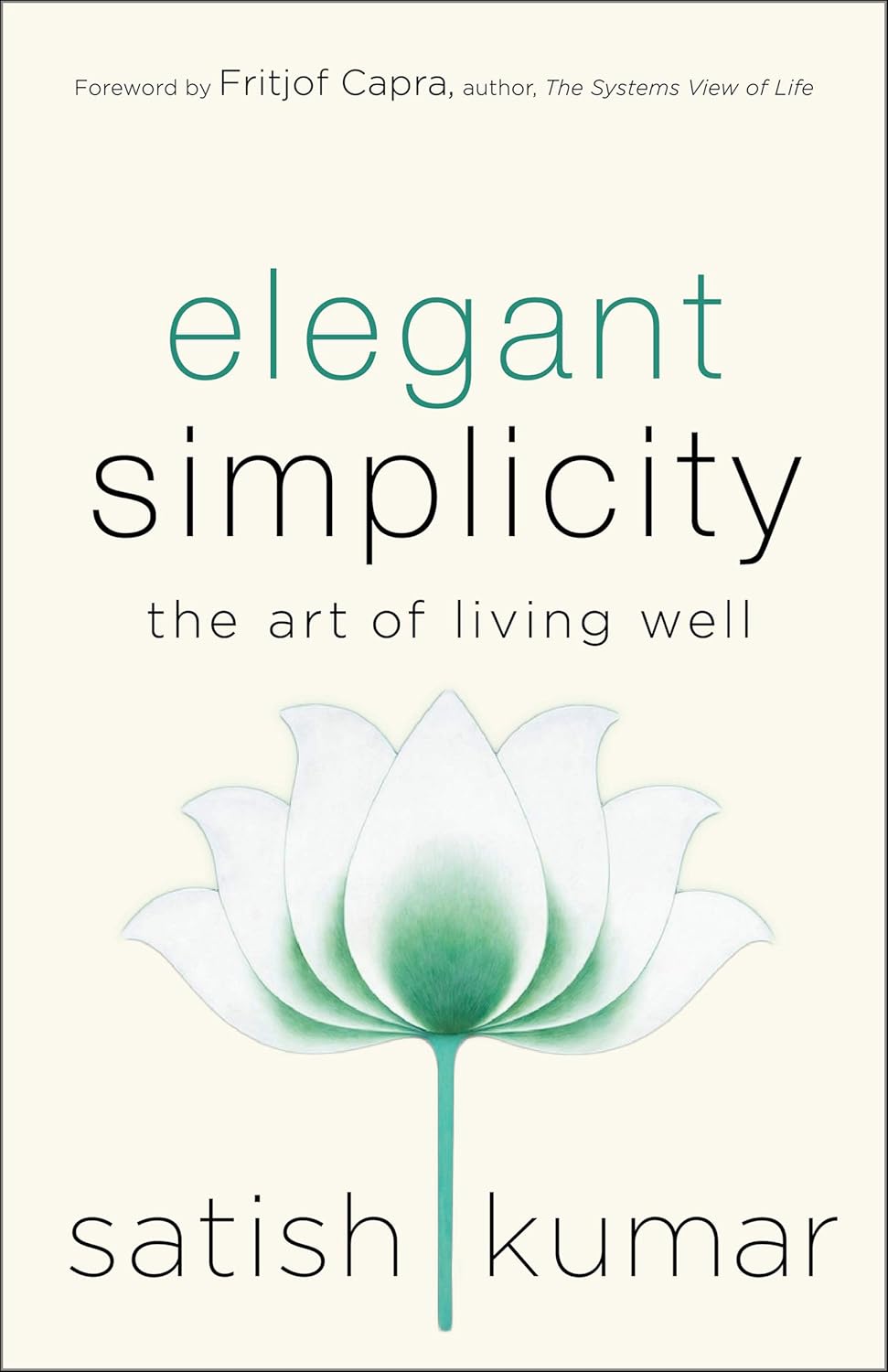
Highly recommended. Satish Kumar (born in 1936) published Elegant Simplicity: the Art of Living Well in 2019 (1). It begins with a foreword by Fritjof Capra and a preface by the author Let’s be Simple which quotes the 1848 Shaker song ‘Tis the gift to be simple, ‘Tis the gift to be free. The book summarises the author’s personal story as well as discussing his values. I have written posts based on some of his other work before (2). I especially recommend this book to anyone interested in knowing more about Satish Kumar’s practice (grounded in Jain spirituality and Gandhi’s non-violent activism) and his influence on deep ecology, creative arts and education.

Elegant Simplicity has a summarising quality, looking back on decades devoted to sacred activism in different forms. It is divided into fourteen chapters: Each is preceded by a brief and relevant quotation from another thinker. The chapter then becomes a meditation on the quote:

1 My Story: Beginnings – ‘True happiness lies in contentment’ Mahatma Gandhi.

2 Simplicity of Walking – ‘All truly great thoughts are conceived by walking’ Friedrich Nietzsche.

3 Life is a Pilgrimage – ‘Faith is not the clinging to a shrine but an endless pilgrimage of the heart’ Abraham Joshua Heschel.

4 Elegant Simplicity – ‘Any fool can make things complicated, it requires a genius to make them simple’ E. F. Schumacher.

5 A Society of Artists – ‘This world is but a canvas to our imagination’ Henry David Thoreau.

6 Yoga of Action – ‘Life is a process not a product’ Brian Goodwin.

7 Learning is Living – ‘Education is not preparation for life; education is life itself’ Thomas Dewey.

8 Right Relationships – ‘We are all related – relationships based on obligation lack dignity’ Wayne Dwyer.

9 Love Unlimited – ‘There is no charm equal to tenderness of the heart’ Jane Austin.

10 Power of Forgiveness – ‘It’s one of the greatest gifts you can give yourself, to forgive. Forgive everybody.’ Maya Angelou.

11 Dance of Opposites – ‘Life and death are one as the river and the sea are one’ Kahlil Gibran.

12 Deep Seeing – ‘To see clearly is poetry, prophecy, and religion, all in one’ John Ruskin.

13 Union of Science and Spirituality – ‘Science is not only compatible with spirituality; it is a profound source of spirituality’ Carl Sagan.

14 Soil, Soul and Society – ‘We live in an interconnected world and in an interconnected time so we need holistic solutions to our interconnected problems‘ Naomi Klein.

Fellow activist and author Vandana Shiva describes Elegant Simplicity as “the distillation” of Satish Kumar’s ideas and actions. “It shows the intimate connections between the inner and the outer world, soil, soul and society, beauty joy and non-violence. It indicates that the solutions to the big problems of our time – climate change, hate, violence, hopelessness and despair – lie in thinking and living with elegant simplicity, reducing our ecological footprint while enlarging our hearts and minds”.

For me, Satish Kumar is an inspiration rather than a direct model. Even in the conditions of the early 1960’s I would not have walked, or aspired to walk, from New Delhi to Washington DC without carrying any money. Yet Satish Kumar and his companion E. P. Menon succeeded and made a huge public impact at the time. Their peace pilgrimage gave oxygen to the campaign for nuclear disarmament. No state gave up its arms, but treaties limiting the numbers and testing of nuclear arms became normalised for some decades. Satish Kumar’s initiatives in deep ecology and education, especially the ‘small school’ and Schumacher College, have changed lives. Directly and indirectly, his influence has awakened many people from the dystopian trance of our dominant cultures. Satish Kumar is a widely revered elder: a peaceful warrior for a more liveable, generous and creative world.

(1) Satish Kumar Elegant Simplicity: The Art of Living Well New Society Publishers (https://www.newsociety.com): Gabriola Island, BC, Canada: 2019

(2) See previous posts:

NEWS OF A DEATH

TWO VIEWS OF THE DIVINE

OUTDOOR WALKING MEDITATION

NOTE: “Satish Kumar (born 9 August 1936)[1] is an Indian British activist and speaker. He has been a Jain monk, nuclear disarmament advocate and pacifist.[3]Now living in England, Kumar is founder and Director of Programmes of the Schumacher College international center for ecological studies, and is Editor Emeritus of Resurgence & Ecologist magazine. His most notable accomplishment is the completion, together with a companion, E. P. Menon, of a peace walk of over 8,000 miles in June 1962 for two and a half years, from New Delhi to MoscowParisLondon, and Washington, D.C., the capitals of the world’s earliest nuclear-armed countries.[4][5] He insists that reverence for nature should be at the heart of every political and social debate.” (Wikipedia)

BOOK REVIEW: STOLEN FOCUS

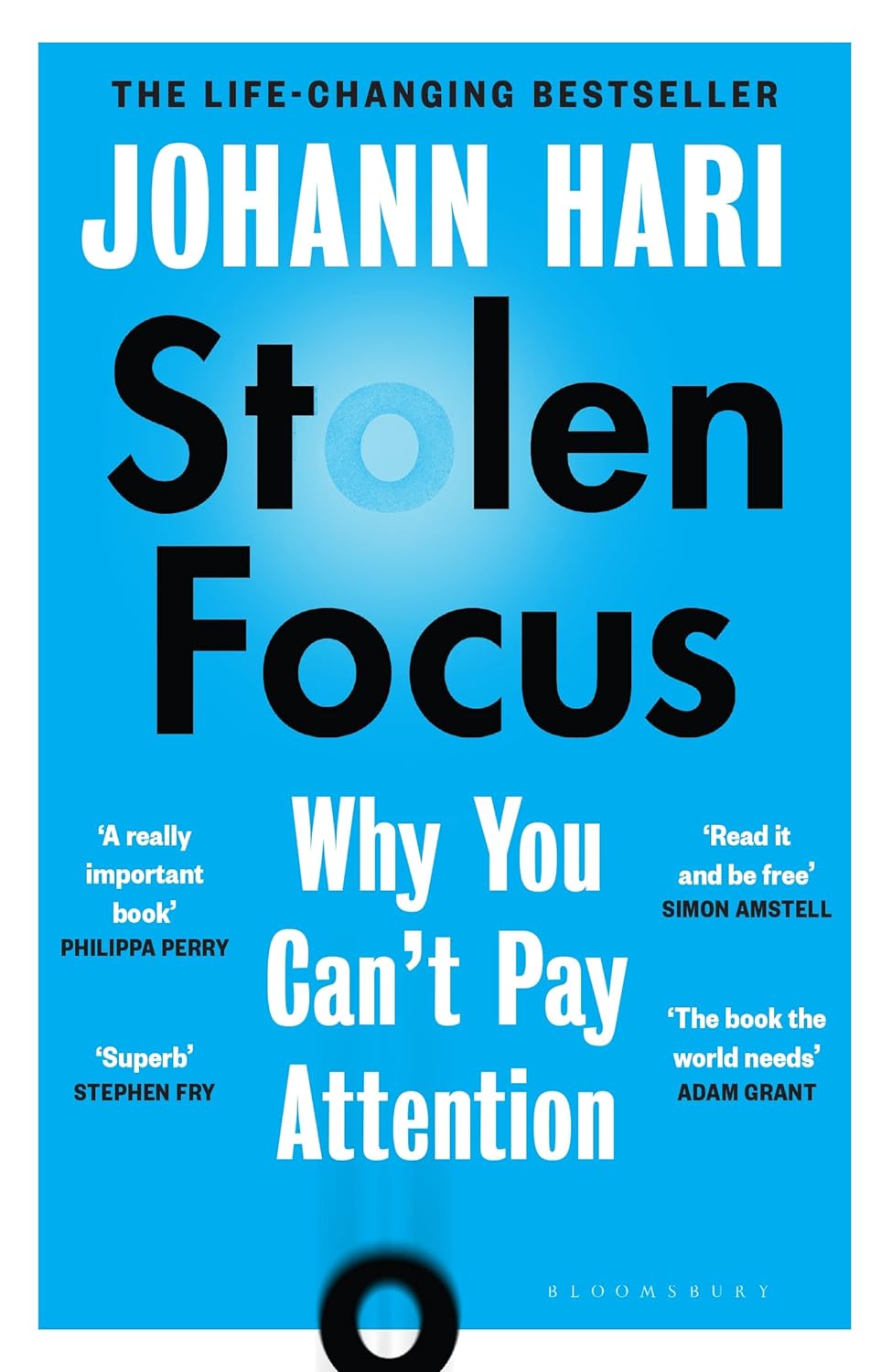
Highly recommended to anyone interested in states of attention, how culture shapes them, and the implications of this shaping. Johann Hari’s Stolen Focus: How You Can’t Pay Attention (1) shows that our diminished capacity to focus is a collective cultural issue and not just a matter of individual willpower. In this book, Hari identifies 12 causes of ‘stolen focus’, developing these themes partly through telling his personal story and partly through conversations with experts in the relevant areas of knowledge. The causes are:

1: Increase in Speed, Switching and Filtering. If we go too fast, and switch between tasks to rapidly, we overload our abilities, and they degrade.

2: Crippling of Flow States Fragmented focus interrupts flow. “Fragmentation makes you … shallower, angrier”, whereas “Flow makes you deeper … calmer”.

3: Rise in Physical and Mental Exhaustion The average amount of time a person sleeps is reducing, damaging our focus. If we stay awake for 19 hours straight we become as cognitively impaired as if drunk.

4: Collapse of Sustained Reading Fewer people are reading books, especially novels. Yet they train focus and encourage empathy. “Very few things worth saying can be explained in 280 characters.”

5: Disruption of Mind-Wandering, seen here not as a form of distraction but as a way of slowly making sense of the world that supports creativity and long-term decisions. Distractions undermine this process.

6: Tec That Can Trap and Manipulate You Big Tec’s business model depends on ‘engagement’ (eyes on screen) to facilitate exposure to advertising and the harvesting of personal data, to be used by the Tec companies themselves and also sold on to other would-be persuaders. Internet services are designed specifically to serve ‘engagement’ in this sense. Traffic is more readily stimulated by exposure to angry rather than calm content. Hence ‘surveillance capitalism’ engineers reactivity, anger and division.

7: Rise of ‘Cruel Optimism‘, a term for offering, in upbeat language, simplistic individual solutions to major social problems – like obesity and addiction. Internet addiction agitation and associated cognitive decline are looked at in the same way.

8: Surge in Stress and Triggering of Vigilance Research shows the top causes of stress for the working population of the USA to be “a lack of health insurance, the constant threat of lay-offs, lack of discretion and autonomy in decision-making, long working hours, low levels of organisational justice and unrealistic demands”. A cause of stolen focus is again linked to powerful external conditions..

9: Deteriorating Diets A widespread switch to supermarket bought processed foods has been “bad for our waistlines and our hearts” and is also “stealing large parts of our ability to pay attention”.

10 Rising Pollution We know that air pollution causes asthma and other breathing problems. There is also “growing evidence to suggest that this pollution is seriously damaging our ability to focus”.

11 ADHD and Our Response to It There has been a huge rise in diagnosed ADHD in school students in the last 30 years. It has been treated largely as a biological disorder, though this is now contested. Personal experiences and environmental conditions are being considered more seriously.

12 Confinement of Children – Physical and Psychological In the western world, children no longer roam free in their own world. Play is indoors and either supervised by adults or located on screens. Schools are largely concerned with preparing and drilling children for tests. This has serious consequences for both learning and focus.

In exploring ‘stolen focus’ and its causes, Johann Hari casts his net wide. In his conclusion, he talks about four levels of now-weakening attention: spotlight, when we focus on immediate actions; starlight, when we focus on projects and longer-term goals; daylight, which makes it possible to know what our longer-term goals are in the first place; and stadium lights, that let us see each other, hear each other, and work together to formulate and fight for common goals. Hari sees all of these lights being dimmed by stolen focus.

Hari advocates for an ‘attention rebellion’ in the manner of XR. Its three main demands would be: to ban surveillance capitalism, because people being “hacked and hooked” can’t focus’; to introduce a four-day week, because people who are chronically exhausted can’t pay attention; rebuild childhood around “letting kids play freely – in their neighbourhoods and at school” to promote a healthy ability to pay attention. He understands that this will be uphill work – the logic of economic growth demands more and more of our time devoted to producing and purchasing. Yet given the crises facing us, especially the climate crisis, we cannot afford the destruction of our attention and ability to think clearly.

This book is not just about big tec and social media. I like the range and quality of the information that Stolen Focus brings to the description and analysis of stolen focus. Hari is clear that self-help solutions – though they may help some people – are not enough. I believe that communities informed by deep ecology, spiritual and therapeutic insights can be oases of sanity and contribute to solutions. But without their being able to influence the mainstream, their impact is bound to be limited. Stolen Focus raises awareness very effectively. Whether or not an ‘attention rebellion’ is the right way forward,, Hari’s recommendations deserve to be taken seriously.

(1) Johann Hari Stolen Focus: Why You Can’t Pay Attention London: Bloomsbury Publishing, 2022 (Kindle edition 2023)

See also: https://contemplativeinquiry.blog/2024/06/13/stolen-focus-speed-switching-and-filtering/

STOLEN FOCUS: SPEED, SWITCHING AND FILTERING

“I went to see the Mona Lisa in Paris, only to find that she is now permanently hidden behind a rugby scrum of people from everywhere on earth, all jostling their way to the front, only for them to immediately turn their backs on her, snap a selfie, and fight their way out again. On the day I was there, I watched the crowd from the side for more than an hour. Nobody – not one person – looked at the Mona Lisa for more than a few seconds.”

Johann Hari’s Stolen Focus: Why You Can’t Pay Attention (1) explores states of attention, how culture shapes them, and the implications of this shaping. I like Hari’s insistence that this is a collective issue and not just a matter of individual willpower. In this book, Hari identifies 12 causes of ‘stolen focus’. I plan to write a review of Stolen Focus soon. This post is about the first cause, which he describes as an increase in speed, switching and filtering.

Speed

According to Hari, modern culture overvalues speed. “People talk significantly faster now than they did in the 1950’s, and in just 20 years, people have started to walk 20% faster in cities” and “the original Blackberry advertising slogan was ‘anything worth doing is worth doing faster'”. But, argues Hari, “if you go too fast, you overload your abilities, and they degrade”. He reminds us that if we engage in deliberately slow practices, like yoga, or tai chi, or meditation … they improve our ability to pay attention by a significant amount.

Switching

Cognitive speeding has been made worse by the myth of multitasking, a term taken from 1960’s computing, when machines began to have more than one processor and could literally do two or more things at once. The human brain doesn’t have that capacity. It is naturally single-minded and isn’t going to change. So when we ‘multitask’, we are actually switching between different tasks, though we may not notice our switching.

The cost of switching is a degradation of our ability to focus, and a decline in our performance. Hewlett- Packard looked at the IQ of some of their workers in two situations. At first they tested their IQ when they were not being distracted or interrupted. Then they tested their IQ when they were receiving emails and phone calls. “The study found that ‘technological distraction’ – just getting email and calls – caused a drop in the workers’ IQ by an average of 10 points … twice the knock to your IQ that you get when you smoke cannabis”. Overall, if you spend your time switching a lot, the evidence suggests “you’ll be slower, you’ll make more mistakes, you’ll be less creative, and you’ll remember less of what you do”.

Filtering

“Think of your brain as a nightclub where, standing at the front of that club, there’s a bouncer. The bouncer’s job is to filter out most of the stimuli that are hitting you at any given moment – the traffic noise, the couple having an argument across the street, the cellphone ringing in the pocket of the person next to you – so that you can think coherently about one thing at a time.” The bouncer in our brain is the pre-frontal cortex, and it is becoming overwhelmed. There are too many stimuli and in many environments noise pollution in particular is interfering more insistently with the flow of our thoughts.

The crisis in attention that Hari outlines is a threat to our quality of life. It weakens our ability to think creatively or deeply. It tends to make us agitated as well as distracted. This is not a good place from which to build healthy relationships or solve complex problems at either the personal or the public level. I experience my contemplative inquiry as a valuable antidote to ‘stolen focus’. But it doesn’t get me everywhere, because loss of focus is a pervasive cultural problem. Beyond writing a review of the whole book, I intend to delve more deeply into the questions that Stolen Focus raises from a personal and a collective point of view.

(1) Johann Hari Stolen Focus: Why You Can’t Pay Attention London: Bloomsbury Publishing, 2022 (Kindle edition 2023)

See also https://contemplativeinquiry.blog/2024/06/17/book-review-stolen-focus/

EQUINOX TRANSITIONS 2023

I am grateful to the Druid community for its varied ways of working with the 8-fold wheel of the year – especially when the festivals are placed in the context of the gradually turning wheel. Within that patterning of both nature and experience, I find the equinoctial periods and my response to them the least predictable of times.

The picture above shows a pre-equinoctial evening in Weymouth harbour, Dorset, England, round about 6 pm. I found this moment gentle and relaxing. The soft sunlight on the houses, boats and water seemed like a welcome home. I was born only 30 miles from Weymouth and it is part of my childhood landscape, my motherland. I took the picture on 18 September, the first day of my first visit for decades. I felt as if I was in a final afterglow of summer, content on familiar ground.

My wife Elaine and I spent only four days in Weymouth. Even over this brief period, we both had a strong sense of the advancing dark, in the mornings and the evenings alike, a shifting alternation of night and day that increasingly favoured night. One of our days was also dominated by high winds and driving rain, followed by a night in which we felt damp and chilled to the bone, unused as we now are to old buildings.

That night I had a rare experience of broken sleep and uncanny dreams. Eventually I woke up fully to a startling level of condensation on old window panes, obscuring an otherwise stunning view. For me this equinoctial period has, at least psychically, emphasised a shift towards the dark rather than a moment of poise and balance. Not a full dark, perhaps, but drained of colour, direction unknown.

The turning of the wheel never stops. On 23 September, the morning of the equinox, I felt the pleasure that can come from enjoying home after a break. I also noticed that the world beyond our many balcony doors was very clearly proclaiming a victory for the darker half of the year. This will be the setting for my journey for some time to come.

Whereas in the world I feel currently secure, I am conscious of uncertainties within. I do not quite see my critical-creative direction. In my 75th year, I wonder about ‘creative ageing’ (an old catch-phrase for me) and ‘critical wisdom’ (a new one). Hot air? Or genuine signposts? The Weymouth visit has stirred me up, but to what specific purpose I don’t yet know.

WILD WRITING

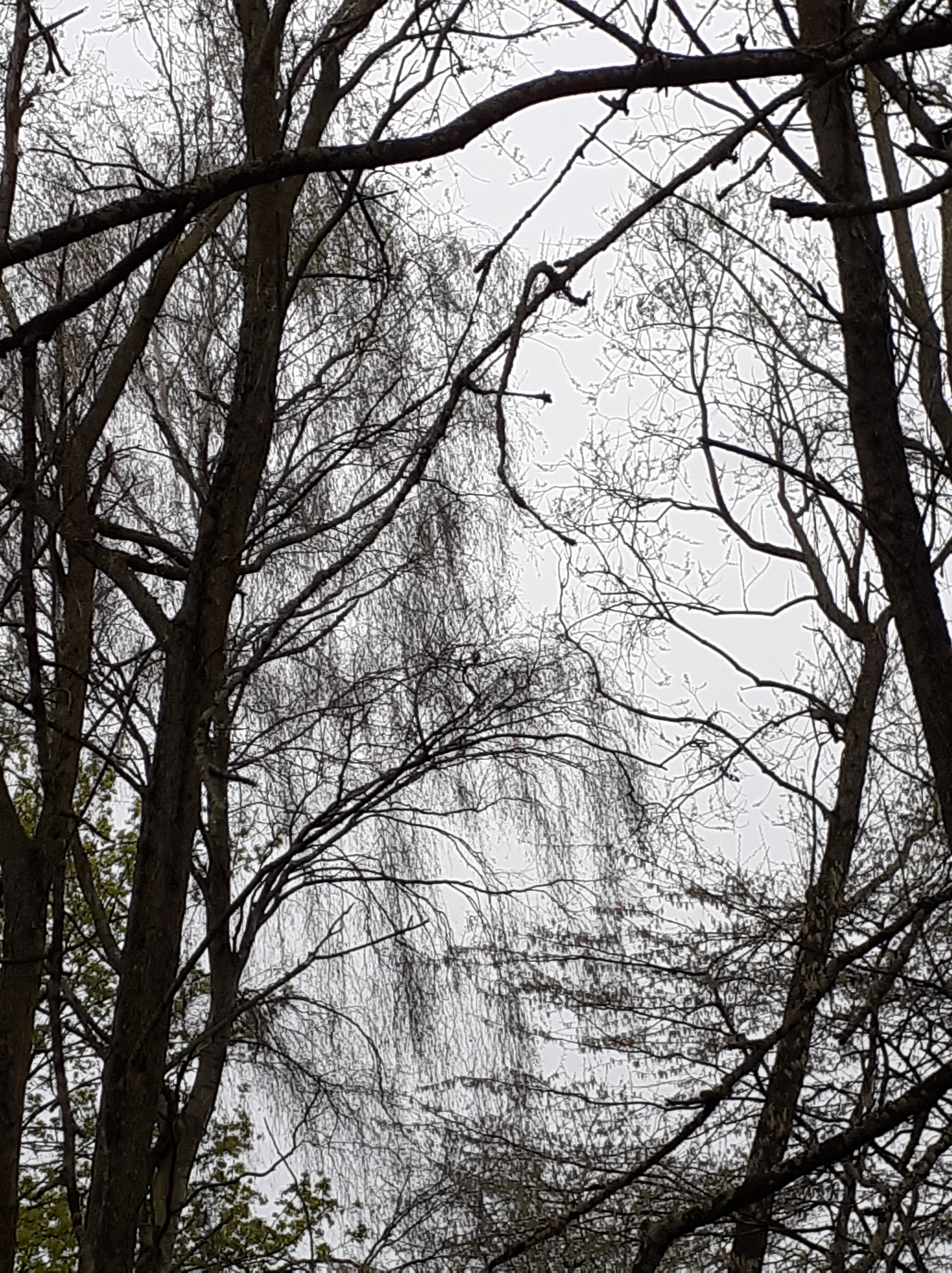
I look at the picture with fresh eyes. It is already a record of the past, and it is much too still. Yet I feel drawn towards this image. I enjoy the tree shapes in their starkness. I sense resilience in the plant life pictured here. I am writing now with sunlight intermittently on my shoulder, and the sounds of wind and rain beyond my strong glass doors.

I am also reflecting on writing as a practice. Natalie Goldberg (1,2) writes books about this and her description of ‘writing practice’ seems to me to have two entirely compatible meanings. The first is that it trains people for the writing of poems, stories and novels. The second points to a form of life practice flowing from the view that “writing is the crack through which you can crawl into a bigger world, into your wild mind” (1).

In Wild Mind: Living the Writer’s Life Natalie Goldberg compares writing practice with journaling. “Journal writing has a fascination with the self, with emotion and situation. It stops there. Writing practice lets everything else run through us; in writing practice, we don’t attach to any of it. We are aware that the underbelly of writing is non-writing. Journal writing seems to be about thought, about rumination and self-analysis. … We want to get below discursive thought to the place where mind – not your mind or my mind but mind itself – is original, fresh. It’s not you thinking. Thoughts just arise impersonally from the bottom of our minds. That is the nature of mind – it creates thoughts. It creates them without controlling them or thinking them … Writing practice knows this, knows how we are not our thoughts, but lets the thoughts, visions, emotions run through us and puts them on the page.” (1)

In her earlier book, Writing Down the Bones: Freeing the Writer Within, Natalie Goldberg quotes Jack Kerouac as saying that a writer should be ‘submissive to everything, open, listening’. She also recommends that “we stay in the trenches with attention to detail”, avoiding escape into abstraction. She points to poetry in particular, “because it brings us back to where we are. It asks us to settle inside ourselves and be awake”. She reproduces the famous William Carlos Williams poem:

“So much depends

upon

a red wheel

barrow

glazed with rain

water

beside the white

chickens.”

I remember this poem from my childhood. I liked it a lot, but couldn’t find anything to say about it in the class room when it was expected that I would. I was embarrassed then. I wouldn’t be now.

Natalie Goldberg also practices Zen Buddhism, with Katagiri Roshi until his death and more recently as an ordained member of the Order of Interbeing founded by Thich Nhat Hanh. She acknowledges the role of Zen in developing her insights into the creative process. I find her approach, including her practical exercises, very helpful.

(1) Natalie Goldberg Wild Mind: Living the Writer’s Life New York, NY: Open Road Integrated Media, 2011 (first published 1990)

(2) Natalie Goldberg Writing Down the Bones: Freeing the Writer Within Boulder, CO: Shambhala, 2016 (30th anniversary edition)

JANUARY FEELINGS

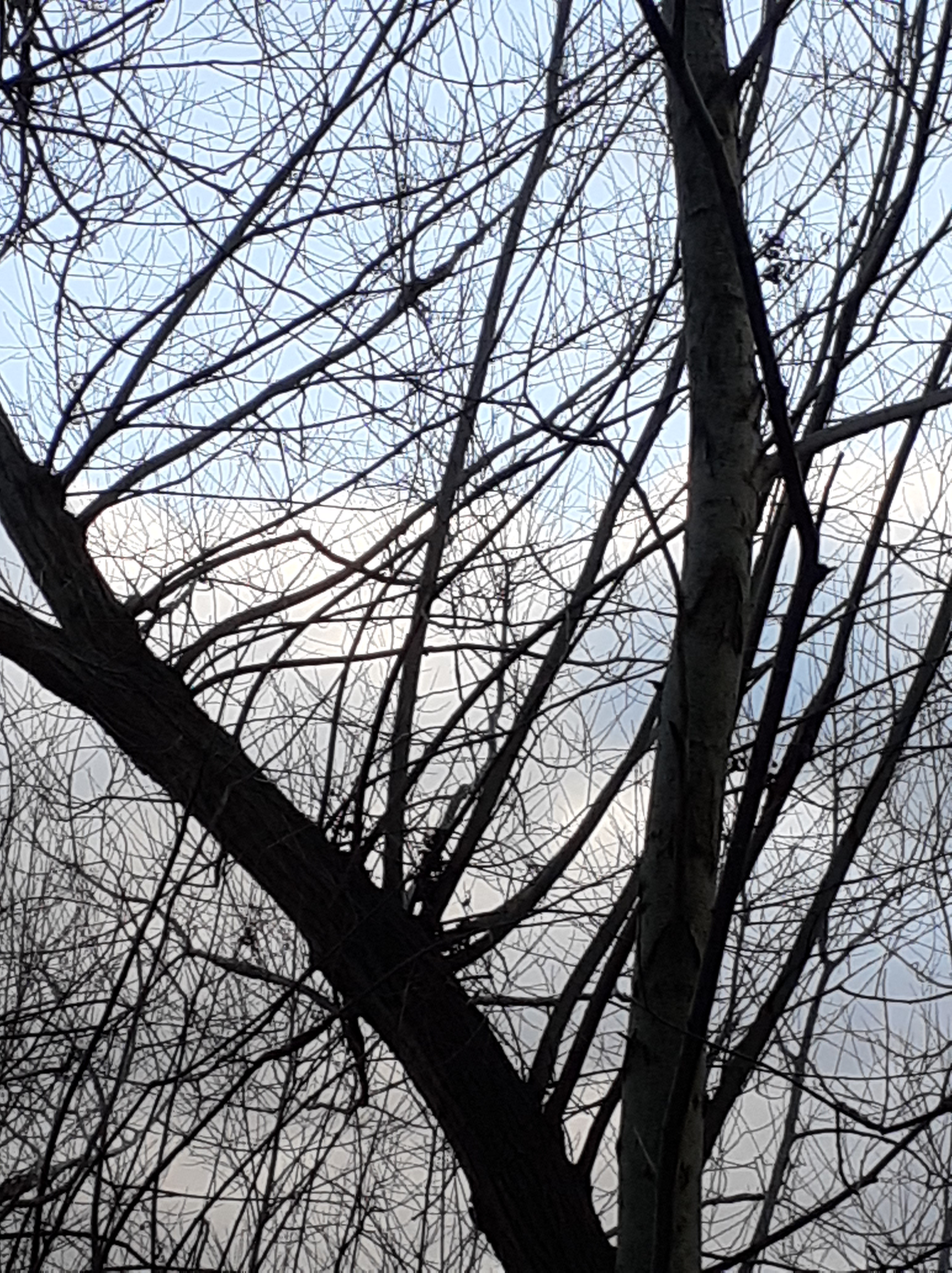
My sense of January this year is one of bleakness qualified by promise. I spent the first week of the year grounded by back pain. So it was a pleasure, when the time came, to walk once more among trees. Their very bareness has a certain majesty. Their simple presence suggests the prospect of transformation as the year goes on.

Here, at 3.30 pm on January 9th,, I am noticing the slow lengthening of the day. It would have been twilight at this time three weeks ago. The change has an expansive note. A new lightness and colour are suggested below. They lead me further from the lassitude and brain fog of recent days. They make the world a genuinely felt privilege to be in.

Yet a taste of disenchantment does have its value. More than once, I have experienced it shortly in advance of a creative shift in energy and direction. My wife Elaine and I will soon be moving to the long=term home we have been working towards for some time. We will be setting it up, not just chasing after it, over the coming weeks. Without quite seeing the future, I do feel a returning zest and optimism.

ACCEPTING THE ARRIVAL OF WINTER

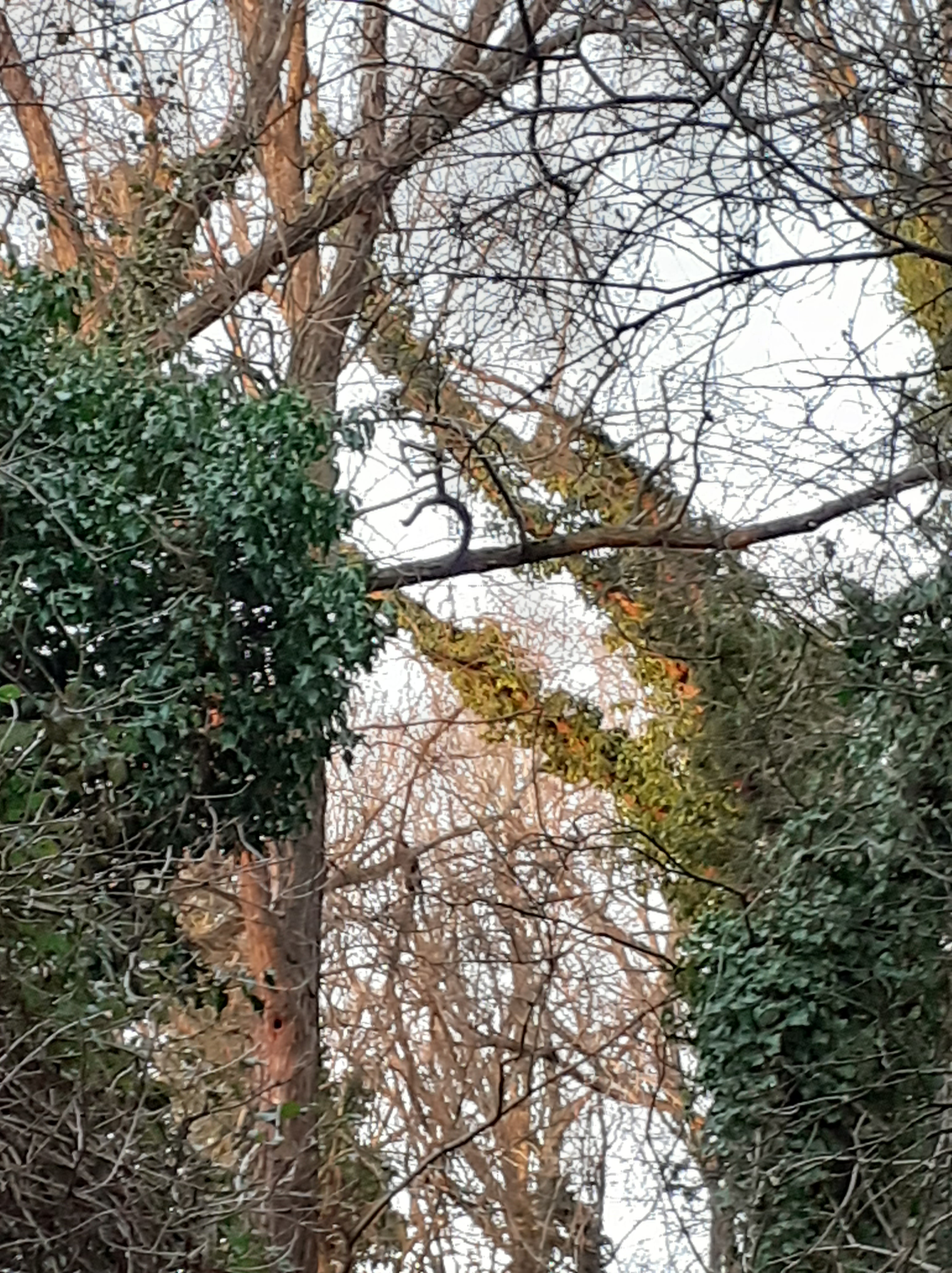
It was 26 November 2022, 11 a.m. I was at the Gloucester end of the Gloucester-Sharpness canal. I found myself accepting the arrival of winter. I was observing three cygnets, now without their parents but still keeping company with each other. The underlying temperature was around 7 C (44.6 F) and good for walking, But I was feeling the pinch of a cold wind. In memory I am feeling it now. The water and sky looked grey. The trees were starting to feel skeletal, whilst still retaining some leaves. My lingering sense of autumn had finally drained away.

To accept winter’s arrival in the presence of swans felt numinous. Swans are otherworldly birds in Celtic tradition. The three together, not yet in their full adult plumage, seemed auspicious. They suggested coming opportunities for creativity, love and celebration. Winter can be a preparation for renewal, both as season and as state of mind. My acceptance goes with a faith in winter’s regenerative darkness, and the riches this can bring.

BOOK REVIEW: BEYOND SUSTAINABILITY

Highly recommended. Beyond Sustainability – Authentic Living at a Time of Climate Crisis – offers an insightful exploration of the changes we need to make at the personal and collective levels. It is part of Moon Books’ Earth Spirit series, and will be released on 28 April 2023.

Author Nimue Brown says that, “as a Druid, I’ve spent my adult life trying to live lightly. There is a great deal to learn about what is possible, and what’s effective, and this is always a work in progress and never as good as I want it to be. I feel very strongly about the need for real change and quietly rage about greenwashing and the ridiculousness of ‘offsetting’. Harm cannot be offset”.

The book is economical with words and rich in content. Its introduction reflects that “humans are increasingly a miserable species, caught in ways of behaving that give us very little and will cost us the earth”. Brown argues that it doesn’t have to be this way and in seven chapters she sketches out pathways to an alternative.

Chapter 1 – What Makes an Authentic Life?- advocates ‘conscious living’, in which we resist the pressure to “to construct our identities out of consuming products”. Instead, we are challenged to discover what inspires and uplifts us, and to build meaningful relationships, with creative and productive communities emancipated from the trance of consumerism.

Chapter 2 – Authenticity and the Unsustainable – explores the narratives that limit and distract us, the stresses of high speed living, the hunger for possessions and ‘experiences’, and the rise of debt culture.

Chapter 3 – Slow Life Sustainability – suggests that ‘life in the slow lane is gentler’. It includes sections on slow fashion, slow transport, slow food, and slow shopping.

Chapter 4 – Wealth in Relationships – looks at ways in which we can support and appreciate each other, and has specific sections on spiritual community, community action, privilege/prejudice and the power of sharing.

Chapter 5 – Creativity for All – emphasises that “being able to imagine is an essential skill for moving towards more sustainable ways of life”. We are nourished by our own creativity and each others.

Chapter 6 – Privilege, Poverty, Inclusion – looks at bigger picture political change, starting with the thought that “sustainability cannot be just a middle class hobby”. There are a lot of things you can’t do if you are poor; shaming and blaming poor people is cruel and useless. Redistribution of wealth is therefore an essential step towards greener living.

Chapter 7 – Political Changes – discusses specific measures such as right of repair, universal basic income, a four day working week, radical changes to agriculture, reducing waste, ‘stop making money out of money’, and not relying simply on changes in technology.

Beyond Sustainability is an informed and distinctive contribution to an increasingly important conversation. It deserves to be widely read and discussed. I suggest that readers of this blog make a note or add it to their lists.

(1) Nimue Brown Beyond Sustainability: Authentic Living at a Time of Climate Crisis Winchester, UK & Washington, USA, 2023 (Part of the Earth Spirit series)

ELDER (RUIS) ENDING A CYCLE

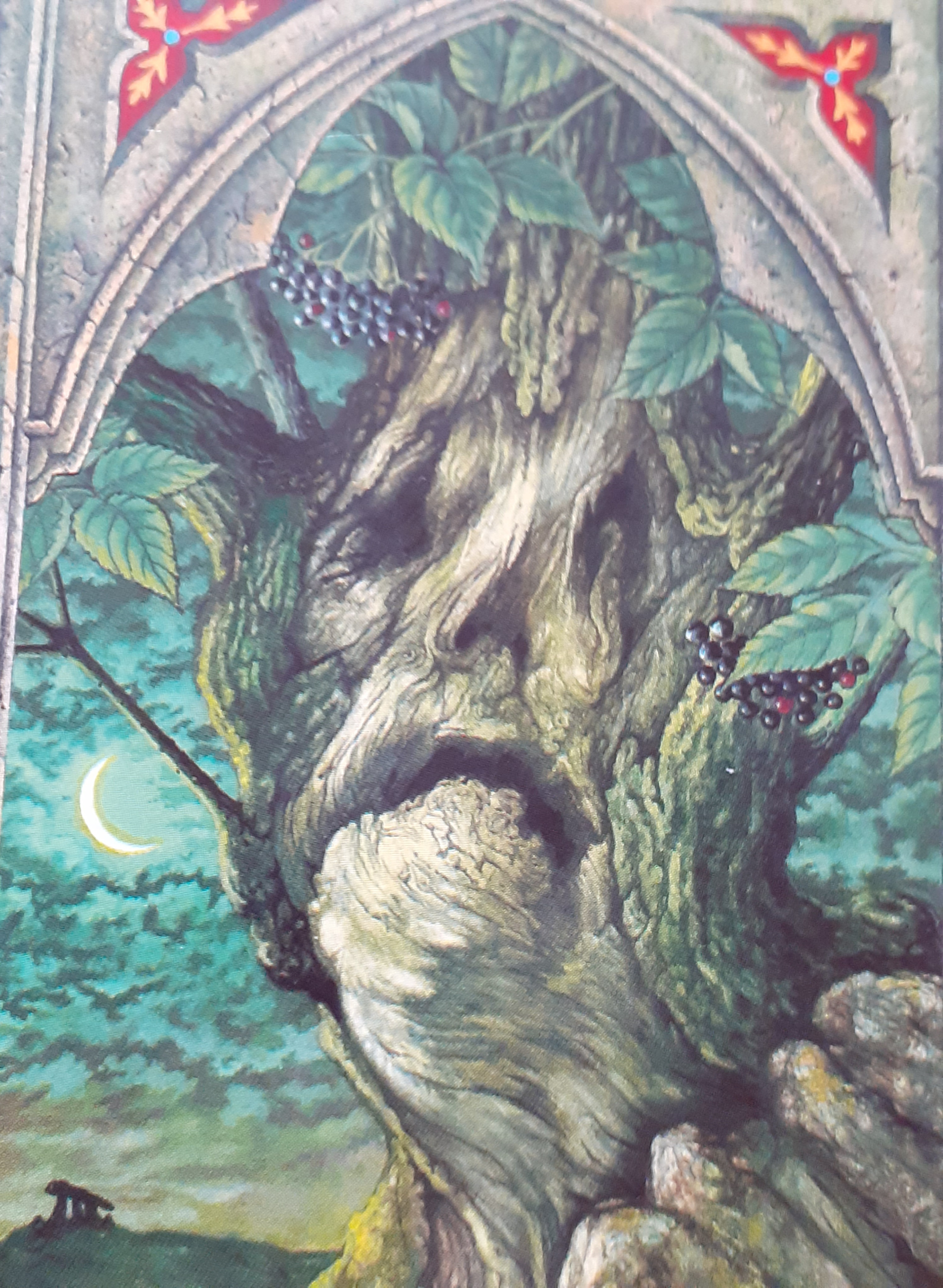
Elder is the tree of the caileach, the crone, the wise older woman. The image above comes from the Green Man Tree Oracle (1), but for me an earlier work, Liz and Colin Murray’s The Celtic Tree Oracle: A System of Divination (2), offers a more illuminating narrative:

“This Ogham card is linked to the eternal turnings of life and death, birth and rebirth. It represents the end in the beginning and the beginning in the end; life in death and death in life; the casting out of the devils of the old year and the renewal of creativity of the new; the timelessness of the cycle by which the fading of old age is always balanced by the new start of birth.

“The card has no reversed position. The circle will always turn afresh, change and creativity arising out of the old and bringing about the new. All is continuously linked as phases of life and experience repeat themselves in subtly different forms, leading always to renewal”.

In my sixteen tree mandala of the year (3) elder covers the period from 24 November to 16 December, following Yew and preceding Holly. If the winter quarter beginning on 1 November is a time of dying and regeneration, then elder deepens the descent into death signalled by the yew, whereas holly brings in the note of regeneration and makes the transition into rebirth. So it is not surprising to me that in Christian folklore elder provided the wood both for the cross of Christ and the self-hanging of Judas Iscariot. There was also a belief that people living in houses built in the shadow of the elder were likely to die young. Indigenous folklore, more benignly, said that to sleep beneath an elder tree is to wake in the Otherworld. If you stood under an elder tree on Midsummer’s Eve you would see the faery troop go by. Casting away fear, and whatever the weather, we may find magic in this tree.

(1) John Matthews & Will Worthington The Green Man Oracle London: Connections, 2003.

(2) Liz & Colin Murray The Celtic Tree Oracle: A System of Divination London: Eddison/Sadd Edition, 1988. (Illustrated by Vanessa Card).

(3) NOTE: This mandala is based on my personal experience of trees in the neighbourhood as well as traditional lore. Moving around the wheel of the year from 1 November, the positions and dates of the trees are:

Yew, north-west, 1-23 November

Elder, north-north-west, 24 November – 16 December

Holly, north, 17 December – 7 January

Alder, north-north-east, 8 – 31 January

Birch, north-east, 1 – 22 February

Ash & Ivy, east-north-east, 23 Feb. – 16 March

Willow, east, 17 March – 7 April

Blackthorn, east-south-east, 8 – 30 April

Hawthorn, south-east, 1 – 23 May

Beech & Bluebell, south-south-east, 24 May – 15 June

Oak, south, 16 June – 8 July

Gorse, south-south-west, 9 – 31 July

Apple, south-west, 1 -23 August

Blackberry & Vine, west-south-west, 24 August – 15 September

Hazel, west, 19 September – 8 October

Rowan, west-north-west, 9 – 31 October.

See also https://contemplativeinquiry.blog/2020/autumn-equinox-2020-hazel-salmon-awen/

Earth Eclectic

music that celebrates Earth and speaks to the heart

Sarah Fuhro Star-Flower Alchemy

Follow the Moon's Cycle

Muddy Feet

Meeting nature on nature's terms

Rosher.Net

A little bit of Mark Rosher in South Gloucestershire, England

Becoming Part of the Land

A monastic polytheist's and animist’s journal

selkiewife

Selkie Writing…

Charlotte Rodgers

Images and words set against a backdrop of outsider art.

Prof Jem Bendell

living with metacrisis and collapse

Towint

The pagan path. The Old Ways In New Times

The Druids Garden

Spiritual journeys in tending the living earth, permaculture, and nature-inspired arts

The Blog of Baphomet

a magickal dialogue between nature and culture

This Simple Life

The gentle art of living with less

Musings of a Scottish Hearth Druid and Heathen

Thoughts about living, loving and worshiping as an autistic Hearth Druid and Heathen. One woman's journey.

Wheel of the Year Blog

An place to read and share stories about the celtic seasonal festivals

Walking the Druid Path

Just another WordPress.com site

anima monday

Exploring our connection to the wider world

Grounded Space Focusing

Become more grounded and spacious with yourself and others, through your own body’s wisdom

The Earthbound Report

Good lives on our one planet

Hopeless Vendetta

News for the residents of Hopeless, Maine