
THE IMAGE AND THE SONG
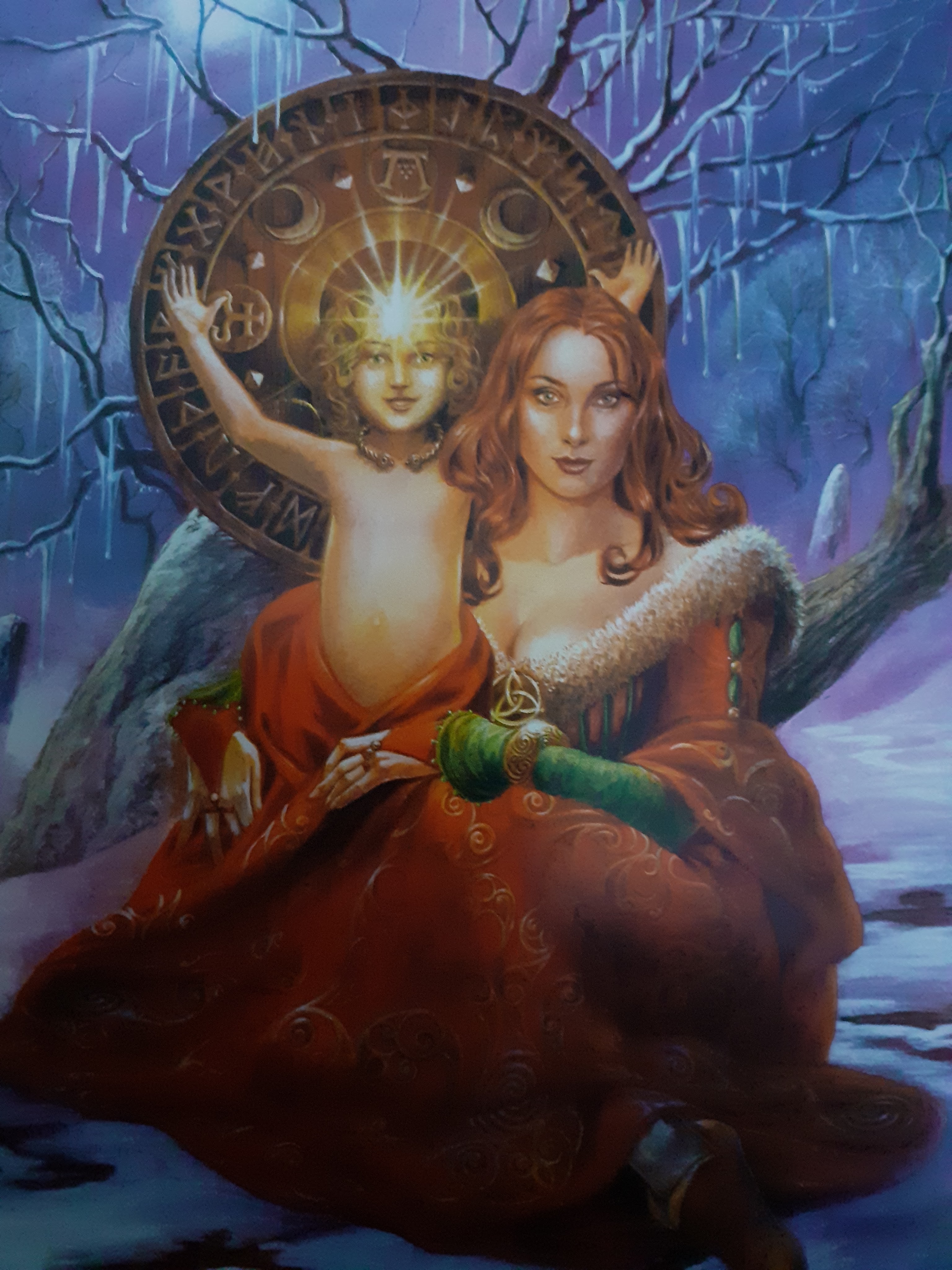
“I am the Mabon. I am the child.
I am YR, the Golden Bough.
I am the dart that the yew lets fly
Three pure rays, the pillars of life.
I am the wren, the King of Birds.
I am the Bard and the teller of lies.
I am a song within the heart.
I am the light that will never die.
I am stars within the Void.
I am the eye of the Aeon.” (1)
For more than a decade, my spiritual practice has been mobilised around a contemplative inquiry. For me, this has been successful in its own terms, but I’m conscious now of something missing. It’s as if, for earnest, intelligent and ethical reasons, I have whitewashed the walls in the church of me. Now I want my murals back. So, recently I have started a course correction.
This course correction includes a glance back at my own pre-inquiry practices, happily well documented. The image of Modron and Mabon used to walk with me: Modron as the primal mother and Mabon as the primal child (2). They were archetypal figures, not everyday humans. My understanding was that these names were from a pre-Celtic language, retained in Brythonic speech. I am not sure if this is true, but for me it offered the possibility that even the surviving Celtic stories (3) were not the first. I was free to dream. In this dreaming I was powerfully influenced by the image at the top of this post (received as a midwinter holiday gift from my wife, then partner, Elaine, in 2007) and by the Silver on the Tree song that follows.
I see the child in the image as androgyne, and not in their earliest infancy. In the song, Mabon is not gendered. The mother in the picture is clearly the Goddess as Mother. Different stories can be drawn from this. In my own journey I tilt the child back somewhat to the masculine. In this pairing, She is Zoe, the life eternal. He is Bios, the life that comes and goes and comes again. Like Taliesin (4), transmuting out of his identity as Gwion, Mabon becomes in a sense his own father. So my midwinter picture appears to reference the Christmas story, but in important ways diverges from it. The image shows a magical midwinter child, who will indeed have an illuminating and transformational influence, but who is not exactly a redeemer in the Christian sense. This is drawn out in the Silver in the Tree song, which includes specifically Celtic references and extends beyond them.
Both Mother and Child live strongly within me, in the imaginal realm. I like and use the old language, Modron and Mabon, because of its sense of ancient mystery. But what it points to is universal. Part of my work now is to re-open my contact with them, who after another fashion I also am.
(1) Silver in the Tree in their 1991 album Eye of the Aeon
(2) NOTE: I am aware that there are divergent visions of Mabon. One centred the Autumn Equinox has become powerful and influential in recent years. Happily modern Druidry is not a religion of the Book though it is enriched by its books. This new literature follows the oral tradition practice of allowing stories to evolve and change in divergent directions. I see this as a strength.
(3) Caitlin Matthews Mabon and the Guardians of Celtic Britain: Hero Myths in the Mabinogion Rochester, VT: Inner Traditions, 2002 (Revised edition of Mabon and the Mysteries of Britain, 1987)
(4) If you visit Loch Maben in Dumfriesshire, in south west Scotland, you may find the feeling-tone similar to the much larger Lake Bala, strongly associated with Taliesin, in north Wales.

 Contemplative Inquiry