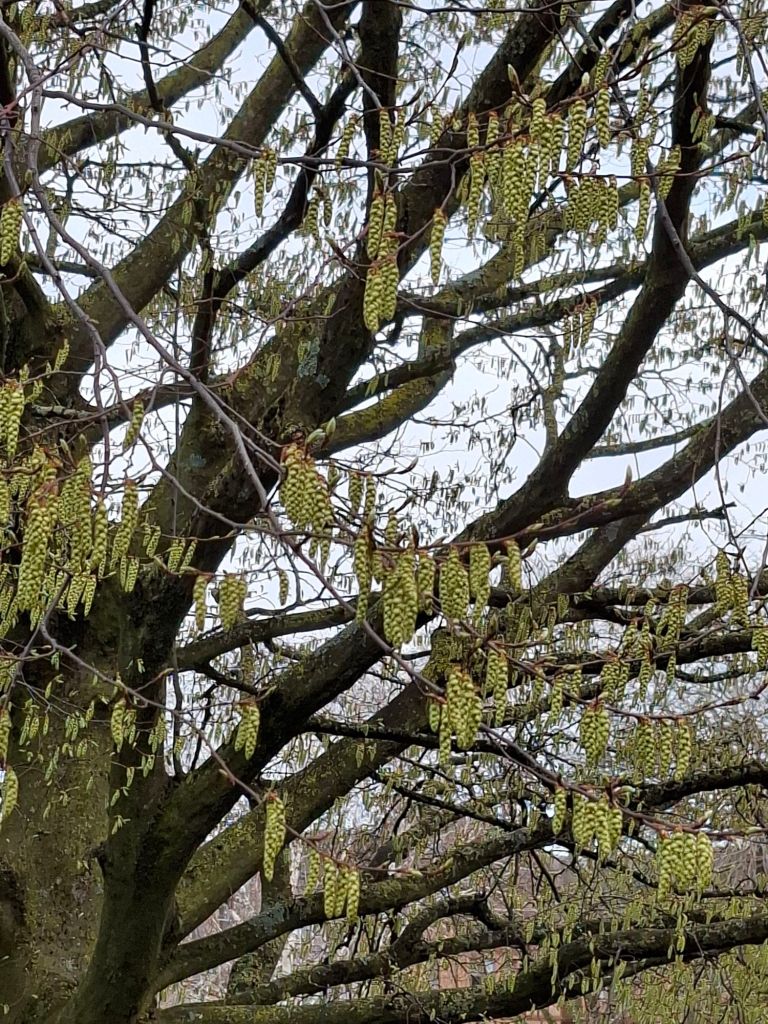
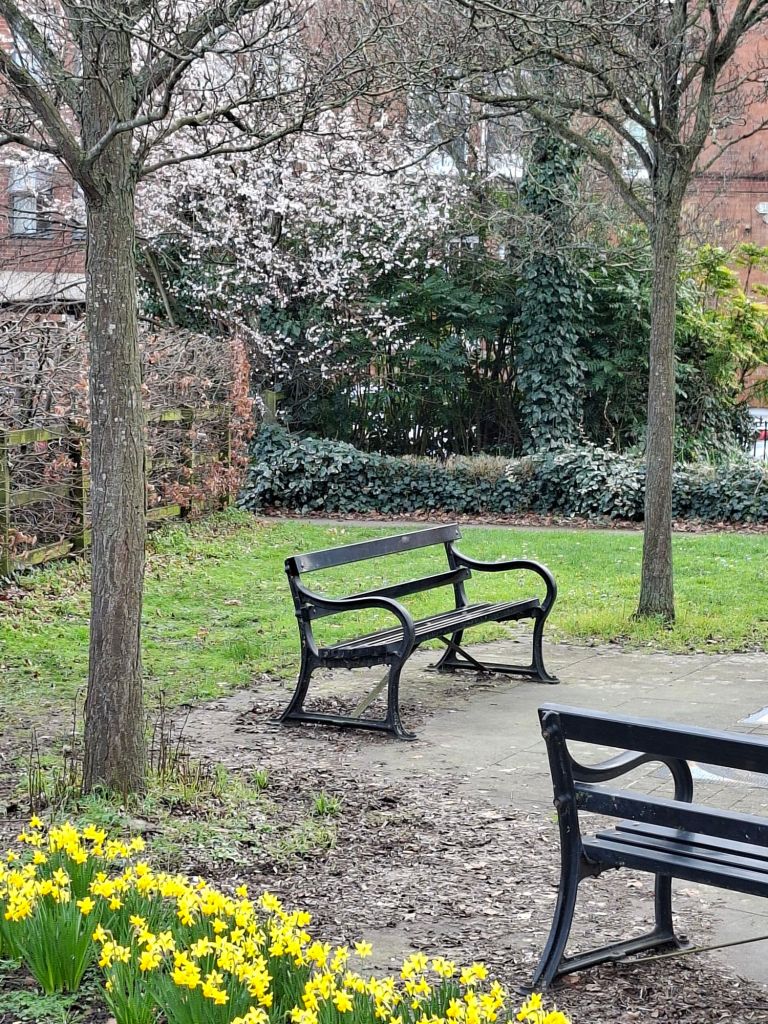
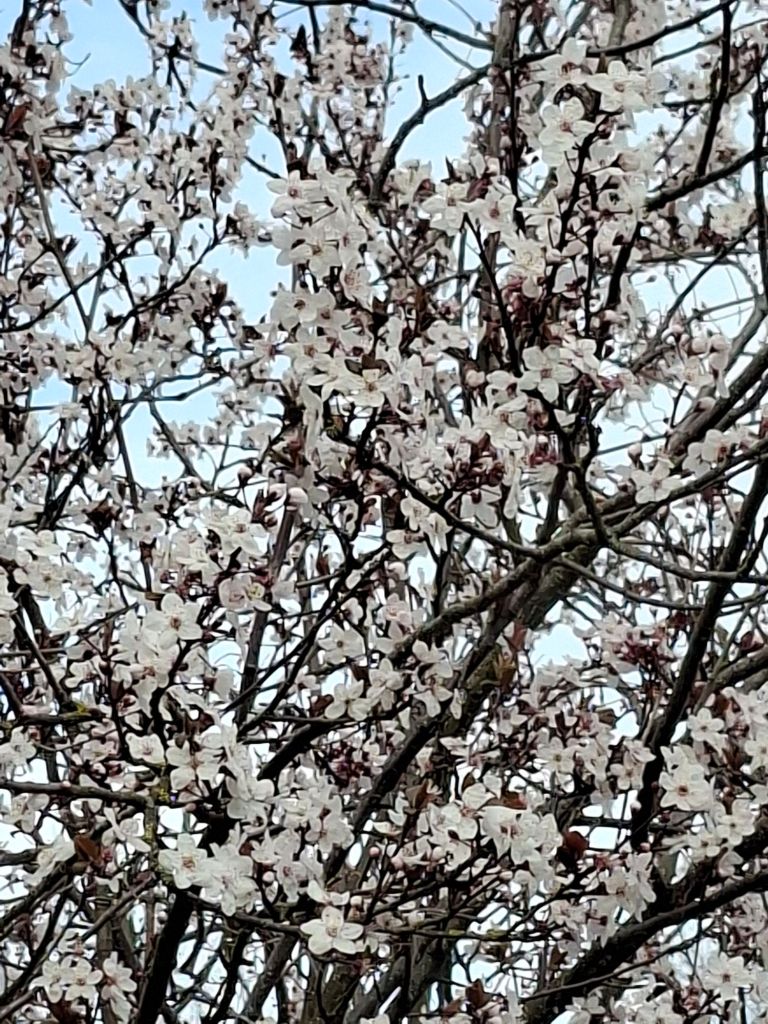
Change is coming as the days lengthen and temperatures begin to rise. I too have begun to feel spring-like – more energised and available to the world.
Stepping out, I am in harmony with the life and growth around me. I become aware, again, of the resilience and potential of the plant kingdom.
I celebrate the life force within and without, both through movement as I walk and in stillness when I pause.
I learn again that a familiar space can be ordinary and extraordinary at the same time.
I open myself to spring 2026, the new season, as the Wheel continues to turn.
Alney Island at midday on 9 November. Looking up, I encountered a bleak majesty of now skeletal trees. Muted sunlight found its way through the grey clouds. In contrast, the river at my side retained a full, lush beauty.
As I walked, the tranquility of the scene was compromised at times by anxiety. The island is a wetland. It had been raining. More rain was due. The paths were puddled and muddy. The grass was soft and wet, half hiding twigs, leaves and slippery earth. I am still not fully recovered from my fall and this walk was a deliberate escalation in challenge. When I reached Richard’s Wood I stumbled over a tree root and nearly fell. At the same time I was able to enjoy a rich carpet of leaves at this late period in the leaf fall.
Among the trees I contemplated branches as living sculpture. It was as if I had reached a destination. Generally the branches were still holding on to at least some leaves. There were even new ones, in this fecund space. Eventually, my encounter with the wood completed, I turned round and made my cautious way home.
For the first time since I fractured my shoulder in a heavy fall, I have walked beside the Gloucester canal. The period between 2pm and 4.30 on 28 October was particularly auspicious. Cool but clear. Blue sky and sunshine.
On this occasion, as I tentatively walked the paths, I found myself in a living world dominated by yellow and green. A fall was happening, but was not very advanced. I noticed my confidence in walking becoming more consistent and reliable. I felt good. I was at ease in the woodland world.
The walk was part of my coming to terms with an advancing age, in which the possibility of a damaging fall is priced in. I felt a little nostalgic for a distant past. At a time when I was impatiently looking forward to my fourth birthday I fell down a flight of stairs and simply got up again. I was pleased to have a story to tell my parents, but couldn’t understand their alarm when I told it. 1953 is indeed another country.
However most of my attention, on this walk, was on the walk itself. Pragmatically, it needed to be, and I was also increasingly held by the spirit of place and time on this benign late October day. I had a strong sense of here, now and home.
I had a goal of reaching a newly refurbished bridge for pedestrians and cyclists only. This would give me time to turn around and get home before sunset (roughly 4.45 now that the clocks have changed). A slowish two and a half hours is as much as I can manage as yet. From a recovery perspective, I feel on track.
I have now lived in Gloucester long enough to have a territorial sense of the city. When walking from a southerly direction, an elegant square and its garden signal my nearness to home. This signal is physical, emotional and psychic. My cognitive knowledge is secondary.
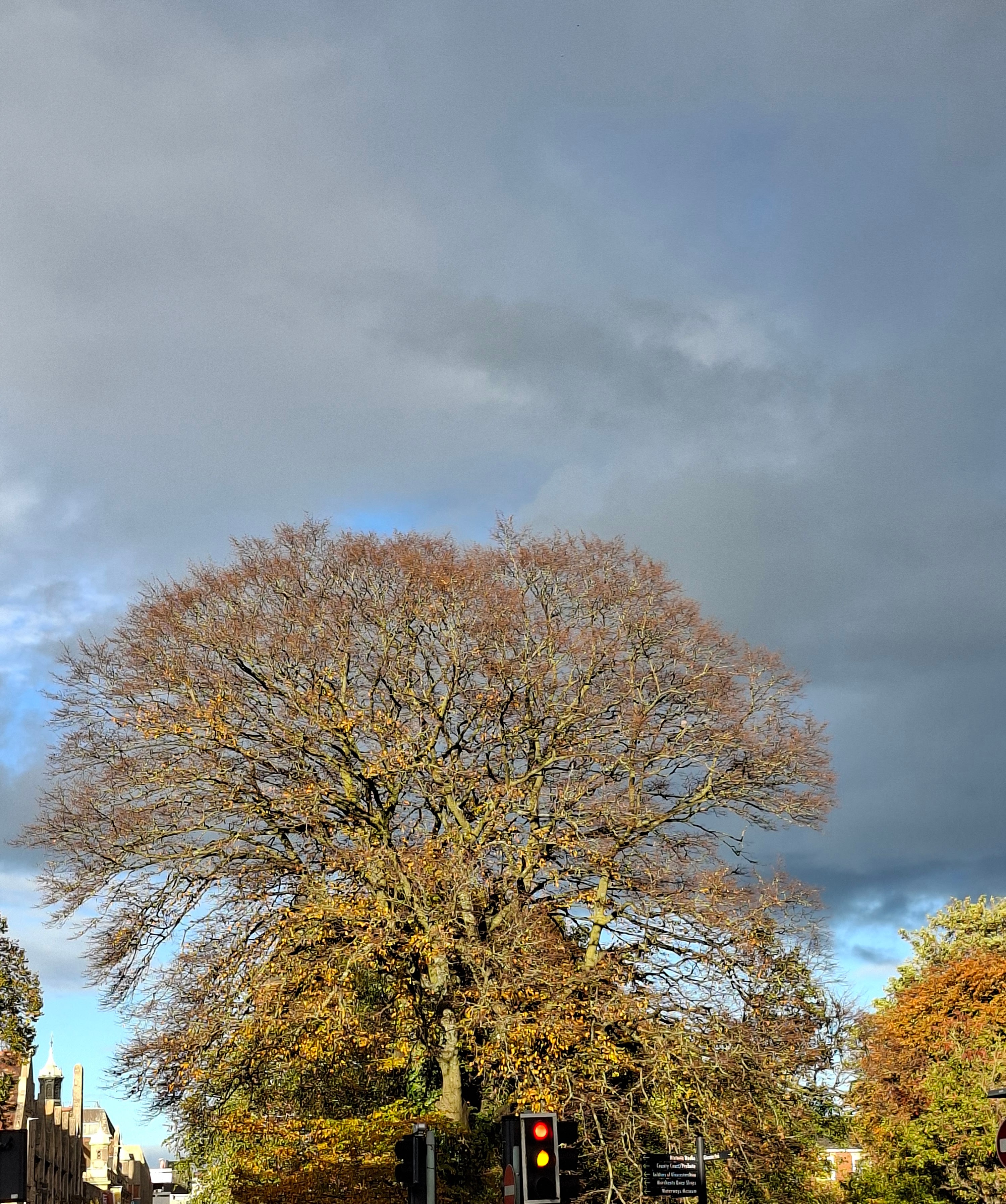
This signal is soon followed up by another, stronger one, closer to our apartment. Under looming grey clouds stands a tall, mature hornbeam. Once indoors, I will be able to look at it through our balcony windows – majestic even as it sheds its leaves.
The hornbeam is an iconic (I might almost say totemic) marker of ‘home’. Elaine and I do not individually own this tree and nor would we want to. But our city council does, with obligations towards it. That’s probably why it’s still there.
This sense of home and blessing: where does it come from? We are not migratory birds. But we used to be a bit more like them. Nomadic, but often within defined territories, however large, which we could get to know and love without the need for exclusive possession. There are people in the world who still try to live in this way but it is becoming increasingly difficult.
I speculate that part of my bodymind finds this arrangement natural, even though culture here is (mostly) very different. The feeling tone of my walking varies dramatically with different levels of newness and familiarity. In the approach to home, signalled not only by distance but also by landmarks, this is particularly strong. Perhaps this is the residue of a long lost pattern of life.
Recently, Elaine and I walked to our local park after a considerable absence. We were both adequately bold and mobile at the same time. We found a park very different, at least visually, to the sad, dried-up space of late August and its premature turn.
Here, above, is lush life against a background suggestive of mist. Close up, we enjoy the patterns and colours of the leaves. They seem fresh, radiant and alive.
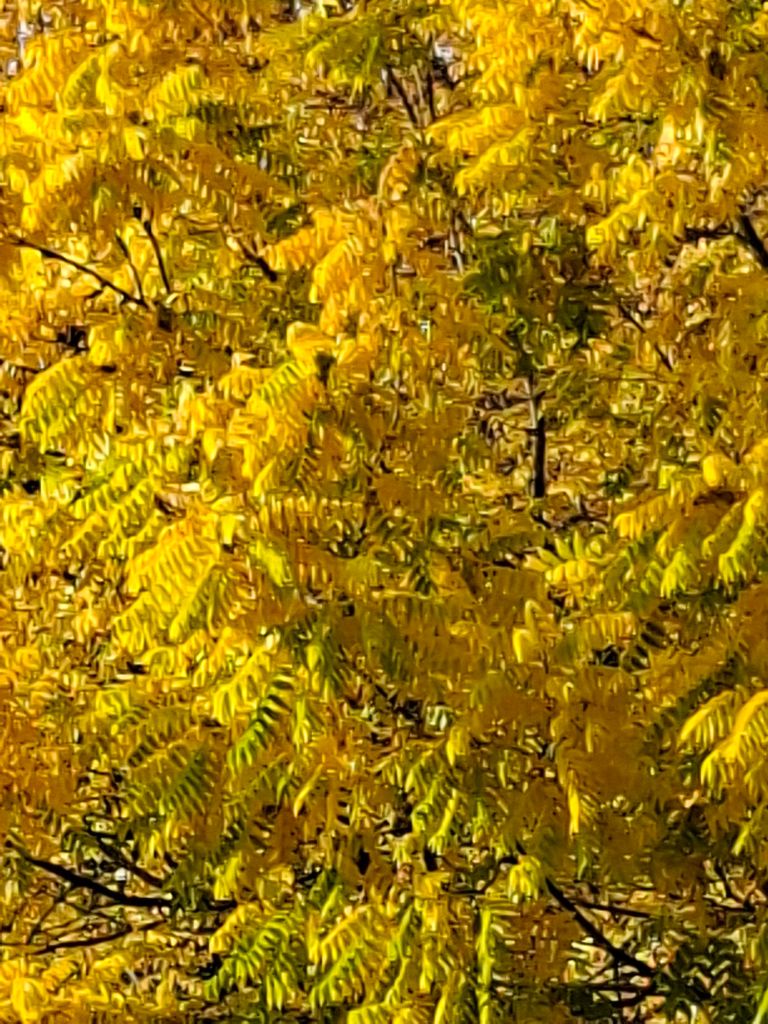
Below, the distinctive yellow of the tree of heaven, and its fern-like leaves, provide a powerful contrast that adds to our enjoyment.
Looking from a somewhat greater distance, below, I experience a sense of majesty in seeing the whole tree (right) leaning into blue sky. Its slightly closer neighbour (left) provides a subtle colour contrast with a deep green intermingled with brown leaves ready to fall.
Below, I have stepped back further from the trees. My picture is of a clump of trees in the park. They are largish trees. The person walking past them is dwarfed. But I’m still enjoying leaves. I like the reddish brown emerging from residual green. I see Nature at work in a way that is both understated and beautiful. I know also that it can be a sheltering space within a generally flat and open park.
I still have a particular affection for willow, going back 20 years when I was studying Druidry. I was in Bristol and befriended a willow on the banks of the Bristol Avon, where it moves out from the old city towards the Clifton suspension bridge and the gorge. I became a literal tree hugger. It was part of a process that indeed changed my life. Hence my affection for willow. I am glad that there are willows in the Gloucester City park.
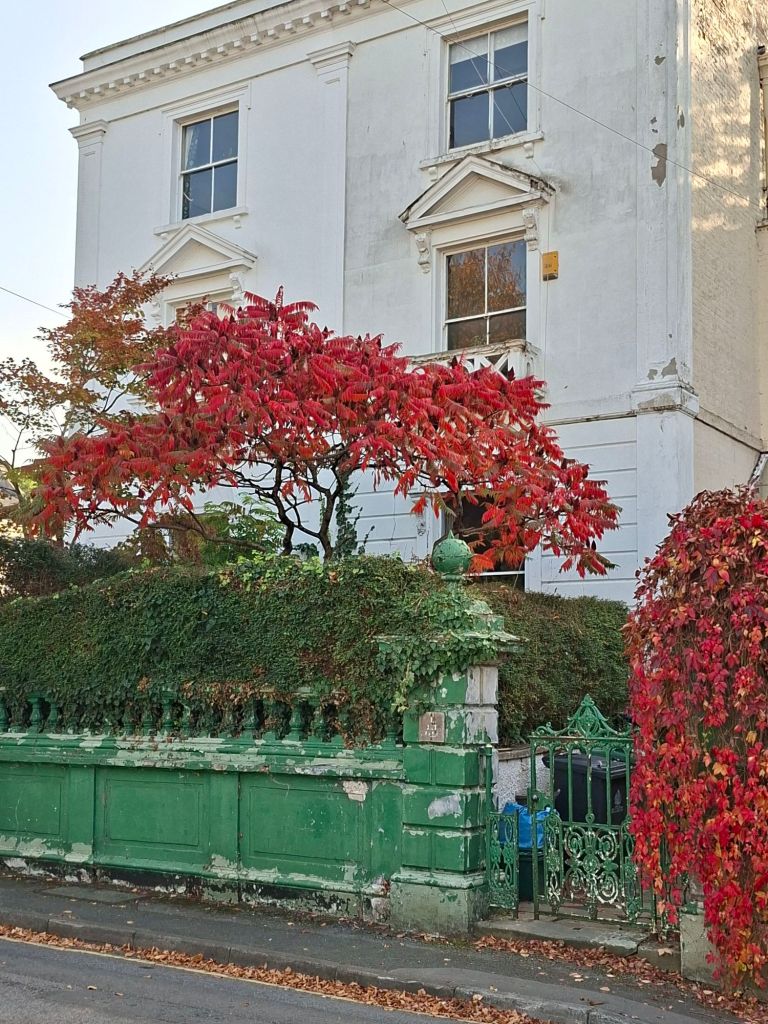
The road we took to and from the park offered leaves of autumnal red. I believe that the tree in the front garden is a stagshorn sumac. When I walk past the tree I get a little distracted by the property’s obvious need for a little tlc. Elaine however celebrates the opportunity taken by the Virginia creeper, as seen particularly in the second of the pictures below. It is great to see such abundance in this unpromising space.
For me, the great virtue of simple pleasures is their simplicity itself. Paying attention to the everyday Nature around us can be deeply nurturing and involves little risk. Yet for some, it can be a portal to re-enchantment in a largely disenchanted world.
Now in the fourth week after my shoulder fracture, I have ventured out on a contemplative walk.
I rested for awhile in the erstwhile physic garden of Llanthony Secunda Priory. It is a friendly space for me. Yet at first I felt very small. An alien energetic sky raced high above me towards an unknown horizon.
I wasn’t used to the outdoors. The garden stretched in front of me, defined by a long straight path. I experienced the world as a place of distance and extension. I felt alarmingly unsheltered, until I stilled myself and looked down.
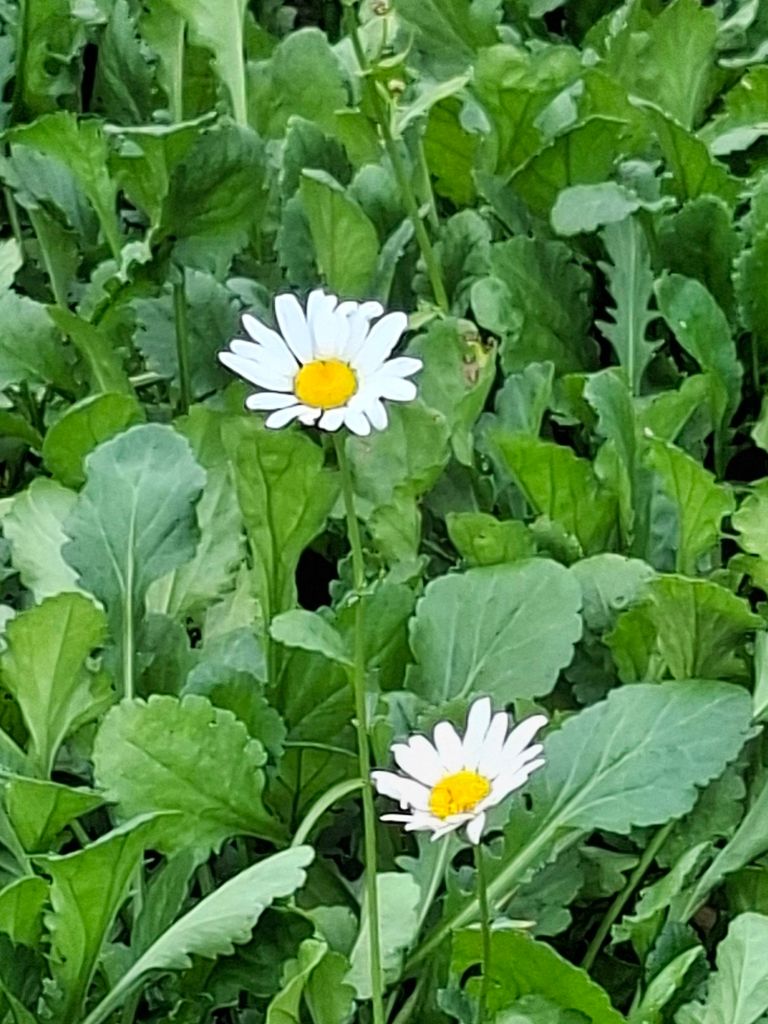
The sight of Michaelmas daisies altered my state. Seasonal flowers and a living, shining green. Although I didn’t move to touch them, I felt like a toddler reaching out for a mother’s hand. I was held again within the wheel of the year. Autumn, the season of bearing fruit.
I looked out further and received rhe assurance of an old stone wall, and the majesty of mature trees. The trees might be turning. The wall might be part of a ruin. But they were still in place, still present in time, still offering a quiet companionship.
These changes in perspective allowed me to experience the garden afresh, more closely and intimately. It was easier to be in, and easier to connect with. Still unsheltered, but unalarmed, I knew that I belong.
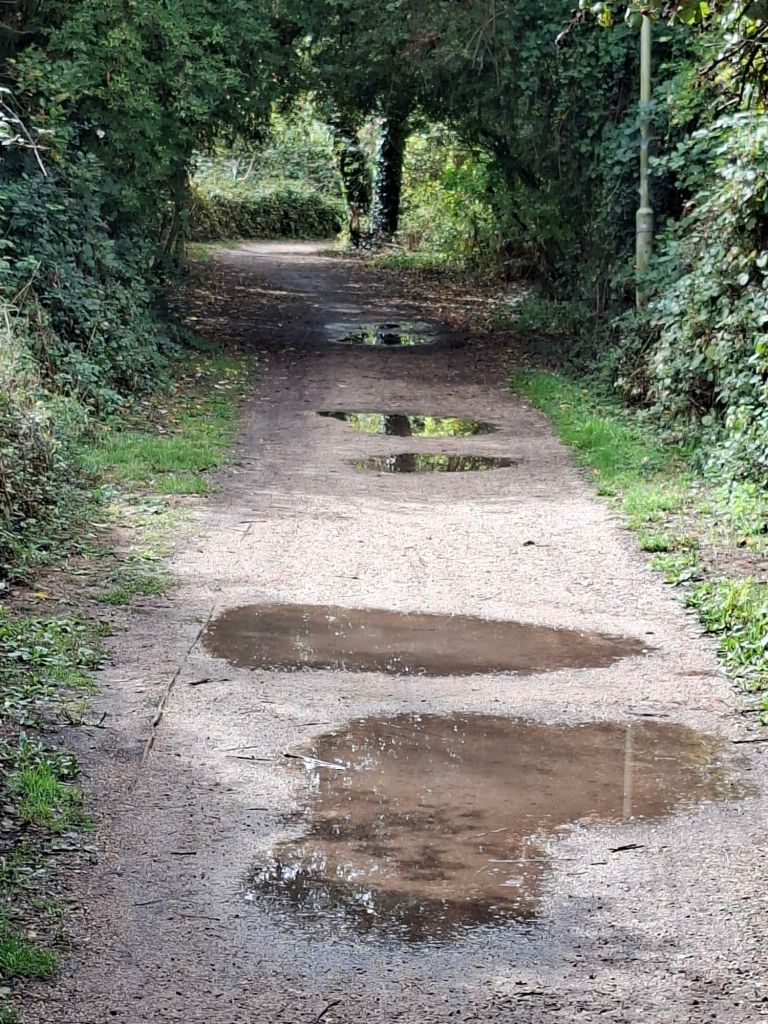
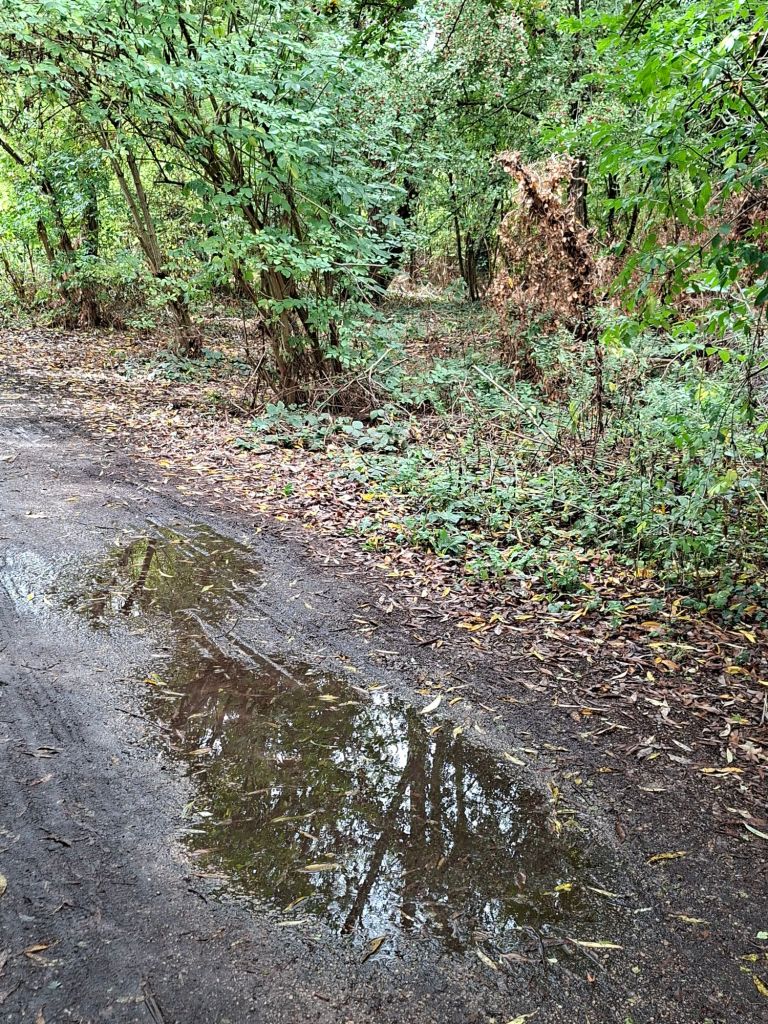
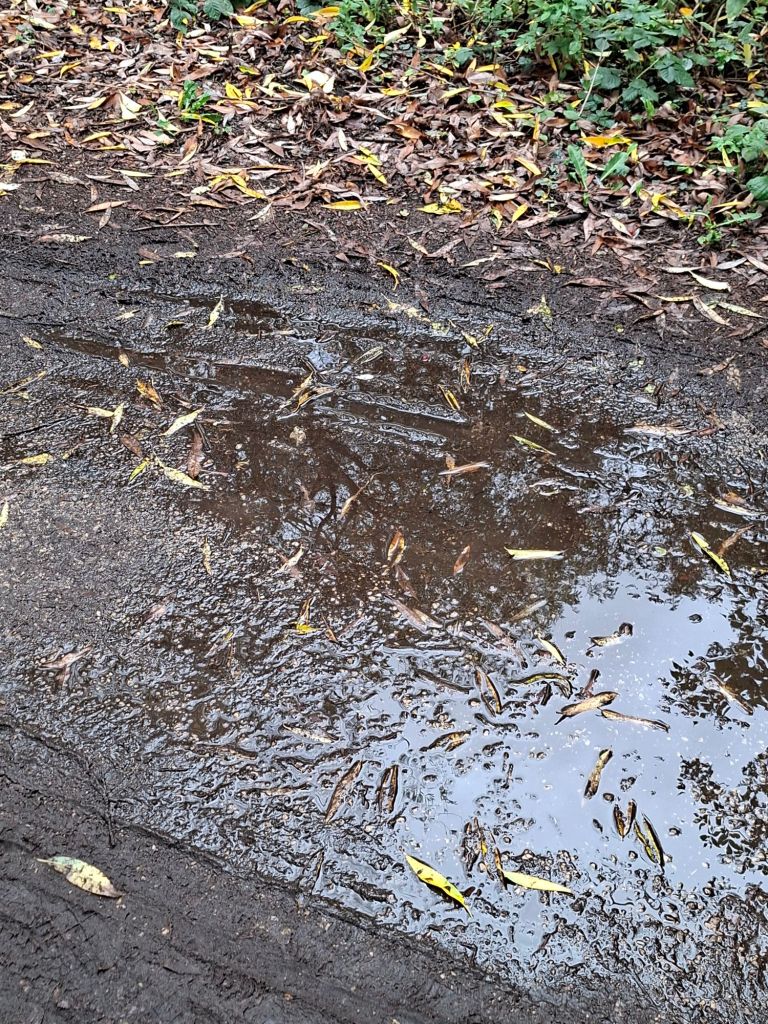
Walking on a familiar path, I found a trail of puddles in front of me. It felt exotic and refreshing. For this had been a parched and dry place for a many months. I dimly recall a past life of finding puddles a minor nuisance – almost an obstacle. Not today. They brought joy and fascination.
I found myself contemplating these small accumulations of fallen rain: noticing their shapes and patterns, seeing how the water creates mud so easily from dried soil, watching the slight movement fallen leaves in these tiny ponds. The circumstance of the long dry period and its ending made rainwater and its effects interesting and worthy of attention in ways that seemed new and almost strange. I opened myself up and became present to them, before moving on.
On my way home I was caught by a brief deluge. I made a brief video of rain on a puddle. I got wet too, yet it somehow completed my walk.
Above, through the trees, we can see one of the chapels belonging to the Arnos Vale Cemetery in Bristol, England. It was built as a garden cemetery extending over 45 acres in 1839, as the city’s old parish graveyards were becoming overcrowded and a health hazard. The new venture was designed to be spacious, with sunlight, fresh air, trees and shrubs.
It worked well for nearly 150 years. But in 1987 the owners announced their intention to clear a large section for ‘development’. An Association for the Preservation of Arnos Vale Cemetery swiftly sprang up. It fought successfully for a safe future for the site, gaining the support of the Bristol City Council, Bristol citizens and many people worldwide.
Now, as the Friends of Arnos vale, they continue to manage what they describe as “a hillside Victorian cemetery and conservation park, with heritage and wild life tours, plus a café”. It takes a lot of effort and activity to keep this precious space going, yet on my occasional visits I still find it tranquil and unspoilt.
For me it is a magical place, largely because the graves are being allowed to sink back into the land. There is something primal about the cross above, rough hewn, almost equal armed, and decorated with foliage. Still a cemetery, Arnos Vale has become something wilder than a garden. At this time of year, the paths become green tunnels, deftly concealing their destinations.
Yesterday I walked in Arnos Vale with a friend, and our direction of travel required a descent towards the main buildings. The steps we went down were not as overgrown as the ones below, but l found them challenging enough. The imagery and effortful activity of descent give me the feeling of a deep earth and underworld journey, and the sense of enchantment that goes with it.
Towards the bottom of the slope, my recognition of a re-enchanted space in a largely disenchanted world is further strengthened. A cross again. Evergreen ivy growing up it. Vivid summer blooms behind and in front. Tall wild grass. Trees in the background. Green abundance enhancing the gravestone rather than diminishing it. Life and death companioning each other without drama or fuss. Contemplating this natural harmony, I feel heartened and refreshed.
It is a little after 7 pm, and the mellowing evening of a hot day. The sky is clear. On 12 July, there are still nearly two and a half hours before sunset. It is about 31C/87.8F with a light breeze. Elaine and I feel comfortable enough to go for a walk in town.
We start quietly in our own neighbourhood. We are, we think, towards the end of a hot period that peaked at 35C/95F. This counts as serious heat in England. For several days, we have been staying indoors for much of the day. There have been quick forays in the mornings, mostly to an air conditioned shopping centre nearby.
We needed to get out at the first opportunity. We are rewarded, in this evening, by a freshness grown unfamiliar, and by powerful contrasts of light and shade as seen in the priory ruins below.
To leave our Greyfriars estate, we walk down a narrow lane that separates a pub from a church. We enter Southgate Street in the old town through an archway. Entering the street, we are conscious again of vivid blue sky, and the mix of sunlight and shadow. The street is hardly crowded, but it is certainly peopled on this warm summer evening.
At this stage we are not sure of our destination. We just want to be free and mobile and outdoors. We decide to turn right. Soon we will be reaching the cross roads at the centre of the old town. If we turn left, we will find ourselves in Westgate Street*, with the Cathedral Close (College Green) as our likely destination.
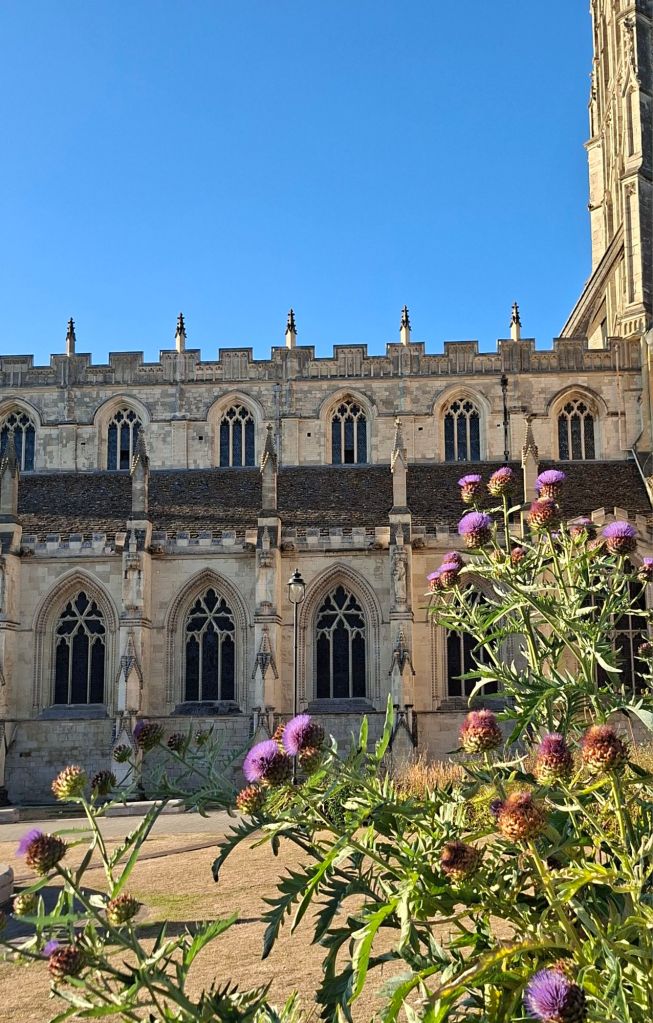
Gloucester Cathedral, and in particular College Green, are a friendly space for us. It is still the dominant set of buildings in the town centre, just a little set apart from the shopping streets. Often a busy place, it is also a contemplative one. As we sit there enjoying the opportunity to be out, we notice that the temperature is cooling as we move towards 8 pm.
Eventually we decide to return home, leaving College Green through another alley, this one a location for shops and restaurants. It’s been a nurturing time in the high summer city.
When Gloucester was first established by the Romans in 97 AD as Colonia Glevum, it was built as a walled city with gates in each of the four cardinal directions. Hence the streets Eastgate, Southgate, Westgate and Northgate. I believe that Aethelflaed, Lady of Mercia, brought the street names back into use in their English form whilst based in Gloucester round about 900 AD.
This post is about Hillfield Gardens (1,2) and the taste of psychic rejuvenation. Just being there, actively opening to the elemental energies of place and time, I felt confident, happy and strong.
The early morning of 20 November was misty and dark in a slushy, miserable kind of way; closed in and confining rather than magical and mysterious. Elaine and I catastrophised together in gloomy harmony about skies made unfriendly by perpetual drizzle and pavements made treacherous by hidden ice. The term stir crazy came up for me. We have begun to expect fresh air and activity outside the home. This time we planned to be in separate spaces. They are good in themselves and healthy for us as a partnership. So the tension of anticipated disappointment was in the air, for a long moment in a dull morning.
Then everything changed, with clear blue sky and sun. After an early lunch, I could wheel Elaine to her creative arts event and then fully stretch my legs in a walk to Hillfield Gardens. When I got there I slowed down again and shifted from a doing mode to a being mode. I became porous to the world – at once disappearing into it and expanding to embrace it. The snow on the ground looked beautiful to me and a crinkly fallen leaf both modified the picture and enhanced the look. William Blake once famously wrote: “if the doors of perception were cleansed, everything would appear as it is, infinite” This brief eternal time (being in two worlds at once) – with the snow on the ground, and the fallen leaf – was like that, or at least something which pointed towards it. I feel tremendous gratitude for the experience. In its afterglow, I found myself feeling confident, happy and strong.
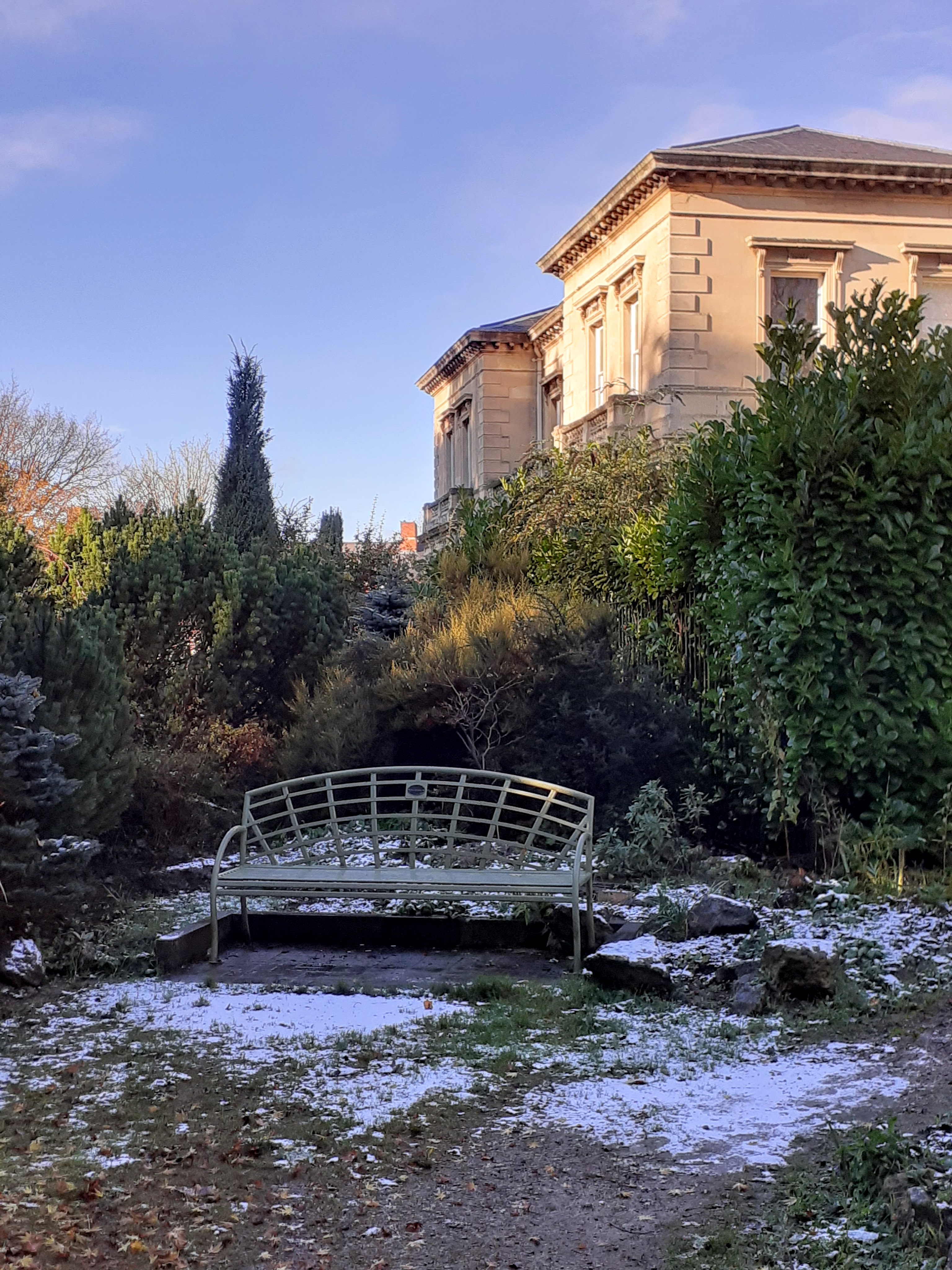
At a reduced level of intensity, I continued my walk. Below, My attention was drawn by a seat, and the snow around it, in a secluded corner of the gardens. Sun shone freely on the buildings, and the bushes, but reached only a small area on the seat.
In the most wooded and unmanicured section of the gardens, I found snow still present on a section of cleared space and pathway. Elsewhere there was no trace of it, even in this relatively shadowed space.
On the buildings below – blue sky, sun and shadow. In the picture below snow is just discernible on a rooftop and in a garden. During the period of my walk (1-1.30 pm) the gardens visibly changed. The snow was retreating and shadows continued to shift.
It wasn’t a long walk – twenty minutes each way for the sake of my legs and thirty in the garden. It was enough. I took away the psychic rejuvenation I named at the beginning of this post. The experience was both mystical and ordinary, a place where the ‘spiritual’ and ‘mundane’ are one – and big part of how I live my Druidry.
(2) NOTE: At the beginning of April 2024 I discovered Hillfield Gardens – a little outside the centre of Gloucester, yet still in easy walking distance (or an easy bus ride) from where I live. Originally the gardens of a large house, Hillfield Gardens are about 1.6 hectares in extent. They are managed by a Friends Group on behalf of Gloucestershire County Council. For me the gardens are a tranquil space, different in feeling-tone from other local parks.

















 Contemplative Inquiry