Contemplative Inquiry

This blog is about contemplative inquiry

Tag: contemplative spirituality

PEACE AS A VIRTUE

I have been thinking of peace, at the personal level, as something other than an energy or state. I am learning to understand it as a virtue to be cultivated, in the sense described by modern Pagan philosopher Brendan Myers. ‘Virtue ethics’, first articulated by the ancient Greeks, is the branch of philosophy that investigates character and identity (1).

To live a fulfilling and happy life, according to Myers, we need to install ways of understanding and being in the world that support our aim: these are the virtues. He specifically talks about the virtues of wonder, such as open-mindedness, curiosity, creativity; the virtues of humanity, such as care, courage, respect and generosity; and the virtues of integrity, like reason, acknowledged vulnerability, forgiveness and the will to let go.

I like Brendan Myers’ approach to virtue ethics. I find it inspiring. I particularly appreciate his account of both the work and rewards of practising virtue ethics: “through the process of identifying and working with virtues, we reach towards the person we want to be and the world we want to live in”. He points to “the possibility of a greater depth of life experience that can appear when I am willing to let go of my illusions, willing to risk harm and despair, in pursuit of a more honest relationship with reality”.

Myers’ approach has influenced my practice, to the extent of creating, working with and revising my own list of personal commitments (2). This is a working document, not a set of commandments or protocols from elsewhere. The commitments are not coterminous with virtues, but virtues are identified and included in them. The first to be named in my list is peace. I say: “I will live from the peace of the centre”. This statement has primacy over the others and is formulated differently. “I will live from …” is different from the “I will cultivate” that begins my other statements. It is linked to my regular use of a (slightly modified) Druid peace prayer: “Deep within my innermost being I find peace; silently, in the stillness of this space, I cultivate peace; heartfully, within the wider web of life, may I stand in peace”. The commitment “I will live from the peace of the centre”, draws on the whole prayer.

I notice that peace, rather than love, is currently the foundation of connection with my innermost being, or the divine within me. Spiritually, heartful peace best describes the reality of my lived experience of non-separation from the divine. This is what I feel moved to take into the world as a form of action (living from). I find this more challenging than finding peace in my innermost being in meditative spaces. Turning outwards, I find often find the world distressed, deluded and difficult to navigate. I am part of this world and therefore obviously vulnerable to my own distress and delusion, and also to a certain ignorance about falling into the mire myself.

Finding and modelling peace are consequently at the top of my list and it is this peace practice that I frame in terms of virtue. The ultimate peace that I experience within is something else, an inspiring gift for which I feel grateful: it is not a personal possession or attainment. Nonetheless, it supports in the work of bringing peace into my daily life.

(1) Brendan Myers Reclaiming Civilization: A Case for Optimism for the Future of Humanity Winchester, UK & Washington, USA: Moon Books, 2017

(2) Personal Commitments (Revised May 2024):

I will live from the peace of the centre.

I will cultivate skilful will and strong will, always within the context of good will, towards self and others.

I will cultivate positive health and well-being, within whatever constraints that may apply.

I will cultivate discernment, creativity and wisdom, to the best of my understanding and capacity.

I will cultivate a life of abundance in simplicity, living lightly on the earth.

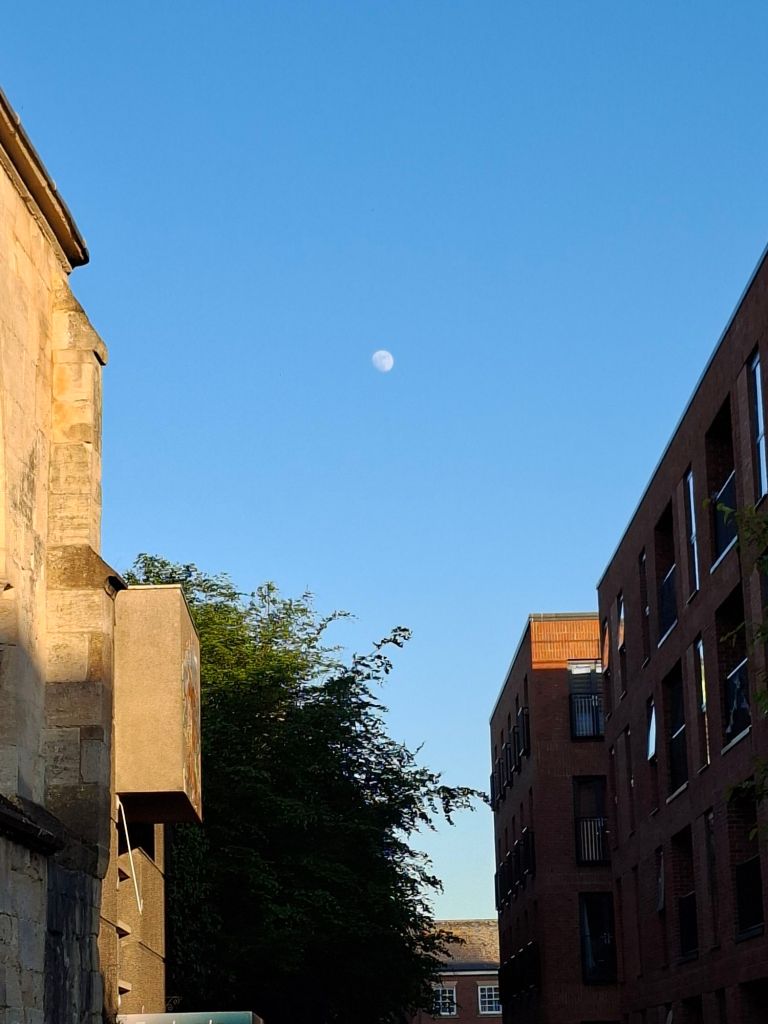
HAIKU: 7.50PM 9 MAY 2025

beyond the May blue sky,

a waxing gibbous moon:

below, evening shadows spread.

‘A SLOW GREEN’

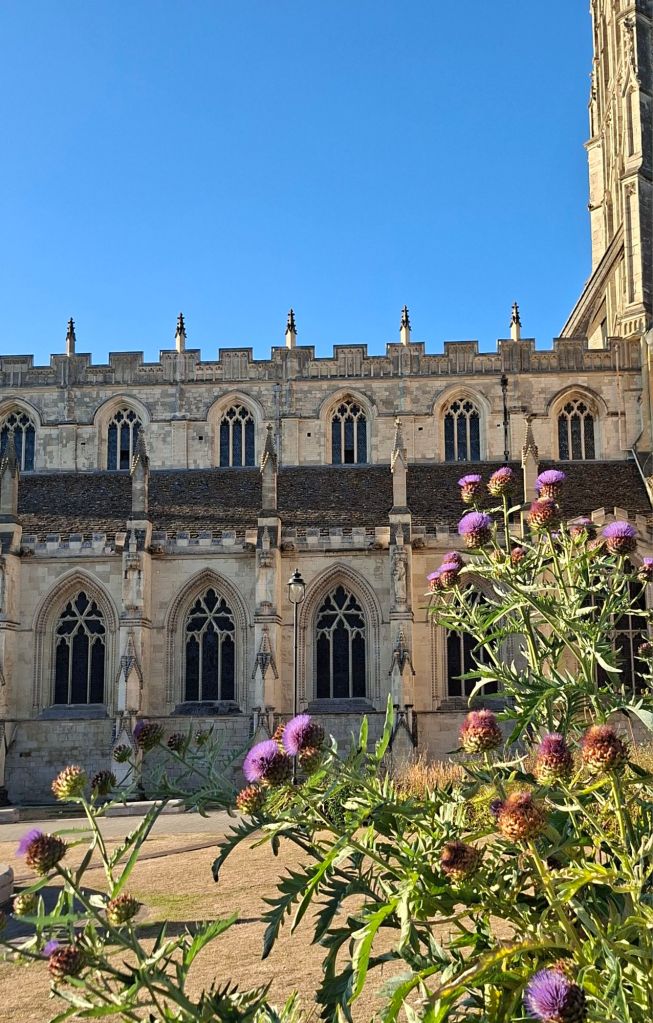
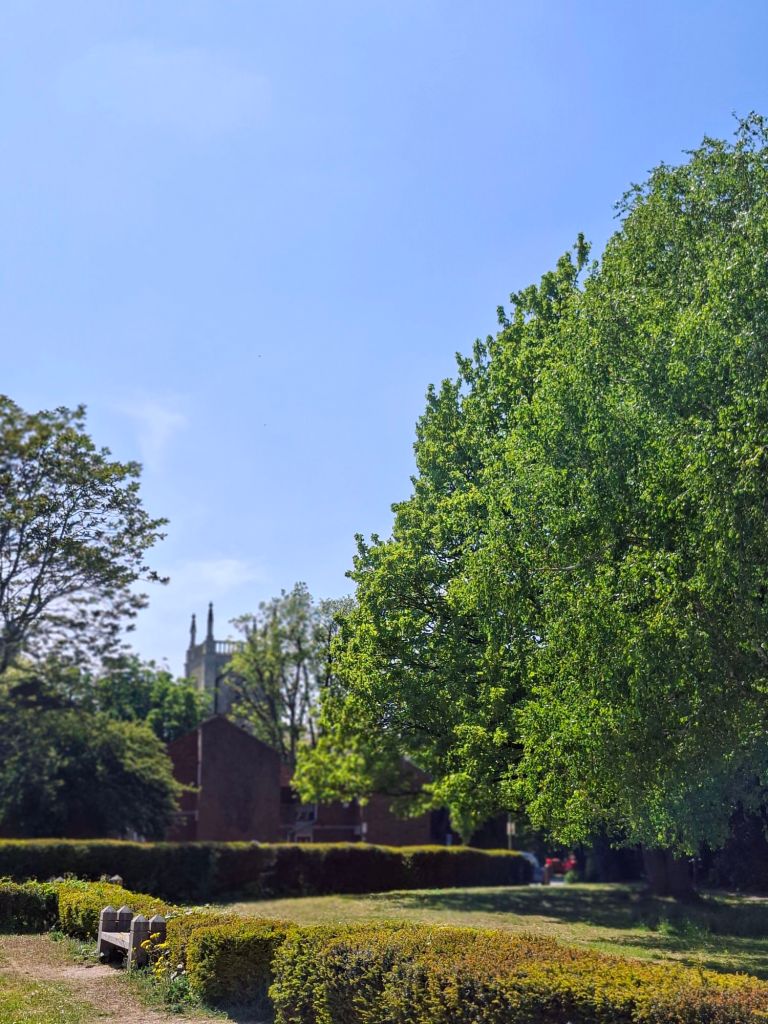
The church of St Mary de Lode, Gloucester, seems to sit among trees. The building salutes the sky without arrogantly trying to reach it. There is a bench towards the foreground of my picture.  I am standing in a friendly urban space, a green space. It is one of many made possible by the Churches and Priories of the old city.  This space is open to all.

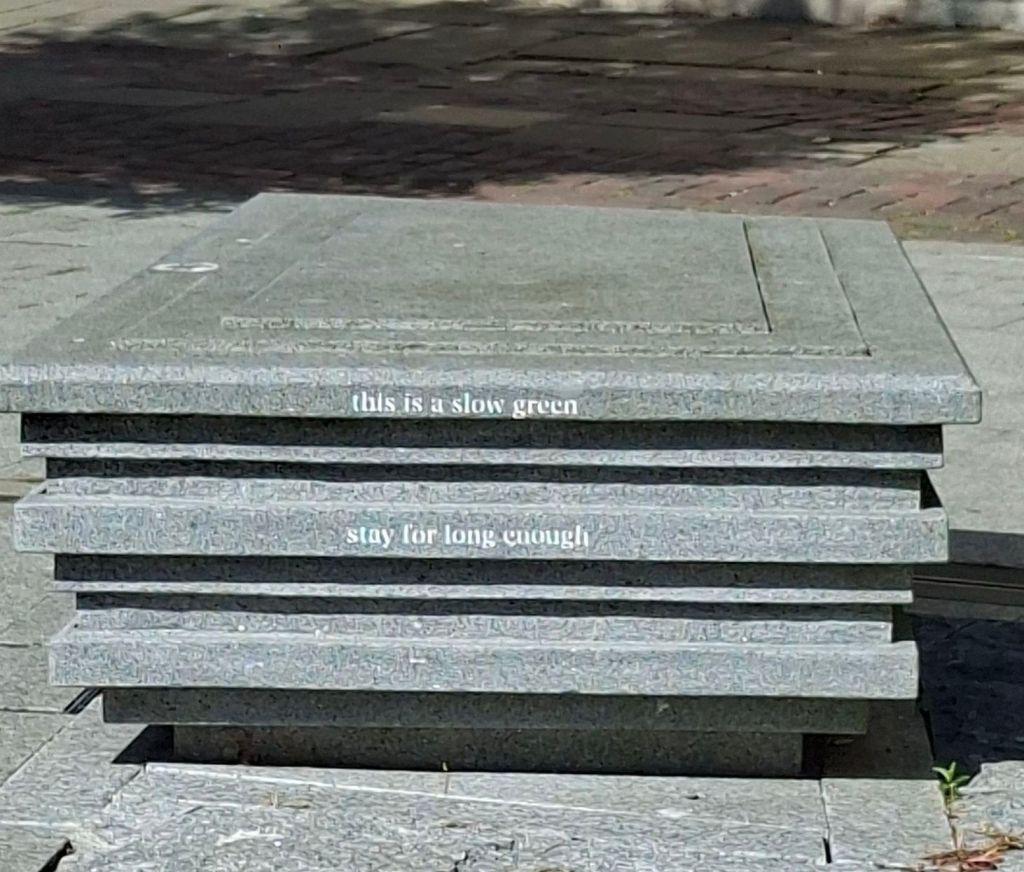
In another such space, on a granite seat close to my home, I recently noticed the words “this is a slow green, stay for long enough”. I have been savouring these words ever since.

They  draw me into an easy receptively, not least when the month is May and the day is warm. The riddle of ‘a slow green’ invites immersion and reverie rather than effortful attention or strategies for problem solving. ‘Stay for long enough’ is probably the wisest counsel. Let’s take the time we need gently to befriend such nurturing spaces when we are blessed to find them.

A MAY’S EVE GIFT

Such casual abundance

In each passing moment:

A May’s Eve gift.

HERTHA AS EARTH MOTHER AND COSMIC GODDESS

Hertha (Nerthus, Erth) was a Germanic Goddess of the Earth, associated with fertility, domestic animals and nature. She was believed to live in an island grove, whilst also touring the land in a cow drawn chariot to bring peace and joy to those who celebrated her. Our ancient information is derived from the Roman author Tacitus, in his Germania (1). Current accounts also link her to themes of rebirth, kinship, health, longevity and tradition. It is said that she can descend through the smoke of any fire to bring gifts. See: https://journeyingtothegoddess.wordpress.com/2012/12/25/goddess-hertha/

Algernon Charles Swinburne’s Victorian poetry is mentioned in two of Ronald Hutton’s Divinity lectures at Gresham College (2,3). In particular he describes the poem Hertha (3) as an important example of Pagan currents in Victorian British culture. Although widely seen then and (for some people) since as transgressive, Swinburne’s voice is confident and strong – as I hope these extracts show:

“I am that which began:

Out of me the years roll;

Out of me God and man;

I am equal and whole;

God changes, and man, and the form of them bodily;

I am the soul.

“Before ever land was,

Before ever the sea,

Or soft hair of the grass,

Or fair limbs of the tree,

Or the flesh-coloured fruit of my branches, I was, and thy soul was in me.

“First life on my sources

First drifted and swam;

Out of me are the forces

That save it or damn;

Out of me man and woman, and wild beast and bird; before God was, I am.”

As I read these verses, Swinburne’s Hertha is cosmic as well as local, universal as well as tribal. Swinburne clearly values Hertha’s specific name and lineage and he identifies Hertha with the World Tree in some verses. But he does not simply revive the old North European traditions. His Paganism models a new culture for a new time.

Although another 150 years have passed since Swinburne wrote this poem, I find it directly relatable. For me, it contains one of the most powerful affirmations of Panentheist Paganism I have heard: “I am the mouth that is kissed and the breath in the kiss, the search, and the sought, and the seeker, the soul and the body that is”. What better time than Beltane to celebrate Hertha and the 19th century seeding of Modern Paganism.

(1) Tacitus Agricola and Germania London: Penguin, 2009 (rev ed)

(2) The Modern Goddess and Where did Modern Paganism start? https://www.gresham.ac.uk/watch-now/

(3) Algernon Charles Swinburne Complete Poetical Works Delphi Classics, 2013 (Kindle edition)

A NEW LENS

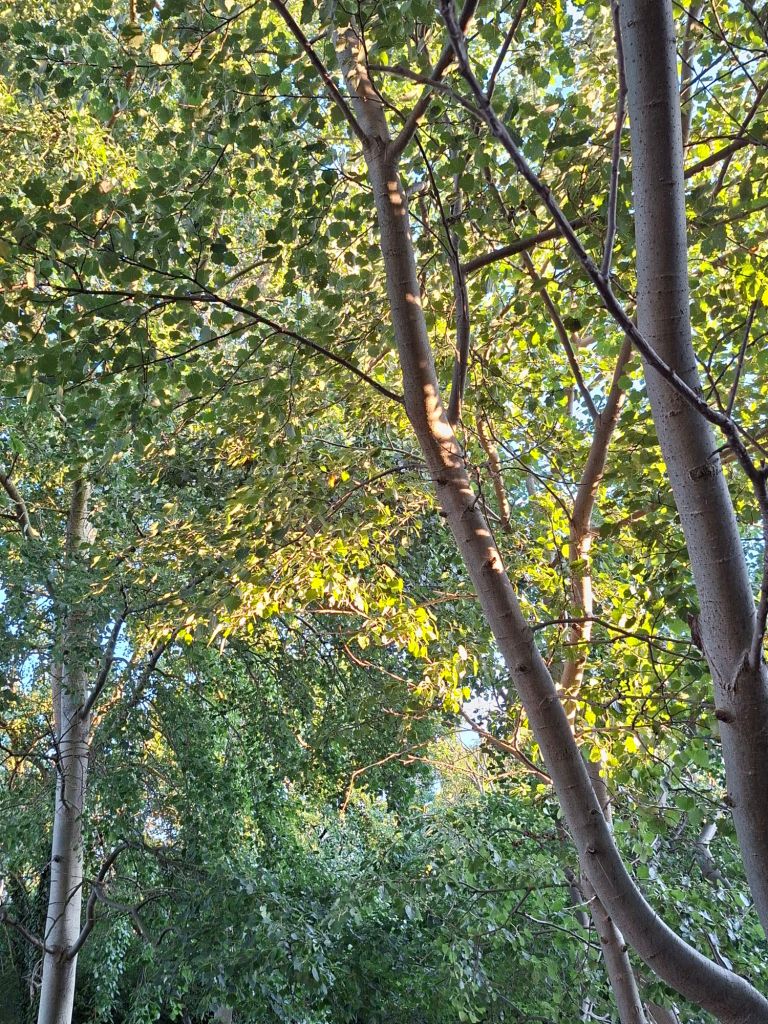
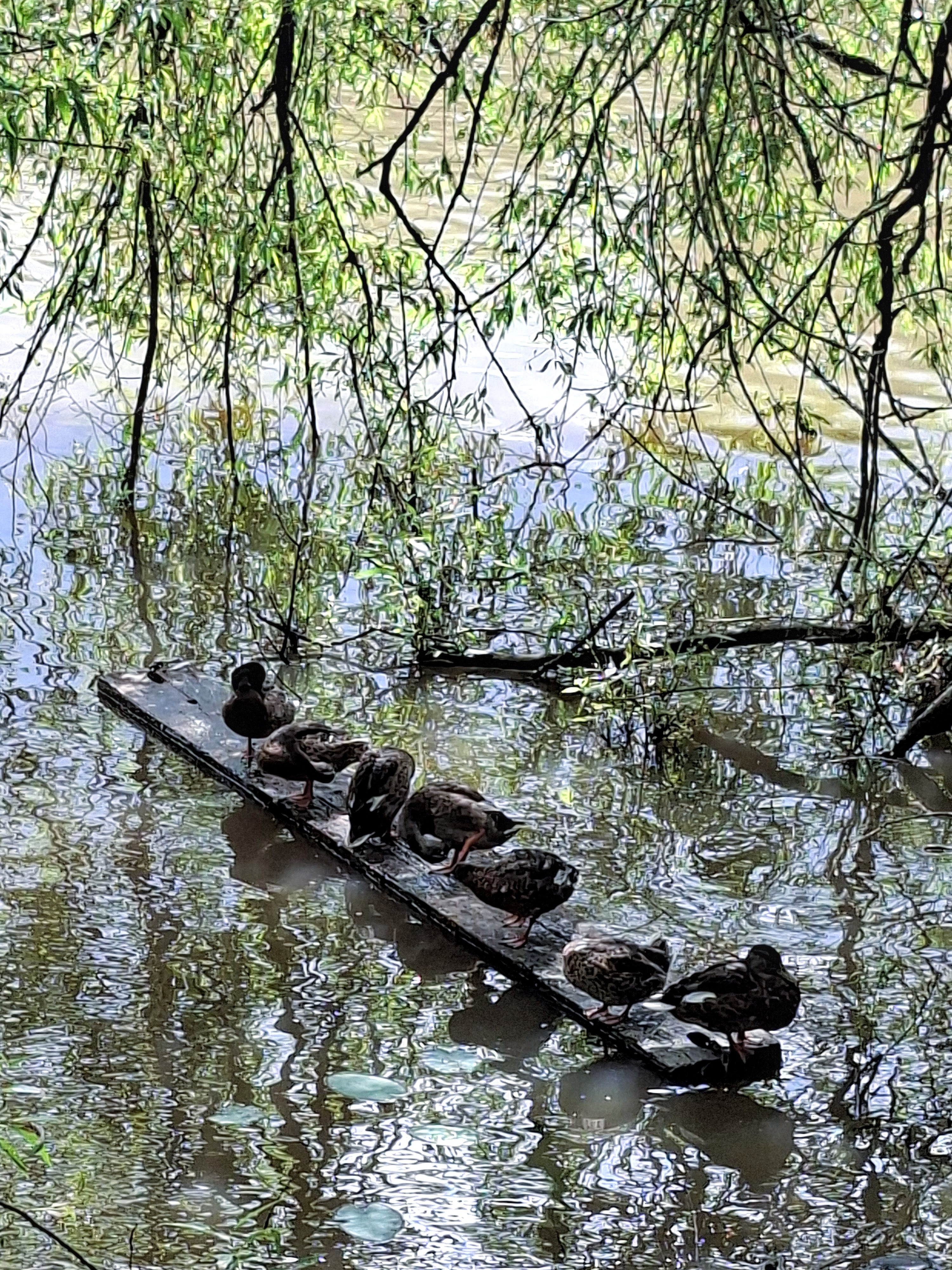
Yesterday I bought a new phone. I find this process stressful and have been putting it off for a long time. But now I have the phone, I can celebrate a new camera. These pictures were taken between 5.30 and 7 pm yesterday evening, when the sun didn’t set until after 8.

My celebration of the camera, here, was also a celebration of clear light and a more abundant greening. The spaces are familiar, but their specific manifestation and my specific experience were, as always, new. My feelings were those of simple gratitude, pleasure and appreciation.

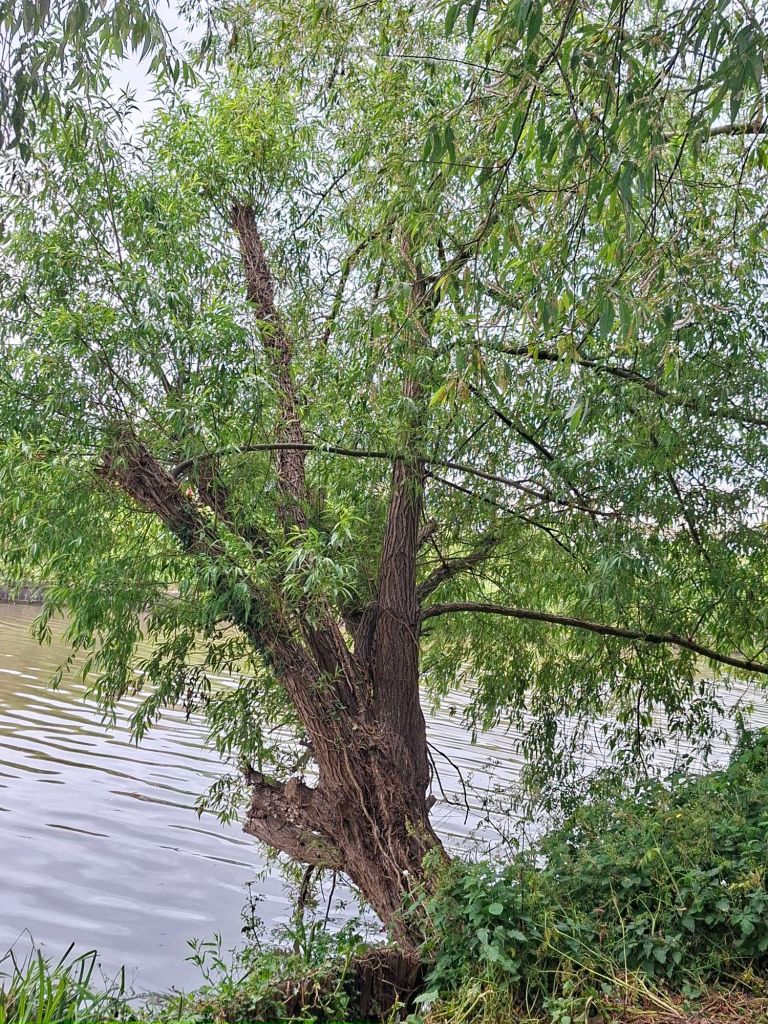
Above, I enjoyed the varied colours and forms of leaves, and the effects of sunlight on them. Below, I noticed the abundance of leaves and catkins on a birch tree.

Towards the water margin, I saw tangled green fecundity on the ground, and the freshness of full rich spring, at the same time utterly magical and yet so familiar, so taken-for-granted that it is easily passed without noticing.

Still closer to the water, and looking out over it, is another familiar scene, this time with contrasts of light and shade and emphasising the energy of rippling water.

Finally, big sky and the power of blue. I was especially drawn to the apparent division of the water. It looks like a tidal effect in the canal, but I am not sure of the cause. Within my contemplation, I am happy with the mystery.

MODERN DRUIDS (RONALD HUTTON) 2 MODERN DRUID MOVEMENTS

Modern Druids is the most recent public lecture (2 April 2025) presented by Professor Ronald Hutton in his tenure as Professor of Divinity at Gresham College, London. I provide a link below (1). This is the second of two posts about the lecture, focusing on Modern Druid movements in Britain from 1781. The first, concerning Hutton’s take on early modern perceptions of ancient Druidry, is published at https://contemplativeinquiry.blog/2025/04/08/ . It distinguishes four understandings, named by Hutton as Nationalist, Green, Demonic and Confessional.

Turning to modern Druid movements, Hutton also distinguishes four different kinds, emerging from the later eighteenth century up to the present:

  1. Masonic Druids The Ancient Order of Druids was launched in London in 1781, as a closed society with initiation rites, secret memberships, signs and passwords, loosely modelled on Masonry. Its purpose was to give working men opportunities for participation in the performing arts. By 1820 it had become a huge success, moving beyond London to the Midlands and North of England. Some members wanted more focus on the insurance side of friendly society life, and in 1833 the United Ancient Order of Druids was formed, splitting off from the AOD. The UAOD lasted until the late twentieth century. The original AOD still exists.
  2. Theosophical Druids emerged in the period from 1910 as an esoteric spiritual group. It followed the ideals of the Theosophical Society and worked towards the recovery of ancient mystical wisdom from all religions and philosophies. Founded by George Watson MacGregor Reid, and originally called the Order of the Universal Bond, the new group mixed Egyptian, Greek, Zoroastrian, Muslim, Jewish and Buddhist ideas with Irish and Welsh literature and using Druid names, roles and status. In 1912 a group of members went to Stonehenge to celebrate the Winter Solstice. Increasingly identified as The Ancient Druid Order they continued their association with Stonehenge for over 70 years. Always unpopular with the archaeologists of that period, the ADO sometimes had the support of the government and site administrators and sometimes not. In 1985 the festival that had grown up on the site was banned under Margaret Thatcher.
  3. New Age Druids is the name Hutton gives to the Order of Bards Ovates and Druids (OBOD). The first iteration of OBOD was a split-off from the ADO in 1964 led by Ross Nichols, who took the new group to Glastonbury for their public ceremonies. On his death in 1975, the Order went into hibernation until 1988, when Philip Carr-Gomm, who had been a youthful apprentice of Ross Nichols, re-awakened it. By 1988 the human potential movement, and a new Celtic revival strand in western alternative spiritualty, were both gathering in strength. True to its Theosophical roots, OBOD declared itself to be a spirituality rather than a religion and opened itself up to people of all religions and none. The bulk of the membership identified as either Pagan, Christian or Buddhist. OBOD declared an aim of “uniting humans with the natural world and their own true selves”, to “heal the disorientation implicit for many in an urbanised and atomised social existence” and “to give peace”. Hutton goes on to mention The British Druid Order (BDO) and The Druid Network (TDN) but doesn’t say much about them. Although they hived off from OBOD, dual or multiple membership is common.
  4. Counter Cultural Druids When the Stonehenge Festival was banned in 1985, many people felt they had lost a clergy and a temple as well as a festival. Some wanted to fight for a religion they saw as under attack. (Hutton does not specifially mention the ‘Battle of the Beanfield’.) The single most prominent leader who arose was Arthur Pendragon, ex-soldier, ex-biker gang leader, and mystic. He was prominently associated with the Glastonbury Order of Druids (GOD), the Secular Order of Druids (SOD) and the Loyal Arthurian Warband (LAW). These groups campaigned for civil liberties and preservation of the countryside. They held demonstrations against laws that limited the former, and organised protest camps on the routes of controversial road and building schemes. Arthur was frequently prosecuted and invariably acquitted by juries. Hutton identifies Arthur as part of a long tradition of working class protest, in which the use of costume and theatre is used to make disempowered people visible. Arthur himself had a more mystical view of his mission. Once, while looking for a sign, he noticed an attractive ceremonial sword in a local shop. Asked where it had come from, he was told that it had been Excalibur in the movie of that name.

Modern Druidry in Britain continues to mutate and develop, but Hutton ends his analysis at this point. I recommend readers to visit the link below and draw their own conclusions.

(1) https://www.gresham.ac.uk/watch-now/modern-druids/

GREYFRIARS PRIORY HAIKU

within the Priory ruins

this weathered arch

frames a living sky.

Note: The priory is the Greyfriars Priory, Gloucester, England

CONTEMPLATIVE DIARY?

Recently I have wondered whether to change the name of this blog from Contemplative Inquiry to Contemplative Diary. I won’t, because the inquiry focus has been very strong over the years. It is ancestral to the diary approach and a deep influence upon it. Some of the older inquiry posts continue to be read. The most popular is A Parable About a Parable first published in July 2018 – https://contemplativeinquiry.blog/2018/07/31/.

But most of my current posts are not like that. They tend to be more informal, more embedded in daily life, more obviously situated in time, place and everyday personal experience. My most recent post, Spring Forward https://contemplativeinquiry.blog/2025/03/31/ – is a case in point.

This shift in emphasis developed in the years of the Covid pandemic and is characterised by living the Wheel of the Year day-by-day (rather than festival by festival) in a specific location. I use my own photographs much more than in the early days of the blog. For me, these changes fit with a name like Contemplative Diary.

Yet the diary approach is itself a fruit of inquiry. It has emerged as I become relatively less concerned with fundamental questions. They are now settled for me as far as they can be in this life. My current work comes out of an individual life practice grounded in modern Druidry, with a firm ethical basis and a light touch in formal ritual and meditation. All of these are illuminated by the sense of a divine presence from which the world, including me, is not separate.

Contemplation and inquiry are still at the heart of my work, in simpler and more relaxed forms than was right for the early years. The diary approach marks an emerging phase of my contemplative inquiry, rather than a break with it. Where it will take me going forward, I cannot yet say.

SPRING FORWARD

I’m on my first canal walk in a while. The picture above shows a small inlet into the bankside woods. It is Sunday 30 March, the first day of British Summer Time. I am encountering a long sunlit evening and feeling energised by the experience. I am drawing power from the clarity and strength of the light.

Sunset will be around 7.30 pm. The pictures above and below were taken a little before 6. I am glad to see blackthorn, a wood said to be used for wizard’s staffs, proclaiming the magic of spring.

A little later, I  focus my attention on a  vivid yet tranquil blue sky, presiding over the canal scene below. I have the same powerful sense of of clarity and strength in the light, and of drawing energy from it.

Later on, at about 6.45 pm, I find a softer, gentler quality of light as I walk homewards through the woods. Looking down, I see it on my path.

Looking up, I see soft light on slender branches and the foliage below them. It feels like celebration.

My final image is of sunlight reflected in Gloucester Docks, both on a warehouse window and on the water. The sun is low now and beginning to set. Rather than pointing at it, as it descends, I point  away from it to honour and record its power in another way. This marks the completion of a rejuvenating and regenerative spring forward walk.

Earth Eclectic

music that celebrates Earth and speaks to the heart

Sarah Fuhro Star-Flower Alchemy

Follow the Moon's Cycle

Muddy Feet

Meeting nature on nature's terms

Rosher.Net

A little bit of Mark Rosher in South Gloucestershire, England

Becoming Part of the Land

A monastic polytheist's and animist’s journal

selkiewife

Selkie Writing…

Charlotte Rodgers

Images and words set against a backdrop of outsider art.

Prof Jem Bendell

living with metacrisis and collapse

Towint

The pagan path. The Old Ways In New Times

The Druids Garden

Spiritual journeys in tending the living earth, permaculture, and nature-inspired arts

The Blog of Baphomet

a magickal dialogue between nature and culture

This Simple Life

The gentle art of living with less

Musings of a Scottish Hearth Druid and Heathen

Thoughts about living, loving and worshiping as an autistic Hearth Druid and Heathen. One woman's journey.

Wheel of the Year Blog

An place to read and share stories about the celtic seasonal festivals

Walking the Druid Path

Just another WordPress.com site

anima monday

Exploring our connection to the wider world

Grounded Space Focusing

Become more grounded and spacious with yourself and others, through your own body’s wisdom

The Earthbound Report

Good lives on our one planet

Hopeless Vendetta

News for the residents of Hopeless, Maine