Contemplative Inquiry

This blog is about contemplative inquiry

Tag: contemplative spirituality

LUNAR LIGHT

Today I felt settled enough in my new sacred space to consult the DruidCraft Tarot (1). It goes with a sense of full arrival in a new home and of readiness for a psychic check-in: what possibilities are latent or emerging in my journey through life?

I was presented with a three card narrative that I found encouraging. The first, the context that I am coming from, was the seven of wands with its sense of challenges successfully faced. The third, the Lady (DruidCraft’s Empress), heavily pregnant, points to abundance and fruition. But it was the middle card, the where-I-am-now card, that got my attention most. The Moon.

For me, the Moon points in particular to the deeper rhythms and tides of the unconscious, aspects of life that have their being outside the bright light of solar awareness, too easily edited out of my narrative identity. This is a world of powerful, yet dimly remembered dreams, unquiet moods and sensations, and half-articulate intuitions. There are qualities here, in this shadowy, softly lit world, to welcome and companion. They hide a distinctive wisdom of their own, unlike that of the image-conscious, yarn-spinning ego.

Much of my focus in recent years has been on the state I call, in ritual space, ‘the peace of the centre’ – sometimes the peace of the Goddess. This is well-anchored now and allows a more panoramic view. Under lunar influence, the peace of the centre is complemented by a perturbation of the margins, also part of the ecology of being human. The process of moving house has reminded me of my talents for anxiety and catastrophising ideation: limitations, perhaps, at times disabling. But they protect me from a blind trust in the world. They generate a wary alertness, and balance my deep sense of peace.

(1) Philip and Stephanie Carr-Gomm The DruidCraft Tarot: Use the Magic of Wicca and Druidry to Guide Your Life London: Connections, 2004 (Illustrated by Will Worthington)

CHANGING PERSPECTIVES

I have been walking among buildings, before being drawn something different – at first, a fleeting impression to my right. I turn to face it. I walk forwards a few yards, as the new vision clarifies, and feel moved to take this picture. I am still aware of buildings, but boats and water now dominate. There are trees and moving clouds in the distance. The world lights up. It feels like a perceptual rebirth. I find myself in a new and different world.

I continue walking, towards the water. Then I turn left, I look left, I and both see and feel the energy of water and clouds. They invite me to follow them out of the city. I take the picture below, and register the prospect of another canal walk, quite different from the one I knew in Stroud.

In this time of changed perspectives, I notice a shift in my sense of contemplation and inquiry. I feel strongly anchored in this life and world, the place where experiences happen. The numinous is embedded in the everyday, and gifts me with a fruitful ground for continuing exploration.

THICH NHAT HANH ON AIMLESSNESS

Thich Nhat Hanh, the much loved Buddhist teacher from Vietnam, died on 22 January at the age of 95. He had been unwell for some time. He is remembered as peace activist, inventor of the term ‘interbeing’ and teacher of mindfulness practice. For him, this is the practice of being aware of what is going on in the present moment. We can be mindful at any moment, whether we are sad, joyful, angry, and whilst cooking, driving or about to send an email.

I am not a Buddhist. Instead, I feel and recognise Thich Nhat Hanh’s influence on my practice of Druidry – especially my sense of at-homeness, or presence, in the living moment. In memory and appreciation of him, I want to share a piece he wrote about aimlessness as as a ‘door of liberation’ (1).

“The concentration on aimlessness means arriving in the present moment to discover that the present moment is the only moment in which you can find everything you’ve been looking for and that you already are everything you want to become.

“Aimlessness does not mean doing nothing. It means not putting something in front of you to chase after. When we remove the objects of our craving and desires, we discover that happiness and freedom are available right here in the present moment.

“We have a habit of running after things, and this habit has been transmitted to us by our parents and ancestors. We don’t feel fulfilled in the here and now, and so we run after all kinds of things we think will make us happier. We sacrifice our life chasing after objects of craving or striving for success in our work or studies. We chase after our life’s dream and lose ourselves along the way. We even lose our freedom and happiness in our efforts to be mindful, to be healthy, to relieve suffering in the world, or to get enlightened. We disregard the wonders of the present moment, thinking that heaven and the ultimate are for later, not for now.

“To practice meditation means to have the time to look deeply and see these things. If you feel restless in the here and now, or you feel ill at ease, you need to ask yourself: ‘what am I longing for? what am I waiting for? what am I searching for?'”

(1) Thich Nhat Hanh The Art of Living London: Rider, 2017

OLD CITY, NEW HOME

Above, a city park containing monastic ruins. I am beginning to make sense of a new habitat. The distance door-to-door is only about ten miles from the old one. But it feels very different. Stroud the Cotswold mill town is hilly and hard on the older pedestrian. Gloucester is an old English city on the river Severn, much flatter. The centre, where we now live, has become highly pedestrian friendly in recent years. This was a key motivator for our move and it already feels transformational.

On an exploratory amble on Sunday, Elaine and I were very aware of history. St. Oswald’s Priory, in the picture above, was founded by Lady Aethelflaed of Mercia, daughter of Alfred the Great, around 900. The Priory Church, initially dedicated to St. Peter, was constructed from recycled Roman stones. (The Romans founded the city, as Glevum, in the first century CE, and it never quite died after their departure from Britain). In Aetheflaed’s time it was a bold and unusual move to build a church as there were frequent Viking raids. Quite possibly Aethelflaed and her husband were later interred in the crypt. Archaeological excavations in the 1970s revealed a 10th century fragment of carved slab from the grave of someone of high importance.

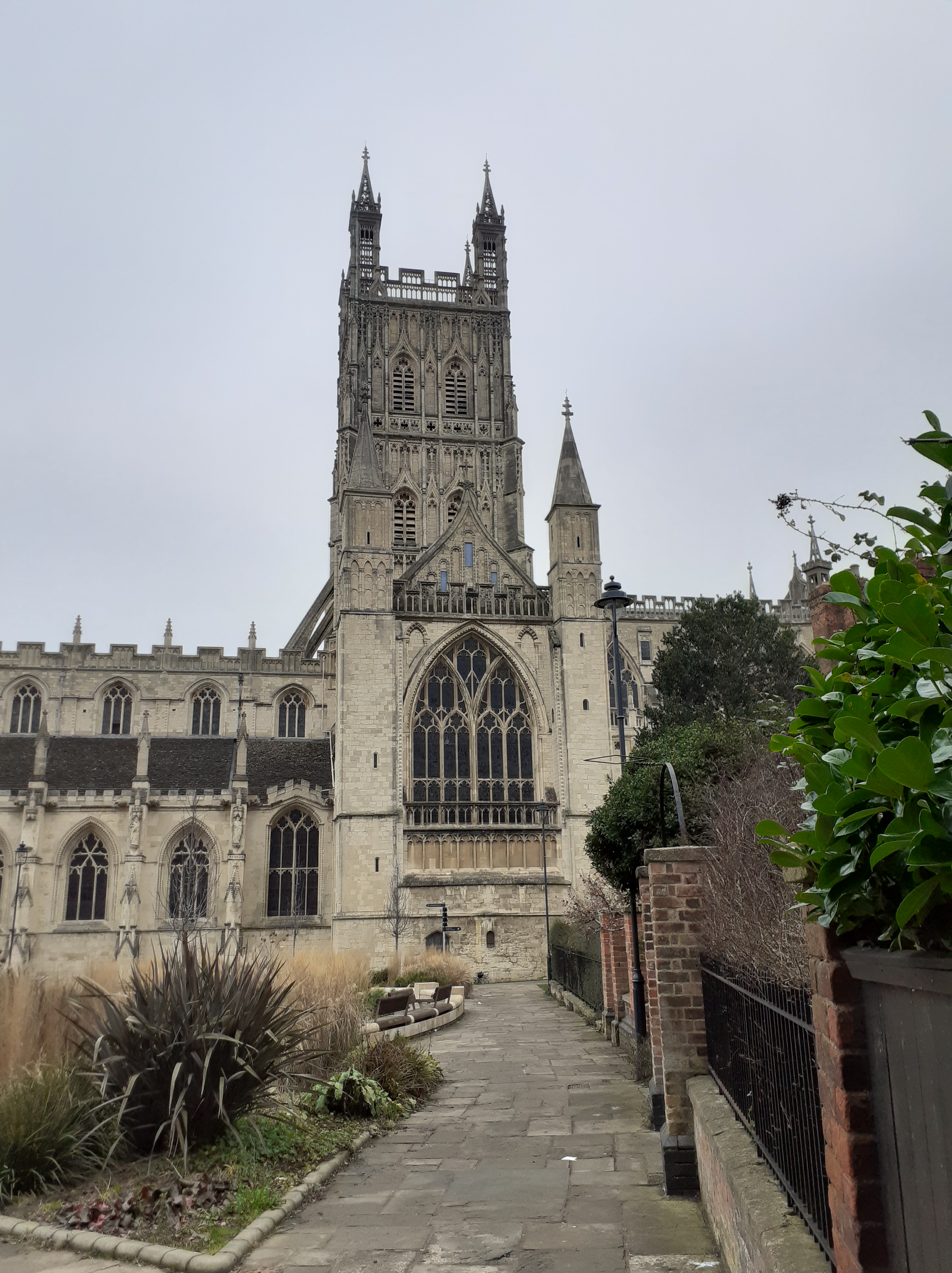
In the centuries that followed St Oswald’s grew rich as a place of pilgrimage and was at the centre of a large parish. But later it declined, as institutions do. It was almost literally in the shadow of the more successful Abbey of St. Peter, now Gloucester Cathedral, where the power of the church was now based. Architecturally, the cathedral (below) still dominates the city.

When Elaine and I were walking together on Sunday, the bells were ringing and we found ourselves enjoying this as an expression of the old city’s identity. As in other old cathedral cities, the cathedral is characteristically approached through narrow, often arched lanes and then appears magnificently in front of us.

We have another church, St. Mary-Le-Crypt (below), even closer to home, and cut through its churchyard to get to a major traditional shopping street. Like the cathedral, it continues to serve Anglican (Episcopalian) worshippers and to be part of the wider community.

I have as yet no idea what effect, if any, living in Gloucester will have on my contemplative inquiry, nested as it is in Druidry and Earth spirituality. It is much too early to tell. From the perspective of the living moment, I am delighted to be soaking in new impressions, aware that this is where I live now. Looking out, this is what I will frequently see. These sights are part of the texture of my daily experience now, and I welcome them as such. It greet a new way of being at home.

READYING FOR RELOCATION

I will be moving house very soon. This will no longer be the view from my bedroom window. My gaze today is tinged with premature nostalgia.

This gaze shows continuity and slow, gradual change in the world outside. This world wears its winter look, with bare branches and extensive views. At other times of the year, both are covered by foliage. But the solstice darkness has already withdrawn from the mid-afternoon. Today is blessed with strong sunlight and blue sky. The year is turning again, now towards the light.

The house move feels more abrupt. I have lived here for longer than anywhere else in my adult life. Chiefly it has been the hallowed setting for my life with Elaine (1). Whilst living here, I completed my OBOD training, later beginning a self-directed exploration of contemplative Druidry, including a 4 year project within the Druid community (2). For a while, contemplative inquiry – within and beyond Druidry – became the guiding principle of my spirituality. Now it is more like an influential thread within my Druid practice.

I wonder what changes life in another location will make, as Elaine and I continue our journey together. There will be only a limited break from the past. We will be in the same county, though not the same town. But there will be differences too. The psychogeography will be different. The spirits of place will be different. The world beyond our windows will be new.

(1) http://www.elaineknight.wordpress.com

(2) James Nichol , Contemplative Druidry: People, Practice and Potential, Amazon/Kindle, 2014.  https://www.amazon.co.uk/contemplative-druidry-people-practice-potential/dp/1500807206/

WELCOMING 2022

Bright Blessings to everyone at the turn of the calendar year. With some fears and greater hopes, I have crossed the threshold into 2022. I have welcomed it into my life and declared myself ready for the journey.

In a way, ‘2022’ is a fiction woven from our human experience of linear time and a cultural decision about numbers. But these things are thoroughly ingrained in me and feel like givens, completely natural. I remember clocking this, or signing up to the tribal custom, in the new year of 1957, when I was 7 years old and found myself remembering 1956 as a full, known year. It was the first time I had been conscious of such a thing. Now I was somewhere new and exciting (1957) though the feel of my bedclothes was familiar in the very dim early morning light. I remember this vividly and, truth be told, better than I remember waking up yesterday.

Flowing water is often used as an image for the passing of linear time. On my walk yesterday morning, I checked this out in nature and made two brief videos of a stream. Standing on the bridge at slightly different times, facing in opposite directions, I filmed a stream flowing both towards me and away from me. My feelings about the two were a little different.

The water coming towards me felt fresh and energised. I was curious about the patterns on the surface both from the flow itself and from the rain. I was drawn in, more meditatively, by the sound. I was also interested in what stories the water might hold. But I didn’t follow these up, out of concern for losing the immediate experience. Above all I, felt invigorated. I enjoyed this flow.

Flowing away was different. It wasn’t raining and I could hear – I think – sea gulls. They are certainly around. Again I enjoyed patterns in the water and the enlivening strength of the flow. But I was strongly aware of it moving away from me. Yes – it was reliably replenished … but for how much longer? And, in any case, a movement away is a movement away. Movements away carry a sense of loss. This isn’t just about my age. It is built into the experience of linear time. Things pass away into a temporal distance. Linear time is the mechanism that allows anything to ‘happen’ at all, but also the guarantor of impermanence. There’s a poignancy in this condition that I allow myself to experience and hold – not, here, seeking comfort in the eternal. I watch the power of a little stream, grateful for the miracle of existence, softly sad about its vulnerable brevity.

STILLNESS IN A TURNING WORLD

Late on Christmas morning, I went out for a midwinter walk. It was relatively warm outside (8C/46F). The world seemed static and still. Yet I had the sense of a new year quietly being born, somewhere under the surface. Ripples in the water seemed to me to confirm this.

The midwinter season that I observe in nature can be like that – superficial dullness masking dynamic transformation. Life is strong in this watery place. The wheel continues to turn. There may be harsh weeks ahead, but the overall movement of time is already leaning towards regeneration, rather than the seasonal dying of late autumn and early winter.

At times like this I sense the presence of an ancient cosmic motherhood that gives me hope for the coming year. May all beings be blessed.

CAILLEACH

I was on a train and had reached my destination. Descending onto the platform at 5.30 pm, I found myself in complete darkness. It might as well have been midnight. I understood that winter had come.

The Goddess in her cailleach, or crone, aspect presides over this time. She it is who determines the length and severity of winter. She is also embodied in the dark woman of knowledge who facilitates both death and transformation (1).

In the context of my contemplative inquiry/blog, I am experiencing a process of this kind, seemingly in a minor key. I want to call it ‘hibernation and renewal’, though I cannot predict how it will really be. In any event, I have decided to do no more posting until the new year. What happens then depends on what I am inspired to do at the time. But now is a time for surrender to endarkenment and sleep.

(1) Philip and Stephanie Carr-Gomm The DruidCraft Tarot: Use the Magic of Wicca and Druidry to Guide Your Life London: Connections, 2004. Illustrated by Will Worthington.

WHAT IS GIVEN

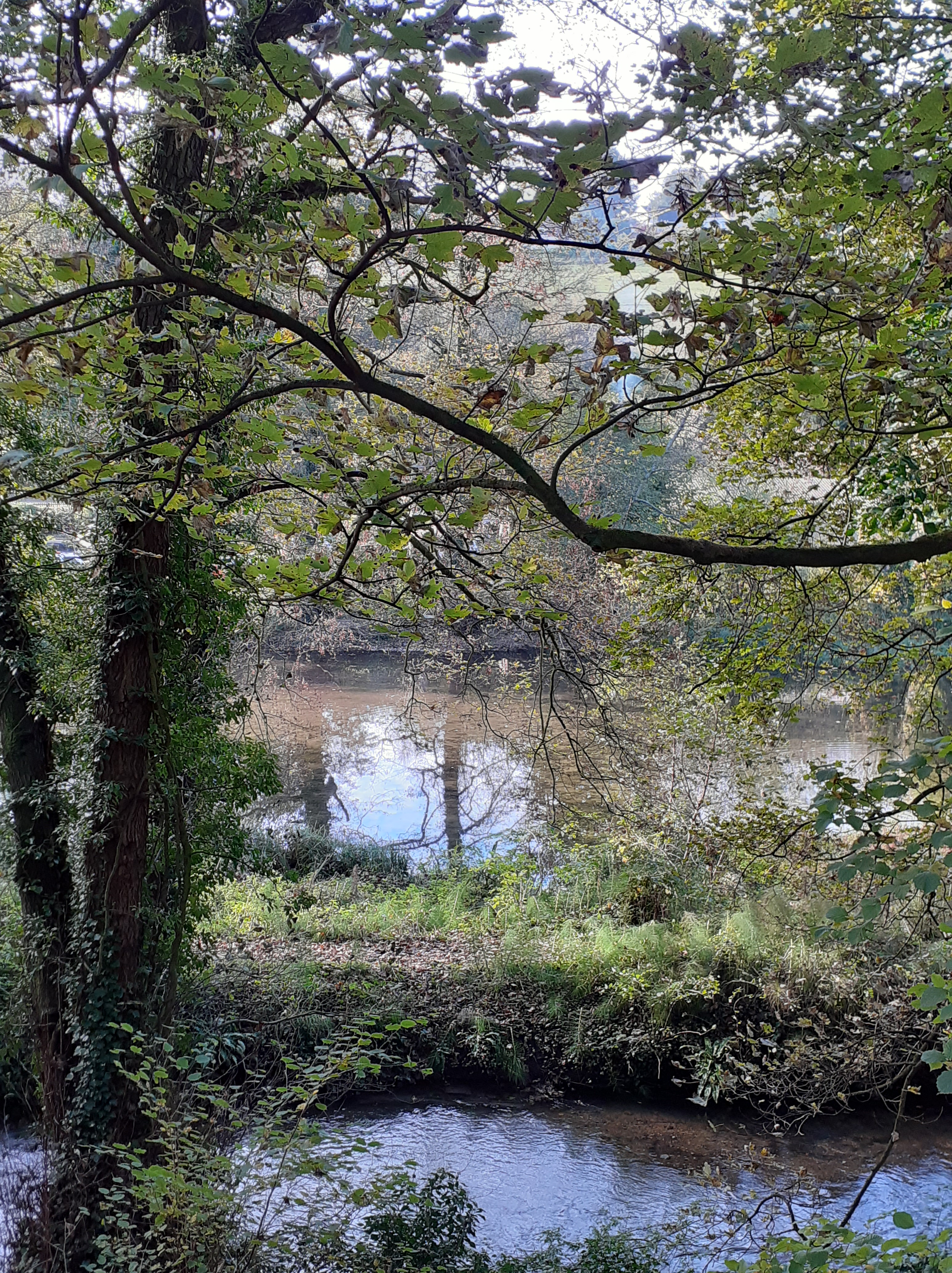
It is colder now, and gloomier indoors for much of the day. But outside, this November keeps on giving. My walking range has increased again with a walk to nearby Nailsworth, a leisurely lunch in this little town, and a walk back again: ten miles. The picture above includes both a stream beside my path and a small lake nearby.

But my attention hasn’t been all on the world around me. I have been reflecting on an old statement about my practice, currently included in my About section, and finding that it still holds. “My inquiry process overall has helped me to discover an underlying peace and at-homeness in the present moment, which, when experienced clearly and spaciously, nourishes and illuminates my life. It is not dependent on belief or circumstance, but on the ultimate acceptance that this is what is given. I find that this perspective supports a spirit of openness, an ethic of interdependence and a life of abundant simplicity.”

There is no reliance on metaphysics here. This allows me a pared down focus on experience and values. My practice has been relatively stable over a long period, whereas my thoughts about metaphysical questions are more volatile. I experience thinking as volatile by nature, and fine within its limits. Over the years this blog has found room for diverse approaches to the meaning, if any, of terms like divinity and consciousness. I have wondered about the possibility (or desirability) of establishing any foundational truth about absolute or indeed conventional ‘reality’. I notice now that when I explore these questions – especially when reading – I am more interested in seeing how people put their worlds together than I am in identifying insights or finding answers to the questions themselves. It has become a human interest rather than a philosophical quest.

I have noticed this especially over recent days when engaging with Carlo Rovelli’s discussion of the Buddhist philosopher Nagarjuna (1,2). My interest was in seeing how a distinguished physicist makes use of Nagarjuna’s emptiness doctrine. I have less stake in assessing the view itself, because my peace and at-homeness are the result of an experiential inquiry, and not of speculative thinking. I continue to find that this perspective supports “a spirit of openness, an ethic of interdependence, and a life of abundant simplicity”, My inquiry focus, if ‘inquiry; is even the right word, is about how best to walk the talk.

(1) Carlo Rovelli Helgoland global.penguinrandomhouse.com 2020 (Translated by Erica Segre & Simon Carnell, 2021). Carlo Rovelli is a theoretical physicist who has made significant contributions to the physics of space and time.

(2) https://contemplativeinquiry.blog/2021/11/08/exploring-emptiness-carlo-rovelli-and-nagarjuna

EXPLORING ‘EMPTINESS’: CARLO ROVELLI AND NAGARJUNA

A modern western humanist learns from an ancient Buddhist philosopher. Carlo Rovelli’s book Helgoland (1) is mostly about the development of quantum mechanics in the early to mid-twentieth century and the scientists who developed it. The title references ‘Werner Heisenberg’s sojourn on the remote island of Helgoland working on the maths. But one chapter concerns the second century CE Buddhist philosopher Nagarjuna, and how his work has helped Rovelli to frame a philosophical understanding of quantum phenomena.

“When speaking about quanta and their relational nature I had frequently met people who asked: Have you read Nagarjuna? … Though not widely read in the West, the work in question is hardly an obscure or minor one: it is one of the most important texts in Buddhist philosophy. … The central thesis of Nagarjuna’s book is simply that there is nothing that exists in itself, independently from something else.

“The resonance with quantum mechanics is immediate. Obviously Nagarjuna knew nothing, and could not have imagined anything, about quanta – that is not the point. The point is that philosophers offer original ways of re-thinking the world, and we can employ them if they turn out to be useful. The perspective offered by Nagarjuna make perhaps make it a little easier to think about the quantum world (2).

“If nothing exists in itself, everything exists only through dependence on something else, in relation to something else. The technical term used by Nagarjuna the absence of independent existence is ‘emptiness’ (sunyata): things are ‘empty’ in the sense of having no autonomous existence. They exist thanks to, as a function of, with respect to, in the perspective of, something else.

“If I look at a cloudy sky – to take a simplistic example – I can see a castle and a dragon. Does a castle and does a dragon really exist, up there in the sky? Obviously not: the dragon and the castle emerge from the encounter between the shape of the clouds and the sensations and thoughts in my head; in themselves they are empty entities, they do not exist. So far, so easy. But Nagarjuna also suggests that the clouds, the sky, sensations, thoughts and my own head are equally things that arise from the encounter with other things: they are empty entities.

“And myself, looking at the star, do I exist? No, not even I. So who is observing the star? No one says Nagarjuna. To see a star is a component of that set of interactions that I normally call my ‘self’. ‘What articulates language does not exist. The circle of thoughts does not exist.’ There is no ultimate or mysterious essence to understand that is the true essence of our being. ‘I’ is nothing other than the vast and interconnected set of phenomena that constitute it, each one dependent on something else. Centuries of Western speculation on the subject, and on the nature of consciousness, vanish like morning mist.

“Like much philosophy and much science, Nagarjuna distinguishes between two levels: conventional, apparent reality with its illusory and perspectival aspects, and ultimate reality. But in this case the distinction takes us in an unexpected direction: the ultimate reality, the essence, its absence, is vacuity. It does not exist.

“If every metaphysics seeks a primary substance, an essence on which everything may depend, the point of departure from which everything follows, Nagarjuna suggests that the ultimate substance, the point of departure … does not exist.

….

“The illusoriness of the world, its samsara, is a general theme of Buddhism; to recognize this is to reach nirvana, liberation and beatitude. For Nagarjuna, samsara and nirvana are the same thing: both empty of their own existence. Non-existent.

“So is emptiness the only reality? Is this, after all, the ultimate reality? No, writes Nagarjuna, in the most vertiginous chapter of the book: every perspective exists only in interdependence with something else, there is never an ultimate reality – and this is the case for his own perspective as well. Even emptiness is devoid of essence: it is conventional. No metaphysics survives. Emptiness is empty.

“Nagarjuna has given us a formidable conceptual tool for thinking about the relationality of quanta: we can think of interdependence without autonomous essence entering the equation, In fact interdependence – and this is the key argument made by Nagarjuna, requires us to forget all about autonomous essences.

“The long search for the ‘ultimate substance’ in physics has passed through matter, molecules, atoms, fields, elementary particles … and has been shipwrecked in the relational complexity of quantum field theory and general relativity. Is is possible that a philosopher from ancient India can provide us with a conceptual tool with which to extricate ourselves?”

“The fascination of Nagarjuna’s thought goes beyond questions raised by contemporary physics. His perspective has something dizzying about it. It resonates with the best of much Western philosophy, both classical and recent. … He speaks about reality, about its complexity and comprehensibility, but he defends us from the conceptual trap of wanting to find it an ultimate foundation.

“His is not metaphysical extravagance: it is sobriety. It recognizes the fact that to inquire about the ultimate foundation of everything is to ask a question that perhaps simply does not make sense.

“This does not shut down investigation. On the contrary, it liberates it. Nagarjuna is not a nihilist negating the reality of the world, and neither is he a sceptic denying that we can know anything about that reality. The world of phenomena is one that we can investigate, gradually improving our understanding of it. We may find general characteristics. But it is a world of interdependence and contingencies, not a world that we should trouble ourselves attempting to derive from an Absolute.

“I believe that one of the greatest mistakes made by human beings is to want certainties when trying to understand something. The search for knowledge is not nourished by certainty: it is nourished by a radical absence of certainty. Thanks to the acute awareness of our ignorance, we are open to doubt and can continue to learn and learn better. This has always been the strength of scientific thinking – thinking born of curiosity, revolt, change. There is no cardinal or final fixed point, philosophical or methodological, with which to anchor the adventure of knowledge.

“I am not a philosopher; I am a physicist: a simple mechanic. And this simple mechanic, who deals with quanta, is taught by Nagarjuna that it is possible to think of the manifestation of objects without having to ask what the object is in itself, independent from its manifestations.

“But Nagarjuna’s emptiness also nourishes an ethical stance that clears the sky of the endless disquietude: to understand that we do not exist as autonomous entities helps us free ourselves from attachments and suffering. Precisely because of its impermanence, because of the absence of any absolute, the now has meaning and is precious.

“For me as a human being, Nagarjuna teaches the serenity, the lightness and the shining beauty of the world: we are nothing but images of images. Reality, including ourselves, is nothing but a thin and fragile veil, beyond which … there is nothing.”

(1) Carlo Rovelli Helgoland global.penguinrandomhouse.com 2020 (Translated by Erica Segre & Simon Carnell, 2021) Carlo Rovelli is a theoretical physicist who has made significant contributions to the physics of space and time.

(2) The Fundamental Wisdom of the Middle Way: Nagarjuna’s Mulamadhyamakakarika: Translation and commentary by Jay L. Garfield. Oxford: The University Press, 1995. Nagarjuna, who lived in South India in approximately the second century CE, is the most important, influential and widely studied Mahayana Buddhist philosopher. At the time of publication Jay L. Garfield was Professor of Philosophy and Director of the Hampshire in India Program, an exchange program with the Tibetan Universities in exile, at Hampshire College, Amherst, Massachusetts. His translation is from a Tibetan, rather than Sanskrit, text.
Earth Eclectic

music that celebrates Earth and speaks to the heart

Sarah Fuhro Star-Flower Alchemy

Follow the Moon's Cycle

Muddy Feet

Meeting nature on nature's terms

Rosher.Net

A little bit of Mark Rosher in South Gloucestershire, England

Becoming Part of the Land

A monastic polytheist's and animist’s journal

selkiewife

Selkie Writing…

Charlotte Rodgers

Images and words set against a backdrop of outsider art.

Prof Jem Bendell

living with metacrisis and collapse

Towint

The pagan path. The Old Ways In New Times

The Druids Garden

Spiritual journeys in tending the living earth, permaculture, and nature-inspired arts

The Blog of Baphomet

a magickal dialogue between nature and culture

This Simple Life

The gentle art of living with less

Musings of a Scottish Hearth Druid and Heathen

Thoughts about living, loving and worshiping as an autistic Hearth Druid and Heathen. One woman's journey.

Wheel of the Year Blog

An place to read and share stories about the celtic seasonal festivals

Walking the Druid Path

Just another WordPress.com site

anima monday

Exploring our connection to the wider world

Grounded Space Focusing

Become more grounded and spacious with yourself and others, through your own body’s wisdom

The Earthbound Report

Good lives on our one planet

Hopeless Vendetta

News for the residents of Hopeless, Maine