Contemplative Inquiry

This blog is about contemplative inquiry

Tag: contemplative spirituality

A MOMENT OF GENTLE RAIN

Saturday morning, 8 July. Gloucester, England. I am warm. I am indoors. I am contentedly lethargic. My gaze turns to a balcony door.

I contemplate Elaine’s balcony garden. The flowers are less dramatic than during the solstice period. Their colours are softer. I see more green. I see raindrops on the other side of the door. They are evidence of a gentle rain falling on this tiny garden.

“I am the movement of the breath and stillness in the breath”, I say in my Druid contemplative liturgy. “Living presence in a field of living presence: here, now and home”. This can be true at any time, but some conditions are more helpful than others. Here and now, I become alive to the balcony garden, fully present. Knowing Elaine as creator of this garden extends my sense of connection. A simple nourishing moment.

Hours later, with a flash and a crash, the heavens opened and my world changed, heralding a new kind of experience.

Raindrops on glass,

Flowers in their pots.

Calm before the storm.

FIVE IMAGES: MIDSUMMER CELEBRATION 2023

The five images in this blog record a dedicated solstice walk, an evening walk beginning 8 pm on 20 June. For me, the solstice period lasts around a week ending on 25 June. I like to acknowledge the stasis (standstill) element. My festival practice is not about a moment in time so much as honouring an extended pause before the wheel turns, at first slowly, towards the dark.

I sought immersion in the unique and sacred flavour of this day at this time in this place. I do not believe my images ‘capture’ that flavour – now gone with the moment it belonged to. But the pictures do provide a suggestive record of that time. They help my memory. They remind me especially that my experience of this practice in 2023 differs from that of 2022, when I first undertook it as a solo, contemplative form of midsummer celebration. (See: https://contemplativeinquiry.blog/2022/06/24/.)

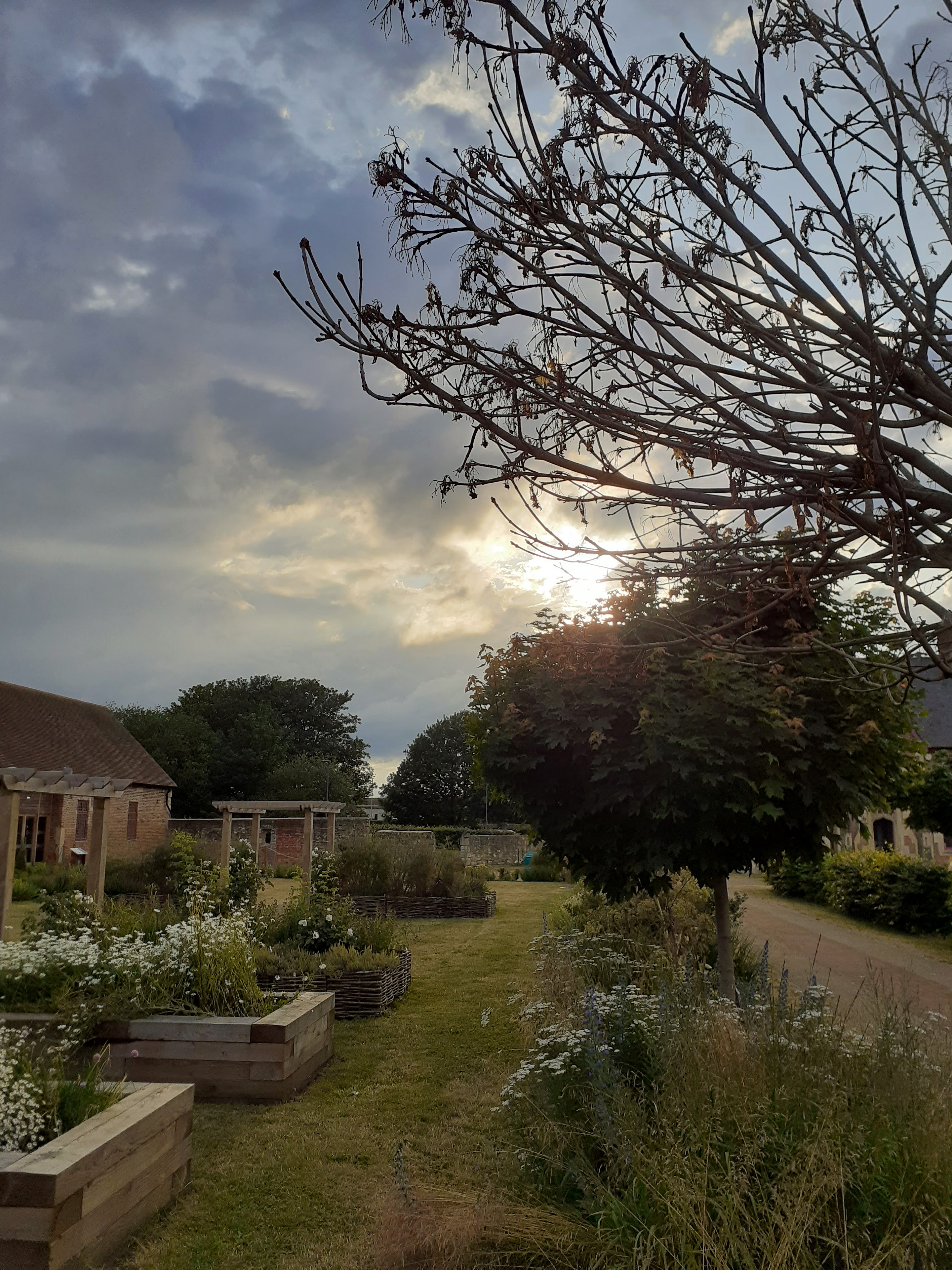
The first image (above) is of Llanthony Priory gardens, dominated this evening by a dramatic sky. Sunlight shines through heavy clouds, dark and suggestive of a storm that we had largely missed in Gloucester. Three canalside images (below) also display the energy of clouds with the sun backlighting them. I find both beauty and power here, indeed a strong sense of powers greater than mine, and indeed of ours collectively. This year, my seasonal immersion has an edge. A modern Druid, I celebrate the seasons and reverence the elements. But I certainly don’t own them, or decide how they are meant to be.

During my walk I spent a lot of time with my eyes turned upwards and skywards, with hints of both awe and foreboding. I understand how sky god spiritualites work. But I also looked across and down and found new life. A pair of swans and their cygnets were finding space on the water on a busy small marina. It is now surrounded by housing on three sides, yet they seemed flourishing and confident. Storm clouds of many kinds threaten. Life goes defiantly on.

BOOK REVIEW: STAFF OF LAUREL, STAFF OF ASH

“If our place is imperilled, so are our myths. If we heal the one, we heal the other … So said priestesses who long ago spoke in the voice of doves. So said the prophetic oaks they tended, who murmured to their suppliants through wind blown leaves.”(1)

Staff of Laurel, Staff of Ash: Sacred Landscapes in Ancient Nature Myth is an inspirational collection of interwoven contemplations on landscape and myth; on enchantment, disenchantment and re-enchantment. I strongly recommend it to anyone with an interest in these themes.

Author Dianna Rhyan says of her own approach to writing: “assembled, these pages refused to assemble, and so altogether, they form a series of sketches, fallen like samaras*, whose order is ultimately undetermined. The priestess of Apollo wrote her prophecies on leaves. When strong winds came, they scattered all over her cave. Did she mind? Amidst the leaves, voices of winds and voices of trees, lost and found, thread their way.” This review shares something of the book’s flavour, rather than attempting a linear account of what is covers.

Rhyan draws strength from wild and marginal spaces, especially the Cuyahoga River in north eastern Ohio. She describes her close relationship with the land but is all too aware of a sadness in its silence. The genocidal displacement of the people who once lived there has erased their stories about this land and their relationship with it. As a mythologist, she looks further afield for inspiration, especially ancient Mesopotamia (now Iraq) and the early Greek speaking world. Even four thousand years ago, in the early Sumerian world, people had doubts about ‘civilisation’. We find the contrasting influences of the laurel, which blooms, and the ash, “a battle-earned artifact”.

In the Epic of Gilgamesh (2) the hero destroys a forest and its guardian at an early stage of his “futile immortality quest” and then goes out of his way to offend the Mother Goddess Inanna. In The Descent of Inanna, she herself must experience death, losing her identity and powers as she descends through seven gates to the Underworld controlled by her sister Ereshkigal. Asking, at each gate, ‘Gatekeeper, why is this done?’, she receives the reply ‘Silence, Inanna. Do not open your mouth against custom. The rules of the Great Below are flawless. You may not question what is perfect.’ Rhyan’s reading of this ritualised and repeated reply finds a new order in which free nature, and the Goddess perceived as its embodiment, need to be rigorously controlled. She comments on the way in which perfection “deadens” and rules “disarm”. For three days Inanna hangs dead, a carcass on a hook. But the upper world needs Inanna in order to reproduce itself and flourish. The Wisdom God Enki sends emissaries to Ershkigal to secure Inanna’s release. She does not stay dead.

Rhyan also draws on Greek sources from different periods. One of them, from Sophocles’ last play, Oedipus at Colonus, is about the final days of Oedipus, after he has blinded himself and been been exiled from his erstwhile kingdom of Thebes. These misfortunes follow the discovery that he has (unwittingly) killed his father, married his mother and thereby, as a source of pollution, caused a plague in the city. He is told: “seek no more to master anything”.

Oedipus is now a pauper, wandering in a wasteland. Letting go of his civic and social identities and surrendering to this fate, he survives. He is reborn as a child of nature on the goddess haunted mountain Cithaeron. For his awakened inner vision has guided him to the place where he was once, as an infant, left out to die. The compassionate nymphs who nursed him then are perhaps looking out for him once more. He has journeyed from palace to periphery, freed from all power and self-determination. At that point, he is given a new role, as guardian of the sacred grove at Colonus. It is a place beloved by immortals, a place of lush growth, where the nightingale sings, and with “cool waters” that never fail. Here, as this new version of himself, he will live out his days.

Late on in her book, Dianna Rhyan says: “if we look over our shoulder, not only what we threw away as detritus is following us. What we had despaired we had lost forever, long ago in the depths of ancient ages, is following us too. We require myth, intensely alive myth, to see it. It is very good at not being seen.” I see her as making a great contribution to making ‘intensely alive myth’ visible once more.

(1) Dianna Rhyan Staff of Laurel, Staff of Ash: Sacred Landscapes in Ancient Nature Myth Winchester, UK & Washington, USA: Moon Books, 2023

(2) https://contemplativeinquiry.blog/2023/05/30/

*Samaras: here, the winged maple seeds found in the author’s local woodlands.

BOOK REVIEW: THE TORCH OF BRIGHID

Highly recommended for anyone interested in Brighid, Celtic spirituality and the evolving culture of modern Paganism. In The Torch of Brighid, Erin Aurelia eloquently describes her flame tending path as a devotee of the Goddess Brighid. For her, this is a path of celebration, contemplation, creativity and deep personal change. Her book shares the fruits of a remarkable journey.

The author makes clear that she is not reconstructing a past Pagan practice. No such practice is known. She references a Christian history dating from 480 CE, where nuns maintained a sacred flame at Kildare in Ireland. This was documented as still in place in the later 12th century CE by Gerald of Wales in his History and Topography of Ireland. It was repressed by the English King Henry VIII – who also ruled Ireland – as part of his violent religious revolution of the 1530s and 40s. On 1 February 1993, flame tending was revived both by Catholic Brigantine sisters in Kildare by the neo-Pagan Daughters of the Flame in Vancouver, BC. Both groups were influenced by Gerald of Wales’ description.

Erin Aurelia has been a flame tender for 20 years. She began in the Daughters of the Flame and then founded her own Order, the Nigheanan Brigde Flametending Order, going on to lead it for eight years. The original model involved moving through cycles of twenty days, in which nineteen flame tenders take a day each to tend the flame, leaving the Goddess to take care of the twentieth. Erin found that she wanted an intensified practice and a closer fellowship with other Brighid devotees. During those years, she writes: “Brighid inspired me to develop guided meditations to use during vigils, seasonal feasts, and lunar phases”. Later came “the template for a whole new way to practice flame tending: the way that the flame tending cycle matches with the twenty letters of the traditional Irish tree ogham alphabet, in which each alphabet letter is denoted by a tree and infused with esoteric meaning”. She describes herself as “enthralled and excited” by this discovery, which lead on to daily communing with Brighid and a fuller development of her work.

She found the process transformative, and learned that “growth is not only made through obtaining wisdom, but by implementing it. And Brighid showed me that I can effectively implement it by embodying her own skills as Shaper, Healer, Seer, and Transformer. Through embodying her skills, I became empowered”. In the narrative of her own journey, Erin shows her willingness to innovate, take initiatives, lead when called to do so, and also step back from leadership. Her relationship with ancient culture is to be inspired by it without being bound by it. I see her as modelling the best of modern Pagan practice in these respects.

Erin provides extensive information on her flame tending vigils, and how to set them up. She shares prayers, meditations and path workings. She includes her unique approach to ogham work, and also her own way of working energetically with the traditional ‘three cauldrons’ (of warming, vocation and knowledge). She shares her ways of working through the four Irish fire festivals from Imbolc (1 Feb.) to Bealtaine (1 May} to Lughnasadh (1 Aug.) to Samhain (1 Nov.). She has an Imbolc advent practice centred around the four Sundays prior to Imbolc – because it starts the year in this tradition and is specifically dedicated to Brighid. Her book is a powerful addition to the growing literature about Brighid as a much loved Goddess.

ANIMATE, INANIMATE AND INTENSELY ANIMATE

The wood thrush has a complex throat that allows it to sing two notes at the same time and harmonize with its own voice.

“Ancient poets in Sumer composed in more than one dialect, and the dialects were gendered. … For example, in Inanna’s Descent when a god or the (male) narrator speaks they use one dialect; when a goddess speaks, her words are in another mode. Noticing the difference between their tongues was a breakthrough that led to the decipherment of broken clay tablets that had long laid separated in museums across the world. I wonder how the artists performed the voices when poetry was sung.

“The score of musical Sumerian speech expands still further. ‘Wood’ had its own symbol in Sumerian, distinguishing it from the other raw materials or swaying trees. Signs expressed the difference between what is animate, inanimate, and intensely animate, in other words, divine.

“Intensively alive clay tablets on museum shelves burrow between Mesopotamian stone seals and terra cotta plaques, bearing nature symbols everywhere. We find compassion, delight, and danger in them: sea-Nammu, storm-Enlil, date palm-Inanna. Bird men on trial before bull-helmeted gods. Feather-skirted goddesses brandishing clusters of heavy fruit. Out of their shoulders leap lightning, grain, sunrays, and fishy streams.

“Humbaba* radiates melam, the vigor of being intensely alive, and Inanna radiates date palm blossoms, arrows, or bolts of energy from her shoulders. The symbol for divinity looked like a star. It radiated the vigor of uniquely dynamic forms of life.

“Look deep into life forms and see shimmering, pulsating cell membranes, the ceremonial fringed dancing-capes of being. Long before we saw a cell shimmer under a microscope, we saw life shimmer in myth”.

Dianna Rhyan Staff of Laurel, Staff of Ash: Sacred Landscapes in Ancient Nature Myth Winchester, UK & Washington, USA: Moon Books, 2023 (I plan to write a review of this book when I have had more time to digest it: see https://contemplativeinquiry.blog/2023/06/14/

*Humbaba is a ‘monstrous, though anthropomorphic, guardian of the Cedar Forest in Lebanon, equipped with superhuman powers in the form of 7 ‘auras’ (or ‘terrors’). In the Epic of Gilgamesh He is defeated (in some versions through trickery) by Gilgamesh and his companion Enkidu, who go on to cut down the forest. The domain of the ‘intensely animate’ is thereby shrunken as heroic ‘civilisation’ marches arrogantly on. Gilgamesh will learn lessons later in the epic.

See: The Epic of Gilgamesh: The Babylonian Epic Poem and Other Texts in Akkadian and Sumerian translated by Andrew George Penguin Random House UK, 2020 (2nd ed. First ed. 1999)

LETTING GO OF MAY 2023

Where I live, the hawthorn is losing its blossom. It looks like a kind of death, but is in fact just another phase in the life cycle of this plant. Its goal is to bear fruit. For many years, as part of my regular Druid practice, I worked with a wheel of the year mandala involving sixteen plants (mostly trees, many of these being ogham trees (1,2). Hawthorn covered the period from 1-23 May. In a previous post I have also looked at the special case of the Glastonbury thorn, with which I felt a strong personal relationship before it was vandalised (3).

In his The Underworld Initiation (4), R. J. Stewart suggests that we see all members of the rose family as sharing the same symbolism – showing in nature a sequence of promise, pain and fulfilment: blossom, thorn and fruit. (For me it seems that the apparent dying back to bear fruit is the ‘pain’, if that’s the right word, rather than the slightly extraneous thorns. Maybe that’s too literal, or maybe I’m identifying too much with the plant as subject).

I notice that my own tree mandala, developing from a kind of dream time, includes three members of the family: blackthorn (8-30 April), hawthorn (1-23 May) and apple (1-23 August). Indeed my original version had the wild rose for midsummer (16 June – 8 July), before I replaced it with the more conventional oak. Yet in my heart’s imagination, the rose is my solarised midsummer and midday plant. More widely, this plant family, both naturally and imaginally, has been vividly important to me over the years.

R. J. Stewart was inspired by Scottish Border ballads, especially Thomas the Rhymer and Tam Lin. I like what he says about working with traditional sources. “One of the most damaging attacks that can be made upon a tradition is to ‘restore’ it, or to ‘prove’ an original model … restoration implies the withdrawal of the vivifying spirit into another world, leaving only a shadow behind … such a restoration can only be made within ourselves, by bringing our imaginations alive with the traditional symbols” and developing them in the way our inspiration prompts. Here and now, I can begin to let go of May 2023, and allow the peak of the light time to come in. The rose family is still there, as companion and teacher.

(1) https://contemplativeinquiry.blog/2020/09/20/autumn-equinox-2020-hazel-salmon-awen/ (A note at the end of the post explains the whole mandala)

(2) https://contemplativeinquiry.blog/2020/08/12/meditation-wisdoms-house (Explains the contemplative context of my tree mandala work)

(3) https://contemplativeinquiry.blog/2021/04/23/remembering-the-glastonbury-thorn/

(4) R. J. Stewart The Underworld Initiation: A Journey Towards Psychic Transformation Wellingborough: The Aquarian Press, 1985

‘SOLITUDE: SEEKING WISDOM IN EXTREMES’: SHAPING THE STORY

This post is a continuation of the last (1). During his experimental year of radical wilderness solitude in Patagonia, Robert Kull maintained a journal. The complete journal was 900 pages long, and he had not only to review it but also to write an edited version. Both the original writing and the editing involved a careful process of selection. Even the original entries told only “one among many possible tales”. Kull says: “I have, though, both in the original journal entries and in the editing process, tried to tell my truth as I lived it”. He is very conscious of the way in which “the magic of words”, and cultural expectations about narratives, including the motif of the ‘hero’s journey’, can come between the experience and the record. These considerations influence what he brings back from his year, and what we can learn from it. I feel moved by, and respectful of, the way he works through these concerns.

“In the journal, a saga of physical adventure and spiritual transformation runs parallel to and weaves through the drifting account of daily life – the autobiographical quest of the hero. This is a recognized, even expected, storytelling mode for someone spending a year alone in the wilderness, and I could have enhanced the heroic saga during editing. But instead I’ve allowed that tidy narrative to remain interrupted over and over by the unruly wildness of the ‘hero’s’ soul.

“In the messier story, the hero’s cultural ideals of personal success, social progress, and free will are questioned in view of the cyclic storms of depression, rage, fear, and doubt about his place in society and a felt lack of spiritual development. Despite differences in theology, moral orientation and self-discipline, the man in that pedestrian tale may have more in common with St. Augustine and his surrender of personal agency to Divine Will than with the stereotypical self-oriented striving of modern culture’s secular hero.

“My goal in the wilderness was not to conquer either the external world or my own inner nature, but to give up the illusion of ownership and control and to experience myself as part of the ebb and flow of something greater than the individual ego. But the goal of attaining enlightenment was elusive – except when it was not. Through a shift in consciousness, my quest came to an end as I realized there was nowhere to go and nothing to get. The notion of a holy grail out there – or even within – was illusory, and what I was seeking I always already had: I was not a special hero, but simply a speck of life like all other specks – unless I was not. Personal agency always reasserted itself, and these two aspects of my being struggled and then tentatively began to dance together.

“Stories of spiritual seekers or solitaries in the wilderness are often portrayals of heroic adventure. It’s difficult not to slip into this mode, but I’ve tried. We already have enough of such writing, and in its most blatant form it’s little better than checkout-counter publications flaunting the amazing lives of superhuman ‘stars’. When I read such stories and compare them to my own actual life, I feel diminished. ‘That’s not how my life is. What’s wrong with me?’ I’m also pulled out of my own life and into vicariously living the imaginary life of another. What I offer instead is a more human account so perhaps we can wander the spaces and silences of wilderness solitude together.” (1)

(1) https://contemplativeinquiry.blog/2023/05/23/radical-wilderness-solitude-an-experiment/

(2) Robert Kull Solitude: Seeking Wisdom in Extremes – A Year Alone in the Patagonian Wilderness Novato, CA: New World Library, 2008

RADICAL WILDERNESS SOLITUDE: AN EXPERIMENT

‘Perhaps the most useful aspect of my year alone in the wilderness was to come to accept that my inner world has its own inherent weather patterns, as does the external world. The recognition that I’m not in control and that grey days do not mean I’ve done something wrong, That all the ups and downs, lights and darks, are part of who I am; who we are’ (1).

This post is a second story from Stephen Batchelor’s The Art of Solitude (1,2) – this time not about him. On 5 February 2001, Robert Kull, then aged 54, spent a year alone on a remote island off the southern coast of Patagonia. The nearest humans were at Puerto Natales, sixty miles away across impassible mountains and fjords. No boats ever passed by. Kull wanted to explore extended solitude as a self-challenging inquiry. He had already experienced three months of solitude in northern BC, Canada, which he found strange, powerful and ‘potentially frightening’ especially ‘without other people to help me maintain my identity’. This had led to a breakdown, as the ‘facade of autonomous self-sufficiency started to crumble’, and then to a breakthrough – an ecstatic experience of mystical union with nature that lasted several weeks.

Wishing for a truly radical solitude off the Patagonian coast, Kull even questioned his own journal writing on the grounds that ‘daily writing feels like breaking solitude’, since ‘as soon as the solitary begins to speak, even if by writing to an imagined reader, he (or she) is no longer truly alone’. For when he writes, or thinks about writing, ‘I’m not really here in solitude, but in an imaginary future where someone else is reading my descriptions’. But he also finds that when he considers not writing, ‘I’m hit with a wave of isolation and loneliness’. Self-compassionately, and out of loyalty to his project, he continues with his journal.

In the early weeks Kull is busy with the construction and maintenance of his cabin (built of material brought with him on a Chilean Navy ship). He is also equipped with a wind generator, solar panels, a wood-burning stove, and a small boat with outboard motors. He has concerns about fresh water, firewood, blackflies and shoulder pains. Once set up, he records his observations of condors, eagles, ducks, dolphins, seals and limpets. He fishes, he reads, and he writes about the books he is reading. He settles into a routine of meditation, philosophical introspection, writing poems, and taking photographs.

Batchelor does not mention that Kull’s sojourn was tied in to a PhD. project for The University of British Columbia at Royal Roads, Vancouver Island. Kull’s research question was: What are the physical, emotional, psychological and spiritual effects of deep wilderness solitude? (3) Kull summarises his methodology: “I develop an innovative methodology of vigilant mindfulness combined with radically honest journal keeping and narrative writing to examine and document my own lived experience in solitude. I extend interdisciplinarity and integrate spiritual practice with academic study, and I share my work with the non-academic community”. This seems to me an important piece of context, which makes the project clearly pre-meditated and planned with a community of peers and an accountability to them. It holds the individual quest within a collective endeavour and, in my view, adds to its meaning.

Unsurprisingly, Kull shows dedication, deep thought and meticulous planning in organising his experiment. He shows courage, honesty and rigour in carrying it out. He finds, and reports, that he does not repeat an earlier ‘enlightenment’ experience. Complex subjective experience is simply too tricky in that respect. It is to Kull’s credit that he can accept a new and different outcome. One lesson I draw from his experiment is that solitude cannot be absolute. It is always relative, always negotiated, and will involve different costs and outcomes depending on who is being solitary and what their arrangements are. Kull’s was a well-resourced collective project, though it may not always have felt like it alone on the island.

I will return to Robert Kull’s wilderness solitude project when I have read his own book. I am grateful to him for putting himself on the line in this remarkable experiment. His willingness to share his personal experience in the setting of an academic project, and to explore the issues that it raises, is a gift to us all.

(1) Stephen Batchelor The Art of Solitude: A Meditation on Being Alone with Others in This World New Haven, CT & London, England: Yale University Press, 2020

(2) See also: https://contemplativeinquiry.blog/2023/05/05/

(3) https://bobkull.org/ Robert Kull’s book for the public, Solitude, Seeking Wisdom in Extremes – A Year Alone in the Patagonia Wilderness, is referenced on this site, with a link to Amazon. See also: https://contemplativeinquiry.blog/2023/05/26/

* Often transliterated as Chuang Tzu

WHEEL OF THE DAY

Two pictures taken 12 hours apart in neighbouring locations. 7.30 am above and 7.30 pm below. The wheel of the day following its course in the light time of the year. Dawn is well past regardless of mist, and sunset yet to come even if shadows are lengthening.

Delighting in these experiences. No further narrative.

CONTEMPLATION IN A PRIORY GARDEN

When Buddhas don’t appear

And their followers are gone,

The wisdom of awakening

Bursts forth by itself.

Stephen Batchelor Verses from the Center: A Buddhist Vision of the Sublime New York, NY: The Berkley Publishing Group, 2000

In the verse above, Batchelor is translating the first century CE Buddhist philosopher and poet Nagarjuna. In the preface to his book, Batchelor declares an intention to locate “Nagarjuna’s central and much misunderstood idea of ’emptiness’ in the wider context of Buddhist, Taoist and Western traditions” and to offer “a contemporary interpretation of Nagarjuna’s vision”. For a fuller exploration of Nagarjuna’s ’emptiness’ (sunyata in Sanskrit), see: https://contemplativeinquiry.blog/2021/11/08/

In the later Middle Ages, Llanthony Secunda was the richest Priory in Gloucester and its largest landlord. When the priory was dissolved by Henry VIII, all of its land and wealth were confiscated by the crown. Now, on a part of its once extensive lands, we have a garden bearing its name.

Earth Eclectic

music that celebrates Earth and speaks to the heart

Sarah Fuhro Star-Flower Alchemy

Follow the Moon's Cycle

Muddy Feet

Meeting nature on nature's terms

Rosher.Net

A little bit of Mark Rosher in South Gloucestershire, England

Becoming Part of the Land

A monastic polytheist's and animist’s journal

selkiewife

Selkie Writing…

Charlotte Rodgers

Images and words set against a backdrop of outsider art.

Prof Jem Bendell

living with metacrisis and collapse

Towint

The pagan path. The Old Ways In New Times

The Druids Garden

Spiritual journeys in tending the living earth, permaculture, and nature-inspired arts

The Blog of Baphomet

a magickal dialogue between nature and culture

This Simple Life

The gentle art of living with less

Musings of a Scottish Hearth Druid and Heathen

Thoughts about living, loving and worshiping as an autistic Hearth Druid and Heathen. One woman's journey.

Wheel of the Year Blog

An place to read and share stories about the celtic seasonal festivals

Walking the Druid Path

Just another WordPress.com site

anima monday

Exploring our connection to the wider world

Grounded Space Focusing

Become more grounded and spacious with yourself and others, through your own body’s wisdom

The Earthbound Report

Good lives on our one planet

Hopeless Vendetta

News for the residents of Hopeless, Maine